

Traveling With Type 1 Diabetes: Time Zones, Supplies and Planning Care Abroad

Key Takeaways
- The CDC advises seeing your diabetes team about four to six weeks before travel to plan insulin timing across time zones and review vaccinations.
- Insulin should never go in checked luggage, because the aircraft hold can freeze it at altitude or overheat it on the ground, and frozen insulin is ruined even after thawing.
- Flying east shortens the day and can make long-acting insulin doses overlap, while flying west lengthens it and can leave a gap with no background insulin; the adjustment plan must come from your prescriber.
- The Mayo Clinic estimates jet lag takes roughly a day per time zone to resolve, and during that period glucose patterns often behave as though you were still at home.
- Cabin pressure changes can cause small unintended insulin deliveries from tubed pumps during ascent, so ask your pump team whether disconnecting during takeoff and landing applies to you.
- Priority boarding and a separate medical bag are usually available on request under disability-access rules, but they are not automatic and should be confirmed with the airline in writing.
Traveling with type 1 diabetes is usually safe with planning: see your diabetes team several weeks ahead, carry all insulin and supplies in hand luggage with a doctor's letter, pack more than you expect to use, and agree a written plan for insulin timing across time zones. Check glucose more often than usual, know the local emergency number, and treat lows and illness exactly as your team has taught you.
The suitcase is open on the bed, and the pile beside it is not clothes. It is pen needles, sensors, a spare meter, glucose tablets in three different pockets, and a small insulated pouch that has become the most valuable object in the house. The flight to Singapore leaves in nine days. The traveler has done this before, but never across thirteen time zones, and the one question nobody at the airline could answer was the only one that mattered: when do I take my long-acting insulin when Tuesday evening simply disappears?
Traveling with type 1 diabetes rewards the boring, unglamorous work done weeks in advance. The condition does not take a vacation, but it does not need to spoil one either. What it asks for is a plan for the predictable problems, a fallback for the unpredictable ones, and an honest conversation with the team who knows your insulin.
This explainer walks through that plan, from time zones to airport scanners to what to do when a street-food lunch turns into a night of vomiting far from home.
Why traveling with type 1 diabetes takes a different kind of planning
Type 1 diabetes is an autoimmune condition in which the pancreas makes little or no insulin, the hormone that moves glucose from the blood into cells. Without injected or pumped insulin, glucose climbs and the body starts burning fat for fuel, producing acids called ketones. That is why every travel decision comes back to one question: will I always have working insulin, and will I know what my glucose is doing?
Travel attacks routine from several directions at once. Meals arrive at odd hours or not at all. Walking doubles, or you sit for fourteen hours. Heat, cold, altitude and stress each nudge glucose in their own direction. The clock itself moves, which matters enormously for insulin that is designed to last a set number of hours.
The Centers for Disease Control and Prevention (CDC) recommends a check-up with your diabetes team roughly four to six weeks before a trip, partly to review vaccinations and partly to make a plan for time zones and supplies. That appointment is the single most useful thing on any travel list, because it turns general advice into instructions written for your insulin, your pump settings and your history of lows.
Here is the honest framing this article takes: most people with type 1 diabetes travel widely and well. The evidence does not point to travel itself as dangerous. It points to gaps, such as insulin left in a hot car, a missed connection with no snacks, or a fever ignored because nobody wanted to spoil the holiday. Planning is about closing those gaps before you leave, so that the trip can be about the trip.
How do time zones actually affect insulin and blood sugar?
Most people with type 1 diabetes use two kinds of insulin: a long-acting (basal) insulin that provides a steady background level, and a rapid-acting (bolus) insulin taken with meals or to correct a high. Insulin pumps replace the long-acting injection with a slow trickle of rapid-acting insulin, programmed to change through the day. Time zones affect each of these differently.

Rapid-acting insulin follows food, not the clock. If you eat, you dose for that meal in the way your team has taught you, whether the local time says lunch or midnight. This part rarely needs new instructions.
Long-acting insulin is the complication. It is built to cover a fixed stretch of hours. Fly east and your day gets shorter, so your next scheduled dose can arrive before the previous one has finished working. Fly west and the day stretches, which can leave a gap with no background insulin at all. Neither outcome is a catastrophe for a single day, but the way your team chooses to handle it depends on which insulin you use, how big the shift is and how you usually respond. The CDC specifically advises asking your provider how to adjust insulin timing before crossing time zones, and this article deliberately does not offer a formula, because the right answer is individual.
Pump users have a simpler mechanical fix but their own hazard. The pump’s clock drives the basal pattern, so changing it to local time on arrival is standard practice, yet the body’s own rhythm has not moved. The Mayo Clinic notes that recovery from jet lag typically takes about a day per time zone crossed, and during that stretch your glucose can behave as though it is still at home.
Who is usually fine to travel, and who is usually asked to wait?
Diabetes teams do not have a checklist that says yes or no. They look at stability, recent events and the demands of the specific trip. A weekend two time zones away is a different proposition from three weeks trekking at altitude with unreliable refrigeration.
People who generally travel without special restrictions have glucose patterns they understand, recognize their own lows, have a working supply of insulin and monitoring equipment, and know their sick-day plan. That describes a large share of adults and older teenagers with type 1 diabetes, and it describes many children traveling with prepared parents.
Teams more often suggest delaying or reshaping a trip when something has recently changed. Common reasons include:
- A hospital admission for diabetic ketoacidosis or severe hypoglycemia in the past few months, until the cause is understood.
- Loss of hypoglycemia awareness, meaning the early warning signs of a low no longer appear, which raises the stakes of traveling alone.
- A brand-new diagnosis, when insulin needs are still shifting week to week.
- A recent change of insulin type, pump or algorithm that has not yet settled.
- Pregnancy with type 1 diabetes, which often calls for closer supervision and specific travel advice.
- Complications such as unstable eye disease or foot ulcers, where long walks or delayed care could cause harm.
None of these is an automatic no. The CDC’s Yellow Book, its reference for travel medicine, frames chronic illness as a reason to plan earlier and more thoroughly rather than to stay home. The point of the pre-travel visit is to have that judgment made by the people who know your records, not by an airline form or a well-meaning relative.
Type 1 diabetes travel checklist: supplies, storage and spares
The CDC’s guidance for travelers with diabetes is blunt about quantity: pack twice as much medicine and as many supplies as you expect to use. Flights get cancelled, bags get lost, and a sensor can fail on day two. Redundancy is not paranoia here; it is the plan.
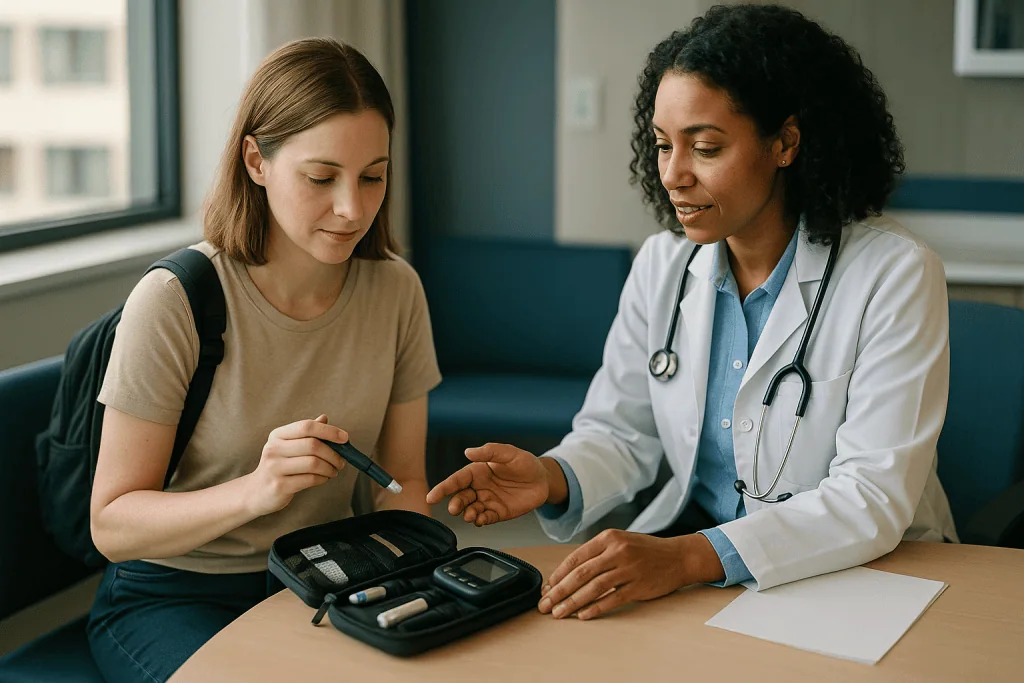
Everything that keeps you alive travels in the cabin with you. Checked luggage rides in a hold that can freeze at altitude and bake on a tarmac, and insulin exposed to either extreme can lose potency without looking any different. The CDC and its Yellow Book both advise keeping insulin and supplies in carry-on baggage, in original labeled packaging where possible.
A type 1 diabetes travel checklist usually covers:
- Insulin, both types if you use two, plus a backup method (pens if you pump, syringes if you use pens) in case a device fails.
- Glucose meter, strips and lancets, even if you wear a sensor, because sensors can fail and some scanners or medications can affect readings.
- Sensors, infusion sets, reservoirs, batteries and chargers with the correct plug adapter.
- Fast-acting carbohydrate in several places: pockets, day bag, hotel room.
- Emergency glucagon, a hormone that raises glucose by releasing the liver’s stores, with someone traveling with you who knows how to use it.
- Blood or urine ketone strips.
- A doctor’s letter, prescriptions using generic names, and your team’s contact details.
Splitting supplies between two carry-on bags, or between two travelers, means one lost bag is an inconvenience rather than an emergency. Keep a written list of what you use, by generic name, so a pharmacist abroad can identify an equivalent if you ever need one. Decisions about substituting insulin abroad belong to a clinician, but the list gets that conversation started fast.
Flying with insulin: what airport security and airlines usually allow
Security screening is where anxiety peaks and, in practice, where problems are rarest. Most national security agencies, including the United States Transportation Security Administration, treat insulin, injection devices, glucose tablets, juice and gel packs as medically necessary items that may exceed the usual liquid limits when declared. Pumps and continuous glucose monitors (CGMs), the small sensors worn on the skin that report glucose every few minutes, are permitted through screening.
Declaring supplies before they go through the scanner speeds everything up. So does having them together in one clear pouch rather than scattered through a bag. The CDC recommends carrying a letter from your provider explaining the condition and listing the medicines and devices you carry, and the Yellow Book advises keeping medications in original labeled containers. Rules differ country by country, so a quick look at the airport’s own website for both your departure and return legs prevents surprises.
Do type 1 diabetics get priority boarding? Not automatically. In the United States the Air Carrier Access Act requires airlines to accommodate passengers with disabilities, and diabetes qualifies, so most carriers will offer pre-boarding or assistance when it is requested, usually at the gate or when booking. Ask; do not assume.
The extra-bag question works the same way. Many airlines allow a bag containing only medical supplies to travel in the cabin in addition to standard hand luggage, but this is airline policy rather than law, and gate staff may not know it. Confirm before you fly, keep the confirmation in writing, and make sure that bag really does contain only medical items.
Flying with insulin also means thinking about the cabin itself. Ask for a special meal if you want one, but carry your own snacks regardless, because meal timing on aircraft is unreliable and a delayed tray is a classic setup for a low.
Insulin pumps and CGMs at altitude: what to know
Aircraft cabins are pressurized, but not to sea level. During climb the air around the pump thins, and during descent it thickens again. Small studies published in peer-reviewed journals have found that these pressure changes can cause a pump to deliver tiny amounts of insulin unintentionally during ascent, and to under-deliver slightly during descent, because air bubbles in the reservoir and tubing expand and contract. The amounts are small, but for a child or a person on low insulin requirements they can matter.
What to do about this is a conversation for your pump team, not a rule to copy from an article. Some clinicians suggest disconnecting a tubed pump during takeoff and landing and checking the line for bubbles before reconnecting; others consider it unnecessary for most adults. Pump manufacturers publish their own guidance in the user manual, and your team can tell you whether it applies to you.
Security scanners raise a separate question. Standard walk-through metal detectors are generally considered safe for pumps and sensors. Full-body imaging scanners and the X-ray machines used for luggage are a different matter, and several device manufacturers advise against exposing their products to them. You are entitled to request a manual pat-down instead, and to ask that the device be inspected by hand rather than sent through the X-ray belt. A brief, calm explanation almost always works.
Two practical points round this out. Bring a backup for the pump in the form of injectable insulin and a way to deliver it, because a pump failure abroad can be difficult to replace quickly. And carry the customer support number for your device; most manufacturers run international lines that can troubleshoot a fault or arrange a replacement in many countries.
East vs west: what changes when you cross time zones
The direction of travel shapes the problem more than the distance. A summary helps make the pattern visible, although your own plan should come from your team.
| Factor | Flying east (day gets shorter) | Flying west (day gets longer) |
|---|---|---|
| Long-acting insulin | Next dose may fall due before the previous one has worn off, raising the risk of overlap | A gap can open with little background insulin, raising the risk of highs and ketones |
| Rapid-acting insulin | Taken with meals as usual, per your team’s instructions | Taken with meals as usual; expect one or two extra meals on a very long day |
| Pump clock | Usually changed to local time on arrival; body rhythm lags behind | Same; the day’s basal pattern runs longer than usual |
| Jet lag | Often harder to adjust to; sleep and appetite disrupted more | Often somewhat easier, but late-night wakefulness is common |
| Glucose checks | More frequent than usual, especially overnight | More frequent than usual, especially during the long day |
The Mayo Clinic describes jet lag as a temporary mismatch between the body’s internal clock and the local clock, with recovery typically taking around a day for each time zone crossed and eastward travel tending to be harder. That mismatch affects the hormones that raise glucose overnight, such as cortisol, as much as it affects sleep. Expect dawn highs to appear at strange hours for a few days.
The CDC reminds travelers that jet lag can also blunt the ability to tell whether you feel low or simply exhausted, which is why more frequent checks are the one recommendation that applies in every direction. A CGM with alarms earns its place on these journeys, but a fingerstick remains the reference when the two disagree.
Jet lag and blood sugar: hypos and highs when routines slip
Hypoglycemia, a glucose level too low for the brain to work properly, is the travel risk that worries most people, and with reason. The NHS lists sweating, shakiness, hunger, tingling lips, palpitations, irritability and difficulty concentrating as typical early signs, and notes that a severe low can lead to confusion, seizures or loss of consciousness if not treated. Every one of those early signs overlaps with jet lag, dehydration and a long day of walking, which is exactly why guessing is unwise.
The practical defense is threefold. Check before you would normally guess, especially before driving, swimming or sleeping. Keep fast-acting carbohydrate within reach at all times, in the amount and form your team has shown you, and recheck after treating, as the NHS advises. Tell at least one companion what your lows look like and where the glucagon is.
Highs arrive from the opposite direction. Unfamiliar food is often richer in carbohydrate than it appears, carbohydrate counting is harder in a language you do not read, and sitting still for hours on a train or plane reduces the muscles’ uptake of glucose. Stress hormones from a missed connection push the same way. A single high is not an emergency; a high that will not come down, or one accompanied by nausea, needs ketone testing and possibly a call to your team.
Alcohol deserves its own sentence. It can lower glucose for many hours after drinking and can mask the signs of a low, so a night out in a new city calls for a snack, a check before sleep and a companion who knows the plan.
Activity works both ways. A day of sightseeing on foot may lower insulin needs; a beach day of lying still may raise them. Your team may give you ranges for adjusting to activity; if they have not, ask before you go rather than improvise abroad.
Sick-day rules abroad: illness, food poisoning and ketones
Travelers’ diarrhea and vomiting are common everywhere, and for someone with type 1 diabetes they carry a specific danger. Illness raises glucose through stress hormones even when you cannot eat, and vomiting can make it tempting to skip insulin. Skipping insulin is the path to diabetic ketoacidosis (DKA), a build-up of ketones that turns the blood acidic and is a medical emergency.
The NHS describes DKA symptoms as needing to urinate more than usual, extreme thirst, nausea or vomiting, abdominal pain, breath that smells fruity or like nail-polish remover, deep or rapid breathing, and confusion or drowsiness. Ketones can be checked with blood or urine strips, which is why they belong in the travel bag.
Every diabetes team gives its patients sick-day rules: how often to check glucose and ketones when ill, when to take extra correction insulin, when to call, and when to go straight to an emergency department. Those rules do not change because you are abroad. What changes is access, so before you leave, write down the local emergency number for each country on your route and the address of the nearest hospital to each place you are staying. The Yellow Book recommends exactly this kind of advance research for travelers with chronic conditions.
Fluids matter more than food when you are unwell. Sugar-free fluids if glucose is high, sugar-containing fluids in small sips if you cannot keep food down and glucose is falling, and never a long stretch without any insulin at all. If vomiting means you cannot keep fluids down for several hours, or ketones are moderate or high, that is the point to seek urgent local care rather than wait for the flight home. A hospital abroad can treat DKA; a hotel room cannot.
What the first days at a new destination usually look like
Arrival day is rarely typical. Sleep is short, meals are at odd times and adrenaline runs high, so glucose may sit stubbornly above your usual range for a day or two or swing wide in both directions. The Mayo Clinic’s estimate of roughly a day of adjustment per time zone applies to sleep, appetite and the hormonal rhythm that governs glucose overnight, so a trip across six zones may bring nearly a week of unfamiliar patterns.
The first evening is a good moment to set the pump or meter clock to local time if you have not already, following your team’s instructions, and to check that insulin has survived the journey. Most insulin products can stay at room temperature for a limited period stated in the manufacturer’s leaflet; check yours, and refrigerate the rest if a reliable fridge is available. A hotel minibar fridge is often colder than it looks; insulin that freezes must be discarded, so keep it away from the cooling element.
Days two and three tend to bring the dawn-phenomenon shift, when the pre-breakfast rise in glucose appears at whatever hour your body still thinks is morning. This settles as jet lag fades. People often find that a walking-heavy itinerary lowers their needs for the first week; others find that heat raises them. Both are normal, and both are reasons to check more often rather than to change anything without guidance.
By the end of the first week most travelers describe a new routine emerging. Meals fall into a pattern, sensors are trusted again, and the diabetes recedes to its usual background hum. The return journey then repeats the process in reverse, and the same written plan should cover it. Many people forget to ask about the trip home; do not be one of them.
Planning care abroad: your diabetes travel letter, insurance and local help
A diabetes travel letter is a short document from your prescriber stating that you have type 1 diabetes, that you must carry insulin, needles, devices and glucose at all times, and listing your medicines by generic name. The CDC recommends carrying one, and the Yellow Book adds that prescriptions should use generic names because brand names differ between countries. Keep a paper copy and a photo on your phone.
Travel insurance is a medical decision as much as a financial one. Policies vary in how they treat pre-existing conditions, and some exclude them unless declared. Read the wording, declare type 1 diabetes and any complications, and confirm that emergency treatment, hospital admission and medical repatriation are included. This article does not compare providers or discuss what cover costs; the point is that gaps in cover are discovered at the worst possible moment.
Local help has three layers. First, the emergency number: it is not the same everywhere, and looking it up in the moment is not a plan. Second, the location of a hospital with an emergency department near each place you sleep. Third, a way to reach your own team, or their out-of-hours line, from abroad, with the time difference written down so you know when they are awake.
Some travelers wear a medical identification bracelet or carry a card in the local language stating that they have insulin-treated diabetes and what to do if they are found confused or unconscious. A translated card takes minutes to prepare and can shorten the time to correct treatment considerably.
For long stays, ask your team before departure whether they would want you to establish contact with a local diabetes service, and how prescriptions would be handled if you ran short. Do not wait until you are down to your last pen to find out.
What people often get wrong about traveling with type 1 diabetes
Myths travel further than facts, and a few of them cause real harm.
“Insulin in checked luggage is fine as long as it’s in a cool bag.” The hold can drop below freezing at cruising altitude and sit in full sun on the ground, and a cool bag insulates in both directions. Frozen insulin is ruined even after it thaws. The CDC’s advice is to keep insulin in the cabin, full stop.
“I’ll skip insulin if I’m not eating.” Long-acting insulin, or a pump’s basal delivery, covers the glucose the liver releases whether or not you eat. Stopping it during illness or a long travel day is the most common route to ketoacidosis in otherwise healthy travelers. Rapid-acting insulin follows food; background insulin does not.
“A CGM means I don’t need a meter.” Sensors fail, fall off in the sea, run out, and can be less reliable in the first hours after insertion or when glucose is changing fast. A meter is the backup that makes the sensor trustworthy.
“Airport scanners will destroy my pump.” Metal detectors are generally considered safe. Full-body imaging and X-ray belts are what some manufacturers advise against, and a pat-down and hand inspection are your right. Fear of the scanner should not stop anyone flying.
“Heat doesn’t matter as long as the insulin doesn’t boil.” Insulin is a protein, and proteins degrade gradually at temperatures well below anything dramatic. A glove box or a beach bag in the sun can quietly weaken a pen over an afternoon. Cloudiness, clumping or unexplained highs after heat exposure are reasons to open a fresh pen.
“Traveling with type 1 diabetes is reckless.” The evidence points the other way: with preparation, people with type 1 diabetes hike, dive, race and work abroad. What is reckless is leaving without a plan.
Questions to ask your care team
The pre-travel appointment goes better when you arrive with your itinerary and specific questions. A thirty-minute conversation can replace hours of anxious searching abroad. Bring the number of time zones you will cross in each direction, the length of flights, the climate, how active you expect to be and whether refrigeration will be reliable.
Questions worth writing down:
- How should I time my long-acting insulin, or adjust my pump clock, on the outbound and return journeys?
- Should I disconnect my pump during takeoff and landing, and should I check the tubing for bubbles?
- What are my sick-day rules for glucose and ketone checks, and at what ketone level should I go to a hospital abroad?
- How should I respond to a day of much more, or much less, activity than usual?
- Will heat or altitude change my insulin needs, and how would I recognize that?
- Do I need any vaccines or malaria advice, and could those affect my glucose?
- Can I have a letter listing my medicines by generic name, and an updated prescription?
- Whom do I call from abroad, and when is your out-of-hours line staffed?
- If I lose my insulin, what generic equivalents would be acceptable, and should I contact a local clinic first?
- Are there any reasons, based on my recent records, that you would prefer I delay this trip?
Ask, too, about anything specific to the trip: scuba diving, high-altitude trekking, a cruise with limited medical facilities, or a work posting that lasts months. Each has its own considerations, and each has been managed successfully by people with type 1 diabetes before you. The answers you get are the plan; everything in this article is only a guide to what that plan should cover.
When to call your doctor
Most travel days with type 1 diabetes end with nothing more than an extra fingerstick. A small number do not, and the gap between a manageable problem and an emergency is usually measured in hours. Knowing the red flags in advance means acting early rather than hoping.
Seek emergency care immediately, using the local emergency number, if you or a companion notice any of the following, which the NHS lists as signs of diabetic ketoacidosis or severe hypoglycemia:
- Persistent vomiting, abdominal pain, deep or rapid breathing, or breath that smells fruity, especially with high glucose or raised ketones.
- Confusion, unusual drowsiness or difficulty staying awake.
- A seizure or loss of consciousness, or a low that does not respond to treatment.
- Moderate or high ketones that do not fall despite following your sick-day rules.
- Inability to keep fluids down for several hours.
Contact your own diabetes team, or seek local medical advice, without waiting for the trip to end if glucose stays well above your usual range for more than a day despite corrections, if you are having repeated lows, if you suspect your insulin has been damaged by heat or cold, if a pump has failed and you are unsure how to manage on injections, or if you develop an infection, fever or a wound that is not healing, particularly on the feet.
A new symptom you cannot explain is a reason to ask, not to wait. Clinicians would far rather hear from a traveler about a problem that turns out to be minor than meet them in an emergency department the following day. Every decision about your treatment, at home or abroad, sits with the team who prescribes it; the purpose of this article has been to help you ask them the right questions.
Frequently asked questions
Does Nick Jonas have type 1 diabetes?
Yes. The musician has spoken publicly for years about being diagnosed with type 1 diabetes as a teenager and about using insulin and glucose monitoring while touring internationally. His openness is often cited as a reminder that people with type 1 diabetes travel constantly for work. His routine is his own, agreed with his clinicians, and is not a template for anyone else’s plan.
Do type 1 diabetics get priority boarding?
Not automatically, but usually on request. In the United States the Air Carrier Access Act requires airlines to accommodate passengers with disabilities, and insulin-treated diabetes qualifies, so most carriers offer pre-boarding or assistance if you ask at booking or at the gate. Policies vary between airlines and countries, so confirm in advance rather than assuming.
Do type 1 diabetics get an extra bag when flying?
Many airlines allow a bag containing only medical supplies to travel in the cabin in addition to the standard carry-on allowance, but this is airline policy rather than law. Check your carrier’s medical-equipment rules before you fly, keep written confirmation, and make sure the bag genuinely contains only insulin, devices and related supplies so it is not counted as ordinary luggage.
Can you fly a plane with type 1 diabetes?
In some countries, yes, under strict conditions. Aviation regulators, including the United States Federal Aviation Administration, have pathways allowing insulin-treated pilots to hold certain medical certificates with detailed glucose-monitoring and reporting requirements. Rules differ widely between countries and licence classes and can change, so anyone considering flying training should consult the relevant regulator and their diabetes team directly.
Can I take insulin through airport security?
Yes. Insulin, injection devices, pumps, sensors, glucose tablets and juice are treated as medically necessary items by most security agencies and may exceed standard liquid limits when declared. Keep them together in one pouch, in original labeled packaging where possible, and carry a doctor’s letter as the CDC recommends. Check the rules for each airport on your route, including the return.
Should my insulin pump go through the airport scanner?
Walk-through metal detectors are generally considered safe for pumps and sensors. Several manufacturers advise against full-body imaging scanners and X-ray luggage belts, so you can request a pat-down instead and ask for hand inspection of the device. Check your device manual before travel and ask your pump team if anything is unclear.
What is a diabetes travel letter and do I need one?
A diabetes travel letter is a short document from your prescriber confirming you have type 1 diabetes and must carry insulin, needles, devices and glucose, with your medicines listed by generic name. The CDC recommends carrying one, and it helps at security, customs and any pharmacy or hospital abroad. Keep a paper copy and a photo on your phone.
How do I keep insulin cool in a hot country?
Keep it out of direct sun and hot vehicles, and use an insulated pouch or evaporative cooling wallet for daily carrying. Refrigerate spare supplies where a reliable fridge exists, away from the cooling element so nothing freezes. Each product’s leaflet states how long it tolerates room temperature; check yours. Cloudiness, clumping or unexplained highs after heat exposure are reasons to open a fresh pen.
How does jet lag affect blood sugar in type 1 diabetes?
Jet lag shifts the hormonal rhythm that raises glucose overnight, so dawn highs can appear at odd hours and sleep loss can blunt your sense of a low. The Mayo Clinic estimates recovery takes about a day per time zone. The CDC advises checking glucose more often than usual during this period rather than guessing whether you feel low or simply tired.
What if I get food poisoning abroad with type 1 diabetes?
Follow the sick-day rules your team gave you: keep taking background insulin, check glucose and ketones frequently, and sip fluids. Seek urgent local care if you cannot keep fluids down for several hours, if ketones are moderate or high, or if you develop vomiting with abdominal pain, deep breathing or drowsiness, which the NHS lists as signs of diabetic ketoacidosis.
References
This article is for general information only and is not a substitute for professional medical advice. Please consult a qualified doctor about your individual situation.

More from the Blog

Living With Hashimoto Thyroiditis: Monitoring Routines, Fatigue and Symptoms to Report
Living with Hashimoto thyroiditis usually means a steady routine rather than a crisis: taking thyroid hormone replacement consistently if your clinician prescribes it, having…

Hyperparathyroidism Work-Up: Calcium and PTH Tests, Bone Density and Kidney Checks Explained
A hyperparathyroidism work-up starts with blood tests for calcium and parathyroid hormone (PTH), usually repeated to confirm the pattern of raised or non-suppressed PTH…

Before Your Thyroid Appointment: Previous Tests, Ultrasound Reports and Medicine Lists to Bring
For a thyroid appointment, bring every previous thyroid blood test you can find (with dates and the lab's reference ranges), the written report from…

What Do Blood Gases, Ketones and Electrolytes Tell the Team During DKA Treatment?
During DKA treatment, blood gases show how acidic the blood is and whether that acid is clearing; blood ketones show whether insulin has switched…

Radioactive Iodine vs Thyroid Surgery for Hyperthyroidism: What Each Path Involves
Radioactive iodine and thyroid surgery are both definitive treatments for hyperthyroidism, meaning each aims to permanently reduce or remove overactive thyroid tissue. Radioactive iodine…

Can Hyperthyroidism Treatment Swing to Hypothyroidism? Why Long-Term Monitoring Continues
Yes. Treatment for an overactive thyroid can swing thyroid hormone levels too low, producing hypothyroidism. After radioactive iodine or total thyroid removal this is…