

Typhoid, Yellow Fever and Rabies Vaccines: When Travelers Need Them

Key Takeaways
- Since the July 2016 amendment to the International Health Regulations, a yellow fever certificate is valid for life and no country may demand a booster for entry.
- Yellow fever is not contagious between people; it needs a day-biting Aedes or forest mosquito, which is why Asian countries with Aedes mosquitoes but no yellow fever check certificates so strictly.
- About 1 in 4 yellow fever vaccine recipients get mild fever or aches 5–10 days later, while the serious viscerotropic reaction occurs in roughly 3 per million and is several times more likely in first-time recipients aged 60 and older.
- Typhoid vaccines reduce risk by roughly 50–80 percent, fade within a few years, and offer no protection against paratyphoid fever or ordinary travelers' diarrhea.
- Rabies kills about 59,000 people a year and is almost always fatal once symptoms appear, yet prompt wound washing and post-exposure treatment are close to 100 percent effective.
- Pre-exposure rabies vaccination removes the need for rabies immunoglobulin after a bite, a product often unavailable outside major cities, but never removes the need for same-day medical care.
Travelers need a yellow fever vaccine when visiting parts of sub-Saharan Africa or South America where the virus circulates, or when a country requires proof of vaccination for entry; for most people the vaccine now gives lifelong protection, so routine boosters are no longer advised. Typhoid vaccination suits trips to places with unsafe food and water, especially South Asia. Rabies vaccination before travel suits long stays, remote areas, animal contact and children.
The check-in agent slid the passport back across the counter and asked for one more document: a small yellow booklet. The traveler behind had no idea what she meant. Scenes like that are playing out more often than usual this season. As of January 2026, searches for the yellow fever vaccine have climbed sharply, pushed by a 2025 rise in confirmed yellow fever cases across South America, including areas of Colombia, Peru, Bolivia and Brazil that sit outside the classic Amazon risk zones, and by peak booking for safaris and rainforest trips.
Two viral claims are riding that wave. One says you need a booster every ten years, advice that expired in 2016. The other says a strong immune system and a good repellent make the shot optional. Both deserve a careful, evidence-first answer.
Travel clinics also field two companion questions in the same appointment: do I need the typhoid vaccine, and is the rabies vaccine worth it? This guide takes all three in turn, explains what the research actually shows, and tells you when the decision belongs with a clinician rather than a search bar.
What is yellow fever, and why was it called yellow jack?
Yellow fever is caused by a flavivirus, a family of mosquito-borne viruses that also includes dengue and Zika. The name tells two stories at once. The fever is obvious. The yellow refers to jaundice, a yellowing of the skin and eyes that happens when the liver is damaged and cannot clear bilirubin, a yellow pigment made when old red blood cells break down.
Most infections are mild or silent. After an incubation period of roughly 3–6 days, a person may develop fever, chills, headache, a characteristic ache in the lower back, nausea and loss of appetite. The majority recover within about four days. Around 15 percent, according to WHO, enter a second, toxic phase within a day of seeming to improve: high fever returns, jaundice appears, the kidneys falter and bleeding can start from the gums, nose, stomach or eyes. Roughly half of those who reach this phase die within 7–10 days. There is no antiviral medicine for the disease; hospital care is supportive.
The nickname yellow jack is older than the virus’s discovery. In the 18th and 19th centuries, ships carrying disease flew a plain yellow quarantine flag, called a jack by sailors, and the dreaded fever took the flag’s name. Yellow jack emptied Philadelphia in 1793 and devastated Memphis in 1878. In 1900, a US Army commission led by Walter Reed confirmed that mosquitoes, not dirty linen or bad air, carried it. Max Theiler then weakened the virus in the laboratory to create the 17D vaccine strain in 1937, work that earned a Nobel Prize in 1951. Remarkably, the vaccine given today still descends from that same 17D strain.
Is yellow fever contagious from person to person?
No. Yellow fever does not pass between people through coughing, touching, kissing or sharing food. A sick traveler in a hotel room poses no direct risk to the person in the next bed. The virus needs a mosquito to move from one human bloodstream to another.

Scientists describe three transmission cycles. In the jungle, or sylvatic, cycle of South America and Africa, forest mosquitoes of the Haemagogus and Sabethes groups pass the virus among monkeys, and people who enter the forest to log, hunt or hike are bitten incidentally. In Africa there is also an intermediate savannah cycle, where semi-domestic mosquitoes bite both monkeys and villagers. The urban cycle is the one public health officials fear most: Aedes aegypti, the same day-biting mosquito that spreads dengue, carries the virus from an infected person to a healthy one in a crowded city. Aedes aegypti thrives in water stored in buckets, tires and flowerpots, which is why dense neighborhoods with patchy water supply are vulnerable.
A person is infectious to mosquitoes only briefly, during the first few days of illness when the virus circulates in the blood. That window matters for travelers in a specific way: an unvaccinated person who catches the virus in the Amazon and flies home with a fever could, in principle, be bitten by a local Aedes mosquito and seed an outbreak. This is precisely why dozens of countries in Asia, where Aedes mosquitoes are common but yellow fever has never established itself, insist on seeing a vaccination certificate from arrivals who have passed through risk areas.
WHO lists 34 countries in Africa and 13 in Central and South America as endemic, meaning the virus circulates there continuously or seasonally. Risk inside those countries is uneven, and the maps in official travel guidance are drawn at the level of regions and even altitude bands.
Who needs the yellow fever vaccine? What CDC and WHO guidance actually says
Two separate reasons bring travelers to a yellow fever vaccination appointment, and it helps to keep them apart.
The first is personal protection. CDC recommends the vaccine for people aged 9 months and older who are traveling to or living in areas where yellow fever virus transmission is a risk. The CDC Yellow Book, the agency’s clinical reference for travel health, splits countries into zones where vaccination is recommended, zones where it is generally not recommended because risk is low, and zones with no risk. A business trip confined to Lima, which sits on the Pacific coast and has no yellow fever, is a different proposition from a river journey out of Iquitos in the Peruvian Amazon.
The second reason is law. Under the International Health Regulations, a WHO treaty that governs how countries respond to health threats at borders, yellow fever is the only disease for which a country can demand proof of vaccination as a condition of entry. Some countries require it from every arriving traveler; many more require it only from people arriving from, or sometimes transiting through, a country with risk. Proof takes the form of the International Certificate of Vaccination or Prophylaxis, the yellow card. It becomes valid 10 days after vaccination, and only designated yellow fever vaccination centers may issue it.
Where recommendation and requirement disagree, a thoughtful conversation is needed. A traveler who is medically unsuited to the vaccine but whose destination insists on a certificate may be offered a medical waiver letter, discussed below. A traveler with no requirement but genuine exposure risk should still weigh vaccination seriously. The decision rests with a travel medicine clinician who can see the full itinerary, the season, and the traveler’s health history side by side.
What happens if you take the yellow fever vaccine?
The yellow fever vaccine is a live attenuated vaccine, meaning it contains a weakened form of the actual virus that can multiply briefly in the body but cannot cause the disease in healthy people. That short, controlled infection is what makes the protection so durable. The immune system meets something very close to the real virus and builds a memory that, in most people, lasts a lifetime.
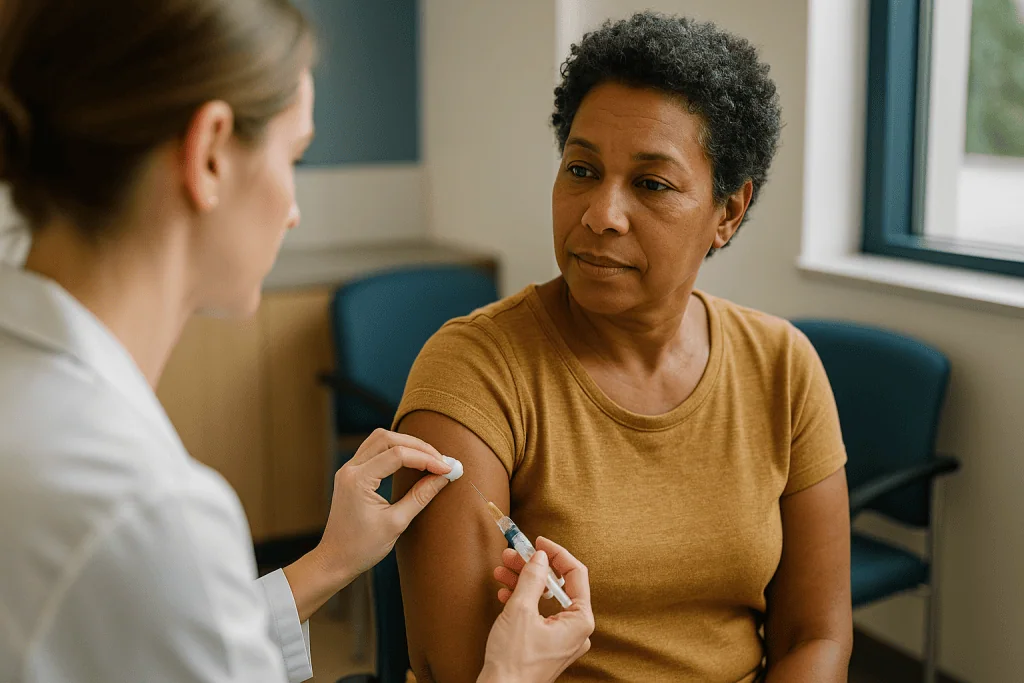
Protection arrives quickly. WHO reports that 80–100 percent of vaccinated people have protective antibodies within 10 days, and more than 99 percent within 30 days, which is why the certificate counts from day 10.
Most people notice little. CDC estimates that about 1 in 4 develop mild effects such as a sore arm, low-grade fever, headache or muscle aches. These typically begin 5–10 days after vaccination, when the weakened virus is at its peak, and settle within a few days.
Serious reactions are rare but real, and honest counseling includes them. A severe allergic reaction occurs in roughly 1 per 100,000 recipients. Two conditions specific to this vaccine deserve mention. Yellow fever vaccine-associated neurologic disease, which includes inflammation of the brain or its lining, is reported at roughly 0.8 per 100,000. Yellow fever vaccine-associated viscerotropic disease, in which the vaccine virus behaves like wild virus and attacks the liver and other organs, is reported at roughly 0.3 per 100,000 overall. Both become several times more likely in people aged 60 and older receiving the vaccine for the first time, which is why age is a formal precaution rather than a footnote.
Since WHO changed its position in 2016, protection is considered lifelong for most travelers, and the certificate no longer expires. CDC does list narrow situations in which a clinician may advise an additional vaccination, for example people who were pregnant or had HIV when first vaccinated. That judgment belongs to the clinician reviewing the individual record.
Who should not have the yellow fever vaccine, and what a medical waiver means
Because the vaccine contains a living virus, the people most likely to be harmed by it are those whose immune systems cannot keep that virus in check. CDC lists clear contraindications, situations in which the vaccine should not be given: infants younger than 6 months; anyone with severe immune compromise, which includes symptomatic HIV with very low CD4 counts, current chemotherapy, high-dose corticosteroid treatment, organ or stem cell transplantation and many immune-modulating biologic medicines; anyone with a thymus disorder or a history of thymus removal; and anyone who has had a severe allergic reaction to a vaccine component, including egg and gelatin.
A second group falls under precautions, where the vaccine may be given after an individual assessment of risk and benefit. This includes adults aged 60 and older, infants aged 6–8 months, people who are pregnant or breastfeeding, and people with asymptomatic HIV. For breastfeeding parents, the concern is a small number of reports of vaccine virus reaching young infants through milk.
For a traveler in one of these groups whose destination demands a certificate, clinicians can complete a medical waiver: a signed, dated letter on official clinic letterhead, stamped with the center’s yellow fever vaccination stamp, stating the medical reason the vaccine is contraindicated. The relevant section of the yellow card is also filled in. Travelers should understand two limits. Acceptance of a waiver is at the discretion of the destination country, and some border officials may still refuse entry or impose quarantine. And a waiver protects against bureaucracy, not against mosquitoes; a person who cannot be vaccinated and is heading into a true risk zone should discuss with their clinician whether the trip itself needs rethinking.
None of this is a self-assessment exercise. Many of the medicines that affect eligibility, including biologics for arthritis, psoriasis or inflammatory bowel disease, are easy to overlook. Bring a full medicine list to the appointment.
How to avoid yellow fever without a vaccine
People ask this question for good reasons: a medical contraindication, an unplanned trip, or simple hesitancy. The honest answer is that no other measure comes close to the vaccine, and nothing replaces an entry certificate where one is required. That said, bite prevention is far from useless, and for those who truly cannot be vaccinated it becomes the whole strategy.
Start with the itinerary. The CDC Yellow Book maps show that risk is concentrated in forested and savannah regions, and that many large cities and high-altitude destinations carry little or none. During an active outbreak, choosing a different region or a different season is the most powerful decision available.
Then make yourself a poor target. Aedes aegypti bites mainly during the day, with peaks around sunrise and late afternoon, so daytime protection matters as much as a bed net at night. CDC advises an EPA-registered repellent on exposed skin; the well-studied active ingredients include DEET, picaridin, IR3535 and oil of lemon eucalyptus. Loose, light-colored clothing with long sleeves and trousers covers more skin, and clothing treated with permethrin, an insecticide that kills or repels mosquitoes on contact with fabric, adds a second layer. Sleep in screened or air-conditioned rooms. Where screens are missing, use a bed net, which also protects against the night-biting mosquitoes that carry malaria.
What will not help: vitamin supplements, garlic, ultrasonic devices and homeopathic preparations marketed as mosquito protection. None has credible trial evidence. There is also no medicine that prevents yellow fever after a bite and no antiviral that treats it once it starts.
Put plainly, bite prevention lowers the odds; the vaccine comes close to removing them. If you cannot have the vaccine, let that fact shape where you go, not just what you pack.
What changed recently with travel vaccines
Several dated developments explain why old advice now circulates as misinformation.
July 2016, yellow fever certificate becomes lifelong. An amendment to the International Health Regulations took effect, declaring a yellow fever certificate valid for the lifetime of the holder. Countries may no longer demand a booster for entry. WHO’s position followed a 2013 review by its Strategic Advisory Group of Experts, which found vanishingly few vaccine failures among hundreds of millions of vaccinated people. CDC’s advisory committee had reached a similar conclusion in 2015, while identifying limited groups in which clinicians may still consider an additional vaccination.
2017 onward, a new generation of typhoid vaccine. WHO prequalified the first typhoid conjugate vaccine in December 2017. A conjugate vaccine links a sugar from the bacterium’s coat to a carrier protein, which produces a stronger and longer-lasting response, including in young children. Pakistan launched the world’s first routine conjugate vaccine campaign in 2019 in response to an extensively drug-resistant typhoid outbreak. The conjugate vaccine is used in endemic countries’ programs; travelers in the United States are offered the injectable polysaccharide or oral vaccine.
2017–2021, a US yellow fever vaccine supply gap. A manufacturing transition left the US-licensed vaccine unavailable for several years, during which an imported vaccine was offered at a limited number of sites. Supply of the US-licensed product resumed in 2021.
May 2022, rabies pre-exposure guidance modernized. CDC’s Advisory Committee on Immunization Practices published a shortened pre-exposure vaccination series and replaced routine boosters with a risk-based approach, using either a booster or an antibody blood test depending on how often a person is likely to face exposure.
2025, yellow fever resurges in the Americas. WHO and regional agencies reported a marked rise in confirmed cases and deaths across Bolivia, Brazil, Colombia and Peru, including transmission in areas outside the traditional Amazon basin. Several countries updated their risk maps, which is the proximate reason this topic is trending.
Typhoid vaccine: who needs it, and what it does not do
Typhoid is an enteric fever, an infection of the gut and bloodstream caused by the bacterium Salmonella Typhi. It spreads through food or water contaminated with the feces of an infected person, sometimes a healthy carrier who has no symptoms. WHO estimates around 9 million cases and roughly 110,000 deaths each year, with the heaviest burden in South Asia, followed by parts of sub-Saharan Africa, Southeast Asia and Latin America.
The illness builds slowly. A fever that climbs day by day, headache, weakness, abdominal pain and either constipation or diarrhea appear 1–3 weeks after exposure. Untreated, the infection can perforate the intestine. Antibiotics treat it, but resistance is a growing problem: a strain resistant to nearly all oral antibiotics has spread in Pakistan since 2016.
CDC recommends the typhoid vaccine for travelers to areas with risk, with the strongest case for South Asia, for stays longer than a few weeks, for people visiting friends and relatives who eat home-cooked food, and for anyone traveling off well-trodden tourist routes. The United States offers an injectable inactivated vaccine, made from a purified sugar from the bacterium’s coat, and an oral live attenuated vaccine taken over several days. The oral version is not suitable for young children or people with weakened immunity, and certain antibiotics interfere with it; the clinic will pick the right product and timing.
Two honest limits. Protection is partial, in the range of 50–80 percent in trials, and it wanes within a few years, so returning travelers may need a booster assessment. And the vaccine does nothing against paratyphoid fever, a close cousin caused by Salmonella Paratyphi, or against the far more common travelers’ diarrhea. Food and water discipline remains the foundation: eat food served hot, peel fruit yourself, avoid ice of unknown origin, and drink sealed or treated water.
Rabies vaccine before travel: who should consider pre-exposure vaccination?
Rabies is unlike the other two diseases in one chilling respect: once symptoms begin, it is almost always fatal. WHO estimates about 59,000 deaths a year, 95 percent of them in Africa and Asia, and up to 99 percent of human cases start with a dog bite. Children under 15 account for roughly four in ten bites, partly because they play with animals and partly because they may not report a scratch.
Pre-exposure prophylaxis means vaccinating before any possible exposure. It does not make a bite trivial, and it never removes the need for urgent medical care afterward. What it does is simplify that care dramatically. An unvaccinated person bitten abroad needs rabies immunoglobulin, a preparation of ready-made antibodies injected around the wound, plus a vaccine course. Immunoglobulin is expensive to produce, in short supply worldwide and frequently unavailable outside major cities. A pre-vaccinated traveler needs no immunoglobulin and a shorter vaccine course, and already has a head start of circulating antibodies while the booster takes effect.
CDC and WHO suggest pre-exposure vaccination for travelers going to areas where dog rabies is common and prompt medical care is uncertain; for longer stays or repeated trips; for remote itineraries; for activities such as cycling, running, trekking, caving and camping that increase contact with animals, including bats; for people working with animals or in wildlife settings; and for children who will spend time in such places. A single week in a resort is a weaker case than a month volunteering in rural villages.
The modern rabies vaccine is inactivated, grown in cell culture, and cannot cause the disease. Side effects are usually a sore arm, headache, nausea or mild fever. The series must be completed before departure and takes weeks, which is one of the better arguments for booking a travel consultation early rather than the week before a flight.
What to do after an animal bite, scratch or bat contact abroad
The first minutes count more than most travelers realize. Wash the wound immediately under running water with soap for a full 15 minutes; WHO regards this step alone as a meaningful reduction in risk because it physically removes virus from the tissue. Apply povidone-iodine or alcohol if available. Do not stitch or seal the wound. Then find medical care the same day.
Post-exposure prophylaxis, the medical treatment given after a possible rabies exposure, is close to 100 percent effective when started promptly and completed. The virus travels slowly along nerves toward the brain, which is why the incubation period is usually 1–3 months, though it can be as short as a week with severe bites to the face or hands. That slow journey is the window in which treatment works. Waiting to see whether the animal looks sick, or whether symptoms appear, throws the window away.
Some exposures are easy to underrate. Bats deserve special mention: their teeth are tiny, bites may leave no visible mark, and CDC advises medical assessment after any direct contact with a bat, or after waking to find a bat in the room. Monkeys around temples and tourist sites bite and scratch frequently. A lick on broken skin or the eyes counts as an exposure. Cats, foxes, jackals and mongooses carry rabies in various regions.
Practically, this may mean leaving a rural area for a city hospital, or in rare cases flying home or to a neighboring country to find immunoglobulin. Travel insurance that covers medical evacuation earns its keep here. Previously vaccinated travelers still need care, but far less of it. Tell the clinician about any earlier rabies vaccination, and ask about a tetanus update at the same visit.
Yellow fever, typhoid and rabies vaccines at a glance
Three diseases, three very different vaccines. The table below condenses the guidance so the differences are easy to see; the details above explain the reasoning behind each row.
| Feature | Yellow fever | Typhoid | Rabies |
|---|---|---|---|
| Cause and spread | Flavivirus; day-biting Aedes and forest mosquitoes; not contagious person to person | Salmonella Typhi bacterium; contaminated food and water | Lyssavirus; bites, scratches or licks on broken skin from infected mammals, chiefly dogs and bats |
| Where risk is highest | Sub-Saharan Africa; Amazon basin and adjoining regions of South America | South Asia above all; also parts of Africa, Southeast Asia, Latin America | Africa and Asia where dog rabies is uncontrolled; remote areas anywhere |
| Who typically needs the vaccine (CDC/WHO) | Travelers aged 9 months and older to risk areas; anyone whose destination requires a certificate | Travelers to risk areas, especially longer stays, rural travel, visiting friends and relatives | Long or remote stays, outdoor and animal-related activities, children, limited access to care |
| Vaccine type | Live attenuated (weakened live virus) | Injectable inactivated or oral live attenuated; conjugate vaccine used in endemic-country programs | Inactivated (cannot cause disease) |
| Lead time before travel | Certificate valid from day 10 after vaccination | Protection builds over 1–2 weeks | Series must be completed before departure; plan weeks ahead |
| How long protection lasts | Lifelong for most; certificate never expires | Partial, wanes within a few years | Depends on ongoing risk; boosters or antibody checks for people with continuing exposure |
| Still needed after vaccination | Bite prevention; care if feverish within 6 days of leaving a risk area | Strict food and water precautions | Urgent wound care and medical assessment after any exposure |
One pattern stands out. The yellow fever vaccine is the only one of the three where a single visit closes the question for life and where the law may require it. The typhoid vaccine is a useful but partial shield that must be renewed. The rabies vaccine is an investment in what happens after the worst moment of a trip, and it never replaces the hospital visit that follows a bite.
What the evidence actually says, and how strong it is
Not all vaccine evidence is built the same way, and travelers deserve to know which claims rest on randomized trials and which on observation.
Yellow fever vaccine: strong, mostly observational. No modern placebo-controlled efficacy trial exists, because withholding a vaccine from people facing a disease that kills half of its severe cases would be unethical. Instead, the evidence comes from immunogenicity trials, randomized studies that measure antibody responses, and from eight decades of real-world data. Mass campaigns in West Africa and Brazil were followed by steep falls in cases. Cohort studies find protective antibodies in people vaccinated 30 or more years earlier. WHO’s 2013 expert review identified only a dozen documented cases of yellow fever in vaccinated people among more than 540 million vaccinations, which underpinned the move to lifelong validity. Randomized trials conducted during the 2016 Democratic Republic of the Congo emergency showed that even reduced vaccine quantities produced comparable immune responses, a finding WHO now uses for outbreak control. Grade: high confidence in effectiveness and durability; rare-side-effect estimates rely on passive surveillance and carry wider uncertainty.
Typhoid vaccine: strong randomized evidence, moderate effect. Large field trials in Nepal, Chile and South Africa in the 1980s and 1990s established the 50–80 percent efficacy range for the oral and injectable vaccines. Recent randomized trials of the conjugate vaccine in Nepal, Malawi and Bangladesh, involving tens of thousands of children, found efficacy of roughly 80 percent over two years. Grade: high confidence that protection is real and partial.
Rabies vaccine: immunogenicity trials plus compelling observation. Efficacy trials of pre-exposure vaccination cannot ethically be done. Randomized immunogenicity studies, including those behind the 2022 CDC schedule change, show reliable antibody responses. The effectiveness of prompt post-exposure treatment is demonstrated by the near-absence of deaths among people who receive it correctly, against tens of thousands of deaths among those who do not. Grade: high confidence, drawn from consistent indirect evidence rather than a single definitive trial.
Common myths about the yellow fever vaccine and other travel shots
Misinformation about travel vaccines tends to be old advice that outlived its evidence, or reasonable-sounding logic applied to the wrong disease. Here are the claims that circulate most, and what the evidence says.
"You need a yellow fever booster every ten years." True until 2016, false since. The International Health Regulations now treat the certificate as valid for life, and WHO considers a completed vaccination protective for life in most people. Clinicians may advise an additional vaccination in specific medical circumstances, but border officials may not demand one.
"Yellow fever spreads like the flu." It does not. Transmission requires a mosquito. Isolation of patients serves to keep mosquitoes from biting them, not to protect caregivers from the air they breathe.
"The vaccine gives you yellow fever." The weakened 17D virus causes a brief, mild reaction in about a quarter of recipients. The rare viscerotropic reaction, in which the vaccine virus behaves like wild virus, occurs in roughly 3 per million recipients overall. That risk is real, counts heavily in older first-time recipients, and is still far below the risk the disease itself poses to an unvaccinated traveler in an outbreak zone.
"A healthy immune system is enough." The toxic phase of yellow fever kills otherwise healthy adults. Diet, supplements and fitness do not change susceptibility to a virus the body has never met.
"The typhoid vaccine means I can eat and drink anything." Protection is partial and does not cover paratyphoid, cholera, hepatitis A or the many bacteria behind travelers’ diarrhea.
"Rabies only comes from obviously sick dogs, so I can wait and see." Infected animals may look normal, bats may leave no mark, and symptoms can take months. By the time the question answers itself, treatment no longer works.
"I had the rabies vaccine, so a bite abroad is no big deal." Pre-exposure vaccination shortens and simplifies treatment; it never replaces it.
When to see a doctor
Every vaccine decision in this article belongs with a clinician who can see your full health history, medicine list and itinerary. A travel medicine appointment 4–6 weeks before departure gives time for the rabies series to finish, for the yellow fever certificate to become valid, and for any waiver paperwork. Book earlier still if you are pregnant, breastfeeding, aged 60 or older, living with HIV, taking immune-modulating medicines, or traveling with an infant.
Seek medical care promptly after vaccination if you notice any of the following:
- Signs of a severe allergic reaction within minutes to hours: hives, swelling of the face or throat, wheezing, difficulty breathing, dizziness or collapse. Call emergency services.
- Within about 10 days of the yellow fever vaccine: high fever with confusion, severe headache, stiff neck, seizures, weakness or numbness in the limbs.
- Within about 10 days of the yellow fever vaccine: yellowing of the skin or eyes, persistent vomiting, unusual bleeding or bruising, or very little urine.
- Mild symptoms such as fever, aches or a sore arm that worsen or persist beyond a few days after any vaccine.
During and after travel, these signs need urgent assessment, and the doctor must hear where you have been:
- Fever starting within 6 days of leaving a yellow fever risk area, especially with jaundice, bleeding gums, dark urine or back pain.
- Fever that climbs over several days, with headache, abdominal pain or altered bowel habit, within 1–3 weeks of travel to South Asia or another typhoid risk area; malaria must also be excluded after any tropical travel.
- Any bite, scratch or lick on broken skin from a mammal abroad, and any direct contact with a bat, whether or not you were vaccinated against rabies. Wash for 15 minutes, then go the same day.
If a symptom is not on this list but worries you, that is reason enough to ask. Travel clinicians and emergency departments would far rather see a false alarm than a late presentation.
Frequently asked questions
What is yellow jack disease?
Yellow jack is the old sailors’ name for yellow fever, taken from the plain yellow quarantine flag, called a jack, that ships flew when disease was aboard. The disease is a mosquito-borne viral infection that causes fever, back pain and, in a minority of cases, jaundice, bleeding and organ failure. Historic epidemics struck Philadelphia in 1793 and Memphis in 1878 before mosquito transmission was proven in 1900.
Is yellow fever contagious?
No, yellow fever does not pass directly from person to person. The virus must be carried by a mosquito, usually the day-biting Aedes aegypti in cities or forest mosquitoes in jungle areas. A person with yellow fever can infect mosquitoes that bite them during the first few days of illness, which is why patients are kept under nets, but caregivers, family members and fellow travelers are not at risk from ordinary contact.
What happens if you take the yellow fever vaccine?
Most people feel nothing beyond a sore arm; about 1 in 4 develop mild fever, headache or aches 5–10 days later that settle within days. Protective antibodies appear in 80–100 percent of recipients within 10 days and more than 99 percent within 30 days, and protection is lifelong for most. Serious reactions affecting the nervous system or internal organs are rare, on the order of a few per million, and more likely in older first-time recipients.
How to avoid yellow fever without a vaccine?
There is no substitute for vaccination, but risk can be lowered by choosing itineraries outside forested risk zones and outbreak areas, using an EPA-registered repellent such as DEET or picaridin during the day when Aedes mosquitoes bite, wearing long permethrin-treated clothing, and sleeping in screened or air-conditioned rooms or under a net. Countries that require a certificate for entry will not accept these measures in its place; a medical waiver letter is the only alternative.
How long does the yellow fever vaccine last?
For most people, a lifetime. WHO concluded in 2013, after reviewing hundreds of millions of vaccinations, that protection does not meaningfully wane, and since July 2016 the international certificate has had no expiry date. CDC identifies a few situations, such as having been pregnant or living with HIV at the time of vaccination, in which a clinician may advise an additional vaccination before high-risk travel; that is a clinical judgment, not a border requirement.
Do I need the typhoid vaccine for India or Pakistan?
CDC recommends the typhoid vaccine for most travelers to South Asia, which has the world’s highest typhoid rates and a strain in Pakistan resistant to nearly all oral antibiotics. The case is strongest for stays beyond a few weeks, rural travel and visits to friends and relatives. Because protection is only 50–80 percent and wanes within a few years, careful food and water choices remain essential, and your clinician will check whether a booster is due.
Is the rabies vaccine worth it for travelers?
It depends on the trip. CDC and WHO suggest pre-exposure rabies vaccination for travelers heading to areas where dog rabies is common and medical care is hard to reach, for long or remote stays, for cycling, trekking, caving or animal work, and for children. Its main value is that after a bite you would not need rabies immunoglobulin, which is often unavailable abroad, and would need a shorter course of treatment.
I had the rabies vaccine before travel and was bitten by a dog. What now?
Wash the wound with soap under running water for 15 minutes and seek medical care the same day, even though you were vaccinated. Pre-exposure vaccination means you will not need rabies immunoglobulin and will need a shorter vaccine course, but you still need that course. Tell the clinician the dates of your earlier vaccination, and ask about a tetanus update at the same time.
Can older adults have the yellow fever vaccine?
Yes, but age 60 and older is a formal precaution rather than a routine go-ahead. The rare serious reactions to the vaccine, particularly the one affecting the liver and other organs, are several times more common in first-time recipients in this age group. CDC advises that the decision weigh the actual risk of exposure on the specific itinerary against the vaccine’s risk, which is a conversation to have with a travel medicine clinician well before departure.
Can I get the yellow fever, typhoid and rabies vaccines at the same visit?
Often, yes. CDC guidance allows inactivated vaccines such as rabies and injectable typhoid to be given on the same day as the live yellow fever vaccine. The main timing rule involves other live vaccines, for example measles-mumps-rubella, which should be given either the same day as yellow fever or spaced apart under clinic guidance. Because the rabies series takes weeks to complete, an early appointment keeps all your options open.
References
- World Health Organization: Yellow fever fact sheet
- CDC: Yellow Fever Vaccine
- World Health Organization: Typhoid fact sheet
- World Health Organization: Rabies fact sheet
This article is for general information only and is not a substitute for professional medical advice. Please consult a qualified doctor about your individual situation.

More from the Blog

Why the Days After a Dengue Fever Breaks Need Close Monitoring: Warning Signs Doctors Look For
Dengue is often most dangerous in the 24 to 48 hours after the fever settles, when fluid can leak out of small blood vessels…

Does a Rapid Test Confirm Malaria? Blood Smears, Parasite Species and How Treatment Is Chosen
A rapid diagnostic test can strongly suggest malaria, but it does not fully confirm it on its own. Guidelines from the CDC and WHO…

Cold Sores: Triggers, Timeline and the Treatments That Shorten Them
Cold sores are painful blisters on or around the lips caused by herpes simplex virus type 1, usually acquired in childhood and carried for…

Traveling to Typhoid-Risk Regions: Vaccination, Food Safety and What to Do If Fever Starts
Typhoid vaccine before travel is recommended by the CDC for most people visiting regions where typhoid is common, especially South Asia. Two types exist:…

How Is Meningitis Treated in the Hospital? Emergency Antimicrobials, Monitoring and Isolation
In hospital, suspected bacterial meningitis is treated as an emergency: intravenous antibiotics usually begin within the first hour, often before test results return, sometimes…

How Long Does a Salmonella Infection Last? Recovery Pace and When You Can Handle Food Again
Most healthy adults with a salmonella infection are ill for about four to seven days, according to the CDC, with symptoms usually beginning six…