

Varicocele Repair Recovery: Swelling, Scrotal Support and the Return to Lifting and Sport

Key Takeaways
- Varicoceles affect roughly 15 percent of adult men and the large majority occur on the left because of how the left testicular vein joins the circulation (Mayo Clinic).
- Mainstream guidance describes a return to non-strenuous activity about two days after repair and to exercise about two weeks later, if comfortable (Mayo Clinic).
- Scrotal swelling and bruising usually peak around day two or three and then recede over one to two weeks; rapid, tense, painful enlargement is a different picture that needs urgent assessment.
- A hydrocele, fluid collecting around the testicle, is a recognized complication that typically appears weeks later, is often painless, and frequently needs no treatment (Mayo Clinic; Cleveland Clinic).
- Sperm take about three months to develop, so a semen analysis before roughly three months post-repair reflects the pre-operative state (Mayo Clinic).
- An isolated right-sided varicocele, especially one that appears suddenly or does not soften lying down, usually prompts imaging of the abdomen before any discussion of repair (Cleveland Clinic).
Recovery after varicocele repair is usually brisk. Most people manage light, non-strenuous activity within about two days and return to exercise around two weeks, provided pain and swelling have settled. Bruising and mild scrotal swelling are expected for one to two weeks; supportive underwear, rest and cold packs help. Heavy lifting and contact sport wait for the surgeon's go-ahead, and any semen changes take roughly three months to appear.
The discharge nurse hands over a printed sheet, a spare gauze pad and a pair of mesh briefs that look like they were designed for someone else’s grandfather. The patient, still a little foggy, has one question that isn’t on the sheet: when can I get back under the bar?
That question sits at the heart of varicocele surgery recovery, and it deserves a better answer than “take it easy.” Most people who have this operation are young, active and healthy in every other respect. They are used to their bodies doing what they ask. The first week after repair asks something unfamiliar of them: patience with a part of the body that swells, bruises and aches in ways that feel out of proportion to two small incisions.
This explainer walks through what the surgery does, why the scrotum swells, what supportive underwear can and cannot do, and how the return to lifting and sport usually unfolds. The timelines are typical ranges from mainstream guidance, not promises, and every decision belongs with the team that did the operation.
Varicocele surgery recovery: the first 48 hours and how many days to rest
The first two days set the tone. You will almost certainly go home the same day, because varicocele repair is an outpatient operation in most settings. The anesthetic leaves the body over several hours, and the groin or lower abdomen feels tight, tender and oddly heavy as the numbing medicine the surgeon placed around the wound wears off.
Rest in these first days means horizontal rest with the scrotum supported, not bed confinement. Lying flat lets gravity stop pulling fluid downward into the scrotum, which is why swelling is often worse after an afternoon spent sitting upright than after a night’s sleep. Short walks around the house are encouraged from the first evening; they keep blood moving in the legs and reduce the stiffness that comes from lying still.
How many days of rest, then? Mainstream guidance is consistent: a return to normal, non-strenuous activities after about two days, as long as you feel comfortable, with more demanding activity such as exercise waiting roughly two weeks (Mayo Clinic). Desk work often fits into the two-day window. Jobs that involve lifting, ladders or long periods on your feet usually need longer, and that conversation happens with your surgeon before you leave.
A few practical details make the first 48 hours easier. Keep the dressing dry until your team tells you otherwise. Wear the supportive underwear day and night, including in bed. Use a cold pack wrapped in a towel over the groin in short intervals, never directly on skin. Eat lightly at first if the anesthetic has left you queasy, and drink enough that you are passing pale urine, because constipation and straining are genuinely unhelpful after groin surgery.
Expect the second day to feel worse than the first. The local anesthetic is gone, the bruise is developing and the swelling is peaking. That pattern is normal and it turns around.
What is a varicocele and how does repair actually work?
A varicocele is a cluster of enlarged veins inside the scrotum, the loose pouch of skin that holds the testicles. The veins involved form a network called the pampiniform plexus, which is simply the web of small veins that drains blood away from each testicle. When the one-way valves inside those veins leak, blood pools instead of flowing upward, and the veins stretch. The result is often described as feeling like a bag of worms, most noticeable when standing.
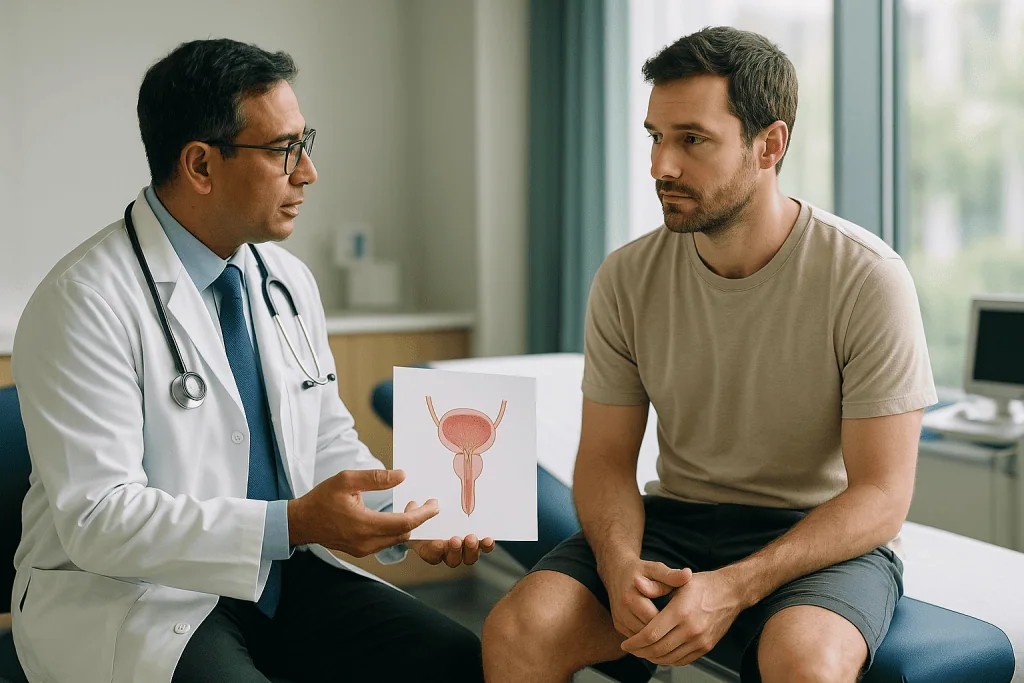
Varicoceles are common, affecting roughly 15 percent of adult men, and the great majority sit on the left side because of how the left testicular vein joins the circulation at a right angle and under higher pressure (Mayo Clinic; Cleveland Clinic).
Repair, called varicocelectomy, does not remove the veins from the scrotum. The surgeon works higher up, in or just below the groin crease, and interrupts the faulty veins so blood reroutes through healthy channels. The testicular artery, the lymphatic vessels and the vas deferens (the tube that carries sperm) are identified and protected. Three approaches are in common use:
- Microsurgical repair uses an operating microscope through a small incision below the groin, allowing the surgeon to separate hair-thin arteries and lymphatics from the veins.
- Laparoscopic repair uses a camera and instruments through small abdominal ports to tie the veins where they run inside the abdomen.
- Percutaneous embolization is not a surgical cut at all. A radiologist threads a thin tube through a vein in the groin or neck and blocks the faulty testicular vein from the inside using coils or a sclerosing agent.
Each has its own recovery pattern, though all three share the same goals: reduce pooling, relieve the dull ache some men feel, and, when fertility is the concern, give the testicle a cooler and better-drained environment (Mayo Clinic).
Is varicocele surgery a major surgery?
Not in the sense most people mean. “Major” surgery usually implies a hospital stay, a large incision, entry into a body cavity and a recovery measured in weeks or months. Varicocele repair is an outpatient procedure, the incision for microsurgical repair is typically a couple of centimeters long, and mainstream guidance describes recovery as quick with pain that is generally mild (Mayo Clinic).
That framing needs two caveats. First, every operation carries risk, and calling something minor does not make its complications minor for the person who has them. Fluid can collect around the testicle afterward, a condition called a hydrocele, which is a painless build-up of clear fluid in the sac surrounding the testicle. The varicocele can recur if a vein is missed or a new collateral channel opens. Infection at the wound, bleeding into the scrotum and, rarely, injury to the testicular artery are all recognized complications (Mayo Clinic; Cleveland Clinic). Laparoscopic approaches add the small risks that come with entering the abdomen.
Second, the anesthetic matters. Microsurgical and laparoscopic repairs are usually done under general anesthesia, which is its own medical event even when the surgery beneath it is modest. Embolization is often done with sedation and local numbing, which is one reason its early recovery can feel lighter.
The honest answer for most patients is that this is a small operation with a recovery that feels bigger than the incision suggests. The scrotum is unusually sensitive, the tissue swells easily, and the ache radiates in a way that surprises people. Knowing that in advance turns a worrying week into an expected one.
What “minor” should never mean is skipping the follow-up. The check at a few weeks confirms the wound has healed, screens for hydrocele and answers the questions that only arise once you are home.
Who is usually offered varicocele repair, and who is usually asked to wait
Most varicoceles never need treatment. They are found incidentally, cause no symptoms, and are simply monitored. Guidance from major centers describes three broad situations in which repair is usually discussed (Mayo Clinic; Johns Hopkins):

- Pain that is persistent, aching, worse with standing or exertion, and not explained by anything else after examination and imaging.
- Fertility concerns, when a couple has struggled to conceive, the semen analysis is abnormal, and the varicocele is clinically detectable rather than visible only on ultrasound.
- Testicular growth in adolescents, when the affected testicle is measurably smaller than the other side and continues to lag.
Who is asked to wait, or not offered surgery at all? Several groups, and for sound reasons. A man with a small varicocele, normal semen results and no pain gains little from an operation whose main benefits are symptom relief and improved sperm parameters. A varicocele detectable only on ultrasound has not been shown to justify repair for fertility purposes in the same way a palpable one has. Someone whose partner has a significant fertility factor of her own may be steered toward assisted reproduction first, because the timeline for any semen improvement after repair runs about three months and may not fit the couple’s plan (Mayo Clinic).
Adolescents with symmetric testicles and no symptoms are usually observed with periodic examinations rather than operated on. Men with bleeding disorders, uncontrolled medical conditions or active infection wait until those are addressed. And anyone whose scrotal pain has another plausible cause, from a hernia to a nerve irritation, should have that ruled out first, because repairing a varicocele that is not the source of pain leaves the pain in place.
The pattern is worth noticing: repair is offered when there is a measurable problem it can plausibly fix. Otherwise, watchful waiting is the evidence-based choice, not a lesser one.
Varicocele surgery recovery timeline, week by week
Timelines vary with the technique, the individual and the surgeon’s preferences, so treat the table below as the shape of a typical course rather than a schedule. The anchors come from mainstream guidance: light activity at about two days, strenuous activity at about two weeks, and semen analysis at roughly three months because that is how long a full cycle of sperm production takes (Mayo Clinic).
| Stage | What is typical | What usually waits |
|---|---|---|
| Day 0 to 2 | Groin tightness, dull scrotal ache, swelling beginning. Short walks indoors. Supportive underwear day and night. | Driving, showering (until cleared), any lifting beyond a light bag. |
| Days 3 to 7 | Bruising appears and may track down into the scrotum or up toward the hip. Swelling peaks then starts to ease. Desk work and gentle walks outside. | Gym, running, cycling, sexual activity if your team has asked you to hold off. |
| Week 2 | Wound edges sealed, dissolvable stitches softening. Most people describe soreness rather than pain. | Heavy lifting, contact sport, anything causing a hard brace of the abdomen. |
| Weeks 3 to 6 | Gradual return to exercise as comfort allows. A firm ridge under the scar is normal healing tissue. Follow-up visit to check for hydrocele. | Maximal lifts and competition until the surgeon confirms. |
| Month 3 onward | Semen analysis if fertility was the reason for repair. Pain outcomes assessed. | Judging success on early results; sperm take about three months to cycle. |
Embolization often trims the early stages, because there is no incision in the groin to heal, though the puncture site and the treated vein still need a few days of care. Laparoscopic repair can add shoulder-tip discomfort from the gas used to inflate the abdomen, which fades within days.
The one column that matters most is the middle one. If your experience sits within it, you are almost certainly healing normally. If it drifts toward the far right, or toward the red flags described later, that is the moment to pick up the phone.
Why is my scrotum swollen after varicocelectomy?
Swelling after this operation has four possible sources, and telling them apart is most of the skill in recovering calmly.
Ordinary surgical swelling is the commonest. Any cut through tissue triggers an inflammatory response: small vessels leak fluid, white cells arrive, and the area becomes puffy and warm. Because scrotal skin is thin and loose, it accommodates far more fluid than the skin over your forearm would, so a modest amount of inflammation looks dramatic. This kind of swelling peaks around the second or third day and then recedes over one to two weeks.
Bruising, medically called ecchymosis, is blood that has leaked from tiny vessels into the tissue under the skin. Gravity pulls it downward, so a bruise that began at the incision can appear in the scrotum a few days later, turning purple, then green, then yellow. It looks alarming and is usually harmless.
Hydrocele is different. It is a collection of clear fluid around the testicle itself, inside the sac that surrounds it, and it develops when the lymphatic vessels that normally drain the testicle were disrupted during the repair. It tends to appear weeks rather than days later, feels like a smooth, painless, water-balloon fullness, and is one of the recognized complications of the operation (Mayo Clinic; Cleveland Clinic). Microsurgical techniques were developed partly to spare those lymphatics. Small hydroceles often need no treatment; larger ones are discussed at follow-up.
Hematoma, a pocket of blood collecting in the scrotum, is the one to watch for early. It arrives fast, often within the first day or two, and brings rapidly enlarging, tense, painful swelling rather than gradual puffiness. That combination belongs in the when-to-call section, not in the wait-and-see column.
Elevation, support and cold in the first days work against the first two causes. They cannot prevent a hydrocele and will not treat a hematoma, which is why knowing the difference matters more than any home remedy.
Scrotal support after surgery: does snug underwear really help?
Those unglamorous mesh briefs are doing real work. The scrotum hangs from the body by the spermatic cord, the bundle of blood vessels, nerves and the sperm-carrying tube that runs from the abdomen down to each testicle, and after surgery that cord is bruised and tender. Every step you take lets the testicle drop and tug on it. Support lifts the weight off, reduces that tugging, and gently compresses the tissue so fluid is less able to pool downward.
Support does three things. It limits the dependent swelling that builds when you are upright. It reduces the sharp twinge that comes with sudden movement. And it holds any dressing in place. What it does not do is speed the underlying healing of the vein ligation or prevent a hydrocele; those are determined in the operating room.
Guidance from surgical centers generally suggests wearing supportive underwear or an athletic supporter continuously for the first several days to two weeks, including overnight, then continuing during activity for as long as it feels helpful (Cleveland Clinic). Loose boxer shorts are the one thing to avoid early on; comfort in the drawer becomes discomfort on the stairs.
A few practical points patients ask about:
- How tight? Snug enough to lift, never tight enough to leave deep marks or feel like a tourniquet. Compression shorts work for many people; a jockstrap works for others.
- Sleeping in support is usually advised early, because turning over in bed is exactly the kind of unguarded movement that hurts.
- Showering means removing support briefly; put a fresh pair on afterward rather than the damp one.
- Weaning off happens naturally. Most people stop noticing they need it somewhere in the second or third week.
If support seems to make things worse rather than better, with more pain or new redness where the fabric sits, that is worth a message to your team rather than pushing through.
How to ease varicocele pain after surgery
The ache after repair has a particular character: dull, dragging, low in the groin and along the cord, worse at the end of the day and after standing. Sharp incisional pain fades within days; the drag lasts longer. Managing it well is mostly about layering several modest measures rather than relying on one.
Position and support come first. Lying flat with a folded towel under the scrotum, or sitting with your feet up and hips slightly raised, takes gravity out of the equation. Supportive underwear does the same job when you are moving.
Cold, applied over the groin through a cloth for short spells in the first two or three days, narrows small vessels and dampens the inflammatory signal. After that window, some people find gentle warmth more soothing for the muscular tightness that develops from guarding the area; either is reasonable if it helps and does not irritate the wound.
Medicines should follow the plan you were given. Acetaminophen works centrally to blunt pain signals and is often the backbone. Anti-inflammatory drugs, the class that includes ibuprofen, reduce the inflammatory swelling itself, though some surgeons ask patients to avoid them early because of bleeding concerns, and anyone with kidney, stomach or heart conditions needs individual advice. Stronger prescription pain relievers are used sparingly, if at all, and only as directed. The prescribing clinician decides what fits your history; this article describes mechanisms, not a regimen.
Avoiding strain matters more than people expect. Coughing, straining on the toilet and lifting all raise pressure in the abdomen and push blood down into the fragile veins around the repair. Staying hydrated, eating fiber and treating constipation early are pain-management measures in disguise.
Pain that is easing week by week, even slowly, is the expected course. Pain that escalates after initially improving, or that arrives with fever, hard swelling or redness, needs assessment rather than another cold pack (MedlinePlus).
When can I lift weights and return to sport after varicocele surgery?
This is the question the printed sheet never answers well, so here is the reasoning behind the typical advice rather than just the number.
Lifting is the concern for two reasons. Heavy loads make you brace hard, which spikes pressure inside the abdomen and drives blood downward into the veins that were just tied off, stressing the ligatures and the fragile healing tissue around them. And in the groin approaches, the incision passes through or near the layers of the abdominal wall, which need time to knit before they are loaded, much as after a hernia repair. Neither problem shows up as pain in the moment; both show up later as swelling, bleeding or a wound that fails to seal.
Mainstream guidance suggests returning to more strenuous activity, exercise included, after roughly two weeks if you are not uncomfortable (Mayo Clinic). In practice, surgeons often layer that advice:
- Walking from day one, building distance daily.
- Light cardio such as the stationary bike or brisk walking once the wound is sealed and the swelling has clearly turned the corner, often toward the end of the first week.
- Running and lighter resistance work from around two weeks, with support worn.
- Heavy compound lifts, maximal efforts and contact or collision sport only after the surgeon has examined the wound and cleared you, commonly a few weeks in.
Cycling deserves a special mention: the saddle sits directly on the healing area, so even fit cyclists often find it the last activity to feel comfortable. Swimming waits until the wound is fully closed to keep it clean. Sports with a real risk of a blow to the groin, from soccer to martial arts, warrant a protective cup and a longer runway.
The signal to trust is not the calendar but the response. If a session leaves the scrotum more swollen or aching the next morning, that was too much, too soon. Drop back a step and try again a few days later.
Sex, fertility and the three-month wait for semen results
Two very different questions hide under this heading, and they have very different timelines.
Sexual activity is usually paused until the wound has sealed and the swelling has settled enough that the mechanics are comfortable, which for many people lands somewhere in the second week. Ejaculation itself does not harm the repair; the veins that were tied lie far upstream of the structures involved. What limits people is soreness and the tug on the spermatic cord during movement. Gentle is the operative word for the first few attempts, and support beforehand helps some. If your team gave a specific interval, that overrides any general range.
Erections and sensation are not affected by the operation in the expected course. The nerves responsible run separately from the veins the surgeon addressed. Temporary numbness of the skin around the incision is common and usually recedes over weeks to months as small skin nerves recover.
Fertility runs on a slower clock. Sperm take about three months to develop from stem cells to mature cells ready for ejaculation, so a semen analysis, the laboratory test that counts sperm and assesses their movement and shape, is not informative until roughly three months after repair, and many teams recheck again several months later (Mayo Clinic). Early samples reflect sperm that were already in production before surgery.
What the evidence actually shows about fertility outcomes is nuanced. Repair of a palpable varicocele in a man with abnormal semen parameters is associated with improvement in those parameters for many, and it is offered on that basis (Johns Hopkins). Whether that translates into a pregnancy depends on the couple as a whole, including the partner’s age and fertility, and no team can promise that outcome. Anyone told otherwise should ask for the guideline or review behind the claim.
Testosterone production is not the target of the surgery and most men notice no hormonal change. Questions about hormones belong with the treating team, who can check levels if there is a reason to.
Is a right side varicocele a cause for concern?
Usually not, but it earns a closer look than a left-sided one, and the reason is anatomy rather than alarm.
The left testicular vein empties into the left kidney vein at a right angle, a longer and higher-pressure route than the right testicular vein, which drains directly into the body’s main abdominal vein at a gentler angle. That difference is why the large majority of varicoceles occur on the left (Mayo Clinic; Cleveland Clinic). A varicocele that appears only on the right, particularly one that develops suddenly in adulthood or that does not soften when a man lies down, is less easily explained by valve failure alone.
In that setting, clinicians want to be sure nothing higher up is pressing on the right testicular vein or the main abdominal vein and obstructing its outflow. A mass in the kidney, a clot in the renal vein or enlarged lymph nodes behind the abdominal cavity are among the possibilities examined. These are uncommon findings, and the point of the work-up is to exclude them, not to expect them. Guidance from mainstream sources describes an isolated right-sided varicocele, or one that appears abruptly, as a reason for imaging of the abdomen rather than a reason for panic (Cleveland Clinic).
What that means practically: a right-sided varicocele typically gets an ultrasound of the scrotum and, where the pattern is unusual, imaging of the abdomen before any conversation about repair. If those are clear, the varicocele is managed like any other, on the basis of symptoms, fertility findings or testicular size.
Bilateral varicoceles, present on both sides, are also common and generally carry no special meaning. The feature that shifts the conversation is a right side on its own, especially one that is new, firm or fails to decompress when lying flat. That combination is worth mentioning to a doctor promptly, not for what it probably is, but for what it needs to be checked against (NHS).
What people often get wrong about varicocele recovery
Online forums are full of good intentions and a few persistent errors. These are the ones worth correcting.
“The bruise means something went wrong.” Bruising that migrates into the scrotum and changes color over a week is blood that has already leaked and is being cleared; it is a sign of healing, not of ongoing bleeding. The worry sign is rapid, tense, painful enlargement, which is a different picture entirely.
“If I can still feel the veins, the surgery failed.” The dilated veins are not removed from the scrotum; their inflow is interrupted higher up. They shrink as they empty, which takes weeks to months. Some residual fullness can persist without the varicocele having recurred. Recurrence is a recognized outcome but is judged at follow-up by examination, not by self-palpation on day ten (Mayo Clinic).
“Pain relief should be immediate.” Post-operative soreness overlaps with the original ache for weeks. Pain outcomes are usually assessed months out, and not every man with varicocele-related pain gets full relief; that uncertainty is part of the pre-operative conversation.
“Bed rest is safest.” Prolonged immobility raises the risk of blood clots in the legs and slows recovery generally. Early, gentle walking is the evidence-based approach, with true rest reserved for the first day or two.
“I can check my fertility next month.” Sperm take about three months to produce, so early testing reflects the pre-operative state (Mayo Clinic).
“A hydrocele means the surgeon made a mistake.” Fluid around the testicle is a known complication linked to disruption of tiny lymphatic vessels, and it can occur even with careful technique. It is discussed, not hidden, and often needs no treatment.
“Right side is the same as left.” As the previous section explained, an isolated right-sided varicocele prompts imaging that a left-sided one usually does not.
The thread running through these myths is impatience with a body part that heals on its own schedule, visibly and uncomfortably, but almost always well.
Questions to ask your care team
The best time to ask most of these is before the operation, when the answers can shape your plans. The rest belong at the follow-up visit. Write them down; the recovery room is a poor place to remember anything.
- Which technique are you recommending for me, and why that one over the others?
- What are the specific risks in my case, including hydrocele, recurrence and injury to the artery, and how would each be handled if it occurred?
- How long do you expect me to need off work, given what my job involves physically?
- Do you want me to avoid anti-inflammatory pain relievers, and if so, for how long and what should I use instead?
- When may I shower, and when may the dressing come off? Are the stitches dissolvable?
- How long should I wear scrotal support, and do you have a preference for the type?
- What is your guidance on driving, and does it change if I have had a general anesthetic?
- When can I start walking for exercise, run, cycle, swim and lift, and what should tell me I have pushed too far?
- When is sexual activity reasonable, and is there anything about it I should know?
- If fertility was the reason for surgery, when will you repeat the semen analysis, and what result would you consider meaningful?
- If pain was the reason, how and when will we judge whether the operation has helped, and what are the next steps if it has not?
- What symptoms should make me call the clinic, and what should send me to urgent care or the emergency department instead?
- Who do I contact out of hours, and how?
- When is my follow-up, and what will you check for at that visit?
A team that answers these clearly and without hurry is telling you something about how the rest of your care will go. Any answer that includes a guarantee of outcome is a reason to ask for the evidence behind it. Good surgeons speak in likelihoods, and they are comfortable saying what is uncertain.
When to call your doctor
Most recoveries from varicocele repair are uneventful, and the previous sections describe the expected ups and downs. A small number of problems need assessment the same day, and a few need emergency care. Knowing which is which removes most of the anxiety of the first fortnight.
Seek urgent or emergency care for any of the following (MedlinePlus; NHS):
- Rapidly enlarging, tense, hard and painful swelling of the scrotum, particularly within the first two days, which can indicate bleeding into the scrotum.
- Sudden severe testicular pain, especially with nausea or vomiting or a testicle that seems to have shifted position, because the blood supply to the testicle must be checked without delay.
- Fever with chills, or a wound that becomes increasingly red, hot, swollen or discharges pus or cloudy fluid.
- Difficulty passing urine for many hours after the anesthetic, or inability to pass urine at all.
- Chest pain, breathlessness, or a swollen, painful calf, which can signal a blood clot after any operation.
- Bleeding from the wound that does not stop with firm pressure for several minutes.
Contact your surgical team, usually the same day, if you notice:
- Pain that was improving and then clearly worsens, or pain not controlled by the plan you were given.
- Swelling that has not begun to settle after the first week, or that develops anew weeks later as a smooth, painless fullness around the testicle, which may be a hydrocele.
- A wound whose edges have separated.
- Numbness or altered sensation that is spreading rather than shrinking.
- Any symptom that simply does not match what you were told to expect. You will not be the first person to call about a bruise, and staff would rather hear from you.
Every one of these judgments, from whether a swelling is normal to when you may return to sport, rests with the team who know your anatomy and your operation. This article describes the typical course so you can recognize where you sit within it. It cannot examine you, and it is no substitute for the people who can.
Frequently asked questions
How many days should I rest after varicocele surgery?
Most people can resume light, non-strenuous activity about two days after varicocele repair, with more demanding activity such as exercise waiting roughly two weeks (Mayo Clinic). Rest in the first days means lying flat with the scrotum supported, interrupted by short walks around the house. Desk work often fits the two-day window; physically demanding jobs usually need longer, and your surgeon sets that limit.
Is varicocele surgery major surgery?
No. Varicocele repair is an outpatient procedure through a small incision or a catheter, and mainstream guidance describes recovery as quick with generally mild pain (Mayo Clinic). It still carries real risks, including hydrocele, recurrence, infection and rarely injury to the testicular artery, and it usually involves a general anesthetic. The recovery often feels bigger than the incision suggests because scrotal tissue swells and bruises so readily.
How can I ease varicocele pain after surgery?
Layer several modest measures: lie flat with the scrotum supported, wear snug supportive underwear when moving, apply a cloth-wrapped cold pack in short spells for the first few days, and avoid straining, lifting and constipation. Take pain medicine exactly as your prescribing clinician directed; acetaminophen and anti-inflammatory drugs work differently and some surgeons restrict the latter early. Escalating pain with fever or hard swelling needs assessment.
Is a right side varicocele a cause for concern?
Usually not, but it warrants a closer look. Most varicoceles occur on the left because of venous anatomy, so an isolated right-sided one, particularly if it appears suddenly or does not soften lying down, prompts imaging of the abdomen to exclude anything obstructing the right testicular vein (Cleveland Clinic). Those findings are uncommon; the work-up exists to rule them out before the varicocele is managed like any other.
How long does swelling last after varicocelectomy?
Ordinary post-operative swelling peaks around the second or third day and then recedes over one to two weeks. Bruising can drift into the scrotum and change color for a week or more. A hydrocele, painless fluid around the testicle, is a separate issue that appears weeks later and is checked at follow-up (Mayo Clinic). Rapidly enlarging, tense, painful swelling in the first days is not normal and needs urgent review.
Do I really need to wear supportive underwear after varicocele surgery?
Yes, in the early days. Support lifts the weight of the testicle off the bruised spermatic cord, limits fluid pooling downward and reduces sharp twinges with movement. Surgical centers generally suggest wearing it continuously, including overnight, for several days to two weeks, then during activity as long as it helps (Cleveland Clinic). It does not speed vein healing or prevent hydrocele, but it makes the recovery considerably more comfortable.
When can I lift weights after varicocele surgery?
Guidance suggests returning to strenuous activity around two weeks if comfortable (Mayo Clinic), but heavy compound lifts, maximal efforts and contact sport usually wait until the surgeon has examined the wound and cleared you. Bracing hard raises abdominal pressure and pushes blood into the healing veins. Build back gradually; if a session leaves the scrotum more swollen or sore the next morning, step back for a few days.
Will varicocele repair improve my fertility?
It may. Repair of a palpable varicocele in men with abnormal semen results is associated with improvement in sperm parameters for many, which is why it is offered (Johns Hopkins). Because sperm take about three months to develop, the first meaningful semen analysis is around three months after surgery (Mayo Clinic). Whether improvement leads to pregnancy depends on the couple as a whole, and no team can promise that outcome.
Can a varicocele come back after surgery?
Yes, recurrence is a recognized outcome, occurring when a vein is missed or a new collateral channel opens (Mayo Clinic). It is diagnosed at follow-up by examination and, if needed, ultrasound, not by feeling the scrotum in the first weeks, because the dilated veins empty and shrink gradually rather than disappearing at once. If a varicocele recurs, the options include observation, embolization or repeat repair, decided with your team.
When can I have sex after varicocele surgery?
Usually once the wound has sealed and swelling has settled enough to be comfortable, often somewhere in the second week, unless your surgeon gave a specific interval. Ejaculation does not harm the repair; soreness and the tug on the spermatic cord during movement are the limiting factors. Erections and sensation are not affected in the expected course, though skin numbness near the incision can persist for weeks to months.
References
This article is for general information only and is not a substitute for professional medical advice. Please consult a qualified doctor about your individual situation.

More from the Blog

Questions to Ask Your Nephrologist When Renal Therapy Options Are on the Table
Before choosing among dialysis, kidney transplant or conservative kidney care, ask your nephrologist what your current eGFR and urine albumin results mean, how quickly…

What to Bring to a Recurrent UTI Visit: Culture Results, Symptom Timing and Medication Lists
For a recurrent UTI appointment, bring every urine culture report you can find with the bacteria and sensitivity columns, a dated symptom diary showing…
Enlarged Prostate (BPH): When Medication Is Enough and When a Procedure Is Considered
Most men with a symptomatic enlarged prostate start with lifestyle changes and, if needed, medication such as an alpha-blocker or a 5-alpha reductase inhibitor.…

Orchitis That Is Not Settling: When to Call Your Urologist About Fever or Worsening Swelling
Orchitis that is not getting better usually deserves a same-day call to your urologist or the clinician who prescribed treatment. Bacterial epididymo-orchitis typically begins…

Why Are PSA Targets Different After Prostate Surgery or Radiation? Monitoring vs Screening
PSA targets differ because the goal changes. Screening looks for cancer in an intact prostate, so a level up to about 4 ng/mL is…

What Happens When a Catheter Is Placed for Urinary Retention: Drainage Explained Step by Step
When a catheter is placed for urinary retention, a thin, flexible tube is passed through the urethra (or, less often, through the lower abdomen)…