

Vasectomy Recovery Timeline: Rest, Cold Packs and When Everyday Activity Usually Resumes

Key Takeaways
- Mayo Clinic advises 24 hours of rest and cold packs for the first two days, not days of bed rest.
- The NHS says many people return to work one or two days after a vasectomy, but sport and heavy lifting should wait at least a week.
- Physical recovery and contraceptive clearance run on separate clocks: another method is needed until a semen test, at least 12 weeks later according to the NHS, confirms no sperm.
- Once a clear test is confirmed, the NHS puts effectiveness above 99 percent with a failure rate below 1 in 2,000.
- Quoted rates of long-term scrotal pain vary widely, from around 1 in 100 in Cleveland Clinic material to around 1 in 10 in NHS material, so ask your surgeon for their figure.
- Testosterone, erections, orgasm and semen volume are essentially unchanged because the blocked tubes carry only sperm, not hormones or most of the fluid.
Most people rest for the first 24 hours after a vasectomy, use wrapped cold packs and snug supportive underwear for about two days, and return to desk work within one to two days. Heavy lifting, sport and sex are usually paused for about a week. Another form of contraception is needed until a semen test, commonly around 12 weeks later, confirms no sperm. Timelines vary, so follow your surgeon's specific instructions.
The bag of frozen peas is already in the freezer. The appointment is booked for the end of the week, the paperwork is signed, and the question that keeps surfacing is not really about the procedure at all. It is about the days afterward: Can I sit at a desk on Monday? Will I be able to carry a toddler up the stairs? How long does this actually take?
Those are sensible questions, and they deserve straighter answers than the internet usually gives. Some pages make it sound like a lunch break; others read like a warning label. The truth about the vasectomy recovery timeline sits between the two, and it depends less on the calendar than on what your body tells you and what your surgeon asked of you.
What follows is a plain account of what usually happens, hour by hour and then week by week, with the evidence behind each figure and honest notes wherever the evidence is thinner than the confident headlines suggest.
What actually happens during a vasectomy
A vasectomy is a minor surgical procedure that blocks the two vas deferens, the thin tubes that carry sperm from each testicle toward the urethra, so that sperm can no longer reach the semen. Everything else in the system keeps working. The testicles still make sperm and testosterone; the sperm simply have nowhere to go and are reabsorbed by the body.
The procedure is almost always done under local anesthetic, meaning the scrotum is numbed while you stay awake. Two techniques are in common use. In the conventional approach the surgeon makes one or two small cuts in the skin of the scrotum. In the no-scalpel approach the surgeon uses a fine instrument to make a single tiny puncture and gently stretches it open. Through that opening each vas deferens is lifted out, a short segment is removed, and the cut ends are sealed by tying, heat (cautery), clips, or a combination. The skin opening is then closed with dissolvable stitches or left to heal on its own.
The whole thing typically takes around 15 to 30 minutes, according to the NHS and Mayo Clinic. You walk in and, after a short rest, you walk out the same day.
One detail surprises many people: the volume and appearance of semen change very little afterward. Most of the fluid in an ejaculate comes from the prostate and the seminal vesicles, glands that sit well downstream of where the tubes are blocked. Sperm are a tiny fraction of the total. Orgasm and ejaculation feel the same because the muscles and nerves involved are untouched.
Knowing the mechanics helps make sense of the recovery timeline. The tissue that has been handled, the scrotal skin and the small area around each tube, is what needs time to settle. That is why the advice centers on rest, cold and support rather than on anything more dramatic.
Who a vasectomy is usually for, and who is usually asked to wait
Vasectomy is offered to adults who are confident they do not want to father children in the future. Both the NHS and Mayo Clinic describe it as a permanent method of contraception, and clinicians counsel on that basis. Reversal operations exist, but they are more complex than the original procedure, are not always available, and do not reliably restore fertility. Nobody should go into a vasectomy planning to undo it later.

Because the decision is meant to be for life, most services build in a conversation before booking. The surgeon or nurse will ask about your current family situation, whether a partner is involved in the decision, and how you would feel if circumstances changed. This is not gatekeeping for its own sake; it is because regret is harder to treat than hesitation.
A clinician may suggest more time to think in a few situations: when someone is very young or has no children and expresses uncertainty, when a relationship is under acute strain, or when the request follows a recent life event such as a pregnancy loss or separation. None of these is an automatic refusal. They are prompts for a second conversation.
There are also medical reasons to pause. Active skin infection in the groin, a current urinary or genital infection, or a bleeding tendency that has not been assessed are usually addressed first. People who take blood-thinning medicines are asked to discuss the plan with the prescribing clinician, because the timing around the procedure is an individual decision that belongs with that team.
Alternatives are worth a mention in neutral terms. Condoms, long-acting reversible methods used by a partner, and tubal sterilization are all options with different profiles of reversibility, effectiveness and who carries the responsibility. A good pre-procedure conversation covers them without steering.
Is a vasectomy painful?
Not in the way most people fear, though “painless” would be an overstatement. Three moments matter.
The first is the anesthetic injection. The numbing medicine is given into the skin of the scrotum and around each tube, and that sting is often the most uncomfortable part of the whole appointment. It lasts seconds. Some clinics use a spray or a very fine needle to soften it.
The second is the procedure itself. Once the area is numb you should not feel sharp pain, but you may feel pressure, movement, or a brief pulling sensation deep in the groin as each tube is lifted. Mayo Clinic describes this tugging as normal. If anything feels sharp, say so; more anesthetic can be given.
The third is afterward. As the numbness wears off over a few hours, a dull ache sets in. The NHS describes mild discomfort, swelling and bruising for a few days, and Mayo Clinic notes that pain and swelling usually improve within a few days. Many people compare the feeling to having been lightly kicked, a heavy ache rather than a sharp one, worst when standing or walking and eased by lying down with support.
Where individual experiences diverge is in how long that ache lingers and how the scrotum responds to handling. A larger bruise or a small collection of blood can make the second and third days more tender than the first. That is uncomfortable but usually not a complication, and the section on the first 48 hours explains why cold and support make a measurable difference.
A minority of people develop pain that persists well beyond healing. That is real, it is discussed later in this article, and it is one of the reasons the pre-procedure conversation should not be rushed.
The vasectomy recovery timeline at a glance
Recovery is not a single event but a set of overlapping milestones. The table below gathers the typical ranges quoted by mainstream sources. Treat every figure as a usual pattern, not a deadline. Your surgeon’s written instructions override anything here.
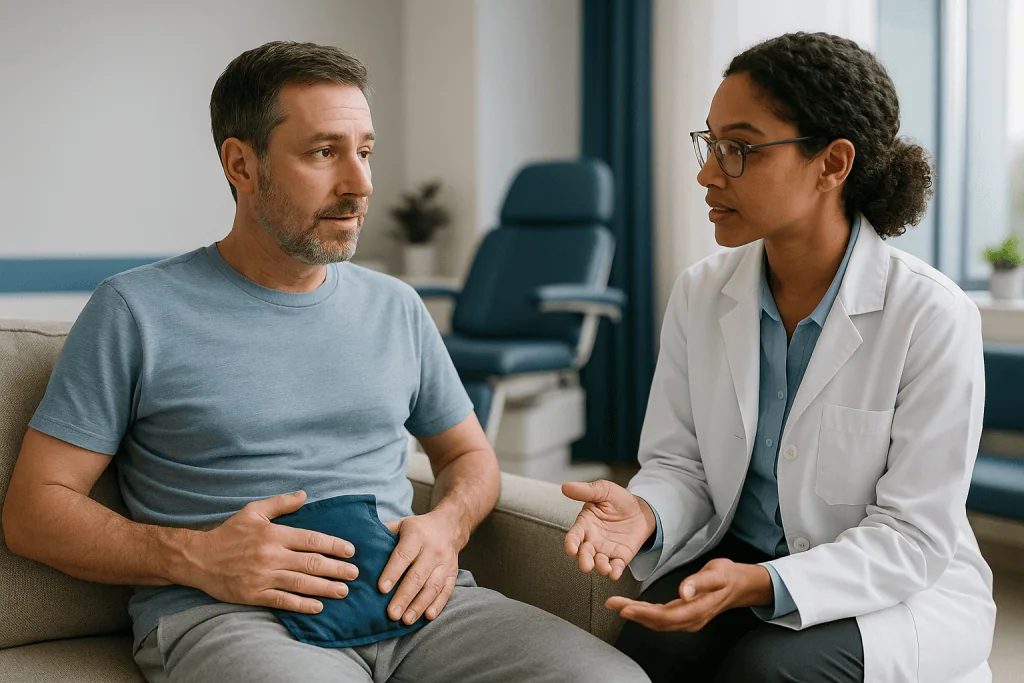
| Period | What usually happens | What is usually advised |
|---|---|---|
| First 24 hours | Numbness fades; aching, mild swelling and bruising begin | Rest at home, lie down when possible, wrapped cold pack, snug supportive underwear (Mayo Clinic, NHS) |
| Days 1 to 3 | Ache often peaks then eases; bruising may spread and darken | Cold packs continue for the first two days; light movement around the house; many return to desk work after 1 to 2 days (NHS) |
| Week 1 | Most discomfort settles; small firm lump at the site may be felt | Avoid sport, heavy lifting and sex for at least a week (NHS, Mayo Clinic) |
| Weeks 2 to 4 | Skin fully healed; residual tenderness with pressure is common | Gradual return to exercise as comfort allows; still using another contraceptive method |
| Around 12 weeks | Sperm already in the tubes have been cleared over repeated ejaculations | Semen test to confirm no sperm; contraception continues until the result is clear (NHS, Mayo Clinic) |
Two features of the table deserve emphasis. First, the physical recovery and the contraceptive clearance run on completely separate clocks. You can feel entirely normal at three weeks and still be fertile. Second, the early days are front-loaded with the most useful actions. Rest, cold and support in the first 48 hours do more for comfort than anything you can do later.
The spread in the ranges reflects real variation between people and between techniques, not sloppiness in the sources. The following sections walk through each period in more detail.
The first 48 hours: rest, cold packs and support
The first two days set the tone. Three simple measures do most of the work, and they are the ones surgeons repeat most often.
Rest comes first. Mayo Clinic advises resting for 24 hours after the procedure. That means lying down as much as is practical, with the scrotum supported rather than hanging, and keeping trips around the house short. Gravity is the enemy in this period: standing lets fluid and blood pool in the loosest tissue in the body, which is exactly where the surgery happened.
Cold is second. Applying a cold pack to the scrotum for the first two days is standard advice from Mayo Clinic, and the NHS recommends the same. Cold narrows small blood vessels, which limits bleeding into the tissue and slows the swelling that follows. It also numbs the ache. The pack should always be wrapped in a cloth, never placed directly on skin, and used in short sessions with breaks between so the skin can rewarm.
Support is third, and it is underrated. Mayo Clinic suggests supporting the scrotum with snug-fitting underwear or a supporter for at least 48 hours, and the NHS advises tight-fitting underwear day and night for two to three days. Firm support reduces the pull on the healing sites every time you shift position, and many people notice it lowers the ache within minutes of putting it on.
Keep the area clean and dry. Most services allow a shower after 24 to 48 hours, patting the area rather than rubbing, but the specific timing is your surgeon’s call. Some bruising, a little oozing onto the dressing, and swelling that makes the scrotum look larger than usual are all expected. Bleeding that soaks the dressing, swelling that grows quickly, or pain that escalates rather than settles are not, and should prompt a call to the team that same day.
How long to ice after a vasectomy?
The short answer, drawn from Mayo Clinic’s guidance, is for the first two days. After that, cold offers diminishing returns for most people, because the bleeding that cold is meant to limit has largely stopped and the tissue has moved into the repair phase.
Understanding the mechanism helps you use cold well rather than mechanically. In the hours after any small operation, tiny blood vessels that were cut or stretched continue to leak. The body seals them quickly, but in the loose, low-pressure tissue of the scrotum even small leaks show up as visible bruising and swelling. Cold applied to the skin cools the tissue beneath it, causes those vessels to constrict, and reduces the volume that leaks. It also slows the nerve signals that carry the aching sensation, which is why the relief feels immediate.
A few practical points follow from that. A wrapped bag of frozen peas or a gel pack molds to the shape of the area better than a rigid block. The wrap matters: prolonged direct contact between ice and skin can damage skin, and the scrotal skin is thin. Short sessions with breaks let the skin recover its temperature and blood flow between applications. Applying cold while lying down, with the scrotum supported, combines all three early measures at once.
Some people find that gentle warmth is more soothing after the second or third day, when the concern shifts from bleeding to stiffness and bruise tenderness. That is reasonable, but it is worth checking with the team, especially if there is any swelling that has not clearly stopped growing.
Cold is a comfort measure, not a treatment for complications. If swelling is expanding hour by hour, no amount of ice substitutes for a phone call.
How long are you on bed rest after a vasectomy?
Strictly speaking, you are not. “Bed rest” in the medical sense means being confined to bed for days, and that is neither necessary nor advised after a vasectomy. What sources actually recommend is far more modest: Mayo Clinic advises resting for 24 hours, and Cleveland Clinic describes resting for the first day, then easing into light activity.
The distinction matters because too much stillness has its own downsides. Lying rigid in bed for several days does nothing extra for the healing sites and makes people stiff, restless and prone to skipping the one thing that does help, which is keeping the scrotum supported and cool.
A more useful way to picture the first day is “sofa rest”. Lie down or recline with your feet up when you can. Get up to use the bathroom, to eat, to move to another room. Avoid long periods of standing, avoid stairs more than necessary, and avoid anything that involves straining. The goal is to keep gravity and jarring movement away from the tissue that has just been handled, not to immobilize yourself.
From the second day, most people can move around the house normally and take a short, slow walk on level ground if it feels comfortable. Sitting for long periods on a hard chair can be less comfortable than lying down, which is why a return to desk work often works better on the second or third day than the first.
The signal to follow is the ache. If an activity makes the dull ache sharpen or the swelling feel heavier, stop and lie down with the cold pack. If it does not, you are within your body’s limits. Your surgeon may give more specific limits based on how the procedure went, and those instructions take priority over general guidance.
Return to work after vasectomy: when everyday activity usually resumes
For most people the return to ordinary life is quick, but “ordinary life” contains very different levels of physical demand, and the guidance reflects that.
Desk-based work is the fastest. The NHS states that you may be able to return to work one or two days after the procedure. Many people book the procedure toward the end of the working week so that the first day of rest and the second day of easing off fall on days when nothing is expected of them. Sitting itself is not harmful, though a cushion and the ability to stand and stretch make the first day back more comfortable.
Physically demanding work is different. Both the NHS and Mayo Clinic advise avoiding heavy lifting and sport for at least a week. Lifting, straining and repeated bending raise pressure in the abdomen and pull on the scrotal tissue, which can reopen tiny vessels and set back the swelling. Anyone whose job involves manual handling should ask the surgeon directly about a return date and whether a period of lighter duties is sensible.
Driving is usually fine once the local anesthetic has fully worn off and you can move comfortably, typically from the day after. If you were given a sedative in addition to local anesthetic, you should not drive that day at all, and someone will need to take you home.
Exercise returns in stages. Walking on level ground can start within a couple of days if comfortable. Running, cycling, gym sessions and contact sport wait until at least the one-week mark and until the ache with movement has faded. Cycling deserves a special word because the saddle presses directly on the area; a padded shorts-and-gentle-start approach is kinder than a long ride on the first attempt.
Childcare is the activity people forget to plan for. Lifting a toddler counts as heavy lifting. Arranging help for that first week is one of the most practical steps you can take.
How long until no pain after vasectomy?
For most people the ache fades over a few days and is gone or barely noticeable within one to two weeks. The NHS describes discomfort, swelling and bruising lasting a few days; Mayo Clinic says pain usually improves within a few days. Residual tenderness when the area is pressed, or a small firm lump at each operation site, can persist for several weeks and is a normal part of healing rather than a sign of trouble.
Comfort in that window is usually managed with the physical measures already described plus, where a clinician advises it, an over-the-counter pain reliever. Two classes are commonly discussed. Acetaminophen (known as paracetamol outside the United States) works mainly through the central nervous system to dampen pain signals. Non-steroidal anti-inflammatory drugs, such as ibuprofen, reduce inflammation at the site and may be avoided around the procedure because they can affect bleeding. Which, if either, is right for you, and for how long, is a decision for the surgeon or your prescribing clinician, particularly if you have kidney disease, stomach problems, or take other medicines.
A second, less common pattern is pain that does not follow the expected downward curve. Some people have an ache that lingers for months, or that flares with ejaculation, exercise or pressure. This is often called post-vasectomy pain syndrome, meaning scrotal pain persisting long after the tissue has healed. The quoted frequency varies with how it is defined and measured. Cleveland Clinic cites a figure in the region of 1 to 2 percent; the NHS gives a broader figure of long-term testicular pain affecting around 1 in 10 men. That spread is honest evidence of uncertainty, not a contradiction to be resolved by picking the number you prefer.
If pain has not clearly improved by the two-week point, or if it returns after settling, tell the surgeon. Persistent pain has causes that can be assessed, and early review is better than quiet endurance.
Sex, ejaculation and the semen test: the second clock in the vasectomy recovery timeline
Physical recovery and contraceptive recovery are separate processes, and confusing them is the most consequential mistake people make.
On the physical side, Mayo Clinic and the NHS both advise waiting about a week before resuming sexual activity, and longer if it still hurts. The first few ejaculations may be uncomfortable, and Mayo Clinic notes you may see a little blood in the semen. That is usually residual blood from the operation site and settles on its own, though blood that persists or increases should be mentioned to the team.
On the contraceptive side, the timeline is much longer. The tubes downstream of the block still contain sperm that were already there before the procedure, and they are cleared only gradually through repeated ejaculation. Until a semen test shows no sperm, you are not sterile, and another form of contraception must be used. The NHS advises the test at least 12 weeks after the procedure; Mayo Clinic describes testing in the range of six to twelve weeks and notes that many ejaculations are needed to clear the tubes. Some services ask for a second confirmatory sample. Only when the clinician tells you the result is clear can you rely on the vasectomy.
Once confirmed, effectiveness is high. The NHS states that vasectomy is more than 99 percent effective, with a failure rate of fewer than 1 in 2,000 in the years after a clear test. Rare late failures happen when the sealed ends rejoin, a process called recanalization, which is one reason some surgeons place a small layer of tissue between the ends.
Nothing about the procedure changes desire, erections or orgasm. Testosterone is made in the testicles and released into the bloodstream, not through the vas deferens, so hormone levels are unaffected. The sensation of ejaculation is unchanged because the fluid volume is almost the same.
Bruising, swelling, lumps and other things that can go wrong
Most people have an uneventful recovery, but a plain list of what can happen, in order of how common it is, makes the odd sensation in week two far less alarming.
Bruising and swelling are expected rather than complications. The scrotal skin is thin and loose, so even a small amount of blood spreads visibly and can look worse than it feels. It fades over one to two weeks.
A hematoma is a collection of blood inside the scrotum. Small ones are common and resolve on their own; larger ones cause a rapidly enlarging, tense, painful swelling in the first day or two and need to be seen. The NHS lists this as one of the recognized complications.
Infection shows up as spreading redness, heat, increasing rather than decreasing pain, pus at the wound, or fever, usually from around the third day onward. It is uncommon and is treated by the surgical team.
A sperm granuloma is a small, firm, sometimes tender lump that forms where sperm leak from the cut end of the tube and provoke a local reaction. Mayo Clinic describes it as a possible effect of vasectomy. Most cause no problems and shrink over time; a few remain tender.
Epididymitis, meaning inflammation of the coiled tube behind the testicle where sperm mature, can produce a dull ache and swelling on one side in the weeks after the procedure and usually settles with support and time.
Chronic scrotal pain, discussed earlier, is the complication that matters most to weigh in advance because it is the one that can affect quality of life. Its quoted frequency ranges from around 1 in 100 to around 1 in 10 depending on the source and definition.
Failure to achieve sterility, either because sperm persist on testing or because the ends later rejoin, is rare and is picked up by the semen test, which is exactly why the test cannot be skipped.
What people often get wrong about recovering from a vasectomy
Several beliefs circulate widely enough to deserve a direct correction.
“You are sterile as soon as it is done.” No. Sperm already beyond the block remain for weeks and are cleared only through repeated ejaculation. The NHS advises a semen test at least 12 weeks after the procedure before relying on it. Pregnancies in the first months after a vasectomy almost always trace back to skipping this step.
“A vasectomy lowers testosterone or affects performance.” Testosterone is released from the testicles into the blood, not through the tubes that are blocked. Mayo Clinic is explicit that vasectomy does not affect sexual performance, hormone levels or masculinity.
“It increases the risk of prostate or testicular cancer.” Concerns were raised in the past, but Mayo Clinic notes there is no proven link between vasectomy and either cancer. Where studies have hinted at associations, they have been inconsistent and have not shown cause and effect.
“No-scalpel means no recovery.” The no-scalpel technique changes how the skin is opened, and some studies suggest less bleeding and faster skin healing. What happens to the tubes underneath is the same, and the guidance on rest, cold, support and a week without heavy exertion applies to both.
“You need a week in bed.” Mayo Clinic’s advice is 24 hours of rest, then gradual movement. Prolonged immobility adds nothing and is uncomfortable.
“Semen will look or feel different.” Sperm make up only a small share of ejaculate volume; the rest comes from glands downstream of the block. Volume, appearance and the sensation of orgasm are essentially unchanged.
“Reversal is easy if I change my mind.” Reversal is a longer, more technical operation, is not always available, and does not reliably restore fertility. Every mainstream source describes vasectomy as permanent, and that is the mindset to bring to the decision.
Questions to ask your care team before and after the procedure
A ten-minute conversation before the procedure, and a short check-in afterward, prevents most of the uncertainty that sends people searching online at midnight. These are the questions that tend to matter most.
- Which technique will you use, and does it change anything about my recovery?
- Are there any medicines or supplements I take that you want me to discuss with my prescribing clinician before the procedure?
- Will I have a sedative as well as local anesthetic, and if so, do I need someone to drive me home?
- How long do you want me to rest, and when can I shower?
- How long should I use cold packs, and is there anything you prefer I use instead?
- When can I return to my specific job, given what it involves physically?
- When can I start walking, running, cycling and lifting again?
- When is it safe to have sex, and what should I expect the first few times?
- When will my semen test be, how do I provide the sample, and will I need more than one?
- Until the test is clear, what contraception do you suggest we use?
- What is your figure for long-term pain after this procedure, and how do you assess and treat it if it happens?
- Which symptoms should make me call you the same day, and what number do I use out of hours?
- Is there a follow-up appointment, or do I only come back if something is wrong?
Write the answers down. Post-procedure instructions from the surgeon who actually performed the operation will always be more useful than general ranges, because they know how the tissue looked, whether there was more bleeding than usual, and what they saw that might change the timeline for you.
When to call your doctor after a vasectomy
The great majority of recoveries need no medical contact beyond the planned semen test. The signs below are the exceptions, and they should prompt a call to the surgical team or, if the team is unavailable, urgent care.
Call the same day if you notice any of the following:
- Swelling of the scrotum that is increasing quickly, especially in the first 48 hours, or a scrotum that feels tense and hard, which can indicate a hematoma
- Bleeding that soaks through the dressing or does not stop with gentle pressure
- A fever, chills, or feeling generally unwell
- Spreading redness, heat or pus at the wound, or pain that is getting worse from the third day onward rather than better
- Severe pain that is not eased by rest, support, cold and any pain reliever your clinician advised
- Difficulty passing urine
Seek urgent, same-day assessment if pain becomes sudden and severe, if the testicle appears to sit higher or at an unusual angle, or if you feel faint or short of breath. These are rare after vasectomy but need to be excluded promptly.
Contact the team, though less urgently, if a firm lump remains tender for many weeks, if blood in the semen persists beyond the first few ejaculations, if pain that had settled returns, or if discomfort has not clearly improved by two weeks. Persistent pain is assessable, and it is easier to address early.
None of these signs means something has definitely gone wrong. They are the points at which a clinician who knows what was done should look rather than a search engine. The semen test is the other non-negotiable contact: keep the appointment, provide the sample, and keep using contraception until the team confirms the result. Every decision about your recovery, from when to lift to when to stop worrying about a lump, belongs with the team that performed the procedure.
Frequently asked questions
Is a vasectomy painful?
The anesthetic injection stings briefly, and afterward most people describe a dull ache with bruising and swelling for a few days rather than sharp pain. During the procedure itself you may feel pressure or a tugging sensation but should not feel sharp pain; if you do, more anesthetic can be given. Rest, wrapped cold packs and snug supportive underwear ease the ache in the first 48 hours. Any pain that worsens after the third day should be reported to the surgical team.
How long are you on bed rest after a vasectomy?
True bed rest is not required. Mayo Clinic advises resting for about 24 hours, meaning lying down as much as practical with the scrotum supported, then easing into light movement around the house from the second day. Prolonged immobility adds nothing to healing and tends to be uncomfortable. The useful signal is the ache: if an activity sharpens it, stop and lie down with a cold pack. Follow your surgeon’s specific instructions over general ranges.
How long until no pain after vasectomy?
For most people the ache fades over a few days and is gone or minimal within one to two weeks, according to NHS and Mayo Clinic guidance. Tenderness with pressure and a small firm lump at each site can persist for several weeks and is a normal part of healing. A minority develop pain that lasts for months; quoted rates range from about 1 to 2 percent to around 1 in 10 depending on the source. Pain that has not clearly improved by two weeks warrants a call to the team.
How long to ice after a vasectomy?
Mayo Clinic recommends applying cold packs to the scrotum for the first two days. Cold constricts small blood vessels, limiting bleeding into the tissue and reducing swelling, and it numbs the ache. Always wrap the pack in cloth rather than placing it directly on skin, use short sessions with breaks between, and apply it while lying down with the scrotum supported. Beyond two days cold offers little extra benefit for most people, and expanding swelling needs a phone call rather than more ice.
When can I return to work after a vasectomy?
The NHS states that you may be able to return to work one or two days after the procedure, which suits desk-based jobs. Physically demanding work is different: both the NHS and Mayo Clinic advise avoiding heavy lifting and sport for at least a week, so manual roles may need lighter duties or more time off. Ask your surgeon for a return date based on what your job actually involves rather than relying on a general figure.
When can I have sex after a vasectomy?
Mayo Clinic and the NHS advise waiting about a week, and longer if it still hurts. The first few ejaculations may be uncomfortable and may contain a little blood, which usually settles. You are not yet sterile at that point: sperm already in the tubes take weeks to clear, so another form of contraception is needed until a semen test, at least 12 weeks after the procedure according to the NHS, confirms no sperm and your clinician tells you the result is clear.
How long after a vasectomy is the semen test, and why does it matter?
The NHS advises a semen test at least 12 weeks after the procedure; Mayo Clinic describes testing between six and twelve weeks, after many ejaculations have cleared sperm from the tubes. Some services request a second confirmatory sample. The test matters because vasectomy is not effective until it is confirmed, and pregnancies in the early months almost always trace back to skipping it. Once cleared, the NHS puts effectiveness above 99 percent.
Does a vasectomy affect testosterone, sex drive or erections?
No. Testosterone is produced in the testicles and released into the bloodstream, not through the vas deferens, so hormone levels are unaffected. Mayo Clinic states that vasectomy does not affect sexual performance or hormone levels. Erections, orgasm and the sensation of ejaculation are unchanged because the nerves and muscles involved are untouched, and semen volume is essentially the same because most of the fluid comes from glands downstream of the block.
Why is there a lump at the vasectomy site weeks later?
A small firm lump where each tube was sealed is common and often represents a sperm granuloma, a local reaction to sperm leaking from the cut end, or simply scar tissue at the site. Mayo Clinic lists granuloma as a recognized effect. Most cause no problems and shrink over time, though some stay tender for a while. A lump that is rapidly growing, hot, very painful or associated with fever should be assessed by the surgical team.
What are the red-flag signs after a vasectomy?
Call the surgical team the same day for scrotal swelling that is enlarging quickly, bleeding that soaks the dressing, fever or chills, spreading redness or pus at the wound, pain that worsens from the third day onward, or difficulty passing urine. Seek urgent assessment for sudden severe pain or a testicle sitting at an unusual angle. Less urgently, report pain that returns after settling, blood in semen that persists, or discomfort that has not clearly improved by two weeks.
References
This article is for general information only and is not a substitute for professional medical advice. Please consult a qualified doctor about your individual situation.

More from the Blog

When Urinary Symptoms Need a Urologist: Which Diagnostic Tests Usually Come First
Most people can start with their primary care clinician, who usually orders a urinalysis and, if needed, a urine culture and basic kidney blood…

How Blood and Urine Tests Reveal Kidney Damage From Medicines, Metals or Contrast
Kidney damage from medicines, heavy metals or contrast dye is usually picked up with two kinds of tests: a blood test measuring creatinine, used…
Why an Acute UTI Sample Is Taken Before Antibiotics Start: Culture, Sensitivity and Timing
A urine sample is taken before antibiotics start because antibiotics begin killing or suppressing bacteria within hours, which can leave a culture falsely negative…

Urinary Incontinence in Older Adults: How Treatment Is Tailored to Health and Mobility
Incontinence in older adults is treated in steps matched to the person's overall health, mobility and memory. Clinicians first look for reversible causes such…

Sling Surgery Recovery: Lifting Limits, Spotting and When Exercise and Intimacy Resume
After sling surgery for stress urinary incontinence, most people are walking the same day and back to light daily routines within about two weeks,…

Can You Take Over-the-Counter Painkillers With Kidney Disease? Why Every Item Is Checked
Some over-the-counter painkillers can be used by people with kidney disease, but only after the treating team has checked them. Non-steroidal anti-inflammatory drugs, the…