

Virtual Colonoscopy: The CT Alternative and Its Honest Trade-offs
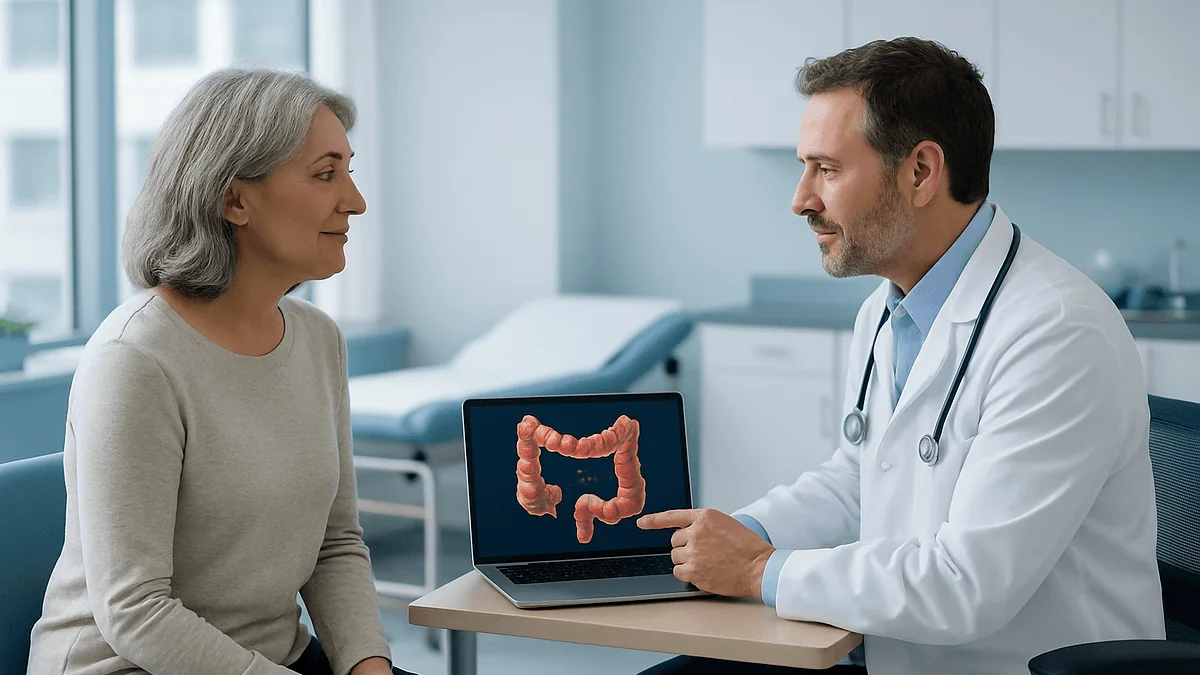
Key Takeaways
- CT colonography detects about 90% of polyps 10 millimeters or larger, but it misses more small and flat lesions than conventional colonoscopy does.
- The bowel prep is essentially identical to colonoscopy's: the real conveniences are no sedation, no escort, and a same-day return to driving and work.
- Roughly one in eight screened people is referred for a follow-up colonoscopy, so ask in advance whether the facility offers same-day scoping on one prep.
- The radiation dose of roughly 1-5 millisieverts equals several months to about a year of natural background exposure.
- Virtual colonoscopy must be repeated every 5 years versus every 10 for a normal colonoscopy, up to seven scans over a 45-to-75 screening lifetime.
- Medicare began covering screening CT colonography in January 2025, but a follow-up colonoscopy or the workup of an incidental finding may still be billed as diagnostic care.
Quick Answer
Virtual colonoscopy, also called CT colonography, screens for colorectal cancer using a low-dose CT scan instead of a scope. It requires the same bowel prep as standard colonoscopy but no sedation, and studies show it detects about 90% of polyps 10 millimeters or larger. If the scan finds a significant polyp, a conventional colonoscopy is still needed to remove it.
The reminder tends to arrive the same year as the reading glasses: you’ve turned 45, and colorectal cancer screening is now officially your business. For many people, the sticking point isn’t fear of what the test might find. It’s the logistics: the sedation, the required escort home, the day off work that quietly becomes two.
That’s the gap virtual colonoscopy was built to fill. A CT scanner, roughly 15 minutes on the table, no anesthesia, and you can drive yourself back to the office. It sounds almost too tidy, and in some ways it is: the prep is just as unglamorous, the scan can’t remove anything it finds, and roughly one in eight people end up scheduling the conventional version anyway.
So here is the honest accounting, what the evidence says this test does well, where it falls short, and how to decide whether it’s the right way for you to get screened at all.
What is a virtual colonoscopy, exactly?
Despite the name, nothing about it happens in a headset. Virtual colonoscopy, formally CT colonography, is a real CT scan of your abdomen and pelvis, read by a radiologist. The “virtual” part is software: hundreds of cross-sectional images are reconstructed into a three-dimensional model of your colon, which the radiologist navigates on screen the way a gastroenterologist would steer a scope. Clinicians sometimes call this view a fly-through.
Two conditions make the pictures readable. The colon has to be clean, which is why the test still requires a full laxative bowel preparation the day before. And it has to be inflated, which is why a thin, flexible tube, about the width of a fingertip, is placed just inside the rectum so carbon dioxide can gently expand the colon walls. A collapsed colon hides polyps; a distended one shows its lining in relief.
The technique dates to the mid-1990s and has since earned a place in mainstream guidelines. The U.S. Preventive Services Task Force lists CT colonography every five years as one of the recommended screening options for average-risk adults ages 45 to 75, alongside annual stool tests and conventional colonoscopy every ten years. In other words, this is not a fringe alternative. It’s a legitimate front-line screening test, with a specific set of strengths and a specific set of compromises.
What actually happens during the scan, minute by minute
You arrive having finished the prep and, usually, a period of not eating that morning. There’s typically no IV line for a screening exam, no gown drama beyond the usual, and no anesthesia consent forms.
In the scan room, you lie on your side while the technologist places the small rectal tube. Carbon dioxide flows in over a few minutes: this is the part people notice most, a spreading sense of fullness and pressure, occasionally crampy. Then you lie on your back, hold your breath for about ten seconds while the scanner passes over you, roll onto your stomach, and repeat. Two positions matter because fluid and residual material shift with gravity; what hides a polyp face-up may reveal it face-down.
Total time on the table: usually 10 to 15 minutes. Total time in the building: often under an hour. The tube comes out, most of the gas is absorbed by your bloodstream and breathed out within half an hour (carbon dioxide clears far faster than room air, which is why modern centers use it), and you’re free to eat, drive, and work.
Compare that with conventional colonoscopy: 30 to 60 minutes of procedure and recovery, sedation that legally sidelines you from driving for the rest of the day, and a companion required to take you home. On pure logistics, the CT version wins decisively. Logistics, though, are only part of the ledger.
Is virtual colonoscopy as good as a colonoscopy?
For the polyps that matter most, it comes close. In the landmark National CT Colonography Trial, which enrolled more than 2,500 adults who underwent both tests, CT colonography detected about 90% of adenomas measuring 10 millimeters or larger: the size range most likely to progress toward cancer. That figure is broadly comparable to colonoscopy for large lesions.
The gap opens at smaller sizes. For polyps in the 6-to-9-millimeter range, reported sensitivity drops to roughly 78-88% across studies, and lesions under 6 millimeters are often not reported at all, partly because their cancer risk is very low and partly because CT genuinely struggles to see them. Flat (sessile) polyps and certain serrated lesions, subtle, pancake-shaped growths, are harder for CT to catch than raised ones, and these are an area where an experienced endoscopist holds a real advantage.
Honesty cuts both ways, though. Colonoscopy is the reference standard, not a perfect test: tandem-colonoscopy studies, where two exams are done back to back, show that even scopes miss a meaningful share of small adenomas. No screening test sees everything.
Here’s the framing the evidence supports: if you will reliably show up for a colonoscopy, it remains the most thorough single exam, because it finds and removes polyps in one visit. If sedation, scheduling, or plain dread means you keep postponing, a virtual colonoscopy done every five years protects you far better than a perfect test you never take. Screening only works when it happens.
The honest trade-offs, side by side
Most comparison articles bury the differences in prose. The numbers are clearer in a table.
| Consideration | Virtual colonoscopy (CT) | Conventional colonoscopy |
|---|---|---|
| Bowel prep | Yes, essentially the same laxative prep | Yes |
| Sedation | None; you stay awake | Usually sedated |
| Time lost | About an hour; drive yourself, work same day | Most of a day; escort required |
| Polyp removal | Not possible, detection only | Removed during the same exam |
| Screening interval | Every 5 years | Every 10 years if normal |
| Chance you’ll need the other test | Roughly 1 in 8 referred for colonoscopy | Rarely needs a second procedure |
| Perforation risk | Extremely rare, well under 1 in 10,000 | Low but higher, especially with polyp removal |
| Radiation | Low dose (roughly 1-5 mSv) | None |
Read down that middle column and a pattern emerges: virtual colonoscopy trades therapeutic capability for convenience and physical safety. It is the gentler, faster, lower-risk encounter, and the one more likely to end with the sentence “you’ll need another appointment.” Which trade is worth it depends less on the technology than on you: your polyp risk, your tolerance for sedation, and your honest track record of following through on medical scheduling.
How painful is a virtual colonoscopy?
Uncomfortable, briefly, painful, rarely. The sensation most people describe is intense fullness, like severe trapped gas, during the few minutes the colon is being inflated. Some feel cramping; a smaller number find one of the two position changes genuinely unpleasant for a moment. Because there’s no sedation, you feel all of it, which surprises people who assume “less invasive” means “nothing felt.”
The flip side is how fast it ends. Carbon dioxide is absorbed across the bowel wall and exhaled through the lungs, so the bloating typically fades within 30 to 60 minutes of leaving the scanner, much faster than the lingering distension older air-based techniques caused. There are no instruments traveling the length of the colon, no biopsies, and usually no needles for a screening exam.
A practical tip worth knowing: slow, steady breathing during insufflation genuinely helps, and technologists can pause the gas flow if cramping builds. Tell them. This is a test done on an awake, communicating person, and the team expects feedback.
Set expectations accordingly: if you’ve ever had a bad gas cramp, you already know the worst of it. People who’ve had both exams often say the CT version’s discomfort is more noticeable in the moment: you’re awake, after all, but the total experience, door to door, is lighter by hours.
Do you still have to do the bowel prep? (Yes, and here’s why)
This is the myth most worth busting. Virtual colonoscopy does not spare you the prep, and any impression otherwise sets people up for disappointment. Surveys consistently find that the laxative preparation, not the procedure, is what people dread most about colonoscopy, and the CT version asks for essentially the same thing: a clear-liquid day and a laxative regimen that empties the colon overnight.
The reason is physics, not tradition. On a CT image, a lump of residual stool and a polyp can look nearly identical. To help radiologists tell them apart, most protocols add a step colonoscopy doesn’t have: you drink a small amount of a contrast liquid that “tags” any leftover material so software and the reader can flag it as debris rather than tissue. It’s an elegant fix, but it means the prep can actually involve one more item, not one fewer.
Some imaging centers have studied reduced-prep or prep-light protocols that lean harder on tagging. Results are promising in research settings, but the standard of care at most facilities remains a full preparation, because a poorly cleaned colon degrades accuracy for both tests.
The takeaway is blunt: choose virtual colonoscopy to avoid sedation, scopes, or a lost workday. Don’t choose it to avoid the prep: that trade isn’t on offer, and the evening-before routine will look almost identical either way.
What are the disadvantages of a virtual colonoscopy?
Laid out plainly, there are six, and they deserve equal billing with the conveniences.
- It can’t fix what it finds. Detection only. A significant polyp means a second appointment, a possible second prep, and conventional colonoscopy after all.
- It sees less at small sizes. Sensitivity drops for 6-9 millimeter polyps and for flat and serrated lesions, some of which carry real long-term risk.
- It uses ionizing radiation. The dose is low, more on that below, but it isn’t zero, and colonoscopy’s is.
- It looks beyond the colon whether you want it to or not. Incidental findings in the kidneys, liver, lungs, and elsewhere are common and can trigger cascades of follow-up testing, expense, and worry, occasionally to your benefit, often not.
- The interval is shorter. Every five years instead of ten, which over decades means twice as many preps, appointments, and scans.
- Coverage and access are uneven. Not every community has a center with radiologists experienced in reading these studies, and reader experience measurably affects accuracy. Insurance handling also varies more than it does for colonoscopy.
None of these is disqualifying. Several, the callback rate, the incidental findings, are simply the cost of doing business with imaging. But a fair comparison puts them on the table before you book, not after the results letter arrives.
How much radiation are we talking about?
Less than most people fear, more than zero. A modern screening CT colonography delivers roughly 1 to 5 millisieverts, and many centers using low-dose protocols land at the bottom of that range. For scale, the average American absorbs about 3 millisieverts per year from natural background sources, radon in the air, cosmic rays, trace minerals in soil and food. One virtual colonoscopy, then, roughly equals several months to a year of simply living on Earth. A standard diagnostic abdominal CT, by contrast, typically runs about 8 to 10 millisieverts.
What does that dose mean for cancer risk? Honestly stated: at these levels, any added risk is too small to measure directly. Estimates come from statistical models extrapolated from much higher exposures, and mainstream bodies including the NIH characterize the theoretical risk from a low-dose screening scan as very small, particularly weighed against the disease being screened for. Colorectal cancer is the second-leading cause of cancer death in the United States when men and women are combined; the math strongly favors screening.
Two caveats keep this honest. Repeating the test every five years from 45 to 75 means up to seven scans, and doses add up, even if the total remains modest. And the calculation shifts for pregnant patients, for whom the test is generally deferred. If radiation is your deciding concern, colonoscopy and stool-based tests deliver none at all: a fair reason to choose them.
The wild card: findings outside your colon
A CT scanner cannot politely avert its gaze. Because the scan captures your entire abdomen and pelvis, it images the kidneys, liver, pancreas, aorta, lung bases, and more, and radiologists are obligated to report what they see. Studies find incidental, extracolonic findings on a large share of screening exams, sometimes reported in more than half. The great majority are trivial: simple kidney cysts, benign liver spots, old healed granulomas.
Roughly 5 to 10% of findings, though, are significant enough to recommend further evaluation. And here the story genuinely forks. Sometimes the scan catches an abdominal aortic aneurysm or an early kidney tumor a person would never otherwise have known about: an unplanned save. More often, the follow-up ultrasound or repeat scan confirms the finding was harmless, after weeks of worry, extra appointments, and bills that screening-benefit rules may not cover, because the workup of an incidental finding is coded as diagnostic care.
Researchers call this the incidentaloma problem, and it’s the least advertised trade-off of any whole-body imaging. Colonoscopy, whatever its drawbacks, examines exactly one organ and stays in its lane.
How you weigh this is personal. Some people find the bonus look reassuring; others know themselves well enough to predict that an ambiguous two-millimeter lung nodule would cost them a month of sleep. Neither reaction is wrong, but you should choose the test knowing this fork exists.
What happens if the scan finds a polyp?
You’ll be referred for a conventional colonoscopy: there is no way around this, because CT can’t remove tissue or take a biopsy. In screening populations, that referral happens to roughly 10 to 13% of people, or about one in eight.
The threshold matters. Most centers recommend colonoscopy for any polyp 6 millimeters or larger, and act with more urgency at 10 millimeters. Findings under 6 millimeters are frequently not reported, a deliberate policy grounded in evidence that diminutive polyps carry very low near-term cancer risk; a small subset of 6-9 millimeter findings may instead be offered surveillance imaging, depending on the center and your preferences.
Here’s the question worth asking before you ever book the scan: “If you find something, can I get a same-day colonoscopy?” Some facilities coordinate the two services so that a positive morning scan rolls directly into an afternoon scope, while your colon is still clean from the single prep. Where that pathway exists, the biggest practical downside of a positive result (doing the dreaded prep twice) disappears. Where it doesn’t, a callback means a second prep on another day, and you should factor that realistic possibility into your choice.
One reframe helps: a positive virtual colonoscopy isn’t the test failing. It’s the test working, finding something worth removing while it’s still just a polyp.
Will insurance cover a virtual colonoscopy?
Increasingly yes, with asterisks worth reading. Because the U.S. Preventive Services Task Force includes CT colonography among its recommended screening options, most private plans governed by the Affordable Care Act cover it as preventive caretypically without cost-sharing, for average-risk adults in the screening age range. Medicare, long the holdout, finalized coverage of screening CT colonography beginning in January 2025, closing a gap that had steered older adults toward other tests for years.
Now the asterisks. Coverage hinges on coding: a scan ordered to screen a symptom-free person is billed differently from one ordered to investigate bleeding or pain, and the diagnostic version can carry normal deductibles and copays. Follow-up creates a second wrinkle, if your scan finds a polyp, the subsequent colonoscopy may be billed as diagnostic rather than preventive, though federal rules have progressively closed this loophole for follow-ups after positive screening tests. The workup of any incidental finding outside the colon is squarely diagnostic and billed accordingly.
Before scheduling, three questions to your plan settle most surprises: Is screening CT colonography covered for my age and risk level? What will I owe if a follow-up colonoscopy is needed? And is the imaging center in network? Ten minutes on the phone beats an unexpected bill: a statement that, unlike much in medicine, carries no uncertainty at all.
Who’s a good candidate, and who should skip it
Virtual colonoscopy shines for specific people, and guidelines are refreshingly concrete about who they are.
Strong candidates include adults for whom sedation is risky, significant heart or lung disease, prior bad anesthesia reactions, and those taking blood thinners, since a scan involves no cutting and no bleeding risk. It’s the standard next step after an incomplete colonoscopy, which happens in a meaningful minority of exams when anatomy, scarring, or a long, winding colon stops the scope short. And it’s a genuinely good answer for people who simply will not schedule a colonoscopy: the person with no one available to drive them home, the shift worker who can’t lose a day, the avoider who has let three reminder letters lapse. For that last group, this test’s existence is arguably its strongest argument.
Poor candidates are just as clearly defined. People at elevated risk: a personal history of polyps or colorectal cancer, inflammatory bowel disease, or a hereditary syndrome such as Lynch syndrome, should have conventional colonoscopy, full stop, because their odds of needing tissue removed are too high for a detection-only test to make sense. The scan is also generally avoided during pregnancy, during an acute diverticulitis flare or active colitis, and shortly after abdominal surgery, when inflating the colon is unwise.
Anyone with current symptoms belongs in a different category entirely, more on that below, because it matters.
How often do you repeat it, and when do you start?
Every five years, beginning at age 45 for average-risk adults: a start age the USPSTF lowered from 50 in 2021 after colorectal cancer rates in younger adults climbed steadily for two decades. Screening in some form is recommended through age 75, with individualized decisions from 76 to 85.
The five-year interval is half of colonoscopy’s ten, a direct consequence of the accuracy gap at smaller polyp sizes: because CT may miss lesions a scope would catch and remove, it needs a second look sooner. Stool-based tests sit at the other end of the spectrum: the common immunochemical test is annual, and the multi-target stool DNA version runs every one to three years.
Over a screening lifetime from 45 to 75, the arithmetic looks like this: three colonoscopies if every exam is normal, versus up to seven virtual colonoscopies, versus as many as thirty annual stool tests. Each schedule works. The evidence is unambiguous that all of the recommended strategies substantially reduce colorectal cancer deaths compared with no screening, and no head-to-head trial has crowned a single winner on mortality.
Which is why the CDC and virtually every major guideline converge on the same unglamorous conclusion: the best test is the one you will actually complete, on schedule, for thirty years. Pick the regimen that fits your life, and then, this is the whole game, keep the appointments.
When to see a doctor instead of scheduling a screening
Everything above applies to people who feel fine. Screening, by definition, is for the symptom-free, and if your body is already sending signals, choosing between screening tests is the wrong decision to be making. You need a diagnostic evaluation, and the path there runs through a clinician, not an imaging center’s online booking page.
Make an appointment promptly if you notice any of the following:
- Blood in your stool, on the toilet paper, or in the bowl, whether bright red or dark and tarry
- A change in bowel habits (new constipation, diarrhea, or narrower stools) lasting more than a few weeks
- Unexplained weight loss
- Persistent abdominal pain, cramping, or bloating that doesn’t resolve
- Ongoing fatigue, or a blood test showing iron-deficiency anemia without an obvious cause
- A feeling that your bowel doesn’t empty completely
None of these means cancer, hemorrhoids, infections, and dietary changes explain far more cases than tumors do. But each one changes the medical question from “is anything silently growing?” to “what is causing this?”, and that question usually calls for conventional colonoscopy, which can biopsy and treat in the same session.
One more prompt deserves its own line: if a parent or sibling had colorectal cancer or advanced polyps, tell your clinician now, whatever your age. Family history can move your screening start date up by a decade or more, and it generally points toward colonoscopy rather than CT.
Frequently asked questions
Is a virtual colonoscopy as good as a regular colonoscopy?
For large polyps, nearly, studies show CT colonography finds about 90% of polyps 10 millimeters or larger, roughly comparable to colonoscopy. It is less sensitive for polyps in the 6-9 millimeter range and for flat or serrated lesions, and it cannot remove anything it finds. Colonoscopy remains the most thorough single exam, but a virtual colonoscopy done on schedule protects you far better than a colonoscopy you keep postponing.
How painful is a virtual colonoscopy?
Most people describe pressure and bloating rather than pain. The colon is inflated with carbon dioxide through a small rectal tube, which feels like intense trapped gas and may cause brief cramping. Because there’s no sedation, you feel it, but the gas is absorbed and breathed out quickly, so discomfort typically fades within 30 to 60 minutes. Slow breathing helps, and the technologist can pause the gas flow if cramping builds.
Will insurance cover a virtual colonoscopy?
Usually, for screening. Because the USPSTF recommends CT colonography as a screening option, most ACA-governed private plans cover it as preventive care for average-risk adults, and Medicare added coverage of screening CT colonography beginning in January 2025. Coverage can differ if the scan is ordered for symptoms, and a follow-up colonoscopy or the workup of an incidental finding may involve cost-sharing. Confirm details with your plan before booking.
What are the main disadvantages of a virtual colonoscopy?
Six stand out: it cannot remove or biopsy polyps, so significant findings require a conventional colonoscopy anyway; it misses more small and flat polyps; it uses a low dose of radiation; it frequently reveals incidental findings outside the colon that can trigger extra testing and worry; it must be repeated every five years instead of ten; and coverage and radiologist experience vary by location.
Do I still need the bowel prep for a virtual colonoscopy?
Yes: this is the most common misconception about the test. The prep is essentially the same laxative regimen and clear-liquid day used before conventional colonoscopy, because residual stool can mimic or hide polyps on CT images. Many protocols also add a contrast liquid that tags leftover material so the radiologist can distinguish it from tissue. Choose this test to avoid sedation and scopes, not to avoid the prep.
Can polyps be removed during a virtual colonoscopy?
No. CT colonography is a detection-only test: there is no instrument inside the colon, so nothing can be removed or biopsied. If the scan finds a polyp 6 millimeters or larger, you’ll be referred for conventional colonoscopy to remove it. Some facilities coordinate a same-day colonoscopy after a positive morning scan, letting you use a single bowel prep for both. Ask whether that pathway exists before you schedule.
How much radiation does a virtual colonoscopy involve?
Roughly 1 to 5 millisieverts with modern low-dose screening protocols, about what the average person absorbs from natural background radiation over several months to a year, and well below a standard diagnostic abdominal CT. Any added cancer risk at this dose is theoretical and too small to measure directly. If avoiding radiation entirely matters to you, colonoscopy and stool-based tests deliver none, and both are recommended alternatives.
How often do you need a virtual colonoscopy?
Every five years, starting at age 45 for average-risk adults and continuing through 75, per USPSTF recommendations. The interval is half of colonoscopy’s ten years because CT may miss smaller lesions that a scope would find and remove, so a sooner second look is prudent. People at higher risk, prior polyps, inflammatory bowel disease, or a strong family history, generally need colonoscopy on an individualized schedule instead.
Can I drive myself home and go back to work afterward?
Yes: this is one of the test’s genuine advantages. Because no sedation is used, you can drive yourself to and from the appointment, eat normally afterward, and return to work the same day. The whole visit often takes under an hour. Expect some bloating for 30 to 60 minutes as the carbon dioxide clears. Conventional colonoscopy, by contrast, requires an escort home and typically costs a full day.
How long does it take to get virtual colonoscopy results?
Typically within a few days, and often sooner. A radiologist reviews the two-dimensional images and the three-dimensional reconstruction, then sends a report to the clinician who ordered the test; many patients see results in an online portal within one to three business days. If a significant polyp is found, expect a call about scheduling a conventional colonoscopy. Reports also note any incidental findings outside the colon and whether they need follow-up.
References
This article is for general information only and is not a substitute for professional medical advice. Please consult a qualified doctor about your individual situation.

More from the Blog

Vitamin D Test: What Level Is Actually Deficient and Who Needs Testing
A vitamin D test measures 25-hydroxyvitamin D in blood. Most US laboratories and the NIH call a level below 12 ng/mL (30 nmol/L) deficient…
Preventive Care Checklist: The Screenings and Vaccines Recommended by Age
Preventive care is the set of screenings, vaccines and counseling that find or prevent disease before symptoms appear. For most adults that means blood…

Whole Genome Sequencing and Polygenic Risk Scores: What Consumer Genomics Can Predict
Whole genome sequencing reads nearly all 3 billion letters of a person's DNA and can reliably identify rare single-gene variants linked to conditions such…
Protein in Urine: What a Urinalysis Finding Means for Your Kidneys
Protein in urine, called proteinuria, means the kidneys' filters are letting protein such as albumin leak through. A single positive result on a urinalysis…
Lynch Syndrome: The Inherited Cancer Risk Worth Knowing About
Lynch syndrome is an inherited condition, caused by a change in one of the DNA mismatch repair genes, that raises lifetime risk of colorectal,…

Genetic Testing: What It Can Detect and How Long Results Take
Genetic testing can detect single-gene conditions such as cystic fibrosis, sickle cell disease and Huntington disease, chromosome differences such as Down syndrome, inherited cancer…