

Walking Pads and Incline Walking: What Desk-Walking Does for Steps, Blood Sugar and Backs

Key Takeaways
- Light walking breaks of a few minutes every half hour lowered post-meal glucose and insulin more than standing in a 2022 meta-analysis of seven randomized crossover trials.
- At a typing pace of 2 miles per hour, reaching 10,000 steps on a walking pad takes roughly an hour and forty minutes; at 3 miles per hour, about an hour and twenty.
- Walking at 3 miles per hour on the flat costs about 3.5 METs, while the same speed at a 10 to 12 percent incline approaches 7 to 8 METs, the effort of jogging without the impact.
- Walking-only programs without dietary change typically produce 1 to 3 percent body-weight loss over 6 to 12 months in randomized trials, so the pad's weight effect is modest on its own.
- The 10,000-step target came from a 1960s pedometer campaign; cohort data show mortality benefits rising from about 4,000 steps and leveling off near 8,000 to 10,000.
- Most walking-pad injuries are falls from stepping off a moving belt or trips over clutter, not overuse, so stopping the belt before dismounting is the single most protective habit.
A walking pad is a slim, low-speed treadmill built for slow walking under a standing desk. Used consistently, it adds real steps and light activity that count toward the 150 weekly minutes of moderate movement guidelines recommend. Evidence from small trials shows slow walking after meals lowers blood sugar spikes and that breaking up sitting eases back stiffness; weight-loss effects are modest unless paired with brisker or incline walking.
Scroll through any hybrid-work forum this spring and you will find the same confession: someone who has never enjoyed a gym is quietly logging 14,000 steps a day while answering email. As of March 2026, the walking pad has become the unofficial appliance of the home office, propelled by a flood of desk-walking videos, the viral “12-3-30” incline routine, and a growing pile of research showing that slow movement spread across a workday does things to blood sugar that a single evening run does not.
The hype has outrun the nuance. Some clips promise effortless weight loss; others claim slow walking is “junk exercise” that does nothing. Both are wrong in instructive ways.
This piece sorts what the evidence actually supports from what it merely suggests, with attention to the three questions readers ask most: does it count as real exercise, what does it do for blood sugar, and will it help or hurt a sore back.
Why is the walking pad trending right now?
Three currents converged. The first is workplace geography: millions of people now spend part of the week in home offices where a compact treadmill fits under a standing desk and a full-size machine does not. The second is social video, where desk-walkers post daily step totals the way runners once posted mile splits. The third, and the one that matters medically, is a shift in how researchers talk about sitting.
For decades the message was simple: get 150 minutes of moderate activity a week, roughly what the CDC still recommends for adults. That target has not changed. What changed is the growing evidence that how you distribute movement across the day matters too. Sitting for long unbroken stretches is associated in large observational studies with higher blood sugar, blood pressure and, over years, higher rates of heart disease and early death, even in people who exercise. The Mayo Clinic summarizes this literature bluntly: sitting less and moving more, in any form, appears to help.
The walking pad slots neatly into that story. It does not replace a brisk walk or a strength session, but it turns the eight sedentary hours between them into something else. Whether that “something else” adds up to measurable health gains is the question the rest of this article takes seriously, section by section, with the evidence graded rather than cheered.
What changed recently in the science of slow walking
Several dated developments explain why clinicians are now asked about walking pads in routine visits.
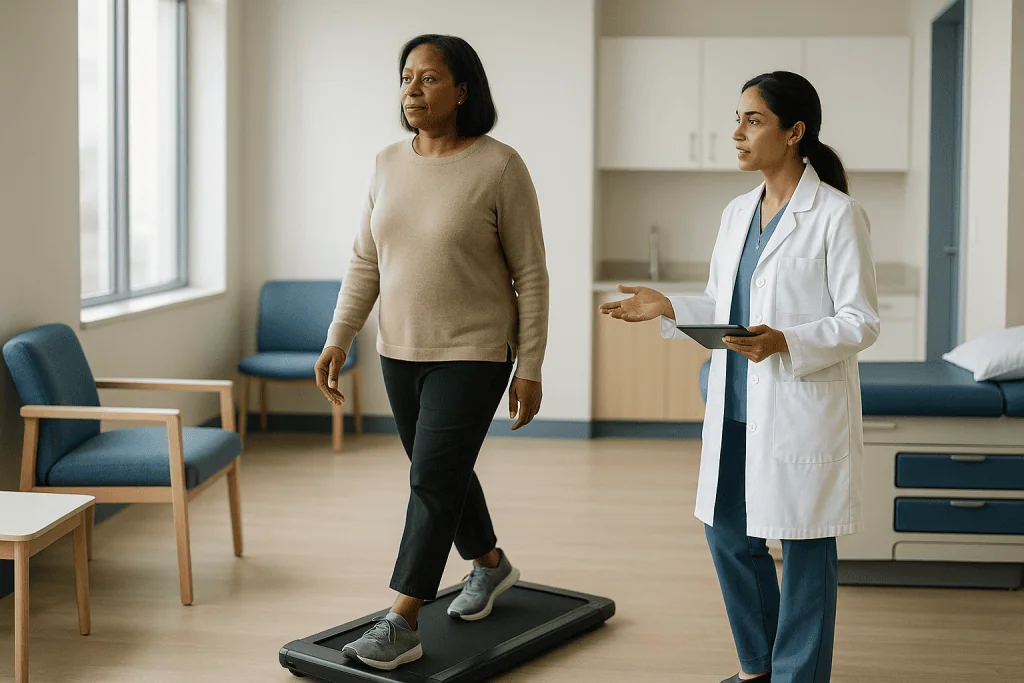
In February 2022, a systematic review and meta-analysis in Sports Medicine pooled seven randomized crossover trials that interrupted prolonged sitting with either standing or light-intensity walking. Walking breaks produced significantly lower post-meal glucose and insulin than uninterrupted sitting, while standing alone lowered glucose only modestly and did little for insulin. The trials were small and short, typically a single day in a laboratory, so this is strong evidence for an acute effect and weaker evidence for long-term outcomes.
The CDC’s current adult guidance, updated on its redesigned physical-activity pages, keeps the 150-minute moderate target but states plainly that any amount of activity is better than none and that light activity still counts toward reducing sitting time. The World Health Organization’s 2020 guidelines said the same, adding for the first time a formal recommendation to limit sedentary time.
On the incline side, the Cleveland Clinic published a physician-reviewed explainer on the “12-3-30” workout, the routine of walking at a 12 percent incline and 3 miles per hour for 30 minutes that went viral on social media. Its verdict, which this article echoes, was that the routine is a legitimate moderate-to-vigorous cardio session, not magic, and that the specific numbers are arbitrary starting points rather than evidence-based prescriptions.
None of these is a new drug or a new disease. Together, though, they moved slow walking from “nice to have” to a movement pattern with a documented metabolic signature, which is why the walking pad went from gadget to genuine health question.
What is a walking pad, and how is it different from a treadmill?
A walking pad is a flat, motorized belt without handrails, usually a few inches high, designed for walking rather than running. Most top out around 3.5 to 4 miles per hour, roughly the pace of a brisk walk, and many are built to slide under a desk.
A conventional treadmill has a taller deck, a console, handrails and a motor strong enough for running at 8 miles per hour or more. Crucially, most full treadmills include an adjustable incline, the feature that turns a walk into a hill climb. Many walking pads have no incline at all; some offer a fixed slight slope or a modest adjustable one. When people say “incline walking on a walking pad,” they often mean a hybrid machine closer to a small treadmill.
The distinction matters for expectations. A walking pad excels at one job: accumulating slow, steady steps during time you would otherwise sit. It is not the right tool for interval training, sprints or steep climbs. Think of it as a movement appliance, the way a kettle boils water without being a stove.
Two terms will recur. Light-intensity activity means movement that barely raises your breathing, like strolling at 2 miles per hour. Moderate-intensity activity makes you breathe noticeably harder but still able to talk, like walking at 3 to 3.5 miles per hour or climbing a gentle hill. Guidelines’ 150-minute target refers to moderate intensity; much desk-walking is light. That gap is where the honest analysis begins.
Is a walking pad as effective as walking outside?
For the physiology of a step, yes, with two caveats. A step on a moving belt at 2.5 miles per hour uses nearly the same muscles and burns nearly the same energy as a step on a sidewalk at that speed. Laboratory comparisons of treadmill and overground walking find small differences in stride length and joint angles, but the energy cost is similar once the belt speed matches your natural pace.

The first caveat is intensity. Outdoor walkers naturally speed up and slow down, take curbs, and lean into wind and slopes; a treadmill belt holds you at whatever speed you set, and desk-walkers set it low so they can type. A 90-minute stroll on a walking pad at 1.8 miles per hour is not the same workout as a 30-minute march around the neighborhood at 3.5. It is more total movement but less cardiovascular stimulus.
The second caveat is everything outdoors adds that a belt cannot: daylight, which helps regulate sleep and mood; uneven ground, which trains balance; and a change of scene, which multiple small studies link to lower rumination and better mood after walking in green spaces. Observational, not causal, but consistent.
So the fair answer to “is a walking pad as effective as walking” is that it is equally effective per step and less effective per minute if you walk slowly, while offering something the outdoors rarely can: 8,000 steps you would not otherwise have taken because they happened during a budget meeting. For most sedentary desk workers, that trade is a good one.
What the evidence actually says, graded by strength
Enthusiasm and evidence are not the same currency, so here is the ledger.
Strong evidence (many randomized trials, consistent): Regular walking at moderate intensity improves cardiorespiratory fitness, lowers blood pressure by a few points, improves insulin sensitivity, and reduces symptoms of depression. Accumulating 150 to 300 minutes a week is associated in large cohort studies with roughly 20 to 30 percent lower all-cause mortality compared with inactivity. This applies to walking pads insofar as they deliver moderate intensity.
Moderate evidence (smaller randomized trials, short duration): Breaking up sitting with 2 to 5 minutes of light walking every 20 to 30 minutes lowers post-meal glucose and insulin on the day it is done. The 2022 Sports Medicine meta-analysis is the anchor here. Whether repeated daily for years this translates into fewer diabetes diagnoses is plausible but not yet proven by long trials.
Observational evidence (associations, not proof): Higher daily step counts track with lower mortality and heart disease in a dose-response pattern up to roughly 8,000 to 10,000 steps, after which benefits flatten. Long uninterrupted sitting is linked to worse outcomes independent of exercise. Confounding is possible: healthier people may simply walk more.
Weak or expert opinion only: Claims that desk-walking improves productivity or creativity, that it “melts belly fat,” or that slow walking is useless. Small studies on cognition during treadmill work are mixed and mostly short-term.
The pattern is telling. The walking pad’s best-supported benefits are metabolic and cardiovascular; its most viral claims are the least supported.
Walking pads and blood sugar: what post-meal walking does
The most useful thing a walking pad may do happens in the two hours after lunch. When you eat carbohydrate, glucose enters the blood and insulin signals muscle to absorb it. Working muscle pulls in glucose through a second, insulin-independent pathway triggered by contraction itself. Even slow walking activates it, which is why light activity after eating blunts the post-meal spike.
Laboratory crossover trials, the design behind the 2022 meta-analysis, typically compare a day of continuous sitting against the same day with brief walking breaks. Walking breaks of a few minutes every half hour lowered post-meal glucose curves meaningfully and lowered insulin as well, indicating the body needed less insulin to handle the same meal. Standing helped glucose slightly but not insulin, suggesting the muscle contraction, not the upright posture, does the work.
Timing appears to matter. Trials that start walking within about an hour of eating show larger effects than those that wait, and the benefit is most visible in people with impaired glucose tolerance or type 2 diabetes, whose spikes are higher to begin with. In lean, insulin-sensitive people the difference is real but smaller.
What the evidence does not show is that desk-walking replaces glucose-lowering medicines or that any specific speed is optimal. It also does not show long-term changes in HbA1c, the three-month average blood sugar marker, from desk-walking alone, because trials that long have not been done. Anyone using insulin or other glucose-lowering medicines should know that added daily walking can shift blood sugar patterns and should discuss that with the prescribing clinician before changing anything.
How long does it take to walk 10,000 steps on a walking pad?
Longer than most people expect, because desk pace is slow. Step rate rises with speed: at a stroll of 1.5 miles per hour, most adults take about 85 to 95 steps a minute; at 2 miles per hour, roughly 100; at a brisk 3 miles per hour, 115 to 125. Stride length varies with height, so treat these as ranges.
| Belt speed | Approximate steps per minute | Time to 10,000 steps | Intensity category |
|---|---|---|---|
| 1.5 mph (typing pace) | 85–95 | About 1 h 50 min to 2 h | Light |
| 2.0 mph (reading, calls) | 95–105 | About 1 h 35 min to 1 h 45 min | Light |
| 2.5 mph | 105–115 | About 1 h 25 min to 1 h 35 min | Light to moderate |
| 3.0 mph (brisk, no typing) | 115–125 | About 1 h 20 min to 1 h 25 min | Moderate |
| 3.0 mph at 10–12 % incline | 115–125 | Same time, far higher effort | Moderate to vigorous |
The number 10,000 itself is a marketing artifact from a 1960s Japanese pedometer, as the Mayo Clinic notes, not a clinical threshold. Cohort studies show mortality benefits rising steeply from about 4,000 steps and continuing to roughly 8,000 to 10,000 before leveling off. For someone who currently manages 3,000, reaching 7,000 is the meaningful jump.
A practical way to read the table: two hours of typing pace across a workday quietly delivers a full day’s step goal, but it delivers it as light activity. To bank moderate minutes, you need either the speed of the bottom rows or an incline, and both make typing hard. Many desk-walkers split the difference: slow steps during focused work, a 20-minute brisk or inclined block at lunch.
Incline walking: what does a slope actually add?
Incline walking means walking on a surface tilted upward, expressed as a percentage grade: a 10 percent incline rises 10 feet for every 100 feet traveled. Tilt the belt and the physics change immediately. Each step must lift your body weight against gravity, so the same 3 miles per hour costs far more energy.
The exercise-science shorthand is METs, or metabolic equivalents, where 1 MET is your energy use at rest. Walking on the flat at 3 miles per hour is about 3.5 METs. Add a 5 percent grade and it climbs to roughly 5 to 6; at 10 to 12 percent it approaches 7 to 8, the territory of jogging, without the pounding. That is why the 12-3-30 routine leaves people breathless: it is vigorous exercise disguised as a walk.
Muscle recruitment shifts too. Electromyography studies show markedly higher activation of the calves, hamstrings and gluteal muscles on inclines compared with flat walking, and a more forward-leaning trunk that many people feel in their lower back the first week. Knee joint compression at a walking pace tends to be lower than running, which is one reason physical therapists often prefer hill walking to jogging for people rebuilding fitness.
The limits are practical. Most compact walking pads offer little or no incline, and no one types productively at a 12 percent grade. Incline walking is therefore better understood as the walking pad’s complement than its feature: a short, honest cardio session that turns the light steps of the workday into a week that actually meets the moderate-to-vigorous target. The Cleveland Clinic’s review reached the same conclusion, adding that the specific numbers are a starting point to adjust, not a prescription.
Can walking 30 minutes a day on a treadmill help you lose weight?
It can contribute, and it will disappoint anyone expecting it to do the job alone. The arithmetic is unglamorous. A 170-pound adult walking briskly at 3 miles per hour for 30 minutes uses roughly 130 to 160 calories above resting. At a desk pace of 2 miles per hour the figure drops toward 100. A single flavored coffee undoes either.
Randomized trials of walking programs without dietary change typically produce weight loss of about 1 to 3 percent of body weight over 6 to 12 months, a few pounds for most people. Trials that combine walking with modest calorie reduction show substantially more. This is the consistent finding across the exercise literature: movement is a powerful tool for keeping weight off and for improving fitness, blood pressure and glucose regardless of the scale, and a weak tool for large initial weight loss by itself.
The walking pad changes the equation in one way. Thirty minutes is easy to skip; three hours of slow steps folded into a workday is hard to skip because it requires no separate time. Total daily energy expenditure can rise more from four hours of light movement than from a 30-minute brisk session, and some desk-walkers report exactly that pattern. Whether it holds long-term is not established by trials.
Adding incline changes it further. Thirty minutes at a 10 percent grade roughly doubles the energy cost of the flat session and builds leg strength that flat walking does not. For weight goals, the evidence points toward pairing the pad’s all-day steps with a shorter, harder block and with attention to what is eaten, rather than expecting any belt speed alone to reshape a body.
Backs, hips and knees: does desk-walking help or hurt?
For most people with ordinary, non-specific low back pain, moving more helps. The NHS and virtually every modern guideline advise staying active rather than resting, and systematic reviews of walking programs for chronic low back pain show small to moderate reductions in pain and disability, comparable to other forms of exercise. The mechanism is partly mechanical, keeping the spine’s supporting muscles and discs nourished through movement, and partly neurological, reducing the fear of movement that sustains many chronic pain cycles.
Sitting itself is the problem the walking pad addresses. Prolonged sitting loads the lumbar discs more than standing and shortens the hip flexors, the muscles at the front of the hip that tilt the pelvis forward when tight. Breaking sitting every 30 minutes, even briefly, is the single most consistent recommendation from ergonomics research for back stiffness.
There are trade-offs. Walking slowly while looking down at a screen encourages a forward head and rounded shoulders, and several hours of it can produce neck and upper-back ache that sitting did not. Feet and calves complain in the first weeks, particularly on hard soles or barefoot. People with hip or knee osteoarthritis generally tolerate slow flat walking well, and the evidence favors it, but sudden large jumps in daily steps are a classic trigger for flare-ups and for plantar fasciitis, the inflammation of the thick band under the foot.
The sensible pattern the evidence supports is gradual: add perhaps 1,000 to 2,000 steps a day per week, wear supportive shoes, and raise the monitor so the eyes look straight ahead. Back pain that is new, worsening or accompanied by leg symptoms is a reason to stop and seek advice, covered below.
Can you really work while walking? Focus, typing and meetings
The honest answer from small laboratory studies is: some tasks yes, others less well. Typing speed drops by roughly 10 to 20 percent when walking at 1.5 miles per hour compared with sitting, and fine mouse work suffers more than typing. Reading comprehension and attention on simple tasks appear largely unaffected at slow speeds, and several studies found participants reported better mood and less afternoon fatigue.
Complex tasks tell a different story. Working memory, the ability to hold and manipulate several pieces of information at once, shows small declines while walking in some studies, particularly at faster speeds or in people new to the setup. Most of these trials involved a single session; the handful that followed office workers for weeks found the deficits shrank as walking became automatic, which fits everyday experience.
Productivity claims that go beyond this, the idea that walking makes people measurably more creative or more effective at work, rest on a few small experiments and a great deal of anecdote. They may be true for some individuals. They are not established.
A practical reading is to match the belt to the task. Calls, video meetings with the camera framed at the shoulders, reading, and email triage suit a slow pace. Detailed spreadsheets, design work and anything requiring precise clicking usually go better seated or standing still. This task-sorting, rather than walking all day regardless, is what long-term desk-walkers describe, and it is also what keeps the neck and shoulders from paying for the steps.
How to set up a walking pad desk safely
Most walking-pad injuries reported in emergency departments are falls and trips, not overuse. Set-up prevents most of them.
Start with height. The desk surface should sit roughly at elbow level when you stand upright on the belt, which is higher than a seated desk by the thickness of the pad plus several inches. Standing desks with a wide adjustment range handle this; a fixed desk often cannot. Position the monitor so the top third is at eye level; looking down for hours is the fastest route to neck pain.
Clear the floor. The belt will move you slightly backward over time, and a chair, cable or rug edge behind you is a hazard. Many walking pads have no handrails, so stepping off while the belt runs is the classic misstep. Stop the belt fully before dismounting, every time, especially when a call ends and attention drifts.
Shoes matter more than they seem. Barefoot or sock-footed walking for hours concentrates load on the forefoot and heel and is a common source of the plantar fasciitis desk-walkers describe. Supportive walking shoes worn only indoors are a small habit with a large payoff.
Build gradually. A person who has been sedentary can comfortably start with 20 to 30 minutes of slow walking spread across a day and add 15 to 20 minutes every few days. Sudden four-hour sessions are what produce the shin, calf and foot complaints that fill user forums.
Finally, keep it plugged into a habit, not a resolution: pairing the belt with a recurring meeting or a specific hour is what turns a novel gadget into a durable change, which is the only kind that shows up in health outcomes.
Common myths about walking pads, corrected
“Slow walking is junk exercise that does nothing.” Trials show light walking measurably lowers post-meal glucose and insulin compared with sitting, and cohort data link higher daily step counts to lower mortality even when most steps are slow. It does less for cardiovascular fitness than brisk walking; it is not nothing.
“Desk-walking melts belly fat.” No study supports spot reduction from any exercise, and walking-only trials produce modest overall weight change. Body-fat changes follow total energy balance over months, not belt hours.
“You must hit 10,000 steps or it doesn’t count.” The figure came from a pedometer campaign, not a trial. Health benefits begin rising from around 4,000 steps and continue through roughly 8,000 to 10,000; the largest gains go to people moving from very low counts to moderate ones.
“Incline walking is bad for knees.” Uphill walking at a walking pace generally loads the knee less than running and strengthens the muscles that protect it. Downhill walking is harder on knees, and most walking pads do not decline. People with knee arthritis usually do well with gradual incline, but individual advice matters.
“A walking pad replaces the gym.” It replaces sitting. Guidelines still recommend two sessions a week of muscle-strengthening activity, which no treadmill provides, plus moderate-to-vigorous aerobic minutes that slow desk pace rarely reaches.
“Walking pads are dangerous.” Fall risk is real when stepping off a moving belt or when the setup is cluttered, and people with balance problems should be cautious. With the belt stopped before dismounting, a clear floor and proper shoes, reported injuries are uncommon relative to hours of use.
Who should take extra care before desk-walking?
Walking is among the safest forms of exercise, and most adults can start without a medical visit. A few groups benefit from a conversation first.
People with heart disease or symptoms of it. Anyone with known coronary disease, heart failure, an arrhythmia, or recent chest pain or breathlessness on exertion should have their clinician’s guidance on intensity. Slow walking is often exactly what is recommended; incline sessions push toward vigorous effort and warrant a check.
People using insulin or other glucose-lowering medicines. Regular added walking can lower blood sugar more than expected, sometimes hours later. This is generally a welcome effect, but it can bring blood sugar too low. The prescribing clinician should know about the new routine, and any adjustment to medicines belongs to them, never to a trial-and-error approach at home.
People with balance or vision problems, peripheral neuropathy, or a history of falls. A handrail-free moving belt is a poor match for unsteady footing. Some will do better with a full treadmill with rails, or with walking breaks on solid ground.
Pregnancy. Walking is encouraged throughout most pregnancies, and guidelines recommend 150 moderate minutes a week for those without complications. Balance shifts in later trimesters, so a rail or a slower speed is sensible, and any bleeding, contractions or dizziness means stopping and calling the maternity team.
Recovery from surgery or injury. Timing and load should follow the surgeon’s or physical therapist’s plan rather than a step goal.
None of these is a reason to avoid movement. Each is a reason to make sure the movement fits the body doing it.
When to see a doctor
Walking pads rarely cause harm, but the body sometimes uses new exercise to reveal something that was already there. Stop walking and seek urgent medical care, calling emergency services if severe, for any of the following:
- Chest pain, pressure or tightness, or pain spreading to the arm, jaw or back, during or after walking.
- Sudden severe breathlessness out of proportion to effort, or breathlessness that does not settle with rest.
- Fainting, near-fainting, or a racing or irregular heartbeat that does not calm within minutes.
- Sudden weakness, numbness, facial drooping, confusion or trouble speaking, which are stroke warning signs.
- Symptoms of low blood sugar that do not resolve with the plan your clinician gave you, such as shaking, sweating, confusion or drowsiness.
Book a non-urgent appointment for problems that persist beyond two weeks or interfere with daily life:
- Back pain that is worsening, wakes you at night, radiates down a leg, or comes with numbness, weakness or any change in bladder or bowel control; the last cluster needs same-day assessment.
- Knee, hip or foot pain that swells, locks or does not ease after several days of rest.
- Heel or arch pain that is worst with the first steps in the morning, the typical pattern of plantar fasciitis.
- Unusual fatigue, dizziness or exercise tolerance that is falling rather than rising over weeks.
- Any planned change to diabetes, blood pressure or heart medicines prompted by your new activity; these decisions belong with the prescribing clinician.
A walking pad is a tool for moving more. If moving more is producing new symptoms rather than easing old ones, that pattern itself is the information a clinician needs, and it is worth bringing to them early rather than pushing through.
Frequently asked questions
Is a walking pad as effective as walking outdoors?
Per step, yes; per minute, usually less, because desk-walkers set slow speeds. The muscles used and energy burned at a given pace match sidewalk walking closely. Outdoors adds daylight, uneven ground for balance and mood benefits that a belt cannot replicate, while a walking pad adds thousands of steps during time you would otherwise sit. Most sedentary workers benefit from both rather than choosing.
Are walking pads any good for health, or just a gimmick?
They are good at one specific thing: replacing hours of sitting with light movement. Trials show that pattern lowers post-meal blood sugar and insulin, and observational studies link higher daily step counts to lower mortality. They are not a substitute for brisk aerobic exercise or strength training, which guidelines still recommend. Judged against what they actually do, rather than viral claims, they hold up.
How long does it take to walk 10,000 steps on a walking pad?
Between about 80 minutes and two hours, depending on speed. At 1.5 miles per hour most adults take around 90 steps a minute, so 10,000 steps needs close to two hours. At 2 miles per hour it is roughly an hour and forty minutes, and at a brisk 3 miles per hour about an hour and twenty. Taller people with longer strides take fewer steps per mile and need slightly longer.
Can walking 30 minutes a day on a treadmill help you lose weight?
It can help modestly. Thirty brisk minutes burns roughly 130 to 160 calories for a 170-pound adult, and walking-only trials show small weight losses of a few pounds over months. Combining walking with modest dietary changes produces far more. Adding incline roughly doubles the energy cost of the session. Walking’s stronger, better-proven effects are on fitness, blood pressure and blood sugar rather than the scale.
What does incline walking do that flat walking does not?
Incline walking makes each step lift your body weight against gravity, so energy use rises sharply at the same speed: from about 3.5 METs on the flat to 7 or 8 at a 10 to 12 percent grade. It activates the calves, hamstrings and glutes far more and reaches vigorous intensity without running’s impact. Most compact walking pads offer little incline, so it usually means a short separate session.
Does walking on a walking pad lower blood sugar?
Acutely, yes. Randomized crossover trials show that light walking breaks after meals lower the glucose and insulin rise compared with continuous sitting, with the largest effect in people with impaired glucose tolerance or type 2 diabetes. Long-term effects on HbA1c from desk-walking alone have not been tested in long trials. Anyone on glucose-lowering medicines should discuss a new routine with their prescriber.
Is a walking pad good for lower back pain?
For ordinary, non-specific low back pain, breaking up sitting with walking generally helps, and reviews of walking programs show small to moderate reductions in pain and disability. Looking down at a screen for hours can create new neck and upper-back ache, so monitor height matters. Back pain that radiates down a leg, worsens steadily, or comes with numbness, weakness or bladder changes needs medical assessment, not more steps.
How fast should I walk on a walking pad while working?
Match speed to task. Most people type comfortably at 1.5 to 2 miles per hour, handle calls and reading up to about 2.5, and find detailed mouse work difficult at any speed. Those paces are light intensity. To bank the moderate minutes guidelines count, you need roughly 3 miles per hour or an incline, which most people do as a separate short block rather than while working.
Is desk-walking safe for older adults or people with balance problems?
Slow walking is safe and beneficial for most older adults, but a moving belt without handrails is a poor fit for anyone with unsteady balance, neuropathy in the feet, poor vision or a history of falls. A full treadmill with rails or frequent walking breaks on solid ground achieves the same sitting-reduction more safely. Stopping the belt completely before stepping off prevents the most common accidents.
Does a walking pad count toward the 150 minutes of weekly exercise?
Only the minutes at moderate intensity, meaning breathing noticeably harder but still able to talk, which typically starts around 3 miles per hour or on an incline. Slower desk-walking is light activity; it still reduces sitting time, which guidelines from the CDC and WHO explicitly encourage, and it still improves post-meal blood sugar. Think of light steps and moderate minutes as two separate, complementary goals.
References
This article is for general information only and is not a substitute for professional medical advice. Please consult a qualified doctor about your individual situation.

More from the Blog

Romanian Deadlift Form: The Hip Hinge That Protects Your Back When Done Right
A Romanian deadlift is a hip-hinge exercise: you hold a barbell or dumbbells, keep knees slightly bent and back neutral, and push your hips…

Zone 2 Cardio: The Easy-Pace Training Everyone Suddenly Swears By
Zone 2 cardio is steady, easy-pace aerobic exercise done at roughly 60 to 70 percent of your maximum heart rate: a pace where you…

Chair Exercises for Seniors: A Full Workout Without Standing Up
Chair exercises for seniors are seated movements, marches, leg extensions, sit-to-stands, arm raises, and gentle twists, that build strength, flexibility, and stamina without requiring…
Rowing Machine Benefits: Why Rowing Is the Full-Body Cardio Doctors Like
A rowing machine delivers low-impact, full-body cardio that works the legs, hips, back and arms in one movement while raising heart rate into the…
The Couch Stretch: A Two-Minute Fix for Chronic Sitters
The couch stretch is a kneeling hip flexor stretch performed with the back shin propped against a couch or wall, targeting muscles that stay…
Exercises for Lower Back Pain: The Evidence-Backed Starter Set
For most nonspecific lower back pain, gentle, regular movement helps more than rest. Evidence supports a starter set of core-stabilizing moves: the modified curl-up,…