

What a Chemotherapy Cycle Looks Like: Treatment Days, Low-Count Days and Recovery
Key Takeaways
- A chemotherapy cycle pairs a treatment period with a rest period, commonly repeating every one to four weeks so bone marrow can recover before the next dose.
- Blood counts typically reach their lowest point, the nadir, around 7 to 14 days after treatment, and that is when infection risk is highest even if you feel well.
- A temperature of 100.4°F (38°C) or higher during chemotherapy is treated as an emergency because fever may be the only sign of infection when white cells are low.
- Acute nausea begins within about 24 hours of treatment while delayed nausea starts a day or more later, which is why anti-sickness medicines are often taken on a schedule.
- Hair loss, when a regimen causes it, usually begins two to four weeks after starting treatment and regrowth typically begins within three to six months of finishing.
- A delayed cycle because counts have not recovered is the safety system working as designed, not evidence that treatment is failing.
A chemotherapy cycle is one treatment session (or a short run of sessions) followed by a planned rest period, commonly repeating every one to four weeks. Blood counts usually fall to their lowest point around days 7 to 14, the period with the highest infection risk, then recover before the next round. Timing, number of cycles and any adjustments are decided by the treating oncology team.
On the first morning, most people notice the chair before anything else. It reclines. There is a blanket, a drip stand, a nurse who asks your date of birth for the third time, and a small plastic bracelet that suddenly makes everything real. Then the hours pass more quietly than expected, and you go home wondering why the calendar your team handed you looks less like a treatment plan and more like a tide table.
That calendar is the thing few people are prepared for. Having a chemotherapy cycle explained properly, with its treatment days, its “low-count” days and its recovery stretch, changes how the whole experience feels. The medicine is only part of the story. The rhythm is the rest.
This article walks through that rhythm the way an oncology nurse would if she had an uninterrupted hour: what each phase does in the body, why the gaps are deliberate, which days deserve extra caution, and which worries the evidence can quietly put to rest.
Chemotherapy cycle explained: why treatment comes in rounds, not one long course
Chemotherapy is a group of medicines that damage cells while they are dividing. Cancer cells divide more often than most healthy cells, so they take the larger hit, but fast-growing normal cells in the bone marrow, the gut lining and the hair follicles are caught in the same net. A cycle is the unit that balances those two facts: a dose period, then a rest period long enough for healthy tissue to recover before the next dose arrives.
The National Cancer Institute describes a cycle as treatment followed by a break, with cycles often repeated every one to four weeks depending on the regimen. The rest is not a pause in care. It is the part of the plan that lets bone marrow rebuild the white cells, red cells and platelets that the medicine knocked down, so the next round can be given safely.
Why not simply wait until every cell has recovered? Because cancer cells recover too. Oncologists aim for a gap that is long enough for marrow to bounce back but short enough that the tumor does not regain lost ground. That window is what the schedule encodes, and it explains why the dates on your calendar are rarely moved casually.
Here is the part worth holding onto: a cycle has a shape, and the shape repeats. Treatment days, then a few days of acute effects, then a dip in blood counts, then a climb back toward baseline. Once you know where you are on that curve, a bad Tuesday in week two stops feeling like a sign that something is wrong and starts feeling like a predictable low tide. The sections that follow trace that curve day by day.
What actually happens on a chemotherapy treatment day
Treatment days begin with blood, not medicine. A sample is drawn and checked before anything is prescribed for that session. The lab is looking at neutrophils (the white cells that fight bacterial infection), hemoglobin (the oxygen-carrying protein in red cells) and platelets (the fragments that help blood clot), along with kidney and liver markers. If the counts have not recovered enough, the session may be delayed by a few days or a week. The NHS notes that these checks happen before every cycle precisely so that treatment is only given when the body is ready.
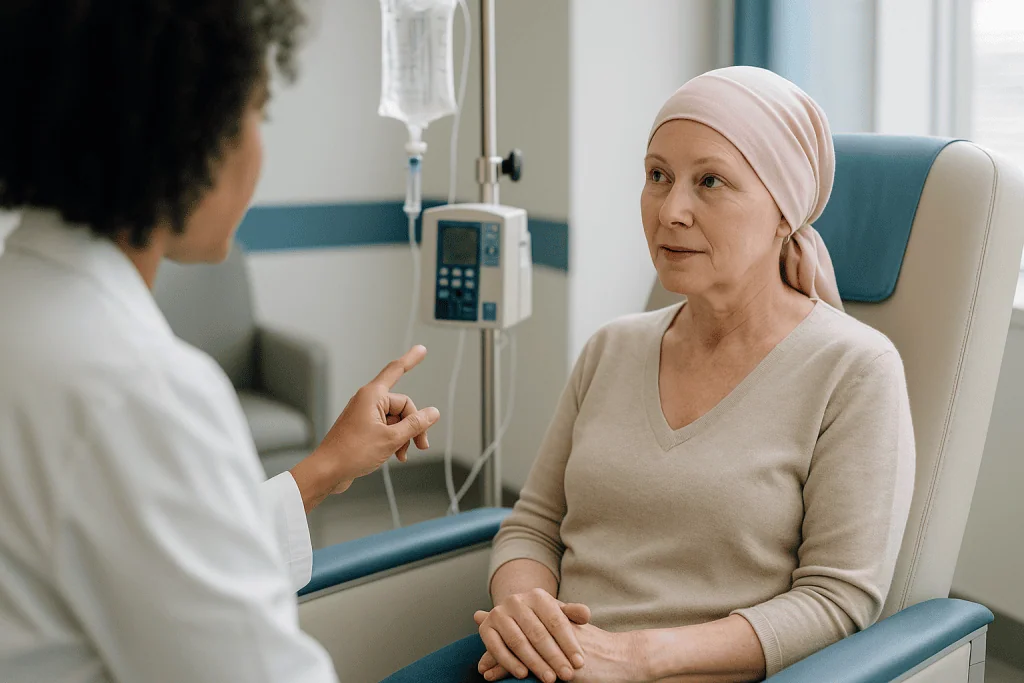
Once the results are cleared, a pharmacist prepares the medicines for that day. Many regimens are given through a vein: a cannula in the hand or arm, or a longer-term line such as a PICC line (a thin tube threaded from the upper arm toward the heart) or a port (a small reservoir placed under the skin of the chest). Others are tablets taken at home, and some combine both.
Pre-medicines usually come first. These are anti-sickness medicines, and sometimes steroids or antihistamines, given to lower the chance of nausea or an infusion reaction. Then the chemotherapy itself runs in, anywhere from under an hour to most of a day, with the nurse checking your blood pressure, temperature and the drip site at intervals.
What surprises many people is how ordinary the hours feel. Patients read, doze, eat lunch, take calls. Mayo Clinic advises bringing a companion if possible, partly for company and partly because some pre-medicines cause drowsiness that makes driving unwise. By the time you leave, the day’s work is done, but the cycle has only just started.
Days 1 to 3: the acute phase, and how anti-sickness medicines fit in
The first 72 hours after an infusion are when the body registers what has arrived. Fatigue, a metallic or altered taste, and nausea are the most common early effects, and their timing is more predictable than people expect. Mayo Clinic distinguishes acute nausea, which begins within the first 24 hours, from delayed nausea, which starts a day or more after treatment and can persist for several days. Different medicines target each phase, which is why your team may give you more than one anti-sickness prescription and ask you to take some on a schedule rather than waiting to feel unwell.
Anti-sickness medicines work by blocking the chemical signals that chemotherapy triggers in the gut and the brain’s vomiting center. Some block serotonin receptors; others block a messenger called substance P; steroids add a separate, less fully understood effect. The combination chosen depends on how likely a given regimen is to cause nausea, a property oncologists grade as low, moderate or high. Any change to what you take, or when, belongs with the prescribing clinician.
Fatigue in this window is often described as heavy rather than sleepy. It tends to be worst in the first few days of each cycle and then eases, though it may build gradually across the whole course. The NHS lists it as the most common side effect of chemotherapy overall.
Practical rhythm matters more than willpower here. Small, bland meals eaten before hunger turns to queasiness, fluids sipped steadily through the day, and planned rest rather than pushed-through afternoons all help. These days are uncomfortable but, for most regimens, not the dangerous ones. The risk shifts in the week that follows.
Days 7 to 14: the chemo nadir period and the low-count days
Nadir is the word oncology teams use for the point when blood counts reach their lowest. Chemotherapy does not kill mature white cells in the bloodstream directly; it damages the dividing precursor cells in the bone marrow. Mature neutrophils live only a few days, so once the marrow stops replacing them, the count slides. The National Cancer Institute places the typical nadir between roughly 7 and 14 days after treatment, though the exact timing depends on the regimen.
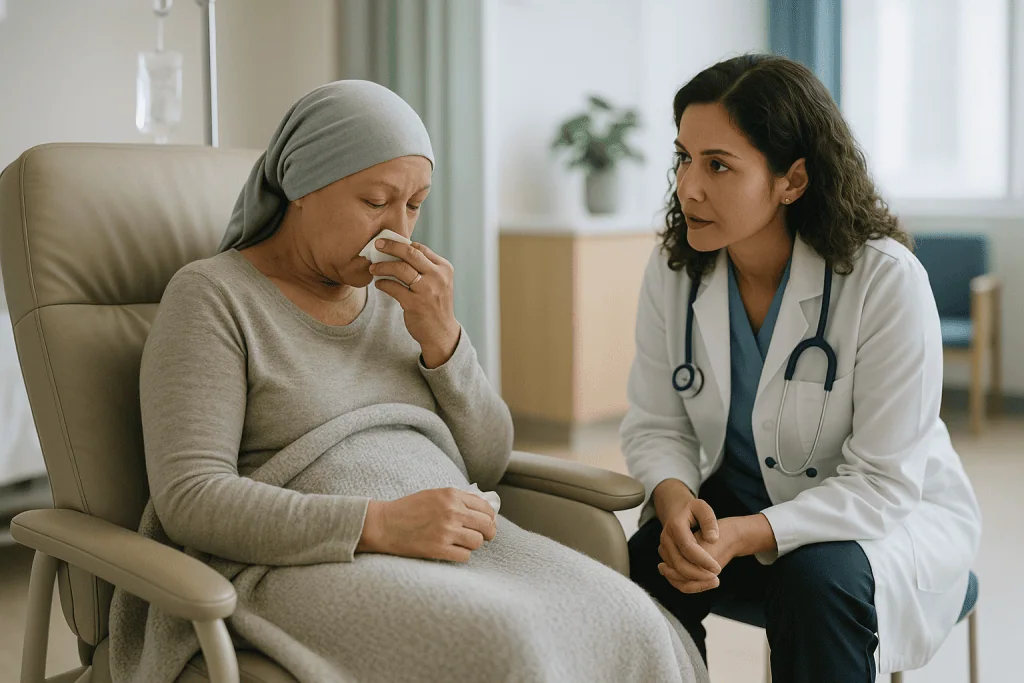
This is the stretch your team means when they talk about “low-count days.” Neutropenia, a low neutrophil count, is the main concern, because neutrophils are the first line of defense against bacteria. With too few of them, an infection that would ordinarily cause a sore throat can escalate quickly, and the usual warning signs can be muted. A fever may be the only clue.
The CDC and Mayo Clinic both define a fever during chemotherapy as a temperature of 100.4°F (38°C) or higher, and both treat it as an emergency rather than a wait-and-see situation. Febrile neutropenia, fever with a low neutrophil count, is assessed urgently and often treated with antibiotics before culture results return.
Platelets fall on a similar timeline, so easy bruising, nosebleeds or bleeding gums can appear. Hemoglobin drops more slowly, because red cells live about four months, so anemia tends to accumulate across cycles rather than within one.
Sensible habits for these days are not elaborate: wash hands often, cook food thoroughly, avoid people with obvious infections, keep a working thermometer within reach, and know exactly which number to call at 3 a.m. Some regimens include a growth-factor injection that prompts the marrow to release neutrophils sooner; whether it is used is a decision for the oncology team based on the regimen’s known risk.
Days 14 to 28: recovery, and how your team decides you are ready for the next round
Recovery is quieter than the nadir but just as important. Once the marrow’s precursor cells repopulate, neutrophil counts climb, often over the course of a week or two, and energy, appetite and taste begin to return. Many people describe a short window near the end of each cycle when they feel almost like themselves. That window is real, and it is worth planning around.
The decision to proceed with the next cycle rests on three things. The first is the blood count on the morning of treatment, which must clear the thresholds set for that regimen. The second is how the previous cycle went: whether side effects stayed within an acceptable range, whether any required hospital care, and whether organs such as the kidneys and liver are coping. The third is you, as reported in the pre-treatment review, which is why honest answers about mouth sores, bowel changes or numbness in the fingertips matter more than stoicism.
If counts have not recovered, the NHS explains that treatment may be delayed, usually by a few days to a week, until they do. A delay is not a failure. It is the safety mechanism working as designed. Where delays become repeated, or side effects are severe, the team may adjust the regimen; that is a clinical judgment made with you, not a sign that treatment has stopped working.
Hair, for regimens that affect it, follows its own longer arc. Mayo Clinic notes that hair loss typically begins two to four weeks after starting treatment and that regrowth usually starts within three to six months of finishing. So while blood counts reset every cycle, some changes accumulate and resolve only after the whole course ends.
How many chemo cycles are typical, and how long does a full course take?
There is no universal number. The count depends on the type of cancer, the goal of treatment and the specific combination of medicines, and the schedule is set by the treating team using established protocols. Within those constraints, some patterns are common enough to describe.
Cycle length is usually two, three or four weeks, with some regimens given weekly and a few on longer intervals; the National Cancer Institute and Mayo Clinic both describe this range. A full course is typically made up of several cycles, and the NHS states that a course usually lasts a few months, sometimes longer, depending on what is being treated.
The goal shapes the length. When chemotherapy is given before surgery to shrink a tumor (neoadjuvant treatment), or after surgery to reduce the risk of recurrence (adjuvant treatment), the course tends to have a defined endpoint. When it is used to control a cancer that cannot be removed, treatment may continue for as long as it is helping and tolerable, with scans and blood tests guiding the decision.
Two questions people often ask deserve direct answers. Does a longer course mean a worse outlook? Not necessarily; it usually reflects the protocol for that cancer type rather than how an individual is doing. Can a course be shortened if side effects are hard? Sometimes, but that is a trade-off to weigh with the oncologist, not a decision to make alone.
It helps to think of the number of cycles as a working plan rather than a contract. Scans partway through, blood results, and your own tolerance all feed back into it. Asking your team “what would change this plan?” early on tends to make later adjustments feel less alarming.
Which phase of chemo is the hardest?
Ask ten patients and you will get three answers, and all of them are correct for the person giving them. The evidence does not crown a single hardest phase, but it does explain why each one earns its reputation.
The first cycle is hardest for many because it is unknown. Every sensation is new, and there is no personal baseline to compare it with. By the second cycle, most people can predict the shape of their own curve, and that predictability is itself a relief.
The low-count days of each cycle carry the highest medical risk, which is a different thing from feeling worst. Fatigue and infection vulnerability peak together, and the need to watch a thermometer adds a background hum of worry.
Later cycles are often hardest in terms of cumulative wear. Fatigue builds across a course, anemia accumulates because red cells are replaced slowly, and some side effects, such as nerve tingling from certain medicines, can worsen with each dose. Mayo Clinic notes that fatigue is often described as getting worse over the course of treatment rather than resetting fully each time.
Then there is the phase nobody warns you about: the weeks after the final cycle. The structure of appointments vanishes, the body is still repairing, and the mind finally has room to process what happened. Oncology nurses often hear that this is the hardest stretch emotionally.
What this means practically is that support should be spread across the whole course, not front-loaded. A friend who drives you to cycle one is wonderful. A friend who texts in week two of cycle five may matter more.
Who is usually offered chemotherapy, and who is usually asked to wait
Chemotherapy is recommended when a multidisciplinary team judges that the expected benefit outweighs the expected harm for a specific person with a specific cancer. That judgment draws on the cancer type and stage, the goal of treatment, and the person’s overall fitness, which oncologists often summarize with a performance status score describing how well someone manages daily activity.
Candidates commonly include people whose cancer is known to respond to chemotherapy, people having treatment before or after surgery to improve the chance of long-term control, and people whose cancer cannot be removed but can be slowed or managed. Chemotherapy may be combined with radiotherapy, targeted medicines or immunotherapy, each with its own cycle logic.
Some people are asked to wait, or offered a different route, for equally evidence-based reasons. An active infection generally needs treating first, because chemotherapy would lower the body’s ability to fight it. Blood counts, kidney or liver function below the thresholds for a given regimen can mean a delay until they recover. Recent surgery sometimes requires healing time before treatment begins. Pregnancy changes the calculus entirely and calls for specialist discussion. Heart or lung conditions can rule out particular medicines while leaving others available.
Age alone is not a reason to withhold treatment; fitness and frailty are what guide the decision. Equally, some cancers are better treated with hormone therapy, targeted drugs or surveillance, and “no chemotherapy” can be a positive recommendation rather than a withheld one.
If you have been asked to wait, ask what specifically needs to change and how it will be rechecked. The Mayo Clinic and NHS both describe this pre-treatment assessment as a standard part of planning, not an obstacle.
How to prepare for chemotherapy: what actually helps the body
Preparation is less about a strict regime and more about removing avoidable problems before the first cycle starts. The evidence-backed steps are modest, and most are things your team will raise anyway.
Dental care is near the top. Chemotherapy can cause mouth sores, and a dental infection during low-count days is harder to treat, so a check-up before starting is commonly advised. Vaccinations are another: the CDC recommends that people about to begin chemotherapy discuss timing with their oncologist, because inactivated vaccines such as the flu shot are generally given before treatment when possible, while live vaccines are typically avoided during treatment.
Nutrition is about reserve, not restriction. Eating a varied diet with adequate protein before treatment helps the body tolerate the weeks when appetite dips. There is no evidence that any special diet or supplement improves chemotherapy results, and some supplements can interfere with medicines, so the NIH Office of Dietary Supplements advises telling your team about everything you take, including herbal products.
Movement helps too. Gentle regular activity before and during treatment is associated with less fatigue in several reviews summarized by Mayo Clinic, and it is safe for most people when adjusted to how they feel on a given day.
Practical preparation is often undervalued. Arrange transport for treatment days. Stock the kitchen with bland, easy foods. Buy a thermometer. Write down who to call out of hours. Tell your employer what the calendar may look like.
A short list of what not to do is just as useful. Do not start any new supplement or alternative treatment without checking. Do not stop any existing prescription on your own. And do not try to fix everything about your health in one fortnight; the goal is to arrive rested, informed and ready, not perfect.
The chemotherapy cycle explained week by week: a summary table
Timelines vary by regimen, and the ranges below describe common patterns drawn from National Cancer Institute, Mayo Clinic and NHS descriptions, not a schedule for any individual. Your team’s calendar overrides this table every time.
| Phase | Typical timing | What is happening in the body | What usually matters most |
|---|---|---|---|
| Treatment day(s) | Day 1, sometimes days 1 to 3 or 1 and 8 | Medicines reach dividing cells; pre-medicines limit nausea and reactions | Blood test clearance, hydration, a companion for the journey home |
| Acute phase | Roughly days 1 to 3 | Nausea signals from gut and brain; early fatigue; taste changes | Taking anti-sickness medicines as prescribed, small frequent meals |
| Low-count days (nadir) | Roughly days 7 to 14 | Marrow output falls; neutrophils and platelets at their lowest | Fever of 100.4°F (38°C) or higher is an emergency; infection precautions |
| Recovery | Roughly days 14 to 28 | Marrow repopulates; counts and energy climb | Pre-treatment review, honest reporting of lingering effects |
| Across the course | Several months for many regimens | Cumulative fatigue, slow-building anemia, possible nerve effects; hair changes from 2 to 4 weeks in | Pacing, periodic scans, open conversation about adjustments |
Two patterns stand out. First, the dangerous phase and the miserable phase are not the same phase, which is why the fever rule exists even on days you feel fine. Second, the cycle resets most things but not everything; fatigue, anemia and nerve symptoms can accumulate, and recognizing that early helps you and your team pace the course rather than being surprised by it in cycle five.
What are the worst side effects of taxanes such as paclitaxel?
Paclitaxel is one of a class of medicines called taxanes, which work by locking up the internal scaffolding (microtubules) a cell needs to divide. It is mentioned here only because so many people search for its side effects by its brand name, not as a recommendation for or against it. Whether it belongs in a regimen is entirely a decision for the oncologist.
The effect patients most often describe as the worst is peripheral neuropathy: numbness, tingling, burning or clumsiness in the fingers and toes caused by damage to nerve endings. It tends to build with each cycle and, according to Mayo Clinic, can persist for months after treatment ends and in some cases does not fully resolve. Reporting it early matters, because dose adjustments made in time can limit how far it progresses.
Hair loss with taxanes is typically extensive and includes eyebrows and eyelashes in many people, with the same two-to-four-week onset Mayo Clinic describes for chemotherapy generally. Muscle and joint aches commonly appear two to three days after each infusion and ease within a few days. Low white cell counts follow the usual nadir pattern.
Infusion reactions, with flushing, breathlessness or back pain during the drip, are the reason pre-medicines are routine with this class; they are most likely during the first one or two infusions and the nurse watches closely. Nail changes, mouth soreness and mild diarrhea round out the common list.
Honesty matters here. Not everyone gets every effect, and severity varies widely. The point of knowing the list is not to brace for all of it but to recognize what you are feeling and name it to your team quickly.
Long-term digestive problems after chemotherapy: what the evidence shows
The gut lining renews itself every few days, which makes it one of the fastest-dividing tissues in the body and a predictable target during treatment. Most digestive effects, including nausea, diarrhea, constipation, mouth sores and altered taste, follow the cycle and settle as the lining regrows. The question people ask Google is about what lingers, and the honest answer is: usually little, sometimes a few specific things.
Taste and smell changes can take weeks to months after the final cycle to normalize, and a minority of people report lasting shifts. Constipation often reflects anti-sickness medicines and reduced activity more than chemotherapy itself, and it tends to resolve once those change.
Where longer-term problems do occur, they are more often linked to the combination of treatments than to chemotherapy alone. Radiotherapy to the abdomen or pelvis, or surgery that removes part of the bowel, can cause persistent changes in bowel habit; the NHS describes these in its guidance on late effects. Some people develop intolerance to lactose after gut lining damage, which can be temporary. Certain medicines are associated with lasting nerve effects that can slow gut movement.
Steroids given as pre-medicines can raise blood sugar during treatment, which is why people with diabetes are monitored more closely; this generally reverts after steroids stop.
What should prompt a conversation rather than patience? Diarrhea or constipation that persists for weeks after treatment ends, unintended weight loss, blood in stool, difficulty swallowing or pain with eating all warrant review, both to rule out other causes and because many of these have effective management options. Dietitians attached to oncology services exist for exactly this, and the referral is usually one question away.
What people often get wrong about chemotherapy cycles
Myths about chemotherapy are remarkably durable, partly because the treatment is frightening and partly because the few things everyone knows (hair, vomiting) are not actually the most important things. Here are the corrections that oncology nurses make most often.
“Feeling fine means it isn’t working.” Side effects reflect which healthy tissues are affected, not how well the cancer is responding. Scans and blood markers measure response; nausea does not.
“A delay means the cancer is winning.” Delays happen because counts have not recovered, which is the safety system functioning. Short delays are common and planned for.
“Everyone loses their hair.” Some regimens cause extensive hair loss; others cause thinning or none at all. The NHS lists it as a possible effect, not a universal one.
“Nausea is unavoidable.” Modern anti-sickness medicines, matched to a regimen’s known risk, prevent or substantially reduce nausea for most people. Vomiting that breaks through is a reason to call, not endure.
“You should fast or follow a special diet to make it work better.” No diet has been shown to improve chemotherapy outcomes, and losing weight during treatment is associated with worse tolerance. Eating what you can, when you can, is the evidence-based advice.
“Supplements are harmless because they’re natural.” Some interact with chemotherapy or affect the liver’s handling of medicines. The NIH Office of Dietary Supplements advises disclosing all of them to your team.
“The worst days are the treatment days.” For most regimens the riskiest days arrive a week or more later, when counts are lowest and you may feel deceptively well.
“Once the last cycle is done, you’re done.” Recovery continues for weeks to months, and the emotional weight often lands after the appointments stop.
Questions to ask your care team before and during treatment
Oncology consultations are short and information-dense, and the questions you wish you had asked tend to surface in the car park. Writing a list beforehand is not fussy; it is how experienced patients get the most from fifteen minutes. MedlinePlus publishes a similar checklist for people starting chemotherapy, and the questions below extend it to the cycle itself.
- How long is each cycle, how many are planned, and what would change that plan?
- Which days of my cycle are my low-count days, and what exactly should I do if my temperature reaches 100.4°F (38°C)?
- What is the single phone number for problems out of hours, and what happens when I ring it?
- Which side effects are expected with my regimen, which should I report straight away, and which can wait for the next review?
- Will I need a line or a port, and how do I care for it between visits?
- How should I take my anti-sickness medicines: on a schedule or only when I feel sick?
- Can I keep working, driving, exercising, and seeing grandchildren or friends? Are there days I should avoid crowds?
- Are there supplements, over-the-counter medicines or foods I should avoid during this regimen?
- How will you know whether treatment is working, and when is the first scan or marker check?
- Who can I speak to about fatigue, mood, finances, work or fertility, and how do I get referred?
- What does recovery after the final cycle usually look like for this regimen, and when should I expect to feel more like myself?
Bring someone to write down the answers if you can. Ask the nurse as well as the doctor; they often know the day-to-day texture of a regimen best. And ask again in later cycles, because the useful questions change as your own pattern becomes clear.
When to call your doctor: red-flag signs during a chemotherapy cycle
Every oncology service gives patients an emergency number, and the single most important thing to understand about it is that it exists to be used. During chemotherapy the threshold for calling is deliberately low, because the usual signs of serious illness can be blunted when white cell counts are down.
Call immediately, day or night, for any of the following, which Mayo Clinic, the CDC and the NHS all flag as urgent during treatment:
- A temperature of 100.4°F (38°C) or higher, even if you feel otherwise well, or a temperature below your normal range with shivering or shaking.
- Feeling suddenly very unwell, confused, drowsy, faint or unusually breathless, with or without a fever.
- Chest pain, a racing heartbeat, or new swelling and pain in a calf or arm, which can signal a clot.
- Bleeding that will not stop, blood in urine or stool, or a rash of small purple or red spots.
- Vomiting that prevents you from keeping fluids or medicines down for more than a few hours, or diarrhea that is severe or persistent.
- Redness, swelling, pain or leaking at a line, port or cannula site.
- Severe mouth or throat pain that stops you eating or drinking, or signs of a reaction such as hives, facial swelling or wheeze.
Report at the next working-hours contact, rather than the emergency line, for new or worsening tingling or numbness in hands or feet, constipation lasting more than a few days, mood changes that are affecting daily life, and any side effect that is manageable but getting worse.
If you are unsure which category a symptom falls into, ring the emergency number. Oncology teams would far rather reassure a hundred people than miss one infection. The decision about what happens next, whether that is advice over the phone, an urgent assessment or an adjustment to your plan, always sits with the treating team.
Frequently asked questions
Which phase of chemo is the hardest?
There is no single hardest phase; the first cycle is hardest for its unfamiliarity, the low-count days carry the highest infection risk, and later cycles bring cumulative fatigue and, with some medicines, worsening nerve symptoms. Many people also find the weeks after the final cycle emotionally hard once the structure of appointments ends. Spreading support across the whole course, rather than only at the start, tends to help most.
What is the chemo nadir period and why does it matter?
The nadir is the point when blood counts, especially neutrophils and platelets, reach their lowest after a treatment, typically around 7 to 14 days later depending on the regimen. It matters because low neutrophils blunt the body’s defense against bacteria, so infections can escalate quickly and quietly. A fever of 100.4°F (38°C) or higher in this window is treated as an emergency and should prompt an immediate call to your oncology team.
How many chemo cycles will I need?
The number depends on the cancer type, the goal of treatment and the specific regimen, and it is set by your oncology team using established protocols. Cycles are commonly two to four weeks long, and a course usually lasts several months, though it can be shorter or longer. Scans and blood results partway through can change the plan, so it is best understood as a working schedule rather than a fixed contract.
How do I prepare my body for chemotherapy?
Focus on removing avoidable problems: arrange a dental check, discuss vaccination timing with your oncologist, eat a varied protein-containing diet to build reserve, keep gently active, and tell your team about every supplement and herbal product you take. No special diet has been shown to improve chemotherapy results. Practical steps, such as buying a thermometer, planning transport and knowing the out-of-hours number, matter as much as anything physical.
What are the long-term digestive problems after chemotherapy?
Most digestive effects settle as the gut lining regrows after each cycle, and lasting problems are uncommon with chemotherapy alone. Taste changes can take weeks to months to normalize, some people develop temporary lactose intolerance, and persistent bowel changes are more often linked to pelvic or abdominal radiotherapy or bowel surgery. Diarrhea, constipation, weight loss or blood in stool that continues after treatment should be reviewed, as effective management options exist.
What are the worst side effects of paclitaxel, often searched as Taxol?
Peripheral neuropathy, meaning numbness, tingling or clumsiness in the fingers and toes, is the effect patients most often describe as the worst, because it can build with each cycle and sometimes persists after treatment. Extensive hair loss, muscle and joint aches a few days after infusion, low white cell counts and infusion reactions during the drip are also common. Reporting nerve symptoms early allows the team to adjust before they progress.
Why do I feel worse a week after chemotherapy rather than on the day?
Chemotherapy damages dividing precursor cells in the bone marrow rather than mature blood cells, and mature white cells live only a few days. Once the marrow pauses, counts slide over the following week, reaching their lowest point around days 7 to 14. Fatigue, mouth soreness and infection vulnerability often peak together in this window, which is why the second week can feel harder than the treatment day itself.
Can I work or exercise during a chemotherapy cycle?
Many people continue some work and gentle activity, adjusting to the rhythm of the cycle: lighter days immediately after treatment and during the nadir, more during the recovery stretch. Gentle regular exercise is associated with less fatigue in several reviews, and is safe for most people when matched to how they feel. Ask your team about crowded environments during low-count days and about any limits specific to your regimen.
Does feeling fine mean the chemotherapy isn't working?
No. Side effects reflect which healthy tissues a regimen affects, not how the cancer is responding. Two people on the same regimen can have very different side effects with the same tumor response. Scans, blood markers and examination are how response is measured, and your team will tell you when the first of these checks is planned.
What happens if my blood counts are too low on a treatment day?
Treatment is usually delayed, often by a few days to a week, until counts recover to the threshold set for your regimen. This is a routine safety check carried out before every cycle, not a sign that treatment has failed. If delays become repeated, the team may discuss adjusting the regimen or adding a growth-factor medicine that encourages the marrow to release white cells sooner; that decision rests with your oncologist.
References
This article is for general information only and is not a substitute for professional medical advice. Please consult a qualified doctor about your individual situation.

More from the Blog

Surgical Oncology Preparation: Staging Scans, Blood Tests and the Anesthesia Assessment
Preparing for cancer surgery usually means three things happening in parallel: staging scans such as CT, MRI or PET-CT to map where the cancer…
What Neck Cancer Follow-Up Looks Like: Physical Exams, Imaging and Side-Effect Reviews
Follow-up after neck cancer treatment usually combines a hands-on physical exam of the neck, mouth and throat at each visit, a camera check of…
Follow-Up After Cervical Cancer Treatment: Pelvic Exams, Imaging and Recurrence Checks
Cervical cancer follow up after treatment usually combines a review of symptoms, a pelvic exam and, depending on the treatment given, cytology or HPV…
Living With Multiple Myeloma: Bone Protection, Kidney Care and Staying Active Safely
People living with multiple myeloma can protect their bones and kidneys through a combination of bone-strengthening medicines chosen by their hematology team, regular dental…

When Radiotherapy Is Added to Lymphoma Treatment and When Chemotherapy Alone Is Enough
Radiotherapy is usually added after chemotherapy for lymphoma when disease was localized or bulky at diagnosis, or when a post-treatment PET scan still shows…
Before Parotidectomy Surgery: Imaging, Fine Needle Biopsy and the Anesthesia Evaluation
Before parotidectomy surgery, most people have three things: imaging (usually ultrasound first, then MRI or CT) to map the lump and its relation to…