

What Causes Cold Feet? Beyond Bad Circulation
Key Takeaways
- Both feet cold in a cool room is usually normal thermoregulation; one foot consistently colder than the other points to a local blood-vessel or nerve problem worth medical evaluation.
- Peripheral artery disease affects roughly 6.5 million Americans over 40 and can be screened with a painless ankle-versus-arm blood pressure comparison.
- Nerve damage from diabetes can make feet feel icy even when they're warm to the touch, about half of people with diabetes develop some neuropathy.
- Nicotine constricts skin blood vessels with every cigarette or vape session, making quitting the single most effective circulation fix available.
- Warming your feet before bed measurably speeds falling asleep, but people with numbness should pre-warm the bed rather than sleep on heating pads, which cause burns.
- A sudden cold, painful, pale, or numb foot is an emergency: it can signal an abruptly blocked artery that threatens the limb.
Cold feet most often reflect normal temperature regulation: skin blood vessels narrow to protect core organs, and the feet cool first. Persistent or one-sided coldness can also stem from Raynaud's phenomenon, peripheral artery disease, an underactive thyroid, anemia, nerve damage from diabetes, or stress. Cold feet accompanied by sores, color changes, pain while walking, or numbness deserve a prompt medical evaluation.
There is a person in nearly every household who wears wool socks to bed in August. Their partner has learned to flinch on contact. At the office, they are the one with a lap blanket in a room everyone else calls comfortable. If that person is you, you have probably wondered whether something is wrong, and probably heard the same three-word verdict from friends: bad circulation.
Sometimes that is true. Often it is not. The feet sit at the far end of the body’s plumbing, wrapped in skin that the nervous system uses as a radiator valve, opening and closing blood flow dozens of times a day. Cold toes are frequently just that valve doing its job.
The more useful question is when cold feet are a quirk of physiology and when they are the body filing an early report on the thyroid, the nerves, the blood, or the arteries. The evidence gives surprisingly clear answers.
Why feet are the first part of the body to go cold
Your body defends one temperature above all others: the roughly 98.6°F (37°C) at its core, where the heart, brain, and other organs live. The feet are negotiable. When the surrounding air cools, the nervous system narrows the small blood vessels in the skin of the hands and feet, a reflex called vasoconstriction, so less warm blood reaches the surface and less heat escapes. Skin temperature in the toes can drop many degrees while your core barely budges.
Feet are also poorly designed for staying warm. They sit farthest from the heart, so blood arrives having already traveled the full length of the body. They carry relatively little muscle, and muscle is the body’s main furnace; a foot is mostly bone, tendon, and skin. On top of that, feet have a large surface area relative to their volume, which makes them efficient at shedding heat, great in a heat wave, less great on a tile floor in January.
Two practical points follow from this. First, cold feet in a cool room, on both sides, in a person who otherwise feels well, are usually normal physiology rather than disease. Cleveland Clinic notes that occasional cold feet are common and typically harmless. Second, because the feet respond so sensitively to blood flow and nerve signals, they can also be an early messenger when something genuinely is off, which is why the pattern of the coldness matters more than the coldness itself.
Why are my feet cold but the rest of my body is warm?
This is one of the most-searched versions of the question, and the answer is reassuring more often than not: the mismatch is the system working as designed. The skin of the feet contains specialized connections between small arteries and veins, arteriovenous shunts, that act like bypass channels. When the body wants to conserve heat, it routes blood through these shunts and away from the skin surface. Your core stays toasty precisely because your toes are being asked to give up their share.
Certain patterns make warm-body, cold-feet more pronounced. People with naturally lower muscle mass generate less baseline heat and often notice cold extremities sooner. Long stretches of sitting slow the calf muscles that normally squeeze blood back up the legs. Even mild dehydration reduces blood volume slightly, giving the body less warm fluid to circulate.
Hormones play a role too. Thyroid hormone sets the body’s metabolic thermostat, and even modest dips can shift how aggressively the body clamps down on skin blood flow. Estrogen influences vessel behavior as well, which is one reason cold hands and feet are reported more often by women and can fluctuate across the menstrual cycle.
The pattern to take seriously is asymmetry. Thermoregulation is an equal-opportunity process: it cools both feet together. When one foot is reliably colder, paler, or number than the other, the explanation is usually local rather than systemic: something affecting the blood vessels or nerves of that specific limb. That distinction, more than any single symptom, separates “wear thicker socks” from “call your doctor.”
Is it really poor circulation? What peripheral artery disease actually is
“Poor circulation” is the folk diagnosis, but medicine has a more precise version: peripheral artery disease, or PAD. In PAD, the same fatty plaque that narrows heart arteries builds up in the arteries supplying the legs and feet. Less blood gets through, and the foot downstream runs cooler. The CDC estimates PAD affects roughly 6.5 million Americans age 40 and older, and many don’t know they have it.
PAD rarely announces itself with cold feet alone. The classic clue is claudication: a cramping ache in the calf, thigh, or buttock that appears with walking and eases within minutes of rest, because the muscle’s demand for blood briefly outstrips the narrowed artery’s supply. Other signals include:
- One leg or foot consistently colder than the other
- Skin on the lower leg that looks shiny, pale, or bluish
- Slower hair growth on the affected leg, or sores on the feet that heal poorly
- A weak or absent pulse at the ankle or top of the foot
Risk rises sharply with smoking, diabetes, high blood pressure, high cholesterol, and age. The condition matters beyond comfort: MedlinePlus notes that PAD signals atherosclerosis throughout the body, meaning the heart and brain arteries are likely accumulating the same plaque. Diagnosing it is straightforward and painless, usually a comparison of blood pressures at the ankle and arm, which makes this one cause of cold feet well worth ruling out rather than guessing about.
Raynaud's phenomenon: when small blood vessels overreact
Some feet aren’t merely cold: they perform a light show. In Raynaud’s phenomenon, the small arteries of the toes (and more often the fingers) spasm shut in response to cold or emotional stress. The affected digits turn white as blood flow stops, often then blue as the remaining blood loses oxygen, and finally red and tingly as vessels reopen and blood rushes back. An episode can last minutes to about an hour, and the rewarming phase can throb or burn.
Estimates suggest somewhere between 2 and 5 percent of people experience Raynaud’s, and it is markedly more common in women and in people who live in colder climates, according to Mayo Clinic. Most have what’s called primary Raynaud’s: uncomfortable, sometimes dramatic, but not damaging to tissue and not a sign of another disease. Triggers can be surprisingly mild, reaching into a freezer case at the grocery store is a classic one.
A smaller group has secondary Raynaud’s, where the vessel spasms ride along with an underlying condition, most often an autoimmune disease such as scleroderma or lupus. Secondary Raynaud’s tends to start later in life (after 35 or 40), affect one side more than the other, and cause more severe episodes, occasionally with skin sores on the fingertips or toes.
The evidence-backed self-care is unglamorous but effective: keep the whole body warm, not just the feet, since core cooling triggers the reflex; wear layers and warm socks preemptively; and avoid nicotine, which provokes the same vessel spasm the condition already overdoes. New, severe, or one-sided color changes warrant a medical workup to sort primary from secondary.
The thyroid connection most people miss
If cold feet came with a companion complaint contest, hypothyroidism would win it. An underactive thyroid slows the body’s entire metabolic rate, and metabolism is, at bottom, heat production. Less thyroid hormone means every cell burns fuel a little more slowly, the body generates less warmth, and the skin vessels compensate by constricting to hoard what heat remains. Cold intolerance, including persistently cold hands and feet, is a textbook feature.
The tell is the company it keeps. Hypothyroidism rarely sends one symptom alone. According to MedlinePlus, the cluster often includes fatigue that sleep doesn’t fix, unexplained weight gain, constipation, dry skin and hair, a puffy face, hoarseness, muscle aches, heavier or irregular menstrual periods, and a low mood. Individually, each is easy to blame on stress or age; together, they sketch a recognizable picture.
The condition is common, it disproportionately affects women and people over 60, and it develops slowly, which is exactly why people normalize it. Someone who has felt cold and tired for two years often stops mentioning it.
Here is the genuinely good news in a topic that doesn’t always offer it: this cause of cold feet is detected by a routine blood test measuring thyroid-stimulating hormone, and once identified, it is a manageable condition under a clinician’s care. If your cold feet arrived alongside fatigue, dry skin, and a creeping sensitivity to cold rooms that never used to bother you, the thyroid deserves a spot near the top of the list to discuss with your doctor.
Diabetes and nerve damage: feet that feel cold but aren't
Here is a strange and important twist: some cold feet aren’t cold at all. Touch them and the skin feels normal, even warm, yet the owner swears they’re standing on ice. This is the signature of peripheral neuropathy, damage to the long nerves that carry sensation from the feet to the brain. Injured nerves misfire, and the brain interprets the garbled signal as coldness, tingling, burning, or the sensation of wearing an invisible sock.
Diabetes is the most common cause. Persistently high blood sugar damages both the small nerves themselves and the tiny vessels that feed them; roughly half of people with diabetes develop some degree of neuropathy over time, typically starting in the toes and creeping upward. Nerve damage can also follow vitamin B12 deficiency, heavy alcohol use, certain chemotherapy treatments, kidney disease, and some autoimmune conditions, as Mayo Clinic outlines.
Diabetes complicates the picture further because it accelerates peripheral artery disease at the same time, so a person can have feet that feel cold from neuropathy and are cold from restricted blood flow simultaneously.
Neuropathy carries a practical danger beyond discomfort. Nerves that misreport coldness also underreport injury. A blister, a pebble in the shoe, or a too-hot heating pad can go unnoticed, and in feet with compromised circulation, small wounds heal slowly and can become serious. This is why clinicians ask people with diabetes to inspect their feet daily and why “my feet feel cold but they’re warm to touch” is a symptom worth reporting rather than a curiosity worth Googling indefinitely.
Can anemia make your feet cold?
Blood does two jobs at once: it carries oxygen, and it carries heat. Anemia, too few red blood cells or too little hemoglobin inside them, shortchanges both deliveries, and the extremities feel it first. When oxygen supply runs lean, the body quietly reprioritizes, steering blood toward the brain and vital organs and away from the skin of the hands and feet.
Iron deficiency is the most common culprit and, per the World Health Organization, the most widespread nutritional deficiency on the planet. Iron sits at the center of the hemoglobin molecule; without enough of it, the bone marrow simply cannot build full-strength red cells. The NIH Office of Dietary Supplements notes that needs run higher for menstruating women, pregnant women, frequent blood donors, and people with gastrointestinal conditions that impair absorption. Deficiencies of vitamin B12 or folate can produce anemia too, and B12 deficiency adds a second route to cold-feeling feet by damaging peripheral nerves directly.
Cold feet from anemia rarely travel alone. Watch for the fuller picture: fatigue out of proportion to activity, paleness (sometimes easiest to see in the inner eyelids or nail beds), shortness of breath climbing stairs, headaches, brittle nails, and, in iron deficiency specifically, the odd but well-documented urge to chew ice.
A standard blood count and iron studies settle the question quickly. One caution grounded in evidence: don’t self-prescribe iron. Excess iron is genuinely harmful, and the deficiency itself has causes worth finding, so testing should come before supplementing.
Stress, anxiety, and the fight-or-flight chill
Wedding-day “cold feet” is not just a metaphor: it is a circulation report. When the brain perceives threat, real or imagined, it triggers the sympathetic nervous system’s fight-or-flight response. Adrenaline surges, the heart speeds up, and blood is redirected toward the large muscles and core organs that would matter in an emergency. Blood vessels in the skin of the hands and feet clamp down within seconds. From an evolutionary standpoint it’s elegant plumbing; from the standpoint of someone sitting in a stressful meeting, it’s icy toes in a 72-degree room.
For most people this is a passing state. The stressor resolves, the vessels relax, warmth returns. Chronic anxiety changes the math: a nervous system that idles in a semi-alarmed state keeps skin vessels partially constricted much of the day, and cold hands and feet become a background feature of life. People often notice their feet warm noticeably on vacation, same body, different signal load.
Emotional stress is also a documented trigger of Raynaud’s episodes, which is why some people’s toes blanch during conflict as readily as in the cold.
The evidence-supported responses are the ones that dial down sympathetic tone generally: regular aerobic exercise (which also directly boosts circulation), slow-breathing practices, adequate sleep, and limiting stimulants like caffeine, which mimics part of the adrenaline response. None of these is a dramatic intervention, but the mechanism is real: warm the nervous system’s outlook, and the feet often follow.
Are cold feet related to heart problems?
This is the fear behind many late-night searches, so it deserves a straight answer. Cold feet, by themselves, are not a recognized warning sign of a heart attack, and the overwhelming majority of people with chronically cold feet do not have heart disease. That said, there are two honest connections worth understanding.
The first is shared roots. Peripheral artery disease, a genuinely common cause of cold feet, is the same atherosclerotic process as coronary artery disease, just located in the legs. A person with PAD carries a substantially elevated risk of heart attack and stroke, which is precisely why clinicians treat leg-artery plaque as a whole-body alarm rather than a foot problem. Cold feet didn’t cause the risk; both symptoms grew from the same soil of smoking, blood pressure, cholesterol, and blood sugar.
The second connection is a weakened pump. In heart failure, the heart moves less blood with each beat, and the body compensates by constricting vessels in the skin to preserve pressure for the organs. Cool, sometimes mottled feet and lower legs can be part of that picture, but essentially never in isolation. The accompanying signs are hard to miss: shortness of breath with exertion or when lying flat, swelling in the ankles and legs, and pronounced fatigue.
So the calibrated takeaway: cold feet alone should not send you spiraling about your heart. Cold feet plus leg pain when walking, or plus breathlessness and swelling, should send you to a doctor, not in fear, but because both patterns are detectable, and early detection changes what happens next.
Everyday habits that quietly make feet colder
Before assuming disease, audit the ordinary. Several daily habits measurably reduce blood flow to the feet, and they stack.
Smoking sits at the top of the list, and the effect is immediate rather than theoretical: nicotine constricts blood vessels with every cigarette, temporarily throttling flow to the skin, and over years it drives the artery-narrowing plaque of PAD. Vaping delivers the same nicotine and the same vessel spasm. If a smoker has cold feet, no other explanation should be pursued with more energy than this one.
Sitting is subtler. The calf muscles function as a second heart for the legs, squeezing blood back upward with each step; hold them still for two hours and circulation in the feet slows noticeably. Crossing your legs for long stretches or perching on a foot adds direct compression to the mix. Tight shoes, narrow toe boxes, and compression that isn’t medically fitted can do the same from the outside: a snug boot can make a foot colder than a loose one despite more insulation, because trapped warm air, not pressure, is what keeps feet warm.
Alcohol deserves its own footnote for being a con artist. A drink dilates skin vessels, which feels warming, while actually dumping core heat out through the skin. In genuinely cold conditions, alcohol raises the risk of dangerous heat loss even as it makes you feel cozy.
Add mild dehydration and skipped meals (digestion generates heat; fasting bodies run cooler), and many cases of “mysterious” cold feet turn out to have unmysterious schedules.
Medications and less common medical causes
Some cold feet come from the medicine cabinet. Several categories of prescription drugs work partly by narrowing blood vessels or slowing the heart’s output, and cooler hands and feet are a recognized side effect for some people taking medicines used for blood pressure, heart rhythm, and migraine prevention. Certain chemotherapy treatments can injure peripheral nerves, producing the cold-feeling-but-warm-to-touch pattern of neuropathy. This is emphatically not a reason to stop or adjust anything on your own, the conditions these medicines manage are more consequential than cold toes, but it is an excellent question to raise with the prescribing clinician or a pharmacist, who can often identify the timing link and discuss options.
A handful of other conditions round out the list:
- Autoimmune diseases such as lupus and scleroderma, which can inflame or stiffen small vessels and cause secondary Raynaud’s
- Very low body weight, since fat is literal insulation and muscle is the body’s furnace, people with little of either run cold as a matter of physics
- Chilblains: itchy, red-purple, swollen patches on toes after cold exposure, caused by small vessels reacting badly to rapid rewarming
- Buerger’s disease, a rare inflammatory vessel condition tightly linked to tobacco use
- Nerve compression in the lower back or ankle, which can alter sensation in one foot specifically
None of these is common enough to be your first guess, and each tends to bring distinctive company: a rash, joint pain, skin changes, or a clear cold-exposure trigger. Their existence is mainly an argument for describing your full symptom picture to a clinician rather than pattern-matching from a list.
How do you fix cold circulation in feet?
If testing has ruled out conditions that need medical management, or if your cold feet are simply the garden-variety kind, the evidence points to a short list of measures that genuinely change blood flow, and a longer list of gadgets that mostly change your credit card balance. The honest hierarchy looks like this:
| What to do | Why it works |
|---|---|
| Walk briskly 20–30 minutes most days | Calf muscle contractions pump blood through the legs; structured walking is the first-line, best-evidenced approach even for diagnosed PAD |
| Quit nicotine entirely | Every dose constricts skin vessels; quitting is the single most powerful circulation intervention available |
| Wear loose, layered wool or thermal socks | Warm feet by trapping air, not squeezing; tight socks and shoes reduce flow |
| Soak feet in warm, never hot, water | Dilates skin vessels directly; test the temperature with your hand or elbow if your feet are numb |
| Break up sitting every 30–60 minutes | Restarts the calf pump and prevents pooling; uncross your legs while you’re at it |
| Manage blood sugar, thyroid, and iron with your clinician | Each directly governs heat production or delivery; fixing the driver fixes the feet |
Notice what’s absent: circulation supplements. The evidence for over-the-counter “circulation boosters” is thin to nonexistent, and some interact with prescription medicines. Movement, warmth, and nicotine-free blood vessels outperform anything sold in a bottle, less satisfying to purchase, considerably more effective to do.
How do I stop my feet from being so cold at night?
Nighttime cold feet earn special resentment because they interfere with sleep, and here the research offers a genuinely satisfying detail. Studies of sleep onset have found that warming of the hands and feet, which signals the body is releasing core heat in preparation for sleep, is one of the better physiological predictors of how fast a person drifts off. Cold feet actively delay that process. Warm them, and many people fall asleep faster.
The safest tools are the boring ones. Loose, breathable bed socks, wool or a wool blend rather than tight cotton, warm feet without restricting flow, and you can push them off in your sleep once they’ve done their job. A warm bath or foot soak 60 to 90 minutes before bed works through an elegant mechanism: it dilates skin vessels, which then dump core heat, and that gentle core cool-down is itself a sleep trigger. Pre-warming the foot of the bed with a hot water bottle, then removing it, avoids all-night heat exposure.
Two cautions with real evidence behind them. Electric heating pads and blankets left on overnight cause burns, and the risk concentrates precisely in the people most drawn to them: anyone with neuropathy or diabetes whose feet cannot reliably report “too hot.” Clinicians consistently advise this group to warm the bed before getting in, never the feet directly while sleeping. And resist propping feet against space heaters or radiators for the same reason, numb skin has no smoke alarm.
When should you see a doctor about cold feet?
Most cold feet never need a waiting room. But certain patterns shift the odds from “quirk” toward “signal,” and they are specific enough to memorize.
Make an appointment if cold feet come with any of the following:
- One foot or leg consistently colder, paler, or bluer than the other
- Cramping pain in the calf, thigh, or buttock when walking that eases with rest
- Sores or cuts on the feet or lower legs that heal slowly or not at all
- Numbness, tingling, burning, or that feels-cold-but-isn’t sensation
- Skin or nail changes on the feet, shininess, hair loss, thickened nails, color changes
- Fatigue, unexplained weight change, dry skin, or new cold intolerance suggesting thyroid or blood issues
- Fingers or toes that turn white then blue in the cold, especially if episodes are new after age 35 or affect one side
One scenario is an emergency rather than an appointment: a foot or leg that suddenly becomes cold, painful, pale or bluish, weak, or numb over minutes to hours. That combination can mean an artery has become abruptly blocked, acute limb ischemia, and it threatens the limb itself. It warrants emergency care immediately, not a call in the morning.
A useful rule of thumb for everything short of that: symmetry and stability are reassuring; asymmetry and change are informative. Feet that have run cold on both sides since your twenties tell one story. A foot that turned cold this winter, on one side, with new numbness, tells another, and the second story is worth a professional listener.
What to expect when you get cold feet checked out
Knowing what the appointment actually involves lowers the barrier to booking it, so here is the honest preview: the workup for cold feet is among the least invasive in medicine.
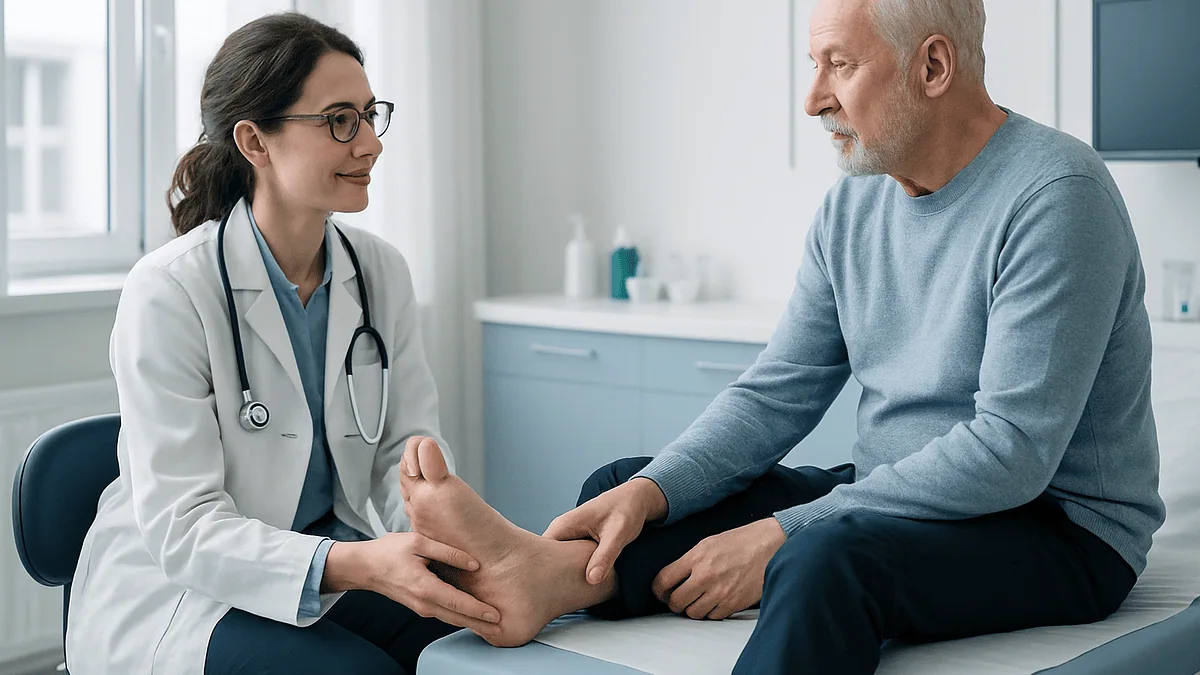
It starts with conversation and hands. Your clinician will ask when the coldness started, whether it’s one foot or both, what triggers it, and what other symptoms have tagged along: the walking-pain question and the fatigue question do a lot of diagnostic work. Then comes the physical exam: feeling for pulses at the ankle and the top of the foot, checking skin color, temperature, hair growth, and how quickly color returns after pressing the skin, and often testing sensation with a thin filament to screen for neuropathy.
If artery disease is a possibility, the standard first test is the ankle-brachial index: blood pressure cuffs on the arm and ankle, a comparison of the two readings, and about ten painless minutes. A healthy ankle reads at or slightly above the arm; a meaningfully lower ankle reading points to narrowed leg arteries. Ultrasound can map the flow in more detail if needed.
Blood tests cover the systemic suspects in a single draw, thyroid function, a complete blood count for anemia, iron studies, blood sugar or A1C, and sometimes B12 or autoimmune markers if the story suggests them.
What you gain from a normal result is not nothing; it is the difference between managing cold feet as a comfort problem and wondering about them as a health problem. Either answer is useful. Only one of them can be bought with wool socks alone.
Frequently asked questions
How do you fix cold circulation in feet?
The best-evidenced fixes are brisk walking most days, quitting nicotine completely, breaking up long sitting, wearing loose warm socks, and treating any underlying condition such as thyroid disease, anemia, or diabetes with your clinician. Walking works because calf muscle contractions actively pump blood through the legs: it’s the first-line approach even for diagnosed artery disease. Over-the-counter “circulation supplements” lack solid evidence and can interact with prescriptions, so skip them in favor of movement and warmth.
How do I stop my feet from being so cold?
Keep your whole body warm, not just your feet, core cooling triggers the reflex that shuts down blood flow to the skin. Layer loose wool socks, keep moving through the day, use warm (not hot) foot soaks, stay hydrated, and avoid nicotine and excess caffeine, both of which constrict vessels. If cold feet persist despite this, or come with numbness, sores, pain when walking, or fatigue, get checked: a treatable cause like thyroid or iron issues may be behind it.
Why are my feet cold but the rest of my body is warm?
Usually because your body is deliberately sacrificing your feet to protect your core. Small vessels in foot skin narrow to conserve heat for vital organs, and feet, far from the heart, low in muscle, high in surface area, cool fastest. This is normal when it affects both feet equally. It becomes worth investigating when one foot is colder than the other, or when coldness comes with numbness, color changes, or pain while walking.
Are cold feet related to heart problems?
Not directly in most cases, cold feet alone are not a heart attack warning sign. There are two real links, though. Peripheral artery disease, a common cause of cold feet, is the same plaque process that affects heart arteries, so it flags elevated cardiovascular risk. And in heart failure, a weakened pump can leave feet cool, but almost always alongside obvious symptoms like breathlessness and leg swelling. Cold feet plus those symptoms warrant a prompt medical visit.
Can anxiety cause cold feet?
Yes, through a well-documented mechanism. Stress activates the fight-or-flight response, and adrenaline redirects blood from the skin of the hands and feet toward core muscles and organs, vessels there clamp down within seconds. Chronic anxiety keeps this system partially activated, making cold extremities a daily feature. Regular aerobic exercise, slow breathing, good sleep, and limiting caffeine all reduce that background constriction. Emotional stress can also trigger Raynaud’s episodes in people who have that condition.
Why do my feet feel cold but are warm to the touch?
That mismatch is a classic sign of peripheral neuropathydamaged nerves misreporting sensation to the brain. Diabetes is the most common cause; vitamin B12 deficiency, heavy alcohol use, certain chemotherapy treatments, and kidney disease can also do it. Because injured nerves underreport real injuries too, this symptom deserves a medical evaluation rather than home monitoring, especially if you have diabetes. Blood tests and a simple sensation exam can usually identify the cause.
Can a vitamin or mineral deficiency cause cold feet?
Yes. Iron deficiency: the world’s most common nutritional shortfall, reduces the blood’s oxygen-carrying hemoglobin, prompting the body to divert blood away from the extremities; cold hands and feet, fatigue, and paleness often travel together. Vitamin B12 deficiency can cause both anemia and direct nerve damage that makes feet feel cold. Get tested before supplementing: excess iron is harmful, and the deficiency itself may have an underlying cause worth finding.
What is Raynaud's and how do I know if I have it?
Raynaud’s phenomenon is a spasm of small arteries in the toes and fingers triggered by cold or stress. The giveaway is a color sequence: digits turn white, often then blue, then red and tingly as blood returns, over minutes to about an hour. It affects an estimated 2 to 5 percent of people, mostly women. Most cases are harmless primary Raynaud’s, but new onset after 35, one-sided episodes, or skin sores suggest a secondary cause needing medical workup.
Is it normal for feet to be cold at night?
Mildly cool feet at bedtime are common, but they can genuinely delay sleep, research shows warming of the feet is one of the better predictors of falling asleep quickly. Loose wool bed socks or a warm bath an hour before bed help through real physiological mechanisms. Avoid sleeping on electric heating pads, especially if you have diabetes or any numbness, because skin that can’t sense heat accurately is at real risk of burns.
When should I worry about cold feet?
See a doctor if one foot is consistently colder than the other, if coldness comes with cramping leg pain while walking, slow-healing sores, numbness or tingling, skin color changes, or new fatigue and cold intolerance. Seek emergency care immediately if a foot becomes suddenly cold, painful, pale, or numb over minutes to hours: that can signal an abruptly blocked artery. Longstanding, symmetric, otherwise symptom-free cold feet are usually a comfort issue rather than a danger.
References
This article is for general information only and is not a substitute for professional medical advice. Please consult a qualified doctor about your individual situation.

More from the Blog
Bowel Changes That Are (and Are Not) Signs of Colon Cancer
Colon spasms by themselves are not a typical sign of colon cancer. Cramping that comes in waves and eases after passing gas or stool…

What IBS Feels Like: Back Pain, Nausea and Blood in the Stool
IBS usually feels like recurring cramping or aching in the belly that changes with a bowel movement, paired with bloating and a shift in…
Is Epilepsy Hereditary? Genetics, Family Risk and What It Means for Planning a Family
Epilepsy can be hereditary, but rarely in a simple, predictable way. Genes contribute to many forms of the condition, and a few rare types…

What an Asthma Attack Feels Like, and How Dangerous It Is
An asthma attack usually feels like a tightening band around the chest, breathlessness that makes finishing a sentence hard, a whistling wheeze on the…

Can Sinusitis Cause Dizziness? Why It Happens, What Helps and When to See a Doctor
Yes, sinusitis can cause dizziness, though usually the light-headed, foggy, slightly-off-balance kind rather than a true spinning sensation. Swollen sinus and nasal linings can…

How Long Pneumonia Lasts, and How Long Recovery Takes
Most people with pneumonia start to feel better within a few days of beginning treatment, and fever usually settles within about a week. Full…