

What Families Can Do Between Therapy Sessions to Support a Child With Cerebral Palsy

Key Takeaways
- Cerebral palsy is the most common motor disability of childhood, affecting about 1 in 345 US children according to the CDC, and roughly 80 percent have the spastic type where muscles resist being stretched.
- The brain injury behind cerebral palsy does not progress, but untreated muscle shortening and hip displacement can, which is why daily positioning, splint wearing and routine hip X-rays matter even when a child seems fine.
- Short bursts of purposeful practice woven into dressing, bathing and mealtimes tend to carry over better than separate therapy hours, and are far easier for families to sustain.
- Intellectual disability co-occurs in an estimated 30 to 50 percent of children with cerebral palsy, meaning a large share have typical intelligence that movement and speech difficulties can easily hide.
- Botulinum toxin injections build their muscle-relaxing effect over days to weeks and wear off over months, so therapists usually intensify stretching and splinting during that window.
- Pain, sleep disturbance and constipation are recognised associated problems that can quietly undermine practice, and a short daily diary of symptoms gives the care team something concrete to act on.
Between therapy sessions, families support a child with cerebral palsy mainly by folding the therapist's goals into daily routines: planned positioning, regular stretching, supported play, consistent use of splints and equipment, and mealtime and communication strategies agreed with the care team. Short, frequent practice tends to carry over better than occasional long sessions, and any new pain, stiffness, feeding difficulty or seizure should be reported to the treating team.
The physical therapist leaves at 4:15 on a Tuesday. The next appointment is in six days. In between sit roughly 140 waking hours of ordinary family life: breakfast, school pick-up, bath, the argument about screen time. Parents often tell us that this gap is where they feel least sure of themselves. Supporting a child with cerebral palsy does not pause when the professional packs up the therapy ball, yet nobody hands you a manual for the other 95 percent of the week.
The encouraging part is that the evidence points in a practical direction. Movement skills are built through repetition in real settings, which means a kitchen floor, a car seat and a bedtime routine are legitimate therapy spaces when they are used with intention.
This explainer sets out what families can realistically do between sessions, where the limits are, and which signs mean it is time to stop practising and pick up the phone.
What cerebral palsy actually does to movement, in plain language
Cerebral palsy is a group of conditions that affect movement, posture and muscle control, caused by an injury to or abnormal development of the brain before, during or shortly after birth. The word palsy simply means a problem with muscle control. The brain injury itself does not get worse, but the way it shows up in the body can change as a child grows, which is why therapy plans are revised over the years.
According to the CDC, cerebral palsy is the most common motor disability of childhood, affecting about 1 in 345 children in the United States. Most children, around 80 percent, have the spastic type, where muscles are stiff and resist being stretched. Smaller groups have dyskinetic cerebral palsy, meaning involuntary movements that make it hard to hold a steady position, or ataxic cerebral palsy, meaning problems with balance and coordination. Many children have a mix.
Spasticity matters for home practice because a muscle that is held short for most of the day gradually loses length. A calf muscle that is rarely stretched can pull the heel up over months, and a hip that always rests in one position can slowly drift out of its socket. This is why so much of what therapists ask families to do looks undramatic: sitting a certain way, wearing a splint, standing in a frame while watching a cartoon. The aim is to keep joints moving through their full range and to give the brain many chances to practise controlled movement.
None of this requires a parent to become a therapist. It requires understanding why the small, repeated tasks matter, which is the foundation for everything that follows.
Why supporting a child with cerebral palsy between sessions matters so much
Think about how a toddler learns to walk. Not in a weekly 45-minute block, but in thousands of wobbly attempts spread across every day. Children with cerebral palsy learn the same way; the difference is that each attempt costs more effort and some attempts need a helping hand or a piece of equipment.
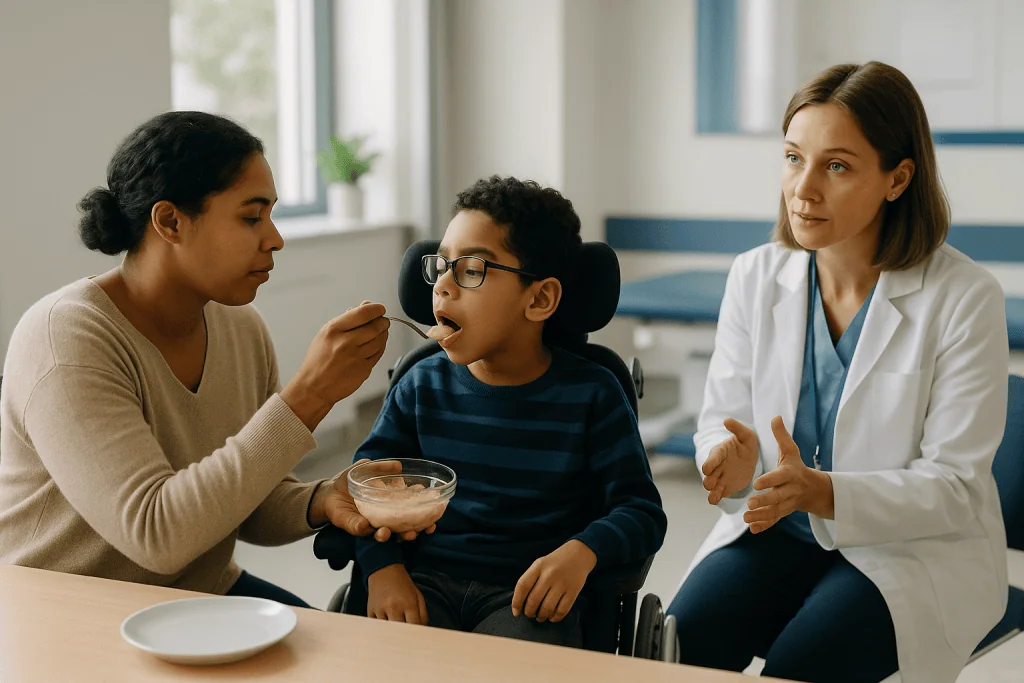
The NHS describes a cerebral palsy care plan as something delivered by a team, with physiotherapy, occupational therapy and speech and language therapy as core elements, and it is explicit that families are part of that team rather than spectators. Therapists set goals and teach techniques; the repetitions mostly happen at home. A child who practises reaching for a cup during every meal gets dozens of trials a day. A child who only reaches during the clinic visit gets a handful a week.
The idea underneath this is neuroplasticity, the brain’s capacity to strengthen the pathways that are used most. Mayo Clinic and the NIH both note that early, consistent intervention supports development, although the evidence does not allow anyone to promise a specific outcome for an individual child. What it does support is a direction of travel: frequent practice in meaningful activities tends to carry over better than occasional intensive bursts.
There is a second reason home support matters. Therapists see a snapshot. Parents see the pattern. You are the one who notices that the left hand is being used less this month, that night waking has crept up, or that a brace is leaving a red mark. Bringing those observations to the next session makes the professional time far more useful.
How is cerebral palsy diagnosed in babies, and why support starts before the label
Many families reading this already have a diagnosis. Others are in the uncertain months when something seems different but nobody has said the words yet. Both groups ask the same question: how is cerebral palsy diagnosed in babies?
Diagnosis is clinical, meaning it rests on what a doctor observes rather than on a single test. The CDC describes a process of developmental monitoring, developmental screening at routine visits, and then a fuller developmental and medical evaluation if concerns arise. Doctors look at muscle tone (whether limbs feel unusually stiff or floppy), whether early reflexes persist longer than expected, whether the baby strongly prefers one hand before 12 months, and whether milestones such as rolling, sitting and crawling are reached. Brain imaging, usually MRI, is often used to look for the underlying injury and to rule out other causes. A general movements assessment, a structured observation of a baby’s spontaneous movements, is sometimes used in infants at high risk.
Timing varies. The CDC notes that most children are diagnosed by age 2, while milder presentations may not be confirmed until later, sometimes around ages 4 to 5. The NHS similarly explains that signs often become clearer during the first two to three years.
The practical message for families is that support does not wait for a confirmed label. Infants flagged as high risk are commonly referred to early intervention services while assessment continues, and the positioning, play and handling advice they receive is the same kind of guidance described in this article. If you have concerns about a baby’s movement, the first step is a conversation with your pediatrician or health visitor, not a search engine.
Who home practice is usually for, and who is usually asked to wait
Almost every child with cerebral palsy is a candidate for some form of home support. The content changes with ability. Therapists commonly describe gross motor function using the GMFCS, the Gross Motor Function Classification System, a five-level scale where level I means walking without limitation and level V means the child needs full support for all mobility. Home goals for a level I child might involve running and stairs; for a level V child they might center on comfortable positioning, head control and communication. Both are real therapy.

Some situations call for a pause or a change in what families do, and this is where the treating team’s instructions override any general article:
- After botulinum toxin injections, a treatment that temporarily relaxes overactive muscles, therapists often adjust the stretching and splinting program to make use of the window while the muscle is looser. The timing is set by the clinician.
- After orthopedic surgery, such as tendon lengthening or hip procedures, there is usually a period of restricted movement, casting or specific weight-bearing rules.
- During serial casting, where a joint is held in a progressively better position with a series of casts, home stretching of that joint is typically stopped.
- When seizures are not yet controlled, the team may limit certain activities, such as unsupervised bathing or standing frames, until things are stable.
- During an acute illness, a chest infection or a flare of pain, rest usually takes priority over practice.
A simple rule works well here. Home practice is for maintaining and building on what the therapist has shown you. It is not for trying techniques you have seen online, however convincing the video. If a stretch or exercise has not been demonstrated to you and checked on your child, ask before you try it.
Cerebral palsy home exercises: turning everyday routines into practice
The most sustainable cerebral palsy home exercises are the ones that disappear into the day. Families who try to run a separate therapy hour often burn out within weeks; families who attach practice to routines that already exist tend to keep going for years.
Dressing is a good example. Pulling a sock on involves bending the hip and knee, reaching the foot and using both hands together. Done slowly, with the child doing as much as they can before you finish the job, that single task becomes range-of-motion work, bilateral hand use and a lesson in independence. Occupational therapists, who focus on daily living skills, often suggest letting the child start a task and the adult complete it, rather than the reverse.
Bath time offers warm water, which many children with spasticity find relaxing, and a natural reason to move arms and legs. Mealtimes provide repeated reaching, grasping and bringing hand to mouth. Floor play with toys placed slightly out of comfortable reach encourages weight shifting and trunk control. A trip to the park becomes practice in uneven ground, stairs and crowds.
A few principles from the NHS and Mayo Clinic guidance on physical therapy translate well to home:
- Little and often beats long and rare; several short bursts of two to five minutes across the day are realistic for most families.
- Movement should be purposeful. Reaching for a wanted toy works better than reaching because an adult said so.
- Symmetry matters: encourage the less-used side without turning every activity into a struggle.
- Stop if the child is in pain, distressed or exhausted. Fatigue is not a sign of effort well spent; it is a sign to rest.
Keep a simple note of what you tried and how it went. Two lines in a phone app is enough to make the next therapy session sharper.
Positioning, splints and equipment: the quiet work that protects joints
The least glamorous part of supporting a child with cerebral palsy may be the most protective. How a child spends the hours when they are not actively moving shapes their joints over years.
A splint, also called an orthosis, is a custom-made support that holds a joint in a better position, most commonly an ankle-foot orthosis that keeps the foot from pointing down. The NHS explains that orthoses help maintain muscle length and improve walking pattern, but they only work when worn as prescribed. Families should know the wearing schedule the orthotist has set, check the skin each time a splint comes off, and report red marks that last more than about 20 minutes, blisters or a child who suddenly refuses a splint they previously tolerated. Growth means splints need regular refitting; a device that fit six months ago may now be doing harm.
Positioning equipment includes supportive seating, standing frames and sleep systems. Standing frames allow children who cannot stand independently to bear weight through the legs, which supports hip development and bone density. Sleep positioning, where it has been recommended, aims to stop the pelvis and legs settling into an asymmetric posture for eight to ten hours a night.
Hip health deserves special mention. Children with cerebral palsy, particularly those with more limited mobility, are at risk of the hip gradually moving out of its socket, a process that can be painless until it is advanced. For this reason many care pathways include scheduled hip X-ray surveillance. Families cannot see this happening, which is exactly why attending those routine X-rays matters even when the child seems fine.
Equipment changes should always be run past the therapy team. A second-hand chair that fits badly can undo months of careful positioning.
Feeding, swallowing and mealtimes with cerebral palsy
Mealtimes can be the hardest hour of the day and also one of the most therapeutic. Cerebral palsy can affect the muscles of the lips, tongue, jaw and throat in the same way it affects the limbs, which the NHS and Mayo Clinic list among the common associated difficulties: problems with chewing, swallowing, drooling and sometimes aspiration, where food or drink enters the airway.
A speech and language therapist, who in this context assesses swallowing as well as speech, will usually have advised on textures, pacing and positioning. Between sessions, the family’s job is to apply that advice consistently:
- Position first. An upright, well-supported posture with the head slightly forward and feet supported makes swallowing safer. Feeding a child who is slumped or tipped back raises the risk of food going the wrong way.
- Follow the texture guidance exactly. If pureed or soft foods and thickened drinks have been recommended, that is a safety instruction rather than a preference.
- Go slowly. Small mouthfuls, time to swallow and a calm environment reduce coughing and fatigue.
- Watch for the quiet signs of trouble: wet or gurgly voice after swallowing, coughing during drinks, repeated chest infections, long mealtimes that stretch beyond 30 to 40 minutes, or weight that is not keeping pace with growth.
Some children receive part or all of their nutrition through a feeding tube. Families sometimes experience this as a failure. The evidence does not support that framing; a tube can turn an exhausting, risky two-hour struggle into a safe, shorter routine that leaves energy for play and connection, and many children continue to taste and enjoy food by mouth alongside it. Whether and when a tube is considered is a decision for the child, the family and the treating team together.
Cerebral palsy and intellectual disability: supporting learning and communication
Parents often ask about the relationship between cerebral palsy and intellectual disability, and the honest answer is that the two overlap but are not the same thing. Cerebral palsy is a movement disorder. The brain injury that causes it can also affect thinking, learning, vision, hearing and behavior, but it does not always do so. NIH and CDC sources describe intellectual disability as a common co-occurring condition, with estimates often quoted in the range of 30 to 50 percent, which also means that a large share of children with cerebral palsy have typical intelligence. The CDC reports that roughly 4 in 10 children with cerebral palsy also have epilepsy, and smaller proportions have autism spectrum disorder.
This matters for home support because movement and speech difficulties can hide ability. A child who cannot point, speak clearly or hold a crayon may be assumed to understand less than they do. Families can counter this in practical ways:
- Presume competence. Talk to the child at their age level, explain what is happening and wait for a response, even when the response is a glance or a change in breathing.
- Use whatever communication works. Augmentative and alternative communication (AAC), meaning any system from picture boards to eye-gaze devices that supplements or replaces speech, is a tool for expression rather than a sign of giving up on talking. Speech therapists guide the choice.
- Offer choices many times a day. Which cup, which book, which song. Choice-making is both communication practice and a daily dose of autonomy.
- Read, sing and play face to face. Shared attention builds language regardless of how a child eventually expresses it.
If learning seems to be falling behind, ask for a formal developmental assessment rather than guessing. Vision and hearing problems are common in cerebral palsy and are frequently the hidden reason a child appears not to be learning.
Which home activities support which therapy goal? A summary table
Families are often given a list of exercises without a clear picture of what each one is for. The table below links common home activities to the goals therapists typically attach to them. It is a map for conversation with your own team, not a program to copy.
| Therapy goal | Everyday activity that supports it | Who usually guides it |
|---|---|---|
| Maintain muscle length and joint range | Prescribed stretches during diaper changes or after a warm bath; wearing splints as scheduled; standing frame time | Physical therapist, orthotist |
| Trunk control and balance | Supported sitting on the floor to play; reaching for toys placed to the side; sitting on a parent’s knee rather than in a chair for short periods | Physical therapist |
| Hand function and two-handed use | Dressing, opening containers, water play, finger foods, helping with cooking tasks | Occupational therapist |
| Safe swallowing and nutrition | Upright positioning, recommended textures, paced mealtimes, oral care | Speech and language therapist, dietitian |
| Communication | Offering choices, pausing for responses, using AAC during daily routines, shared books | Speech and language therapist |
| Independence in daily living | Letting the child start tasks (toothbrushing, undressing) before the adult finishes them | Occupational therapist |
| Fitness and participation | Adapted sports, swimming, park visits, cycling with adapted bikes | Physical therapist, community programs |
Two observations stand out. First, most of the right-hand column is ordinary parenting done a little more deliberately. Second, nearly every row has a professional attached, which is a reminder that home support works best when it is a continuation of clinic guidance rather than a substitute for it. If an activity in your home routine does not seem to fit any goal, ask the team whether it should still be there. Programs accumulate over the years, and trimming them is part of good care.
What the weeks after a new treatment or goal usually look like
Care for cerebral palsy comes in phases, and the weeks after a change are when home support has to adapt fastest. Three common scenarios illustrate the pattern; the specific timing for your child always comes from the treating team.
After a new therapy goal. Expect the first week or two to feel clumsy. A new way of carrying, sitting or feeding will take longer than the old way and may be met with protest. Therapists generally review goals over a period of weeks to months, so the early phase is about building the habit, not seeing results. Note what is hard and bring it back to the next session rather than quietly dropping the task.
After botulinum toxin injections. This treatment works by blocking the signal between nerve and muscle in the injected area, reducing spasticity for a limited period. The NHS and Mayo Clinic describe an effect that builds over the first days to weeks and gradually wears off over the following months. Therapists usually schedule intensive stretching, splinting or casting during that window, so home practice tends to increase for a while. Mild soreness at injection sites is common; weakness that affects swallowing or breathing is not, and should be reported immediately.
After orthopedic surgery. Recovery typically involves a period in casts or braces, then a gradual return to weight bearing, with physiotherapy over several months. Pain management and skin care under casts dominate the first weeks. Home practice follows the surgeon’s protocol exactly, and the family’s main role is comfort, positioning and spotting problems such as swelling, numbness or a bad smell from a cast.
Across all three, the same truth holds: plateaus and even temporary steps backward are normal and are not evidence that the family is doing something wrong.
Pain, sleep and comfort: what to watch and what helps
Pain is common in cerebral palsy and is frequently underestimated, partly because some children cannot say where it hurts. The NHS lists pain, sleep disturbance and constipation among the recognised associated problems, and each one can quietly undermine everything else a family is trying to do. A child in pain does not practise, does not sleep and does not learn.
Common sources include muscle spasms, hip problems, pressure from poorly fitting equipment, constipation and reflux, where stomach acid moves up into the food pipe. Dental pain is easily missed. Signs in a child with limited speech might be irritability, grimacing, changes in sleep, a new refusal of a splint or a seat, or a drop in appetite. If your child uses a communication system, make sure it includes a way to say that something hurts and where.
Comfort measures that families can use between sessions include warmth, gentle massage where a therapist has shown the technique, changing position regularly, and keeping to the stretching and positioning program, since tight muscles are often painful muscles. Spasticity can be made worse by a full bladder, constipation, illness, cold, anxiety or a badly fitting orthosis, so it is worth checking those triggers before assuming the underlying condition has changed.
Sleep problems deserve the same practical attention. A consistent routine, a dark and quiet room, attention to positioning and a check for pain or reflux cover much of the ground. Where medicines are involved, whether for spasticity, seizures, reflux or sleep, their timing and adjustment belong to the prescribing clinician. Families can help most by keeping a short diary of sleep, pain and spasm patterns, which turns a vague worry into information the team can act on.
Supporting a person with cerebral palsy with respect: siblings, friends and the risk of isolation
People search for how to deal with someone with cerebral palsy, and the phrasing itself hints at the problem. The child is not a situation to be dealt with; they are a person with a condition that affects movement. The most useful home practice of all may be modelling, for siblings, grandparents and visitors, how to relate to the child as a child first.
In practice that looks like talking directly to the child rather than over their head, waiting for answers, asking before helping, and including them in decisions that affect them. It means letting them try, fail and try again, because overhelping, however loving, removes the repetitions that build skill. It also means acknowledging frustration honestly instead of brushing it aside.
Siblings carry their own load. They may feel invisible, responsible or resentful, sometimes all in one afternoon. Protected one-to-one time, age-appropriate explanations of the condition, and permission to have ordinary complaints go a long way. Sibling support groups exist in many areas and are worth asking the care team about.
Parental isolation is real and well recognised. Caring for a child with complex needs can shrink social circles, strain relationships and crowd out sleep and work. Mayo Clinic and the NHS both point to caregiver support, respite care and parent networks as part of the overall care plan rather than optional extras. Respite, meaning short periods when a trained person takes over care, is not a sign of failing; it is a maintenance task for the person the whole system depends on.
If low mood, constant anxiety or exhaustion is becoming the background of your life, tell your own doctor. Supporting a child with cerebral palsy over the long term depends on the parents being supported too.
What people often get wrong about supporting a child with cerebral palsy
Myths cluster around cerebral palsy, and several of them actively harm home practice. Here are the ones clinicians hear most, set against what the evidence shows.
Myth: more therapy is always better. Intensity matters, but there is no evidence that exhausting a child or a family produces better outcomes. Guidance from the NHS frames therapy as goal-directed and integrated into daily life. A child who is too tired to play has lost the most natural practice there is.
Myth: cerebral palsy gets worse over time. The brain injury does not progress. What can change is the body’s response to growth, spasticity and inactivity, which is precisely why positioning, stretching and hip surveillance matter. Deterioration in function should always prompt a review rather than being accepted as inevitable.
Myth: a child who cannot speak cannot understand. Covered above, but worth repeating because it is the error with the highest cost.
Myth: mild cerebral palsy disappears in adulthood. People searching for mild cerebral palsy symptoms in adults often describe a tight calf, a limp that worsens with fatigue, hand clumsiness or long-standing back and joint pain. Adults with cerebral palsy commonly report increasing pain, fatigue and reduced mobility in their twenties and thirties, which is one reason good habits in childhood, including fitness and joint protection, are an investment rather than a chore.
Myth: unproven therapies are worth a try because they cannot hurt. Treatments marketed with dramatic promises, including some forms of stem cell therapy and hyperbaric oxygen, lack reliable evidence of benefit for cerebral palsy in mainstream sources such as Mayo Clinic and NIH. They can cost families savings, time and hope, and some carry physical risk. Bring any treatment you are considering to the care team before committing.
Myth: if progress stalls, the family failed. Plateaus are expected. Goals get revised, not graded.
Questions to ask your care team
Appointments are short and the questions that matter tend to surface in the car afterwards. Writing them down in advance changes that. The following are the ones families most often wish they had asked, grouped by the professional most likely to answer them.
For the physical therapist
- Which three things should we prioritise at home if we can only manage three?
- How will we know whether a stretch is being done correctly, and what does too far look like?
- What is our child’s GMFCS level, and what does that mean for realistic goals this year?
- Is our child due for hip X-ray surveillance, and how often?
For the occupational therapist
- Which daily tasks should our child be attempting independently now, even if slowly?
- Does any of our home equipment need refitting as our child grows?
- What small adaptations at home or school would reduce effort without reducing practice?
For the speech and language therapist
- Are there signs of unsafe swallowing we should be watching for?
- Should we be exploring augmentative communication, and when?
For the doctor
- Which medicines is our child taking, what is each one for, and what side effects should we report?
- If botulinum toxin, casting or surgery is being discussed, what would home life look like in the weeks afterwards, and what are the alternatives?
- Who do we contact between appointments, and what counts as urgent?
- Is there a parent support service or respite provision we can be referred to?
One further question is worth asking everyone: what should we stop doing? Home programs expand over the years as advice accumulates. A deliberate pruning every six to twelve months keeps the plan honest and the family sane.
When to call your doctor
Most days of home practice end with nothing to report. Some signs, though, should interrupt the routine and prompt a call to the care team or, where noted, emergency services. Trust the pattern you know; a change from your child’s usual is the most reliable red flag of all.
Seek emergency care immediately for:
- A first seizure, a seizure lasting longer than five minutes, or repeated seizures without recovery in between.
- Difficulty breathing, blue or grey lips, or choking that does not clear.
- Sudden weakness affecting swallowing or breathing after botulinum toxin injections.
- A limb that is cold, pale, numb or severely swollen under a cast or splint.
Contact the care team the same day for:
- New or worsening pain, especially in the hip, back or groin, or a child who has become much harder to position or dress.
- Coughing or a wet, gurgly voice with meals, repeated chest infections, or a marked drop in how much the child eats or drinks.
- A sudden increase in spasticity or spasms that has no obvious trigger such as illness or constipation.
- Fever with a cast in place, or a bad smell or discharge from under a cast.
- Skin that is red, broken or blistered under an orthosis or seating.
- A loss of skills the child previously had, such as no longer sitting, reaching or communicating as before.
Raise at the next appointment: slow weight gain, worsening sleep, constipation, drooling that has increased, concerns about vision, hearing or learning, and any home activity that consistently causes distress.
Every decision about changing therapy, equipment or medicine rests with the treating team. Families are not expected to judge whether a sign is serious; they are expected to report it, and clinicians would far rather hear about a false alarm than miss a real one.
Frequently asked questions
How is cerebral palsy diagnosed in babies?
Cerebral palsy is diagnosed clinically through developmental monitoring, screening at routine visits and a full developmental and medical evaluation if concerns arise. Doctors assess muscle tone, reflexes, hand preference and milestones, and often use MRI to look for the underlying brain injury. The CDC notes most children are diagnosed by age 2, with milder cases sometimes confirmed later.
What are the symptoms of mild cerebral palsy in adults?
Adults with mild cerebral palsy often describe a tight calf or limp that worsens with fatigue, hand clumsiness, balance problems and long-standing joint or back pain. The condition does not disappear with age; many adults report increasing pain, fatigue and reduced mobility over time, which is why childhood habits around fitness and joint protection matter.
What are good cerebral palsy home exercises for families to do?
The best home exercises are the ones your therapist has demonstrated on your child: prescribed stretches during diaper changes or after a bath, supported floor play that encourages reaching and weight shifting, standing frame time, and daily tasks like dressing done slowly with the child leading. Little and often works better than long sessions, and new techniques from videos should be checked with the team first.
What is the relationship between cerebral palsy and intellectual disability?
Cerebral palsy is a movement disorder, and intellectual disability is a separate but frequently co-occurring condition caused by the same brain injury. NIH and CDC sources estimate it affects roughly 30 to 50 percent of children with cerebral palsy, so many have typical intelligence. Movement and speech difficulties can hide ability, which is why formal assessment and communication support matter.
How should I deal with someone with cerebral palsy respectfully?
Treat the person as a person first: speak directly to them rather than over their head, wait for a response, ask before helping, and include them in decisions. For children, allowing them to try tasks and sometimes fail provides the repetitions that build skill. Overhelping, however kind, removes practice and independence.
How long should a child wear splints or orthoses each day?
The wearing schedule is set individually by the orthotist or therapist and depends on the joint, the goal and the child’s tolerance, so there is no universal number. What families can do is follow that schedule consistently, check the skin each time a splint comes off, and report persistent red marks, blisters or a sudden refusal to wear a device that was previously accepted.
What are signs of swallowing problems in a child with cerebral palsy?
Watch for coughing or choking during drinks, a wet or gurgly voice after swallowing, repeated chest infections, mealtimes that stretch well beyond 30 to 40 minutes, and weight that is not keeping pace with growth. Upright positioning and the textures recommended by the speech and language therapist reduce risk, and any new sign should be reported to the care team.
What happens in the weeks after botulinum toxin injections for spasticity?
Botulinum toxin blocks the signal between nerve and muscle in the injected area, with the relaxing effect building over days to weeks and wearing off over the following months. Therapists usually intensify stretching, splinting or casting during this window. Mild soreness at injection sites is common; any weakness affecting swallowing or breathing needs immediate medical attention.
Does cerebral palsy get worse as a child grows?
The brain injury itself does not get worse. What can change is how the body responds to growth, spasticity and inactivity, including muscle shortening and hip displacement, and these are the problems that positioning, stretching and hip surveillance are designed to limit. Any loss of previously held skills should prompt a review by the care team rather than being accepted as inevitable.
Are stem cell or hyperbaric oxygen treatments effective for cerebral palsy?
Mainstream sources including Mayo Clinic and NIH do not list these as evidence-based treatments for cerebral palsy, and reliable proof of benefit is lacking. Some carry physical risk and significant financial and emotional cost. Families considering any treatment outside the standard care plan should discuss it with the treating team before committing.
References
- CDC: About Cerebral Palsy
- NHS: Cerebral palsy, treatment
- NIH NINDS: Cerebral Palsy
- MedlinePlus: Cerebral Palsy
This article is for general information only and is not a substitute for professional medical advice. Please consult a qualified doctor about your individual situation.

More from the Blog

Can Cognitive Stimulation and Nutrition Help in Alzheimer’s Disease? What Care Plans Include
Cognitive stimulation, usually delivered as structured group sessions, produces small but measurable gains in thinking and quality of life for people with mild to…

Who Is a Candidate for Deep Brain Stimulation in Parkinson’s Disease? How Teams Decide
A person is usually considered a candidate for deep brain stimulation in Parkinson's disease when the diagnosis is confirmed, symptoms still respond well to…

How Can Family Help During and After a Seizure? A Caregiver’s Guide to Epilepsy Care
Helping someone during a seizure means keeping them safe, not stopping the seizure. Ease them to the floor, cushion the head, move hard objects…

When Symptoms Do Not Match the Scans: How an FND Diagnosis Is Confirmed and Treatment Begins
FND is diagnosed by a neurologist on the basis of positive clinical signs, not by normal scans alone. The examiner looks for features that…

Preparing an Infant for Congenital Hydrocephalus Surgery: Imaging, Feeding and Anesthesia
Preparing a baby for hydrocephalus surgery usually involves three strands: imaging (head ultrasound, MRI or CT) to confirm where fluid is building up; fasting…

Sleep, Caffeine and Screens: How Lifestyle Guidance Fits Into a Headache Medicine Plan
A headache lifestyle plan is the set of daily habits, mainly regular sleep, steady caffeine use, screen and light management, consistent meals, hydration and…