

What Tests Come Before a Dementia Diagnosis? Imaging, Blood Work and Cognitive Screening
Key Takeaways
- No single test diagnoses dementia; the picture is assembled from a detailed history, a cognitive screen, blood work and a brain scan, with specialist tests added only when the cause remains unclear.
- Routine blood tests in a dementia workup check thyroid function, vitamin B12, blood count, kidney, liver, glucose and calcium to find treatable conditions that can mimic dementia.
- The Mini-Cog, MMSE and MoCA are screening tools that flag a need for closer assessment; their scores must be read against age, education and language, not treated as a diagnosis.
- A normal CT or MRI rules out strokes, bleeds, tumors and fluid buildup, but it does not exclude early Alzheimer's disease or several other dementia types.
- Blood biomarker tests for amyloid and tau detect Alzheimer's biology, not dementia itself, and mainstream guidance does not yet support their use as a screening test in people without symptoms.
- Clinicians often postpone testing during or soon after delirium, active depression or a recent medicine change, because results taken then do not reflect the person's true baseline.
Before a dementia diagnosis, clinicians usually take a detailed history from the person and someone who knows them well, run a brief cognitive screen such as the Mini-Cog, MMSE or MoCA, order blood tests to rule out treatable causes like thyroid or vitamin B12 problems, and arrange a brain scan, usually CT or MRI. Specialist memory testing, PET or spinal fluid tests are added only when the picture stays unclear.
The kettle has been boiled three times and nobody has made the tea. Her daughter notices it on a Sunday visit, the way she noticed the unopened mail last month and the repeated question about the neighbor’s dog the month before that. Nothing dramatic. Just a pattern that has quietly stopped looking like ordinary forgetfulness.
What follows for many families is a strange gap: a sense that something is wrong, and no clear idea of what happens next. The phrase people type into a search bar at midnight is some version of “tests before dementia diagnosis,” and the answers they find are often either frightening or vague.
The reality is more orderly than either. A dementia assessment is a sequence of modest steps, each designed to answer a specific question. Some of those steps rule things in. Just as many are there to rule things out. Here is what each one actually involves, what it can show, and what it cannot.
How is dementia diagnosed when there is no single test?
Dementia is not one disease. It is a clinical description: a decline in thinking skills severe enough to interfere with daily life, caused by damage to brain cells from one of several underlying conditions. Alzheimer’s disease is the most common cause, but vascular disease, Lewy body disease and frontotemporal degeneration each produce their own version, and mixed pictures are frequent in older adults, according to the National Institute on Aging.
Because the label describes a pattern rather than a single lab value, no blood test or scan can hand a doctor the answer on its own. The diagnosis is built the way a detective builds a case: from the person’s own account, from the observations of someone who knows them well, from structured tests of memory and reasoning, from blood work, and from imaging. Each piece narrows the possibilities. The clinician then asks whether the whole picture fits a recognized condition and whether anything else could explain it.
That second question matters enormously. Several conditions can mimic dementia, including depression, delirium from infection, thyroid problems, low vitamin B12, medication side effects, hearing loss and normal pressure hydrocephalus, a buildup of fluid in the brain. Many of these can be treated or managed, and a careful workup exists in large part to catch them.
So when people ask what tests come before a dementia diagnosis, the honest answer is that the tests serve two purposes at once. They look for evidence of a progressive brain disease, and they hunt just as hard for anything that is not one. Understanding that dual purpose takes some of the dread out of the process. A referral for a memory assessment is not a verdict. It is the start of a structured inquiry, and a fair proportion of those inquiries end somewhere other than dementia.
Step one is a conversation, not a scan
The most informative part of a dementia assessment is still the interview. A primary care clinician or memory specialist will want to know what changed, when it started, whether it came on gradually or stepwise, and how it affects ordinary tasks: paying bills, cooking, taking medicines, finding the way home from familiar places.

Crucially, they will want to hear from a second person. Memory problems have an awkward feature: the person experiencing them may be the least able to describe them accurately, not through denial but because the memory needed to notice a gap is the very thing under strain. A spouse, adult child or close friend often provides the timeline the clinician needs. Mayo Clinic and the NHS both describe this informant history as a standard part of assessment.
Expect questions that reach well beyond memory. Clinicians ask about mood, sleep, appetite and energy, because depression in older adults can present as poor concentration and forgetfulness. They ask about alcohol, about falls and head injuries, about every prescription and over-the-counter product in the house, since several common medicine classes, including some sleep aids and bladder medicines with anticholinergic effects, can cloud thinking. They ask about hearing and vision, because sensory loss can look like cognitive decline on a test. They ask about family history, strokes, heart disease and diabetes.
A physical and neurological examination usually follows: reflexes, gait, balance, eye movements, muscle tone. A shuffling walk or tremor points the assessment in one direction; a sudden stepwise decline after a known stroke points in another.
None of this feels high-tech, and families sometimes worry that it is not thorough enough. The opposite is true. A well-taken history frequently decides which tests are worth ordering and which would only add noise. The scan comes later for a reason.
Dementia screening tests in the clinic: Mini-Cog, MMSE and MoCA
Cognitive screening tests are short, paper-and-pencil tasks that give a structured snapshot of thinking skills. They are not diagnostic. A low score says “look closer,” and a normal score does not rule everything out, particularly in someone with a high level of education who may compensate well.
Three are common in US and UK practice:
- Mini-Cog. The person is asked to remember three unrelated words, then to draw a clock face showing a specific time, then to recall the words. It takes a few minutes and is designed for busy primary care settings.
- Mini-Mental State Examination (MMSE). A 30-point test covering orientation to time and place, attention, short-term recall, language and the ability to copy a simple figure.
- Montreal Cognitive Assessment (MoCA). Also scored out of 30, but with more weight on executive function, the planning and problem-solving skills that may slip early in some conditions. It tends to be more sensitive to mild change than the MMSE.
The National Institute on Aging notes that these brief tests are a starting point, not an endpoint. Scores are interpreted against age, education, language and culture. Someone taking a test in their second language, or someone with limited schooling, can score lower without having any brain disease at all, and experienced clinicians adjust for this.
Primary care doctors may also use longer tools, such as the GPCOG or the 6-CIT, that fold in a few questions for the informant. The tool matters less than how the result is used: as one data point among several.
Families sometimes ask whether they should practice the test at home beforehand. Please do not. Coaching inflates the score and hides the very information the clinician needs to help. A screening test is most useful when it reflects an ordinary day.
What the blood work actually looks for
There is no routine blood test that confirms dementia. The standard panel does something arguably more valuable: it searches for conditions that can impair thinking and that can often be treated or managed.

Both the NHS and Mayo Clinic describe a set of tests that typically includes:
- A full blood count, to check for anemia, which can cause fatigue and poor concentration.
- Thyroid function, because an underactive thyroid slows thinking, mood and movement.
- Vitamin B12 and sometimes folate, since deficiency can produce memory loss and nerve symptoms, and is more common in older adults and in people on certain long-term medicines.
- Kidney and liver function, because waste products that these organs normally clear can affect the brain when they accumulate.
- Blood sugar and calcium, both of which can disturb cognition when very high or very low.
Depending on history, a clinician may add tests for syphilis, HIV, or inflammatory markers. These are not routine for everyone; they are added when something in the story suggests them.
A sample is drawn from a vein in the arm in the usual way. Results typically return within days, and the clinician will review them alongside everything else rather than in isolation. An abnormal thyroid result, for example, does not prove the thyroid is the whole explanation. It means that treating the thyroid condition and then reassessing is the sensible next step before any dementia label is applied.
It is worth saying plainly what this panel is not. It is not a genetic test. APOE genotyping, which looks at a gene variant associated with Alzheimer’s risk, is not part of standard diagnosis because carrying the variant neither confirms nor excludes the disease, and the National Institute on Aging advises that it is generally reserved for research or specialist counseling. The blood work before a dementia diagnosis is about excluding the treatable, not predicting the future.
Brain imaging: what CT and MRI can and cannot show
A brain scan is usually part of a first dementia workup, and families often assume it is the test that gives the answer. It rarely is. Imaging answers a narrower question: is there a structural cause for these symptoms that would change what we do?
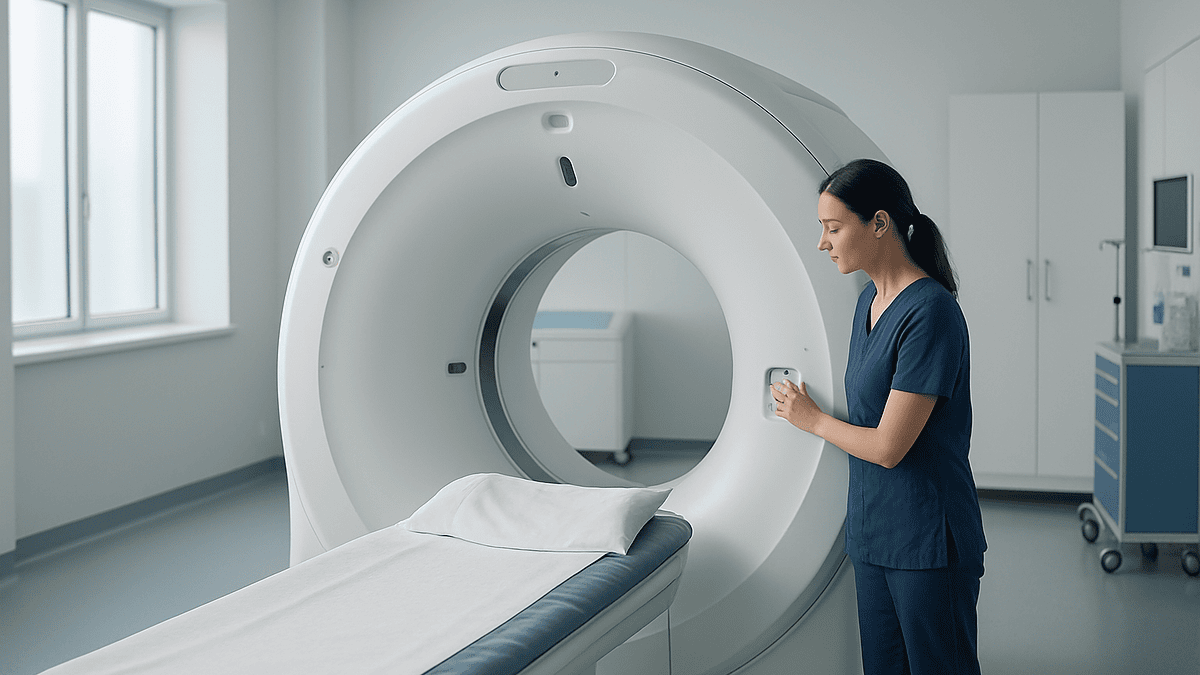
A CT scan (computed tomography) uses X-rays to produce cross-sectional pictures of the brain in a few minutes. It is good at showing bleeds, tumors, large strokes and fluid buildup. An MRI scan (magnetic resonance imaging) uses a strong magnet and radio waves instead of radiation, takes longer, and gives finer detail of brain tissue. It can show small-vessel damage, old minor strokes and the pattern of shrinkage, or atrophy, in specific regions.
Why does the pattern matter? Different conditions tend to shrink different parts of the brain first. Loss of volume in the hippocampus, the seahorse-shaped structure central to forming new memories, is typical of Alzheimer’s disease. Shrinkage concentrated at the front and sides is more suggestive of frontotemporal degeneration. Scattered white-matter changes and old infarcts point toward vascular disease. Mayo Clinic describes these imaging patterns as supportive evidence rather than proof, and that is the honest framing.
What a normal scan does not do is rule dementia out. Early Alzheimer’s disease can be present with an MRI that a radiologist reads as unremarkable for age. Conversely, a scan showing some age-related change in a person with normal thinking is not a diagnosis of anything.
The practical experience is straightforward. For MRI, the person lies on a sliding table inside a tunnel for roughly half an hour, with ear protection against the loud knocking sounds. People with certain implanted metal devices may be offered CT instead. A contrast dye is sometimes injected to improve the images, usually when a tumor or infection is a concern. Sedation is not normally required, though anyone who finds enclosed spaces difficult should say so beforehand.
When specialists add neuropsychological testing, PET or spinal fluid
If the basics leave real uncertainty, especially in a younger person, someone with an unusual pattern of symptoms, or when the cause of dementia would change management, a specialist may add deeper tests.
Neuropsychological testing is an extended session, often lasting a few hours, with a psychologist trained to measure specific domains of thinking: episodic memory, language, attention, visuospatial skill and executive function. It is far more detailed than a screening test and better at separating depression, normal aging, mild cognitive impairment and early dementia. It also establishes a baseline against which future change can be measured.
Amyloid PET is a scan in which a small amount of a radioactive tracer is injected; the tracer binds to amyloid plaques, the abnormal protein clumps that build up in Alzheimer’s disease, and lights them up on the image. Tau PET does the same for tau tangles, the second hallmark protein. FDG-PET maps how actively different brain regions use glucose, which can reveal patterns of reduced activity before structural shrinkage is obvious. The National Institute on Aging describes these as tools that support diagnosis, mainly in specialist or research settings.
Cerebrospinal fluid analysis involves a lumbar puncture, in which a thin needle is placed into the lower back to collect a small sample of the fluid surrounding the brain and spinal cord. Levels of amyloid and tau in this fluid shift in characteristic ways in Alzheimer’s disease. The procedure causes some pressure and discomfort, and a headache afterward is the most common side effect; serious complications are uncommon.
A DaTscan, which images dopamine transporter activity, can help when Lewy body dementia or Parkinson’s-related dementia is suspected. An EEG, recording the brain’s electrical activity, is occasionally used if seizures or certain rare conditions are in question.
None of these is routine for everyone, and that is appropriate. They are deployed when the answer would change the plan.
The new blood tests for Alzheimer's disease: what the evidence shows so far
Headlines about a simple blood test for Alzheimer’s disease have been arriving steadily, and they are not hype in the usual sense. Researchers can now measure forms of tau and amyloid in blood, and some of these markers track closely with what amyloid PET and spinal fluid tests show. The National Institute on Aging describes blood biomarker tests as an active area of development that may make diagnosis more accessible over time.
That said, the gap between a promising research tool and a test that belongs in a routine primary care workup is real, and it is worth being precise about where things stand.
First, these tests detect the biology of Alzheimer’s disease, not dementia itself. Amyloid can accumulate in the brain for years before any symptoms appear, and many people with amyloid never develop dementia in their lifetime. A positive result in someone with no symptoms is difficult to interpret and can cause harm through anxiety without any clear action to take.
Second, the tests are specific to Alzheimer’s pathology. They say nothing about vascular dementia, Lewy body disease or frontotemporal degeneration, and nothing about depression, thyroid disease or medication effects. They cannot replace the rule-out blood work described above.
Third, performance depends on the population tested. Results validated in research cohorts, which tend to be healthier and less diverse than the general public, may not translate directly to everyone sitting in a clinic waiting room.
The responsible current position, and the one reflected in mainstream guidance, is that blood biomarkers are increasingly useful in specialist settings to support a diagnosis in people who already have cognitive symptoms, and they are not yet a screening test for the general population. If a clinician offers one, it should come with a clear conversation about what a result would and would not mean. Ask that question before the needle, not after.
Who is assessed right away, and who is usually asked to wait
Not everyone with a memory complaint moves straight into a full dementia workup, and the reasons are clinical rather than bureaucratic.
A prompt assessment is generally appropriate when thinking has changed in a way that affects daily function, when a family member has noticed decline over months, when there are new problems with language, judgment or finding the way, or when symptoms appear in someone under 65. Changes in personality or behavior, visual hallucinations, or new movement problems alongside cognitive change also warrant early specialist attention, since they can point to Lewy body or frontotemporal conditions.
By contrast, clinicians often ask people to pause and recheck in a few situations:
- After a recent acute illness. Delirium, a sudden confusional state caused by infection, surgery, dehydration or medication, can take weeks to clear in older adults. Testing during or just after delirium produces results that do not reflect the person’s baseline.
- When depression or a major life stress is active. Grief, insomnia and low mood impair concentration. Treating the mood disorder and then reassessing avoids mislabeling.
- When a reversible result has been found. If blood work shows a very low B12 or an underactive thyroid, the sensible sequence is to correct it, allow time, and test again.
- When a medicine with cognitive side effects has recently started. A review with the prescriber comes first.
- When hearing or vision is uncorrected. A hearing test is sometimes the most useful “memory test” of all.
Waiting in these cases is not the same as being dismissed. It is a deliberate step to make sure that whatever is eventually diagnosed is real and not an artifact of a bad month. If the delay feels indefinite, or symptoms are clearly progressing while waiting, it is reasonable to go back and say so.
The decision about timing, like every other decision in this pathway, sits with the treating team, informed by the person’s wishes.
Tests before dementia diagnosis at a glance
The table below summarizes the main components of a standard assessment and what each is realistically for. It is a map of the usual terrain, not a checklist every person will complete; the sequence and depth depend on the individual picture.
| Test | What it involves | What it can show | What it cannot do |
|---|---|---|---|
| History and informant interview | Structured conversation with the person and someone close to them | Onset, pace and pattern of change; mood, medicines, risk factors | Confirm a cause on its own |
| Cognitive screen (Mini-Cog, MMSE, MoCA) | Short paper-and-pencil tasks, a few to fifteen minutes | Whether thinking skills fall outside the expected range | Diagnose dementia or identify its type |
| Blood panel | Standard venous sample | Thyroid, B12, anemia, kidney, liver and metabolic problems that impair cognition | Confirm Alzheimer’s or other neurodegenerative disease |
| CT or MRI | Structural scan, minutes to about half an hour | Strokes, bleeds, tumors, fluid buildup, patterns of shrinkage | Rule dementia out when normal |
| Neuropsychological testing | Extended session with a psychologist | Detailed profile across memory, language, attention and executive skills | Show what is happening biologically in the brain |
| Amyloid or tau PET, FDG-PET | Tracer injection and scan, specialist setting | Presence of Alzheimer’s proteins or regional underactivity | Detect non-Alzheimer’s causes; predict timing of symptoms |
| Cerebrospinal fluid | Lumbar puncture | Amyloid and tau levels consistent with Alzheimer’s disease | Replace clinical judgment about function and daily life |
Two things stand out when the pieces sit side by side. The early steps are cheap in effort and rich in information, which is why they come first. And no row in the right-hand column is empty: every test has a boundary. A clinician’s skill lies in reading them together, weighting each according to the person in front of them, and resisting the temptation to let any single result carry more meaning than it can bear.
What the following weeks usually look like
For many people, the journey begins with a primary care appointment. The clinician takes a history, runs a brief screen, orders blood tests and often an initial scan. Results typically arrive over the following week or two. If they point to a treatable problem, that gets addressed first.
If they do not, a referral to a memory service, neurologist, geriatrician or old-age psychiatrist usually follows. Waiting times vary widely between regions, and the NHS notes that the process from first visit to a conclusion can take several weeks or longer, particularly if specialist tests are added or a period of monitoring is advised. US timelines depend on local specialist availability in much the same way.
The specialist appointment is longer than a routine visit. Expect a detailed interview, often with the informant present for part of it, a more thorough cognitive assessment, and a review of the scan images rather than just the report. Some services arrange neuropsychological testing on a separate day.
Then comes a results conversation, and this is a point where people should feel free to shape what happens. Some want a clear diagnosis and all the information available. Others prefer to know only what is necessary for the next step. Mayo Clinic and the NHS both emphasize that the person being assessed has the right to decide how much they want to be told and who should be present. Saying so at the outset is entirely reasonable.
Three outcomes are common. One is a clear diagnosis of a specific dementia type, with a plan for support, safety, future planning and, where appropriate, a discussion of medicine options with the prescriber. Another is a diagnosis of mild cognitive impairment, meaning measurable change that does not yet interfere with daily life, with scheduled review. The third is reassurance, sometimes with a plan to recheck in a year.
Between appointments, keeping a simple diary of concrete examples, dated and specific, helps more than any amount of worrying. It gives the next clinician the material they need.
What is vascular dementia, and how do tests tell the types apart?
Vascular dementia is cognitive decline caused by reduced blood flow to the brain, usually through many small strokes, disease of the tiny vessels deep in the brain, or occasionally a single stroke in a critical location. The NHS and Mayo Clinic describe it as one of the most common forms after Alzheimer’s disease, and it often coexists with Alzheimer’s changes in the same brain.
Its signature is different. Where Alzheimer’s typically begins with difficulty forming new memories and progresses gradually, vascular dementia more often starts with slowed thinking, trouble planning and organizing, and problems with attention. Decline may proceed in steps, with sudden drops followed by plateaus. Mood changes and walking difficulties are common. These differences show up in the history, in the pattern of scores on neuropsychological testing, and on MRI, where white-matter changes and small infarcts are visible.
The distinction is not academic. Vascular dementia shares its risk factors with heart disease: high blood pressure, diabetes, high cholesterol, smoking and atrial fibrillation. Managing these does not reverse damage already done, but it is the main lever for slowing further vascular injury, and that conversation belongs with the treating team.
Other types leave their own fingerprints. Lewy body dementia tends to bring fluctuating alertness, detailed visual hallucinations, movement features resembling Parkinson’s disease and a sleep disorder in which people act out dreams. Frontotemporal degeneration, more common among those diagnosed under 65, often begins with personality and behavior change or with language difficulty while memory is relatively spared.
Early onset dementia, sometimes called young onset, simply means symptoms beginning before 65. It is less common, more often misattributed to stress or depression at first, and more likely to involve Alzheimer’s with an atypical presentation or a frontotemporal condition. The workup is the same in structure but usually more thorough, with specialist testing added earlier, because the stakes for work, family and planning are different at 55 than at 85.
What people often get wrong about dementia testing
“If the scan is normal, it isn’t dementia.” A normal CT or MRI excludes some structural causes; it does not exclude early Alzheimer’s disease or several other conditions. Imaging is one input, and clinicians weigh it alongside history and testing.
“A low score on the memory test means dementia.” Screening tests flag a need to look further. Low scores can reflect hearing loss, anxiety on the day, limited schooling, testing in a second language, pain, poor sleep or depression. Interpretation depends on context.
“Forgetting names is the first sign.” Occasionally struggling for a word or a name is a normal feature of aging. The National Institute on Aging distinguishes this from forgetting recently learned information repeatedly, getting lost in familiar places, or being unable to manage tasks that were once routine. The pattern and its effect on daily life matter more than any single lapse.
“There’s a gene test that will tell me.” For the vast majority of people, genetic testing is not part of diagnosis. Rare inherited forms exist, typically with symptoms in the forties or fifties and a strong family history, and these are assessed through specialist genetic counseling. Common risk variants do not confirm or exclude disease.
“Dementia is just part of getting old.” Age is the biggest risk factor, but dementia is caused by disease, not by the passage of years. Most people in their eighties do not have it.
“There’s no point being tested because nothing can be done.” A thorough workup finds treatable conditions in a meaningful minority of people. Even when a progressive dementia is confirmed, an early diagnosis allows planning, safety measures, support for carers, management of risk factors and informed decisions about medicine with the prescriber. Knowing changes what families can do, even when it does not change the underlying biology.
“Supplements or brain-training apps can prevent the need for testing.” No supplement has been shown in rigorous trials to prevent or treat dementia, and the NIH Office of Dietary Supplements advises caution about such claims. Cognitive activity is good for wellbeing, but it is not a substitute for assessment.
Questions to ask your care team
A memory assessment can feel like something that is done to you. It goes better when it is done with you. These questions help steer it.
Before testing begins
- Which tests are you planning, and what question is each one meant to answer?
- Are there treatable conditions you are checking for first, and how will I hear about those results?
- Should a family member or friend come to the appointment, and will you want to speak with them separately?
- Are any of my current medicines, including over-the-counter ones, likely to affect thinking or test results?
- Would a hearing or vision check be useful before cognitive testing?
About the results
- How much do I want to be told, and who should be present when results are discussed? (It is appropriate to state your preference, not just ask.)
- If the result is uncertain, what is the plan for review, and over what period?
- What type of dementia do you think this is, and what makes you think so?
- Are specialist tests such as PET or spinal fluid analysis relevant in my case, and what would their result change?
- Is this likely to be mild cognitive impairment rather than dementia, and what does that distinction mean in practice?
About what comes next
- Are there medicines that may be appropriate, and what is realistic to expect from them? (Decisions here rest with the prescribing clinician.)
- What risk factors can be managed, such as blood pressure, hearing, sleep or alcohol?
- Who do I contact between appointments if things change suddenly?
- What support exists for carers, and how do I reach it?
- Are there decisions about driving, work, finances or legal planning that I should think about now?
Writing the answers down, or asking permission to record the conversation, is sensible. Few people remember everything said in an appointment of this kind, and that has nothing to do with dementia.
When to call your doctor
Most memory concerns can wait for a scheduled appointment. Some cannot. Seek urgent medical attention, which in many cases means emergency services, if confusion comes on suddenly over hours or a day or two rather than months. Sudden confusion in an older adult often signals delirium from infection, dehydration, medication or another acute illness, and it needs prompt evaluation regardless of whether dementia is also present.
Treat the following as red flags requiring immediate care:
- Sudden weakness or numbness on one side of the body, facial drooping, slurred speech or sudden difficulty understanding language. These are signs of stroke, and the American Heart Association emphasizes that every minute counts.
- A severe headache unlike any previous one, especially with confusion, vomiting or neck stiffness.
- Confusion after a fall or head injury, even a minor one, particularly in anyone taking blood-thinning medicine.
- A seizure in someone who has not had one before.
- Rapid decline over days, with drowsiness, agitation or hallucinations that are new.
- Fever with new confusion.
Contact the usual clinician within days rather than weeks if there is a new inability to recognize familiar people or places, a marked change in personality or behavior, difficulty swallowing, unexplained weight loss, or if a person already being assessed is clearly worse than at their last visit.
Carers should also call when the situation at home is becoming unsafe: wandering, leaving the stove on, mismanaging medicines, or distress that cannot be settled. These are not failures. They are the exact circumstances in which the care team can adjust the plan, and they are often the moment at which additional support becomes available.
Finally, if the person being assessed expresses hopelessness or talks about not wanting to go on, treat it as urgent. Low mood is common around a diagnosis, it is treatable, and the treating team wants to know.
Frequently asked questions
How is dementia diagnosed if there is no definitive test?
Dementia is diagnosed by combining several sources of evidence rather than by one result. A clinician takes a history from the person and someone who knows them well, assesses thinking with structured tests, orders blood work to exclude treatable causes, and reviews a brain scan. If the pattern fits a recognized condition and nothing else explains it, a diagnosis is made. Specialist imaging or spinal fluid tests are added when uncertainty remains.
What dementia screening tests are used in a first appointment?
The most common brief screens are the Mini-Cog, which pairs three-word recall with clock drawing; the Mini-Mental State Examination, a 30-point test of orientation, recall and language; and the Montreal Cognitive Assessment, also out of 30 and more sensitive to early problems with planning and attention. Some primary care clinicians use tools such as the GPCOG that include informant questions. All are starting points, not diagnoses.
What is early onset dementia?
Early onset, or young onset, dementia refers to dementia that begins before age 65. It is less common than dementia in older adults and is often initially mistaken for stress, depression or burnout. Alzheimer’s disease, sometimes with unusual features, and frontotemporal degeneration are frequent causes. Assessment follows the same structure but usually involves specialist testing earlier because the implications for work, family and planning differ.
What is vascular dementia and how is it identified?
Vascular dementia is cognitive decline caused by reduced blood flow to the brain, usually from small strokes or disease of the brain’s tiny blood vessels. It often begins with slowed thinking and difficulty planning rather than memory loss, and may progress in steps. Clinicians identify it through the history, the pattern of test results and MRI findings such as white-matter changes and small infarcts, often alongside cardiovascular risk factors.
Can a blood test diagnose Alzheimer's disease?
Not yet as a stand-alone test for most people. Research blood tests measuring forms of tau and amyloid correlate well with PET and spinal fluid results and are increasingly used in specialist settings to support a diagnosis in people who already have symptoms. They detect Alzheimer’s biology, not dementia itself, and say nothing about other causes, so they do not replace the standard workup or serve as a screening tool.
Why did my doctor order thyroid and vitamin B12 tests for memory problems?
Because an underactive thyroid and low vitamin B12 can both impair memory, concentration and mood, and both are treatable. These tests are part of the standard panel used to exclude conditions that mimic dementia, along with blood count, kidney and liver function, glucose and calcium. An abnormal result does not necessarily explain everything, but correcting it and reassessing is the sensible next step before any dementia label is applied.
Does a normal MRI mean I do not have dementia?
No. A normal MRI or CT scan rules out structural problems such as tumors, bleeds, large strokes and fluid buildup, which is valuable. It does not exclude early Alzheimer’s disease or several other dementia types, which can be present while the scan looks unremarkable for age. Imaging is one piece of evidence that clinicians weigh alongside the history, cognitive testing and blood results.
How do you get a dementia patient to sleep?
Start with routine: consistent waking and bedtimes, daylight and gentle activity in the morning, limited daytime napping, and a calm, dim environment in the evening with screens off. Pain, a full bladder, constipation and some medicines commonly disrupt sleep and should be reviewed with the clinician. Sleep medicines can increase confusion and falls in older adults, so any decision about them belongs with the prescribing clinician.
What are some coping mechanisms people with Alzheimer's disease can use?
Routine and simplification help most: keeping important items in fixed places, using a single large calendar and written reminders, breaking tasks into steps, and setting up medicines with the help of a pharmacist or family member. Staying socially and physically active, treating hearing loss, and joining a peer support group are consistently recommended by the National Institute on Aging and the NHS. Early planning for finances and care reduces later stress.
What happens after the tests before a dementia diagnosis are complete?
The clinician brings the results together at a review appointment. Common outcomes are a specific dementia diagnosis with a support and management plan, a diagnosis of mild cognitive impairment with scheduled monitoring, identification of a treatable cause to address first, or reassurance with a plan to recheck later. You can say in advance how much you want to be told and who should be present. Decisions about medicines rest with the prescriber.
References
- National Institute on Aging (NIH): How Is Alzheimer's Disease Diagnosed?
- National Institute on Aging (NIH): What Is Dementia? Symptoms, Types, and Diagnosis
- MedlinePlus: Dementia
- Cleveland Clinic: Dementia
This article is for general information only and is not a substitute for professional medical advice. Please consult a qualified doctor about your individual situation.

More from the Blog

How Is ALS Confirmed? EMG, Nerve Studies and the Tests That Rule Out Similar Conditions
ALS is confirmed by a neurologist through a pattern of findings rather than one test. The exam must show progressive weakness with signs of…

How to Read a Movement Disorder Treatment Plan: Questions Worth Asking Your Neurologist
A movement disorder treatment plan usually lists the working diagnosis, the goals of care, medicines described by class and timing, non-drug therapies such as…

Gamma Knife or Open Surgery for a Brain Tumor: When Is Focused Radiation Chosen Instead?
Gamma Knife radiosurgery is usually chosen over open surgery when a brain tumor is small, well defined, sits in or near tissue that is…

Gamma Knife Recovery: Going Home the Same Day, Mild Headache and Returning to Routine
Gamma Knife recovery is usually brief because the treatment involves no incision and no general anesthesia. Most people go home the same day, and…

How Peripheral Nerve Surgery Is Performed: Decompression, Repair and Tumor Removal Explained
Peripheral nerve surgery is performed under local, regional or general anesthesia, usually through a small incision and often with a microscope. A surgeon either…

How Is Alzheimer’s Disease Diagnosed? Cognitive Testing, Blood Work and Brain Imaging
Alzheimer's disease is diagnosed by a clinician who combines several pieces of evidence: a detailed history from the person and someone who knows them…