

When Does Lipedema Need Surgery? Compression, Lymphatic Drainage and the Surgical Step
Key Takeaways
- Lipedema fat is painful, bruises easily, spares the feet and does not respond to dieting the way ordinary fat does, which is why weight loss alone rarely changes the shape of affected limbs.
- Fitted flat-knit compression is both the first treatment and the main test: pain that compression controls generally does not need an operation.
- Manual lymphatic drainage moves fluid and can ease heaviness and tenderness, but it does not remove diseased fat, so a poor response to it is not by itself a reason for surgery.
- No controlled trial shows GLP-1 medicines reduce lipedema fat; they may address co-existing obesity under a prescriber's care, which is a different goal.
- Lymph-sparing liposuction is usually staged over several sessions, requires weeks of post-operative compression and does not remove loose skin or treat the underlying disorder.
- A sudden hot, red, swollen limb with fever, or one-sided calf pain, needs urgent assessment because cellulitis and blood clots are more dangerous in lipedema tissue.
Lipedema usually needs surgery only when a documented period of conservative care, including fitted compression, lymphatic drainage, movement and weight stabilization, has not controlled pain, swelling or mobility problems, and the condition keeps progressing. Lymph-sparing liposuction removes diseased fat but does not treat the underlying disorder, so the decision rests with a specialist team weighing stage, symptoms, overall health and realistic goals.
She has been doing everything right for three years. Compression stockings laced on before breakfast, a weekly session with a lymphatic therapist, swimming on Tuesdays, a food diary that would impress a dietitian. Her waist is smaller. Her legs are not. They still bruise when the dog brushes past, still ache by evening, still feel heavy in a way that has nothing to do with the number on the scale. And now a friend has mentioned surgery.
That is the moment most people start searching the phrase when does lipedema need surgery. The answer matters, because the internet offers two unhelpful extremes: clinics presenting liposuction as the obvious next step, and forums insisting no one should ever cut.
The truth sits in the middle, and it depends on what conservative care has and has not achieved for you. This article walks through that sequence, from compression to the operating room, using what mainstream evidence actually supports.
Why lipedema fat does not behave like ordinary weight
Lipedema is a chronic condition in which fat accumulates symmetrically in the legs, hips and sometimes the arms, while the hands and feet stay slim. The NHS describes the classic picture as a sudden step in width at the ankle, as though the leg had been cuffed. This fat is not simply stored energy. It is tender to pressure, bruises easily and resists dieting in a way that frustrates patients and clinicians alike.
The condition almost exclusively affects women and typically appears around hormonal transitions such as puberty, pregnancy or menopause, according to the Cleveland Clinic. Why is still unclear. Current thinking points to a disorder of fat tissue itself, with inflammation, fragile small blood vessels and fluid accumulation between cells, rather than a problem of calories in and out.
That distinction explains the central injustice of lipedema: a person can lose a meaningful amount of body weight from the trunk and face while the affected limbs barely change. Johns Hopkins notes that even bariatric surgery tends to shrink non-lipedema fat while the disproportion persists. People are often told to try harder, when the tissue they are fighting does not respond to effort in the usual way.
Understanding this changes the whole treatment conversation. Conservative care is not about shrinking the legs through willpower. It is about controlling pain, swelling and progression. Surgery, when it comes up, is about removing tissue that no other method can reach. Keeping those goals separate in your mind helps you judge whether any proposed treatment is doing its actual job.
Lipedema vs lymphedema: why the distinction changes everything
Lymphedema is swelling caused when the lymphatic system, the network of vessels that drains protein-rich fluid from tissues, is damaged or overwhelmed. Lipedema is primarily a fat disorder. They look alike at a glance, and the two can coexist, which is why confusion is so common.

A few features help clinicians tell them apart. Mayo Clinic describes lymphedema as usually affecting one limb more than the other, often including the foot or hand, and producing skin that may thicken or pit when pressed. Lipedema is symmetrical, spares the feet, hurts when touched and bruises readily. The Stemmer sign, where a clinician tries to pinch and lift the skin at the base of the second toe, is typically positive in lymphedema and negative in early lipedema, though it is a clue rather than a verdict.
The distinction matters because the treatments diverge. Lymphedema is managed with decongestive therapy, meticulous skin care to prevent infection, and lifelong compression. Lipedema also uses compression and drainage, but its pain and disproportion do not respond to decongestion alone, and in selected cases diseased fat can be removed surgically.
There is a further reason to get the diagnosis right. Over years, untreated lipedema can strain lymphatic drainage until a secondary lymphedema develops, a combined state sometimes called lipo-lymphedema. Once that happens, the legs carry both problems, infection risk rises and surgery becomes more complex. Clinicians who assess lipedema often examine for signs of lymphatic involvement precisely because it influences how urgent, and how safe, any procedure would be.
Lipedema stages: can lipedema stay at stage 1?
Most specialists describe lipedema in stages, and the Cleveland Clinic summarizes them in plain terms. In stage 1 the skin is smooth but the fat beneath feels soft and nodular, like small beads under the surface. Stage 2 brings an uneven, dimpled skin surface with larger fatty lumps. Stage 3 involves large overhanging folds of tissue that can distort the shape of the knees and thighs and interfere with walking. Some classifications add a stage 4 for lipedema with established lymphedema.
Staging describes tissue, not suffering. A person at stage 1 can have daily pain; a person at stage 3 may be relatively comfortable. That is why guideline-style assessments combine stage with symptoms, function and the pattern of distribution (legs only, legs and arms, and so on) rather than relying on a number.
So can lipedema stay at stage 1? Honestly, nobody can promise that, and the evidence on progression rates is thin. What can be said is that progression is not inevitable at a fixed pace. Hormonal shifts, significant weight gain and prolonged inactivity are repeatedly described as factors that accelerate it, while consistent compression, movement and weight stability are associated with slower change in clinical experience, even though controlled trials are lacking.
The practical takeaway is that early diagnosis buys options. Someone identified at stage 1 has the widest range of conservative tools and the longest runway before any surgical question arises. Someone diagnosed at stage 3, after years of being told to diet, has fewer. That gap, more than any single treatment, is the strongest argument for taking the condition seriously early.
Lipedema treatment without surgery: compression comes first
Compression therapy means wearing medical-grade garments, usually flat-knit stockings, leggings or sleeves, that apply graded external pressure to the limb. It is the foundation of lipedema care, and the NHS lists it alongside exercise and skin care as the first-line approach.
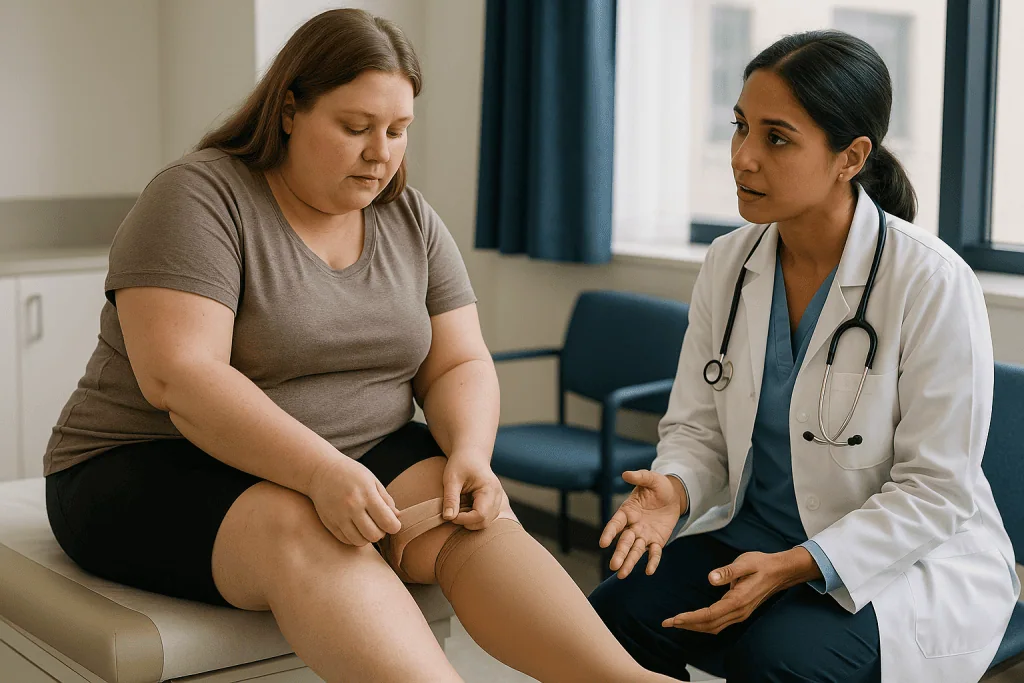
Mechanically, compression does three things. It supports the walls of small blood and lymph vessels so less fluid leaks into tissue. It assists the calf muscle pump, pushing fluid upward with every step. And it reduces the shear forces that make lipedema tissue ache after a day on your feet. Many people report that the heaviness eases within days of wearing a properly fitted garment, though the fat itself does not shrink.
Fit is everything. Off-the-shelf circular-knit stockings designed for varicose veins often roll, cut in at the knee or ankle and worsen pain in nodular tissue. Flat-knit garments, measured and often custom-made, distribute pressure more evenly across irregular contours. A trained fitter or lymphedema therapist can advise on class of compression, which is decided by the treating team rather than by the patient alone.
Compression is a long-term commitment rather than a course of treatment. Garments lose elasticity and are typically replaced on a schedule the fitter will suggest. Heat makes them less tolerable, so some people use lighter weights in summer and heavier in winter. None of this is glamorous, which is partly why people skip it. Yet when surgeons assess whether someone is a candidate for liposuction, the question they ask first is usually whether consistent, well-fitted compression has been tried and for how long. It is both a treatment and a test.
Manual lymphatic drainage: what the evidence does and does not show
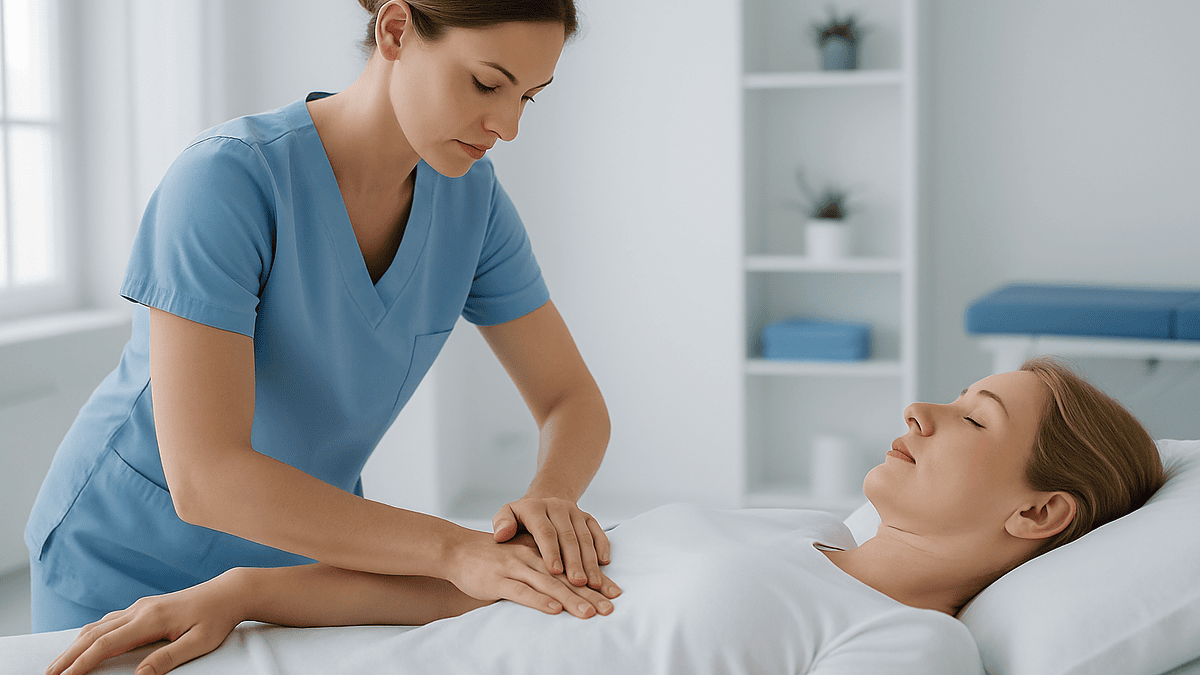
Manual lymphatic drainage, usually shortened to MLD, is a gentle, rhythmic skin-stretching technique performed by a trained therapist to encourage lymph fluid to move toward functioning lymph nodes. It forms part of complete decongestive therapy, the structured program developed for lymphedema that also includes bandaging, exercise and skin care.
For lipedema specifically, the evidence is modest. The NHS lists MLD among non-surgical options that may help with pain and swelling, and Johns Hopkins includes it in the standard conservative package. What the published literature shows is mainly small studies and patient-reported improvement in heaviness, tenderness and limb circumference over weeks of treatment, often when combined with compression. What it does not show is any reduction in the diseased fat itself. MLD moves fluid; it does not dissolve tissue.
That has two implications. First, MLD is most likely to help the person whose dominant complaint is swelling and tightness that worsens through the day, and least likely to help the person whose main problem is bulk or shape. Second, because effects are temporary, it works best as part of a routine rather than a one-off course, which raises practical questions about time and access that a care team can help you think through.
Self-drainage techniques and pneumatic compression pumps, inflatable sleeves that squeeze the limb in sequence, are sometimes used to extend the benefit between sessions. These too have limited lipedema-specific data. The honest position is that MLD is low-risk, often comforting and reasonable to try, but it is a symptom tool, and a lack of response to it does not by itself mean surgery is needed.
Movement, water and weight: what helps alongside compression
Exercise advice for lipedema is specific rather than generic. High-impact activity on painful, bruise-prone legs tends to backfire, so the NHS and Cleveland Clinic both point toward low-impact options: walking, cycling, and above all water-based exercise.
Water deserves its reputation. Immersion provides natural, graduated compression that is strongest at the deepest point, so standing chest-deep already supports the legs more than most garments. Movement against water resistance strengthens muscle without jarring joints, and the calf pump works on every stroke. People who cannot tolerate stockings in summer often find a pool is the one place their legs feel light.
Weight management needs careful framing, because so many people with lipedema have been harmed by blunt advice. Diet and exercise do not reduce lipedema fat, and expecting them to is a recipe for discouragement. What weight stability does do is protect the parts that can change: it limits strain on joints already loaded by heavy limbs, lowers the risk of secondary lymphedema and reduces co-existing non-lipedema fat that compounds the overall burden. Johns Hopkins notes that weight gain can worsen lipedema symptoms, which is a reason for stability, not a reason for blame.
Skin care rounds out the conservative package. Dry, stretched skin in folds between fatty lobules is vulnerable to fungal infection and cellulitis, a bacterial infection of the skin and underlying tissue that can spread quickly. Daily moisturizing, drying between folds and prompt attention to cuts are unglamorous habits that prevent hospital admissions. Clinicians will often ask about these routines before any surgical discussion, because healing after liposuction depends on healthy skin.
Will a GLP-1 medicine help with lipedema?
The question arrives in almost every consultation now, usually phrased around a brand name. The class in question is GLP-1 receptor agonists, injectable medicines originally developed for type 2 diabetes that mimic a gut hormone to slow stomach emptying and reduce appetite, producing weight loss over months in people with obesity.
Here the evidence is clear about what is missing. There are no large controlled trials showing that GLP-1 medicines reduce lipedema fat or lipedema pain. Lipedema tissue resists conventional weight loss, and nothing published so far establishes that medically induced weight loss behaves differently. Early case reports and small observational series exist, but they cannot separate improvement in general obesity from any effect on the diseased tissue, and they are not the basis for recommendations in any mainstream guideline.
That does not make the medicines irrelevant. Many people with lipedema also carry non-lipedema weight, often with insulin resistance or other metabolic conditions for which these medicines are licensed. Reducing that component can ease joint load, improve mobility and make compression easier to wear. Some surgeons also prefer that overall weight be stable before operating, and a prescribing clinician may consider medical options as part of that preparation when there is an independent indication.
Side effects, which commonly include nausea, digestive upset and loss of lean muscle alongside fat, deserve weight in the decision, and the medicines are not appropriate for everyone. Whether to start, continue or stop any of them is a judgment for the prescriber who knows your full history. The useful question to bring is not whether a medicine treats lipedema, since current evidence says it does not, but whether it addresses something else in your health picture that happens to make lipedema easier to live with.
When does lipedema need surgery? The criteria teams actually use
No single test says the moment has arrived. In practice, specialist teams look for a cluster of conditions, and the pattern is consistent across the NHS, Cleveland Clinic and Johns Hopkins descriptions of care.
| Factor | Points toward continuing conservative care | Points toward discussing surgery |
|---|---|---|
| Conservative care | Not yet tried, or tried inconsistently | Well-fitted compression, drainage and exercise used consistently without adequate relief |
| Pain and function | Controlled; walking and daily tasks manageable | Persistent pain, difficulty walking, knee or hip strain from tissue bulk |
| Progression | Stable over repeated assessments | Documented increase in limb size or stage despite treatment |
| Weight | Fluctuating or rising | Stable for a sustained period agreed with the team |
| Lymphatic status | Early secondary lymphedema not yet optimized | Lymphedema absent or well controlled |
| General health | Uncontrolled conditions affecting anesthesia or healing | Medical conditions optimized and reviewed |
Three themes dominate. The first is a genuine conservative trial, not a token one; surgeons want to see that compression was fitted properly and worn, because pain that compression controls does not need an operation. The second is function: surgery is justified by what the tissue is doing to a person’s life, not by its size on its own. The third is stability, since operating on a limb that is actively changing makes results harder to maintain.
The NHS is candid that liposuction for lipedema is not routinely funded in its system because the evidence base, while encouraging in symptom studies, is limited in size and quality. That caution is worth carrying into any consultation. Meeting the criteria above makes surgery a reasonable option to discuss. It does not make it compulsory, and the final judgment belongs to the treating team together with you.
What happens during lipedema surgery
Lipedema surgery is a specialized form of liposuction, the removal of fat through small incisions using a thin hollow tube called a cannula connected to suction. What distinguishes it from cosmetic liposuction is the goal and the technique: the aim is to reduce pain and restore function by removing as much diseased tissue as can be safely taken, while protecting the lymphatic vessels that run through it.
Two approaches are widely described. Tumescent liposuction involves infiltrating the tissue with a large volume of dilute fluid containing local anesthetic and a vessel-constricting agent, which firms the fat, limits bleeding and allows the procedure to be done under local anesthesia with sedation in some cases, or general anesthesia in others. Water-assisted liposuction uses a pulsed jet of fluid to loosen fat before suction. Both are intended to be lymph-sparing, meaning the cannula is moved along the long axis of the limb, parallel to lymphatic vessels, rather than across them, and with less force than older techniques.
Because lipedema often affects large areas, treatment is commonly staged over several sessions spaced weeks or months apart, each addressing one region such as the outer thighs, the inner thighs and knees, or the arms. The volume removed in one session is limited for safety, and the surgeon will explain how they plan the sequence.
The operation is typically a day case or an overnight stay depending on volume and anesthesia. Compression garments are applied in the operating room and worn continuously afterward, and most protocols ask patients to walk on the same day to reduce clot risk. In stage 3 disease, large folds of skin may need separate excisional procedures later, since liposuction removes fat but cannot remove excess skin.
Lipedema surgery recovery: the first days and weeks
Recovery follows the general pattern described by the NHS for liposuction, with the added weight of lipedema-specific tissue that bruises more readily. The first two or three days bring the heaviest fluid leakage from incision sites; this is expected and absorbent dressings are used. Bruising is often extensive and can look alarming before it fades, usually over a few weeks.
Compression is non-negotiable in this phase. Garments are worn around the clock in the early weeks and then according to the surgeon’s plan, with the NHS describing several weeks of compression as typical after liposuction. Many teams also arrange manual lymphatic drainage sessions during recovery, on the reasoning that it helps clear the fluid and inflammation that follow surgery and may reduce the risk of persistent swelling.
Walking starts the same day and increases gradually. Most people return to desk-based work within about two weeks, again in line with NHS guidance on liposuction, while strenuous activity and swimming wait until incisions have fully healed and the surgeon clears them. Numbness, tingling and firm, lumpy areas in the treated tissue are common for weeks and usually soften with time and gentle massage.
Setting expectations about timelines matters. Swelling obscures the result for a long while, and the NHS notes it can take several months for the final appearance to settle. Pain relief, interestingly, is often reported sooner than shape change, which fits with the idea that removing inflamed tissue addresses symptoms directly. If multiple sessions are planned, the team will usually wait until the previous area has recovered before proceeding. None of these ranges is a promise; individual recovery varies with the volume removed, the stage of disease and general health.
Risks, limits and what surgery cannot do
Every operation carries risk, and honest counseling lists it. The NHS summarizes liposuction risks as including bleeding, infection, fluid collections beneath the skin called seromas, blood clots in the leg veins, uneven contours, persistent numbness and, rarely, more serious complications related to fluid shifts or anesthesia. Lipedema adds specific concerns: the tissue bleeds and bruises more, large volumes are often involved, and damage to lymphatic vessels can cause or worsen lymphedema if the technique is not lymph-sparing.
The limits are as important as the risks. Liposuction does not treat the underlying disorder, so new lipedema fat can develop in untreated or even treated areas over time, particularly with weight gain or hormonal change. It does not remove loose skin, which may require later excision. It does not replace compression; most teams advise continued garment use after recovery, though sometimes at a lighter class. And it does not reliably resolve secondary lymphedema that has already become established.
Evidence on long-term outcomes comes mainly from follow-up studies in surgical centers rather than independent randomized trials. Those studies generally report reduced pain, less bruising and improved mobility that persist for years in many patients, but they share the limitations of any uncontrolled series, including the possibility that the people who return for follow-up are those who did well. The NHS reflects this by describing the research as encouraging while noting it is limited.
Deciding well means weighing a real but imperfect evidence base against your own symptoms, the surgeon’s experience with lymph-sparing technique and your capacity for a demanding recovery. A team that volunteers the limits alongside the benefits is usually a team worth listening to.
Who is usually asked to wait, and why
Being asked to wait is not a rejection. It usually reflects a specific, fixable reason, and knowing the common ones helps you plan.
The most frequent is an incomplete conservative trial. If compression was never professionally fitted, or was worn only occasionally, the team cannot tell how much of your pain is treatable without surgery. A structured period of consistent care, often several months, resolves that question in either direction.
Unstable weight is the second. Significant weight gain after surgery can bring back disproportion and makes results hard to interpret, while rapid loss changes skin laxity. Many teams ask for stability over a period they define before scheduling.
Active medical issues come next. Uncontrolled diabetes, poorly managed blood pressure, smoking, certain clotting disorders and some medicines affect anesthesia safety and wound healing. Optimizing these is part of preparation, and the surgeon will coordinate with the relevant prescribing clinicians rather than adjusting anything themselves.
Secondary lymphedema that has not yet been decongested is another reason to pause. Operating on a limb full of fluid raises complication risk; a period of intensive decongestive therapy first often makes the eventual surgery safer and the result more durable.
Pregnancy, recent childbirth and the months around major hormonal change are typically times to defer, since tissue is shifting and results would be unpredictable. Finally, some people are asked to wait because their expectations do not match what the procedure can do. If the hope is slim, cosmetically perfect legs rather than less pain and better function, a frank conversation now prevents disappointment later. Each of these decisions sits with the treating team, and most are revisited rather than closed.
What people often get wrong about lipedema and surgery
The myths around this condition are durable, so it is worth naming the common ones directly.
It is just obesity. It is not. Lipedema fat is painful, bruises easily, spares the feet and resists dieting. People with lipedema can be any overall weight, and the Cleveland Clinic lists it as a distinct disorder of fat tissue, though obesity can coexist and worsen symptoms.
There is a new official name. Searches for a new name for lipedema usually reflect two things: the UK spelling, lipoedema, used by the NHS, and older terms such as painful fat syndrome or lipalgia. The World Health Organization’s ICD-11 classification lists lipoedema as its own entry, which is a formal recognition rather than a renaming. Adiposis dolorosa, sometimes confused with lipedema, is a different condition known as Dercum’s disease.
Surgery is a one-time fix. Liposuction removes tissue but not the disorder. Compression usually continues, multiple sessions are common and new fat can accumulate over time.
If compression does not shrink my legs, it is not working. Compression is for pain, swelling and progression, not for size. Judging it by circumference misses its purpose.
Lymphatic drainage removes fat. It moves fluid. Benefits are real for some but temporary and symptom-focused.
Weight-loss injections treat lipedema. No controlled evidence supports that. They may help co-existing obesity under a prescriber’s care.
Earlier surgery is always better. Earlier diagnosis is better. Surgery is reserved for people whose symptoms persist despite good conservative care, at any stage, and the NHS continues to describe the evidence as limited. Enthusiasm for operating early should be met with questions about what conservative care has been tried.
Questions to ask your care team
A good consultation leaves you with fewer unknowns, not more. These questions tend to surface the information that matters most.
- What stage and distribution of lipedema do you see, and is there any sign of secondary lymphedema?
- Which conservative measures have I genuinely completed, and which, if any, would you want to see tried or improved before considering surgery?
- What specifically do you expect surgery to change for me: pain, mobility, bruising, shape? And what will it not change?
- Which technique do you use, and how does it protect lymphatic vessels?
- How many sessions do you anticipate, over what span, and how is the volume per session decided?
- What type of anesthesia is planned, and where will I recover?
- What does your follow-up look like in the first week, the first month and the first year?
- What compression and drainage plan do you expect after surgery, and for how long?
- What complications have you seen in patients like me, and how were they managed?
- Will I need skin-removal surgery later, and how would that be sequenced?
- If my weight or hormones change after surgery, what should I expect?
- Who do I contact, day or night, if something worries me after the procedure?
Bring a written record of your conservative care: when compression was fitted, how often garments are worn, drainage sessions, exercise, weight over time. Teams make better decisions with that evidence in front of them, and it moves the conversation from impression to data. Take notes, or bring someone who can. If answers are vague about risks or limits, that itself is useful information. The decision to proceed, delay or decline belongs to you and the treating team together, and a thoughtful clinician will say so without prompting.
When to call your doctor
Some situations need prompt attention whether or not you have had surgery.
Seek urgent care for a limb that becomes suddenly more swollen, hot, red or painful, especially with fever or chills; this pattern suggests cellulitis, which can spread quickly in lipedema and lymphedema tissue and usually needs antibiotic treatment decided by a clinician. Swelling or pain in one calf, particularly if it is tender along the deep veins, warrants same-day assessment for a blood clot, and any sudden breathlessness or chest pain requires emergency services.
After lipedema surgery, contact the surgical team if bleeding soaks through dressings repeatedly, if a firm, enlarging or increasingly painful swelling appears under the skin, if incisions discharge cloudy or foul-smelling fluid, if numbness spreads or weakness develops, or if you feel faint, confused or unusually unwell. Skin that turns dusky or blistered under a compression garment needs the garment loosened and the team called.
Outside emergencies, arrange a routine review if pain, heaviness or bruising is worsening despite consistent conservative care, if you can no longer tolerate your compression garments, if walking or stairs are becoming harder, or if your mood is suffering under the weight of a long-term condition. Lipedema takes a psychological toll that is well recognized, and support is part of proper care.
None of the guidance in this article replaces an assessment by someone who can examine you. Treatment plans, including whether and when surgery is appropriate, are decisions for your treating team, informed by your history, your examination and your own priorities.
Frequently asked questions
When does lipedema need surgery?
Surgery is usually considered when consistent conservative care, including properly fitted compression, lymphatic drainage and low-impact exercise, has not adequately controlled pain, swelling or mobility, and the condition is still progressing. Teams also look for stable weight, optimized general health and realistic expectations. Meeting those criteria makes surgery reasonable to discuss, not mandatory; the decision rests with the treating specialist team.
What happens during lipedema surgery?
Lipedema surgery is a lymph-sparing form of liposuction. The tissue is infiltrated with fluid, then diseased fat is removed through small incisions with a thin cannula moved along the limb to protect lymphatic vessels. Water-assisted and tumescent techniques are both used. Because large areas are involved, treatment is commonly staged over several sessions, and compression garments are applied immediately afterward.
Will Ozempic help with lipedema?
There is no controlled evidence that GLP-1 receptor agonists, the class that includes semaglutide, reduce lipedema fat or lipedema pain. They can produce general weight loss, which may ease joint load and make compression easier in people who also have obesity. Whether such a medicine suits your situation is a decision for the prescribing clinician based on your overall health, not on lipedema alone.
What is the new name for lipedema?
There is no new official name. The UK spelling is lipoedema, which the NHS uses, and older terms include painful fat syndrome. The World Health Organization’s ICD-11 classification gives lipoedema its own entry, which recognizes it as a distinct condition rather than renaming it. Dercum’s disease, or adiposis dolorosa, is sometimes confused with lipedema but is a separate disorder.
Can lipedema stay at stage 1?
Some people remain at stage 1 for many years, but no treatment can guarantee it, and evidence on progression rates is limited. Weight gain, hormonal transitions and inactivity are described as factors that accelerate progression, while consistent compression, movement and weight stability are associated with slower change in clinical experience. Early diagnosis gives the widest range of options.
What is the difference between lipedema vs lymphedema?
Lipedema is a disorder of fat tissue that is symmetrical, painful to touch, bruises easily and spares the feet. Lymphedema is fluid swelling from an impaired lymphatic system, often one-sided, involving the foot or hand, with skin that may pit or thicken. The two can coexist, and long-standing lipedema can lead to secondary lymphedema, which changes both the risks and the treatment plan.
What does lipedema surgery recovery look like?
Expect fluid leakage from incisions for the first few days, extensive bruising that fades over weeks, and continuous compression wear in the early period. Walking begins the same day; most people resume desk work in about two weeks according to NHS liposuction guidance, with strenuous activity later. Swelling can take several months to settle, and pain relief often arrives before visible shape change.
Is there effective lipedema treatment without surgery?
Yes, and it comes first. Fitted flat-knit compression, manual lymphatic drainage, low-impact and water-based exercise, skin care and weight stability form the standard conservative package described by the NHS, Cleveland Clinic and Johns Hopkins. These measures control pain, swelling and progression rather than shrinking the fat, and many people manage well on them long term without ever needing surgery.
Does compression therapy reduce lipedema fat?
No. Compression supports small vessels, assists the calf muscle pump and reduces the tissue strain that causes aching, which is why heaviness often eases within days of a proper fit. It does not shrink diseased fat. Judging compression by limb circumference misunderstands its role; judge it by comfort, swelling and whether the condition is holding steady.
Can lipedema come back after liposuction?
It can. Liposuction removes diseased tissue but does not treat the underlying disorder, so new lipedema fat may accumulate in treated or untreated areas, particularly with weight gain or hormonal change. Follow-up studies from surgical centers generally report lasting symptom improvement in many patients, but these are uncontrolled series, and most teams advise continued compression and weight stability after recovery.
References
This article is for general information only and is not a substitute for professional medical advice. Please consult a qualified doctor about your individual situation.

More from the Blog

Hi Def Liposuction Recovery: Weeks in Compression, Bruising and When Definition Appears
Hi def liposuction recovery typically involves wearing a compression garment for several weeks, with bruising fading over the first few weeks and swelling settling…
Do You Need a Thigh Lift or Thigh Liposuction? How Skin Elasticity Decides
Whether you need a thigh lift or liposuction depends mainly on skin elasticity, not on how much fat is present. Liposuction removes fat and…
Laser Aesthetics vs Body Surgery: Which Skin and Fat Concerns Each One Actually Suits
Laser aesthetics and body surgery solve different problems. Lasers work best on skin-level concerns such as texture, sun damage, fine lines, small scars, and…

Vaginoplasty vs Perineoplasty: What Each Repair Addresses and When They Are Combined
Vaginoplasty and perineoplasty are different operations on neighboring tissue. Perineoplasty rebuilds the perineum, the skin and muscle between the vaginal opening and the anus,…

What Are the Risks of HD Liposculpture? Contour Irregularity, Fibrosis and Honest Limits
HD liposculpture carries the same risks as any liposuction, including contour irregularity, seroma, bruising, numbness, infection and, rarely, blood clots or fat embolism. Because…

Life After Monsplasty: Scar Placement, Clothing Choices and When Exercise Can Resume
Life after monsplasty usually means a scar tucked low in the pubic hairline or the natural crease, a supportive garment for several weeks, loose…