

Hi Def Liposuction Recovery: Weeks in Compression, Bruising and When Definition Appears

Key Takeaways
- High-definition liposuction treats the thin superficial fat layer just under the skin, which is why it bruises more, swells more and stays firm longer than deep-layer liposuction.
- Mayo Clinic describes a return to desk work within a few days and to strenuous activity after a few weeks, while the NHS says the treated area can take up to six months to settle completely.
- Compression garments are typically worn for a few weeks to limit fluid collection and help skin re-attach, but the exact schedule is set by the individual surgeon, and tighter is not better.
- Looking bigger around three weeks is usually fluid retention plus early fibrosis, the firm collagen phase of healing, and it typically softens over subsequent months.
- Constipation after lipo 360 is driven by anesthesia, opioid pain relievers, reduced movement and low fluid intake; fluids, fiber and walking are the first-line measures MedlinePlus lists.
- Removed fat cells do not regenerate in meaningful numbers, but remaining cells enlarge with weight gain, so Mayo Clinic ties long-lasting results to maintaining a stable weight.
Hi def liposuction recovery typically involves wearing a compression garment for several weeks, with bruising fading over the first few weeks and swelling settling gradually over months. Most people return to desk work within a few days and lighter exercise after a few weeks, but muscle definition tends to appear slowly as swelling and firmness resolve, sometimes taking up to six months. Your surgical team sets your individual timeline.
It is ten days after surgery and she is standing sideways in the bathroom mirror, garment peeled down to the hips, trying to find the abdominal lines she paid for under a landscape of yellow-green bruises and puffy skin. Nothing looks sculpted. Her waist is, if anything, wider than it was last week. She takes a photo, compares it with the one from the operating room, and feels her stomach drop for reasons that have nothing to do with fat.
This is the ordinary midpoint of hi def liposuction recovery, and almost nobody is warned how disorienting it feels. The procedure is sold on images of finished results; the healing is lived in weeks of compression, discoloration and swelling that hides everything.
What follows is the honest version: what the garment is doing, how bruising and swelling behave, why week three often looks worse than week one, and when definition actually tends to appear, grounded in what mainstream medical sources say rather than in marketing.
What actually happens during high-definition liposuction
Standard liposuction removes fat through small incisions using a cannula, a thin hollow tube attached to suction. High-definition liposuction, often shortened to hi def or HD lipo, uses the same tool with a different map. The surgeon thins the fat lying over the edges of muscles, such as the grooves beside the rectus abdominis (the ‘six-pack’ muscle) or the lower border of the chest, and deliberately leaves a little more fat over the muscle bellies. Once swelling settles, the skin drapes into those thinned channels and the outline underneath shows through.
Before any fat is removed, the area is filled with tumescent fluid: salt water mixed with a local anesthetic and a medicine that temporarily narrows blood vessels. Mayo Clinic explains that this firms the tissue, reduces bleeding and eases pain during and after surgery. Many surgeons then loosen the fat with energy before suctioning it, most commonly ultrasound (sound waves that break up fat cells) or a mechanically vibrating cannula. Neither is a separate operation; each is a variation in how fat is released.
The detail that matters most for recovery is depth. Ordinary liposuction works mainly in the deeper fat layer. HD work also treats the thin superficial layer just under the skin, and tissue disturbed that close to the surface bruises more visibly, swells more, and stays firm for longer. Incisions are usually a few millimeters long and may be stitched or left open to drain fluid in the first day or two. A compression garment goes on before you leave the recovery area.
One caveat: the institutions cited here describe liposuction as a whole. HD technique is a refinement within it, so most of what is known about healing comes from liposuction research generally rather than from HD-specific trials.
Who hi def liposuction is usually for, and who is usually asked to wait
Surgeons tend to describe the same profile: an adult already at or near a stable weight, with reasonable muscle tone under the skin and skin that still snaps back when pinched. Definition is revealed rather than created. If there is little muscle to reveal, or the skin has lost elasticity through large weight change, pregnancy or age, thinning the fat may produce loose folds or visible ridges instead of clean lines. Mayo Clinic is direct that liposuction is not a weight-loss method and does not treat cellulite or loose skin.

Health matters as much as shape. Teams commonly ask about diabetes control, heart and lung conditions, previous blood clots, bleeding disorders, and any medicine that thins the blood or affects clotting, including some over-the-counter pain relievers and supplements. The NHS notes that smoking slows wound healing and raises complication risk, so people who smoke are often asked to stop well in advance. Any change to a prescribed medicine is decided by the prescribing clinician, never on your own.
Who is usually asked to wait? People still losing weight, since sculpted contours would shift as fat elsewhere changes. Anyone planning pregnancy soon, because abdominal stretching can alter the result. Those with active skin infection at the site, poorly controlled chronic illness, or expectations no operation can meet. A stable body for several months, a plan for maintaining it, and a clear understanding that swelling will hide the outcome for a long while are the quiet prerequisites.
The final call rests with the treating team after examination. A surgeon who explains why you should wait is doing part of the job well.
Hi def liposuction recovery: what the first 72 hours are really like
Most people go home the same day or after one night, according to the NHS, and the first evening is a blur of drowsiness, thirst and the strange sensation of a firm garment holding everything in place. Expect the small incisions to leak a pinkish, watery fluid. This is leftover tumescent solution mixed with a little blood, not fresh bleeding. Absorbent pads under the garment and dark towels on the bed spare a lot of worry.
Discomfort is usually described less as sharp pain and more as the deep ache of an intense workout that reaches the whole treated area at once. HD work in the superficial layer can add a burning, sunburn-like quality to the skin. Pain medicines prescribed for this phase act in different ways: some reduce inflammation in the tissue, others dampen pain signaling in the nervous system. Which ones and for how long is set by the surgical team, and it is worth asking in advance what to do if the plan is not enough.
Movement starts sooner than most people expect. Short, slow walks around the home several times a day keep blood moving in the legs, one of the main ways surgical teams reduce clot risk. Getting up from lying down is easier by rolling to the side first. Sleeping slightly propped, with pillows under the knees, takes tension off a treated abdomen.
Fluids by mouth matter because a lot of body water has shifted into the tissues. Light meals, a temperature check if you feel feverish, and a glance at the garment edges for skin that is being pinched round out the first days.
HD lipo recovery timeline week by week
Timelines are ranges, not appointments. Two people with the same operation heal at different speeds, and your surgical team’s instructions override any general guide. Still, the broad shape of an HD lipo recovery timeline is consistent enough to plan around.
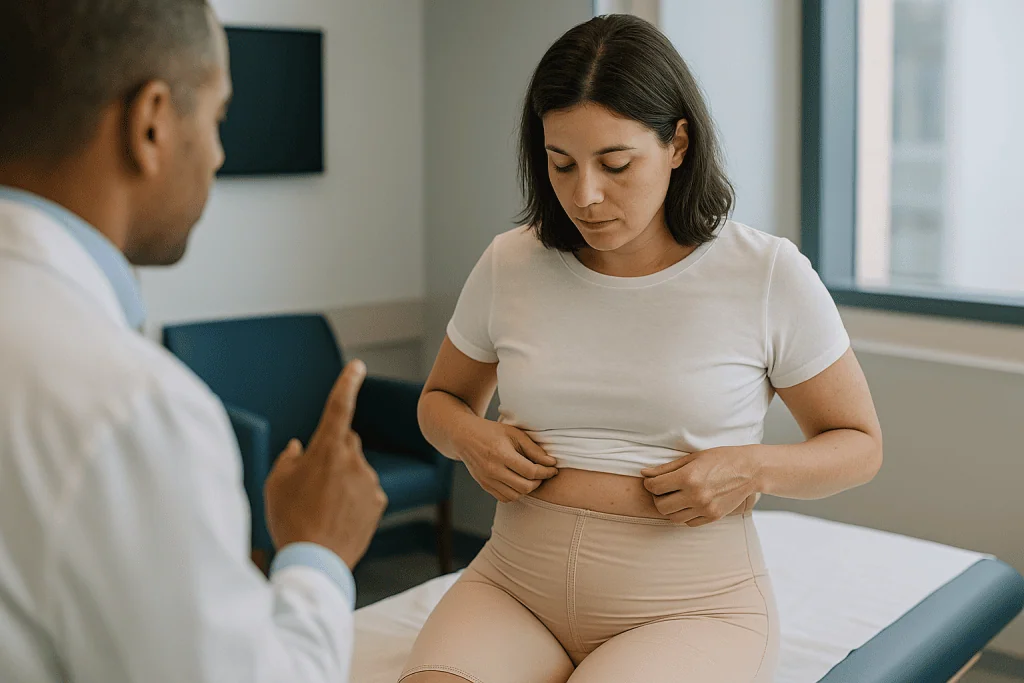
| Stage | What is usually happening | What most people are doing |
|---|---|---|
| Days 1–3 | Fluid drainage from incisions, peak soreness, swelling building | Resting, short indoor walks, garment on around the clock |
| Days 4–10 | Bruises darken then begin to change color; drainage stops | Returning to desk work within a few days if cleared (Mayo Clinic) |
| Weeks 2–4 | Swelling often most stubborn; tissue firm and lumpy; numbness common | Longer walks; strenuous activity still restricted for a few weeks |
| Weeks 4–8 | Bruising largely gone; firmness slowly softening; early contour changes | Gradual return to exercise as approved; garment often stepped down |
| Months 3–6 | Residual swelling clears; skin settles onto muscle outline | Normal activity; the NHS notes up to 6 months for the area to settle completely |
Two features deserve emphasis. First, the week 2 to 4 window is where morale often dips: acute pain has faded, yet the mirror shows a puffy, uneven midsection that looks nothing like the goal. That is expected, not a sign of failure. Second, the endpoint is measured in months. Mayo Clinic describes swelling subsiding over a few weeks with a leaner appearance emerging over several months, and the NHS gives the six-month figure for full settling. Because of its superficial work, HD technique tends to sit at the longer end of that range.
How long to wear compression after lipo, and why it matters
The compression garment is the least glamorous and most argued-about part of hi def liposuction recovery. Its jobs are straightforward. Firm, even pressure limits how much fluid collects in the space the fat used to occupy, supports the skin as it shrinks and re-attaches to the tissue beneath, and reduces the chance of a seroma, a pocket of clear fluid that can form under the skin and is listed by Mayo Clinic among the recognized complications of liposuction.
How long to wear compression after lipo has no universal answer, because garment protocols are set by individual surgeons based on the extent of the work. Both the NHS and Mayo Clinic describe wearing a compression garment for a few weeks after liposuction. In practice many teams use two phases: a firmer first-stage garment worn nearly continuously in the early weeks, then a lighter second-stage garment for daytime as swelling eases. Your team’s schedule is the one that counts.
Fit is where problems arise. A garment should feel snug and supportive, never like a tourniquet. Rolling edges that dig into the groin or under the ribs create deep creases in swollen tissue, and those creases can persist for weeks. Numb skin cannot warn you it is being pinched, so a daily visual check of the edges matters. Any foam or padding worn under the garment must sit exactly as shown, because uneven padding leaves uneven skin.
Wearing a garment tighter or longer than advised does not sculpt harder. It can restrict breathing, irritate skin and, in extreme cases, affect circulation. The aim is steady, even pressure for the period your surgeon sets, then a gradual step down.
Bruising after liposuction: what is normal and how it fades
Bruising is blood that has escaped from small vessels into surrounding tissue, and the color parade you see is hemoglobin breaking down: red and purple in the first days, then green and yellow as the pigment clears. HD lipo bruises more than deep-layer liposuction because superficial vessels are disturbed, and the injected tumescent fluid carries blood a surprising distance from where the work was done. A bruise on the inner thigh after abdominal work usually reflects gravity pulling fluid downward, not a new injury.
The NHS lists bruising and swelling among the expected effects of liposuction, and both the NHS and Mayo Clinic describe them fading over weeks rather than days. There is no honest way to accelerate this beyond the basics: protecting the area from pressure, walking to keep circulation moving, and not restarting any medicine or supplement that affects clotting without your team’s go-ahead. Some over-the-counter anti-inflammatory pain relievers and several common supplements increase bruising, which is why teams ask about them before surgery and again afterward.
Sun exposure on a bruised area can leave a brown stain that outlasts the bruise itself, particularly in skin that tans easily. Keeping treated skin covered until discoloration has cleared is a small habit with a long payoff.
What separates normal bruising from a problem? Normal bruising is flat, spreads slowly, changes color and does not become more painful. A rapidly enlarging, tense, very painful swelling that appears within the first day or two can signal a hematoma, a collection of blood under the skin, and that warrants a same-day call to the surgical team.
Swelling after HD liposuction: why you may look bigger at 3 weeks
‘Why do I look bigger three weeks after liposuction?’ is asked so often it deserves its own answer. Several ordinary processes are stacking up at once.
Fluid comes first. Surgery triggers inflammation, and inflammation means plasma leaks from vessels into tissue spaces. Tumescent solution adds volume of its own early on. With the lymphatic channels that normally drain that fluid bruised and disrupted, drainage slows. The result is a soft, doughy layer that adds visible girth exactly where fat was removed.
Firmness follows. Around two to four weeks, many people notice the treated area becoming hard and lumpy, with ridges or cords under the skin. This is early fibrosis, the body laying down collagen as part of healing. Over subsequent weeks and months it typically softens as the collagen remodels, which is one reason Mayo Clinic advises expecting contour irregularities while the remaining fat settles into position.
Then there is comparison error. Photographs taken immediately after surgery can look deceptively defined because tumescent fluid temporarily filled and tightened the skin. Comparing week three against that moment, rather than against the pre-surgery baseline, makes things seem worse than they are. The scale misleads too: retained fluid weighs something, and constipation after surgery adds abdominal bloat. Neither is fat.
Swelling after HD liposuction should be distinguished from a seroma. Generalized puffiness is symmetrical and firm-to-doughy. A seroma is a discrete, soft, often sloshing bulge that may enlarge when the garment is off. Seromas sometimes need to be drained with a needle by the surgical team, and pointing one out early is easier than waiting for it to organize.
When will I see results after liposuction? When definition appears
When will I see results after liposuction? Sooner than you might fear, later than you might hope, and not all at once. Mayo Clinic frames it in stages: swelling subsides over a few weeks and the area looks less bulky, then over several months a leaner appearance emerges. HD work adds a step, because definition depends on skin settling into channels that stay hidden while the superficial layer is swollen and firm.
A rough sequence many people describe: by the end of the first month the silhouette is smaller than before surgery even if the surface is uneven. Between the second and third months the firmness starts to give, and the first hint of a groove beside the abdominal muscles or under the chest may appear, often clearer in the morning before daytime fluid accumulates. By the NHS marker of up to six months for the area to settle completely, most swelling has resolved and the outline is close to its final form. Subtle refinement of skin texture can continue beyond that.
Definition also depends on things liposuction cannot control. Muscle bulk underneath casts the shadow; if training stops for months during recovery, the muscles the surgeon carved around may be smaller when swelling clears. Body fat percentage matters as well, since fat cells left behind enlarge with weight gain and blur the lines.
A practical approach is to photograph the area in the same light, pose and time of day once a month, and to stop checking daily. Daily inspection amplifies normal fluctuation. Monthly comparison shows the direction of travel, which is what actually matters.
How to poop after lipo 360: constipation after surgery
How to poop after lipo 360 is not a comfortable search, but it is a sensible one. Lipo 360 refers to liposuction all the way around the trunk, and a sore, swollen abdomen makes every part of using the bathroom harder.
The causes stack up. General anesthesia slows the gut for a day or more. Opioid pain relievers, if prescribed, bind to receptors in the bowel wall and reduce its movement, which is why constipation is among their most predictable effects. People move less, drink less than usual and eat differently. The abdominal muscles that help you bear down are bruised. Many people also fear that straining will damage incisions or ‘undo’ the result, so they hold back, and stool hardens the longer it waits.
MedlinePlus lists the same practical measures for constipation that surgical teams tend to recommend: plenty of fluids, fiber from fruit, vegetables and whole grains, and regular physical activity, which after liposuction means the walking you are already meant to be doing. A footstool that raises the knees above the hips changes the angle of the pelvis and reduces the need to push. Bracing a pillow gently against the abdomen supports the sore area.
Laxatives, stool softeners and fiber supplements all exist, and many teams suggest one preemptively. Which product and when to start it is a decision for the prescribing clinician, since some interact with other medicines or suit some people poorly. If a pain medicine is the culprit, the team may adjust the plan; do not change it yourself.
Straining will not tear internal work, but it hurts and raises pressure in swollen tissue. Several days without a bowel movement, especially with vomiting or a hard, distended belly, is a reason to call.
Lymphatic drainage massage and other aftercare: what the evidence shows
Search results for HD lipo aftercare are crowded with lymphatic drainage massage packages and ‘recovery’ intravenous drips. It is worth separating what mainstream evidence supports from what is simply popular.
Lymphatic drainage massage is a very light, rhythmic technique intended to encourage fluid to move along lymph vessels toward the nodes. Cleveland Clinic describes it as an established part of care for lymphedema, the chronic swelling that follows lymph node damage. Many surgeons recommend it after liposuction on the reasoning that treated tissue is swollen for similar mechanical reasons. What the evidence actually shows is thinner: small studies and a great deal of clinical experience, but no large trial demonstrating that massage changes the final contour or speeds the appearance of definition. Performed gently by someone experienced with post-surgical tissue, and approved by your surgeon, it is generally considered low risk, and many people find it eases the tight, heavy feeling. Deep or vigorous massage in the early weeks can worsen bruising.
Intravenous vitamin or hydration drips marketed for recovery have no evidence base in healthy adults who can drink. The NHS and Mayo Clinic make no mention of infusions in their aftercare guidance. Drinking to thirst and eating protein-rich meals does the same job without a needle.
The unglamorous measures carry the weight: wearing the garment as instructed, walking daily, keeping incisions clean and dry as directed, not smoking, limiting alcohol while tissue heals and while taking pain medicines, and attending every follow-up so the team can catch a seroma or infection early. Sun protection and scar care once incisions have fully closed are commonly advised.
How long does hi def liposuction last?
How long does high-definition liposuction last? The honest answer is: as long as the body underneath stays broadly the same. Adults have a relatively fixed number of fat cells, and cells that are suctioned out do not grow back in meaningful numbers. Mayo Clinic states that liposuction results are generally long lasting provided weight is maintained. The word ‘provided’ carries the whole sentence.
Fat cells left in place still respond to energy balance. Gain weight and they enlarge, both in the treated area and elsewhere. Because HD technique relies on a thin, even layer over muscle edges, even modest enlargement of those remaining cells can soften the grooves that make the result visible. Some people notice that new fat seems to settle preferentially in untreated zones, such as the back, arms or thighs, because those areas kept their full complement of cells.
Muscle is the other half of the equation. The shadows that read as definition are cast by muscle bulk. Consistent resistance training after clearance from the surgical team helps preserve the contours; a long lapse allows the outline to flatten regardless of fat.
Life events matter. Pregnancy stretches the abdominal wall and skin, and weight fluctuation, age-related loss of elasticity and hormonal shifts all alter how skin drapes. None of this means the operation ‘wears off.’ Fat that was removed remains removed. What changes is the frame around it.
No reliable percentage exists for how many people keep a defined look at five or ten years, and readers should be wary of anyone who quotes one. Longevity is a function of maintenance, not a property of the procedure.
Risks and complications during hi def liposuction recovery
Neutral information about risk is part of informed consent, and it belongs in a recovery guide because many complications announce themselves during healing. Mayo Clinic lists the recognized risks of liposuction: contour irregularities such as bumps or wavy skin, fluid accumulation under the skin (seroma), numbness that may be temporary or persistent, infection, internal puncture if the cannula goes too deep, fat embolism where fat enters a blood vessel and travels to the lungs or brain, kidney and heart problems from large fluid shifts, and toxicity from the local anesthetic in the tumescent fluid.
High-definition work adds emphasis to a few of these. Because the superficial layer is treated thinly, the margin between a smooth groove and a visible dent is narrow, so irregularities and asymmetry are a particular concern. Ultrasound energy used near the skin can, rarely, cause heat injury. Skin discoloration and prolonged firmness are more frequent than with deep-layer work alone. Treating the whole trunk, as in lipo 360, means larger fluid shifts and longer anesthesia, which is why teams limit how much can be safely removed in one session.
Blood clots deserve their own paragraph. Deep vein thrombosis, a clot in a leg vein, can form after any operation involving reduced mobility, and a fragment can travel to the lungs as a pulmonary embolism. The CDC lists swelling, pain, tenderness and warmth in one leg, and sudden breathlessness, chest pain or coughing up blood, as warning signs needing urgent care. Early walking, hydration and any clot-prevention measures your team prescribes are the main defenses.
Alternatives depend on the goal: diet and training alone, conventional liposuction without etching, non-surgical fat reduction devices with more modest effects, or, where loose skin is the issue, procedures that remove skin. Each has trade-offs, and a good consultation covers them without steering.
What people often get wrong about hi def liposuction recovery
Myths cluster around this procedure because the marketing images are so vivid. Correcting a few makes recovery easier to live through.
‘It is a shortcut to losing weight.’ Mayo Clinic is explicit that liposuction is not a weight-loss method. The volume removed is small relative to body weight, and the aim is shape, not the number on a scale.
‘Definition should be visible when the garment first comes off.’ Swelling and early firmness hide the result for weeks to months. The NHS figure of up to six months for full settling applies here more than to most liposuction.
‘Tighter compression means better results.’ Pressure that creases skin or restricts breathing damages tissue and can leave lasting lines. Even, comfortable pressure for the prescribed period is the goal.
‘Lymphatic massage is required, and more is better.’ Evidence that it changes the final outcome is limited. Gentle, surgeon-approved sessions may ease discomfort; deep massage early can increase bruising.
‘Looking bigger at three weeks means it failed.’ Fluid, fibrosis and bloating peak in this window. The mirror is measuring healing, not outcome.
‘Fat comes back in the same place.’ Removed cells do not regenerate in meaningful numbers, but remaining cells enlarge with weight gain, and untreated areas may gain more noticeably.
‘Numbness means permanent nerve damage.’ Altered sensation is common after liposuction and usually improves over months, though Mayo Clinic notes it can occasionally persist. Report it; do not panic over it.
‘Recovery is the same for everyone.’ Extent of treatment, age, skin quality, general health and the amount of superficial work all change the timeline. Your surgeon’s plan is the reference, not a forum post.
Questions to ask your care team before and after surgery
A consultation goes better with a written list. These questions shape hi def liposuction recovery rather than the procedure itself, and the answers will be specific to you.
- Which areas and how much of the superficial layer will you treat, and how will that change my swelling and firmness compared with standard liposuction?
- What anesthesia will be used, and will I stay overnight?
- Will I have drains, and if so, how are they cared for and removed?
- What is your compression protocol: which garment, how many hours a day, for how many weeks, and when does it step down?
- How do I recognize a seroma or hematoma, and what should I do if I suspect one?
- Which of my current medicines and supplements need to pause or continue, and who decides?
- What is the plan for pain relief, and what should I do if it is not enough?
- What measures will reduce my clot risk, and when should I start walking?
- When may I return to desk work, driving, lifting and structured exercise?
- Do you recommend lymphatic massage, and if so, what evidence and timing do you rely on?
- What contour irregularities are common with your technique, and how are they managed if they persist?
- What is my follow-up schedule, and how do I reach the team after hours?
- Realistically, when should I judge the result, and what would make you consider a revision?
Write the answers down or ask permission to record them. Post-surgery brain fog is real, and the compression schedule in particular is easy to misremember. If any answer conflicts with something you have read online, including this article, the surgeon’s instruction for your case takes precedence.
When to call your doctor
Most of recovery is uncomfortable but uneventful. A small number of signs need a call to the surgical team the same day, and a few need emergency services. Keep the after-hours number where you can find it.
Call the surgical team promptly for: a fever, or chills and feeling generally unwell; spreading redness, warmth or increasing pain around an incision; cloudy, foul-smelling or persistent drainage after the first days; a rapidly enlarging, tense or very painful swelling suggesting bleeding under the skin; a soft, fluctuating bulge that grows when the garment is off, which may be a seroma; skin over the treated area that becomes dusky, blistered or very dark; pain that escalates rather than easing after the first few days; no bowel movement for several days with a hard, bloated abdomen or vomiting; or new numbness or weakness in a limb.
Seek emergency care immediately for: sudden shortness of breath, chest pain, a racing heart or coughing up blood, which the CDC describes as possible signs of a clot in the lungs; swelling, pain, warmth or color change in one calf or thigh, possible signs of deep vein thrombosis; confusion, fainting, severe dizziness or difficulty staying awake; bleeding that soaks dressings and does not slow with firm pressure; or severe abdominal pain with a rigid belly.
The rule most surgeons give is simple: if you are worried enough to search for it, you are worried enough to call. A brief phone conversation that turns out to be nothing costs little. A delayed one can turn a manageable problem into a serious one. Your treating team, not a chat forum, is the right first call.
Frequently asked questions
How long does high def liposuction last?
Results are generally long lasting provided body weight stays stable, according to Mayo Clinic. Fat cells that were removed do not grow back in meaningful numbers, but the remaining cells enlarge with weight gain and can blur the muscle grooves that define the result. Muscle bulk underneath also matters, so consistent training after clearance helps preserve the contours. No reliable long-term percentage exists.
How to poop after lipo 360 without straining?
Drink plenty of fluids, eat fiber from fruit, vegetables and whole grains, and keep up the short walks your team has asked for; these are the measures MedlinePlus lists for constipation. A footstool that raises the knees reduces the need to push, and a pillow braced against the abdomen supports sore tissue. Ask your prescribing clinician before using any laxative or stool softener.
Why do I look bigger 3 weeks after liposuction?
Because fluid and early scar tissue peak around this time. Inflammation pushes fluid into the treated area while bruised lymphatic channels drain it slowly, and the body lays down firm collagen that feels lumpy. Mayo Clinic advises expecting contour irregularities while remaining fat settles. Constipation and fluid on the scale add to the impression. It typically softens over the following months.
How many days should I rest after liposuction?
Most people rest for a few days before returning to desk-type work, according to Mayo Clinic, then wait a few weeks before strenuous activity or exercise. Rest does not mean lying still; short, frequent walks from the first day help circulation and lower clot risk. Larger treated areas and more superficial HD work usually mean a slower return, and your surgical team sets the specific timing.
How long to wear compression after lipo?
Typically a few weeks, as both the NHS and Mayo Clinic describe, though the exact number of hours per day and total duration is set by your surgeon based on how much was treated. Many teams use a firmer garment early and a lighter one later. Wearing it tighter or longer than advised does not improve results and can crease swollen tissue or restrict breathing.
When will I see results after liposuction if it was high-definition?
Gradually, over months. Mayo Clinic describes swelling easing over a few weeks and a leaner look emerging over several months; the NHS says the area can take up to six months to settle completely. HD definition tends to appear toward the later end, because muscle grooves stay hidden until superficial swelling and firmness soften. Monthly photos show progress better than daily mirror checks.
What does a typical hd lipo recovery timeline look like?
The first days bring drainage, soreness and rising swelling; bruising changes color across the first two weeks; weeks two to four are often the puffiest and firmest; by one to two months bruising has largely cleared and exercise is gradually resumed with approval; and over three to six months residual swelling clears and the outline settles, per NHS and Mayo Clinic descriptions of liposuction healing.
Is lymphatic drainage massage necessary after HD lipo?
It is widely recommended by surgeons but not proven to change the final result. Cleveland Clinic describes lymphatic drainage massage as an established treatment for lymphedema; evidence for speeding definition after liposuction is limited to small studies and clinical experience. Gentle, surgeon-approved sessions are generally low risk and may relieve tightness. Deep massage in the early weeks can worsen bruising.
Is swelling after HD liposuction different from a seroma?
Yes. General swelling is symmetrical, firm-to-doughy and spread across the treated area. A seroma is a discrete, soft pocket of clear fluid that may slosh or enlarge when the garment is off, and Mayo Clinic lists it among recognized liposuction complications. Seromas sometimes need to be drained by the surgical team, so a suspicious localized bulge should be reported promptly rather than watched.
Is numbness normal during hi def liposuction recovery?
Altered or reduced sensation over the treated area is common and, according to Mayo Clinic, is usually temporary, though it can occasionally persist. Small skin nerves are disturbed during liposuction and recover slowly over months. Numb skin cannot feel a pinching garment edge, so check the skin visually each day. New numbness or weakness in a limb, rather than the treated skin, should be reported.
References
- NHS: Liposuction
- MedlinePlus: Liposuction
- Cleveland Clinic: Lymphatic Drainage Massage
- CDC: About Venous Thromboembolism (Blood Clots)
This article is for general information only and is not a substitute for professional medical advice. Please consult a qualified doctor about your individual situation.

Planning This Treatment in Turkey
Our full guide for international patients: techniques, hospital stay, recovery and cost.
More from the Blog
Do You Need a Thigh Lift or Thigh Liposuction? How Skin Elasticity Decides
Whether you need a thigh lift or liposuction depends mainly on skin elasticity, not on how much fat is present. Liposuction removes fat and…
Laser Aesthetics vs Body Surgery: Which Skin and Fat Concerns Each One Actually Suits
Laser aesthetics and body surgery solve different problems. Lasers work best on skin-level concerns such as texture, sun damage, fine lines, small scars, and…

Vaginoplasty vs Perineoplasty: What Each Repair Addresses and When They Are Combined
Vaginoplasty and perineoplasty are different operations on neighboring tissue. Perineoplasty rebuilds the perineum, the skin and muscle between the vaginal opening and the anus,…

What Are the Risks of HD Liposculpture? Contour Irregularity, Fibrosis and Honest Limits
HD liposculpture carries the same risks as any liposuction, including contour irregularity, seroma, bruising, numbness, infection and, rarely, blood clots or fat embolism. Because…

Life After Monsplasty: Scar Placement, Clothing Choices and When Exercise Can Resume
Life after monsplasty usually means a scar tucked low in the pubic hairline or the natural crease, a supportive garment for several weeks, loose…

Questions to Ask Before an Arm Lift: Scar Position, Drains, Garments and Follow-Up
Before an arm lift (brachioplasty), ask your surgeon where the scar will sit and how long it runs, whether drains are planned and what…