

When Is Earwax Build Up a Job for an ENT Specialist Rather Than Ear Drops?
Key Takeaways
- Earwax is produced only in the outer third of the ear canal and migrates outward with jaw movement, so wax pressed against the eardrum almost always got there by being pushed.
- NHS guidance describes using softening drops over a few days, typically 3–5, before judging whether an ear has cleared, and a brief worsening of muffling during that time is expected.
- The Mayo Clinic advises against putting any drops or water into an ear with a known or suspected perforation, ear tubes, recent surgery, pain or discharge.
- Specialist referral is usually reserved for failed or unsafe first-line care, an eardrum that cannot be seen, recurrent blockage in hearing aid users or narrow canals, and any red-flag symptom.
- A blocked feeling that persists after wax is cleared points to something behind the eardrum, most often Eustachian tube dysfunction or middle ear fluid, which an ENT can assess in the same visit.
- Ear candling generates no measurable suction and has caused documented burns and eardrum perforations, so mainstream guidance classes it as a hazard rather than a treatment.
Most earwax build up clears on its own or with a few days of softening ear drops, so an ENT is not the first stop. Referral is usually considered when a blocked feeling or muffled hearing persists after drops, when pain, discharge, dizziness or a known eardrum perforation is present, when hearing aids or ear surgery complicate home care, or when a clinician cannot see the eardrum. Sudden hearing loss needs same-day assessment.
The sound of a friend’s voice from the passenger seat comes through as if she is speaking from the next room. You tilt your head, tug at the earlobe, swallow hard. Nothing shifts. Somewhere under a plug of wax you cannot see, a perfectly good ear is waiting to be heard through again, and the question forming is a practical one: drops from the bathroom cabinet, or an appointment with someone who can actually look inside?
Knowing when to see an ENT for earwax is less about the wax itself and more about what sits behind it. Ear, nose and throat specialists, formally called otolaryngologists, spend surprisingly little of their week on routine wax. What they do spend time on is the small group of ears where home care is unsafe, has already failed, or is masking something else.
This explainer walks through how a healthy ear manages its own housekeeping, what drops can and cannot do, and the specific situations in which a specialist’s tools and eyes earn their place.
What earwax is actually doing in your ear
Earwax, or cerumen, is not dirt. It is a mixture of secretions from two kinds of glands in the skin of the outer third of the ear canal, blended with shed skin cells and a little trapped dust. The Cleveland Clinic describes it as a self-cleaning system: the wax traps debris, keeps the canal skin from drying and cracking, and is mildly acidic, which discourages bacteria and fungi from settling in.
The clever part is the exit strategy. Skin in the ear canal grows outward from the eardrum, like a very slow conveyor belt, and every time you chew or talk the jaw joint nudges the canal wall. Old wax rides that belt toward the opening and falls away unnoticed, often while you sleep. In most people this happens year after year without a single intervention.
Wax type varies. Some people produce a wetter, honey-colored cerumen, others a dry, flaky version; genetics decides, and neither type is a problem in itself. What tips a healthy system into a blockage is usually one of three things: the canal is narrow or crooked, so the belt jams; something is pushed in against the direction of travel, most commonly a cotton swab, earplug or hearing aid; or the wax is unusually hard and abundant, which becomes more common with age as the glands change and canal hairs coarsen.
Understanding this mechanism explains much of the advice that follows. Drops work by softening wax so the belt can move it again. A specialist steps in when the belt has stopped and needs help that gravity and softening cannot provide.
What are the signs of earwax blockage, and why they overlap with other problems
A blocked ear tends to announce itself as a feeling of fullness or pressure, often described as being underwater on one side. Hearing on that side dulls, particularly for higher-pitched sounds and speech in a noisy room. Some people notice a ringing or buzzing, a sensation clinicians call tinnitus, which often eases once the canal is clear. Itching, a faint earache and a tickly cough are also reported, because the ear canal shares nerve supply with the throat.

Less familiar is the dizziness. A dense plug pressing on the eardrum can produce a mild off-balance feeling, which the Mayo Clinic lists among the recognized features of blockage. A sudden change after showering or swimming is a classic pattern: water reaches a plug that was tolerable when dry, the wax swells, and hearing drops within minutes.
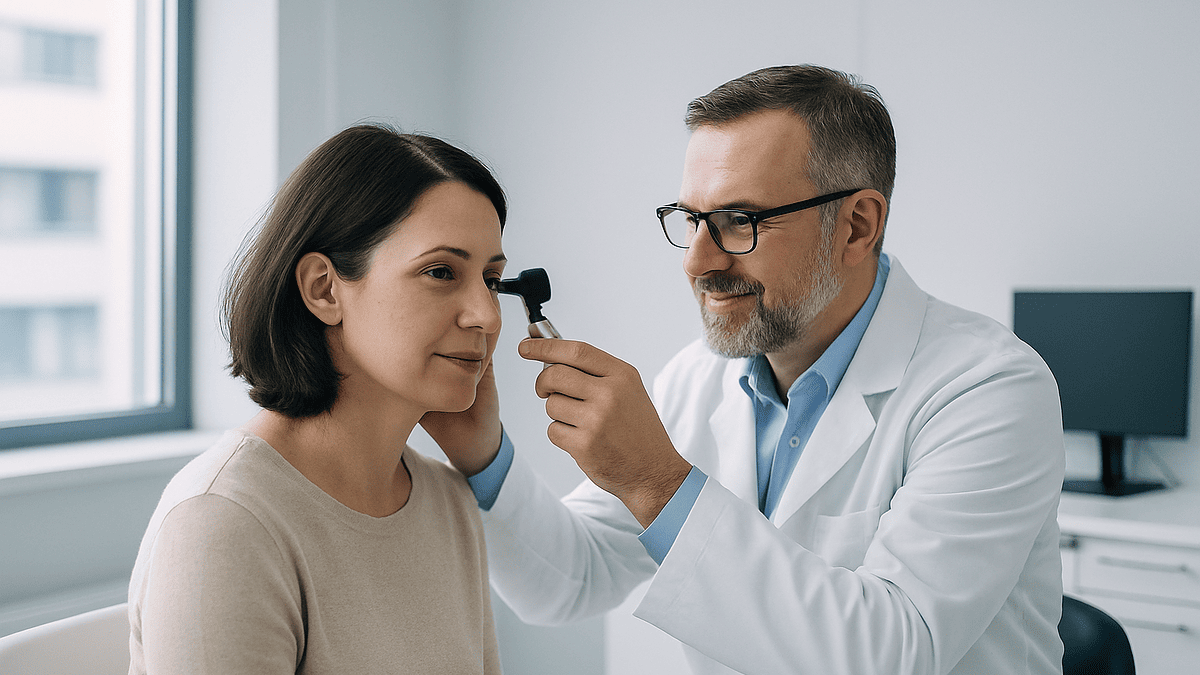
Here is the honest caveat. Every one of these sensations can also come from fluid behind the eardrum, an infection of the canal skin, a problem with the pressure-equalizing tube from the middle ear, or, rarely, a sudden loss of the inner ear’s hearing cells. A blocked feeling is a symptom, not a diagnosis. The only way to know that wax is the culprit is for someone to look, using an otoscope, the handheld lit magnifier clinicians use to view the canal and eardrum.
That is why guidance from the NHS and Mayo Clinic is consistent on one point: if an ear is bothering you and you have not had it examined, get it looked at before assuming wax and before pouring anything into it. The look takes seconds and changes the plan entirely.
How ear drops work, and how long they usually take
Softening drops do one job. They loosen the outer layers of a wax plug so the canal’s natural outward movement can carry fragments to the opening. They do not dissolve wax on contact, and they do not pull it out. That distinction matters because it sets realistic expectations.
Several ingredient classes are used. Simple oils, such as olive or almond oil, coat and soften. Water-based drops containing a small amount of a bicarbonate or peroxide compound break wax up more actively, sometimes with a fizzing sensation that surprises first-time users. The NHS and Harvard Health both describe these as reasonable first steps for adults with no history of eardrum damage; which one suits a particular ear is a conversation for a pharmacist or clinician, not a recipe for this page.
Timelines are gradual. NHS guidance describes using softening drops over a few days, typically in the range of 3–5, before judging whether the ear has cleared. Many people notice crackling or a sudden pop as a plug shifts, then a flood of hearing that feels almost too loud for an hour. Others notice nothing, because a softened plug may still be too large or too wedged to move.
Drops are not for everyone. The Mayo Clinic advises against putting anything in an ear with a known or suspected perforation, ear tubes, recent ear surgery, discharge, or pain. Fluid entering the middle ear through a hole can cause infection or dizziness. A history of ear problems is therefore itself a reason to skip the cabinet and book an examination, and any decision about drops in those circumstances belongs to the treating clinician.
When to see an ENT for earwax: the clinical triggers
Think of the pathway as three tiers. Tier one is watchful waiting and softening drops. Tier two is removal by a trained primary care clinician or nurse, who can irrigate or use a small instrument once they have seen the eardrum. Tier three is the specialist. Most ears never leave tier one, and most of the remainder are handled in tier two. When to see an ENT for earwax comes down to a short list of situations where tier three adds genuine safety or capability.
The first is failed or unsafe first-line care. If drops and a primary care attempt have not cleared the canal, or if irrigation is unwise because of a perforation, prior surgery, ear tubes or a single hearing ear, a specialist with a microscope and suction can remove wax under direct vision without pushing water into the middle ear.
The second is uncertainty about what is behind the wax. If a clinician cannot see the eardrum and the story includes pain, discharge, marked hearing loss or dizziness, an ENT can clear the view and assess the eardrum and middle ear in the same visit.
The third is a canal that keeps blocking. Recurrent impaction in someone who wears hearing aids, has a very narrow or hairy canal, has skin conditions such as eczema affecting the ear, or has had radiotherapy to the head and neck often needs a planned specialist routine rather than repeated crisis visits.
The fourth is any red-flag feature, covered in the final section, where specialist assessment is urgent regardless of whether wax is suspected. In each case the referral decision sits with the clinician who examined you.
Who is usually asked to wait, and who is seen sooner
Referral systems ration specialist time, and earwax sits low on the priority list for good reason: it is rarely dangerous and often resolves. Understanding how clinicians sort ears helps explain why one person is offered drops and a review while another is booked promptly.

People commonly asked to try drops first include otherwise healthy adults with a blocked sensation, no pain, no discharge, an intact eardrum on examination or a clear history of one, and no prior ear surgery. The NHS route for this group is softening drops over a few days followed by a review, with removal offered only if the ear remains blocked. Children with visible wax but no symptoms are often left alone entirely, since wax that is not causing trouble does not need removing.
People typically seen sooner include those with only one hearing ear, where any complication of removal carries high stakes; those with a perforated eardrum, ear tubes or previous mastoid or eardrum surgery, where irrigation is avoided; those with diabetes or a weakened immune system, in whom canal infections behave more aggressively; and anyone whose blockage comes with pain, bleeding, discharge, facial weakness or spinning vertigo.
A separate group is seen for reasons beyond the wax: hearing aid users who need a clear canal for an aid to function, people awaiting a hearing test that wax would distort, and those with recurrent blockage who need a maintenance plan.
None of this is a judgement on how much the blockage bothers you. It reflects where a specialist’s specific tools change the safety of the procedure or the accuracy of the diagnosis.
Will an ENT clear out ear wax? What happens at the appointment
Yes, ear wax removal by ENT is routine, though it is usually the opening act rather than the whole show. The appointment typically begins with questions: how long the ear has felt blocked, whether there is pain or discharge, any history of perforation, surgery, ear tubes or hearing aid use, and what has already been tried at home.
The specialist then looks. In most ENT rooms this is done with a binocular microscope rather than a handheld otoscope, giving a magnified, well-lit, three-dimensional view down the canal. You sit or lie with your head turned, and the clinician gently straightens the canal by drawing the outer ear back.
Removal itself takes one of three forms. Microsuction uses a fine metal tube attached to a low-pressure suction pump to lift wax out piece by piece under the microscope; it is noisy, a little cold, and over in a few minutes for most ears. Manual instrumentation uses a curette, a small loop or scoop, or fine forceps to hook fragments out. Irrigation, warm water directed along the canal wall to flush wax out, is used less often in specialist settings and avoided where the eardrum is not intact.
Once the canal is clear, the eardrum is inspected. This is the part that justifies the referral. The specialist checks for a perforation, retraction, fluid behind the drum, inflammation of the canal skin, or anything unexpected. If hearing remains reduced after clearance, a hearing test may be arranged that day or soon after.
Expect the whole visit to be shorter than the waiting room suggests. Expect, too, that the plan afterwards is agreed with you rather than handed down.
Ear drops vs irrigation vs microsuction: how the options compare
People often arrive at a specialist assuming one method is simply better. The truth is that each has a place, and the right choice depends on the ear in front of the clinician. The table below summarizes the mainstream picture described by the Mayo Clinic, NHS and Cleveland Clinic.
| Approach | How it works | Usually suits | Usually avoided when | Common sensations |
|---|---|---|---|---|
| Softening drops | Loosen wax so natural canal movement expels it | Healthy ears, mild blockage, first-line care | Perforation, tubes, recent surgery, discharge, pain | Fizzing, temporary worsening of muffling |
| Irrigation | Warm water flushes softened wax along the canal | Intact eardrum, no surgery, often in primary care | Perforation, single hearing ear, prior surgery, dizziness history | Fullness, brief dizziness, water in ear |
| Microsuction | Low-pressure suction under microscope lifts wax out | Failed irrigation, perforation, surgery, tubes, narrow canals | Very hard wax may need softening first | Loud noise, cold, brief lightheadedness |
| Manual instruments | Curette or forceps hook fragments under direct vision | Soft or fragmented wax, children, combined with suction | Wax deep against eardrum without magnification | Scraping feeling, occasional cough reflex |
Two honest notes. First, the comparative evidence is thinner than the confident marketing around each method suggests; a well-trained clinician using the technique they know best on a suitable ear is what matters. Second, every method carries small risks: canal skin abrasion, infection, temporary dizziness, and, rarely, eardrum injury. Microsuction reduces the risk of water entering the middle ear but introduces noise exposure; irrigation is gentle but blind. Your treating team weighs these against your ear’s history, not against a league table.
What happens if ear wax is left untreated?
The reassuring answer first: for most people, nothing dramatic. Wax that is not causing symptoms does not need removing, and the NHS explicitly advises leaving it alone. Many plugs loosen and fall out on their own within weeks, particularly in people who chew and talk normally and do not push anything into the canal.
Earwax blockage left untreated becomes a problem in a few predictable ways. Hearing stays reduced, which is more than an inconvenience. In older adults, uncorrected hearing loss is linked in observational studies to social withdrawal and cognitive strain, and a wax plug is one of the few fully reversible causes. Tinnitus and the off-balance feeling tend to persist while the plug presses on the eardrum.
A wedged plug can also trap moisture against the canal skin. That damp, dark environment favors otitis externa, an infection of the ear canal skin sometimes called swimmer’s ear, which brings pain, swelling and discharge. In people with diabetes or reduced immunity, canal infections can spread more deeply and need prompt specialist care.
Hearing aid users face a specific loop: wax blocks the aid, the aid pushes wax deeper, feedback whistles, and the device is set aside, so hearing worsens on two fronts. Anyone relying on an aid is generally encouraged to have canals checked at routine intervals rather than waiting for failure.
What does not happen is the frightening scenario some online sources imply. Wax does not erode the eardrum, does not cause permanent nerve deafness, and does not reach the brain. The realistic harms are discomfort, muffled hearing, infection risk and, occasionally, a missed diagnosis of something else hiding behind the plug. That last point is the strongest argument for getting a persistent blockage examined.
Eustachian tube blocked or earwax? Can an ENT tell the difference
The Eustachian tube is the narrow passage that runs from the middle ear, the air-filled space behind the eardrum, to the back of the nose. Its job is to equalize pressure and drain fluid; it opens briefly when you swallow or yawn, which is why ears pop on descent in an aircraft. When it fails to open properly, the middle ear develops a vacuum or fills with fluid, and the ear feels blocked and dull in a way that is almost indistinguishable, from the inside, from a wax plug.
Distinguishing the two is exactly what a specialist examination does. Once the canal is clear, the ENT looks at the eardrum. A drum pulled inward, dull rather than pearly, or with a visible fluid level or bubbles behind it, points to Eustachian tube dysfunction or middle ear fluid. A clear, mobile drum with the wax gone points to the wax having been the whole story.
Further tests refine the picture. Tympanometry gently changes air pressure in the canal and measures how the eardrum moves; a stiff drum suggests fluid or negative pressure behind it. A hearing test can separate conductive loss, where sound is physically blocked, from sensorineural loss, where the inner ear or nerve is affected. In adults with one-sided persistent Eustachian tube symptoms, a specialist may also examine the back of the nose with a thin flexible endoscope to look at the tube’s opening.
So the practical message is this: a blocked feeling that survives wax clearance is not a failure of the procedure. It is useful information, and it is the reason a specialist rather than a syringe is sometimes the right first move when symptoms include pressure changes, a cold that will not settle, or hearing that fluctuates through the day.
Why hearing aids, earbuds and narrow canals change the picture
The ear canal’s conveyor belt assumes an open exit. Anything that sits in the opening for hours a day interrupts it, and the modern ear is busier than it has ever been. Hearing aid domes, in-ear monitors, wireless earbuds worn through commutes and workouts, foam earplugs at night: each one blocks outward migration and, on insertion, nudges wax back toward the drum.
Hearing aid users are the group clinicians think about most. The Mayo Clinic and Cleveland Clinic both note that aids increase the likelihood of impaction, partly by obstruction and partly because the ear responds to a foreign object by producing more wax. Aids also fail quietly when their receiver ports clog, so a user may blame the device or their hearing when the real issue is a canal that needs clearing. Audiology teams commonly recommend routine checks rather than reactive ones, and specialist microsuction is often the preferred method because it avoids water contact with the aid’s mold and because many long-term users have canals that have been instrumented before.
Anatomy matters too. Some people are born with canals that are unusually narrow or sharply angled; others acquire bony outgrowths, called exostoses, from years of cold-water swimming. Skin conditions such as eczema and psoriasis can flake into the canal and mix with wax to form a stubborn, dry plug. Older adults produce harder wax and grow coarser canal hairs that trap it.
In these ears, recurrence is expected, not a failure of hygiene. A specialist can map the anatomy, document the pattern, and set a sensible interval for planned clearance. That is a very different, and far calmer, relationship with earwax than a cycle of sudden blockages and urgent appointments.
What the following days and weeks usually look like after ear wax removal by ENT
The first sensation after a canal is cleared is often disproportion. The world sounds sharp, even harsh, and your own voice may seem loud. This settles within hours as the brain recalibrates to the restored signal. If hearing was reduced for weeks, the adjustment can take a day or two.
Mild aftereffects are common and short-lived. The canal skin may feel tender or itchy for a day, particularly if the plug was firmly adherent and the skin beneath was inflamed. A brief lightheaded or slightly off-balance feeling can follow suction or irrigation, because temperature change and pressure near the eardrum stimulate the balance organ; sitting for a few minutes before standing usually suffices. A little pinkish staining on a tissue is not unusual if the canal was abraded, though frank bleeding is not expected.
The Mayo Clinic advises keeping the ear dry for a day or so if the skin looked irritated, and avoiding cotton swabs entirely, since freshly cleared canals are easier to scratch. If the specialist prescribed drops for canal inflammation, the mechanism is anti-inflammatory or antimicrobial and the course is typically short; follow their instructions, and raise any questions with them rather than adjusting on your own.
Over the following weeks, two things are worth watching. First, whether hearing that remained reduced after clearance improves, stays the same or fluctuates; this shapes whether a hearing test or further assessment is needed. Second, how quickly wax returns. For most people the answer is many months or years. For hearing aid users or those with narrow canals, the interval may be shorter, and your team may suggest a review date rather than waiting for symptoms.
What people often get wrong about earwax removal
The most persistent myth is that a clean ear is a wax-free ear. The opposite is closer to the truth. The Cleveland Clinic and Harvard Health both make the point that wax protects the canal, and that stripping it out invites dryness, itching and infection. Visible wax at the ear opening is the system working, not failing.
Cotton swabs are the second error, and they are remarkably durable in bathroom cabinets despite decades of advice. A swab removes a little wax from the outer canal and compacts the rest against the eardrum, exactly where the conveyor belt cannot reach it. Harvard Health describes this as the single most common cause of the impactions clinicians see. Hairpins, keys and pen caps do the same with the added risk of a torn drum.
Ear candling deserves its own paragraph because it still circulates as a natural alternative. A hollow candle is placed in the ear and lit, on the theory that heat creates suction. The Mayo Clinic notes that studies show no suction is generated, the residue inside the candle is candle wax rather than earwax, and documented harms include burns to the face and canal, wax dripping into the ear and eardrum perforation. It is not a therapy; it is a hazard.
A subtler misunderstanding is that drops should work immediately and that no change after two nights means failure. Softening is gradual, and a brief worsening of muffling as the plug swells is expected. Conversely, some people assume a specialist can always clear an ear in one sitting; very hard wax sometimes needs softening first and a second visit.
Last, dizziness or hearing change after removal is not proof the clinician did something wrong. Brief vestibular stimulation is normal; persistent symptoms are what warrant a call.
Questions to ask your care team about earwax and your ears
A specialist appointment moves quickly, and the questions that matter most tend to surface in the car park afterward. Bringing a short list turns a procedure into a conversation. These are the ones that experienced clinicians say they wish more patients asked.
- What did you see once the wax was out? Is my eardrum intact and does the middle ear look normal?
- Was wax the whole explanation for my symptoms, or is something else contributing?
- Do I need a hearing test now, or only if hearing does not return over the next week or two?
- Which removal method did you use, and is that the method you would recommend for me in future?
- Are there reasons I should avoid softening drops or home irrigation, such as a perforation or previous surgery?
- Given my canal shape and whether I wear hearing aids, how often would you expect this to recur?
- Should I book a routine review, and if so at what interval?
- What signs after this procedure would you want to hear about the same day?
- Is there anything about my skin, my earbuds or my swimming habits that is making wax worse?
- If the blocked feeling comes back but you find no wax, what would the next step be?
Two of these carry particular weight. The first, about what the eardrum looked like, is the real clinical value of a specialist visit and is worth hearing in plain words. The last, about a blocked ear without wax, sets expectations for the possibility of Eustachian tube or middle ear issues and saves a repeat cycle of drops that were never going to help.
Write the answers down, or ask for them in the clinic letter. Ears blocked again in a year are far easier to manage when the last plan is in front of you.
When to call your doctor: red-flag signs that should not wait
Earwax is rarely urgent, but the ear as a whole can be. Some features mean a blocked feeling should be assessed promptly by a clinician, and ideally by an ENT, rather than treated at home or left for a routine slot. If any of the following apply, contact your care team the same day or use urgent care services.
Sudden hearing loss in one ear, arriving over minutes or hours, is treated as an emergency in mainstream guidance because sudden inner ear hearing loss has a narrow window for assessment; do not assume wax and do not wait for drops to work. Severe ear pain, especially with fever, swelling around the ear or a discharge that is bloody, thick or foul-smelling, suggests infection rather than wax and needs examination. Spinning vertigo, persistent vomiting or a marked loss of balance after any ear procedure, or arising spontaneously with a blocked ear, warrants urgent review.
Weakness or drooping on one side of the face, new numbness, or a severe headache with ear symptoms are signs that something beyond the canal may be involved and should be assessed without delay. Any ear symptom in a person with diabetes, a weakened immune system, or a history of ear surgery or a perforated eardrum deserves a lower threshold for calling, since complications in these groups progress faster.
After removal specifically, call if pain worsens rather than eases over 24 hours, if there is more than light staining of blood, if hearing that improved then drops again, or if dizziness does not settle within a few hours.
None of these signs diagnoses anything on their own. They are the cue for a trained person to look, and the decision about what happens next rests with the team who examine you.
Frequently asked questions
Will an ENT clear out ear wax?
Yes, clearing earwax is a routine part of an ENT appointment, usually by microsuction or fine instruments under a microscope. The specialist first asks about pain, discharge, surgery and hearing aid use, then examines the canal, removes the wax, and inspects the eardrum and middle ear. If hearing remains reduced after clearance, a hearing test may follow. The appointment is typically short, and the aftercare plan is agreed with you.
What are the signs of earwax blockage?
A blocked or full feeling, muffled hearing on one side, ringing, itching, mild earache and occasionally a slightly off-balance sensation are the features clinicians associate with wax impaction, according to the Mayo Clinic. The same sensations can come from middle ear fluid, canal infection or Eustachian tube problems, so an examination with an otoscope is the only way to confirm that wax is responsible.
What happens if ear wax is left untreated?
Usually very little; asymptomatic wax does not need removing and many plugs fall out on their own. If a blockage persists, hearing stays reduced, tinnitus and imbalance may continue, and trapped moisture raises the risk of canal infection. Hearing aid users may find devices fail or whistle. Wax does not damage the eardrum or cause permanent nerve deafness, but a persistent blockage should be examined so nothing else is missed.
Can an ENT see if your Eustachian tube is blocked?
Yes, indirectly and reliably. Once the canal is clear, the specialist looks at the eardrum for retraction, dullness or fluid behind it, which suggest the Eustachian tube is not equalizing pressure. Tympanometry measures how the drum moves under gentle pressure changes, and a hearing test separates blocked sound from inner ear loss. In persistent one-sided cases, a thin endoscope through the nose can view the tube’s opening.
How long should I try ear drops before seeing someone?
NHS guidance describes a course of softening drops over a few days, typically around 3–5, followed by a review if the ear remains blocked. Muffling may briefly worsen as the plug swells before it loosens. If there is pain, discharge, a history of perforation, ear tubes or ear surgery, or sudden hearing loss, skip the drops and arrange an examination first, since drops may be unsafe in those situations.
Is ear wax removal by ENT painful?
Most people describe microsuction as noisy and a little cold rather than painful, and manual removal as a scraping sensation. Discomfort is more likely if the canal skin is already inflamed under a hard plug. Brief lightheadedness can follow because the balance organ sits close to the eardrum. Tell the clinician if anything hurts; they can pause, soften the wax, or arrange a second visit rather than push through.
Do hearing aids cause more earwax build up?
They increase the likelihood of impaction, according to the Mayo Clinic and Cleveland Clinic. An aid sits in the canal opening and blocks the natural outward migration of wax, pushes wax inward on insertion, and can stimulate extra production as the ear responds to a foreign object. Many audiology and ENT teams recommend planned canal checks at regular intervals for aid users rather than waiting for the device to fail.
Why do my ears feel blocked after wax removal?
Two explanations are common. Hearing may be adjusting; after weeks of muffling the restored signal can feel odd for a day. More importantly, if the blocked feeling genuinely persists, wax may not have been the whole story. Fluid behind the eardrum, Eustachian tube dysfunction or inner ear hearing loss can all feel similar from the inside. Report a persistent blocked feeling to your care team so the next step can be planned.
Is ear candling a safe alternative to seeing a specialist?
No. The Mayo Clinic reports that ear candling produces no measurable suction, that the residue inside the candle is candle wax rather than earwax, and that documented harms include burns to the face and ear canal, hot wax entering the ear, and eardrum perforation. Mainstream guidance does not recognize it as a treatment for wax. Softening drops or removal by a trained clinician are the recognized routes.
Can earwax cause dizziness or ringing in the ear?
It can. A dense plug pressing on the eardrum is a recognized cause of tinnitus and a mild off-balance or dizzy feeling, and both often ease once the canal is cleared. Spinning vertigo, dizziness with vomiting, or ringing that persists after wax is removed points away from wax and toward the middle or inner ear, and those symptoms should be assessed rather than attributed to a plug.
References
This article is for general information only and is not a substitute for professional medical advice. Please consult a qualified doctor about your individual situation.

More from the Blog

When Does Vertigo Need an ENT Specialist Rather Than Waiting for It to Pass?
See a doctor promptly for any first episode of vertigo, and seek same-day or emergency care if spinning arrives with a severe new headache,…

After an Intratympanic Steroid Injection: Ear Fullness, Dizziness and What to Report
After an intratympanic steroid injection, most people notice temporary ear fullness, muffled hearing and brief dizziness that settle within hours to a few days,…

Living With an Implantable Hearing Aid: Swimming, Skin Care Around the Post and Daily Use
Living with an implantable hearing aid usually means a short daily routine: the external sound processor comes off before swimming, bathing or sleeping, and…

Flying and Pressure Changes After Stapedectomy Surgery: What International Patients Ask
Most surgeons ask patients to avoid flying after stapedectomy for a period of weeks, not days, because cabin pressure changes stress the healing eardrum…

Mastoid Surgery Recovery: Dressings, Ear Drops and When Dizziness and Fullness Settle
Mastoidectomy recovery usually means a padded head dressing for the first day or so, dissolvable or removable packing in the ear canal for several…

Who Is a Candidate for Endoscopic Sinus Surgery (ESS)? Chronic Sinus Disease and Nasal Polyps
Endoscopic sinus surgery is usually considered for adults with chronic rhinosinusitis, meaning sinus inflammation lasting 12 weeks or more, whose symptoms persist despite an…