Quick answer
Psoriasis is a chronic inflammatory skin disease in which the immune system speeds up skin-cell turnover, causing scaly, red, and sometimes itchy or painful plaques. At Acibadem in Turkey, psoriasis is evaluated by dermatologists and managed according to its type and severity with topical treatments, light therapy, and systemic or biologic medicines, with monitoring for related conditions when needed.
What is psoriasis?
Psoriasis is a long-term (chronic) condition of the immune system that mainly shows up on the skin. In people with psoriasis, the immune system: the body’s defense network, becomes overactive and sends faulty signals that make skin cells grow much faster than normal. Healthy skin cells usually mature and shed over the course of about a month. In psoriasis, this process is dramatically shortened, so new cells pile up on the surface before old ones have shed. The result is thickened, scaly patches of skin called plaques, which can be itchy, sore, or both.
Psoriasis is not an infection and it is not contagious. You cannot catch it from another person or pass it on by touch. It is classified under the medical code ICD-10 L40.9, which refers to psoriasis when the specific type has not been further defined.
The condition affects people of all ages, skin tones, and backgrounds. It can begin at any point in life, although it often first appears in early adulthood or, less commonly, in later middle age. Men and women are affected in roughly similar ways. Psoriasis tends to follow a relapsing and remitting course, which means symptoms flare up at times and then improve or almost disappear at others. For most people it is a lifelong condition, but with modern care it can usually be managed so that it interferes less with daily life.
Psoriasis is more than a skin problem. Because it involves the immune system, it can be linked with other health issues, including a form of joint inflammation called psoriatic arthritis, as well as an increased likelihood of conditions such as high blood pressure, diabetes, and depression. This is one reason doctors take psoriasis seriously even when the visible patches seem small.
Symptoms of psoriasis
Psoriasis symptoms vary widely from person to person, from a few small patches to widespread involvement of the skin. The most common signs include:
- Raised, well-defined patches of skin (plaques) that look red or pink on lighter skin and may appear purple, brown, or gray on darker skin
- Silvery-white or grayish scale covering the plaques
- Dry, cracked skin that may bleed, especially over joints
- Itching, burning, or soreness in and around affected areas
- Nail changes, such as small pits, thickening, discoloration, or the nail lifting away from the nail bed
- Scalp involvement, with flaking that can be mistaken for severe dandruff
- Stiff, swollen, or painful joints in people who develop psoriatic arthritis
Symptoms also differ by the type of psoriasis a person has:
- Plaque psoriasis is the most common form. It causes thick, scaly plaques that often appear on the elbows, knees, lower back, and scalp, usually on both sides of the body in a fairly symmetrical pattern.
- Guttate psoriasis appears as many small, drop-shaped spots, often on the trunk, arms, and legs. It frequently follows a throat infection, particularly in children and young adults.
- Inverse psoriasis affects skin folds such as the armpits, groin, and under the breasts. Because these areas are moist, the patches are usually smooth and shiny rather than scaly.
- Pustular psoriasis causes small, pus-filled bumps (pustules) on top of inflamed skin. The pus is caused by inflammation, not infection. It can be limited to the hands and feet or, rarely, spread across the body.
- Erythrodermic psoriasis is a rare but serious form in which most of the body’s skin becomes intensely red, inflamed, and shedding. It can disturb the body’s ability to control temperature and fluids and needs urgent medical care.
Symptoms often come and go in stages. During a flare, plaques may spread, thicken, and itch more. During quieter periods, patches may fade, flatten, and leave only slight discoloration behind. Common flare triggers include stress, skin injury, certain medications, infections, cold and dry weather, smoking, and heavy alcohol use, although triggers differ from person to person.
Causes and risk factors
The exact cause of psoriasis is not fully understood, but researchers agree that it results from a combination of genetics and environmental triggers acting on the immune system. In simple terms, certain inherited genes make the immune system prone to overreacting. When something sets it off, immune cells release chemical messengers that speed up skin cell production and cause inflammation, which is the body’s protective response gone into overdrive.
Recognized psoriasis causes and risk factors include:
- Family history. Psoriasis often runs in families. Having a parent or sibling with the condition increases the chance of developing it, although many people with psoriasis have no affected relatives.
- Infections. Streptococcal throat infections (“strep throat”) are a well-known trigger, especially for guttate psoriasis. Other infections and illnesses can also provoke flares.
- Skin injury. Cuts, scrapes, sunburn, tattoos, or even scratching can cause new psoriasis patches to appear at the site of the injury. Doctors call this the Koebner phenomenon.
- Stress. Emotional or physical stress is one of the most commonly reported flare triggers.
- Certain medications. Some drugs, including certain blood pressure medicines, lithium (used for mood disorders), and antimalarial drugs, can trigger or worsen psoriasis in some people. Stopping oral or injected steroid medicines abruptly can also provoke a flare. Never stop a prescribed medicine without medical advice.
- Smoking and alcohol. Both are associated with a higher risk of developing psoriasis and with more severe or treatment-resistant disease.
- Obesity. Excess body weight is linked to more severe psoriasis, and patches often form in skin folds and creases.
- Cold, dry weather. Many people notice their skin worsens in winter and improves with moderate sun exposure in summer.
It is important to understand that psoriasis is not caused by poor hygiene, and nothing a person did “wrong” made it appear. Triggers can bring on flares, but the underlying tendency is largely genetic and immune-based.
Diagnosis
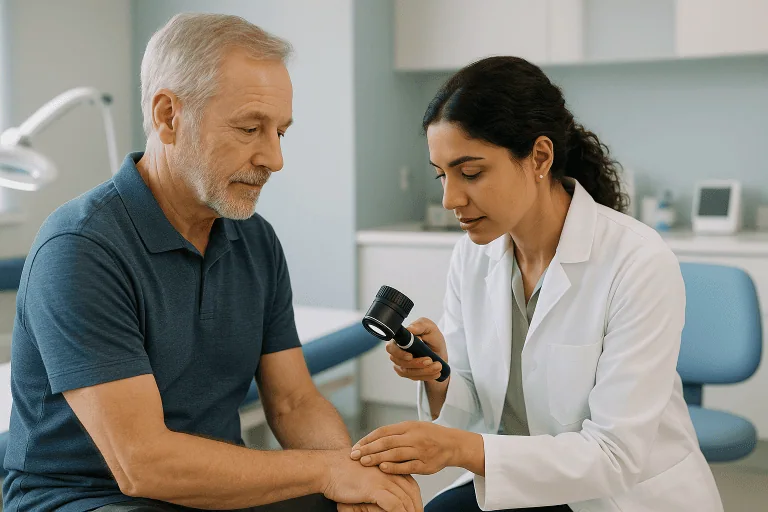
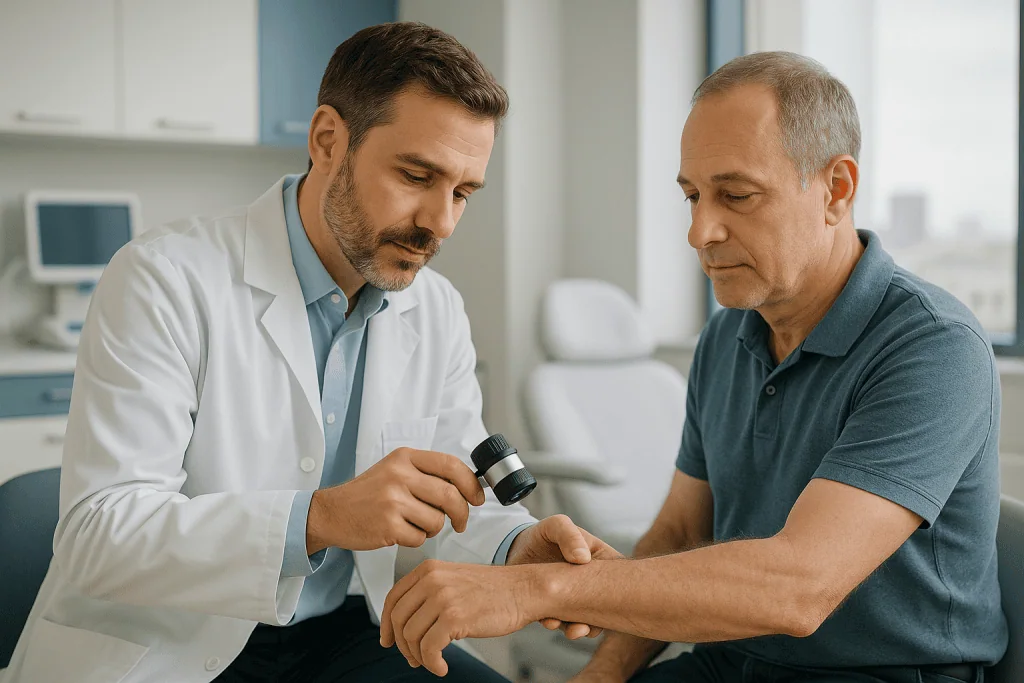
Psoriasis diagnosis is usually made by a doctor, often a dermatologist, a physician who specializes in skin conditions, based on a careful look at the skin, scalp, and nails, together with questions about your symptoms, medical history, and family history. In many cases, no laboratory test is needed, because the appearance and distribution of the plaques are often distinctive.
During the evaluation, your doctor may:
- Examine the skin, scalp, and nails to look for the typical raised, scaly plaques and characteristic nail changes.
- Ask about triggers and timing, such as recent infections, new medications, stress, or family members with psoriasis.
- Perform a skin biopsy if the diagnosis is uncertain. A biopsy means removing a very small piece of skin under local anesthetic so it can be examined under a microscope. This helps rule out look-alike conditions such as eczema, fungal infections, or other inflammatory skin diseases.
- Order blood tests in selected cases, not to confirm psoriasis itself, but to check overall health, look for related conditions, or prepare for certain treatments.
- Assess the joints if you report joint pain, stiffness, or swelling. If psoriatic arthritis is suspected, your doctor may arrange imaging such as X-rays or ultrasound and may refer you to a rheumatologist, a specialist in joint and autoimmune diseases.
Doctors also estimate how severe the psoriasis is, often by considering how much of the body surface is involved, how thick and inflamed the plaques are, and how much the condition affects quality of life. Severity guides treatment choices: what is appropriate for a few small patches differs from what is needed for widespread disease.
Treatment options
There is currently no permanent cure for psoriasis, but a wide range of effective treatments can reduce inflammation, clear or shrink plaques, and keep symptoms under control, often for long periods. Psoriasis treatment is tailored to the type and severity of the disease, the areas of the body involved, your general health, and your preferences. Care is typically coordinated through a hospital’s dermatology department; at Acibadem, for example, dermatologists manage the condition, working with rheumatologists when joints are involved. A general overview of how the condition is managed is available on the hospital group’s psoriasis treatment page.
Topical treatments
For mild to moderate psoriasis, treatment usually starts with medicines applied directly to the skin:
- Corticosteroid creams and ointments (anti-inflammatory steroid medicines) reduce redness, scaling, and itching. They come in different strengths and are used carefully to avoid thinning the skin.
- Vitamin D analogues, which are lab-made forms of vitamin D, slow down excess skin cell growth and are often combined with steroids.
- Moisturizers (emollients) soften scale, ease dryness and itching, and support other treatments.
- Coal tar and salicylic acid products help lift scale and calm inflammation, particularly on the scalp.
- Calcineurin inhibitors, non-steroid anti-inflammatory creams, may be used for sensitive areas such as the face and skin folds.
Phototherapy
Phototherapy means treating the skin with controlled doses of ultraviolet (UV) light under medical supervision, usually several times a week in a clinic. Narrow-band UVB is the most commonly used form. Phototherapy can be effective for widespread psoriasis that does not respond well to creams alone. It is quite different from using tanning beds, which are not a safe substitute and can damage the skin.
Systemic medications
For moderate to severe psoriasis, or when psoriatic arthritis is present, doctors may prescribe systemic treatments, medicines that work throughout the whole body:
- Conventional systemic drugs such as methotrexate, cyclosporine, or acitretin dampen the overactive immune response or slow skin cell turnover. They require regular monitoring with blood tests.
- Biologic medicines are newer injected or infused drugs that block specific immune signals involved in psoriasis. They can be highly effective for many people with severe disease, though they require screening and monitoring because they alter immune activity.
- Targeted oral medicines, small-molecule drugs taken by mouth, are another option for some patients who cannot use or prefer not to use injections.
Watchful waiting and self-care
When psoriasis is very mild and does not bother the person, a doctor may recommend simple skin care and observation rather than active medication. Everyday measures, regular moisturizing, gentle bathing, avoiding known triggers, not smoking, limiting alcohol, and maintaining a healthy weight, support all forms of treatment.
Surgery is not a treatment for psoriasis itself, as the condition arises from the immune system rather than a removable abnormality. Finding the right regimen sometimes takes time and adjustment, because treatments that work well for one person may work less well for another, and effectiveness can change over the years.
Living with psoriasis and outlook
Psoriasis is a lifelong condition for most people, but it is highly manageable, and the outlook has improved substantially with modern therapies. Many people achieve long periods with clear or nearly clear skin. Flares can still happen, often triggered by stress, infection, or seasonal changes, so ongoing follow-up with a dermatologist is helpful even when the skin looks good.
Living well with psoriasis often involves more than medication:
- Learn your triggers. Keeping a simple diary of flares can reveal patterns linked to stress, illness, weather, or specific products.
- Care for your skin daily. Regular moisturizing and gentle cleansing reduce dryness, cracking, and itching.
- Protect your overall health. Because psoriasis is associated with heart and metabolic conditions, routine checks of blood pressure, blood sugar, and cholesterol are sensible. A balanced diet, regular exercise, and not smoking benefit both the skin and general health.
- Address the emotional impact. Visible skin disease can affect confidence, relationships, and mood. Anxiety and depression are more common in people with psoriasis. Talking with your doctor, a counselor, or a patient support group can make a genuine difference, and treating the skin often improves well-being too.
- Watch your joints. Report any new joint pain, swelling, or morning stiffness promptly, because early treatment of psoriatic arthritis helps protect the joints from damage.
No doctor can promise that psoriasis will never return, and honest care means acknowledging that treatment goals focus on control rather than cure. Even so, with the range of options available today, most people can expect meaningful, lasting improvement.
Frequently asked questions
What is psoriasis in simple terms?
Psoriasis is a chronic condition in which an overactive immune system makes skin cells grow too quickly, so they build up into thick, scaly, inflamed patches. It is not an infection and cannot be spread from person to person. It tends to flare and settle over time and is usually managed rather than cured.
Can psoriasis be cured or heal on its own?
There is currently no permanent cure for psoriasis. Patches can fade for long periods, sometimes months or years, especially with treatment, and mild guttate psoriasis after an infection sometimes clears on its own. However, the underlying tendency remains, so flares can return. Modern treatments can often keep the skin clear or nearly clear for extended periods.
How serious is psoriasis?
Severity varies enormously. Many people have mild disease limited to a few patches, while others have widespread involvement that significantly affects daily life. Psoriasis is also linked with psoriatic arthritis and with a higher likelihood of heart and metabolic conditions, which is why regular medical follow-up matters. Rare forms, such as erythrodermic or generalized pustular psoriasis, can be medical emergencies.
What triggers psoriasis flares?
Common triggers include stress, skin injury, throat and other infections, cold and dry weather, smoking, heavy alcohol use, and certain medications. Triggers differ between individuals, and identifying yours, for example by keeping a flare diary, can help you and your doctor reduce how often symptoms return.
Is psoriasis contagious?
No. Psoriasis is caused by the immune system and genetics, not by bacteria, viruses, or fungi. You cannot catch it by touching someone’s skin, sharing towels, swimming in the same pool, or any other form of contact. Understanding this can help reduce the social discomfort some people with psoriasis experience.
How is psoriasis diagnosed?
In most cases, a doctor diagnoses psoriasis by examining the skin, scalp, and nails and asking about your history. If the picture is unclear, a small skin sample (biopsy) may be taken to confirm the diagnosis and rule out conditions that look similar, such as eczema or fungal infections. Blood tests and joint imaging may be added if related problems are suspected.
What is the best treatment for psoriasis?
There is no single best treatment for everyone. Mild psoriasis is often managed with creams and ointments, while moderate to severe disease may need light therapy, oral medicines, or biologic injections that target the immune system. The right choice depends on your type and extent of psoriasis, your overall health, and your preferences, and it may change over time. A dermatologist can help you weigh the options.
When to see a doctor
See a doctor if you notice persistent scaly, itchy, or sore patches of skin, unexplained nail changes, or if psoriasis that was previously controlled starts to worsen or spread. Also seek advice if your current treatment no longer seems to work, if side effects concern you, or if the condition is affecting your sleep, mood, or daily activities.
Seek urgent medical attention if you experience any of the following red-flag signs:
- Widespread redness and shedding of the skin over most of the body, especially with chills, shivering, or feeling very unwell, possible erythrodermic psoriasis, which is a medical emergency
- Sudden spread of pus-filled bumps across large areas of skin, particularly with fever, possible generalized pustular psoriasis
- Fever, increasing pain, warmth, or spreading redness around cracked or broken plaques, which may signal a skin infection
- New joint pain, swelling, or morning stiffness, which may indicate psoriatic arthritis and benefits from early assessment
- Signs of dehydration or difficulty regulating body temperature during a severe flare
- Severe emotional distress, hopelessness, or thoughts of self-harm related to the condition, mental health support is an important part of care
Psoriasis is a manageable condition, and timely medical guidance, whether for a first assessment, a stubborn flare, or one of the warning signs above, gives you the best chance of keeping it under control.
Medically reviewed by the Acıbadem International Medical Board September 2, 2026
See our medical review board →
Update history
- PublishedJune 14, 2026
- Medical review approvedSeptember 2, 2026
- Last content updateSeptember 2, 2026