

When Whooping Cough Needs Hospital Care: Monitoring, Breathing Support and Hydration

Key Takeaways
- The CDC reports that about 1 in 3 babies under one year with whooping cough need hospital care, and roughly 2 in 3 of those admitted experience pauses in breathing (apnea).
- Antibiotics are most useful in the first one to two weeks of illness; after three weeks of cough they rarely change symptoms but still stop spread, which the CDC says ends after five full days of treatment.
- Hospital care is mostly continuous monitoring, airway suction, oxygen and fluids; the medicine given on a ward is usually the same class prescribed at home.
- Infants often never whoop, so a quiet baby who gags, pales or stops breathing after coughing can be more worrying than one who makes the classic sound.
- The paroxysmal phase typically lasts 1–6 weeks and the convalescent cough can continue for weeks to months, with fits often rebounding when a new cold arrives.
- A pertussis booster given during pregnancy, ideally at 27–36 weeks according to the CDC, passes protective antibodies to the baby before birth.
Whooping cough (pertussis) needs hospital care mainly when a baby under about six months, or anyone with severe disease, has pauses in breathing, turns blue during coughing fits, cannot feed or drink, or shows signs of pneumonia or exhaustion. In hospital, treatment centers on continuous monitoring of breathing and oxygen, airway suction, supplemental oxygen, fluids or tube feeding, antibiotics to limit spread, and intensive care if breathing fails.
At three in the morning the pediatric ward is almost quiet, apart from one sound every parent on the corridor recognizes by now: a run of coughs so fast there is no room to breathe between them, then a long, rasping gasp. The baby in cot four is eleven weeks old. Her mother is watching the green number on the monitor the way other people watch a kettle.
That number, and the question of whooping cough treatment in hospital, is really what this article is about. Most children and nearly all adults with pertussis are managed at home. A minority, overwhelmingly young infants, are admitted not because the hospital holds a stronger medicine, but because someone needs to be watching when the breathing stops.
Knowing what that watching involves, what breathing support actually means on a ward, and why a cough can quietly dehydrate a small child, makes the decision to admit, and the days that follow, far less frightening.
Why whooping cough is different from a bad cold
Pertussis is caused by a bacterium, Bordetella pertussis, which settles on the lining of the windpipe and bronchi and releases toxins. Those toxins paralyze the cilia, the microscopic hair-like fibers that normally sweep mucus upward, and inflame the airway wall. Mucus pools, the airway becomes irritable, and the brain’s cough reflex is triggered again and again until the lungs are nearly empty of air. The signature “whoop” is simply the sound of air being dragged back in through a narrowed, swollen voice box.
The illness runs in stages. The CDC describes a catarrhal phase of roughly 1–2 weeks that looks like an ordinary cold, a paroxysmal phase of 1–6 weeks (sometimes up to 10) when the coughing fits peak, and a convalescent phase of weeks to months when fits slowly fade. The incubation period is usually 5–10 days but can stretch to 21 days, which is why cases spread through households before anyone suspects pertussis.
Two features make it dangerous rather than merely miserable. First, the coughing fits (paroxysms) can end in vomiting, a brief loss of color, or a pause in breathing. Second, the damage to the cilia outlasts the bacteria, so coughing continues long after antibiotics have cleared the infection. A fever is often absent or mild, which lulls families into thinking it cannot be serious. The illness is also underestimated in teenagers and adults, in whom it may present as a stubborn cough that lasts for weeks without a whoop. Those same adults are the most common source of infection for infants who are too young to be fully vaccinated, a point that shapes everything about who ends up on a hospital ward.
Who usually needs whooping cough treatment in hospital, and who is usually cared for at home
Age is the single strongest predictor. According to the CDC, about 1 in 3 babies younger than one year who develop whooping cough need care in a hospital, and the risk is highest in the first few months of life. Among infants admitted, roughly 2 in 3 experience apnea (a pause in breathing), about 1 in 5 develop pneumonia, around 1 in 50 have seizures, and about 1 in 100 do not survive. The NHS advises that babies under six months with suspected pertussis may be admitted as a matter of routine because the illness can worsen suddenly.

Clinicians weigh several things when deciding on admission:
- Any observed pause in breathing, or a blue or dusky color during a coughing fit.
- Inability to feed or keep fluids down because fits are too frequent.
- Signs of pneumonia such as fast breathing or chest wall indrawing.
- Oxygen levels that dip during or between fits.
- Prematurity, heart or lung conditions, or a weakened immune system.
- Exhausted caregivers who cannot safely observe a child overnight.
Older children, teenagers and most adults are usually asked to stay home with rest, fluids and, where appropriate, antibiotics. They can expect an unpleasant and prolonged cough, yet their airways are wide enough and their respiratory muscles strong enough to cope with the fits. Pregnant people in the final weeks, and older adults with chronic lung disease, sit somewhere in the middle and are assessed case by case. The honest summary is that hospital admission is driven less by how loud the cough sounds and more by whether the person can reliably breathe and drink through it.
Whooping cough in babies: why the hospital watches for pauses in breathing
Infants often do not whoop at all. Instead of the classic noisy intake of breath, a young baby may cough weakly, gag, turn red then pale, and simply stop breathing for several seconds. Apnea, defined as a pause in breathing long enough to drop oxygen levels or heart rate, is the complication that fills pediatric beds during a pertussis season, and the CDC lists it as the most frequent problem in hospitalized infants.
Why babies? Their airways are narrow, so the swelling and mucus that an adult barely notices can block a significant share of the passage. Their respiratory control centers in the brainstem are still immature, which means a strong cough reflex can be followed by a failure to restart breathing. They also tire quickly; a fit that lasts thirty seconds can leave a two-month-old too exhausted to feed afterward.
On the ward, a baby with pertussis is usually connected to a pulse oximeter, a small sensor wrapped around a foot or hand that shines light through the skin to estimate how much oxygen the blood is carrying, and often to a cardiorespiratory monitor that tracks heart rate and breathing movements. Alarm limits are set so that a nurse is alerted within seconds of a pause or a drop. In practice, that nurse may do nothing more than reposition the baby, suction the nose and mouth, and watch color return. Sometimes stimulation is enough to restart breathing. Sometimes oxygen is held near the face. The point of admission is that someone trained is present at the exact moment it matters, around the clock, in a way that is not realistic at home even for the most attentive parents.
What actually happens during whooping cough treatment in hospital
Families often expect a dramatic intervention and find instead a routine of observation, which can feel anticlimactic until a fit occurs. A typical admission unfolds like this.
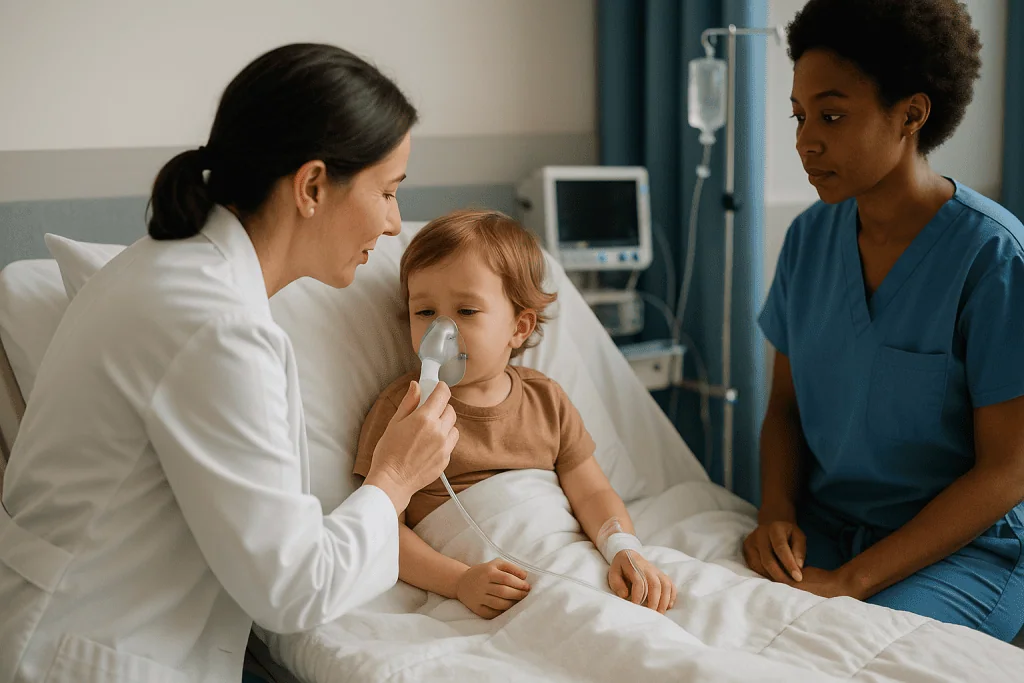
On arrival, the team confirms the diagnosis, usually with a swab from the back of the nose tested by PCR, a laboratory method that detects the bacterium’s genetic material. Blood tests may be taken; a very high white blood cell count is one of the markers clinicians associate with more severe infant disease. A chest X-ray is ordered if pneumonia is suspected.
The child is placed in a single room or a designated bay with droplet precautions, meaning staff wear masks and the child is kept apart from other patients. Monitoring begins immediately and continues until the team is satisfied that fits are no longer causing drops in oxygen or heart rate.
Between fits, the ward focuses on three things:
- Keeping the airway clear with gentle suction when mucus builds up.
- Delivering oxygen if saturations fall, through nasal prongs or a mask.
- Maintaining hydration and nutrition through small frequent feeds, a feeding tube passed through the nose into the stomach, or an intravenous line.
Antibiotics are started when the diagnosis is likely, both to shorten the period of infectiousness and, if early enough, to blunt the illness. Household members are usually offered preventive antibiotics too; that decision is made by the treating team and public health staff, not by the ward alone.
Most of the day is quiet. Nurses chart the number, length and character of coughing fits, what happened to color and oxygen during each one, and how much the child drank. Those charts, more than any single test, guide the decision about when it is safe to go home.
Breathing support: from suction to oxygen to intensive care
“Breathing support” covers a wide ladder of care, and most admitted children stay on the bottom rungs.
The first rung is positioning and suction. A soft catheter attached to gentle suction clears thick mucus from the nose and the back of the throat, which infants cannot blow or cough out effectively. Done before a feed, it can make the difference between a baby who finishes a bottle and one who vomits it back.
The second rung is supplemental oxygen, given when the pulse oximeter shows levels dropping during or after fits. It does not stop the cough; it gives the body a reserve so that a thirty-second pause in breathing does not translate into a dangerous fall in oxygen reaching the brain.
The third rung is heated, humidified high-flow oxygen through nasal prongs, which delivers warm moist air at a steady flow, keeps small airways open and reduces the effort of breathing. Some children move from here to CPAP, continuous positive airway pressure, a mask or prong system that holds a gentle constant pressure in the airway.
The top rung is the intensive care unit, where a child who cannot sustain breathing is sedated and connected to a ventilator through a tube in the windpipe. Pertussis-related pneumonia and pulmonary hypertension, a rise in blood pressure in the lung vessels that is strongly linked to the very high white cell counts seen in severe infant disease, are the usual reasons. In rare, severe cases, teams may use blood-filtering or exchange procedures to lower those cell counts; the evidence is observational and the decision sits with the intensive care team.
Each step up is a judgment made at the bedside by the clinicians watching the trend, never by a formula.
Hydration and feeding: why a cough can dehydrate a small child
Dehydration is the quiet complication. A baby in the paroxysmal phase may have a coughing fit every time it is laid down, every time it is fed, and several times an hour in between. Fits often end in vomiting, so a feed that took twenty minutes to deliver can be lost in seconds. Fast breathing and fever, when present, increase fluid loss through the lungs and skin. Mayo Clinic and the NHS both emphasize fluids as a core part of home and hospital care for exactly this reason.
On the ward, nurses count wet nappies, weigh the child daily and look at skin, mouth and the soft spot on the head. When intake is falling behind, the options are stepped:
- Smaller, more frequent breast or bottle feeds, often after suctioning, with the baby held upright.
- A nasogastric tube, a thin soft tube passed through the nose into the stomach, through which expressed breast milk or formula can be given slowly.
- Intravenous fluids when the stomach cannot be used or when vomiting persists.
Parents frequently worry that a tube means things are getting worse. In practice it often means the opposite: the team is protecting the child’s energy, so that calories go toward recovery rather than toward fighting through a bottle between fits.
Older children and adults rarely need this kind of support, but the principle is the same. Frequent sips of water, soups and oral rehydration drinks between fits are more effective than large drinks that may be vomited. Eating small meals rather than full plates reduces the chance that a fit triggers vomiting after food. None of this changes the course of the infection; it keeps the body in a position to tolerate it.
Do whooping cough antibiotics help once you are in hospital?
This is where expectations most often collide with evidence. Antibiotics in the macrolide class are the standard treatment for pertussis, and they work by stopping the bacterium from making the proteins it needs to multiply. What they do not do is repair airway cilia that have already been damaged by toxin. The CDC states that antibiotics are most helpful when started during the first one to two weeks of illness, before the paroxysmal coughing fits set in, and that starting treatment after three weeks of cough is unlikely to change symptoms, although infants under one year and pregnant people may still be treated up to six weeks after onset because of their higher risk.
So why are antibiotics still given to a baby admitted in week three? Two reasons. First, they clear the bacteria from the nose and throat and end infectiousness; the CDC advises that a person is no longer contagious after five full days of appropriate antibiotics. Second, the exact onset date in infants is often uncertain, so clinicians lean toward treating.
The medicine is chosen and timed by the prescribing clinician, who weighs age, other medications and any allergies. There is no role for antiviral drugs; pertussis is bacterial, and products designed for viral infections such as COVID-19 do not act on it.
Hospital care is not about a more powerful antibiotic. Every clinician on the ward knows that the drug given on day one will still leave a child coughing on day twenty. The admission is for the breathing, the fluids and the watching. Understanding that distinction protects families from false hope on day two and from disappointment on day ten.
Why cough medicines are not part of the plan
It seems obvious that an illness defined by coughing should be treated with something to stop the cough. The evidence runs the other way. Mayo Clinic and the NHS both advise against over-the-counter cough and cold medicines for pertussis, and they are generally not recommended for young children for any cough because of limited benefit and real risks, including drowsiness that can mask a deteriorating child.
Mechanically, the problem is that the cough in pertussis is driven by inflamed, toxin-damaged airway tissue rather than by excess secretions that a medicine could dry up. Suppressing the reflex pharmacologically does little against that trigger and may leave mucus sitting in airways that have lost their cilia.
Other treatments have been studied and found wanting:
- Corticosteroids, anti-inflammatory hormones, have not been shown in trials to shorten fits or admissions.
- Bronchodilators, the inhalers used for asthma, do not help because pertussis does not narrow airways by muscle spasm.
- Antihistamines and so-called “natural” cough remedies have no supporting evidence and are not recommended.
What does help is environmental and practical. A cool-mist humidifier can soothe irritated airways. Keeping the air free of smoke, dust and strong fragrances removes triggers. Calm handling matters; crying and agitation set off fits in infants, so wards try to cluster examinations and keep rooms quiet. Small meals reduce post-tussive vomiting, the vomiting that follows a fit.
None of this will satisfy a parent who wants the cough to stop tonight. The honest position, supported by every mainstream guideline, is that time is the only thing that heals the airway, and the hospital’s job is to keep the child safe while that happens.
Home care, ward care and intensive care compared
The table below summarizes how the same illness is handled at three levels of care. It is a general guide drawn from CDC and NHS descriptions, not a rule; the treating team decides which level fits a particular patient and may move someone up or down as the picture changes.
| Aspect of care | Home | Hospital ward | Intensive care |
|---|---|---|---|
| Typical patient | Older children, teenagers, adults without complications | Infants, especially under six months; anyone with apnea, poor feeding or low oxygen | Infants with recurrent apnea, pneumonia, respiratory failure or very high white cell counts |
| Monitoring | Caregiver observation of fits, color, fluid intake | Continuous pulse oximetry and heart-rate monitoring, charted fits | Continuous monitoring plus blood gases, blood pressure and ventilator settings |
| Breathing support | Humidified air, smoke-free environment | Suction, oxygen by prongs or mask, sometimes high-flow or CPAP | Mechanical ventilation, in rare cases advanced lung and blood support |
| Hydration | Frequent small drinks and meals | Small feeds, nasogastric tube or intravenous fluids | Intravenous fluids and nutrition |
| Antibiotics | Yes if within the recommended window | Yes, usually started on admission | Yes, alongside treatment of pneumonia if present |
| Isolation | Stay home until 5 days of antibiotics completed (CDC) | Droplet precautions, single room | Droplet precautions, single room |
Two patterns stand out. The antibiotic row barely changes across the columns, which underlines that hospital admission is not about stronger drugs. The monitoring and breathing rows change the most, which is where the hospital earns its keep. Families reading the table sometimes ask whether they could reproduce ward care at home with a purchased pulse oximeter. Consumer devices can give false readings on small, moving infants, and a number on a screen is only useful if someone trained is present to act on it. The honest answer is that the monitor is the smaller part of what the ward provides; the person watching it is the larger part.
How long does whooping cough last? The days and weeks after admission
Expect a long illness. The NHS notes that the cough commonly lasts for several weeks or months, which is why older medical texts called pertussis the hundred-day cough. The CDC’s stage timings give the clearest framework: the paroxysmal phase typically runs 1–6 weeks, and the convalescent phase, when fits become less frequent and less severe, can continue for weeks to months. A fresh cold during convalescence often brings the fits back for a while, not because the infection has returned but because the healing airway is still irritable.
For an admitted infant, the hospital stay itself is usually measured in days rather than weeks, although severe cases in intensive care can be much longer. Discharge is typically considered once the child has gone a reasonable stretch without pauses in breathing or color changes, is maintaining oxygen levels in room air, is feeding well enough to gain or hold weight, and has caregivers who feel confident managing fits at home. There is no fixed number of hours that applies to everyone; the team sets the threshold based on the pattern of fits recorded on the ward.
What the following weeks commonly look like:
- Coughing fits continue, often worse at night, but gradually space out.
- Appetite returns before the cough resolves; weight is a useful reassurance.
- Sleep is disrupted for the whole household; planning for rest matters.
- A follow-up visit is usually arranged to check weight, feeding and breathing.
Teenagers and adults describe a similar arc without the hospital chapter: two or three weeks of escalating fits, then a slow taper that can test patience. Broken ribs from violent coughing, hernias and fainting during fits are recognized adult complications, and a cough that lasts beyond the expected window, or any new fever or breathlessness, should prompt review. Timeframes here are typical ranges from the cited sources, not a schedule any individual should be measured against.
Is whooping cough contagious while in hospital? Isolation and household contacts
Pertussis spreads through droplets released when an infected person coughs or sneezes, and the CDC describes it as highly contagious, particularly during the catarrhal phase when it looks like a cold and no one is being careful. A hospitalized child is therefore nursed under droplet precautions: a single room where possible, masks for staff and visitors, and hand hygiene before and after contact. These measures protect other patients, especially other infants on the ward, rather than the child with pertussis.
The infectious period ends in one of two ways. Without antibiotics, a person can spread the bacterium for about three weeks after the coughing fits begin. With an appropriate antibiotic, the CDC states that infectiousness ends after five full days of treatment, which is why the ward will often lift strict precautions partway through a stay. National guidance varies slightly on exact timings, so follow what the treating team says.
Household contacts are the other half of the picture. Public health teams and clinicians commonly recommend preventive antibiotics for everyone living with the patient, regardless of vaccination status, because the aim is to stop a chain of transmission that could reach an unvaccinated newborn or a pregnant person. Whether and when to offer this is a clinical and public health decision; families are usually contacted by the hospital or a public health service.
Vaccination is the long-term answer. Childhood vaccination against diphtheria, tetanus and pertussis gives strong early protection that wanes over years, and the CDC recommends a booster during every pregnancy, ideally between 27 and 36 weeks, so that antibodies pass to the baby before birth. That maternal booster is the main reason some very young infants arrive on the ward with milder disease than they would otherwise have had.
What people often get wrong about whooping cough
Myths cluster around this illness because it is both old and unfamiliar. A few corrections, grounded in the sources cited at the end.
“No whoop, so it cannot be whooping cough.” Infants frequently never whoop; they gag, go quiet and pale, or stop breathing. Adults commonly have a persistent dry cough with no whoop at all. The sound is suggestive when present and tells you nothing when absent.
“Antibiotics will stop the cough.” They clear the bacteria and end infectiousness, and they can soften the illness if given in the first week or two. They do not repair the airway damage that drives the fits.
“It is a childhood disease.” Vaccine protection fades over time, and teenagers and adults are regularly infected, often serving as the unrecognized source for a baby in the family.
“A vaccinated child cannot catch it.” Vaccination greatly reduces risk and severity but is not absolute, and protection declines with years since the last dose. A vaccinated child who does catch pertussis usually has a milder course.
“A home pulse oximeter is as good as a hospital.” A device can misread on a wriggling infant, and a reading only helps if a trained person can act within seconds. The ward’s value lies in the response, not the sensor.
“Cough syrup is harmless and might help.” Guidelines advise against it, especially in young children, where sedation can hide deterioration.
“Once the cough improves, the danger has passed.” Fits can rebound for weeks with any new cold, and infants remain vulnerable until they have completed early vaccinations. None of this is reason for fear; it is reason for watchfulness, which is a different thing.
Questions to ask your care team
Admission days are a blur of unfamiliar faces, and questions arrive at two in the morning when no one is around. Writing them down helps. These are the ones families most often wish they had asked earlier.
- What specifically are you watching for on the monitor, and what would make you more worried?
- What happened to her oxygen and heart rate during the last few fits, and is the trend improving?
- Which stage of the illness do you think we are in, and what does that mean for the next week?
- Why has an antibiotic been started now, and what do you expect it to change, if anything?
- Should the rest of our household receive preventive antibiotics, and who will arrange that?
- How are you deciding between bottle feeds, a feeding tube and intravenous fluids today?
- Can I hold and feed my baby during a fit, and what should I do if she stops breathing while I am holding her?
- What would prompt a move to a higher level of care, and how would that be explained to us?
- What are the criteria for discharge, and who decides when they are met?
- After we go home, which signs should bring us straight back, and whom do we call out of hours?
- When should the household’s vaccinations be reviewed, including boosters for adults and during any future pregnancy?
Ask the team to show you how they suction and reposition, so that you can do the same confidently after discharge. Request a written summary of the typical course for your child’s age, with the warning signs listed, since memory is unreliable on no sleep. Clinicians generally welcome these questions. A family who understands the plan notices changes earlier, and that is exactly what the hospital stay is designed to achieve.
When to call your doctor
Whether you are at home from the start or recently discharged, the signs that need urgent attention are the same, and they center on breathing and fluids. Call emergency services immediately if a baby or child stops breathing, turns blue or gray around the lips or face, goes limp or unresponsive, or has a seizure. These are emergencies, not reasons to wait for a morning appointment.
Contact your doctor or an urgent care service the same day if you notice:
- Coughing fits that end in a pause in breathing, a change in color, or repeated vomiting.
- Fast breathing between fits, the skin pulling in between the ribs or under the ribcage, or grunting.
- Fewer wet nappies than usual, a dry mouth, no tears, or a sunken soft spot on an infant’s head.
- Refusal of feeds over several hours, or weight loss noted at a check.
- A new or rising fever, or a child who seems unusually sleepy or hard to rouse.
- A cough in anyone who lives with or cares for a baby under six months, or a pregnant person.
Adults and older children should seek review for coughing severe enough to cause fainting, chest pain, or a cough that is not easing after the expected weeks, since pneumonia and rib injury are recognized complications.
Any whooping cough suspected in a household with a newborn warrants a call even if the baby seems well, because preventive treatment and early assessment are time-sensitive. Trust your observation: parents often detect a change in color or behavior before any monitor alarms. The decision about admission, readmission, antibiotics and the right level of breathing support always rests with the treating team, and they would far rather see a child who turns out to be fine than hear about one who was kept at home a day too long.
Frequently asked questions
What is the medical treatment for whooping cough?
Treatment is a macrolide-class antibiotic prescribed by a clinician, plus supportive care: rest, frequent small fluids, a humidified smoke-free environment and, for infants or anyone with breathing difficulty, hospital monitoring with suction, oxygen and feeding support. Antibiotics help most in the first one to two weeks and end infectiousness after five days, but they do not shorten an established cough.
When does whooping cough in babies need hospital care?
Babies under about six months are often admitted as a precaution, and any infant who pauses breathing, changes color during fits, cannot feed, breathes fast or shows low oxygen readings should be assessed urgently. The CDC notes about one third of infants under one year with pertussis need hospital care, and the decision rests with the assessing team.
How long does whooping cough last after a hospital stay?
The stay itself is often days, but the cough usually continues long afterward. The CDC describes a paroxysmal phase of about 1–6 weeks and a convalescent phase lasting weeks to months, and the NHS notes the cough can persist for several weeks or months. Fits often flare briefly with any new respiratory infection during recovery.
Is whooping cough contagious once treatment has started?
Yes, for a short while. The CDC states a person remains contagious until five full days of an appropriate antibiotic have been completed; without antibiotics, spread can continue for about three weeks after coughing fits begin. Hospitals use droplet precautions during that period, and household contacts are often offered preventive antibiotics by the treating or public health team.
Do whooping cough antibiotics work if the cough has lasted three weeks?
By then they are unlikely to change the cough, because the airway damage from bacterial toxin has already occurred. They still clear bacteria and stop spread, so clinicians often prescribe them anyway, and the CDC supports treating infants under one year and pregnant people up to six weeks after onset. The prescribing clinician makes the call.
What breathing support is given in hospital for whooping cough?
It ranges from gentle suction of mucus and repositioning, through supplemental oxygen by nasal prongs or mask, to heated high-flow oxygen or CPAP, and in severe cases mechanical ventilation in intensive care. Most admitted children need only the lower steps. The team moves up or down the ladder based on continuous monitoring of oxygen and heart rate.
Why is my baby being fed through a tube?
Frequent coughing fits and post-cough vomiting make bottle or breast feeding exhausting and unreliable, and infants dehydrate quickly. A nasogastric tube delivers expressed milk or formula slowly into the stomach so calories and fluids are kept up while the baby rests. It is usually a protective step, not a sign that the illness is worsening.
Can I give cough syrup for whooping cough?
Mainstream guidance from Mayo Clinic and the NHS advises against over-the-counter cough and cold medicines for pertussis, and they are generally not recommended for young children at all. They do not address the toxin-driven airway irritation and may cause drowsiness that masks deterioration. A cool-mist humidifier, smoke-free air, calm handling and small meals are the supported measures.
Should I take Paxlovid or another antiviral for whooping cough?
No. Whooping cough is caused by a bacterium, Bordetella pertussis, and antiviral medicines designed for infections such as COVID-19 have no action against bacteria. Pertussis is treated with antibiotics chosen by a clinician, alongside supportive care. If you are unsure whether a cough is viral or bacterial, a clinician can test for pertussis with a nasal swab.
How can I protect a newborn from whooping cough?
The CDC recommends a pertussis booster during every pregnancy, ideally at 27–36 weeks, so antibodies transfer before birth, followed by the baby’s own vaccinations on schedule. Adults and older siblings who are up to date on boosters, hand hygiene, and keeping anyone with a cough away from the baby all reduce risk. Seek prompt assessment if a household member develops a persistent cough.
References
- CDC: About Whooping Cough
- CDC: Whooping Cough Symptoms and Complications
- NHS: Whooping cough
- MedlinePlus: Whooping Cough
This article is for general information only and is not a substitute for professional medical advice. Please consult a qualified doctor about your individual situation.

More from the Blog

Incomplete Kawasaki Disease: How Pediatricians Decide to Treat When Not Every Sign Appears
Incomplete Kawasaki disease is diagnosed when a child has prolonged, unexplained fever with only two or three of the five classic signs instead of…

Heart Murmurs in Children: Why Most Are Innocent
A heart murmur in children is an extra whooshing sound made by blood moving through the heart, and most are innocent: they come from…

How Viral Croup Is Assessed and Treated: Oxygen Checks, Airway Swelling and Monitoring
Viral croup is treated by calming the child, checking oxygen levels and breathing effort, and reducing airway swelling. Most children need only rest, fluids…

Is Bronchiolitis Contagious? Daycare Return, Sibling Contact and Hand Hygiene Explained
Bronchiolitis itself is not passed from child to child; the viruses that cause it are. The most common one, RSV, is usually contagious for…

How a Developmental Delay Assessment Works: Hearing, Vision, Milestones and Specialist Reviews
A developmental delay assessment is a staged evaluation of how a child is progressing in movement, language, thinking and social skills. It usually begins…

How Much Exercise Do Kids Need? The Guidelines and Why Play Counts
Children aged 5 to 17 need an average of at least 60 minutes a day of moderate-to-vigorous physical activity across the week, according to…