

Who Benefits From Oral Health Therapy? Early Gum Changes, Braces and Dry Mouth

Key Takeaways
- Gingivitis is the only stage of gum disease that is fully reversible, and the Mayo Clinic notes gums commonly return to healthy pink within days to weeks of a professional cleaning plus consistent home care.
- The WHO estimates severe periodontal disease affects about 19 percent of adults worldwide, while untreated decay in permanent teeth affects roughly 2 billion people, making these two conditions the main targets of oral health therapy.
- An oral health therapist can perform everything a hygienist does plus simple fillings and primary-tooth extractions where permitted, but cannot diagnose, so any suspicious finding goes back to the dentist.
- Fixed braces typically stay on for around 18 months to two years according to the NHS, which is why white spot lesions around brackets are a long-window risk that fluoride and technique coaching aim to prevent.
- Dry mouth is a measurable decay risk factor, not a nuisance: the NHS lists medicines, radiotherapy, Sjögren's syndrome, diabetes and mouth-breathing among its common causes, and exposed root surfaces decay first.
- People on blood thinners, those with certain heart valve conditions, and those receiving bone-strengthening or cancer treatment are usually discussed with their physician before gum treatment, a coordination step the dentist leads.
Oral health therapy usually suits people whose main need is prevention and early treatment rather than complex dentistry: those with bleeding or swollen gums in the early gingivitis stage, people wearing braces who struggle to keep plaque off brackets, and anyone with dry mouth from medicines, medical conditions or radiotherapy, which raises decay risk. A dentist or physician decides the referral and remains responsible for diagnosis.
The first sign is often small enough to ignore. A faint pink tinge on the toothbrush. A teenager three months into braces whose gums look puffier than they did at the fitting. A retired teacher who wakes at three in the morning with a tongue that feels stuck to the roof of her mouth. None of these people feels ill, and none is likely to book a dental emergency. Yet each of them is exactly the sort of person a dentist might send down the corridor to a colleague with a different job title.
That colleague is an oral health therapist, and the question of who needs oral health therapy comes up more than most people expect. The role sits between the hygienist’s cleaning chair and the dentist’s drill, with a scope that varies by country and, in the United States, by state.
This article explains what the visit involves, which situations it fits, who is usually asked to see a dentist first, and what the weeks afterward tend to look like.
Who needs oral health therapy? A plain-language starting point
Start with what the word therapy means here. It is not talking therapy and it is not surgery. Oral health therapy is a bundle of preventive and early-intervention care delivered by a licensed mid-level dental professional, working alongside a dentist. The bundle includes removing plaque and hardened deposits, applying protective fluoride, sealing the grooves of children’s molars, placing simple fillings where the law allows, and coaching people on habits that keep disease from returning.
Plaque, the term you will meet repeatedly, is the soft, sticky film of bacteria that forms on teeth within hours of brushing. Left alone, it inflames the gum edge and dissolves enamel. Almost every referral to oral health therapy comes back to controlling plaque in someone whose circumstances make that harder than average.
Three groups come up again and again. The first is people whose gums have started to change but have not yet lost the bone that anchors teeth. The second is orthodontic patients, because brackets and wires create dozens of new hiding places for bacteria. The third is anyone with reduced saliva, since saliva is the mouth’s own rinsing and buffering system. The World Health Organization estimates that oral diseases affect close to 3.5 billion people worldwide, with untreated tooth decay in permanent teeth the most common single condition, which gives some sense of how large the preventive task is.
Who needs oral health therapy, then, is less about a particular diagnosis and more about a pattern: a risk that is rising, a problem that is still reversible or containable, and a person who would benefit from more time and coaching than a standard dental check-up allows. The dentist or physician makes that call. The therapist carries it out and reports back.
What does an oral health therapist do during a visit?
Picture a forty-minute appointment rather than a ten-minute check. The therapist begins by looking, not scraping. Gums are inspected for color, swelling and how easily they bleed when a blunt probe is run gently along the edge. Depths between gum and tooth may be measured in millimeters and recorded on a chart, so that changes can be tracked over months.
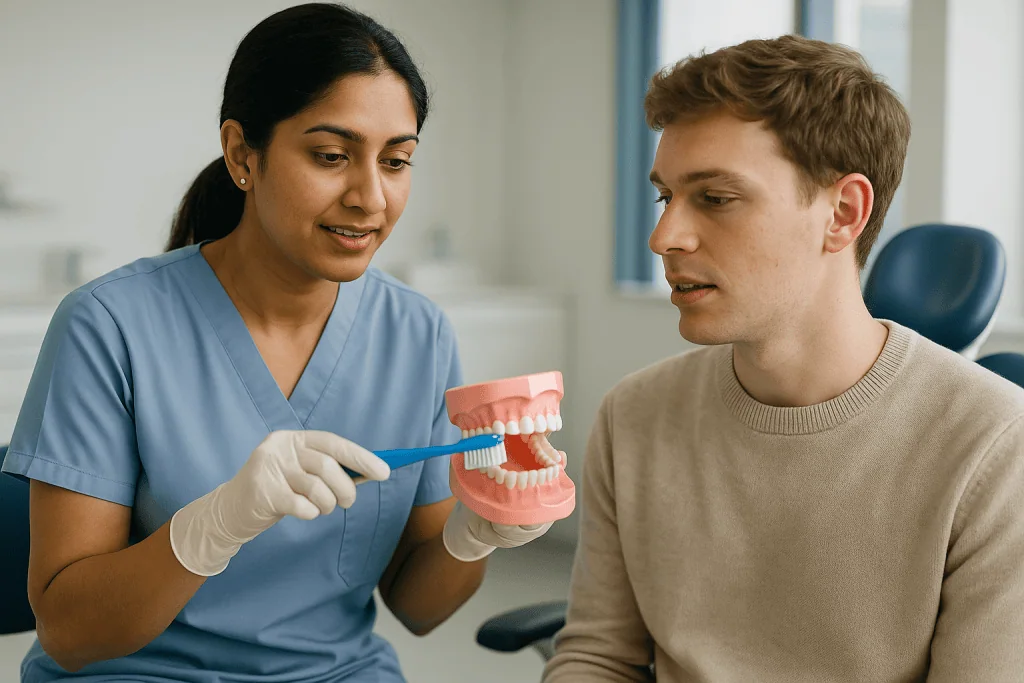
Scaling comes next when it is needed. Scaling means removing plaque and calculus, the mineralized deposit that plaque turns into when it sits undisturbed, from above and just below the gumline. Some clinicians use hand instruments; many use an ultrasonic tip that vibrates and sprays water. Polishing follows, smoothing the surface so new plaque sticks less readily.
Fluoride varnish is a common finishing step. Fluoride is a mineral that hardens enamel and slows the acid attack that leads to cavities; the varnish form is painted on and sets on contact with saliva. Sealants, thin resin coatings flowed into the deep grooves of back teeth, are used mainly in children and are described later.
Where legislation permits, a therapist may place fillings in primary teeth and, in some jurisdictions, in permanent teeth, and may remove baby teeth that are already loose or beyond saving. Anything more complex, including root canal treatment, crowns and the extraction of permanent teeth, is referred to the dentist.
The final third of the visit is conversation. Which teeth are being missed? Is an interdental brush or floss the better fit for the gaps you have? What does your snack pattern look like across a working day? The NHS advice on gum disease stresses brushing twice daily and cleaning between the teeth every day as the foundation of control, and much of the therapist’s craft lies in turning that generic advice into something a specific person will actually do.
Dental therapist vs hygienist vs dentist: what is the difference?
Three job titles, one chair, and a lot of understandable confusion. The simplest distinction is scope. A hygienist focuses on prevention: cleaning, scaling, fluoride, sealants and education. A dental therapist does everything a hygienist does and adds restorative work within a defined limit, typically simple fillings and the removal of primary teeth. An oral health therapist, the title used in several countries, is usually someone qualified in both roles. A dentist holds the broadest license, diagnoses disease, and performs complex treatment.
| Role | Typical training | Usually does | Usually refers on |
|---|---|---|---|
| Dental hygienist | Associate or bachelor degree in hygiene | Scaling, polishing, fluoride, sealants, home-care coaching | Any filling, extraction or diagnosis question |
| Dental or oral health therapist | Bachelor-level program in therapy, often dual with hygiene | All hygienist tasks plus simple fillings and primary-tooth extractions where permitted | Root canals, crowns, permanent-tooth extractions, complex cases |
| Dentist | Doctoral degree (DDS or DMD) plus licensure | Diagnosis, treatment planning, all restorative and surgical care | Specialists such as orthodontists or periodontists when needed |
Supervision arrangements differ. In the United States, therapists work under a collaborative agreement with a dentist and are authorized in a growing number of states, with the exact list changing as legislation moves. In the United Kingdom, dental therapists are registered independently but work to a prescription from a dentist. Because rules vary so much, a person moving between regions should not assume the role is identical.
Is an oral health therapist the same as a hygienist? Not quite. The overlap is large, but the therapist’s restorative scope is the difference. Is a therapist a dentist? No, and that matters most when a symptom needs a diagnosis rather than a cleaning.
Early gum changes: why bleeding gums are the classic referral
Gums are not meant to bleed. When they do, even lightly, the usual explanation is gingivitis, the earliest stage of gum disease, in which plaque along the gumline triggers inflammation without yet damaging the bone beneath. The gum edge looks redder and rounder than the pale, knife-edged tissue of health, and it may feel tender when flossed.
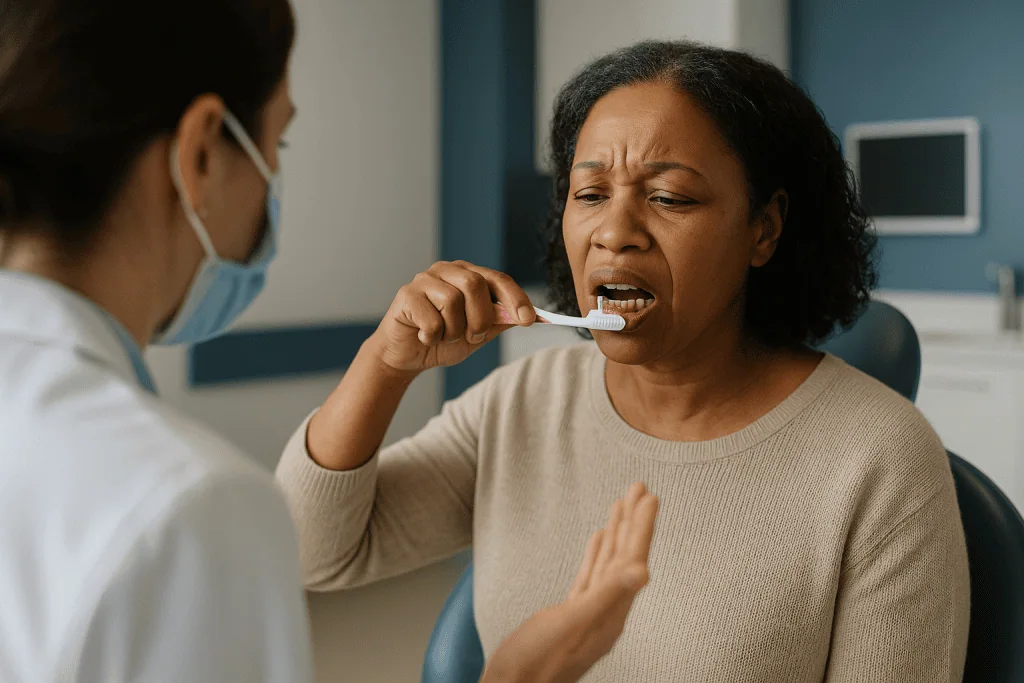
Gingivitis is the stage where oral health therapy earns its keep, for one reason: it is reversible. The Mayo Clinic notes that with a professional cleaning followed by consistent brushing and interdental cleaning, gum tissue commonly returns to a healthy pink within days to weeks. No other stage of gum disease offers that outcome, which is why dentists move quickly when they see it.
The alternative is periodontitis, the deeper form in which inflammation spreads below the gumline and begins to dissolve the ligament and bone holding teeth in place. The WHO estimates severe periodontal disease affects roughly 19 percent of adults worldwide, more than a billion people. Bone that has gone does not regrow on its own, so treatment shifts from reversing to controlling.
A therapist’s role at the early stage is practical. Deposits are removed so that the gum has a clean surface to heal against. The person is shown, in a mirror, which areas are being missed, since bleeding usually clusters where the brush never reaches. Measurements taken at that first visit become the baseline for the next.
Smoking, diabetes, pregnancy hormones and some medicines make gums more reactive, and the therapist will ask about them because they change how aggressively the plan needs to run. People with well-controlled early gingivitis and no such factors may need only a short course of visits before returning to routine review. Those with several risk factors are often kept on a closer schedule, a decision the dentist sets and revisits.
Oral health therapy for braces: keeping plaque off brackets
Fixed braces change the geometry of the mouth. Each bracket adds edges and a shadowed ledge where the tooth meets the metal, and the archwire runs across every surface a brush would normally sweep clean in a single stroke. Plaque loves ledges. Within weeks of a fitting, gums often become puffy along the brackets and the enamel around them starts to lose mineral.
That loss shows up as white spot lesions, chalky pale patches on enamel where acid has drawn calcium and phosphate out of the surface. They are the first stage of decay and are largely preventable, yet they are one of the most common unwanted results of orthodontic treatment. Because the NHS describes a typical course of fixed-brace treatment as lasting around 18 months to two years, the window for damage is long.
An oral health therapist working with orthodontic patients has three main levers. The first is technique: showing how to angle the brush above and below the wire, how to thread floss or use an interdental brush under it, and how to check the result with a disclosing tablet that stains leftover plaque. The second is fluoride, applied as varnish at visits and reinforced by whatever the orthodontist recommends for home use. Fluoride helps the enamel take mineral back up before a white spot becomes a cavity. The third is diet coaching, because sugary and acidic drinks sipped through the day are the most reliable way to turn a ledge into a lesion.
Referral for oral health therapy for braces is often built into the orthodontic plan rather than triggered by a problem. The orthodontist straightens teeth; the therapist keeps the teeth worth straightening. When gum inflammation becomes severe enough to bleed at the lightest touch or to grow over brackets, the orthodontist may pause adjustments until the tissue settles, which is a decision that team makes together.
Dry mouth dental care: when saliva runs short, risk climbs
Saliva does more than keep speech comfortable. It washes food debris off teeth, neutralizes the acid bacteria produce, delivers calcium and phosphate back into enamel, and contains proteins that limit bacterial growth. Take it away and a mouth that was stable for decades can develop cavities along the gumline within a year.
Dry mouth, known clinically as xerostomia, is the subjective feeling of not having enough saliva. The NHS lists its usual causes as dehydration, breathing through the mouth, certain medicines, radiotherapy to the head and neck, autoimmune conditions such as Sjögren’s syndrome, and diabetes. The medicines are a long list: antihistamines, many antidepressants, some blood-pressure treatments including diuretics, and drugs for bladder control are common examples. The mechanism is usually a reduction in the nerve signals that tell salivary glands to secrete, so the effect tends to build with each added prescription rather than with any single one.
This is where dry mouth dental care and oral health therapy overlap. A person cannot simply brush harder to replace saliva. What a therapist can do is raise the mouth’s defenses in other ways: more frequent fluoride varnish, help choosing sugar-free products that stimulate whatever saliva remains, guidance on sipping water and avoiding acidic drinks, and closer monitoring of the root surfaces that decay first when the mouth is dry. Denture wearers with dry mouth are checked for the sore spots and fungal irritation that appear when there is no film of saliva between plastic and gum.
What a therapist will not do is change your prescriptions. If a medicine seems to be the cause, the therapist notes it and the dentist or physician takes the conversation from there. Saliva-stimulating medicines exist and work by directly activating gland receptors, but whether one is appropriate depends on the rest of a person’s health, and that judgment belongs to the prescriber.
Who is usually asked to wait, or seen by a dentist first
Not every mouth belongs in the therapist’s chair on the first visit. A sensible triage sends some people to the dentist first, either because a diagnosis is needed or because the treatment required lies outside the therapist’s scope.
Pain is the clearest example. A throbbing tooth, a swelling in the jaw or a tooth that hurts to bite on suggests infection or a crack, both of which need a dentist’s assessment and possibly imaging before any cleaning begins. A therapist can recognize these signs but is not licensed to diagnose them, so the referral goes back rather than forward.
Advanced gum disease is another. When measurements show deep pockets and the dentist suspects bone loss, the plan may involve a periodontist, a dentist specializing in gum and bone. The therapist often remains part of the maintenance phase afterward, but the initial staging is a dentist’s task.
Certain medical situations call for planning before any gum treatment. People on blood-thinning medicines, those with a history of infective endocarditis or with some heart valve conditions, people receiving intravenous or oral bone-strengthening medicines, and anyone undergoing cancer treatment are usually discussed with their physician first. The American Heart Association’s guidance on antibiotic prophylaxis before dental procedures applies to a small, defined group, and the dentist checks whether a person falls into it.
Timing can also matter. A person in the middle of chemotherapy may be asked to wait until blood counts recover. Someone who has just had a heart attack or stroke is generally seen once their physician is comfortable. Pregnancy is not a reason to wait; gum treatment is safe and often helpful, though elective work may be scheduled for the second trimester when nausea has usually eased.
None of this means the person is refused care. It means the order of the steps is being set by the team best placed to set it.
What the following days and weeks usually look like
Expect a little tenderness. After scaling, gums that were inflamed can feel sore for a day or two, and teeth may be briefly sensitive to cold where calculus was removed from root surfaces it had been covering. Mild bleeding when brushing that evening is normal; it should lessen each day as inflammation falls.
The first two weeks are the test of the home-care plan. This is when the Mayo Clinic’s observation about early gingivitis plays out: with consistent brushing and daily cleaning between teeth, gums typically firm up and stop bleeding within days to a couple of weeks. If they do not, the usual reasons are technique, a spot being missed, or an underlying factor such as smoking or uncontrolled diabetes, all of which the therapist will revisit rather than assume the plan failed.
Orthodontic patients follow a slightly different rhythm. Their check with the therapist often falls a few weeks after each adjustment, since new wires create new plaque traps. White spots, once present, may fade a little over months as fluoride helps enamel take up mineral again, but they rarely disappear completely, which is why prevention rather than repair is the emphasis.
People with dry mouth tend to be seen more often than average because their risk does not fall between visits the way an inflamed gum does. The interval is set by the dentist; the NHS notes that recall intervals for dental review can range from a few months to two years depending on individual risk, and someone with little saliva sits at the short end of that range.
Fluoride varnish leaves a slightly sticky film and a yellowish tint for a few hours. Most clinicians ask people to avoid hard, hot or sticky foods and to skip brushing until the following morning so the varnish stays in contact with enamel as long as possible. Sealants need no aftercare beyond checking at the next visit that they are intact.
The most common oral health diseases a therapist helps prevent
People often search for a list of the ten most common oral diseases, and the honest answer is that mainstream bodies do not publish a neat top ten. The WHO’s oral health fact sheet instead names the conditions that account for most of the global burden, and it is a shorter, more useful list.
Dental caries, the technical name for tooth decay, leads the count. The WHO estimates roughly 2 billion people live with untreated decay in permanent teeth and about 514 million children have untreated decay in primary teeth. Periodontal disease follows, with severe forms affecting around 19 percent of adults. Then come edentulism, the complete loss of natural teeth, which the WHO places at roughly 7 percent of adults aged 20 and over; oral cancers; oro-dental trauma from falls, sport and accidents; noma, a severe gangrenous disease of the mouth seen mainly in young children living in extreme poverty; and cleft lip and palate, which are birth differences rather than acquired diseases.
Where does oral health therapy sit against that list? Squarely on the first two. Decay and gum disease share a cause in plaque and a solution in its control, and between them they account for the overwhelming majority of dental visits worldwide. A therapist cannot prevent trauma or clefts and does not treat cancer, though the routine soft-tissue check at each visit is one of the ways unusual patches on the tongue, cheek or floor of the mouth get noticed early and referred.
Two smaller conditions belong on the practical list even if not on the WHO’s. Dental erosion, the chemical wearing of enamel by acid from drinks or reflux, is increasingly common and largely behavioral. Oral candidiasis, a fungal overgrowth that flourishes in dry mouths and under dentures, is another the therapist watches for because it signals that the mouth’s defenses are down.
Children and oral health therapy: sealants, fluoride varnish and habits
A six-year-old’s new molars arrive with deep, narrow fissures on their chewing surfaces, grooves too fine for a toothbrush bristle to reach the bottom of. Food and bacteria settle in, and the result is that these back teeth are where most childhood decay begins.
Fissure sealants answer that problem directly. A sealant is a thin flowable resin painted into the grooves and hardened with a light, leaving a smooth surface that plaque cannot lodge in. The procedure needs no drilling and no numbing, which makes it one of the first treatments many children experience, and a gentle introduction to the dental chair. Sealants are checked at each visit and touched up if they chip.
Fluoride varnish is the other mainstay. In children it is applied to all the teeth, not just molars, and the routine repeats at intervals set by the dentist based on decay risk. The CDC and the NHS both list varnish among the core preventive measures for children, alongside fluoride toothpaste and community water fluoridation where available.
The therapist’s third task with children is less visible: habits. Watching a child brush and quietly correcting grip and angle. Asking what goes in the bottle or cup at bedtime, since milk or juice pooling around teeth overnight is a classic cause of early decay. Talking with parents about when to start supervising brushing and when a child can be trusted alone, which the NHS suggests is generally around the age of seven or eight.
Preparation for a first visit is mostly about tone. Children pick up anxiety from adults, so describing the appointment as counting teeth and painting them tends to work better than warnings about needles that will not be used. Comfort afterward is rarely an issue; sealants and varnish do not hurt. Any question about pain relief for a child belongs with the dentist or pediatrician, not this article.
Older adults, medicines and receding gums
Getting older does not, by itself, cause gum disease. What changes is the accumulation of factors that make plaque control harder: more medicines, drier mouths, arthritic hands that struggle with floss, and gums that have receded enough to expose root surfaces which decay more easily than enamel.
Root caries is the specific worry. The root of a tooth is covered in cementum and dentin rather than enamel, and both dissolve at a less acidic level than enamel does. A person who went sixty years without a cavity can develop several along the gumline within a year or two of starting medicines that dry the mouth. The NIH’s National Institute of Dental and Craniofacial Research describes dry mouth as a common side effect of hundreds of medicines and a major contributor to decay in older adults.
An oral health therapist adapts the plan rather than the person. Electric brushes with larger handles, floss holders or interdental brushes for hands that cannot manage thread, more frequent fluoride varnish for exposed roots, and denture checks for fit and cleanliness. Partial dentures in particular gather plaque against the remaining natural teeth, and those teeth need extra attention.
The medical history matters more with age. Anticoagulant medicines increase bleeding after scaling, so the dentist coordinates with the prescribing physician; the therapist never adjusts them. Bone-strengthening medicines used for osteoporosis carry a small, well-documented risk of jaw bone complications after extractions, which is a reason therapists refer even a loose tooth back for the dentist to weigh. Diabetes and gum disease worsen each other in both directions, so a stable gum status can be part of overall metabolic control.
Care home residents and people with dementia are a particular concern, because the person who once brushed twice daily may now depend on someone else, and mouths in that situation deteriorate fast. Oral health therapists increasingly work in these settings, training care staff as much as treating residents.
What people often get wrong about oral health therapy
Misunderstandings cluster around a handful of ideas, and each one can keep someone from care that would help.
Bleeding gums mean you are brushing too hard, so brush less. Almost always the reverse. Gums bleed because plaque has inflamed them, and the fix is more thorough, not less frequent, cleaning. Bleeding that persists after two weeks of good technique needs assessment, not avoidance.
A therapist is a lesser dentist. The scope is narrower, not the standard lower. Therapists are licensed professionals trained specifically in the preventive and early-restorative work they perform, and they refer up when a problem exceeds that scope. Seeing one is not a sign that your problem is being taken less seriously.
Scaling damages enamel or loosens teeth. Scaling removes deposits, not tooth. Teeth can feel looser for a short time after heavy calculus is removed from around them, because the calculus had been acting as a kind of splint, but the underlying looseness was already there and was being hidden.
Dry mouth is just a nuisance. It is a measurable risk factor for rapid decay and fungal infection. Treating it as cosmetic delays the preventive steps that would keep root surfaces intact.
Once gums recede, therapy cannot help. Recession itself does not reverse without surgery, but the exposed root can be protected and the inflammation that drives further recession can be controlled. Stabilizing is a real outcome even when regrowing is not.
Braces mean cavities are inevitable. White spot lesions are common but not compulsory. Orthodontic patients who keep plaque off brackets and use fluoride as advised often finish treatment without them. The difference is effort and support, not luck.
Children’s baby teeth do not matter because they fall out. Decayed primary teeth cause pain, infection and school absence, and their early loss can crowd the permanent teeth behind them. Sealants and varnish exist because those teeth do matter.
Risks, limits and alternatives, described plainly
Oral health therapy is low-risk, but not risk-free, and the honest account includes the downsides.
Scaling can cause temporary sensitivity, particularly on root surfaces newly exposed once calculus is gone. That usually fades over days to weeks as the tooth lays down protective dentin, though for some people it lingers and needs a dentist’s attention. Gum tenderness and minor bleeding for a day or two are expected. Ultrasonic instruments create an aerosol, which is why clinics use suction and, in some settings, screen people for infectious illness before appointments.
Fluoride varnish occasionally causes a brief, harmless taste disturbance or a feeling of stickiness. Allergic reaction is rare. Sealants can chip or wear and need replacing; a sealant that has partially failed can trap plaque underneath, which is why they are checked at every visit rather than fitted and forgotten.
The larger limit is scope. A therapist cannot diagnose, so a serious problem noticed during a visit becomes a referral rather than an immediate treatment. In a well-run team that referral happens the same day. Where the collaborating dentist is remote, as in some rural or community-health arrangements, there may be a wait, and people should ask how that handoff works.
Alternatives exist at every stage. Someone with early gum changes could see a hygienist rather than a therapist and receive very similar preventive care. Someone with a small cavity could have it filled by a dentist instead. Advanced disease has no substitute for a dentist or specialist. Home care alone, without professional deposit removal, can hold very mild gingivitis in some people but does not remove calculus once it has formed.
What oral health therapy does not offer is a guarantee. Gums that are stabilized can flare again if smoking resumes or diabetes control slips. Decay risk in a dry mouth stays high as long as the mouth stays dry. The treating team can describe what is likely; it cannot promise what will happen.
Questions to ask your care team
A good appointment leaves you knowing what was found, what is planned and why. These questions help get there, and none of them should be unwelcome.
- What stage is my gum disease at, and is it the reversible kind or the kind we are managing?
- Which measurements were taken today, and what would need to change for you to be concerned at the next visit?
- Are there specific teeth or areas I am consistently missing, and can you show me in a mirror?
- Which interdental tool suits the gaps I have, and how do I know I am using it correctly?
- How often do you want to see me, and what would make that interval shorter or longer?
- Do any of my medicines or medical conditions affect this plan, and should my physician be part of the conversation?
- If you find something outside your scope, how quickly can I see the dentist, and is that in the same building?
- For braces: how will you and the orthodontist coordinate, and what should I do if my gums bleed heavily between visits?
- For dry mouth: what can be done at this visit to lower my decay risk, and what should I raise with my prescriber?
- For a child: what will you do today, how should I describe it beforehand, and is there anything to watch for afterward?
One more worth asking of yourself rather than the team: what is the single change you could realistically keep up for the next month? Plans built around one sustainable habit tend to outlast plans built around six. A therapist who hears that question will usually help you pick the one that matters most for your mouth, whether that is an interdental brush at bedtime, switching a mid-morning drink, or simply brushing along the gumline rather than across the middle of the teeth.
When to call your doctor or dentist
Most oral health therapy is unhurried by design. A few signs, though, mean the timetable should change and a dentist or physician should hear from you promptly rather than at the next scheduled visit.
Seek same-day care for facial swelling, especially if it is spreading toward the eye or down the neck, or if it comes with fever, difficulty swallowing or trouble breathing. These can indicate a spreading dental infection and are emergencies. A tooth that has been knocked out or fractured after an injury also needs urgent attention; a permanent tooth stored in milk or saliva has the best chance of being replanted if seen within an hour.
Call within a day or two for severe or worsening tooth pain that keeps you awake, pain that lingers for more than a few seconds after hot or cold, a persistent bad taste or pus at the gumline, a tooth that has suddenly become loose without injury, or bleeding after a dental procedure that does not slow with firm pressure over twenty minutes, particularly if you take blood-thinning medicines.
Book a non-urgent appointment for gum bleeding that continues beyond two weeks of good home care, a mouth ulcer or patch that has not healed after three weeks, a white or red area on the tongue, cheek or floor of the mouth, numbness or tingling in the lip or tongue, or dry mouth that has become persistent, especially if it began after a new medicine or alongside dry eyes or joint pain.
Your physician rather than your dentist is the right call when dry mouth accompanies increased thirst and urination, unexplained weight loss, or extreme fatigue, since these can point to diabetes or other systemic causes.
In every case the decision about what happens next, from imaging to antibiotics to a change in medicines, sits with the treating team. The therapist’s role is to notice, record and refer, and a good one will tell you which of these signs applies to you before you leave the chair.
Frequently asked questions
What's the difference between a dentist and an oral health therapist?
A dentist holds a doctoral degree, diagnoses disease and performs the full range of restorative and surgical treatment. An oral health therapist is a mid-level professional focused on prevention and early treatment: scaling, fluoride, sealants, and, where laws permit, simple fillings and removal of baby teeth. Therapists work with a dentist and refer anything beyond their scope, including diagnosis, root canals, crowns and permanent-tooth extractions.
Is an oral health therapist the same as a hygienist?
Not exactly, though the overlap is large. A hygienist concentrates on preventive care such as cleaning, fluoride and education. A therapist does all of that and adds a limited restorative scope, typically simple fillings and primary-tooth extractions. The title oral health therapist is often used for someone qualified in both roles. Exact permissions vary by country and by US state, so it is reasonable to ask what your clinician is licensed to do.
What does an oral health therapist do at a first appointment?
Usually an assessment before any treatment: inspecting gums for color and swelling, measuring the gap between gum and tooth with a probe, and recording where bleeding occurs. Scaling and polishing follow if deposits are present, often with fluoride varnish afterward. Much of the visit is spent on technique, working out which areas you miss and which interdental tool fits your gaps. Findings are shared with the supervising dentist.
Who needs oral health therapy most urgently?
Urgency is not really the therapist’s domain; pain, swelling and infection go straight to a dentist. Oral health therapy is most valuable for people whose risk is climbing but whose problem is still reversible or containable: bleeding gums without bone loss, orthodontic patients struggling with plaque around brackets, and people with dry mouth from medicines or medical conditions. The referral decision rests with the dentist or physician.
What are the 10 most common oral health diseases?
No major health body publishes a ranked top ten. The WHO instead names the conditions carrying most of the global burden: dental caries, periodontal disease, tooth loss, oral cancers, oro-dental trauma, noma and cleft lip and palate. In everyday practice, dental erosion and oral candidiasis also appear often. Decay and gum disease together dominate, and they are the two that oral health therapy directly targets through plaque control and fluoride.
How does dental therapist vs hygienist care differ for someone with braces?
For braces, the two roles deliver much the same preventive package: cleaning around brackets, fluoride varnish, technique coaching and diet advice to prevent white spot lesions. The difference arises only if a small cavity develops during treatment, which a therapist may be permitted to fill while a hygienist would refer to the dentist. Either way, the orthodontist coordinates the plan and decides whether adjustments should pause for inflamed gums.
Can oral health therapy help with dry mouth dental care?
Yes, by raising the mouth’s other defenses while saliva is low. That means more frequent fluoride varnish for exposed roots, help choosing sugar-free products that stimulate remaining saliva, guidance on water intake and avoiding acidic drinks, and closer checks on root surfaces and dentures. What a therapist will not do is alter your medicines; if a prescription seems responsible, the dentist or physician takes that conversation forward.
How long does it take for gums to improve after oral health therapy?
For early gingivitis, the Mayo Clinic notes that gums commonly return to a healthy pink within days to weeks after a professional cleaning combined with consistent brushing and daily cleaning between teeth. Bleeding that persists beyond two weeks usually points to missed areas, technique, or a factor such as smoking or diabetes. Advanced gum disease follows a longer course of control rather than reversal, set by the dentist.
Is oral health therapy safe during pregnancy?
Gum treatment is considered safe in pregnancy and is often helpful, because hormonal changes make gums more reactive to plaque and bleeding gums are common. Scaling, polishing and oral hygiene coaching can proceed. Elective procedures are frequently scheduled for the second trimester, when nausea has usually eased and lying back is still comfortable. Tell the team you are pregnant so that any imaging or treatment planning can take it into account.
Do children need oral health therapy if their teeth look fine?
Often yes, because the point is to keep them that way. New molars arrive with deep grooves a brush cannot clean, and sealants flowed into those grooves prevent decay before it starts. Fluoride varnish and habit coaching, including what goes in the bedtime cup, complete the preventive picture. The dentist sets how often a child is seen based on decay risk, and none of these procedures involves drilling or numbing.
References
- World Health Organization – Oral health fact sheet
- NHS – Gum disease
- NHS – Dry mouth
- NIH National Institute of Dental and Craniofacial Research – Periodontal (gum) disease
This article is for general information only and is not a substitute for professional medical advice. Please consult a qualified doctor about your individual situation.

More from the Blog

What Halitosis Treatment Can Change and How Quickly Breath Usually Improves
Halitosis treatment can usually change the source of the odor rather than mask it: bacterial coating on the tongue, gum disease, dry mouth, or…
What Bruxism Treatment Can and Cannot Do: Protecting Teeth vs Stopping the Grinding
Bruxism treatment results depend on which goal you mean. Custom night guards and dental repairs reliably protect teeth from further wear, but current evidence…

Preparing for an Orofacial Pain Appointment: Records, Imaging and a Pain Diary
To prepare for an orofacial pain appointment, gather your past dental and medical records, any existing X-rays or scans, and a current list of…

Living With Bruxism: Caffeine, Sleep Quality and Habits That Support Your Night Guard
Bruxism lifestyle changes work alongside a night guard, not instead of it. Evidence from major health bodies points to reducing caffeine, alcohol and nicotine…
Replacing an Old Dental Filling: Cracks, Leaks and What Happens if Decay Returns
Old dental fillings are not replaced on a schedule; they are replaced when there is a clear problem, most often decay creeping in beneath…

Daily Life With a Removable Appliance: Wear Schedule, Cleaning and Storing It Safely
A removable appliance stays healthiest when you rinse it every time it comes out, brush it daily with a soft brush and mild soap…