

Why Joint Fluid Analysis and Stool or Urine Tests May Precede Reactive Arthritis Treatment

Key Takeaways
- Reactive arthritis is a diagnosis of exclusion, so the joint fluid test is ordered mainly to rule out septic arthritis and crystal disease, not to confirm reactive arthritis.
- Symptoms typically begin 1 to 4 weeks after the triggering infection (Mayo Clinic), which is why stool and urine tests are often negative by the time the joint swells.
- Chlamydia trachomatis is the most common trigger and usually causes no symptoms (NIH, CDC), so a urine test is ordered even when nothing feels wrong below the waist.
- Antibiotics treat a surviving infection and protect partners, but the NHS is clear they do not treat the arthritis itself.
- A Gram stain and white cell count are usually back within hours, while culture takes days, which is why treatment may start on a 'probable' diagnosis.
- Most people return to normal activities within about 3 to 6 months and symptoms rarely last beyond a year (NHS), though HLA-B27 carriers tend toward longer or recurring courses (NIH).
Reactive arthritis is diagnosed by ruling other causes out, so doctors often draw fluid from the swollen joint to exclude joint infection and crystal arthritis, and send stool or urine tests to find the gut or genital infection that triggered it. Those results shape treatment: antibiotics only if an active infection is found, anti-inflammatory approaches for the joint itself. The treating team decides which tests apply.
The knee came first. Two weeks after a camping trip ended in a miserable night of food poisoning, a man in his thirties woke to find his right knee swollen, warm and too stiff to bend past a right angle. He expected a prescription. What he got was a needle, two sample cups and an explanation that a reactive arthritis joint fluid test, plus stool and urine samples, had to come before anyone chose a treatment.
That sequence surprises almost everyone. It feels like delay. In practice it is the fastest route to the right treatment, because a swollen joint after an infection has a short list of possible causes, and two of them are emergencies that look exactly like the third.
This explainer walks through what each test looks for, how the needle actually feels, why a negative result can still support the diagnosis, and what the weeks afterward tend to look like. The decisions along the way belong to your treating team; the aim here is to make their reasoning visible.
What is reactive arthritis, and what is its most common cause?
Reactive arthritis is joint inflammation that flares as the immune system’s delayed answer to an infection somewhere else, most often the bowel or the genital and urinary tract. By the time the joint hurts, the germ has usually left it; what remains is an immune response that has lost its target and settled into a knee, an ankle or the lower back. Symptoms typically appear 1 to 4 weeks after the triggering infection, according to the Mayo Clinic, which is long enough that many people never connect the two events.
The triggers form a short, well-studied list. In the gut group, Salmonella, Shigella, Campylobacter and Yersinia lead, the bacteria behind many episodes of food poisoning and travelers’ diarrhea. In the genitourinary group, Chlamydia trachomatis stands out, and the NIH’s arthritis institute names it as the most common trigger overall. Chlamydia matters for a second reason: it frequently causes no symptoms, so a person can arrive with a swollen knee and no memory of ever being unwell.
The condition tends to pick a few large joints on one side of the body, usually in the legs. It can also inflame the spots where tendons meet bone (a pattern called enthesitis), the eye and the urethra. That combination, not a single blood result, is what makes a clinician suspect it. Men between 20 and 40 are affected more often than women, the Mayo Clinic notes, and people who carry an inherited cell-surface marker called HLA-B27 are more prone to it after a qualifying infection, though most carriers never develop it. No test proves reactive arthritis directly. The diagnosis is built by excluding the look-alikes, which is why the needle and the sample cups come before any prescription.
Why does a reactive arthritis joint fluid test come before treatment?
The honest reason is that a hot, swollen single joint has a short list of causes, and one of them can damage cartilage within days. Septic arthritis, an infection growing inside the joint itself, looks almost identical to reactive arthritis from the outside: warmth, swelling, pain on movement, sometimes fever. The two conditions call for opposite responses. Septic arthritis needs urgent antibiotics and often drainage; reactive arthritis is usually managed with anti-inflammatory treatment that would do nothing against bacteria in the joint. Guessing wrong in either direction carries a real cost, so clinicians draw the fluid and let the laboratory settle the question.
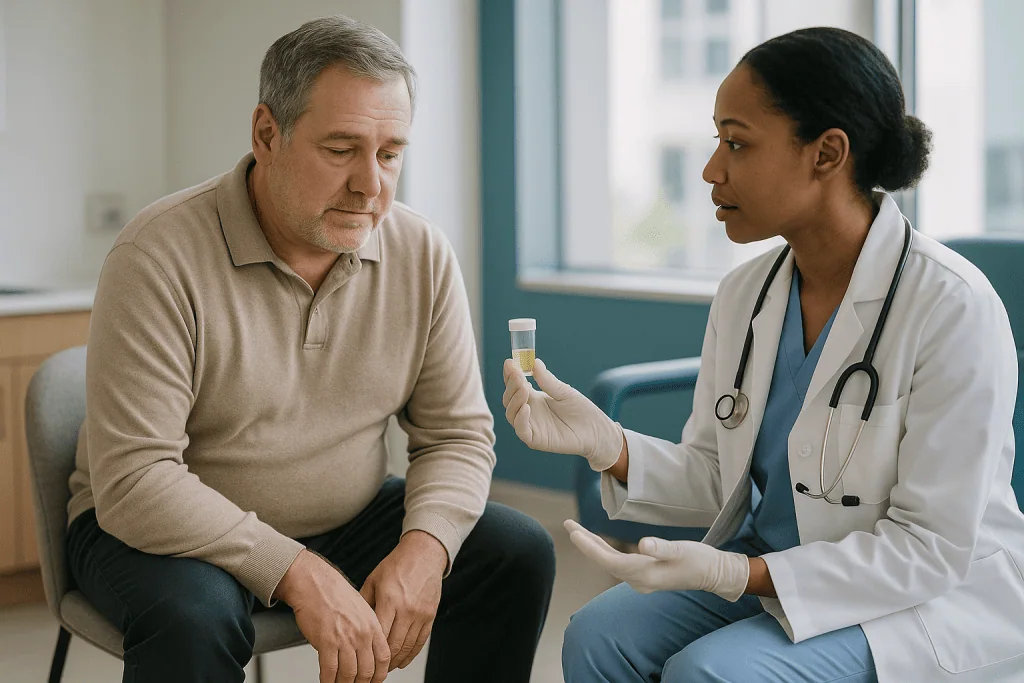
Gout and pseudogout sit on the same list. Both are caused by crystals (uric acid in gout, calcium pyrophosphate in pseudogout) that provoke sudden, furious inflammation, and both can mimic an infection or a reactive flare. Crystals show up under a polarizing microscope soon after the fluid reaches the lab, faster than almost any other answer in rheumatology.
There is a third, quieter reason. Reactive arthritis is a diagnosis of exclusion, meaning it is accepted only after the alternatives are ruled out, so the joint fluid test is less about confirming reactive arthritis and more about clearing the field. The Mayo Clinic lists joint fluid analysis among the core diagnostic steps, alongside blood tests and sometimes imaging, because one sample can answer three questions at once: how inflamed the joint is, whether crystals are present, and whether bacteria grow. A result that is inflammatory, crystal-free and sterile, in a person with a recent gut or genital infection, is as close as medicine gets to a positive answer for this condition.
How does synovial fluid analysis for reactive arthritis actually work?
Synovial fluid is the slippery, egg-white liquid that lubricates a joint. A healthy knee holds very little of it; an inflamed knee can hold many times more. Arthrocentesis is the procedure of drawing that fluid out with a needle, and MedlinePlus describes it as the way synovial fluid analysis begins.
The sequence is simple. The clinician cleans the skin with antiseptic, often numbs it with a local anesthetic, and guides a needle into the joint space, sometimes using ultrasound to confirm the position. Fluid is drawn into one or more syringes. The needle work itself usually takes a few minutes; most of the appointment is preparation.
What happens in the laboratory is the useful part. The fluid is first judged by eye. Clear and pale yellow suggests a non-inflammatory process, cloudy suggests inflammation or infection, and frank pus points toward infection. A technician counts the white blood cells and notes which types predominate. A Gram stain, a dye test that lets bacteria show up under a microscope within hours, is performed, and a portion goes for culture, where any bacteria present are encouraged to grow over the following days. Another drop goes under a polarizing microscope in search of crystals.
In reactive arthritis the typical pattern is an inflammatory fluid: cloudy, rich in white cells, yet with no crystals and no growth. Some centers also run a genetic test on the fluid for chlamydia DNA, though this is not universal and a negative result does not exclude the condition. Draining the fluid often eases pressure and pain as a side benefit, and the same needle can deliver a corticosteroid injection if the team judges infection unlikely. That judgment usually waits for the first laboratory results, which is exactly the point.
How painful is joint aspiration, honestly?
People brace for the worst and are usually surprised. Most describe a sharp pinch as the local anesthetic goes in, then a sensation of pressure or fullness as the needle enters the joint, lasting seconds. The knee, the joint most often involved in reactive arthritis, is also the easiest to aspirate: it is large, close to the skin and keeps its fluid in a pocket above the kneecap that a needle can reach without passing near major nerves.

Two things change the experience. The first is how tight the joint is. A knee stretched taut with fluid is already painful, and drawing off the excess frequently relieves that pressure, so many people feel better walking out than walking in. The second is tension. Clenching the thigh compresses the joint space and makes the needle harder to place; clinicians will ask you to let the leg go heavy, and it genuinely helps.
Afterward, the joint may ache for a day or so where the needle passed, much like a bruise. MedlinePlus lists the recognized risks as infection introduced into the joint, bleeding into the joint and, rarely, injury to nearby structures, all uncommon with sterile technique. People who take blood-thinning medicines should say so beforehand; aspiration is usually still possible, but the team may adjust how it is done. Anyone with a skin infection over the joint should also mention it, because the needle should not pass through infected skin.
Hips and small joints are harder to reach and more often done with ultrasound or X-ray guidance, which adds time rather than pain. When a child needs the procedure, teams commonly use numbing cream, distraction and sometimes light sedation, planned with the family in advance.
What does a reactive arthritis stool test look for?
A stool test looks backward in time. It asks whether one of the bowel bacteria known to trigger reactive arthritis is still present, and the answer changes what, if anything, needs treating besides the joint.
The classic method is stool culture: a sample is placed on nutrient plates designed to favor Salmonella, Shigella, Campylobacter and Yersinia, and the lab watches for growth over several days. Many laboratories now use a molecular panel instead, a test that detects the genetic material of a dozen or more gut pathogens at once, often within a day. Either way, the goal is identification, not a measure of how sick you are.
Timing explains why the test is often negative. Reactive arthritis appears 1 to 4 weeks after the infection (Mayo Clinic), and by then the diarrhea has usually settled and the bacteria have largely cleared. A negative stool test therefore does not rule out a gut trigger; it simply says the germ is no longer detectable. Clinicians weigh the history, a recent bout of diarrhea, a shared meal that made others ill, recent travel, as heavily as the sample. Blood tests for antibodies against these bacteria exist and can sometimes show that an infection occurred, though they are used selectively because results vary with timing and prior exposure.
When a stool test is positive, it has two consequences. Antibiotics may be considered for the active infection, a decision resting on the specific organism and the person’s circumstances, since some gut infections resolve on their own and treating them does not shorten the arthritis, a point the NHS makes plainly. The second consequence is public health: certain bacteria are notifiable, household contacts may be asked about symptoms, and food handlers may be advised about returning to work. That is why ‘what do you do for a living’ sometimes follows a positive result.
What does a reactive arthritis urine test check, even without urinary symptoms?
The urine test is looking for Chlamydia trachomatis, and it is ordered even when a person reports nothing unusual below the waist. The CDC notes that most chlamydia infections cause no symptoms, which makes the infection easy to carry and easy to miss. A swollen knee can be the first sign anyone notices.
The modern test is a nucleic acid amplification test, or NAAT, which detects the organism’s genetic material rather than trying to grow it. A first-catch urine sample, the first portion of the stream rather than midstream, usually suffices. Depending on history, a clinician may also take a swab from the urethra, cervix, vagina, throat or rectum, because urine alone can miss infection at other sites. The same sample is typically tested for gonorrhea, which the CDC also lists among possible triggers.
A standard urine dipstick, the paper strip test done in many clinics, is a different thing. It can show white cells or blood in the urine, which may hint at urethritis, inflammation of the urine tube that forms part of the classic reactive arthritis picture, but it cannot identify a cause. If the dipstick is abnormal, a urine culture may be added to check for an ordinary urinary tract infection.
A positive chlamydia result reshapes the plan more than any other test on this page. The infection warrants treatment regardless of the joint, and the CDC advises that recent sexual partners be tested and treated to prevent reinfection, with retesting some months later because reinfection is common. Those are conversations your clinician should raise directly and privately. The arthritis, meanwhile, follows its own course; clearing the chlamydia is necessary, but it does not switch the joint inflammation off, so the two are managed in parallel.
Who is usually offered a reactive arthritis joint fluid test, and who is asked to wait?
The strongest case for aspiration is a single hot, swollen joint whose cause is uncertain, especially with fever, with a person who feels unwell, or with anything that raises the possibility of infection: a recent injection into that joint, a skin wound nearby, a prosthetic joint, diabetes or a weakened immune system. In those circumstances guidance treats aspiration as urgent rather than optional, because septic arthritis has to be excluded before anti-inflammatory treatment begins.
Aspiration also makes sense when a diagnosis would change management: a suspected first attack of gout, a joint that has not responded as expected, or a person whose story fits reactive arthritis but whose results so far are ambiguous. Larger joints with enough fluid to sample are the practical candidates, and the knee is the usual target.
Some people are asked to wait, or are steered toward other tests first. If several joints are mildly inflamed in a symmetric pattern with no fever, the picture points away from infection and toward conditions such as rheumatoid arthritis or a viral arthritis, where blood tests and time tell more than fluid would. Infected or broken skin directly over the joint is a reason to postpone, since the needle should not pass through it. A severe bleeding disorder or very high anticoagulation may prompt a pause while the team plans the safest approach. Joints with too little fluid to reach may be imaged instead.
Repeat aspiration has its own logic. If a culture is negative but the joint stays angry, or if symptoms change character, the team may sample again. Each time, the decision belongs to the treating clinician, weighing what the result would change against the small risks of the procedure.
How do joint fluid results differ between reactive, septic and crystal arthritis?
The table summarizes the broad patterns laboratories describe. Real results overlap at the edges, which is one reason clinicians never read a single line in isolation.
| Feature | Normal joint | Reactive arthritis | Septic arthritis | Gout or pseudogout |
|---|---|---|---|---|
| Appearance | Clear, pale yellow | Cloudy, yellow | Opaque, often pus-like | Cloudy |
| White cells | Very few | Raised, inflammatory range | Very high | Raised, inflammatory range |
| Crystals | None | None | None | Present |
| Gram stain and culture | Negative | Negative | Often positive | Negative |
| Usual implication | No inflammatory arthritis | Anti-inflammatory approach; treat trigger if still present | Urgent antibiotics, often drainage | Anti-inflammatory and crystal-lowering approach |
Two rows deserve a closer look. White cell counts in reactive arthritis sit in the inflammatory range and overlap with gout and early infection, so the count alone cannot separate them; the crystal search and the culture do that work. Culture is the slowest result, and a negative culture is only reassuring once enough time has passed and the Gram stain, cell count and clinical course all agree. Antibiotics taken before aspiration can suppress growth and muddy this picture, which is why clinicians prefer to sample first when it is safe to do so.
Blood tests complete the picture rather than replace it. Inflammatory markers such as C-reactive protein (CRP) and erythrocyte sedimentation rate (ESR) are usually raised in reactive, septic and crystal arthritis alike, so they measure intensity, not cause. HLA-B27 supports the diagnosis when positive and is linked with a longer course, the NIH notes, but a negative result does not exclude reactive arthritis and a positive one does not confirm it. Imaging adds a third layer: X-rays are often normal early on, while ultrasound can show fluid and inflamed tendon attachments and guide the needle itself.
What happens in the days and weeks after the tests?
The first day belongs to the Gram stain and the cell count, which are typically available within hours. If they point toward infection, treatment for septic arthritis starts immediately and hospital admission is common. If they show inflammation without organisms, the team may begin anti-inflammatory treatment while the culture incubates, keeping a close eye on the joint.
Culture, stool and urine results arrive over the following days, depending on the laboratory. This is the window where people often feel in limbo: ‘probable reactive arthritis’ is already being treated, but no one has said the words with certainty yet. That is normal. Reactive arthritis is confirmed by what fails to appear.
During these early weeks the joint is often at its most swollen. Rest for the joint, not for the whole person, is the usual advice, with gentle range-of-motion movement to keep it from stiffening. Ice helps acute swelling. The aspirated joint may feel bruised for a day or two. If a corticosteroid was injected at the time of aspiration, relief often begins within days, though the timing varies.
Once results are back, follow-up visits check whether the joint is settling, whether new joints have joined in, and whether eye symptoms have appeared, because conjunctivitis and uveitis can develop after the joints do. Anyone who tested positive for chlamydia or a gut bacterium will have had that infection treated and, for chlamydia, partners notified.
Beyond that, the timeline widens. The Mayo Clinic describes most people improving over weeks to months, and physical therapy often enters here to rebuild strength in muscles that spent weeks protecting a sore joint. If symptoms persist past several months, that is the point at which a rheumatologist typically revisits both the diagnosis and the longer-term options.
How is reactive arthritis treated once the results are back?
People searching ‘how to clear up reactive arthritis’ usually hope for a single pill that ends it. The evidence points to something less tidy: a two-track approach that treats any surviving infection and, separately, calms the joint while the immune system stands down on its own schedule.
Track one is the infection. If chlamydia or a gut bacterium is detected, antibiotics treat that infection and prevent spread. The NHS is explicit that antibiotics do not treat the arthritis itself, so antibiotic courses are not usually prescribed for the joints alone. Whether and how to treat a detected organism rests with the prescribing clinician.
Track two is the joint. Nonsteroidal anti-inflammatory drugs, the class that blocks enzymes driving inflammation and pain, are the usual first step, as both the Mayo Clinic and the NHS describe. For a stubborn single joint, a corticosteroid injected directly into it delivers a concentrated anti-inflammatory effect locally; oral corticosteroids are sometimes used when several joints are involved. If inflammation persists for months, rheumatologists may turn to disease-modifying antirheumatic drugs (DMARDs), medicines that dampen the immune response more broadly and take weeks to act. Biologic agents that block specific inflammatory signals are reserved for the small group with persistent, severe disease.
The non-drug track matters more than people expect. Physical therapy restores range of motion and strengthens the muscles that protect a joint. Eye involvement needs prompt assessment by an eye specialist, because uveitis is treated differently from conjunctivitis and can threaten vision if missed. Skin and mouth changes are managed on their own merits. Which combination suits a given person depends on their results and circumstances, and every choice here, including when to step treatment down, belongs to the treating team.
How long does it take for reactive arthritis to go away?
Most people recover, and most recover within months rather than years. The NHS describes most people returning to normal activities after about 3 to 6 months, with symptoms rarely lasting beyond 12 months, and the NIH describes a typical course of a few months to a year. Those are population patterns, not a forecast for any individual knee, and the range is wide for reasons only partly understood.
A few factors shift the odds toward a longer course. Carrying HLA-B27 is associated with more prolonged and recurrent disease, according to the NIH. Involvement of the spine or sacroiliac joints, a chlamydia trigger left untreated, and many inflamed joints at the start are also linked with slower settling. None of these decides the outcome on its own.
Recurrence is real. A minority of people have further episodes, sometimes after a new infection and sometimes without an obvious trigger, and a smaller group develops chronic arthritis that needs ongoing rheumatology care, which both the NHS and the NIH acknowledge. Hearing this early is better than discovering it at month seven, because it reframes a slow recovery as a known variant of the condition rather than a treatment failure.
‘Going away’ also has layers. Swelling usually resolves first; stiffness and fatigue often linger; strength around the joint can take weeks of deliberate work to return. Heel pain from enthesitis is notorious for outlasting everything else. People often feel mostly better long before they feel normal, and a calendar expectation measured in weeks tends to produce frustration. A realistic plan treats the first few months as active recovery, with a check-in at each stage and a low threshold to revisit the diagnosis if the pattern changes.
What people often get wrong about reactive arthritis testing
Myth one: a negative stool or urine test means it was not reactive arthritis. The trigger infection often clears before the joint flares, so these tests are expected to be negative in many genuine cases. The diagnosis rests on the pattern and the exclusion of alternatives, not on catching the germ.
Myth two: joint fluid analysis confirms reactive arthritis. It does not. No fluid finding is specific to the condition; the test exists to rule out septic arthritis and crystal disease. An inflammatory, sterile, crystal-free fluid is consistent with reactive arthritis and with several other inflammatory arthritides.
Myth three: HLA-B27 is a diagnostic test. The NIH describes it as a marker that raises susceptibility and may predict a longer course. Many people with reactive arthritis test negative, and most carriers never develop the condition.
Myth four: antibiotics will clear the joint. Antibiotics treat a surviving infection and protect partners and contacts; the NHS notes they do not treat the arthritis itself. Expecting a course of antibiotics to resolve a swollen knee leads to disappointment and sometimes to unnecessary repeat prescriptions.
Myth five: reactive arthritis is a sexually transmitted disease. It is not transmissible. One possible trigger can be, and that trigger needs addressing, but a person can develop reactive arthritis after food poisoning and never have had a sexually transmitted infection. Assuming otherwise damages relationships and keeps people from seeking care.
Myth six: feeling better after aspiration means the problem is solved. Draining fluid relieves pressure, and a steroid injection calms inflammation, but neither changes the underlying immune process. Follow-up still matters, particularly for eye symptoms, which can appear after the joint has quieted.
Myth seven: the older name Reiter’s syndrome describes a different disease. It is the same condition under a name most specialists have retired, and the triad it described (joints, eyes, urethra) occurs in only a portion of cases.
Questions to ask your care team
A swollen joint tends to arrive with a rush of information and little time to absorb it. Writing questions down before the appointment, or bringing someone who will, makes the conversation more useful. These are the ones that tend to unlock the clearest answers.
- What are you trying to rule out with the joint fluid test, and what will each result change about my treatment?
- Which stool or urine tests are you ordering, and should I expect them to be negative given how long ago my infection was?
- When will each result be back, and who will call me if something needs urgent action?
- If the fluid shows inflammation but no infection, will you start treatment before the culture is final?
- Are you planning to inject a corticosteroid at the time of aspiration, or wait for results first?
- Do I need an HLA-B27 test, and how would the result change the plan or the outlook?
- Should I see an eye specialist now, or only if I notice symptoms?
- If chlamydia is found, how will partner testing be handled, and how is my privacy protected?
- What does recovery usually look like for someone with my pattern of joints, and at what point would you reconsider the diagnosis?
- Which symptoms should make me call before my next appointment?
Two follow-up habits help. Ask for a copy of your fluid and laboratory results, so that if you see a different clinician later you can show exactly what was excluded and when. And ask how to reach the team between visits, because reactive arthritis can add a new joint or an eye symptom at any point in the first months, and the fastest route to advice is knowing it in advance.
When to call your doctor
Most of the course of reactive arthritis unfolds slowly enough to discuss at scheduled visits. A few situations are different, because they can signal septic arthritis, eye inflammation that threatens sight, or a complication of the aspiration itself. Seek same-day medical advice, or emergency care if you cannot reach your team, for any of the following.
- Fever or chills together with a joint that is hot, red and rapidly more painful, especially if you cannot bear weight or move it at all; this combination is treated as infection until proven otherwise.
- A new red, painful eye, sensitivity to light or blurred vision; uveitis can damage sight and needs prompt assessment by an eye specialist, not a wait-and-see approach.
- After a joint aspiration, increasing redness, warmth, swelling or discharge at the needle site, or a fever in the following days.
- Chest pain, palpitations, breathlessness or fainting; heart involvement in reactive arthritis is rare but recognized, and these symptoms always warrant urgent evaluation.
- Severe abdominal pain, blood in the stool or signs of dehydration if a gut infection is still active.
- Pain, burning or discharge when passing urine, or pelvic pain, which may indicate an untreated genitourinary infection.
- A new or worsening symptom in a different joint, or back pain that wakes you at night, which your team will want to know about even if it is not an emergency.
Between those extremes, trust the pattern. A joint that is slowly improving, with stiffness that eases with movement, is behaving as expected. A joint that was improving and then abruptly worsens is not, and that change is worth a phone call. Your treating team, who know your results and your history, remain the right people to decide what each signal means.
Frequently asked questions
How painful is joint fluid analysis?
Most people feel a brief sting from the local anesthetic and a few seconds of pressure as the needle enters the joint; the sampling itself is usually over within minutes. A tense, fluid-filled knee often feels better once drained. Mild bruise-like soreness for a day or so is common. Serious problems such as infection or bleeding into the joint are uncommon with sterile technique, according to MedlinePlus.
What is the most common cause of reactive arthritis?
Chlamydia trachomatis, a sexually transmitted bacterium, is the most common trigger overall, according to the NIH. Gut infections with Salmonella, Shigella, Campylobacter and Yersinia are the other main group. The bacteria do not infect the joint; the arthritis is the immune system’s delayed reaction, typically appearing 1 to 4 weeks after the infection, as the Mayo Clinic describes.
How long does it take for reactive arthritis to go away?
For most people, months rather than years. The NHS describes a return to normal activities after about 3 to 6 months, with symptoms rarely lasting beyond 12 months, and the NIH gives a similar range. A minority experience recurrences or a chronic course, more often among those who carry HLA-B27. Your team can place your own pattern within these ranges.
How do you clear up reactive arthritis quickly?
There is no quick switch. Treatment runs on two tracks: antibiotics only if an active triggering infection is found, and anti-inflammatory approaches, such as nonsteroidal anti-inflammatory drugs or a corticosteroid injection into the joint, for the inflammation itself, as the Mayo Clinic and NHS describe. Physical therapy supports recovery. The immune response settles on its own timetable, and the prescribing clinician decides the combination.
Is synovial fluid analysis for reactive arthritis always needed?
Not always, but it is strongly favored whenever a single hot, swollen joint could be infected or caused by crystals, because those conditions need different, sometimes urgent, treatment. When several joints are mildly and symmetrically inflamed without fever, blood tests and observation may come first. The treating clinician weighs what the result would change against the small procedural risks.
Can a reactive arthritis stool test be negative even if food poisoning caused it?
Yes, and that is common. The arthritis typically appears 1 to 4 weeks after the gut infection (Mayo Clinic), by which time the bacteria have often cleared from the bowel. A negative stool culture or molecular panel means the organism is no longer detectable, not that it was never there. Clinicians rely heavily on the history of recent diarrhea or shared illness.
Why is a reactive arthritis urine test done when I have no urinary symptoms?
Because chlamydia, the most common trigger, usually causes no symptoms at all, according to the CDC. A urine nucleic acid amplification test detects the bacterium’s genetic material from a first-catch sample. Finding it matters beyond the joint: the infection itself needs treatment, and recent partners need testing to prevent reinfection, which the CDC advises as standard practice.
Is reactive arthritis contagious?
No. Reactive arthritis itself cannot be passed from person to person. Some of its triggers can be: chlamydia and gonorrhea are sexually transmitted, and gut bacteria such as Salmonella spread through contaminated food or contact. Treating a detected infection protects others from that infection, but the joint inflammation is an immune reaction unique to the affected person.
Will I need to stop blood thinners before joint aspiration?
Usually not, but tell the team you take them. Aspiration is commonly performed in people on anticoagulants, with attention to technique and sometimes a check of clotting levels first. Never stop or adjust a prescribed blood thinner on your own; the clinician performing the procedure and the one who prescribed the medicine will decide together what, if anything, should change.
What does a positive HLA-B27 result mean for me?
It means you carry an inherited marker that raises susceptibility to reactive arthritis and related conditions and is associated with a longer or recurring course, according to the NIH. It does not confirm the diagnosis, and most carriers never develop the condition. A negative result does not rule reactive arthritis out either. Your team interprets it alongside your symptoms and other results.
References
- NHS: Reactive arthritis
- MedlinePlus Medical Encyclopedia: Synovial fluid analysis
- NIH NIAMS: Reactive Arthritis
- CDC: About Chlamydia
This article is for general information only and is not a substitute for professional medical advice. Please consult a qualified doctor about your individual situation.

More from the Blog

When Rheumatic Fever Care Needs Urgent Review: Chest Pain, Fainting or New Joint Swelling
In someone with a history of rheumatic fever, new chest pain, fainting or near-fainting, or fresh joint swelling should prompt same-day medical review rather…

On Biologics for Psoriatic Arthritis: Blood Tests, Vaccination Review and Infection Checks
Psoriatic arthritis biologics monitoring usually means a set of checks before the first dose and at intervals afterward: blood tests such as a full…

Polymyalgia Rheumatica and Giant Cell Arteritis: Why New Headache or Jaw Pain Is Urgent
Polymyalgia rheumatica (PMR) and giant cell arteritis (GCA) are linked inflammatory conditions that almost always begin after age 50. NIAMS estimates roughly 15% of…

Why Routine Eye Exams Are Part of Juvenile Idiopathic Arthritis Treatment
Routine eye exams are built into juvenile idiopathic arthritis treatment because the same immune process that inflames a child's joints can inflame the front…

Systemic Lupus Erythematosus in Young Adults: Building a Treatment Routine That Lasts
Lupus treatment for young adults usually combines an antimalarial medicine taken long term, short courses of other medicines during flares, regular blood and urine…
Lupus and Pregnancy Planning: Why Your Rheumatologist Wants to Know Early
Lupus and pregnancy planning means meeting your rheumatologist before you try to conceive, ideally after about six months of quiet disease, so your medicines…