Back Surgery for Herniated Disc: Procedure, Recovery and Results

Most herniated discs improve without surgery; an operation is considered for persistent disabling symptoms, progressive weakness, or certain emergencies. Microdiscectomy and discectomy are designed to relieve pressure on a spinal nerve, especially when sciatica is caused by a lumbar disc herniation.
Key Takeaways
- Most herniated discs improve without surgery; an operation is considered for persistent disabling symptoms, progressive weakness, or certain emergencies.
- Microdiscectomy and discectomy are designed to relieve pressure on a spinal nerve, especially when sciatica is caused by a lumbar disc herniation.
- Recovery varies, but many people begin walking shortly after surgery and gradually return to usual activities over several weeks.
- Surgery can improve leg pain more reliably than back pain; numbness and weakness may take longer to improve.
- Possible risks include infection, bleeding, spinal fluid leak, nerve injury, recurrent disc herniation, and ongoing symptoms.
Back surgery for herniated disc is usually considered when a displaced spinal disc continues to compress a nerve and causes persistent leg pain, weakness, or loss of function despite appropriate nonsurgical care. The most common operation, lumbar discectomy or microdiscectomy, removes the portion of disc pressing on the nerve rather than replacing the entire disc.
Overview: what back surgery for a herniated disc does
Back surgery for herniated disc is performed to reduce pressure on a spinal nerve caused by disc material that has moved beyond its usual boundary. In the lower back, this pressure may cause sciatica: pain that travels from the buttock into the leg, sometimes with tingling, numbness, or weakness. Surgery is generally not the first step, because many disc herniations settle with time, activity modification, medicines, physiotherapy, or targeted injections.
The operation most often used is a lumbar discectomy, frequently performed through a smaller incision with magnification and called a microdiscectomy. The surgeon removes only the disc fragment or bulging material that is irritating the nerve. The aim is to improve nerve-related leg symptoms while preserving as much of the disc and normal spinal movement as possible.
When symptoms and scans point to a lumbar disc herniation, the decision is based on the person’s pain, neurological examination, daily function, and imaging findings—not on an MRI result alone. A consultation with a spine specialist can clarify whether surgery is likely to offer meaningful benefit.
How do they fix a herniated disc in your back?
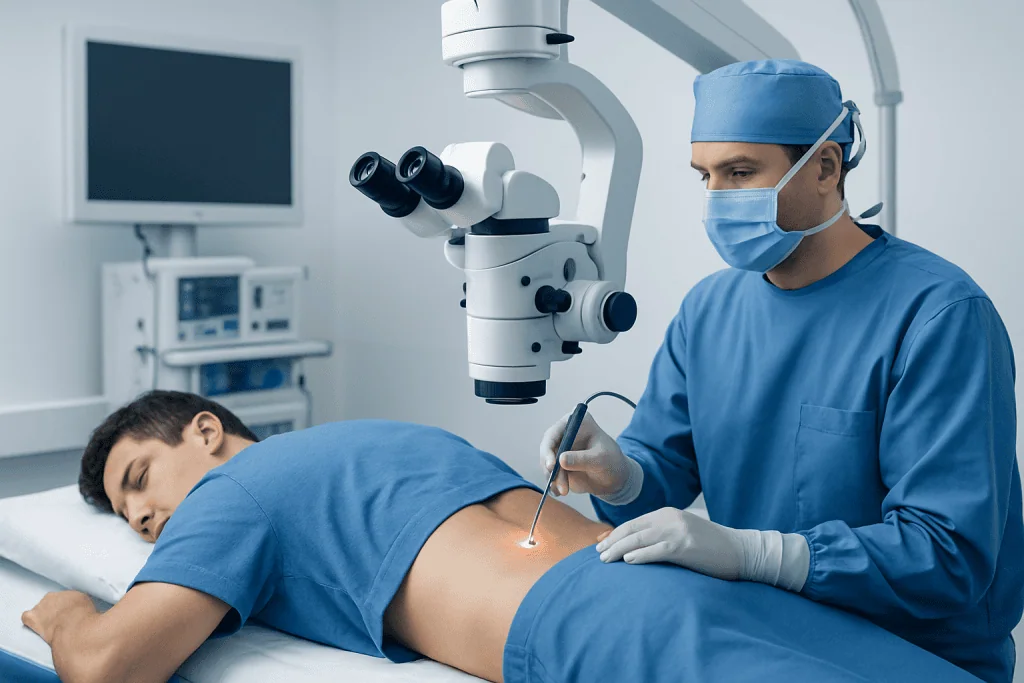
During a discectomy, the surgeon reaches the affected area of the spine through an incision in the back. Small amounts of bone or ligament may be carefully moved or removed if needed to create a safe path to the compressed nerve. The nerve is gently protected, and the surgeon removes the disc fragment that is pressing on it.
In a microdiscectomy, special magnification or a surgical microscope helps the surgeon work through a smaller exposure. Some patients may be candidates for endoscopic techniques, which use a camera and specialized instruments through a very small incision. The best approach depends on the location and size of the disc herniation, spinal anatomy, prior operations, and the surgeon’s assessment.
A fusion procedure is not routinely needed for a straightforward first-time disc herniation. It may be discussed when there is spinal instability, significant vertebral slippage, severe disc degeneration with mechanical pain, or a need for more extensive decompression. The planned procedure should be tailored to the individual diagnosis rather than chosen by incision size alone.
Who may benefit from surgery and how the procedure is planned

People may be considered for surgery when leg pain from nerve compression remains severe and limiting after a suitable period of nonsurgical treatment. Surgery may also be advised earlier when there is worsening muscle weakness, such as difficulty lifting the foot, or pain that prevents sleep, walking, or essential daily activities despite conservative measures.
Before recommending an operation, the clinical team reviews the symptom pattern, medical history, medication use, physical examination, and imaging such as MRI. The most helpful surgical situation is one in which the symptoms, examination findings, and scan all identify the same irritated nerve root. Other causes of back or leg symptoms should be considered, including spinal stenosis, hip disease, peripheral nerve conditions, and vascular problems.
Urgent assessment is important if there are signs of cauda equina syndrome, a rare but serious form of nerve compression. These include new difficulty passing urine, loss of bowel control, numbness around the genitals or inner thighs, or rapidly progressing leg weakness. These symptoms require immediate emergency medical care.
- Persistent sciatica with a confirmed nerve-compressing disc herniation may support surgery.
- Progressive or significant weakness can make earlier surgery appropriate.
- Smoking, uncontrolled diabetes, poor general health, and some blood-thinning medicines may affect surgical planning and recovery.
Step-by-step: what happens on the day of surgery
Most lumbar discectomy procedures are carried out under general anaesthesia, so the patient is asleep. After positioning the person face-down, the surgical area is cleaned and covered with sterile drapes. The surgeon makes an incision over the affected spinal level, using X-ray guidance when needed to confirm the exact location.
The back muscles are gently moved aside rather than broadly cut whenever possible. The surgeon accesses the spinal canal, identifies the affected nerve root, and removes the herniated disc material compressing it. The nerve is checked to ensure it has adequate space. The incision is then closed, and a dressing is applied.
The procedure often lasts one to two hours, although timing varies with the surgical method and complexity. Some people go home the same day or after one night in hospital, while others need a longer stay because of medical needs, pain control, mobility, or the extent of surgery. The care team provides individualized instructions about wound care, medicines, walking, sitting, driving, and returning to work.
How long does it take to recover from L5 S1 disc bulge surgery?
Recovery after L5 S1 disc bulge surgery varies, but many people are encouraged to stand and take short walks on the day of surgery or the following day. Early recovery focuses on controlling discomfort, protecting the incision, avoiding prolonged sitting, and gradually increasing walking. Leg pain may improve quickly when nerve pressure has been relieved, although recovery is not identical for everyone.
For a straightforward microdiscectomy, desk-based work may be possible after roughly two to six weeks, depending on symptoms and the treating surgeon’s advice. Jobs involving lifting, repeated bending, vibration, or physical labor commonly require a longer, staged return. More demanding exercise and heavy lifting are usually reintroduced gradually over several weeks to months.
Numbness, tingling, and weakness can improve more slowly than pain because an irritated nerve needs time to recover. If symptoms were present for a long time before surgery or there was substantial weakness, recovery may be incomplete. A tailored rehabilitation plan can help restore movement, trunk strength, confidence, and safe activity habits.
Follow-up appointments allow the team to check wound healing, neurological recovery, and return-to-activity plans. New severe leg pain, fever, drainage from the wound, increasing redness, or worsening weakness should be reported promptly.
What are the signs that a herniated disc is healing?
Common signs of improvement include less pain radiating down the leg, a greater ability to walk or sit comfortably, reduced tingling, and better sleep. A person may also notice improved strength and greater confidence with routine movements. Recovery often occurs in steps rather than as a smooth day-by-day change.
After surgery, it is common to have some incision soreness and temporary stiffness in the back. Brief fluctuations in nerve sensations can also occur as healing continues, particularly after increased activity. The overall trend should be toward better function and decreasing symptoms rather than steadily worsening pain or weakness.
Healing does not necessarily mean that every symptom disappears immediately. Nerves heal slowly, and numbness can persist even when the compression has been removed successfully. Regular walking, clinician-guided exercises, good sleep, and avoidance of smoking may support recovery, but activities should progress according to the treating team’s advice.
What are the risks associated with herniated disc surgery?
Discectomy is a commonly performed spinal procedure, but every operation has potential risks. These include anaesthesia-related complications, bleeding, infection, blood clots, wound problems, and reactions to medicines. The surgical team reviews personal risks in advance and uses preventive measures suited to the individual.
Procedure-specific risks include a tear in the membrane around the spinal fluid, known as a dural tear, injury or irritation of a nerve, persistent numbness or weakness, and incomplete relief of pain. In uncommon cases, disc material can herniate again at the same level, or symptoms may arise from disc changes at another level over time.
Back surgery tends to be most effective for leg symptoms that clearly match nerve compression. It may not fully resolve long-standing numbness, weakness, or back pain that has more than one cause. A careful discussion of expected benefits, alternatives, and uncertainties helps patients make an informed decision.
For international patients seeking coordinated spine care, Acibadem International’s multidisciplinary specialists and JCI-accredited hospitals diagnose and treat spinal conditions with individualized planning and follow-up support.
When to seek medical care
A medical review is appropriate for back pain with leg pain, numbness, tingling, or weakness that does not improve, limits everyday activity, or recurs frequently. A clinician can assess whether symptoms may be due to a herniated disc and whether conservative treatment, rehabilitation, injections, imaging, or a surgical opinion is appropriate.
Emergency medical care is needed for new loss of bladder or bowel control, inability to urinate, numbness in the saddle area around the genitals and buttocks, or rapidly worsening weakness in one or both legs. These symptoms may indicate severe nerve compression and should not be managed at home.
After an operation, patients should contact their surgical team for uncontrolled pain, a fever, increasing wound redness or discharge, new weakness, or new changes in bladder or bowel function. Prompt review helps distinguish expected recovery symptoms from problems that need treatment.
Frequently asked questions
Is back surgery for herniated disc always necessary?
No. Many herniated discs improve with nonsurgical care, including remaining appropriately active, physiotherapy, pain management, and time. Surgery is usually considered when symptoms remain disabling, weakness progresses, or there are emergency signs of severe nerve compression.
How successful is microdiscectomy for sciatica?
Microdiscectomy is generally intended to relieve leg pain caused by a clearly compressed spinal nerve. Relief of radiating leg pain can be substantial, but outcomes vary according to nerve damage, symptom duration, overall health, and whether symptoms match the imaging findings. It is less predictable for pain that is mainly in the lower back.
Will a herniated disc grow back after surgery?
The removed disc fragment does not grow back, but another fragment can herniate from the same disc in some people. Disc degeneration may also continue over time, and new problems can occur at other spinal levels. Following rehabilitation guidance and using safe movement and lifting habits may help reduce strain on the back.
How painful is recovery after herniated disc surgery?
Some incision discomfort, back stiffness, and muscle soreness are expected after surgery, and pain control is part of the recovery plan. Many patients notice improvement in nerve-related leg pain early, though nerve sensations can take longer to settle. The surgical team can adjust pain management if discomfort is not adequately controlled.
Can someone walk after L5 S1 disc surgery?
In many cases, walking begins soon after surgery under guidance from the care team. Short, frequent walks are commonly increased gradually because they support circulation and mobility without excessive strain. The exact plan depends on the operation performed and the person’s medical condition.
What should be avoided after lumbar discectomy?
Early after surgery, patients are commonly advised to avoid heavy lifting, repetitive bending or twisting, high-impact exercise, and prolonged sitting. Restrictions differ among surgeons and procedures, so the individual discharge plan should take priority. Activities are gradually resumed as healing and strength improve.
References
- American Academy of Orthopaedic Surgeons
- North American Spine Society
- National Institute of Neurological Disorders and Stroke
- National Health Service
- Mayo Clinic
This article is for general information only and is not a substitute for professional medical advice. Please consult a qualified doctor about your individual situation.
Joint and spine care in Turkey — expert assessment & treatment
JCI-accredited · board-certified surgeons · reply within 24h
Add us as a Preferred Source to see more of our trusted health content across Google Search, AI Overviews and Discover.