Breast Biopsy Results: Procedure, Recovery and Results

A breast biopsy removes a small tissue sample for examination by a pathologist. Most breast biopsy findings are benign, such as fibrocystic changes, cysts or fibroadenomas.
Key Takeaways
- A breast biopsy removes a small tissue sample for examination by a pathologist.
- Most breast biopsy findings are benign, such as fibrocystic changes, cysts or fibroadenomas.
- Results commonly take several business days, because tissue must be processed and reviewed carefully.
- Recovery after a needle biopsy is usually brief, with mild bruising or soreness that improves over days.
- A cancer diagnosis does not necessarily make results take longer; timing depends mainly on the tests needed to classify the tissue.
Breast biopsy results provide a clear laboratory assessment of a suspicious area seen on imaging or felt during an examination. Most biopsies do not show cancer, and the report helps the care team decide whether monitoring, further testing or treatment is needed.
Overview: What breast biopsy results mean
Breast biopsy results explain what is present in a small sample of breast tissue taken from an area that looked unusual on a mammogram, ultrasound, MRI or clinical breast examination. The report may show benign changes, an abnormal but non-cancerous condition, or cancer. It is the most reliable way to determine the nature of a suspicious breast finding.
A biopsy recommendation does not mean that a person has breast cancer. Imaging can identify areas that need closer assessment, but it cannot always determine the cause. In many cases, the final finding is benign. The result allows the doctor to match the laboratory findings with the imaging appearance and plan appropriate next steps.
Biopsies are commonly performed using a needle and image guidance, usually as an outpatient procedure under local anaesthetic. Less often, a surgeon removes part or all of an abnormal area through an open surgical biopsy. The method depends on the size, location and imaging features of the finding.
How a breast biopsy works and who may need one
A breast biopsy is considered when an imaging test shows a mass, calcifications, distortion or another change that cannot confidently be called benign. It may also be recommended for a new breast lump, persistent focal breast change, suspicious skin or nipple changes, or enlarged lymph nodes. The decision is based on the complete clinical picture, not on one test alone.
Before the procedure, the team reviews medical history, allergies and medicines. Blood-thinning medication, aspirin, supplements and some anti-inflammatory medicines can affect bleeding risk, so patients should ask their prescribing clinician and biopsy team for individual instructions before changing any medicine. Pregnancy or the possibility of pregnancy should also be mentioned, especially when mammographic guidance is planned.
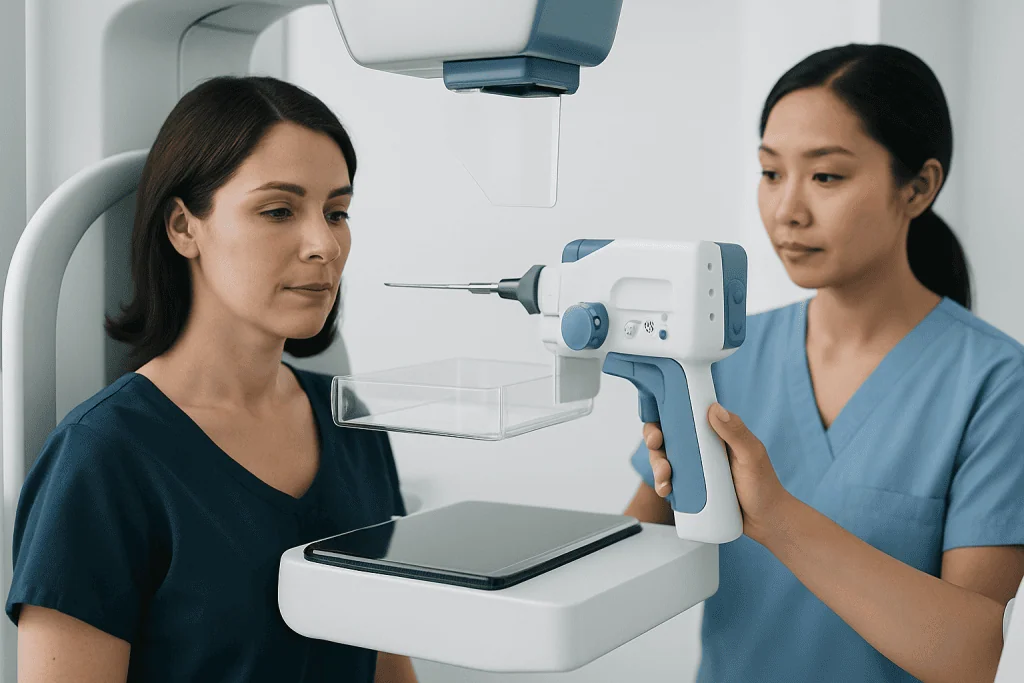
The type of guidance used depends on how the area is best seen. Ultrasound-guided biopsy is often used for a lump visible on ultrasound. Stereotactic biopsy uses mammographic images, often for calcifications, while MRI-guided biopsy may be used for an area visible only on breast MRI. These approaches aim to obtain an accurate sample while limiting removal of normal tissue.
A biopsy is part of a broader breast assessment pathway. If cancer is diagnosed, further review may include imaging, pathology tests and discussion with breast surgery, medical oncology, radiation oncology and other relevant specialists. Information about breast cancer can help patients understand this possible next stage.
Step by step: what happens during the procedure
For most image-guided needle biopsies, the patient lies on an examination table or sits in a position that allows the radiologist to access the breast. The skin is cleaned and a local anaesthetic is injected to numb the area. Patients may feel brief pressure or stinging from the anaesthetic, but they should not feel sharp pain during tissue sampling.
The clinician uses ultrasound, mammography or MRI images to guide a hollow needle to the target. Several small samples are collected because examining more than one piece of tissue improves the chance of an accurate diagnosis. A tiny marker clip may be placed at the biopsy site; this is safe and helps identify the exact location on future imaging, even if the finding becomes less visible after sampling.
Pressure is applied afterward to reduce bleeding, followed by adhesive strips or a small dressing. Stitches are generally not needed after a needle biopsy. A surgical biopsy is more extensive, may use local anaesthetic with sedation or general anaesthetic, and can involve an incision and stitches.
Patients are usually given written aftercare instructions before leaving. They should arrange practical support if sedation was used and follow their own team’s advice about driving, work and physical activity. Breast imaging and tissue diagnosis may be coordinated through breast biopsy services when a suspicious finding needs definitive assessment.
Recovery timeline, benefits and possible risks
After a needle biopsy, mild tenderness, swelling and bruising are common. Applying an ice pack over the dressing at intervals during the first day, wearing a supportive bra and using pain relief recommended by the care team can improve comfort. Most people return to quiet daily activities the same day or the following day.
How many days should I rest after a breast biopsy? Many people need only 24 to 48 hours of relative rest after a needle biopsy. Strenuous exercise, heavy lifting, repetitive arm movements and swimming are often avoided for several days, or until the site is comfortable and the dressing instructions allow it. A surgical biopsy may require a longer recovery period, often about one to two weeks depending on the procedure and the person’s work.
The main benefit of biopsy is diagnostic certainty: it can prevent unnecessary surgery for benign findings and guides treatment when an abnormality needs attention. Possible risks include bruising, bleeding, a small collection of blood called a hematoma, infection, discomfort and, rarely, an inadequate sample that requires repeat biopsy. Needle biopsy does not cause breast cancer to spread.
To protect healing tissue, patients should keep the site clean and dry as instructed, avoid removing adhesive strips early, and attend the planned follow-up. They should contact the care team if instructions are unclear rather than relying on general advice alone.
Understanding breast biopsy results and timing
The pathology report may use terms such as benign, atypia, high-risk lesion, in situ disease or invasive cancer. A benign result means no cancer was found in the sampled tissue. Examples include fibrocystic changes, cysts, fibroadenoma, fat necrosis, usual ductal hyperplasia and benign calcifications. Some benign findings need only routine screening, while others need short-interval imaging or surgical review depending on whether the pathology result fully explains the imaging finding.
What is the most common diagnosis found on a breast biopsy? Benign breast changes are the most common overall outcome. Specific diagnoses vary with age, symptoms and why the biopsy was performed, but fibrocystic changes and fibroadenomas are frequent benign explanations for a sampled area. The important question is whether the pathology is concordant with the imaging result; the radiologist and pathologist help make this comparison.
What percentage of breast biopsies come back with cancer? The percentage varies considerably according to the level of suspicion on imaging, the population being assessed and the biopsy method. Overall, most breast biopsies are benign rather than cancerous. A clinician can give a more meaningful estimate by explaining the imaging assessment category and the individual reason for biopsy.
Results often take several business days to around a week, although timing differs between laboratories and may be longer when special tests are required. Do biopsy results take longer if it’s cancer? Not necessarily. Cancer itself does not automatically delay a report, but additional pathology tests may be needed to identify the cancer type, grade and biomarkers such as hormone receptor and HER2 status. These details are important for treatment planning and can be reported after the initial diagnosis.
What happens after the report
The doctor should explain the result in plain language and confirm whether it matches the imaging finding. This imaging-pathology correlation is essential. If the sample is benign and clearly accounts for the abnormality, routine screening or targeted follow-up may be advised. If the result does not adequately explain a suspicious image, a repeat needle biopsy or surgical excision may be recommended.
Atypical cells and certain high-risk lesions are not the same as cancer, but they may require a breast specialist’s review. Depending on the specific diagnosis, the next step may be surgical removal of the area, enhanced surveillance or discussion of personal risk factors. Patients may wish to ask for a copy of the pathology report and to write down questions before the follow-up appointment.
If cancer is found, the team will discuss its type and features, whether further imaging is needed, and the sequence of treatment. Management can include breast cancer treatment such as surgery, radiotherapy, systemic treatment or a combination, tailored to the individual diagnosis. A diagnosis is a starting point for informed planning, not a complete prediction of outcome.
Acibadem International’s multidisciplinary specialists in JCI-accredited hospitals can assess breast biopsy findings and coordinate care for international patients when further evaluation or treatment is required.
When to seek medical care
Patients should contact the biopsy team promptly if bleeding soaks through the dressing and does not stop with firm, steady pressure, if breast swelling is rapidly increasing, or if pain becomes severe or is not improving with the recommended measures. These problems are uncommon but should be assessed.
Medical advice is also needed for increasing redness, warmth, pus-like drainage, fever, chills or an opening at a surgical incision, as these may suggest infection or delayed healing. New shortness of breath, chest pain or a severe allergic reaction requires urgent emergency care.
Even when recovery is uncomplicated, it is important to receive and discuss the pathology result. A person should also see a doctor for any new or changing breast lump, skin dimpling, nipple inversion, bloody nipple discharge or persistent focal breast symptoms, regardless of a previous benign biopsy.
Frequently asked questions
How long do breast biopsy results take?
Many breast biopsy results are available within several business days to about one week. Timing can be longer if the laboratory needs special stains, expert review or biomarker testing. The biopsy team can provide the most accurate expected timeframe.
Can a breast biopsy be wrong?
Breast biopsy is highly accurate when the correct area is sampled and the tissue result matches the imaging findings. Occasionally, the sample may not explain a suspicious image or may be insufficient. In that situation, the doctor may recommend repeat biopsy or surgical excision.
How many days should I rest after a breast biopsy?
After a needle biopsy, many people resume light activities within 24 to 48 hours. Heavy lifting, strenuous exercise and vigorous arm movements may need to wait for several days, based on the care team’s instructions. Surgical biopsies usually require more recovery time.
What percentage of breast biopsies come back with cancer?
Most breast biopsies do not show cancer, but there is no single percentage that applies to every person. The likelihood depends on how suspicious the area looked on imaging and why the biopsy was recommended. A radiologist or breast specialist can explain the individual level of concern.
What is the most common diagnosis found on a breast biopsy?
Benign breast changes are the most common overall result. Fibrocystic changes, fibroadenomas, benign cyst-related changes and benign calcifications are examples. The precise diagnosis depends on the appearance of the breast finding and the person’s clinical history.
Do biopsy results take longer if it's cancer?
Not always. An initial cancer diagnosis may be available on a similar timeline to a benign result. However, additional tests that describe the cancer’s subtype, receptors and other features can take extra time because they guide treatment decisions.
References
- American Cancer Society
- National Cancer Institute
- American College of Radiology
- Mayo Clinic
This article is for general information only and is not a substitute for professional medical advice. Please consult a qualified doctor about your individual situation.
Oncology care in Turkey — second opinion and treatment plan
JCI-accredited · board-certified surgeons · reply within 24h
Add us as a Preferred Source to see more of our trusted health content across Google Search, AI Overviews and Discover.