Quick answer
A breast lump is a localized swelling or mass in the breast that may be benign or, less commonly, a sign of breast cancer, so it needs careful medical evaluation. At Acibadem in Turkey, assessment typically includes clinical examination, breast imaging such as ultrasound or mammography, and when needed, biopsy, with treatment planned according to the underlying cause.
What is breast lump?
A breast lump is an area of tissue in the breast that feels different from the tissue around it. It may feel like a firm knot, a smooth rounded bump, or a general area of thickening. Doctors record an unspecified breast lump under the diagnostic code ICD-10 N63.0. Understanding what is breast lump and what it may mean is one of the most common reasons people search for breast health information, because finding a lump can be worrying.
It is important to know that most breast lumps are benign, which means they are not cancer. Common benign causes include cysts (fluid-filled sacs), fibroadenomas (solid, smooth, movable lumps made of glandular and connective tissue), and areas of fibrocystic change (a normal, often hormone-related lumpiness of breast tissue). However, a lump can also be an early sign of breast cancer, so every new or changing breast lump should be checked by a healthcare professional.
Breast lumps can affect people of all ages and sexes. They are most common in women, particularly during the reproductive years when hormone levels change with the menstrual cycle, but they also occur in men and in adolescents. The likely cause of a lump often varies with age: in younger women, fibroadenomas and cysts are more common, while the possibility of cancer increases with age. Because breast tissue is naturally uneven in many people, learning what is normal for your own body helps you notice changes early.
Symptoms of a breast lump
Breast lump symptoms vary widely depending on the cause. Some lumps are painful and change with the menstrual cycle, while others are painless and stay the same size for a long time. The lump itself is the main finding, but there are often other signs to notice.
- A new lump or thickened area in the breast or in the armpit (the armpit contains lymph nodes, small glands that filter fluid from the breast).
- Breast pain or tenderness, which may be constant or may come and go with hormonal changes.
- A change in breast size or shape, or one breast becoming noticeably different from the other.
- Skin changes such as dimpling, puckering, redness, or skin that looks like the peel of an orange.
- Nipple changes, including a nipple that turns inward (inversion), a rash around the nipple, or discharge, especially if the discharge is bloody or comes from only one breast.
- Swelling in part of the breast or around the collarbone or armpit.
How breast lump symptoms feel often gives clues about the type of lump. Cysts frequently feel smooth and slightly squeezable, and they may become larger and more tender before a menstrual period. Fibroadenomas usually feel firm, smooth, and rubbery, and they often move easily under the fingers. An infection of the breast, called mastitis, can cause a painful, red, warm lump, sometimes with fever; this is especially common during breastfeeding. In contrast, a lump caused by cancer is often, though not always, painless, hard, irregular in shape, and fixed in place rather than movable.
Symptoms can also differ by stage when cancer is the cause. An early cancer may be a small, painless lump with no other changes. A more advanced cancer may cause visible skin changes, nipple retraction, swollen lymph nodes in the armpit, or persistent swelling. Because no one can reliably tell whether a lump is benign or cancerous by touch alone, any new lump deserves a medical evaluation even if it seems harmless.
Causes and risk factors
Breast lump causes range from normal hormonal changes to infections, benign growths, and cancer. Common causes include:
- Fibrocystic changes: a general lumpiness or rope-like texture in the breast tissue, often influenced by hormones and most noticeable before a period. This is very common and not harmful.
- Breast cysts: fluid-filled sacs that can appear quickly, feel tender, and change with the menstrual cycle. They are most common in women in their 30s to 50s.
- Fibroadenomas: benign solid lumps made of glandular and fibrous tissue, most common in younger women.
- Infection and abscess: a bacterial infection of the breast (mastitis) can form a painful collection of pus called an abscess, often related to breastfeeding.
- Fat necrosis: a firm lump that forms when fatty breast tissue is damaged, for example after an injury, surgery, or radiation therapy. It is benign but can feel similar to cancer.
- Lipoma: a soft, benign lump made of fatty tissue.
- Intraductal papilloma: a small, benign growth in a milk duct that can cause nipple discharge.
- Breast cancer: a malignant (cancerous) growth. It is less common than benign causes but is the most important cause to rule out.
Certain factors increase the likelihood of developing lumps in general, or increase the risk that a lump is cancerous. Risk factors for breast cancer include increasing age, being female, a personal or family history of breast or ovarian cancer, inherited gene changes such as BRCA1 or BRCA2 mutations, earlier chest radiation therapy, early first menstrual period or late menopause, never having given birth or having a first child at an older age, long-term hormone replacement therapy, obesity after menopause, alcohol use, and physical inactivity. Having a risk factor does not mean a person will develop cancer, and many people with breast cancer have no known risk factors. Similarly, hormonal fluctuations, breastfeeding, and benign breast conditions can all make benign lumps more likely without raising cancer risk in most cases.
Diagnosis of a breast lump
Breast lump diagnosis follows a stepwise approach that doctors often call the triple assessment: a clinical examination, imaging tests, and, when needed, a tissue sample. The goal is to determine what the lump is and, above all, to rule out or confirm cancer.
Medical history and physical examination. Your doctor will ask when you noticed the lump, whether it has changed, whether it is painful, whether it varies with your menstrual cycle, and about your personal and family medical history. During the examination, the doctor feels both breasts and the lymph nodes in the armpits and around the collarbone, noting the size, texture, mobility, and location of any lump.
Imaging tests. Which imaging test comes first often depends on your age and the situation:
- Breast ultrasound: uses sound waves to create pictures of the breast. It is usually the first test in younger women, whose breast tissue is denser, and it is very good at telling a fluid-filled cyst from a solid lump.
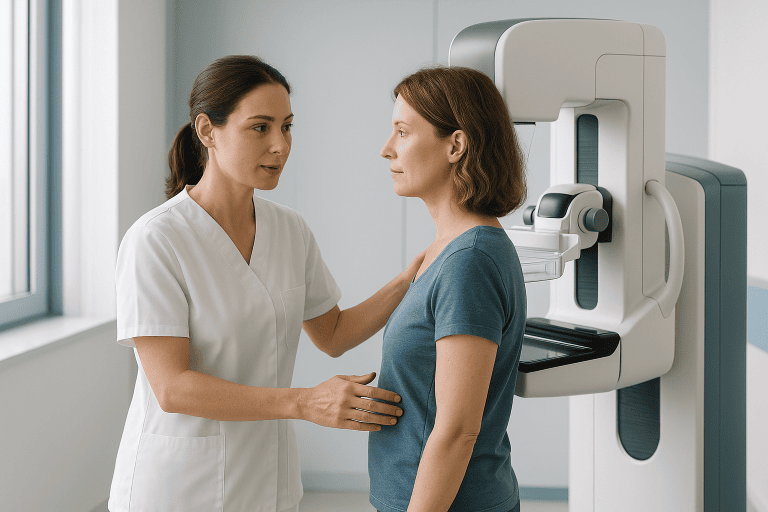
- Mammogram: a low-dose X-ray of the breast, commonly used in women over about 40 and often combined with ultrasound. A diagnostic mammogram takes extra views of the area of concern.
- Breast MRI (magnetic resonance imaging): a scan that uses magnets and radio waves; it may be used in selected cases, for example when other tests are unclear or in people at high genetic risk.
Biopsy. If imaging shows a solid or suspicious lump, the only way to know for certain what it is involves taking a small sample of tissue for examination under a microscope. Options include fine-needle aspiration (a thin needle draws out fluid or cells, often used for cysts), core needle biopsy (a slightly larger needle removes small cylinders of tissue, usually guided by ultrasound or mammography), and, less commonly, surgical biopsy (removing part or all of the lump in an operation). A pathologist, a doctor who studies tissue samples, then determines whether the cells are benign or malignant.
Radiologists often describe imaging findings using a standardized scale called BI-RADS, which indicates how suspicious a finding looks and guides the next step, such as routine follow-up, short-interval repeat imaging, or biopsy. If a cyst is confirmed and drained, and the fluid looks typical, no further treatment may be needed. If a biopsy confirms cancer, additional tests help determine the type and extent of the disease so that treatment can be planned.
Treatment options for a breast lump
Breast lump treatment depends entirely on the cause, so an accurate diagnosis always comes first. Many lumps need no treatment at all, while others require medication, a minor procedure, or surgery.
Watchful waiting. For clearly benign findings such as fibrocystic changes or a small, confirmed fibroadenoma, doctors often recommend simply monitoring the lump over time. This may involve repeat clinical examinations and imaging after several months to confirm the lump is stable. Watchful waiting is a legitimate and safe approach when the diagnosis is confident, and it spares people unnecessary procedures.
Treatment for cysts. Simple cysts often need no treatment. If a cyst is large, painful, or bothersome, the doctor may drain it with a thin needle (aspiration), which usually relieves symptoms quickly. Cysts can refill and may need repeat drainage in some cases.
Medication. If the lump is caused by a breast infection, antibiotics are the main treatment, and an abscess may also need to be drained. For cyclical breast pain associated with fibrocystic changes, doctors may suggest over-the-counter pain relievers, a well-fitting supportive bra, and sometimes adjustments to hormonal medications. If a lump is diagnosed as breast cancer, medication can be a central part of treatment, including chemotherapy (drugs that kill fast-growing cells), hormone therapy (drugs that block hormones that fuel some cancers), and targeted therapies (drugs aimed at specific features of cancer cells), depending on the tumor type.
Procedures and surgery. Benign solid lumps such as fibroadenomas can be surgically removed if they are large, growing, painful, or causing anxiety, although removal is not always necessary. In some centers, minimally invasive techniques such as vacuum-assisted excision may be offered for suitable benign lumps. When cancer is confirmed, surgical options generally include lumpectomy (removing the tumor with a margin of healthy tissue while preserving the breast) or mastectomy (removing the whole breast), often combined with checking or removing lymph nodes in the armpit. Surgery for cancer is usually part of a broader plan that may include radiation therapy and the medications described above, decided by a multidisciplinary team.
Evaluation and surgical management of breast lumps is commonly handled by breast specialists within a general surgery department; at hospital groups such as Acibadem, this specialty typically coordinates the diagnostic workup and any procedures that are needed. Your own care team will explain which option fits your specific diagnosis, and it is always reasonable to ask why a particular approach is recommended.
Living with breast lump / outlook
The outlook for a person with a breast lump depends on its cause. For the majority of people, the lump turns out to be benign, and the long-term outlook is excellent. Benign lumps such as cysts and fibroadenomas do not turn into cancer in most cases, although some benign biopsy findings can modestly increase future breast cancer risk, and your doctor will tell you if that applies to you. Living with benign lumpy breasts often simply means becoming familiar with your normal texture, attending recommended check-ups, and reporting any new changes.
If the lump is cancer, the outlook varies with the type of tumor, its size, whether it has spread, and how it responds to treatment. In general, breast cancers found early tend to have better outcomes than those found late, which is one reason prompt evaluation of any new lump matters. Treatment for breast cancer has improved considerably over time, and many people are treated successfully, but no doctor can guarantee a specific outcome for an individual patient.
Practical steps that support breast health include maintaining a healthy weight, staying physically active, limiting alcohol, and following the breast screening schedule recommended for your age and risk level. Screening mammograms can find cancers before a lump can be felt. Emotionally, discovering a lump can cause significant anxiety even when it proves benign; talking with your doctor, asking questions during the diagnostic process, and seeking support from family, friends, or counseling services can help while you wait for results.
Frequently asked questions
What is a breast lump and is it always cancer?
A breast lump is any area of tissue that feels different from the surrounding breast, such as a bump, knot, or thickened patch. It is not always cancer; in fact, most breast lumps are benign and caused by cysts, fibroadenomas, hormonal changes, or infections. However, because cancer cannot be ruled out by touch alone, every new lump should be examined by a healthcare professional.
How can I tell if a breast lump is serious?
You cannot reliably tell by feel, but certain features raise concern: a lump that is hard, irregular, painless, and fixed in place; skin dimpling; nipple inversion or bloody discharge; and swollen lymph nodes in the armpit. Lumps that persist after your menstrual cycle or that keep growing also warrant attention. Only a medical evaluation with imaging, and sometimes a biopsy, can determine how serious a lump is.
Can a breast lump go away on its own?
Some breast lumps can resolve without treatment. Cysts may shrink or disappear, and lumps related to hormonal changes often become less noticeable after a menstrual period. Lumps caused by infection usually improve with antibiotic treatment. Solid lumps such as fibroadenomas generally do not disappear, though they may stay stable for years. If a lump does not go away within a menstrual cycle or two, or if you are past menopause, have it checked.
What causes breast lumps in young women?
In women in their teens, 20s, and 30s, the most common breast lump causes are fibroadenomas and fibrocystic changes, both benign and often influenced by hormones. Cysts and infections related to breastfeeding are also frequent. Breast cancer is uncommon in young women but does occur, so a persistent lump at any age should still be evaluated, usually starting with an ultrasound.
How is a breast lump diagnosed?
Breast lump diagnosis typically uses a triple assessment: a physical examination by a doctor, imaging with ultrasound and/or a mammogram, and, if the lump is solid or suspicious, a needle biopsy to sample tissue. The combination of these steps allows doctors to confirm whether a lump is benign or cancerous with a high degree of confidence in most cases.
Does breast lump treatment always mean surgery?
No. Many lumps need no treatment beyond monitoring, and cysts can often be drained with a simple needle procedure. Infections are treated with antibiotics. Surgery is generally reserved for benign lumps that are large, growing, or bothersome, and for confirmed cancers, where it is usually combined with other treatments. Your doctor will explain which breast lump treatment fits your diagnosis.
How long does recovery take after breast lump surgery?
Recovery depends on the type of operation. After removal of a benign lump or a lumpectomy, many people return to light daily activities within days and fuller activity within a few weeks, though healing times vary from person to person. Larger operations such as mastectomy, or surgery combined with lymph node removal, usually require a longer recovery. Your surgical team will give you guidance specific to your procedure.
When to see a doctor
Any new breast lump should be evaluated by a healthcare professional, even if it is painless and even if you have recently had a normal mammogram. Do not wait to see whether it goes away if you are past menopause or if the lump persists beyond one or two menstrual cycles. Seek medical attention promptly if you notice any of the following red-flag signs:
- A hard, irregular, or fixed lump in the breast or armpit that does not change with your menstrual cycle.
- A lump that is growing or has clearly changed in size or feel.
- Skin changes such as dimpling, puckering, redness, thickening, or an orange-peel appearance.
- Nipple changes, including a newly inverted nipple, a persistent rash or scaling around the nipple, or discharge that is bloody or comes from one breast only.
- Persistent breast pain in one specific area that does not go away.
- A red, hot, swollen, painful breast with fever, which may indicate an infection or abscess needing urgent treatment.
- Swelling in the armpit or around the collarbone, which can indicate involved lymph nodes.
Most people who see a doctor about a breast lump receive reassuring news, but a timely evaluation is the only way to know for certain. If cancer is present, finding it early generally offers the best chance of successful treatment.
Medically reviewed by the Acıbadem International Medical Board September 3, 2026
See our medical review board →
Update history
- PublishedJune 14, 2026
- Medical review approvedSeptember 3, 2026
- Last content updateSeptember 3, 2026