Hearing Screening Neonatal: How It Works, Results and What to Expect
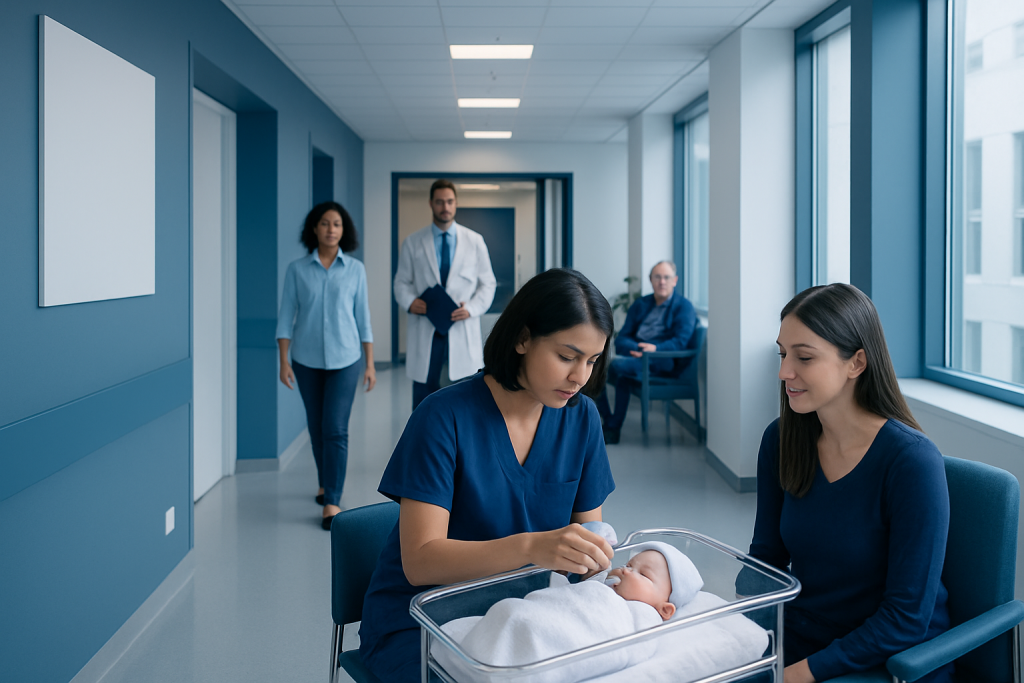
Newborn hearing screening is usually completed before hospital discharge or within the first month of life. The test is painless, safe, and works best while a baby is sleeping or quietly resting.
Key Takeaways
- Newborn hearing screening is usually completed before hospital discharge or within the first month of life.
- The test is painless, safe, and works best while a baby is sleeping or quietly resting.
- A “refer” or “did not pass” result is not a diagnosis and often reflects temporary factors such as fluid, noise, or movement.
- The 1:3:6 guideline supports screening by 1 month, diagnostic testing by 3 months, and early intervention by 6 months when hearing loss is confirmed.
- Prompt follow-up after an unclear result helps protect access to language, communication, and developmental support.
Hearing screening neonatal is a routine, non-invasive check performed soon after birth to identify babies who may need further hearing assessment. Most babies pass, and a result that needs repeat testing does not by itself mean a baby has permanent hearing loss.
Overview: what neonatal hearing screening checks
Hearing screening neonatal is a simple test that checks whether a newborn’s ears and hearing pathways respond to sound. It is usually offered before a baby leaves the birth facility, although it can also be arranged shortly after discharge. The screening is designed to identify babies who may benefit from a more detailed hearing assessment as early as possible.
The test does not measure intelligence, speech development, or how well a child will hear every type of sound later in life. Instead, it helps detect possible hearing differences present at birth, including those that may not be obvious to parents or clinicians during routine newborn care. Early identification allows families to receive clear advice, diagnostic evaluation, and support when needed.
Newborns can appear to react to sound even when they have a hearing difference, and some forms of hearing loss affect only certain pitches or one ear. For this reason, screening is recommended for all babies, not only those with a known family history or a medical risk factor.
How does newborn hearing screening work?
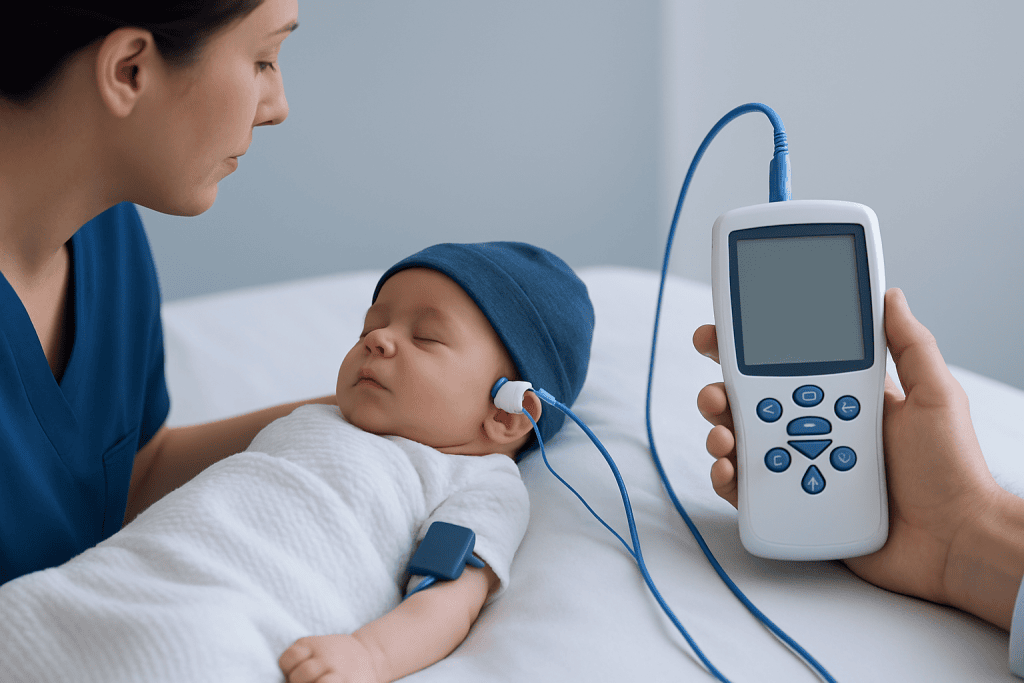
Newborn hearing screening is most often performed while the baby is asleep, feeding, or calmly resting. A trained healthcare professional places small sensors or a soft earpiece near the baby’s ears. The test is painless, does not require needles or sedation, and commonly takes only a few minutes for each ear.
Two established methods may be used. Otoacoustic emissions (OAE) testing uses a tiny probe to send quiet sounds into the ear and measure an echo produced by healthy inner-ear sensory cells. Automated auditory brainstem response (AABR) testing uses small sensors placed on the skin to record how the hearing nerve and brainstem respond to soft clicking sounds.
Some hospitals use one method first and repeat it if the result is unclear; others use both methods, especially for babies who spent time in a neonatal intensive care unit. The screening is not a diagnostic hearing test. If a baby does not pass, an audiologist can carry out more detailed testing to clarify hearing levels and the possible cause.
Candidacy and the step-by-step screening process
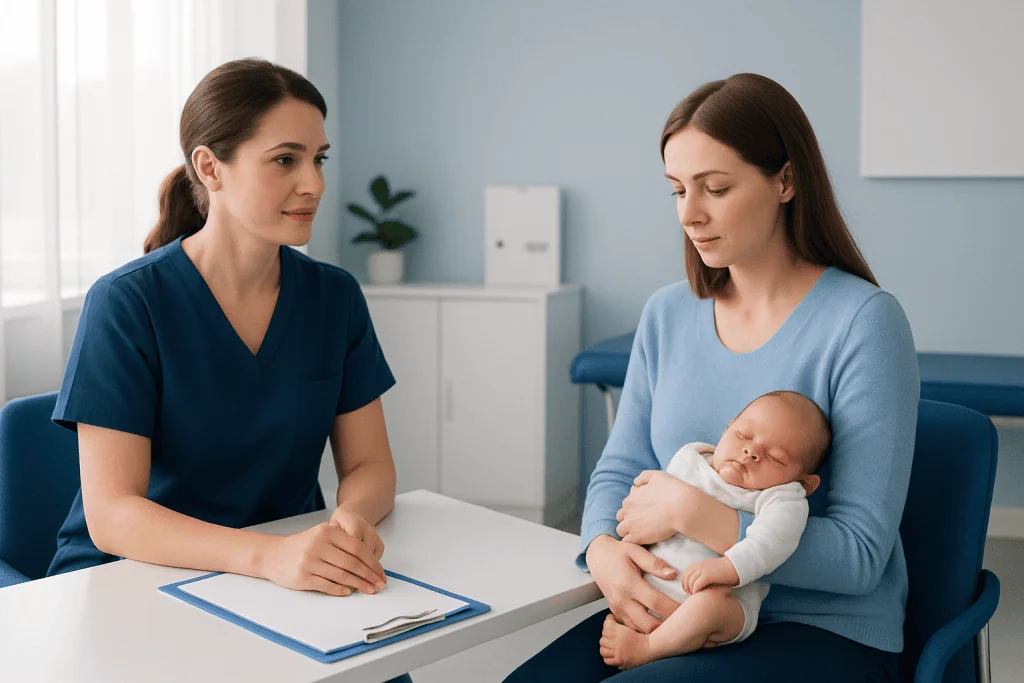
Universal newborn hearing screening is appropriate for nearly every baby. It is recommended because hearing loss can occur without visible signs or known risk factors. Babies born early, those who need intensive neonatal care, and those with a family history of childhood hearing loss may need particularly careful follow-up, but screening remains useful for all newborns.
In a typical screening, the clinician first aims to test the baby in a quiet state. For OAE testing, a small, soft tip is placed at the opening of the ear canal. For AABR testing, disposable sensors are placed gently on the forehead and behind the ears, then removed after the recording is complete. Parents can usually remain with the baby throughout.
Testing may be repeated if the baby is crying, moving frequently, has fluid or vernix in the ear canal, or if there is background noise. A repeat screen can be performed before discharge, at a follow-up visit, or through an audiology service. This repeat step is common and should be viewed as part of obtaining a reliable result rather than as confirmation of hearing loss.
What are the normal results for a newborn hearing screening?
A normal newborn hearing screening result is usually reported as “pass” for each ear. This means the screening response was detected at the level and under the conditions used for the test. A pass result is reassuring and generally means no further testing is needed immediately unless the baby has specific risk factors or later concerns about hearing, speech, or development.
A result may also be reported as “refer,” “did not pass,” or “incomplete.” These terms mean that a clear screening response was not obtained in one or both ears. They do not diagnose permanent hearing loss. Temporary fluid in the middle ear, material in the ear canal, movement, crying, or a noisy testing environment can all affect the result.
Even after a pass result, hearing can change or a hearing difference may become apparent later in childhood. Parents should continue to attend routine child health visits and discuss concerns such as limited response to sounds, delayed babbling, delayed speech, recurrent ear infections, or loss of previously acquired communication skills.
How common is it for a newborn to fail a hearing test?
It is not unusual for a newborn to need another hearing screen. Many babies who do not pass the first test have temporary reasons for an unclear result, particularly in the first days after birth. Fluid in or behind the ear, residual birth-related material in the ear canal, and normal newborn restlessness are common explanations.
The important next step is attending the recommended rescreening or diagnostic appointment. Most babies who are referred after an initial screen will ultimately be found to have typical hearing, but some will have a hearing difference that needs ongoing care. Follow-up testing provides the information needed to distinguish between these possibilities.
If permanent hearing loss is confirmed, care may involve pediatric audiology, ear, nose and throat specialists, pediatricians, speech and language professionals, and early-intervention services. The care plan is individualized and may include monitoring, treatment of middle-ear conditions, hearing devices, communication support, or assessment for options such as cochlear implant treatment when clinically appropriate.
What is the 1:3:6 rule for newborn hearing screening?
The 1:3:6 rule is a widely used early hearing detection and intervention benchmark. It recommends completing newborn hearing screening by 1 month of age, completing diagnostic audiology assessment by 3 months of age for babies who do not pass screening, and enrolling babies with confirmed permanent hearing loss in early-intervention services by 6 months of age.
These timeframes are intended to reduce delays during a period when babies are rapidly developing listening, language, and communication skills. They do not mean that help is no longer useful after 6 months. Children identified later can still benefit from assessment and individualized intervention; however, prompt action gives families the earliest opportunity to make informed decisions.
Families should keep a copy of screening results and ask the maternity team where follow-up will take place. If an appointment has not been arranged, a pediatrician or pediatric audiologist can help coordinate it. A diagnostic evaluation is more detailed than the screening and may include repeat OAE or AABR testing, behavioral testing when age-appropriate, and examination for ear-related causes.
Benefits, limitations, recovery, and follow-up
The main benefit of neonatal hearing screening is early recognition of babies who may need support. Detecting hearing differences early can help clinicians and families plan timely diagnostic care and make decisions about communication, hearing technology, medical treatment, and developmental services. The procedure itself is non-invasive and has no recovery period: babies can be fed, held, and cared for normally immediately afterward.
There are no known physical risks from OAE or AABR screening. Its main limitation is that it is a screening test rather than a final diagnosis. A baby may receive a refer result without having permanent hearing loss, and a baby who passes may later develop hearing difficulties. This is why routine developmental surveillance remains important.
Depending on the findings, an ear specialist may assess for treatable ear conditions and an audiologist may recommend ongoing hearing monitoring. Acibadem International’s multidisciplinary specialists and JCI-accredited hospitals can evaluate hearing concerns and coordinate care for international patients. Families should seek advice from a qualified pediatric clinician or audiologist for recommendations tailored to their child.
When to seek medical care
Parents should contact a pediatrician, newborn screening program, or pediatric audiologist if their baby did not pass a screen and a follow-up test has not been arranged promptly. It is also sensible to seek advice if a result was incomplete, if the baby missed screening, or if the family has questions about what the report means.
Medical review is appropriate at any age if a child does not seem to respond to everyday sounds, has delayed speech or language development, stops using sounds or words previously used, develops frequent ear infections, or has a family history of childhood hearing loss. These signs do not always indicate hearing loss, but they deserve assessment.
Urgent care may be needed if an infant appears seriously unwell, has a high fever according to age-specific medical guidance, or develops swelling, discharge, or marked redness around the ear. For non-urgent hearing concerns, timely outpatient assessment is usually the most appropriate next step.
Frequently asked questions
Is newborn hearing screening painful?
No. Newborn hearing screening is painless and non-invasive. It uses soft ear probes and, in some cases, small sensors on the skin to record responses to quiet sounds while the baby rests.
What happens if a newborn does not pass the hearing screen?
A baby who does not pass is usually offered a repeat screen or referred for a diagnostic hearing assessment with an audiologist. This result does not confirm hearing loss, because temporary fluid, noise, or movement can affect the first test. It is important to attend follow-up promptly.
Can a baby pass the newborn hearing screen and still have hearing loss?
Yes, although a pass is reassuring. Some hearing differences can develop later or may not be detected under screening conditions. Parents should still discuss concerns about sound responses, communication, or speech development with their child’s clinician.
When should newborn hearing screening be completed?
Newborn hearing screening should ideally be completed by 1 month of age, preferably before discharge after birth. If the test is missed in the birth facility, parents should arrange it through their pediatrician or a local audiology service as soon as possible.
Why would a newborn need AABR instead of OAE testing?
AABR testing measures the response of the hearing nerve and brainstem to sound, while OAE testing checks inner-ear responses. AABR may be used for babies with certain medical histories, including some who received neonatal intensive care, because it can identify types of hearing difficulty not detected by OAE alone.
Does fluid in a newborn’s ears affect the hearing screen?
Yes. Temporary fluid in the middle ear or material in the ear canal can make it harder to obtain a clear screening response. This is one reason a baby may need repeat testing, particularly when the first screen is performed soon after birth.
References
- Joint Committee on Infant Hearing
- Centers for Disease Control and Prevention
- American Academy of Pediatrics
- World Health Organization
- National Institute on Deafness and Other Communication Disorders
This article is for general information only and is not a substitute for professional medical advice. Please consult a qualified doctor about your individual situation.
Explore treatments in Turkey — costs, top hospitals & a free quote
JCI-accredited · board-certified surgeons · reply within 24h