Cochlear Implant
A cochlear implant is an electronic hearing device surgically placed to help people with severe to profound sensorineural hearing loss hear sounds more clearly.
Quick answer
A cochlear implant is an electronic hearing system for severe to profound sensorineural hearing loss when hearing aids no longer help. An external processor captures sound and sends it to an internal device, surgically placed, whose electrode array stimulates the auditory nerve directly. The brain learns to interpret these signals as sound through programming sessions and auditory rehabilitation over months.
What Is a Cochlear Implant?
A cochlear implant is an electronic hearing system for people with severe to profound sensorineural hearing loss who receive limited benefit from conventional hearing aids. Instead of making sound louder, it bypasses the damaged part of the inner ear and sends electrical signals directly to the auditory nerve, and the brain gradually learns to interpret those signals as sound. It is used in both children and adults, always after a structured candidacy assessment, not everyone with hearing loss is a suitable candidate, and a careful evaluation matters as much as the operation itself.
Sensorineural hearing loss usually occurs because the delicate hair cells inside the cochlea, the spiral hearing organ of the inner ear, are damaged or absent. Hearing aids amplify sound, but if the cochlear hair cells cannot convert vibrations into clear nerve signals, amplification alone may not deliver enough speech understanding. You may hear that someone is speaking without being able to make out the words. That is the specific gap a cochlear implant is designed to fill.
The system has two main parts. The external component includes a microphone and sound processor worn behind the ear or on the head. It captures sound, converts it into digital information and sends it across the skin to the implanted component. The internal component is surgically placed beneath the skin and connected to an electrode array inserted into the cochlea. The electrodes stimulate different regions of the cochlea that correspond to different sound frequencies, which is how the device conveys pitch as well as loudness.
One thing should be clear from the outset. Cochlear implants do not restore natural hearing in the way eyeglasses correct vision. Sounds may initially seem mechanical, unfamiliar or incomplete. With programming, practice and rehabilitation, many recipients learn to understand speech more clearly, especially in quiet settings, and gain better awareness of environmental sounds. Outcomes vary from person to person, and timely treatment, careful candidacy evaluation and consistent auditory training are among the most important factors in achieving meaningful benefit.
How do cochlear implants work?
Cochlear implants work by converting sound into patterns of electrical stimulation that the auditory nerve can carry to the brain. The microphone picks up sound, the processor codes it into digital signals, and a transmitting coil sends those signals through the skin to the internal receiver. The receiver activates the electrode array inside the cochlea. Electrodes near the base of the cochlea represent higher-pitched sounds and those further along the spiral represent lower pitches, broadly mirroring the natural frequency arrangement of the inner ear.
The brain then has to learn what these signals mean. This learning takes time, particularly for people who have lived with long-standing hearing loss, and for children whose auditory pathways are developing for the first time. Daily, consistent use of the processor is one of the most practical things a recipient can do, because the brain adapts to what it hears regularly.
Can a deaf person hear with a cochlear implant?
Yes, many people with profound deafness gain useful access to sound through a cochlear implant, provided the auditory nerve can still carry signals to the brain. What they hear is not identical to natural hearing. Early on, voices may sound artificial or distorted; over the following months, as the brain adapts and the audiologist refines the programming, speech typically becomes more recognisable. How much hearing a person gains depends heavily on their history. An adult who once heard normally and later lost hearing usually has auditory memory to build on. An adult who was born deaf and has never heard spoken language generally gains less speech understanding, although sound awareness alone can still be valuable. Children born deaf who are implanted early often have strong potential to develop listening and spoken language, when implantation is followed by consistent therapy.
When Hearing Loss Begins to Limit Life
Severe hearing loss affects far more than the ability to hear sounds. It changes how you communicate with family, participate in school or work, recognise warnings in your environment and feel connected to daily life. For parents, it may begin with the worry that a child is not responding to voices or developing speech as expected. For adults, it is often the gradual realisation that hearing aids no longer provide enough clarity, even when they make sounds louder.
Many people considering a cochlear implant have already spent years adapting. You may read lips, avoid noisy settings, rely on captions or withdraw from conversations because listening has become exhausting. Others face a sudden or progressive loss of hearing and need clear guidance about what can realistically be done. It is natural to feel uncertain about surgery, the technology, the rehabilitation process and whether an implant will genuinely help: those are the right questions to ask.
A cochlear implant is not simply a hearing device you buy and wear. It is a medical treatment that requires assessment, surgery, programming and auditory rehabilitation, in that order. When appropriately selected and supported, cochlear implants can help children develop spoken language and help adults regain access to speech, environmental sounds and more confident communication. The decision is personal, but it should rest on complete information and a specialist team experienced in hearing restoration.
At Acibadem, cochlear implant care is planned through a structured pathway that brings together ear, nose and throat specialists, audiologists, radiologists, paediatric specialists when a child is being treated, speech and language therapists and anaesthesiology teams. This coordinated model matters because evaluation, surgery, device activation and follow-up build on one another and must be organised with precision and continuity rather than improvised visit by visit.
Who May Need a Cochlear Implant?
A cochlear implant may be considered when hearing loss is severe enough that hearing aids no longer support effective communication. Some candidates have hearing loss in both ears. Others have profound loss in one ear with significant functional difficulties, depending on medical assessment and local candidacy criteria. Children may be evaluated when hearing loss interferes with speech and language development; adults may be evaluated when hearing aids provide sound awareness but poor speech clarity.
Common signs that an evaluation may be appropriate include difficulty understanding spoken words even with well-fitted hearing aids, needing to watch a speaker’s face to follow conversation, struggling on the telephone, missing speech in background noise, or withdrawing from social and professional situations because listening has become unreliable. In children, warning signs may include limited response to sound, delayed babbling or speech, inconsistent reaction to voices, or lack of progress despite hearing aids and therapy.
Diagnosis begins with a detailed hearing evaluation. Audiologists measure the type and degree of hearing loss, assess hearing aid benefit and perform speech perception testing when age and language abilities allow. For infants and young children, objective tests may include auditory brainstem response testing, otoacoustic emissions, tympanometry and behavioural hearing assessments matched to developmental age. These tests confirm whether the hearing loss is sensorineural and how much usable hearing remains.
Imaging is equally important. High-resolution computed tomography or magnetic resonance imaging is used to evaluate the anatomy of the inner ear, auditory nerve, middle ear and temporal bone. Imaging tells the surgical team whether the cochlea can accept an electrode array, identifies congenital variations, shows the effects of previous infection or trauma, and shapes the safest surgical approach for your specific anatomy.
A complete evaluation also considers speech and language development, educational needs, communication goals, general health, anaesthesia suitability, family expectations and the ability to attend follow-up programming and rehabilitation. Discussing these elements early keeps expectations realistic on both sides and prevents surprises later in the pathway.
Conditions and Indications Cochlear Implants Address
Cochlear implants are used for selected patients whose hearing loss stems from damage to the cochlea or inner ear pathways, when the auditory nerve can still transmit signals to the brain. The most common indication is bilateral severe to profound sensorineural hearing loss with limited benefit from appropriately fitted hearing aids. In children, early identification matters particularly, because the brain’s capacity to develop spoken language is time-sensitive.
Potential indications include:
- Congenital hearing loss identified in infancy or early childhood
- Genetic hearing loss, whether present at birth or progressive
- Hearing loss following infections such as meningitis
- Progressive hearing loss that has advanced beyond hearing aid benefit
- Age-related severe hearing loss with poor speech understanding
- Inner ear malformations that still allow electrode placement
- Hearing loss after certain types of trauma or exposure to ototoxic medication
Some patients with residual low-frequency hearing may be candidates for approaches that aim to preserve existing hearing while providing electrical stimulation for the higher frequencies, depending on anatomy and hearing profile. In selected cases, implantation is also evaluated for single-sided deafness, profound loss in one ear with better hearing in the other, where restoring input to the deaf ear may support sound localisation and listening in noise, and can be considered alongside its effect on severe tinnitus in that ear. Adults who once heard normally often adapt well because the brain has already learned to process speech. Adults with long-standing deafness may still benefit, but expectations and rehabilitation planning must be individualised. Children born with profound hearing loss can have strong potential for spoken language when implantation occurs early and is followed by consistent auditory-verbal or speech therapy, family participation and appropriate educational support.
Not every person with hearing loss is a candidate. A cochlear implant may not be recommended if the auditory nerve is absent or severely impaired, if the cochlea cannot accommodate an electrode, if medical risks outweigh the likely benefit, or if hearing aids still provide sufficient speech understanding. Some patients are better served by optimised hearing aids, bone conduction devices or middle ear procedures. In the rare situation where the auditory nerve itself cannot carry signals, an auditory brainstem implant may be discussed instead: a different procedure planned together with a neurosurgery team. The role of the implant team is to identify the option most likely to support your communication goals, not to default to surgery.
How Cochlear Implant Surgery Is Performed
Cochlear implant surgery is one stage in a longer pathway that starts with candidacy assessment and continues through activation and rehabilitation. Understanding each stage helps you judge what the operation can and cannot do on its own.
Preparation and Candidacy Evaluation
Treatment begins well before the day of surgery. The first step is a comprehensive review of your hearing history, prior test results, hearing aid use, medical conditions, medications and communication needs. For children, the evaluation also covers pregnancy and birth history, developmental progress, family history of hearing loss, and the child’s response to hearing aids and therapy so far.
Audiological testing is central. Adults and older children typically undergo pure-tone audiometry, speech recognition testing with and without hearing aids, and aided sound-field testing. The goal is not only to measure how loud sounds must be before they are heard, but how clearly speech can be understood: the two are not the same thing. For babies and patients who cannot complete standard behavioural tests, objective measures define hearing thresholds and auditory pathway function.
Imaging supports surgical planning. Detailed scans let the surgeon assess the cochlea, mastoid bone, the course of the facial nerve, the middle ear structures and the auditory nerve. Some patients need additional evaluation: vestibular assessment for balance symptoms, genetic consultation for children or families, or neurological review where there are broader developmental or nerve-related concerns.
Before surgery, you and your family meet the care team to discuss realistic expectations. This conversation is essential. An implant provides access to sound; the brain must learn how to use it. You are informed about the operation, anaesthesia, the incision, device selection considerations, the activation schedule, possible risks, device care and the importance of follow-up programming. Vaccination recommendations, particularly relating to meningitis prevention, are also reviewed by the medical team according to current guidelines.
Is a cochlear implant a big surgery?
Cochlear implant surgery is a significant operation, but for experienced ear surgeons it is a well-established procedure with a predictable sequence. It is performed under general anaesthesia and usually takes a few hours, though duration depends on anatomy, whether one or both ears are implanted, and whether additional procedures are needed. Most patients return home or to their accommodation after a short hospital stay, based on the surgeon’s assessment and the patient’s general condition.
The operation typically follows these steps:
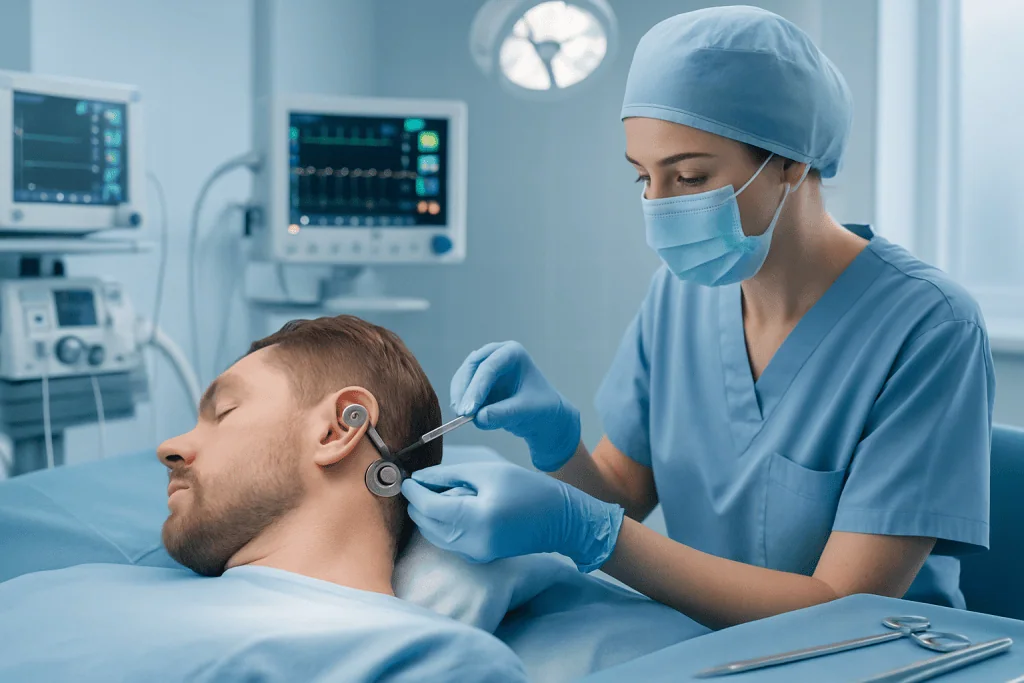
- An incision is made behind the ear and a secure pocket is created for the internal receiver.
- A pathway is prepared through the mastoid bone to reach the middle ear and cochlea.
- Under microscopic visualisation, a carefully selected opening into the cochlea is made.
- The electrode array is inserted into the cochlea using delicate otologic instruments.
- The internal receiver is positioned beneath the skin and the electrode connections are secured.
- The incision is closed and a protective dressing is applied.
Modern practice relies on detailed preoperative imaging, high-magnification visualisation, facial nerve monitoring and fine surgical instruments to protect important structures and reduce uncertainty. During surgery cochlear implants are usually tested before the incision is closed, so the team can confirm the device is functioning as intended. In selected cases, techniques are adapted to preserve residual hearing as far as the anatomy allows.
Afterwards, you are monitored as you wake from anaesthesia. Mild dizziness, ear pressure, nausea or discomfort around the incision can occur and generally improves over the first days. The implant sits under the skin and is not switched on immediately: the surgical area must heal before activation.
Activation, Programming and Rehabilitation
Activation usually takes place once the incision has healed, often several weeks after surgery. At this appointment the external sound processor is fitted and connected to the internal implant for the first time. The audiologist programs the device by setting stimulation levels that are comfortable and useful. First activation can be an emotional moment, but it is important to understand that sound may not be clear right away, for many people it starts as beeps, buzzes or oddly pitched voices.
Programming, also called mapping, is refined over multiple visits. As the auditory nerve and brain adapt, settings are adjusted to improve audibility, comfort and speech access. Children need careful, age-appropriate testing and observation, and their maps change as they grow and as their responses become more reliable. Adults can give direct feedback about loudness, sound quality and clarity, which speeds the process.
Rehabilitation is a major part of treatment, not an optional extra. Adults typically work on recognising environmental sounds, distinguishing speech patterns, improving conversational listening and gradually using the implant in more complex sound environments. Children need structured speech and language therapy, family coaching and collaboration with educators. Progress is usually gradual, with improvements continuing over months and beyond as the brain gains experience with electrical hearing.
Follow-up planning is discussed before surgery, not afterwards. Some programming visits need to take place at the implanting centre, while longer-term rehabilitation can often be coordinated with qualified professionals closer to where you live. Clear documentation of device settings, surgical details and therapy recommendations keeps that handover reliable.
Risks and Downsides of Cochlear Implants
An honest picture includes the drawbacks. Cochlear implantation is generally considered a safe procedure in experienced hands, but it carries real risks and lasting commitments that deserve as much attention as the benefits.
What are the downsides to a cochlear implant?
The main downsides fall into two groups: surgical risks and everyday trade-offs. Surgical risks include infection, bleeding, temporary or persistent dizziness, tinnitus, changes in taste, and, rarely, injury to the facial nerve, which runs close to the surgical pathway and is monitored throughout the operation. Electrode insertion can reduce or eliminate any natural hearing remaining in the implanted ear, which is why hearing preservation is discussed beforehand when relevant. Device failure is possible; if it occurs, reimplantation can be considered. Because of a recognised association between inner ear surgery and meningitis risk, vaccination status is reviewed as part of preparation.
The everyday trade-offs are less dramatic but permanent:
- You wear external hardware that needs batteries or charging, and care around water, sweat and impact sports.
- You hear only when the processor is worn, overnight or when it is removed, the implanted ear is effectively deaf.
- MRI scanning requires precautions that depend on the specific implant model, and this must be flagged before any future imaging.
- Mapping appointments, rehabilitation sessions and eventual processor maintenance are ongoing commitments, not a one-off event.
- Background noise, group conversation and music can remain difficult even after good adaptation.
Why do some people say cochlear implants are bad?
Criticism of cochlear implants usually comes from three honest places. First, outcomes vary: a person implanted after decades of deafness who expects natural hearing may be disappointed, and disappointed recipients are often the most vocal. Second, the sound is genuinely different from acoustic hearing, and some recipients never come to enjoy music or effortless conversation in noise. Third, parts of the Deaf community view deafness as a cultural and linguistic identity rather than a condition to be treated, and object to implantation of children on those grounds. These perspectives are worth hearing. The clinical response is not to dismiss them but to select candidates carefully, set expectations truthfully and commit to rehabilitation: the circumstances under which most dissatisfaction arises are precisely poor candidacy, poor expectation-setting and poor follow-up.
How long do cochlear implants last?
The internal implant is designed as a long-term device, intended to remain in place and functioning for many years, often decades, without replacement. The external sound processor is a piece of wearable electronics: it is serviced, repaired and periodically upgraded as technology advances, without further surgery, because newer processors are generally designed to work with existing internal devices from the same manufacturer. If an internal device ever fails or is damaged, revision surgery to replace it can be evaluated. Long-term care consists of periodic audiology reviews, processor maintenance and updated mapping as your hearing needs change.
Why Acting Early Matters
Hearing is closely linked to brain development, communication, learning and social interaction. When the brain receives limited sound input over a long period, the auditory pathways become less responsive. This matters most for infants and young children, whose speech and language development depends on timely access to sound. Early diagnosis, appropriate hearing aid fitting and prompt cochlear implant evaluation when hearing aids fall short can make a meaningful difference to developmental potential.
Delay carries consequences for adults too. Untreated severe hearing loss tends to increase communication strain, listening fatigue, social isolation, reduced work performance and dependence on visual cues. Some adults begin avoiding group settings entirely because communication has become unpredictable. Cochlear implantation can still help many adults after years of hearing loss, but prolonged auditory deprivation generally makes adaptation slower and harder.
Certain conditions carry particular time sensitivity. Hearing loss after meningitis may be associated with cochlear ossification, in which the cochlea begins to fill with new bone: a process that can make electrode insertion progressively more difficult. Sudden severe hearing loss and rapidly progressive childhood hearing loss are further situations in which timing can influence which treatment options remain available.
Acting early does not mean rushing into surgery without proper assessment. It means obtaining the right tests, specialist interpretation and a treatment plan before critical opportunities close. A careful evaluation can clarify whether implantation is appropriate now, whether hearing aids should be optimised first, or whether another intervention fits better.
Benefits of Cochlear Implant Treatment
What you can expect depends on age, hearing history, anatomy, rehabilitation and consistent device use, but many patients experience meaningful improvement in daily communication.
| Benefit | What It Means for You |
|---|---|
| Improved access to speech | Many recipients understand spoken language more clearly than with hearing aids alone, especially in quiet environments and with practice. |
| Better awareness of environmental sounds | Doorbells, alarms, traffic, voices and household noises may become more recognisable, supporting safety and independence. |
| Support for speech and language development in children | For appropriately selected children, early implantation combined with therapy can support listening, spoken language and educational participation. |
| Reduced listening effort | Conversations may become less tiring as the brain gains more usable sound information, although noisy settings can remain challenging. |
| Greater participation in daily life | Improved hearing access can help you engage more confidently in family, school, professional and social situations. |
Recovery Timeline After Cochlear Implant Surgery
Recovery has two distinct strands: physical healing from the operation, and auditory adaptation after the device is activated. They run on different clocks.
| Time Period | What to Expect |
|---|---|
| Day 1 | Monitoring after anaesthesia. Mild pain, pressure, dizziness or nausea may occur. The implant remains off and the surgical dressing stays in place as instructed. |
| First week | Light activities gradually resume. The incision is protected; strenuous exercise, heavy lifting and water exposure near the incision are avoided. |
| First month | Healing is assessed and the external processor is fitted once the surgeon confirms readiness. Initial sounds may be unfamiliar, and mapping begins. |
| Three to six months | Regular programming and listening practice improve sound comfort and speech recognition. Children continue structured speech and language therapy. |
| Longer term | Progress can continue with consistent use, mapping adjustments and rehabilitation. Long-term care means device maintenance and periodic hearing follow-up. |
Timelines vary between individuals, and the surgeon confirms readiness at each stage rather than following the calendar alone. Healing of the incision and of the skin over the internal receiver is what determines when the processor can first be worn, which is why activation dates are set at review appointments rather than fixed in advance. Auditory adaptation is even more individual: some recipients recognise familiar voices within weeks, while others need months of steady listening practice before speech becomes comfortable, both patterns are normal.
Factors That Influence Outcomes
Results are highly individual. A good outcome is not defined only by test scores; it is measured by how well you use sound in real life. For one person, success means following conversation at work. For another, it means a child responding to a parent’s voice, developing spoken words or participating more actively in school.
Duration of hearing loss is one of the strongest factors. People who have had access to sound in the past carry auditory memory that helps the brain interpret implant signals. Those with very long-standing profound hearing loss may need more time and may reach more limited speech understanding, though they can still gain sound awareness and improved communication support.
Age at implantation matters especially for children. Earlier access to sound during key developmental windows is generally associated with stronger potential for spoken language. But age is only one variable: consistent device use, family engagement, therapy quality, educational support and any additional developmental or medical conditions all shape progress.
The condition of the auditory nerve and cochlea matters too. Imaging determines whether the anatomy is favourable. Some inner ear malformations can still be implanted with special surgical planning and careful counselling. Previous meningitis, ossification, trauma or chronic ear disease can make surgery more complex and can affect results.
Hearing aid use before implantation is another factor. Patients who wore hearing aids consistently may have maintained stronger auditory stimulation even when speech understanding was limited. In children, well-fitted hearing aids before implantation support early auditory development and provide useful information about candidacy.
Rehabilitation and follow-up are non-negotiable. The implant provides access to sound; the brain must learn to organise and interpret it. Regular mapping, structured listening exercises, speech therapy where needed and daily device use all contribute to better real-world results. Plan follow-up deliberately, especially if the implanting centre is far from where you live, so progress does not stall once the early appointments are over.
Finally, expectations should be realistic and individual. Cochlear implants often improve hearing access substantially, but they do not eliminate every listening challenge. Background noise, group conversation, music appreciation, telephone use and listening in a second language may all require extra training and time. Knowing this in advance is what keeps people motivated through rehabilitation rather than discouraged by it.
Cochlear Implant Manufacturers and Device Choice
Cochlear implant systems are produced by a small number of specialist manufacturers; internationally you may encounter names such as Cochlear (represented in the United States by Cochlear Americas), MED-EL and Advanced Bionics. All established systems share the same fundamental design, an implanted receiver and electrode array paired with an external processor, but they differ in processor styles, accessories, wireless connectivity, water resistance options and the specific conditions under which MRI scanning is permitted.
Device selection is a clinical conversation, not a shopping decision. Your surgeon and audiologist consider your anatomy, hearing profile, lifestyle and the availability of programming and servicing support where you live. That last point deserves attention: it is sensible to confirm that the chosen system can be programmed and serviced by professionals close to where you live, so long-term care does not depend on repeated long-distance travel.
Whichever system is used, the internal component is intended to stay with you long term, while the external processor evolves. Manufacturers generally maintain compatibility so that newer processors work with older implanted devices, which is how recipients benefit from advancing technology without repeat surgery.
How Cochlear Implant Care Is Organised at Acibadem
Cochlear implant treatment is a long process rather than a single event: it spans diagnosis, imaging, surgery, activation, programming, rehabilitation planning and ongoing communication with the professionals who follow your hearing over time. Acibadem’s model is built around that whole pathway rather than the operation alone.
Patients are evaluated by experienced ear, nose and throat physicians and audiology teams familiar with adult and paediatric implant pathways. Complex cases are discussed across disciplines, radiology, anaesthesiology, paediatrics, neurology, genetics, speech and language therapy, as the situation requires. This matters most for children with congenital hearing loss, patients with inner ear malformations and adults with additional medical conditions.
Rather than treating implantation as a single operation, the team considers the full hearing journey: whether you are a suitable candidate at all, which ear or ears should be considered, whether hearing preservation is relevant, how anaesthesia risk should be managed, when activation should occur and how rehabilitation will continue afterwards. High-resolution imaging defines the anatomy before surgery; in the operating room, microscopic visualisation, facial nerve monitoring, fine otologic instruments and intraoperative implant testing support careful electrode placement.
Continuity of care is discussed early, because implant benefit develops over time and requires ongoing adjustment. The care team provides medical reports, programming information, operative notes and therapy recommendations to support collaboration with the audiologists and rehabilitation professionals who will see you between visits. For paediatric patients, the pathway extends to guidance on activation, home listening routines, school support and long-term device use; for adults, counselling can focus on workplace listening, telephone use, music expectations and adapting to sound after years of hearing difficulty.
Moving Forward With a Cochlear Implant Evaluation
Considering a cochlear implant is a significant decision. It brings hope, and it also raises fair questions about surgery, recovery, sound quality, language development and long-term commitment. The most useful next step for anyone at this stage is a detailed evaluation by a team that can explain whether an implant is appropriate, what the alternatives are, and what realistic progress looks like in a specific situation.
An evaluation does not obligate anyone to proceed with surgery. Its purpose is clarity: a confirmed diagnosis, an honest candidacy assessment, a picture of the rehabilitation ahead and an understanding of timing, including whether hearing aids should be optimised first or whether particular medical circumstances make earlier assessment sensible.
Second opinions are a normal part of this field. Candidacy criteria involve judgement as well as measurement, and people are sometimes told they are, or are not, candidates on the basis of incomplete testing. Reviewing hearing tests, imaging, medical history and communication goals with an experienced implant team is the reliable way to understand which pathway genuinely fits, whether that turns out to be a cochlear implant, a different hearing solution, or continued observation with the technology you already use.
Preparation
- Before surgery, patients usually have hearing tests, speech evaluation, imaging, and an ENT assessment to confirm suitability. Vaccination status, medications, and anesthesia risks are reviewed. Patients are advised when to stop eating, drinking, or taking certain medicines before the operation.
Aftercare
- After surgery, the incision area must be kept clean and protected while healing. The implant is typically activated after the surgical site heals, followed by sound mapping and auditory rehabilitation. Regular follow-up with ENT and audiology teams is important for device adjustment and hearing progress.
Frequently Asked Questions
What affects the cost of a cochlear implant?
The main factors are the implant system, whether one or both ears are treated, diagnostic tests, hospital and surgeon fees, anesthesia, length of care, activation, mapping, rehabilitation, and travel support. A personalised quote is needed because each candidate has different medical and hearing requirements.
How can I get a personalised quote from Acibadem?
You can request a free consultation and share your recent audiogram, speech test results if available, imaging reports, medical history, and any previous hearing aid or implant records. The team can then review suitability and prepare an itemized treatment plan.
Does a cochlear implant package usually include the external processor?
Many packages include the internal implant and an external sound processor, but inclusions vary by device brand and hospital plan. Patients should ask whether activation, mapping visits, accessories, warranty details, and rehabilitation sessions are included.
Are follow-up and mapping important for the final cost?
Yes. A cochlear implant is not complete at surgery alone. Activation, processor programming, hearing training, and ongoing mapping are important parts of the care pathway and should be planned before travel.
Is Turkey a suitable option for international cochlear implant patients?
Turkey can be a practical option for international patients when the hospital provides ENT surgery, audiology, imaging, interpreter support, and coordinated follow-up planning. At Acibadem, selected hospitals hold JCI accreditation, and suitability is assessed by specialists before treatment is confirmed.
Medically reviewed by the Acıbadem International Medical Board August 31, 2026
See our medical review board →
Update history
- PublishedJune 8, 2026
- Medical review approvedAugust 31, 2026
- Last content updateAugust 31, 2026
References1
- Cochlear Implants medlineplus.gov
Trusted care for international patients
From the Acibadem Blog

Auditory Rehabilitation After a Cochlear Implant: Why Does Practice Shape the Result?
Cochlear implant rehabilitation is the structured program of device programming, listening practice and follow-up that turns the electrical signals from an implant into meaningful…

How Cochlear Implants Work, and Why Some People Argue Against Them
Cochlear implants work by bypassing damaged hair cells in the inner ear. An external sound processor captures sound, converts it into digital signals, and…
What Does Hearing Sound Like With a Cochlear Implant? Realistic Expectations After Activation
A cochlear implant does not restore natural hearing. At activation, most people describe sound as mechanical, tinny, or cartoon-like, with voices that are hard…