Humerus Fracture: A Complete Medical Overview

The humerus can break near the shoulder, through the shaft, or near the elbow, and each location is managed differently. Pain, swelling, bruising, and difficulty moving the arm are common symptoms of a humerus fracture.
Key Takeaways
- The humerus can break near the shoulder, through the shaft, or near the elbow, and each location is managed differently.
- Pain, swelling, bruising, and difficulty moving the arm are common symptoms of a humerus fracture.
- Many humerus fractures heal well with a sling, brace, and rehabilitation, while some require surgery to restore alignment and function.
- Prompt medical assessment is important if there is severe deformity, numbness, weakness, an open wound, or reduced blood flow to the hand.
- Recovery often includes gradual movement, strengthening, and follow-up imaging to confirm bone healing.
A humerus fracture is a break in the long bone of the upper arm, between the shoulder and the elbow. Treatment depends on where the bone is broken, how far the pieces have moved, and whether nearby nerves, blood vessels, or joints are involved.
What is a humerus fracture?
A humerus fracture is a break in the humerus, the long bone of the upper arm that connects the shoulder to the elbow. In practical terms, it can affect the upper part of the arm near the shoulder, the middle shaft, or the lower part near the elbow. Because the humerus helps position the shoulder, move the elbow, and support daily arm function, the effects of a fracture vary depending on the exact location and pattern of injury.
Some humerus fractures are simple cracks that remain well aligned, while others involve several pieces of bone, displacement, or extension into a joint. Doctors usually describe these injuries as proximal humerus fractures, humeral shaft fractures, or distal humerus fractures. This classification helps guide treatment and gives a clearer idea of expected recovery.
Not every person with a humerus fracture needs surgery. Many stable fractures heal with immobilization, pain relief, and supervised rehabilitation. However, fractures that are significantly displaced, unstable, open, or associated with nerve or blood vessel injury may need prompt orthopedic treatment, including orthopedic care or an operation.
How a humerus fracture happens
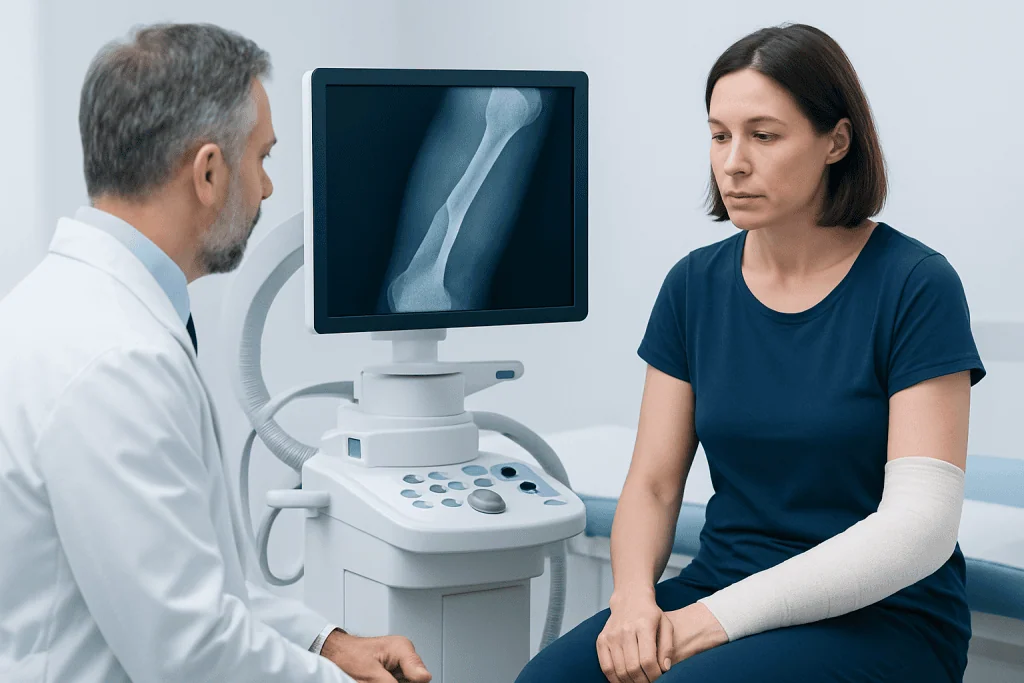
The humerus usually breaks because of a fall, a direct blow, a sports injury, or a traffic-related accident. In younger adults, high-energy trauma is a common cause. In older adults, a lower-energy fall may be enough to cause a fracture, especially if the bone has become weaker over time.
Bone health matters. Osteoporosis can make the humerus more vulnerable to breaking after a minor injury, particularly near the shoulder. Less commonly, a fracture can happen through bone that has been weakened by another medical condition, sometimes called a pathologic fracture.
The exact mechanism often influences the fracture pattern. A fall onto an outstretched hand may transmit force up the arm, while a direct impact may cause a more obvious break in the shaft. Understanding how the injury happened helps clinicians look for associated problems such as shoulder dislocation, elbow injury, or soft tissue damage.
Signs and symptoms

The most common symptom of a humerus fracture is sudden pain in the upper arm after an injury. The arm may become swollen, bruised, and difficult to move. Many people instinctively support the injured arm with the other hand because lifting, rotating, or bending it is painful.
Some fractures cause a visible change in shape or position, especially if the bone ends have shifted. A grinding sensation, marked tenderness, or inability to use the arm can also occur. If the fracture is near the shoulder, raising the arm may be especially difficult. If it is near the elbow, bending or straightening the arm may be limited.
Doctors also pay close attention to warning signs that suggest nerve or blood vessel involvement. These include numbness, tingling, weakness in the hand or wrist, pale or cool fingers, or a weak pulse. In humeral shaft fractures, the radial nerve can sometimes be affected, leading to trouble extending the wrist or fingers.
- Pain that worsens with movement
- Swelling and bruising of the upper arm
- Deformity or abnormal arm position
- Reduced shoulder or elbow movement
- Numbness, tingling, or weakness
- An open wound over the fracture site
How doctors diagnose it
Diagnosis begins with a history of the injury and a physical examination. The clinician checks where the pain is located, whether the arm looks deformed, and how the hand and forearm are functioning. Sensation, muscle strength, skin condition, and circulation are all important because fracture care is not only about the bone itself.
X-rays are the main test used to confirm a humerus fracture and show its location, alignment, and complexity. Images are often taken in more than one view, and the joints above and below the fracture may also be assessed. If the injury pattern is complex or extends into the shoulder or elbow joint, the doctor may request advanced imaging or a CT scan to better plan treatment.
In some cases, the medical team also evaluates related injuries. For example, a person with a high-energy injury may need assessment for chest, shoulder, or elbow trauma. If the fracture is thought to be related to weakened bone, further evaluation for conditions such as osteoporosis may be appropriate after the acute injury has been treated.
Treatment options for a humerus fracture
Treatment depends on the fracture location, whether the bone fragments are aligned, the person’s age and activity level, and whether nerves, blood vessels, or joints are involved. The first steps usually include supporting the arm, controlling pain, and checking for urgent complications. A sling, splint, or functional brace may then be used to keep the bone in a position that allows healing.
Many proximal humerus and humeral shaft fractures can be treated without surgery if the alignment is acceptable and the fracture is stable. Over time, supervised movement is introduced to prevent stiffness while protecting the healing bone. Follow-up appointments and repeat X-rays are important because some fractures can shift during the early healing period.
Surgery may be recommended when the fracture is open, significantly displaced, unstable, involves the joint surface, or cannot be expected to heal in a good position with bracing alone. Procedures may include plates and screws, rods, or in selected shoulder fractures, joint replacement options. Depending on the injury pattern, treatment may involve shoulder replacement surgery or specialized orthopedic surgical techniques when clinically appropriate.
Rehabilitation is part of treatment, not just recovery. Guided exercises help restore shoulder, elbow, and hand movement and gradually rebuild strength. The pace varies from person to person, and the safest plan is the one tailored by the treating orthopedic team.
Healing and recovery
Recovery from a humerus fracture is often gradual. Pain usually improves earlier than strength and range of motion, so it is common for daily tasks to remain limited for some time even after the bone begins to heal. The expected timeline depends on the fracture type, the person’s age, general health, and whether surgery was needed.
During healing, the medical team may encourage finger, wrist, and sometimes elbow movement quite early to reduce stiffness and swelling. Shoulder motion is introduced more carefully in fractures near the top of the humerus. People are usually advised to avoid lifting, pushing, pulling, or driving until their doctor confirms that it is safe.
Potential complications include delayed healing, nonunion, malunion, stiffness, chronic pain, and nerve problems. These issues do not happen in every case, but regular follow-up helps detect them early. If recovery seems slower than expected, the doctor may review imaging, rehabilitation progress, and bone health factors to decide whether the treatment plan should be adjusted.
Self-care and preventing future fractures
Good self-care supports healing and lowers the chance of reinjury. Patients are usually advised to follow immobilization instructions carefully, keep follow-up appointments, and perform prescribed exercises exactly as directed. Resting the arm while still moving the unaffected joints can help control stiffness and swelling.
Healthy habits also matter. Adequate nutrition, enough protein, and appropriate calcium and vitamin D intake support bone healing, while smoking can slow recovery. If a fall caused the fracture, it may be helpful to review balance, vision, footwear, and home safety to reduce future fall risk.
For older adults and anyone with a low-impact fracture, clinicians may recommend checking for underlying bone weakness. Identifying and treating conditions that reduce bone strength can help prevent another fracture. In a broader sense, regular exercise, strength training, and fall-prevention strategies are important parts of long-term bone protection.
When to seek medical care
Medical evaluation is important after any suspected humerus fracture, especially if there is significant pain, swelling, or inability to move the arm after an injury. A fracture can look similar to a severe sprain or dislocation, so imaging is often needed to make the diagnosis and guide treatment safely.
Urgent care is needed if the arm looks deformed, there is an open wound, the fingers become pale or cold, or numbness and weakness develop. These signs can suggest displacement, circulation problems, or nerve injury. A person should also seek prompt assessment if pain is severe despite rest or if the injury follows major trauma.
If symptoms worsen after treatment, such as increasing swelling, fever, new numbness, or difficulty moving the hand, the treating team should be contacted. Near the end of the care pathway, patients who need coordinated assessment and rehabilitation may be evaluated by multidisciplinary specialists; Acibadem International’s JCI-accredited hospitals provide diagnosis and treatment for international patients with upper-limb fractures and related conditions such as shoulder dislocation.
Frequently asked questions
Is a humerus fracture the same as a broken shoulder?
Not exactly. The humerus is the upper arm bone, and a fracture can happen near the shoulder, in the middle of the arm, or near the elbow. A proximal humerus fracture is close to the shoulder, but other shoulder injuries can involve different bones or a dislocation instead.
Can a humerus fracture heal without surgery?
Yes, many humerus fractures heal well without surgery. Whether non-surgical treatment is appropriate depends on the fracture's location, alignment, stability, and whether the joints, nerves, or blood vessels are involved. An orthopedic doctor uses examination and imaging to decide the safest option.
How long does a humerus fracture take to heal?
Bone healing often takes several weeks, but full recovery usually lasts longer because movement and strength need to return gradually. The timeline varies based on age, fracture type, bone health, and treatment method. Recovery near the shoulder may also take extra time because stiffness can develop.
What should someone avoid after a humerus fracture?
People are usually advised to avoid lifting, pushing, pulling, contact sports, and driving until their doctor says it is safe. Removing a sling or brace too early, or doing exercises that were not recommended, can interfere with healing. It is best to follow the treatment plan closely and ask before resuming regular activities.
Can a humerus fracture cause nerve damage?
It can, especially in fractures of the humeral shaft where the radial nerve may be affected. This may cause numbness, tingling, or weakness in the wrist or fingers. Nerve function is checked at the first assessment and during follow-up visits.
When should someone go to the emergency department for a suspected humerus fracture?
Emergency care is important if there is severe deformity, an open wound, uncontrolled pain, heavy swelling, or signs of poor circulation such as pale or cold fingers. New numbness or inability to move the hand also needs urgent attention. These symptoms may indicate complications that should be treated quickly.
References
- American Academy of Orthopaedic Surgeons
- National Institute of Arthritis and Musculoskeletal and Skin Diseases
- MedlinePlus
- OrthoInfo
- National Health Service
This article is for general information only and is not a substitute for professional medical advice. Please consult a qualified doctor about your individual situation.
Joint and spine care in Turkey — expert assessment & treatment
JCI-accredited · board-certified surgeons · reply within 24h

More from the Health Library



Related Specialists

Dr. Seher Tutkun
Dermatology
Prof. Dr. Banu Atalar
Radiation Oncology
Prof. Dr. Beril Akman
Internal Medicine
Dt. Tarcan Topçuoğlu
Oral and Dental Health