

How to Prepare a Caregiver Handover Before Returning Home from Turkey

To prepare a caregiver handover before returning home from Turkey, start one to three days before discharge. Gather your discharge summary, a plain-language medicine list, wound or device care instructions, activity limits, follow-up contacts and a first-48-hours home plan. Keep one printed summary page plus digital copies, and walk your caregiver through it before you travel.
Who is going to help you at home, and will they actually know what to do? That question tends to arrive late, often the night before the flight, once treatment is behind you and the packing starts.
A written caregiver handover makes the first days at home easier for everyone. It turns a folder of hospital paperwork into something a tired relative or hired carer can actually use: what you take and when, how you should move, what recovery normally looks like, and who to call about what. This guide shows you how to prepare a caregiver handover before returning home from Turkey, what to include, how to format it, and which questions to ask your care team before you leave.
At a glance
- Best time to prepare: Start 24-72 hours before discharge or travel, not on the way to the airport
- Who needs it: You, your travel companion, the caregiver at home and your local doctor if relevant
- What to include: Medicines, wound or device care, activity limits, warning signs your team described, and follow-up contacts
- Helpful format: One printed summary page, with full documents behind it and digital copies on your phone
- Language tip: Ask for plain-language instructions and translated summaries if your caregiver reads a different language
Why you should prepare a caregiver handover before returning home from Turkey
When you travel abroad for treatment, there is a built-in gap that patients treated locally do not have: the people who cared for you and the people who will help you at home may never meet. Your caregiver at home was probably not in the room when the surgeon explained your restrictions, when the nurse demonstrated dressing changes, or when the discharge medicines were reviewed. Everything they know will come from you, and travel day is a poor time to explain anything from memory.
That is the whole case for preparing a caregiver handover before returning home from Turkey. It is not extra paperwork. It is a translation layer between two healthcare settings, two languages in many cases, and two groups of people who cannot easily speak to each other directly.
A good handover is also more than a medical summary. It covers daily life after discharge: when medicines are due, how to move safely, when to rest, what a normal recovery looks like at this stage, and which changes your treating team told you to take seriously. It reduces the guesswork that causes most friction in the first week: the caregiver who is unsure whether to wake you for a dose, the relative who does not know whether stairs are allowed, the local pharmacist looking at an unfamiliar brand name.
Hospitals that regularly treat international patients usually have staff who prepare discharge papers, clarify instructions and arrange interpreter support, and these things are easiest to sort out a day or two before departure, while there is still time to fill gaps. The separate guide on preparing a caregiver for your recovery at home covers the home side of the same conversation.
What your handover pack should contain

Aim for one main summary page, then keep the supporting documents behind it in a fixed order. The summary page is for your caregiver at three in the morning; the documents behind it are for your local doctor at the first appointment. If you can, prepare both a paper version and a digital folder on your phone or email, so the pack is easy to share after landing.
The core of the pack is your discharge documentation. Before you fly, check that you actually hold everything a doctor in your home country might ask for, imaging reports, laboratory results, operative notes if you had surgery, pathology reports if relevant, and any implant or device documentation. The guides on what discharge documents you receive before you travel home and what your discharge summary should include explain what to look for. It still pays to check your own folder line by line before you leave, because a missing report is far harder to chase from another country.
The essential contents
- Discharge summary and treatment notes in a language your caregiver and local doctor can read
- Full medicine list with names, doses, timing and duration
- Allergy list and existing medical conditions
- Wound, dressing, drain or device care instructions, if relevant
- Activity limits: lifting, driving, bathing, stairs, exercise
- The warning signs your treating team told you to watch for, written in their words
- Follow-up dates, contact names and how each contact prefers to be reached
- Copies of imaging, laboratory and operative reports for your doctor at home
Add practical travel information too: your fit-to-fly note if one was provided, transfer arrangements, and any advice your team gave about compression stockings, hydration, walking breaks during the flight or airport assistance. Your caregiver should know what travel day involved, because it shapes how tired you will be on arrival.
How to explain medicines, wound care and daily routines
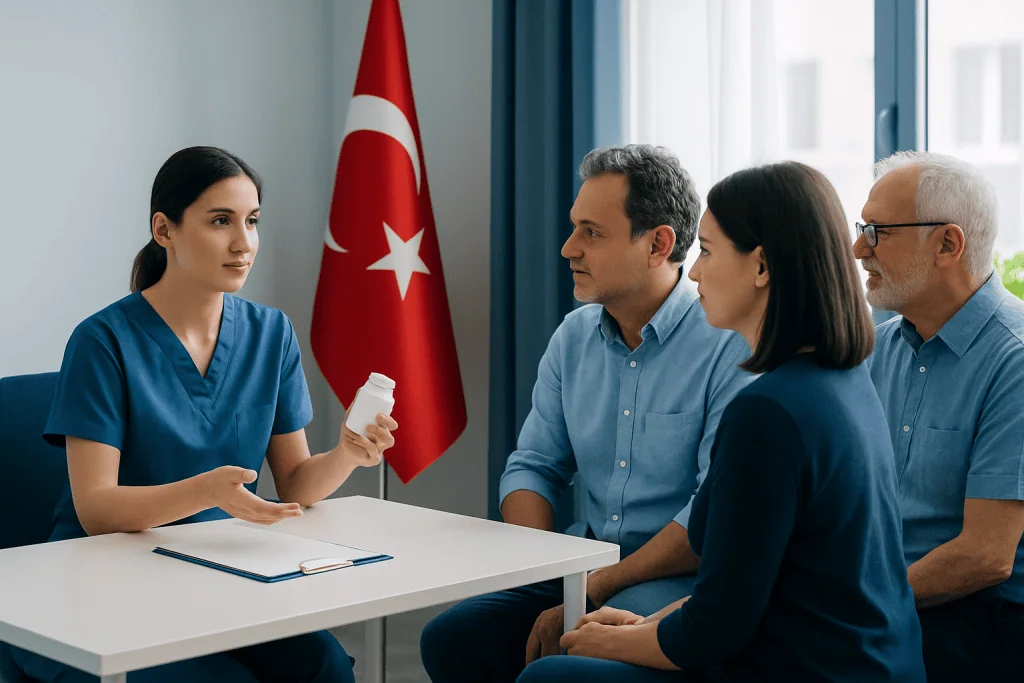
Medicines are where most confusion happens after medical travel, mainly because brand names differ between countries. Do not rely on memory, and do not rely on the box alone. Ask your care team to write each medicine down clearly, and ask specifically for the generic (international) name alongside the Turkish brand name, so a pharmacist at home can identify it immediately. A useful medicine entry answers five questions at a glance:
| Field | What to write down |
|---|---|
| Name | Generic name plus the brand name on the packaging you carry |
| Purpose | What it is for, in everyday words |
| Dose and timing | How much, when, and whether with food, exactly as your team wrote it |
| Duration | How long to continue, and who decides what happens after that |
| Notes | Anything your team flagged, such as interactions or things to avoid |
Any change to a medicine, starting, stopping, or adjusting a dose, belongs to your treating doctor or your local doctor, never to the handover document itself. The handover records the plan you were given; it does not create one. The guide on returning home with new medicines after treatment in Turkey covers naming, customs paperwork and pharmacy questions in more depth.
If you have a wound, dressing, drain or special equipment, ask for a demonstration before discharge, and ask for it twice if you need it. It is entirely reasonable to have the nurse repeat the steps, show you what a normal healing wound looks like at your stage, and describe what would not be normal. If your companion is with you in Turkey, have them watch the demonstration and take notes or, with permission, a short video on your phone. A thirty-second clip of a dressing change is worth more to a caregiver at home than a page of text.
Daily routines matter as much as the clinical detail. Write down how much walking is advised, which movements to avoid, how to sleep or sit more comfortably, any bathing restrictions, dietary suggestions, and whether hydration or breathing exercises were emphasised for you. These small, unglamorous instructions are what a caregiver reaches for most in the first week, when you are tired from travel and would rather not think.
Planning the journey home and the first 48 hours
Travel day is often the most tiring day of the whole recovery, so it deserves its own section in the handover. Note when you need to leave for the airport, whether wheelchair or airport assistance has been booked, how often you should stand or move during the flight if your team advised it, and where your medicines are packed. Keep essential medicines and your summary page in your hand luggage unless told otherwise, checked bags go missing, and a handover locked inside one is no handover at all. The guide on preparing for a safe flight home walks through flight-day logistics in detail.
Then write a short arrival plan for the first 24 to 48 hours at home. Decide in advance who collects you from the airport, whether you need help with stairs, where you will rest on the first night, how meals will be managed, and whether someone should stay overnight. If you are likely to be jet-lagged, sore, or drowsy from prescribed medicines, your caregiver should know that before you land rather than working it out at the front door. If the house itself needs arranging, a bed moved downstairs, rugs lifted, supplies bought, the guide on preparing your home before returning from treatment in Turkey covers it step by step, and much of it can be delegated to the caregiver while you are still abroad.
Before you leave, ask your team whether there are travel-specific instructions worth repeating in the home plan, activity limits during the first days, hydration advice, or the expected timing of any follow-up contact after arrival. Writing these into the handover means nobody has to remember them through jet lag.
Making follow-up easy for your caregiver and local doctor
One of the most useful pages in any handover is a contact map: who to reach for which kind of issue. Typically that means the treating team in Turkey for questions about the procedure and discharge plan, your local doctor for routine review and prescriptions, your pharmacy for medicine supply questions, and your local emergency services for anything urgent. Writing this down once prevents the common failure mode where every question, big or small, lands on the caregiver with no obvious route forward.
If follow-up by phone, video or secure messaging is planned, note the likely time frame and how it will be arranged. Remember the time zone difference between Turkey and your home country and write both times next to any scheduled call. If you will need to send wound photos, blood pressure readings or updated test results, explain this to your caregiver in advance so they can help you produce them properly, good lighting and a consistent angle make wound photos far more useful.
Share your records with your doctor at home early, rather than waiting until a question arises. A concise summary from the treating team, together with the major reports and any medication changes, gives your local clinician what they need for continuity of care. It also spares your caregiver the awkward position of being the only bridge between two health systems.
If your caregiver was not with you in Turkey
Many international patients travel with one companion, or alone, while the person who will do most of the caring waits at home. That gap is manageable if you close it deliberately. Three things help most.
First, arrange a short call or video conversation before you fly, in which you (or your companion) walk the caregiver through the summary page: medicines, daily care, restrictions, contacts. Hearing the plan explained is different from reading it. Second, send the digital folder ahead of you, so the caregiver has read everything before you land and arrives at the airport with questions rather than confusion. Third, ask the caregiver to repeat the plan back in their own words. If they can explain the medicine schedule and the first-night plan without prompting, the handover works. If they cannot, you have found the gaps while there is still time to fix them.
Be honest in the plan about the help you may actually need. Some patients prefer to sound independent and later find themselves struggling with stairs, showering, meals or remembering doses. “I may need help with bathing for a few days” or “please remind me to walk every few hours” is far more useful to a caregiver than polite vagueness.
Keeping the handover clear, calm and realistic
Your handover does not need to be perfect. It needs to be usable by a tired person. Avoid long notes that bury the essentials; a one-page overview with headings, medicines, daily care, warning signs, appointments, contacts, is the format most caregivers can actually work with. Keep the detailed reports behind it, in order, for the professionals.
Ask questions before discharge until you genuinely understand the plan, not just hold the paperwork. If something sounds technical, ask for a plain-language version. If English is not your first language, or your caregiver reads another language, request interpreter support and translated summaries where available. The goal is that both of you leave with instructions you understand, not documents you carry.
Step by step
- Start your handover list before discharge day. Begin one to three days before you travel, while there is still time to fill gaps. Open a note on your phone or a printed checklist and collect questions as they occur to you, instead of trying to remember everything at the last minute.
- Ask for one clear summary in plain language. Request a concise explanation of what treatment you had, what recovery should look like at your stage, and what your restrictions are. If anything sounds too technical, ask the team to explain it in everyday terms your caregiver can use.
- Review medicines line by line with your caregiver or companion. Confirm each medicine’s name, purpose, dose, timing and duration, and ask for the generic name to be noted so your local pharmacy and doctor can identify it easily.
- Watch, and record, any care demonstrations. If dressings, drains or devices are involved, have the demonstration repeated until you are confident, take notes, and with permission capture a short video for the caregiver at home.
- Write a first-48-hours home plan. Cover airport pickup, stairs, meals, rest arrangements, bathroom access, sleeping setup and who stays the first night. This prevents avoidable stress when you are exhausted and just want to be home.
- Record the warning signs your team described, in their words. Ask which symptoms are expected at your stage of recovery and which are not, and put that guidance, as your team gave it, at the top of the summary page alongside the contact map.
- Build the digital folder and send it ahead. Photograph or scan the discharge papers, prescriptions and reports, store them in one folder, and share it with your caregiver and, if appropriate, your doctor at home before you fly.
- Confirm the follow-up route before leaving Turkey. Check how post-discharge questions will be handled after you return, including contact details, channels and expected response times, and write the answer into the contact map.
Your checklist
- Printed discharge summary and digital backup
- Full medication schedule with generic names, doses, timing and duration
- Allergy list and current medical conditions
- Wound, dressing or device care instructions, if relevant
- Travel-day plan, including any airport assistance
- Warning signs as described by your treating team, in plain language
- Contact map: treating team, coordinator, local doctor, pharmacy, local emergency services
- Copies of imaging, test results, operative and pathology reports
- Home arrival plan for the first 24-48 hours
- Confirmation that the caregiver has read the pack and can explain it back
Key takeaways
- A caregiver handover turns discharge paperwork into a plan another person can follow without guessing.
- The essentials are medicines with generic names, daily care instructions, the warning signs your team described, and a contact map.
- Prepare a one-page summary with full documents behind it, in both paper and digital form.
- Include travel-day logistics and a first-48-hours home plan, not just medical notes.
- Close the distance gap: send the folder ahead, hold a handover call, and have the caregiver explain the plan back.
Frequently asked questions
When should I prepare a caregiver handover before returning home from Turkey?
Ideally, start 24 to 72 hours before discharge or your flight home. That leaves time to ask questions, collect documents, watch care demonstrations, and make sure your caregiver understands the plan without anyone feeling rushed on travel day.
Can foreigners go to hospital in Turkey?
Yes. Turkey treats large numbers of international patients each year, and many private hospital groups run dedicated international patient departments that handle admissions, interpreting and paperwork for visitors. You will normally need your passport, relevant medical records and clarity on how your treatment is being paid for, travel insurance rarely covers planned treatment, so most international patients arrange this directly with the hospital in advance.
Does Turkey have good medical care?
Turkey has a large and well-established private hospital sector with significant experience treating international patients, and modern facilities are common in the major cities. As anywhere, quality varies between institutions, so it is sensible to look at the specific hospital and team treating you, ask how communication and follow-up will work, and confirm that you will receive full documentation before travelling home.
What if my caregiver was not with me in Turkey?
That is common, and it makes a written handover more important, not less. Send the digital folder before you fly, arrange a short call or video conversation to walk through the summary page, and ask the caregiver to repeat the plan back in their own words so you can find gaps while there is still time to fix them.
Do I need translated documents?
If you or your caregiver are not fully comfortable reading the language of the discharge papers, translated or plain-language summaries help considerably. Many hospitals with international patient departments can arrange interpreters or clearer documentation; raising this before discharge is far easier than resolving it after landing.
How detailed should the medicine list be?
Detailed enough that another person could help you without guessing. Include the generic and brand name, the purpose in everyday words, the dose, exact timing, whether it is taken with food, how long to continue, and any special notes your team gave. Any change to the plan itself belongs to your treating doctor or local doctor, not to the list.
What should the warning-signs section cover?
It should record what your treating team told you specifically: which symptoms are expected at your stage of recovery, which are not, and what guidance they gave about seeking care. Write their advice in plain language near the top of the summary page, next to the contact map, rather than relying on general lists from the internet.
Who should receive my handover information?
The person helping you most in the first days at home, a partner, relative, friend or professional carer, plus your local doctor, especially if medicines changed or follow-up tests are planned. Sharing the key documents early supports continuity of care and spares your caregiver from being the only link between two health systems.
Add us as a Preferred Source to see more of our trusted health content across Google Search, AI Overviews and Discover.

Update history
- PublishedJuly 6, 2026
- Medical review approvedSeptember 13, 2026
- Last content updateSeptember 12, 2026
References3
- NHS: Being discharged from hospital nhs.uk
- MedlinePlus: After Surgery medlineplus.gov
- CDC Travelers' Health: Blood Clots During Travel wwwnc.cdc.gov
More Patient Guides

Flying After a C-Section: Timing for New Mothers
A C-section is real abdominal surgery that happens to come with a newborn attached, so the flying question has two clocks…

When Can You Drive After Anesthesia or Sedation?
You feel fine an hour after the procedure. You are chatting, you walked to the car unaided, you could obviously drive it.…

Flying After Hip Replacement: When Is It Safe?
Hip replacement recovers famously well, many patients walk further at three weeks than they had in three years. Flying is part…

Flying After Knee Replacement: When Is It Safe?
The knee is new, the physio is going well, and there is a boarding pass with your name on it. Flying after…