

Knee Arthroscopy Recovery: Week by Week
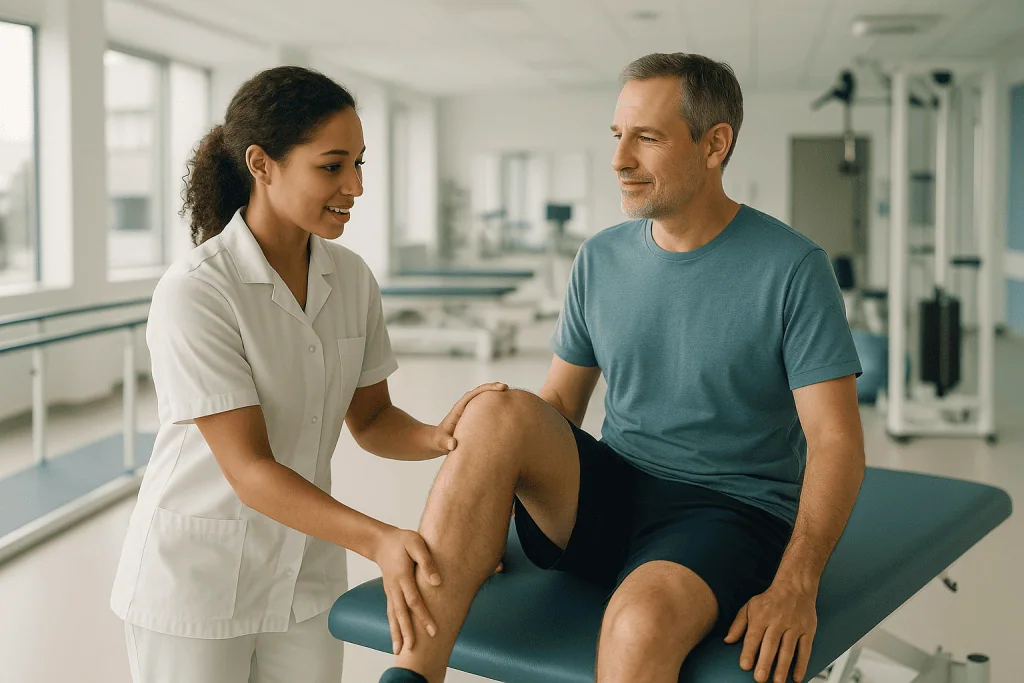
Knee arthroscopy is usually a day-case operation, with discharge the same day or after one night. Most people walk with support within the first day or two, eat and drink normally once the anaesthetic has worn off, and shower once the dressings are secure. Short flights are typically possible after a few days to two weeks, and routine recovery usually takes 2 to 6 weeks.
Key Takeaways
- Knee arthroscopy is usually a day case, with discharge the same day or after one night.
- Most people walk with crutches within a day or two and shower once the incisions are sealed.
- Stitches are typically removed between 7 and 14 days; driving usually resumes around 1 to 2 weeks.
- Published recovery time is 2 to 6 weeks; repairs may need staged physiotherapy for longer.
- Most people are cleared to fly within a few days to two weeks, but the operating team decides.
- Calf pain, breathlessness, fever or wound discharge need immediate contact with your care team.
What recovery from knee arthroscopy actually involves
Knee arthroscopy is a minimally invasive operation in which the surgeon looks inside the joint through a small incision using a slim camera, and treats damaged cartilage, ligaments, tendons or loose fragments through additional small incisions. You can read a full description on the arthroscopy procedure page. The operation itself usually takes between 30 minutes and 2 hours under general anaesthesia, and most people go home the same day or after one night in hospital. The published recovery time is 2 to 6 weeks.
How quickly you recover depends mainly on what was done inside the knee. A diagnostic look or the removal of a small loose fragment usually settles faster than a cartilage, ligament or tendon repair, which is more likely to need a period of protected movement and physical therapy. The stages below describe what most people experience, but every knee is different. Your surgeon’s instructions always take precedence over any general timeline.
Knee arthroscopy recovery timeline
The first 48 hours
- Pain and swelling: the knee is usually sore and swollen. Prescribed pain relief, rest, elevation of the leg above heart level and regular ice packs over the dressing typically control this. Take medicines as prescribed rather than waiting for pain to build.
- Movement: most people are helped to stand and walk short distances before discharge, often with crutches. Gentle ankle pumps and the simple exercises you are shown help circulation and reduce swelling. Avoid lifting anything heavier than a small bag.
- Wound and dressing: the small incisions are closed with stitches or adhesive strips and covered with a dressing. Keep it clean and dry unless told otherwise.
- Eating and drinking: after fasting for general anaesthesia, start with fluids and light food once you feel ready. Nausea from the anaesthetic usually passes within the first day.
- Washing: a wash at the sink is usually recommended rather than a shower until the team confirms the dressing can be protected or changed.
- Sleeping: lie on your back with the leg supported on pillows so the knee is slightly raised; avoid placing a pillow only under the knee if you have been told to keep it straight.
- Driving: do not drive. You will need someone to take you back to your accommodation.
Week 1
- Pain: discomfort usually eases day by day. Many people move from prescribed medication to over-the-counter pain relief during this week, following the discharge plan. Continue ice and elevation several times a day.
- Movement: walking indoors usually becomes easier, with crutches used for as long as your surgeon or physiotherapist advises, typically a few days to two weeks. Start the prescribed exercises. Avoid deep squatting, kneeling and carrying loads.
- Wound and dressing: the outer dressing is usually changed or reduced at the first wound check. A small amount of dried blood on the dressing is common; fresh, spreading discharge is not.
- Eating and drinking: normal diet. Drink well, particularly if you are using stronger pain relief, which can cause constipation.
- Washing and showering: most people can shower once the incisions are sealed and covered with a waterproof dressing, usually within the first few days. Avoid soaking the knee in a bath or pool.
- Sleeping: continue to keep the leg elevated on pillows at night if swelling persists.
- Driving: not usually advised in the first week, especially if the operated knee is used for braking.
- Work: people with desk-based jobs sometimes return to light or remote work towards the end of this week if pain and swelling allow.
Week 2
- Pain: usually mild and mainly noticed after activity. Simple pain relief before exercises may help.
- Movement: most people walk without crutches by the end of week two after simpler procedures. After a repair, your surgeon may still limit how much weight you put through the leg or how far the knee bends.
- Wound: stitches, if not dissolvable, are usually removed between 7 and 14 days. Once the skin has healed, dressings are typically no longer needed.
- Eating and drinking: normal.
- Washing: showering without a dressing is usually fine once the incisions are dry and closed; pat them dry rather than rubbing.
- Driving: many people are able to drive again around 1 to 2 weeks after surgery, provided they are off strong pain relief, can bend the knee comfortably and can perform an emergency stop. Check with your surgeon and your insurer.
- Work: desk work is usually manageable. Jobs involving standing, lifting or climbing typically need longer.
Weeks 3 to 6
- Pain: most people need little or no pain relief. Some stiffness and mild swelling after longer walks is common and usually settles with rest and ice.
- Movement: walking distance increases and strengthening exercises progress. Physical therapy is often recommended in this phase, particularly after ligament, cartilage or tendon repair. Light cycling on a stationary bike and swimming are often introduced once the wounds are fully healed, if your surgeon agrees.
- Wound: the small scars usually fade over the following months. Protect them from strong sun.
- Washing and sleeping: normal routines resume for most people.
- Work: most people are back at work by the end of this period, which matches the published recovery time of 2 to 6 weeks. Heavy manual work may need to wait until the end of this window or longer.
- Sport: low-impact activity is often allowed; running, pivoting sports and contact sports usually wait until strength and control have returned and your surgeon has cleared you.
Months 2 to 3
- Pain: usually absent at rest. Occasional aching after unusual effort is common.
- Movement and sport: for simpler procedures, this is typically when a gradual return to running and recreational sport begins. After a repair, the physiotherapy programme usually continues and the return to sport is staged.
- Work: most people, including those in physical jobs, are back to their normal duties, following the surgeon’s guidance.
Months 6 to 12
- Who this applies to: people who had only a diagnostic arthroscopy or a minor procedure have usually completed their recovery long before this point. This stage mainly concerns those who had ligament, cartilage or tendon repair.
- Movement and sport: after a repair, a full return to pivoting or contact sport typically falls within this window and depends on strength, balance and confidence in the knee, as assessed by the treating team.
- Pain: persistent pain, swelling, locking or giving way at this stage should be reported so the cause can be checked.
When it is safe to fly home
For a straightforward knee arthroscopy, most people are cleared to fly home within a few days to about two weeks after surgery. Shorter flights are usually possible earlier than long-haul journeys, and a more complex repair may require a longer wait. The operating team gives the final clearance; do not book a non-refundable return flight until this has been discussed.
Timing matters for three reasons. Sitting still for hours can increase swelling in a recently operated knee. Cabin pressure changes may make a swollen joint more uncomfortable. Most importantly, reduced mobility after leg surgery raises the risk of a blood clot in the calf, and long-haul travel adds to that risk. Many surgeons therefore prefer that you are walking comfortably and that the wounds are healing well before you travel.
A fitness-to-fly assessment is part of the discharge process. It usually covers your wound, the level of swelling, your ability to walk and to get in and out of a seat, your pain control, whether you need medication or compression stockings for the journey, and any conditions that affect clot risk.
- Seat and mobility: ask the airline for an aisle seat, ideally with extra legroom, so you can stretch the knee and stand every hour or so. Do regular ankle and calf exercises while seated and keep well hydrated.
- Support: request airport assistance if you are still using crutches. Wear compression stockings if they have been advised.
- Hand luggage: carry your discharge letter and operation note, a list of medicines with enough supply for the journey and the first days at home, any prescribed pain relief and anti-clotting medication, a spare dressing, your exercise sheet, and your surgeon’s contact route for the remote follow-up.
Warning signs, when to contact your care team immediately
- Fever or chills, or feeling generally unwell.
- Redness spreading outwards from an incision, or increasing warmth around the knee.
- Pus, cloudy fluid or persistent bleeding from a wound, or a wound that opens.
- Pain, tenderness or swelling in the calf, or a leg that feels hot or looks discoloured.
- Sudden breathlessness, chest pain or coughing up blood, seek emergency help at once.
- Pain that is not controlled by the prescribed medication or that suddenly worsens.
- Rapidly increasing swelling of the knee, or a knee that becomes tense and hard to bend.
- Numbness, tingling or coldness in the foot or toes that does not settle with elevation.
- Locking, catching or giving way of the knee that is new since surgery.
Recovering in Türkiye and then at home
Knee arthroscopy is performed in the Orthopedics & Joint Center at Acibadem hospitals in İstanbul and Ankara. The international patient team coordinates your prior reports and imaging, arranges your appointments and organises the hospital visit, and interpreters can be arranged for consultations and wound checks. Because most people are discharged the same day or after one night, plan accommodation close to the hospital for the days before your flight so that wound checks, physiotherapy sessions and the fitness-to-fly assessment are easy to attend without long journeys.
Before you leave, a follow-up appointment with the operating team is usually arranged to check the wounds, review swelling and pain, confirm the exercise plan and complete the fitness-to-fly assessment. Ask for the following records to take home: the operation note describing exactly what was found and treated, the discharge summary, the arthroscopy images if available, a medication list, the physiotherapy programme and the planned dates for remote follow-up.
After you return home, follow-up is done remotely with the operating team. Keep photographs of the wounds during the first two weeks so that any change can be shown at a remote review, and arrange local physiotherapy if this has been recommended, sharing the programme provided by the surgical team.
Questions to ask your surgeon before you fly out
- Exactly what was found and treated inside my knee, and does that change my expected recovery?
- How much weight can I put through the leg, and for how long should I use crutches?
- When can I shower without a dressing, and when will the stitches be removed or dissolve?
- What is my earliest safe date to fly, and does this differ for a connecting or long-haul flight?
- Do I need compression stockings or medication to reduce clot risk on the journey?
- When can I drive, return to my type of work and return to my sport?
- Which exercises should I do, how often, and when should I start physiotherapy at home?
- How and when will the remote follow-up happen, and who do I contact if a warning sign appears?
Add us as a Preferred Source to see more of our trusted health content across Google Search, AI Overviews and Discover.

Update history
- PublishedSeptember 9, 2026
- Medical review approvedSeptember 10, 2026
- Last content updateSeptember 9, 2026
More Patient Guides

Septoplasty Recovery: Week by Week
Learn what to expect after deviated septum surgery: a week-by-week septoplasty recovery timeline, when it is usually safe to fly home, and…

Gallbladder Surgery Recovery: Week by Week
Learn what to expect after gallbladder surgery: a week-by-week recovery timeline, pain, diet, wound care, when it is safe to fly home…
Robotic Hysterectomy Recovery: Week by Week
Recovery from robotic hysterectomy week by week: pain, lifting, wounds, driving, flying home safely, warning signs and questions to ask before you…
Breast Reconstruction Recovery: Week by Week
DIEP flap recovery week by week: hospital stay, drains, pain, walking, showering, driving, when it is usually safe to fly home, and…