

Meniscus Surgery Recovery: Week by Week
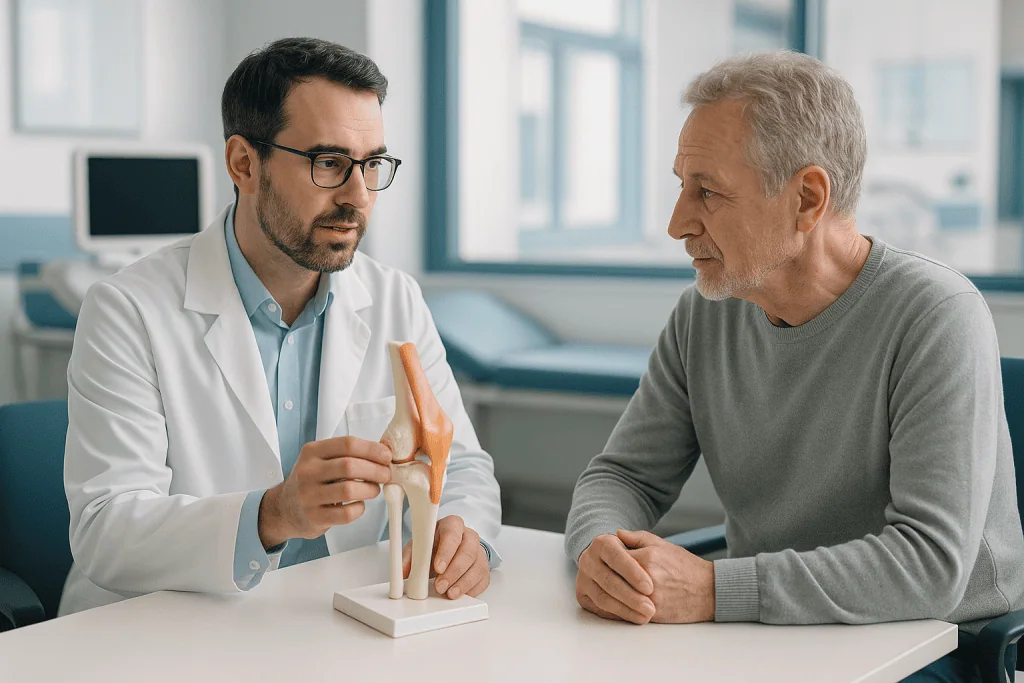
Meniscus surgery is usually a keyhole operation under regional anaesthesia, with a same-day or one-night hospital stay. Most people walk with crutches within hours, eat normally the same day and shower once the wound is sealed, usually within the first week. Short flights are often cleared within about a week, long-haul later, and full recovery usually takes 4 to 12 weeks.
Key Takeaways
- Meniscus surgery is usually keyhole, under regional anaesthesia, and takes 30 to 90 minutes.
- Most people go home the same day or after one night; full recovery usually takes 4 to 12 weeks.
- A partial meniscectomy usually allows weight-bearing quickly; a repair needs several weeks of protection.
- Stitches are typically removed 7 to 14 days after surgery; showering usually resumes once wounds are sealed.
- Short flights are often cleared within about a week; long-haul and repairs usually wait longer.
- Calf pain, breathlessness, fever or spreading wound redness need immediate contact with the care team.
What recovery from meniscus surgery actually involves
Meniscus surgery is usually performed by arthroscopy, through small incisions, under regional anaesthesia, and the operation itself typically takes 30 to 90 minutes. The surgeon either stitches the torn cartilage back together (a meniscus repair) or trims away the unstable fragment (a partial meniscectomy). Most people go home the same day or after one night. The published recovery time is 4 to 12 weeks, and where you fall in that range depends largely on which of the two procedures was done: after a partial meniscectomy the knee can usually bear weight quickly, while a repaired meniscus needs protecting so the stitched tissue can heal. You can read how the operation itself is planned and performed on the meniscus surgery treatment page.
Recovery is more than the wound closing. It is a sequence: controlling swelling, regaining full straightening and bending of the knee, rebuilding thigh muscle, and then relearning confident walking, stairs and eventually sport. Physical therapy guides each of those steps, and return to sport or heavy activity is gradual and directed by the surgeon. The timeline below describes what most people experience week by week. It is general guidance only. Your surgeon’s instructions always take precedence over any general timeline.
Recovery timeline, week by week
The first 48 hours
- Pain: the regional anaesthetic keeps the leg numb for several hours. As it wears off, most people feel a deep ache and a tight, swollen knee. The oral painkillers given at discharge, ice packs applied over the dressing and keeping the leg raised usually control this.
- Moving and lifting: you are helped to stand and take your first steps, usually with crutches, before you leave. After a partial meniscectomy most people may put weight through the leg as comfort allows; after a repair the surgeon may limit weight-bearing and fit a brace. Ankle pumps and gentle thigh-tightening exercises are typically started straight away. No lifting beyond a light bag.
- Wound and dressing: the small incisions are covered with dressings. Some blood-stained fluid on the dressing is normal in the first day or two. Keep it dry and do not remove it yourself.
- Eating and drinking: fluids and light food usually resume within a few hours once the anaesthesia team is satisfied, then a normal diet.
- Washing: wash at the sink rather than showering until the dressing has been checked.
- Sleeping: on your back with the leg raised on pillows under the calf and heel, not behind the knee, so the knee can rest straight.
- Driving: not permitted. Someone must take you to your hotel or home.
Week 1
- Pain: usually eases day by day, and most people move from regular painkillers to taking them only when needed. Swelling typically peaks in the first few days and then slowly settles; ice several times a day helps.
- Moving and lifting: crutches are used for balance and are usually weaned gradually after a partial meniscectomy as the surgeon allows. After a repair, most people keep to the prescribed weight-bearing limit and brace settings. Range-of-motion and straight-leg-raise exercises continue. Avoid deep squatting, kneeling, twisting on the leg and carrying heavy loads.
- Wound and dressing: the dressing is usually changed at a wound check within the first week. If stitches are not dissolvable they are typically removed 7 to 14 days after surgery.
- Eating and drinking: normal diet. Drink plenty of water and eat fibre-rich food, as painkillers can cause constipation.
- Washing: brief showers are usually allowed once the team confirms the incisions are sealed, with a waterproof cover over the dressing. No baths, pools or soaking.
- Sleeping: on your back with the leg elevated is most comfortable; a pillow between the knees helps if you side-sleep.
- Driving: not usually in the first week.
- Work: some people with desk-based jobs manage light work from home toward the end of the week.
Week 2
- Pain: usually mild, mostly stiffness and an ache after activity.
- Moving and lifting: many people who had a partial meniscectomy are walking without crutches by now. After a repair, restrictions typically continue for several more weeks. Formal physical therapy sessions focus on regaining full straightening, gradual bending and thigh muscle activation.
- Wound: stitches out or dissolved; small scars may be pink and slightly raised. Keep them clean and avoid soaking until fully closed.
- Eating and drinking: normal.
- Washing: shower normally once the incisions are dry and closed.
- Driving: some people are cleared once the operated knee is not braced, they can perform a firm emergency stop, and they are no longer taking painkillers that cause drowsiness. This is usually later for the right knee and after a repair. Confirm with your surgeon and insurer.
- Work: sedentary work is commonly resumed. Jobs involving standing, walking or lifting usually wait.
Weeks 3 to 6
- Pain: occasional swelling after longer walks or exercise is common and usually settles with rest and ice.
- Moving and lifting: therapy progresses to strengthening, balance work and often a stationary bike. After a repair, most people come off the brace and crutches during this window as the surgeon directs. Light lifting is usually fine; heavy or repetitive lifting typically waits.
- Wound: healed. Gentle scar massage may be suggested.
- Driving: most people are cleared by now.
- Work: people with physically active jobs who had a partial meniscectomy often return toward the end of this period; heavier manual work usually comes later, particularly after a repair.
- Sport: low-impact activity only, such as cycling or swimming once cleared. No running, jumping or pivoting yet. Four weeks is the lower end of the published recovery range and usually applies to a straightforward partial meniscectomy.
Months 2 to 3
- Pain: usually minimal. Persistent swelling, catching or locking should be reported.
- Moving and lifting: most people reach the end of the published 4 to 12 week recovery window here. After a repair, strength and confidence often still need building.
- Work: heavy manual work is typically resumed within this period if strength allows.
- Sport: a gradual return to jogging is often introduced once the surgeon and therapist are satisfied with strength and control. Sports that involve cutting and pivoting usually wait longer, particularly after a repair.
Months 6 to 12
- Knee: repaired tissue continues to mature. Most people are back to their usual activities, and return to pivoting or contact sport after a repair is typically cleared somewhere in this window, guided by the surgeon.
- Maintenance: keeping the thigh muscles strong protects the knee. Report any new locking, giving way or recurrent swelling to your care team.
- Follow-up: late reviews are usually done remotely with the operating team.
When it is safe to fly home
There is no single fixed rule, and the operating team gives the final clearance. As a guide, after arthroscopic meniscus surgery most people are cleared for a short flight within about a week, once the first wound check has been done, pain is controlled with tablets and they can walk safely to the gate and the aircraft lavatory. For long-haul flights, and after a meniscus repair with weight-bearing restrictions, the team usually prefers a longer wait, often one to two weeks or more.
Timing matters for three reasons. Swelling in the operated leg tends to increase during a flight, and cabin pressure changes can make a swollen knee uncomfortable. Sitting still for hours, combined with recent surgery on a leg, increases the risk of a blood clot in the calf, and long-haul travel raises that risk further. And if a problem does develop, you want to still be near the team that operated on you.
A fitness-to-fly assessment is part of the discharge process. It usually covers wound healing, swelling and calf checks, pain control, how safely you walk with or without crutches, and a clot-prevention plan, which may include compression stockings, regular walking on board and, for some people, a blood-thinning injection prescribed for the journey.
- Seat and mobility: book an aisle seat with room to stretch the leg, request wheelchair assistance through the airport if you are on crutches, stand and walk every one to two hours, and do ankle pumps while seated. Drink water and avoid alcohol.
- Hand luggage: your discharge summary, operative note and imaging, prescriptions and enough painkillers for the journey, a spare dressing, compression stockings, your brace if you have one, and a letter explaining any crutches, brace or injections for airport security.
Warning signs: when to contact your care team immediately
- Fever or shivering.
- Redness spreading outward from an incision, or the skin becoming hot and hard.
- Cloudy, yellow or foul-smelling discharge from a wound, or a wound that reopens.
- Pain, tenderness or swelling in the calf of either leg.
- Sudden breathlessness, chest pain or coughing up blood, which are emergencies.
- Pain that is worsening rather than easing, or not controlled by the prescribed medication.
- A knee that suddenly swells tightly, or that locks or cannot be straightened.
- Numbness, tingling or a cold, pale foot on the operated side.
Recovering in Türkiye and then at home
Because the hospital stay is short, much of the first week is spent in accommodation near the hospital. Choose a room with lift access, a walk-in shower and space to raise the leg, and plan for someone to accompany you. The international patient team coordinates your prior reports and imaging, arranges appointments and organises the hospital visit, and interpreters can be arranged. The procedure is performed within the Orthopedics & Joint Center at Acibadem hospitals in Ankara and İstanbul.
Before you are discharged to travel, a follow-up appointment with the operating surgeon usually includes a wound check, review of your exercises and the fitness-to-fly assessment. Once you are home, follow-up is done remotely with the operating team, and the international patient team organises this. Take home your discharge summary, operative report, before-and-after imaging, physiotherapy programme, medication list and the dates of planned remote reviews, so that a local physiotherapist or doctor can continue your care.
Questions to ask your surgeon before you fly out
- Was my meniscus repaired or partially removed, and how does that change my weight-bearing and brace instructions?
- How long should I use crutches, and when may I start bending the knee fully?
- When will my stitches be removed, and who does this if I am already home?
- When is the earliest you would clear me to fly, and does that differ for a long-haul flight?
- Do I need compression stockings or a blood-thinning injection for the journey?
- When can I drive, shower without a cover, and return to my type of work?
- Which exercises should I do daily, and when should I start supervised physiotherapy at home?
- What symptoms should prompt me to seek care locally rather than wait for a remote review?
Add us as a Preferred Source to see more of our trusted health content across Google Search, AI Overviews and Discover.

Update history
- PublishedSeptember 9, 2026
- Medical review approvedSeptember 10, 2026
- Last content updateSeptember 9, 2026
More Patient Guides

Septoplasty Recovery: Week by Week
Learn what to expect after deviated septum surgery: a week-by-week septoplasty recovery timeline, when it is usually safe to fly home, and…

Gallbladder Surgery Recovery: Week by Week
Learn what to expect after gallbladder surgery: a week-by-week recovery timeline, pain, diet, wound care, when it is safe to fly home…
Robotic Hysterectomy Recovery: Week by Week
Recovery from robotic hysterectomy week by week: pain, lifting, wounds, driving, flying home safely, warning signs and questions to ask before you…

Breast Reconstruction Recovery: Week by Week
DIEP flap recovery week by week: hospital stay, drains, pain, walking, showering, driving, when it is usually safe to fly home, and…