

Paying for Treatment in Turkey from Abroad: Cards, Bank Transfers, and Timing

Paying for treatment in Turkey from abroad usually means a card payment or an international bank transfer, arranged against a written quote. Cards clear quickly; transfers can take several business days and may lose small amounts to bank charges. Confirm the currency, the official bank details and the payment deadline early, keep every receipt, and reconfirm that funds have arrived 24–72 hours before admission.
Will your money arrive before you do? That is the question most patients forget to ask until the week of the flight. Flights and hotels confirm instantly. International payments do not always behave the same way, and a hospital cannot admit you against a transfer that is still somewhere between two banks.
This guide explains how paying for treatment in Turkey from abroad actually works: who pays and why, how quotes are built, when cards beat bank transfers, where currency and timing problems hide, and what to confirm before you travel. It is practical rather than promotional, because the payment step goes wrong for practical reasons, almost never dramatic ones.
At a glance
- Who pays: International patients pay privately; Turkish public health insurance does not cover visitors
- Common methods: Credit or debit card and international bank transfer; some settings also accept cash
- Best time to confirm payment: When your treatment date firms up, and again 24–72 hours before admission
- What to check first: Billing currency, transfer lead time, card limits, and the official beneficiary details
- Why timing matters: International transfers can take several business days to clear, longer over weekends and holidays
- Useful documents: Passport, written quote, transfer receipt or card confirmation, and your coordinator’s contact details
What paying for treatment in Turkey from abroad involves
Paying for treatment in Turkey from abroad is usually straightforward, but it works best when you treat it as part of your travel planning rather than a task for the departure lounge. The typical sequence is simple: you receive a written treatment plan or quote, you confirm which payment methods the hospital accepts, and you arrange either a card payment or a bank transfer within the timeline the billing team gives you.
The part patients underestimate is that payment is often more than one step. Many hospitals ask for a deposit to confirm a date, with the balance settled before or at admission. If your medical plan changes after the doctors examine you in person, an extra scan, a different implant, a longer stay, the amount can change with it. That is not a sign that something went wrong. Treatment plans made from records and photos are provisional by nature, and honest providers say so in the quote itself. Our guide on how unexpected tests affect timing and cost explains this in more detail.
Keep every payment document in one place from the start: the quote, any proforma invoice, the bank details, receipts, and the name of your international patient coordinator. At Acibadem, international patient teams walk patients through these billing steps as part of planning the visit, so the finance side is settled before the medical side begins.
Do you have to pay for hospital treatment in Turkey?
If you are visiting from another country, yes. Turkey’s public health insurance system (SGK) covers Turkish citizens and registered residents who contribute to it. It does not cover tourists or people who travel specifically for treatment. As an international patient you pay privately, either yourself, through a family member or sponsor, or through an insurer if your policy explicitly covers planned treatment abroad, which is rarer than most people assume.
Travel insurance deserves a separate mention because it confuses many patients. Standard travel policies are designed for unexpected illness or injury during a trip. They generally exclude treatment you travelled for on purpose, and many exclude complications of planned procedures abroad as well. Read the policy wording before you rely on it, and if an insurer or employer is paying, tell the hospital early: third-party payments usually need extra paperwork and extra lead time.
How quotes are built and what the amount depends on
You will notice this guide gives no figures. That is deliberate: any number printed here would be wrong for your case. What is worth understanding is the structure of a quote, because the structure is what you can actually check.
A medical quote is typically built from the procedure itself, the surgeon’s and anaesthetist’s involvement, the expected number of hospital nights, standard pre-operative tests, medications used during the stay, and any package elements such as transfers or a companion bed. What sits outside the quote matters just as much: additional imaging, unplanned consultations, an extended stay, or companion costs are often billed separately. A consultation-only visit works the same way in miniature: the amount depends on the specialty, the tests ordered, and whether imaging or laboratory work is added on the day.
The practical rule: read the quote line by line and ask two questions. What is included? And what would trigger an additional charge? A provider that answers both clearly, in writing, is telling you it expects to be held to its own document.
Cards or bank transfer: how to choose
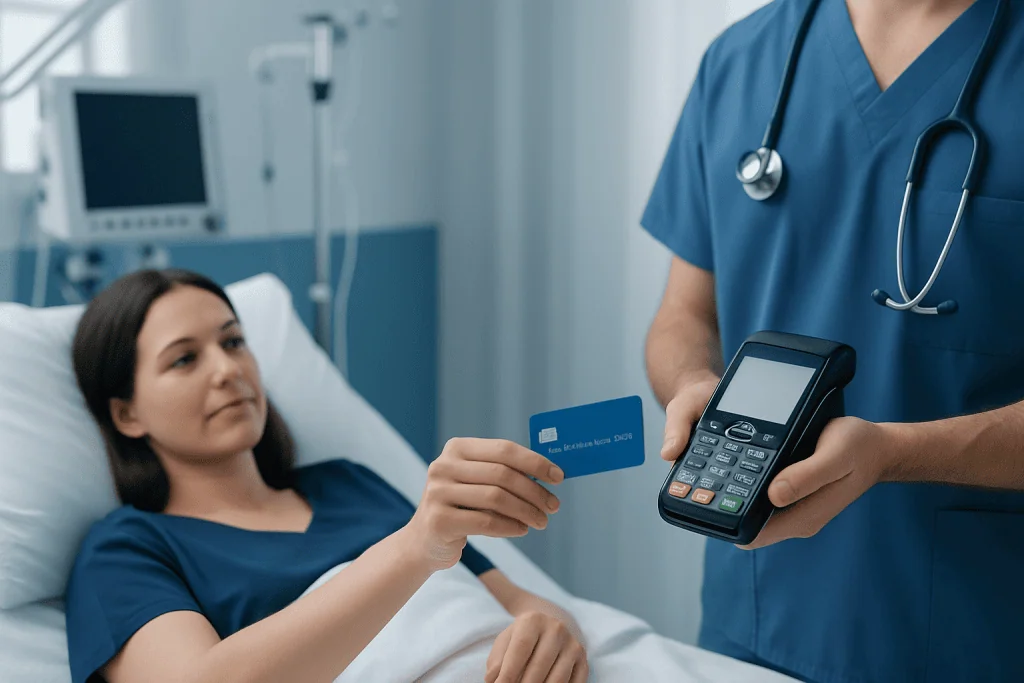
Cards win on speed and confirmation. A successful card payment is visible almost immediately, which matters when your admission date is close. The weak points are limits and security checks. Check your daily purchase limit before you rely on a card, hospital payments are far larger than your bank’s fraud model expects from you. Check whether your issuer blocks high-value overseas healthcare transactions by default. And check how your bank confirms payments: if approval arrives by SMS to your home number, make sure that number works in Turkey, or that your banking app works over local data. A working connection solves most of this, see our guide to mobile internet and SIM cards in Turkey.
Bank transfers suit larger amounts and patients who prefer paying from an account rather than a card. They are predictable in one sense, the amount is fixed when you send it, and unpredictable in another: an international transfer can take several business days, and intermediary banks along the route can add both delay and small deductions. Never assume a transfer sent today is credited today, and never treat your bank’s “sent” status as proof of arrival. Only the receiving hospital can confirm that funds have arrived and cleared.
Most patients decide on timing and control. Admission soon: a card is usually easier, if accepted for your type of payment. Planning weeks ahead: a transfer works well, provided you send it early and keep the receipt. Whichever you choose, ask the billing team exactly how to reference the payment, usually your full name as written in your passport, plus a patient or file number, so it can be matched to your file without a hunt.
- Ask which cards are accepted, and whether the payment can be made remotely or must be made in person.
- Confirm the official beneficiary name, IBAN and bank details through the hospital’s own channels before any transfer.
- Ask your bank about outward transfer fees, currency conversion charges, and daily cut-off times.
- Keep screenshots, receipts and transaction reference numbers for every payment, including the deposit.
For a fuller comparison, including where cash still has a role, see Paying for Treatment in Turkey: Card, Bank Transfer, Cash, and Currency Tips.
Currency, exchange rates, and hidden delays

Should you pay in your home currency or in the currency named on the quote? Follow the hospital’s billing instructions exactly, and ask which currency applies before you compare anything. Quotes for international patients are often issued in euros or US dollars, but this varies, and a quote compared in the wrong currency is a quote compared wrongly.
Three cost effects hide in the currency step. First, your bank or card issuer may apply its own conversion rate plus a foreign transaction charge, so the amount leaving your account differs from the amount on the invoice. Second, if you pay by card in person and the terminal offers to charge you in your home currency, a practice called dynamic currency conversion, the rate offered is usually worse than your own bank’s; it is generally better to be charged in the billed currency and let your bank convert. Third, transfers routed through correspondent banks can arrive slightly short after intermediary deductions. If the hospital needs the full amount to clear before admission, even a small shortfall can slow check-in until the difference is settled. Ask in advance how transfer charges should be handled, many billing teams will tell you to select the option where the sender bears all fees.
Timing compounds all of this. Exchange rates move between the day you send money and the day it arrives, and a transfer sent on a Friday afternoon may not begin moving until the following week. Sending early is not only calmer; it is cheaper in stress and often in money.
When to pay and what to confirm before you travel
The right time to pay depends on the treatment, the provider’s policy, and how soon you fly. The safe general rule: the moment your treatment date starts to become real, before you book non-refundable flights, you should know whether a deposit is expected, when the balance is due, and when proof of payment must be shared. How deposits, timing and final billing fit together is explained in At Acibadem, How We Explain Deposits, Payment Timing, and Final Billing.
Then build in one final checkpoint: 24 to 72 hours before departure or admission, confirm that your payment has been received, cleared, and recorded under your full name or patient number. If you paid by transfer, do not rely on your bank’s confirmation that it was sent, ask the hospital whether it has arrived. This single check prevents the most common admission-day delay there is. It pairs naturally with the medical side of arrival planning covered in When to Arrive Before Surgery in Turkey.
- Confirm the latest acceptable payment date for your admission.
- Ask whether treatment can proceed if funds are documented as sent but still in transit.
- Ask how additional tests or plan changes would be billed and paid.
- Get a billing contact who is reachable outside office hours if you land on a weekend or at night.
Documents and proof to keep with you
Even when everything has been paid correctly, travel with your paperwork. Time zones, weekends and airport changes mean you may arrive when the finance office is hardest to reach, and a receipt in your hand luggage resolves in minutes what an email chain resolves in hours.
The documents that earn their place: your quote or treatment estimate, the invoice or payment request, the transfer receipt or card confirmation with its transaction reference, your passport, and your coordinator’s contact details. If you paid for a package, also carry the written list of what it includes, extra imaging, consultations, medications, extended stay and companion costs are the items most often billed separately, and knowing which side of the line each falls on prevents check-in debates.
Keep two copies of everything: a folder on your phone and a thin printed set. Phones run out of battery at exactly the wrong moment.
If you fall ill during your stay: how paying works then
Planned treatment is not the only way visitors meet the Turkish health system, so it helps to know the payment side of unplanned care too. Turkey has an extensive network of public and private hospitals, and cities that receive international patients have hospitals accustomed to foreign visitors and card payments. As a visitor you pay for this care privately at the point of use, then claim from your travel insurer if your policy covers it, which is why keeping itemised receipts matters for unplanned care just as much as for planned care.
Pharmacies (marked eczane) are widespread and pharmacists commonly handle minor requests, but Turkey regulates prescription medicines in the way most European countries do: antibiotics and many other medicines require a doctor’s prescription and are not sold over the counter. Whether any medicine is appropriate for you is a decision for a doctor who has examined you, not something a guide, a pharmacist abroad, or a forum can settle. If you take regular medication, carry it in original packaging with your prescription documentation, and carry enough for delays.
How to avoid the common payment problems
Almost every payment problem in this setting is one of five: a late transfer, a declined card, a name that does not match the booking, a missing payment reference, or confusion about what the quote includes. All five are preventable, and none of them is prevented on the day itself.
Two habits do most of the work. First, tell your bank before you travel and before you pay, so a large overseas healthcare payment is not flagged as fraud at the worst moment. Second, verify bank details only through the hospital’s official channels. Payment-diversion fraud: a message that looks like your provider announcing “updated bank details”, targets exactly this kind of high-value international payment. If beneficiary details change from earlier correspondence in any way, stop and confirm through a channel you already trust before sending anything.
Finally, leave margin in your budget. Plans can change after in-person assessment, and exchange rates and bank charges nibble at fixed sums. Allowing for that is not pessimism; it is the difference between a variation and a crisis. A reputable provider will explain its billing steps in writing and give you a named contact for questions, treat the willingness to do both as part of your due diligence. If you want a structured set of questions to put to any provider, see Paying for Treatment from Abroad: Questions to Check.
Step by step
- Review your quote line by line. Confirm what is included, what could be added later, and which currency applies. Resolve anything unclear in writing before you arrange payment, not after you land.
- Confirm the accepted payment method. Ask whether card, transfer or cash is accepted for your payment, whether any method is preferred for your timeline, and whether payment must clear before admission or can be finalised at check-in.
- Check your bank and card limits. Ask about overseas payment limits, fraud blocks, foreign transaction fees and transfer cut-off times. Large healthcare payments rarely fit your normal spending pattern, and banks react to that.
- Send payment early. For transfers, allow several business days and remember that weekends and public holidays, in both countries, pause processing. If the date is close, ask whether a faster method is acceptable.
- Share proof of payment promptly. Send the receipt or confirmation through the official channel, with your full passport name, patient number if you have one, and treatment date, so finance can match it to your file quickly.
- Reconfirm before departure. One to three days before you fly, ask whether the payment has been received and cleared. This is the single check that most reliably prevents admission-day delays.
- Carry your records. Digital and printed copies of the quote, invoice, receipt and passport travel in your hand luggage, not your suitcase.
Your checklist
- Confirm the exact amount, the billing currency, and the payment deadline
- Check whether a deposit or advance payment is required to hold your date
- Verify official bank details through a trusted hospital channel only
- Ask your bank about transfer times, fees, and card limits before paying
- Choose the transfer fee option the hospital specifies, so the full amount arrives
- Save every receipt and transaction reference, including the deposit
- Send proof of payment with your full passport name and patient number
- Reconfirm receipt of cleared funds 24–72 hours before travel
- Bring printed and digital copies of all payment documents
Key takeaways
- International patients pay privately in Turkey; public insurance covers residents, not visitors, and travel insurance rarely covers planned treatment.
- Cards are faster; bank transfers need lead time and can lose small amounts to intermediary charges.
- Always confirm the billing currency, the deadline, and the official beneficiary details before sending money.
- Your bank saying “sent” is not the hospital saying “received”, only the second one counts for admission.
- Keep receipts, references and a billing contact with you, and reconfirm cleared funds before you fly.
Frequently asked questions
Do you have to pay for hospital treatment in Turkey?
As an international visitor, yes. Turkey’s public health insurance covers citizens and registered residents, not tourists or people travelling for treatment. Visitors pay privately, personally, through a sponsor, or through an insurer if the policy explicitly covers care abroad. Standard travel insurance is designed for unexpected illness during a trip and generally excludes treatment you travelled for on purpose.
How much does a doctor visit cost in Turkey?
There is no single figure, and any number quoted online is unreliable for your case. The amount depends on the specialty, whether it is a first consultation or a follow-up, and whether tests, imaging or laboratory work are added on the day. The dependable approach is a written quote from the provider itself, stating the currency and what the amount covers.
Can I buy antibiotics in Turkey over the counter?
No. Antibiotics in Turkey are prescription-only, as in most European countries, so a doctor must assess you and prescribe before a pharmacy can dispense them. Pharmacies, marked eczaneare widespread and can help with non-prescription items, but decisions about prescription medicines belong to the doctor treating you.
What happens if I get sick in Turkey as a visitor?
Turkey has an extensive network of public and private hospitals, and cities that receive international visitors have hospitals used to treating foreigners. As a visitor you pay for unplanned care privately at the point of use and claim from your travel insurer afterwards if your policy covers it, so keep itemised receipts for anything you pay.
How long does an international bank transfer usually take?
Often several business days, and longer when intermediary banks are involved or when the transfer is sent close to a weekend or a public holiday in either country. Your bank may show the payment as sent well before the receiving hospital can confirm the funds have arrived and cleared, and only the hospital’s confirmation matters for admission.
Should I pay before I travel or when I arrive?
Follow the provider’s policy, but where you have the choice, settling required payments before travel is usually the calmer option. Paying early leaves time to resolve transfer delays, card declines or questions about the quote while you are still at home with full access to your bank.
Can someone else pay on my behalf from another country?
In many cases yes, but the payment must be clearly linked to you: your full passport name and patient number should appear in the payment reference. If a family member, employer or insurer is paying, tell the hospital in advance, third-party payments often need extra paperwork and extra lead time.
What if the final treatment plan changes after I arrive?
Plans made from records can change after in-person assessment: an additional test, a different approach, a longer stay. If that happens, ask for a written explanation of what changed, what it means for the bill, and how any extra payment would be handled, before you agree to the change.
Add us as a Preferred Source to see more of our trusted health content across Google Search, AI Overviews and Discover.

Update history
- PublishedJuly 8, 2026
- Medical review approvedSeptember 13, 2026
- Last content updateSeptember 12, 2026
References2
More Patient Guides

Private MRI, CT and Check-Up Costs in Turkey: How Scans Are Priced
How private MRI, CT, PET-CT and full check-up packages are priced in Turkey, modality, region, contrast, reporting, and what a…

Cataract Surgery Cost in Turkey: Per-Eye Prices and Lens Options
Cataract surgery in Turkey is priced per eye and the lens decides the quote. Biometry, both eyes on one trip, and what…

Lip Filler Cost in Turkey: Per-ml Prices Explained
Lip filler in Turkey is priced per millilitre with licensed hyaluronic acid brands and physician injectors. Volume, product, dissolving, safety and what…

Botox Cost in Turkey: Per-Area and Per-Unit Prices
How Botox is priced in Turkey, per area or per unit, brand, physician injectors, medical indications, and what a serious…