

Supporting an Elderly Patient During Treatment in Turkey

Supporting an elderly patient during treatment in Turkey means handling logistics so the patient can focus on treatment: organised medical records, medication lists, mobility assistance at airports, interpreter support at appointments, and clear written discharge instructions. You do not replace the medical team. You observe, take notes, ask questions early, and know when a symptom needs urgent local emergency care rather than a message to the hospital.
Will your father manage the flight? Who will explain what the doctor said? What happens if your mother becomes confused in an unfamiliar hospital room? When an older parent, spouse or relative travels to Turkey for treatment, these are usually the first questions on your mind, and they are practical questions with practical answers.
This guide walks you through supporting an elderly patient during treatment in Turkey from start to finish: preparation at home, the flight, hospital days, communication with the care team, discharge, and the return home. It also covers the one thing many family guides skip, how to recognise when a situation is urgent and what to do about it, without softening the answer.
At a glance
- Best for: Family members or companions supporting an older patient in Turkey
- Main focus: Travel planning, documents, mobility, interpreters, hospital days and discharge
- Key support: International patient services, interpreter arrangements and care coordination
- Plan ahead: Medication lists, mobility needs, records in hand luggage, aftercare instructions in writing
- Safety note: Urgent symptoms go through local emergency services first, in Turkey the emergency number is 112, never through email or messages to the hospital
Understanding your role as a companion
Supporting an elderly patient during treatment in Turkey usually means becoming the person who notices details, remembers instructions and keeps the patient feeling secure in an unfamiliar place. You are not expected to act like a nurse or make medical judgements. Your most useful contributions are simpler: being present, staying organised, asking practical questions on the patient’s behalf, and writing down the answers so nothing depends on memory after a tiring day.
Before travel, talk honestly with the patient about how much help they want. Some older patients prefer a companion to handle every conversation and form. Others want to stay closely involved in each decision and will feel sidelined if you speak over them. Agree this in advance: it protects dignity during check-in, consultations and recovery, and it prevents small frictions from building up over a two-week stay.
At Acibadem, international patient services coordinate appointments, interpreter support, airport transfers and hospital orientation, which takes a large share of logistics off your shoulders. You can read what that looks like in practice in how families and companions are supported during treatment travel. Even with that support, keep your own notes, your own document copies and a simple daily plan. Coordinators manage the system; you remain the patient’s steady point of reference from arrival to return home.
Preparing before you leave home
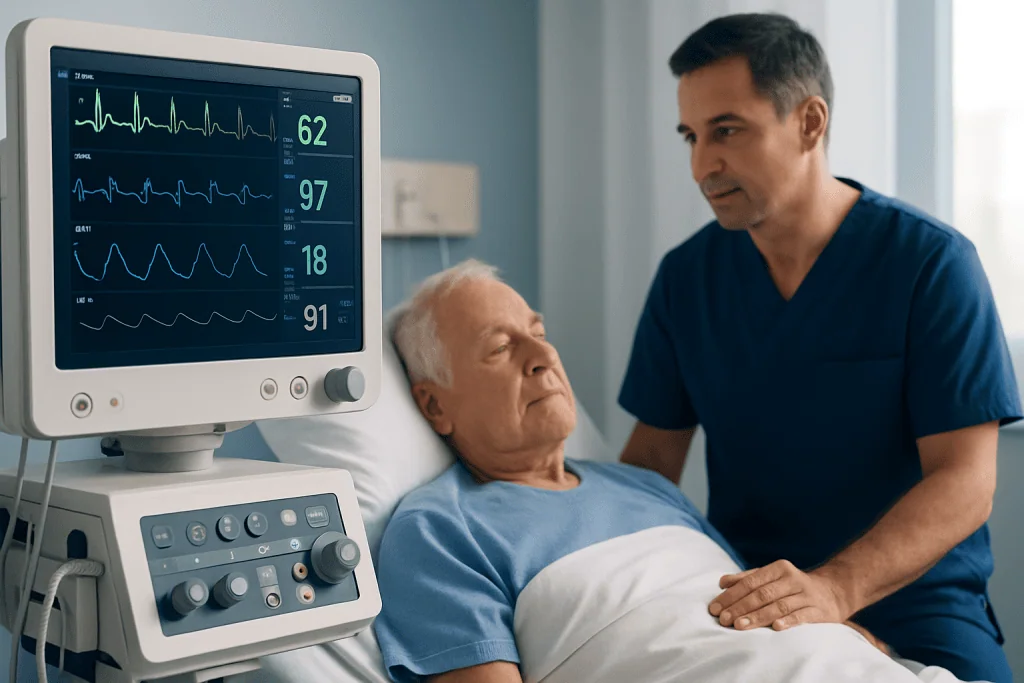
Preparation matters more for an older patient than for a younger one, because small gaps: a missing hearing aid battery, a medication left in checked baggage, an unreadable discharge letter from a previous hospital, create stress out of proportion to their size. Start with the medical file: recent test results, imaging files, discharge summaries, the current medication list with generic names and doses, allergy information, and contact details for the patient’s doctors at home. Keep printed copies and digital copies in your hand luggage, never only in checked baggage. A simple system for this is described in how to keep your medical records organised during treatment in Turkey.
Then review everyday needs as carefully as medical ones. Glasses and a spare pair if available. Hearing aids with batteries or charger. Dentures and cleaning supplies. The patient’s usual walking stick or frame, familiar equipment reduces fall risk more reliably than borrowed equipment. Compression stockings if they have been prescribed. Continence supplies if used, because sourcing an unfamiliar brand abroad adds needless hassle. Comfortable, well-fitting shoes with closed backs. Chargers with a plug adapter for Turkish sockets (type F, the standard two-pin European plug).
Two conversations belong in this stage. First, ask the patient’s doctor at home whether the trip requires any special precautions given their heart, lung, kidney or diabetes history, and whether they are fit to fly. Second, tell the hospital coordination team in advance about memory problems, anxiety, limited mobility, hearing loss or a history of falls. Teams can plan around these needs, but only if they know before arrival rather than on the ward.
Medication deserves its own plan. Bring enough for the full trip plus a buffer of extra days in case dates shift, keep medicines in original packaging, and carry the written list everywhere. If the journey crosses time zones, do not guess how to shift doses, ask the prescribing doctor, and read how to keep regular medicines on schedule during medical travel for the practical mechanics.
Travel, arrival and mobility planning

The journey itself is often the hardest day of the whole trip for an older patient, even on a short flight. Build in extra time at every stage: leaving home, check-in, security, passport control, baggage collection and the transfer to the hotel or hospital. Rushing raises fatigue, and fatigue in older patients often shows up as confusion, irritability or unsteadiness. Choose the slower, simpler option at every fork.
Request wheelchair assistance from the airline when you book, not at the airport, and confirm it again 48 hours before departure: this is a free service on virtually all airlines, but it needs notice. On the flight, an aisle seat makes toilet trips and gentle movement easier. Encourage water rather than coffee or alcohol, and follow whatever movement advice the patient’s own doctor gave for the flight. Keep medications, medical documents, a change of clothes, permitted snacks and essential devices in cabin luggage.
Foreigners can absolutely be treated in Turkish hospitals: Turkey has a large, well-established international patient sector, and hospitals with international departments handle admissions, interpreting and paperwork for overseas patients routinely. Many nationalities can enter Turkey visa-free or with an e-visa; check the current requirements for your passport well before booking, and confirm both passports are valid for the length required.
Acibadem can usually coordinate airport transfers and arrival guidance, depending on your care plan. On arrival, find the international patient desk, save the coordinator’s number in your phone, and ask for the day’s instructions in writing, after a long journey, nobody’s memory is reliable, and there is no prize for pretending otherwise. If your stay includes moving around the city between appointments, plan routes that suit limited mobility, for most older patients, a door-to-door taxi or hospital transfer beats public transport, especially in the first days after treatment.
Communication with doctors, nurses and interpreters
Clear communication is the single most valuable thing you provide. Before each appointment, write down the patient’s current symptoms, concerns, medications and questions. During the consultation, listen for five things: the plan, the next step, the warning signs to report, any restrictions on eating, movement or bathing, and when you will see the team again. Write the answers down in the room, not afterwards.
If the patient does not share a language with the care team, ask for professional interpreter support rather than translating yourself. This matters most for consent discussions, risks, medication instructions and discharge planning, moments where a family member’s love is no substitute for precise vocabulary, and where relatives sometimes soften bad news without meaning to. Even if your own English or Turkish is strong, an interpreter frees you to be the son, daughter or spouse in the room instead of the translator.
Useful questions that experienced companions ask early: What should we expect today? Which symptoms should we report immediately, and to whom? Can the patient eat or drink before the next test? Have any medications changed, and is that written down? When will we receive written discharge instructions, and in which language? Asking early is not rude: it helps the team help you.
Comfort, dignity and emotional reassurance
Older patients often feel most vulnerable not during procedures but in the quiet hours between them, far from home, in a room that smells and sounds unfamiliar. Routine is the antidote. Morning hygiene at the usual time. Familiar music or radio. A short walk if the team has approved it. A daily call home at a fixed hour. Meals that respect their preferences and any dietary restrictions, tell the care team about allergies and special diets before the first hospital meal, not after.
Dignity is protected in small acts. Ask permission before discussing personal matters in front of staff or other visitors. Help the patient dress properly for appointments rather than defaulting to pyjamas. Direct questions to the patient first, not about them. If you need a private word with the medical team, tell the patient why, so they never feel that decisions are happening behind their back.
Manage the family channel deliberately. Too many messages exhaust the patient; silence makes relatives anxious and generates a stream of incoming calls. One calm, factual update per day to a single family group works well. Report what the medical team has actually said, and resist speculation, half-confirmed news travels fast and is hard to retract.
Hospital stay and discharge planning
During an inpatient stay, your job is to observe, record and relay. Keep a small notebook or phone note with medication changes, doctor visits, test times, pain levels, appetite, sleep, walking ability and anything the patient mentions in passing, older patients often understate symptoms to avoid being a bother. Note changes with the date and time; a written pattern is far more useful to a doctor than “she seemed worse yesterday”. A structured approach is described in how to keep a daily recovery log during treatment in Turkey. If something seems wrong on the ward, tell the nurse straight away rather than waiting for the next scheduled round.
If you are staying alongside the patient for several days, plan for your own comfort toostaying comfortable during a multi-day hospital stay in Turkey covers what companions typically need.
Discharge is the moment errors happen, because everyone is relieved and in a hurry. Slow it down. Before leaving, get written instructions in a language you understand, and confirm: wound care if relevant, each medication’s name, dose and timing, diet guidance, mobility and bathing limits, follow-up appointment dates, the fit-to-fly assessment, and exactly whom to contact with questions, and separately, which symptoms bypass all of that and go straight to emergency services. If the patient will spend recovery days in a hotel before flying, ask specifically what is safe: stairs, showering, walking distance, sitting in a car. Your goal is to leave with a clear plan, not just a folder of papers.
Warning signs that need urgent action
This section matters more than any other. Older patients can deteriorate quickly, and abroad the instinct to “wait and message the coordinator” is dangerous. Learn the difference between a question and an emergency before you need it.
If the patient develops sudden confusion or unusual drowsiness, chest pain or pressure, new or worsening difficulty breathing, signs of stroke such as face drooping, arm weakness or slurred speech, heavy bleeding, a fall with a head injury, or a fever with shaking and rapid decline, call your local emergency number or go to the nearest emergency department now. In Turkey, the emergency number for an ambulance is 112. Do this first. Do not wait for a reply from a coordinator, a WhatsApp message, or an opinion from anyone, emergency care is always the first step, and updates to the treating hospital come afterwards.
Sudden confusion deserves particular emphasis, because families often dismiss it as jet lag or stress. In older people, new confusion (delirium) can signal infection, dehydration, medication effects or another acute problem, and it is not something to observe overnight. If it appears suddenly, treat it as urgent as described above; if the patient is already on the ward, alert the nursing staff immediately. For a fuller picture of preparing for the unexpected, read complications during treatment abroad: how international patients in Turkey can prepareafter the emergency route is understood, not instead of it.
Taking care of yourself as the companion
Supporting an elderly patient during treatment in Turkey is demanding work, and companions routinely run themselves down while watching someone else’s health. Yet your usefulness depends directly on sleep, meals, water and short breaks. An exhausted companion mishears instructions, snaps during stressful moments and misses the small changes that matter.
Build minimal self-care into every day: your own medications and documents, comfortable shoes, real meals rather than vending-machine snacks, and at least one short walk outside the hospital. If a relative at home can take over the family updates, flight changes or paperwork remotely, delegate it, carrying every role alone is a choice, not a requirement.
Anxiety is normal when an older loved one is being treated abroad. When worry rises, separate what is known from what is uncertain, and bring the medical questions back to the care team rather than to a search engine at 2 a.m. A good companion is not fearless. A good companion is rested, organised and willing to ask for help.
Step by step
- Confirm the care plan and travel timing. Before booking flights, confirm appointment dates, expected length of stay and whether the patient should arrive early for tests. Ask the treating team and the doctor at home whether the patient’s condition affects flying.
- Build the medical and personal file. Reports, imaging, prescriptions, allergies and emergency contacts, printed and digital, carried in hand luggage. Share copies with the coordination team when asked.
- Arrange mobility and arrival support. Book airline wheelchair assistance in advance and reconfirm before departure. Agree transfer and arrival instructions so the first day in Turkey is predictable.
- Set up communication. Confirm interpreter availability, identify your main hospital contact, and keep a running list of questions for each appointment. Ask for written answers whenever the topic is complex.
- Create a daily routine. Regular meals, rest, hygiene, approved movement and one fixed update to family. Familiar rhythm is the cheapest anxiety treatment available.
- Learn the urgent-versus-routine line. Know which symptoms mean calling 112 or going straight to an emergency department, and which can wait for the coordinator or the next appointment. Ask the team to spell this out at discharge.
- Review discharge instructions slowly. Medications, restrictions, warning signs, follow-up dates and fit-to-fly confirmation, all in writing, all understood before you leave the building.
- Plan the return home. Confirm when the patient is medically fit to travel, keep discharge reports and medication changes accessible during the journey, and book the home doctor’s follow-up before you land.
Your checklist
- Passports, visas or e-visas if required, and appointment confirmations
- Printed and digital medical records, imaging and test results in hand luggage
- Medication list with generic names, doses, timing and allergies
- Enough medication for the trip plus extra days, in original packaging
- Glasses, hearing aids with batteries, dentures, walking aid, comfortable shoes
- Airline wheelchair assistance booked and reconfirmed
- Hospital contact numbers and international patient coordinator details saved in your phone
- Interpreter arrangements confirmed for consultations and discharge
- Insurance or payment documents, if applicable
- A notebook for questions, symptoms, medication changes and daily notes
- The Turkish emergency number, 112, written where you can find it fast
- Return-home plan including fit-to-fly confirmation and follow-up needs
Key takeaways
- Your role is calm, organised, practical support, not replacing the medical team.
- Preparation carries extra weight for elderly patients: mobility aids, medication continuity and familiar routines shape the whole trip.
- Professional interpreters and written instructions prevent the misunderstandings that matter most: consent, medication and discharge.
- Sudden confusion, chest pain, breathing difficulty, stroke signs or heavy bleeding are emergencies, local emergency services first, every time.
- Discharge planning should cover medications, restrictions, warning signs, follow-up and travel readiness, all in writing.
- Your own rest is not a luxury; it is the condition for doing this job safely.
Frequently asked questions
How can I be a good caregiver for an elderly patient abroad?
Focus on four things: organisation (documents, medications, notes from every appointment), observation (write down changes in pain, appetite, walking and mood with dates), communication (ask questions early and get answers in writing), and dignity (include the patient in conversations and decisions). You do not need medical training. You need to be rested, present and willing to ask, and to know which symptoms mean emergency services rather than a question for the coordinator.
Can foreigners go to hospital in Turkey?
Yes. Turkey treats large numbers of international patients, and hospitals with international departments handle admissions, interpreting and paperwork for overseas visitors as a routine part of their work. Emergency departments treat anyone who arrives, regardless of nationality. For planned treatment, contact the hospital’s international patient services in advance so appointments, records and interpreter support are arranged before you travel.
Which country has the best elderly care system?
There is no honest single answer, rankings vary depending on whether they measure long-term care, hospital treatment, home support or funding models, and they change over time. For a family planning treatment abroad, the more useful question is whether the specific hospital can meet this specific patient’s needs: interpreter support, mobility assistance, companion access and clear discharge planning. Ask those questions directly rather than relying on country-level rankings.
Can I stay with my elderly relative during hospital appointments in Turkey?
In many situations, yes: a companion can attend consultations to help the patient communicate and remember what was said. Policies vary by department, room type, infection-control rules and the patient’s clinical condition, so ask the international patient team in advance what is possible during consultations, tests and inpatient stays rather than assuming.
What should I do if my parent or spouse becomes confused during the trip?
If confusion appears suddenly or comes with fever, breathing difficulty, chest pain or a recent fall, call your local emergency number or go to the nearest emergency department now, in Turkey, dial 112. Sudden confusion in older people can signal infection, dehydration or medication problems and should never be watched overnight. If the patient is already on the ward, alert the nursing staff immediately. For milder, gradual disorientation, keep the environment calm, ensure glasses and hearing aids are in use, and report it to the care team the same day.
Should I translate for the patient myself?
Help with everyday comfort and preferences, but leave medical interpretation to trained interpreters when available, especially for consent, risks, medication instructions and discharge. Family members often unintentionally soften or summarise, and precision matters most at exactly those moments. Ask the international patient team about interpreter arrangements before appointments.
How can I manage medications safely while abroad?
Bring enough for the full trip plus spare days, keep medicines in original packaging, and carry a written list with generic names, doses and timing. Show that list to the treating team at the first appointment. Any change, stopping, starting, adjusting timing across time zones, is a decision for the treating doctor or the prescriber at home, not something to work out yourselves.
How long should we stay in Turkey after treatment?
It depends on the patient’s condition, the treatment, recovery progress and the treating doctor’s assessment of fitness to fly. Do not set the return date around flight prices or family schedules. Before booking or changing flights, ask the treating team when travel is medically appropriate and whether any follow-up visits are needed before departure.
Add us as a Preferred Source to see more of our trusted health content across Google Search, AI Overviews and Discover.

Update history
- PublishedJune 9, 2026
- Medical review approvedSeptember 13, 2026
- Last content updateSeptember 12, 2026
References3
- Confusion (sudden): NHS nhs.uk
- Senior Citizen Travelers: CDC Travelers' Health wwwnc.cdc.gov
- Caregivers: MedlinePlus medlineplus.gov
More Patient Guides
Medical Travel with a Companion: Who Should Come and Why
Medical travel with a companion can make treatment in Turkey easier by providing practical help, communication support and reassurance before and after…

How Family Members Can Help Without Disrupting Recovery
Family support during recovery helps when you listen, organize practical tasks and follow the care plan without taking over, in Turkey or…

Need a Family Member to Travel With You? A Companion Decision Guide
A companion travel guide for treatment in Turkey: decide who should travel with you, plan practical support, and prepare for Istanbul care.

Unexpected Overnight Stay in Turkey: What Patients and Companions Should Be Ready For
Unexpected overnight stay in Turkey? Here is what patients and companions should prepare for, from essentials and updates to hospital logistics in…