

Using Credit or Debit Cards for Hospital Bills in Turkey

Yes, you can normally pay hospital bills in Turkey with an international Visa or Mastercard credit or debit card at large private hospitals. The most common problems come from your own bank, not the hospital: transaction limits, fraud blocks and security codes. Tell your bank before you travel, confirm your limits, carry a backup card, and keep every receipt for insurance or your own records.
You are standing at a hospital cashier desk in another country, about to approve the largest transaction your card has seen in years. Will it go through? That worry is common. It is also, in most cases, avoidable.
Using credit or debit cards for hospital bills in Turkey is normally straightforward at large private hospitals. What separates a smooth payment from a stressful one is preparation: telling your bank you are travelling, understanding how currency conversion works, knowing your card limits, and keeping a clean paper trail from quote to final receipt.
This guide walks you through what to expect before, during and after payment. It also answers the questions patients actually search for: whether your debit card carries fees in Turkey, whether tourists get free healthcare, and whether card or cash is the better choice. The goal is simple, keep the money side quiet so you can concentrate on your care.
At a glance
- Card types: International Visa and Mastercard are widely accepted at large private hospitals; other networks vary
- Most common problem: A block from your own bank, not a refusal by the hospital
- Best preparation: Notify your bank, confirm limits, and make sure you can receive security codes abroad
- Main cost variables: Your card issuer’s exchange rate and any foreign transaction fee, set by your bank, not the hospital
- Keep every document: Written quote, card slip, hospital receipt, invoice and insurance paperwork
- Support: International patient teams can direct you to billing desks and help with interpretation
What to Expect When Paying by Card in Turkey
Paying by card is a familiar option for international patients at large private hospitals in Turkey, including Acibadem hospitals. These institutions run structured cashier and billing departments that process international cards through standard chip-and-PIN or contactless terminals and issue formal receipts. In practical terms, the hospital side of the transaction usually works the way it would at home.
The variables sit on your side. Whether a payment succeeds depends on your bank, your available limit, your card’s security settings and the currency conversion your issuer applies. A hospital payment is often larger than anything else on your statement, made in a foreign country, in a merchant category your bank rarely sees from you. That combination is exactly what fraud-detection systems are built to flag.
So treat your card as part of your medical travel plan. Just as you arrange flights, accommodation and medical documents, confirm before departure how you will pay deposits, final balances, pharmacy items and any extras. A few checks at home can prevent an urgent call to your bank from a cashier desk. Using credit or debit cards for hospital bills in Turkey works best when the surprises have been removed in advance.
Keep payments simple and traceable. Ask for a written estimate before you travel where possible, keep billing conversations in one email thread, and save every receipt. If your treatment plan changes after consultation or tests, ask the international patient team how that affects payment timing and documentation. For the wider picture, including bank transfers, see our guide to paying medical bills in Turkey: cards, bank transfers, and receipts.
Card Acceptance, Limits and Bank Authorisation
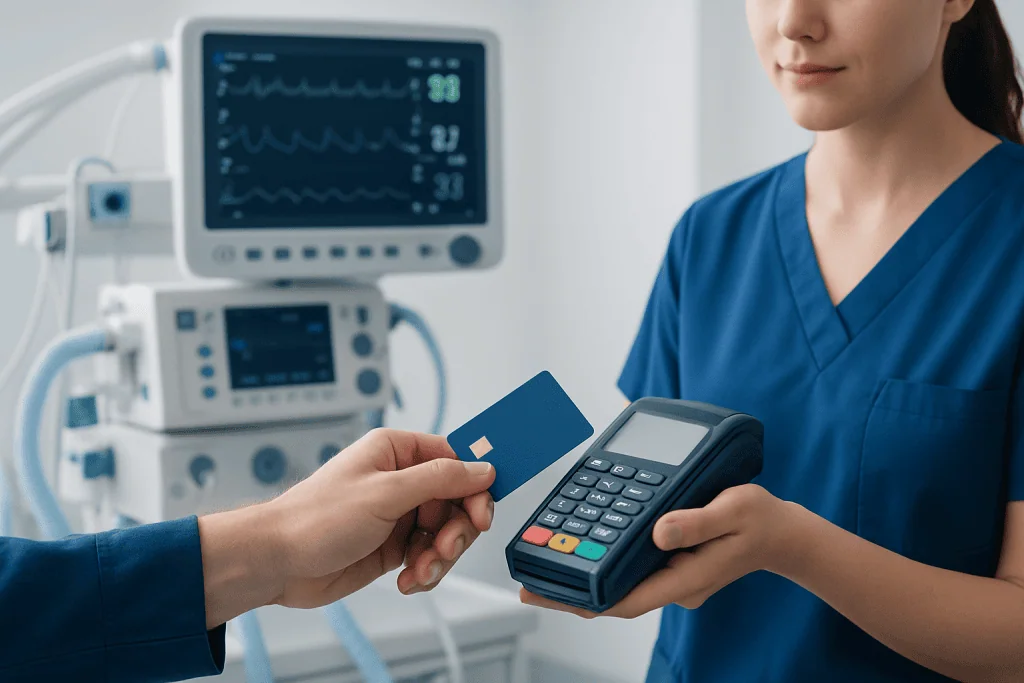
International Visa and Mastercard credit and debit cards are the networks travellers use most in Turkey, and large hospital cashier desks handle them routinely. Other networks may or may not be supported, depending on the bank behind the terminal. If you rely on a less common card, confirm options with your hospital coordinator in advance and bring a backup card from a different provider.
The most common failure is not refusal by the hospital but a temporary block by your own bank. Before leaving home, call your bank or use its secure in-app chat and confirm:
- Your daily and single-transaction limits, for each card you plan to bring
- Whether international in-person transactions are enabled on the card
- Whether online payments or secure payment links are permitted, in case you need them
- How to approve a high-value transaction while abroad, some banks need an in-app confirmation, others send a code
- Whether you need roaming or an eSIM to receive one-time passwords sent to your home number
That last point trips up more patients than any other. If your bank verifies large payments by SMS to your home-country number and your phone cannot receive that message in Turkey, the payment fails even though everything else is in order. Sort out connectivity before you fly: our guide to mobile internet and SIM cards in Turkey explains the options, including keeping your home number active for security codes.
If you expect to pay a larger balance, ask your bank whether it can temporarily raise your limit for your travel dates. Note the request in writing where possible, and check that your mobile banking app works abroad; some banks restrict app access from foreign networks unless you enable it first.
Currency, Exchange Rates and Card Fees

Hospital billing in Turkey runs through formal accounting systems. Depending on the institution, the service and any international patient arrangement, the amount may be shown in Turkish lira or another agreed currency. When you pay by card, your issuer converts the transaction into your home currency using its own exchange rate, and may add a foreign transaction fee on top. The figure on your bank statement can therefore differ slightly from the figure on the hospital receipt.
It helps to separate two things clearly. The hospital controls what it charges and can document that amount in full. It does not control, and cannot see, your bank’s exchange rate, its foreign transaction fee, or its cash advance rules. Those are set entirely by your card issuer, and they answer the common search question “do I get charged for using my debit card in Turkey?” honestly: it depends on your card’s terms, not on Turkey. Some debit cards charge nothing extra abroad; others apply a conversion margin, a per-transaction fee, or both. Check your card’s terms before you travel, because it is the one cost variable you can research precisely in advance.
Watch for dynamic currency conversion at the terminal. If the payment screen offers a choice between Turkish lira and your home currency, pause before choosing. Paying in your home currency looks reassuring, but the exchange rate applied at the terminal is often less favourable than the one your own bank would use. Many travellers choose to pay in lira and let their issuer convert, though the right answer depends on your specific card. There is no rush: you are entitled to a moment to decide.
For budget planning, keep a modest buffer beyond the quoted amount. Not because hidden charges are expected, but because exchange-rate movement, prescribed medications, extra nights, additional consultations or companion services can change the total you actually pay during your stay. If you want to understand what appears on a Turkish medical invoice line by line, see our guide to taxes and service charges on medical bills in Turkey.
Card or Cash: Which Is Better for Hospital Payments?
For hospital bills specifically, card is usually the more practical choice. It creates an automatic record on your statement, it removes the risk of carrying large sums through airports and hotels, and it matches how hospital cashier systems are designed to work. Bank transfer is the other structured option for larger balances, covered in our guide to cards, bank transfer and currency tips.
Cash still has a role, but a small one. A limited amount of Turkish lira is useful for taxis, pharmacies, cafés and small personal expenses, where card acceptance is broad but not universal. What cash should not be is your plan for the hospital bill itself. Carrying enough cash to cover a significant medical payment exposes you to loss and theft, complicates record-keeping, and may run into declaration rules when you travel. If anyone urges you to pay a large medical bill only in cash, treat that as a reason to ask more questions, not fewer, formal hospitals issue formal receipts regardless of payment method.
The sensible split for most patients: cards (plus a backup card) for the hospital, a small cash float for daily life, and no large cash sums at all.
Do Tourists Get Free Healthcare in Turkey?
No. Visitors to Turkey are not covered by the Turkish public health system and should expect to pay for treatment, whether at a public or private facility. Emergency departments will assess and treat you in an emergency, but treatment is not free for tourists, and you or your insurer will be billed. This is why travel insurance with medical cover, or a confirmed arrangement with your international health insurer, matters so much for any trip, and doubly so for a planned medical trip.
If you hold international cover, check before travel whether your insurer works with your chosen hospital directly, whether it issues a guarantee of payment, or whether you pay by card and claim reimbursement afterwards. Each route has different paperwork. Our guide to using international insurance for treatment in Turkey explains how guarantee letters, pre-authorisation and reimbursement claims typically work.
If you become unwell in Turkey outside a planned treatment, contact your hotel, your hospital coordinator or your insurer’s assistance line for guidance on where to be seen. For anything serious or time-critical, call your local emergency number or go to the nearest emergency department now. In Turkey, the national emergency number is 112.
Deposits, Final Bills and Payment Timing
Payment timing depends on your treatment pathway. Some services require a deposit before scheduling; others are paid after consultation, after diagnostic tests, before admission or at discharge. Your international patient coordinator can explain the expected stages for your plan, but the final bill can only be confirmed once your doctor has reviewed your case in person and your actual care plan is settled.
Treat any pre-arrival quote as exactly that: an estimate built on the information available at the time. After examination, laboratory work, imaging or specialist review, your plan may change, and the bill with it. It is entirely reasonable to ask for an updated estimate before approving additional services whenever the situation allows. A good billing team expects that question.
At Acibadem International, patient support is built around these practical steps. Your coordinator can direct you to the right billing desk, arrange interpretation for financial discussions, and clarify which documents are available after payment. That support matters most when a family member is paying on your behalf, or when your insurer requires specific paperwork in a specific format.
Receipts, Invoices and Insurance Documentation
Keep a complete payment trail. For card payments, that means the card slip, the hospital receipt, and the official invoice or statement of services where available. If you intend to claim reimbursement from an insurer or employer, ask them in advance exactly which documents they require, rules differ between companies and countries, and it is far easier to gather paperwork while you are still in Turkey than to chase it from home.
Insurers commonly request diagnosis codes, treatment descriptions, doctor reports, itemised invoices, proof of payment and discharge summaries. The hospital can provide medical and financial documents according to its policies and applicable privacy rules, but some take time to prepare. Request them early, ideally before discharge.
Use a simple folder system, digital or physical. Keep your quote, appointment confirmations, passport copy, insurance guarantee letter if you have one, receipts, invoices, prescriptions and discharge documents together. If you use more than one card, note which card paid which part of the bill, so your records reconcile against your bank statements later without guesswork.
Security at the Cashier Desk
Card payment through official hospital cashier channels is a generally secure method. Protect yourself with a few habits. Never send full card details by email or messaging apps unless the hospital has provided a verified secure payment method. If you receive a payment link, confirm it came from your official coordinator or the hospital’s authorised billing department before entering anything.
At the desk itself, check the amount and currency on the terminal before entering your PIN or tapping to approve. If anything is unclear, pause and ask for an English explanation or interpreter support, payment conversations are calmer when both sides understand the figures, and international patient teams can help bridge the language gap.
Bring more than one way to pay. A second card from a different bank, plus a small amount of cash for personal expenses, takes the pressure off if your main card is temporarily blocked. Keep cards and passport secure throughout your stay, and pack your backup card separately from your main one.
If a Card Payment Is Declined
A decline does not mean something is wrong with your account. Common causes are a daily limit, fraud protection, insufficient available balance or credit, a missed security code, an inactive international setting, or a plain network glitch. Stay calm and ask the cashier whether the transaction can be retried after you speak to your bank.
Call the number on the back of your card or use your banking app’s secure support channel. Tell your bank you are in Turkey, give the approximate amount, the hospital name, and whether the payment was chip-and-PIN, contactless, online or via a payment link. Ask them to confirm when the card is ready to try again, and get that confirmation before you return to the desk.
If the payment still cannot go through, talk to your international patient coordinator about alternatives. Depending on hospital policy, options may include splitting the amount across cards, a bank transfer, an insurer guarantee arrangement, or another authorised payer. Do not assume every alternative is available in every situation; ask early so the team can point you to the correct process rather than improvising at discharge.
Step by step
- Request a written estimate before travel. Ask for a quote based on your current medical information, and understand it may be updated after in-person examination, tests or specialist review.
- Contact your bank before departure. Give your travel dates, destination and the fact that you expect to make a hospital payment. Confirm international card use, limits, security approvals and any foreign transaction fees on each card.
- Prepare backup payment options. Bring at least one additional card, ideally from a different bank or network, packed separately. Keep enough headroom in balance or credit limit for deposits, the final bill and small extras.
- Make sure security codes reach you in Turkey. Enable roaming or arrange an eSIM so one-time passwords and in-app approvals work abroad: this is the single most common point of failure.
- Confirm payment timing with your coordinator. Ask when deposits, admission payments or discharge payments are expected, and who to contact at the billing desk.
- Review the amount before approving. Check the amount and currency on the terminal, and if offered a currency choice, decide deliberately rather than by default. Pause and ask if anything is unclear.
- Collect and store all documents. Keep the card slip, hospital receipt, invoice and any itemised statement. Photograph or scan everything as a backup for insurance, tax or personal records.
- Check your bank statement after payment. Review the posted amount, exchange rate and any fees once the payment settles. If you spot a duplicate or unclear charge, contact both your bank and the hospital billing office with your receipt details.
Your checklist
- Written quote or estimate saved on your phone
- Bank notified about travel to Turkey and an expected medical payment
- Daily and single-transaction limits confirmed for every card you carry
- Mobile banking app tested and working, security notifications enabled
- Roaming or eSIM arranged so one-time passwords arrive in Turkey
- Backup card packed separately from your main card
- Small amount of Turkish lira planned for daily expenses, not the hospital bill
- Insurance reimbursement requirements checked before travel
- Receipts, invoices and card slips stored and photographed
- Coordinator and billing contact details saved
- Modest budget buffer planned for exchange-rate movement or extra services
Key takeaways
- Using credit or debit cards for hospital bills in Turkey is common practice at large private hospitals; your own bank’s limits and security rules are usually the deciding factor, not the hospital.
- Debit card fees abroad depend on your card’s terms, not on Turkey, check them before you travel.
- Tourists are not covered by Turkish public healthcare and should expect to pay, which makes insurance and payment planning essential.
- Exchange rates and foreign transaction fees are set by your card issuer; if offered a currency choice at the terminal, decide deliberately.
- Always clarify whether an amount is an estimate, a deposit or a final balance, and keep every receipt, invoice and slip, especially for reimbursement claims.
- International patient teams can guide you through billing desks, interpretation and document requests, but they cannot control your bank’s approvals or fees.
Frequently asked questions
Do I get charged for using my debit card in Turkey?
It depends entirely on your card’s terms, not on Turkey. Some debit cards apply no extra charges abroad; others add a currency conversion margin, a per-transaction foreign fee, or both. The hospital does not set or receive these fees. Check your card’s fee schedule before travel, and be cautious with the terminal’s offer to charge you in your home currency, as that rate is often less favourable than your own bank’s.
Do tourists get free healthcare in Turkey?
No. Visitors are not covered by the Turkish public health system and should expect to pay for treatment at public or private facilities. Emergency departments will treat you in an emergency, but the care is billed. Travel insurance with medical cover, or a confirmed arrangement with an international health insurer, is strongly advisable for any visit and essential for a planned medical trip.
Is it better to use a debit card or cash in Turkey?
For hospital bills, card is usually the better choice: it creates an automatic record, avoids carrying large sums, and matches how hospital cashier systems work. Cash is useful only as a small float for taxis, pharmacies and daily expenses. Avoid carrying enough cash to cover a medical bill: it adds risk without adding any benefit.
Can I pay hospital bills in Turkey with an international credit card?
At large private hospitals, international Visa and Mastercard credit cards are commonly accepted through standard cashier terminals. Acceptance can still depend on the card network, your bank’s rules and the transaction size. Confirm payment options with your hospital coordinator before travel, and make sure your bank has enabled high-value overseas payments on the card.
Will I be charged in Turkish lira or my home currency?
The billed amount may be shown in Turkish lira or another agreed currency depending on the hospital and your international patient arrangement. Your card issuer then converts the payment into your home currency on your statement. If the terminal offers you a currency choice, review it carefully, paying in lira and letting your own bank convert is often the better option, but check your card’s terms.
What should I do if my card is declined at the hospital?
Do not panic, declines are usually caused by limits, fraud protection or a missed security code, not a problem with your account. Call the number on the back of your card or use your banking app, explain you are making a hospital payment in Turkey, and ask when the card can be retried. Then speak with the billing desk or your coordinator about retrying or using an approved alternative such as a second card or bank transfer.
Can a family member pay the bill with their card?
Often yes, but the hospital may need to follow identification, consent and billing procedures, and the cardholder should usually be present or available to authorise the payment. Tell your coordinator in advance if someone else will be paying, so the correct process can be explained before the cashier desk rather than at it.
Does Acibadem International help with payment questions?
Acibadem International patient services can direct you to the relevant billing desk, arrange interpretation for financial discussions, and explain which documents are available for your records or insurance claim. They cannot control your bank’s approvals, exchange rate or foreign transaction fees: those must be checked directly with your card provider before you travel.
Add us as a Preferred Source to see more of our trusted health content across Google Search, AI Overviews and Discover.

Update history
- PublishedJune 9, 2026
- Medical review approvedAugust 30, 2026
- Last content updateAugust 30, 2026
References1
More Patient Guides

Private MRI, CT and Check-Up Costs in Turkey: How Scans Are Priced
How private MRI, CT, PET-CT and full check-up packages are priced in Turkey, modality, region, contrast, reporting, and what a…

Cataract Surgery Cost in Turkey: Per-Eye Prices and Lens Options
Cataract surgery in Turkey is priced per eye and the lens decides the quote. Biometry, both eyes on one trip, and what…

Lip Filler Cost in Turkey: Per-ml Prices Explained
Lip filler in Turkey is priced per millilitre with licensed hyaluronic acid brands and physician injectors. Volume, product, dissolving, safety and what…
Botox Cost in Turkey: Per-Area and Per-Unit Prices
How Botox is priced in Turkey, per area or per unit, brand, physician injectors, medical indications, and what a serious…