

Paying Medical Bills in Turkey: Cards, Bank Transfers, and Receipts

Most international patients settle hospital bills in Turkey by credit or debit card, by international bank transfer, or through a third party such as an insurer or sponsor. Deposits are often requested before planned procedures, the balance is settled before discharge, and official receipts and itemised invoices are available on request. Confirm accepted methods, billing currency, and payment deadlines before you travel.
Will your card work at the cashier desk? How early does a deposit need to leave your bank? These are the questions that tend to surface a week before the flight, once the treatment date is fixed and the practicalities become real.
This guide explains the practical side of paying medical bills in Turkey: which payment methods hospitals commonly accept, how deposits and final balances are usually timed, what an official receipt should show, and which documents to collect before you fly home. None of it is complicated, but the sequence matters, and knowing it in advance removes most of the stress.
At a glance
- Main payment methods: Credit or debit card and international bank transfer are the most commonly used options for larger bills
- Typical sequence: Written estimate, deposit for planned procedures, settlement of the balance before discharge
- Receipts: Official receipts are standard; itemised invoices are available on request for insurers and employers
- Best time to confirm details: Before travel, and again at admission
- Who handles it: The hospital billing or cashier desk, usually with support from international patient services
- What to prepare: Passport, treatment estimate, payer details, and proof of any transfer already sent
- Currency point: Ask which currency the bill is issued in and who carries bank or card fees
How paying medical bills in Turkey usually works
Private hospitals in Turkey handle payments through a billing or cashier desk, and international patients are normally guided by a dedicated coordinator who acts as the link between you, the clinical team, and the finance office. The sequence for paying medical bills in Turkey follows a fairly predictable shape: a written estimate before travel, a deposit if a procedure is planned, interim payments if the stay is long, and a final account settled before discharge.
How much of that sequence applies to you depends on the care itself. A same-day consultation or an imaging appointment is usually paid on the day, at the desk, before or immediately after the visit. Surgery or an inpatient stay involves more steps: a pre-arrival estimate, often a deposit to confirm the booking, and a final reconciliation once treatment is complete. If the plan changes during your stay, an extra test, a longer admission, the finance team issues a revised balance rather than surprising you at checkout.
The hospital’s international patient department is the place to ask who to pay, when payment is due, and which documents you will receive at each stage. If you want the deposit-and-balance sequence in more depth, the guide on deposits, balances, and billing questions walks through it step by step.
One structural point worth understanding early: hospitals quote against a treatment plan, not a fixed menu. The estimate reflects the procedure, the expected length of stay, the class of room, and the tests your doctor anticipates. That is why two patients having the same operation can receive different quotes, and why the honest answer to most cost questions is a written, personalised estimate rather than a number from a website.
Do tourists get free healthcare in Turkey?
No. Turkey’s public health insurance system covers people who are enrolled in it, residents, employees, and citizens, not visitors. As a tourist or a medical traveller, you are a private, self-paying patient unless an insurer, employer, or sponsor has agreed to cover you. Turkish state hospitals provide emergency stabilisation regardless of a patient’s ability to pay at the door, but treatment beyond that point, and essentially all care in private hospitals, is charged to the patient or their payer.
This is why travel insurance or a clear payment arrangement matters even for a short trip. Some bilateral healthcare agreements exist between Turkey and a handful of countries, but they are narrow, they generally apply to residents of those countries in specific circumstances, and they should never be assumed to cover planned treatment. If you are travelling specifically for treatment, the safe working assumption is simple: you or your named payer will settle the bill, and the hospital will tell you in writing how and when.
Using credit or debit cards
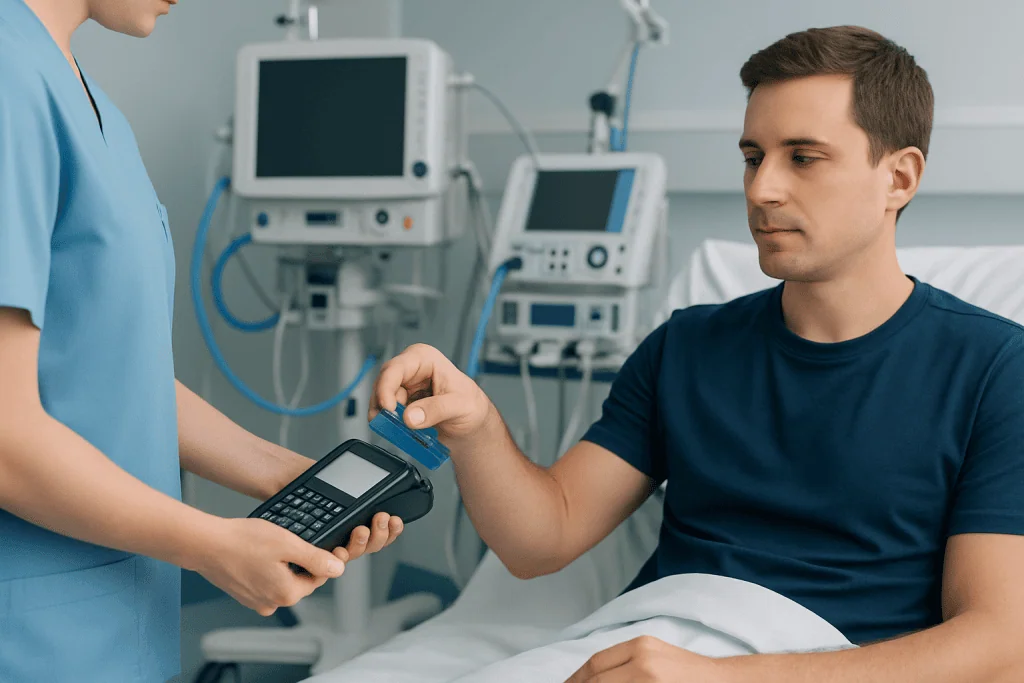
Card payment is the simplest route for most international patients: fast, traceable, and easy to reconcile against your own bank statement later. Major private hospitals commonly accept widely used credit and debit cards. It is still sensible to confirm accepted card types before you travel, particularly if you plan to use a business card, a prepaid card, or a card issued outside your home region, because acceptance rules vary and you do not want to discover a gap at the cashier desk.
Two things cause most card failures at hospital desks, and both are preventable. The first is a security block: a high-value transaction in a foreign country looks exactly like fraud to your bank’s automated systems, so tell your bank in advance that you will be making a medical payment in Turkey. The second is a daily limit: many debit cards carry a per-day ceiling well below the cost of a procedure, and raising it usually takes a phone call or an in-app change made before, not during, the payment.
Ask your bank about foreign transaction fees, the exchange rate applied to Turkish lira transactions, and whether large payments need in-app approval. At the desk, if the terminal offers to charge you in your home currency instead of lira, a practice called dynamic currency conversion, be aware that the conversion rate offered by the terminal is often less favourable than your own bank’s rate. Neither choice is wrong; you simply want to make it knowingly.
- Confirm accepted card brands with the hospital before arrival
- Notify your bank and check daily limits and international usage settings
- Ask whether the bill will be charged in Turkish lira or another currency
- Check in advance if you intend to split payment across two cards
- Keep every card slip alongside the hospital-issued receipt
If cards will carry most of your payment, the dedicated guide on using credit or debit cards for hospital bills in Turkey covers limits, blocks, and currency handling in more detail.
Card or cash?
For hospital bills, card or transfer beats cash on almost every measure: traceability, safety, and paperwork. Cash still has a place in Turkey for taxis, small shops, and tips, so carrying a modest amount for daily life makes sense. But carrying enough cash to settle a medical bill means travelling with a large sum, declaring it where customs rules require, and losing the automatic paper trail a card gives you. If you do pay any part of a bill in cash, insist on an official receipt at the moment of payment: the receipt is your only record.
Paying by bank transfer

Bank transfer is the usual route for deposits, scheduled procedures, and higher-value treatment plans, and it is often the only practical option when a sponsor or family member is paying from another country. Before sending anything, ask the hospital for its official payment details in writing: beneficiary name, bank and branch, IBAN, SWIFT/BIC code, and, critically, the payment reference you must include. The reference is what lets the finance team match your money to your patient file. A transfer without it can sit unallocated for days.
International transfers take time. Between correspondent banks, compliance checks, weekends, and public holidays in either country, a transfer can take several working days to clear. Do not leave a required deposit until the last minute. Ask two specific questions: by what date must cleared funds arrive, and is a transfer confirmation (the SWIFT copy or your bank’s receipt) enough to hold the booking while the money is in transit? Hospitals answer these questions routinely; you just need to ask them early.
Also clarify who carries the transfer charges. International payments typically offer three fee arrangements, sender pays all, charges shared, or receiver pays, and intermediary banks can deduct their own fees along the way. If fees are deducted in transit, the hospital receives less than you sent and a small balance remains on your account. Choosing the sender-pays option, where your bank offers it, avoids that gap. After sending, save the confirmation and pass it to your billing contact so admission runs smoothly. Verify account details through a channel you already trust before transferring; the practicalities of doing all this from abroad are covered in paying for treatment in Turkey from abroad.
Invoices, receipts, and the documents worth keeping
Receipts matter for insurance reimbursement, employer claims, embassy sponsorship files, tax questions in some countries, and your own records. After any payment, ask for an official receipt showing the hospital name, the date, the amount and currency, and the patient name or file number. If you need something more detailed, most insurers do, ask for an itemised invoice that breaks the account into its components: procedure, room, medicines, tests, consumables.
If someone else is paying on your behalf, tell the billing team before the invoice is issued. Depending on the insurer or sponsor, the document may need to name the patient, the payer, or both, and correcting an invoice after the fact is slower than issuing it correctly the first time. The same applies to name spellings: the invoice should match your passport exactly, because a mismatch can cause a reimbursement claim to be queried months later.
Keep a single folder, physical and digital, holding every estimate, deposit confirmation, receipt, itemised invoice, and the discharge account summary. Photograph paper documents as soon as you receive them and email the set to yourself or a trusted family member. The guide on medical invoices and receipts for international patients explains which documents are issued automatically and which you should request explicitly.
Taxes, service charges, and what can change the final bill
Turkish medical invoices can include tax and administrative components alongside the clinical charges, and it is reasonable to ask the billing team to point these out on your itemised invoice so you understand exactly what each line represents. The separate guide on taxes and service charges on medical bills in Turkey covers how these items typically appear.
Beyond taxes, the final amount can differ from the pre-travel estimate for ordinary clinical reasons. An estimate is built on the plan as it stands before your doctor examines you in person. Additional tests, medicines, consumables, an extra consultation, or a longer stay all change the account, not because anything went wrong, but because the plan adapted to what the examination found. The useful question to ask before you travel is therefore not only “how much?” but “what is included, and what is commonly billed separately?”
Your total out-of-pocket amount is also shaped by things the hospital does not control: your bank’s foreign transaction fees, the exchange rate on the day, intermediary transfer charges, and card scheme rates. A transfer may suit one patient better, a card another; the right choice depends on the amount, the timing, and your home bank’s rules. Before you settle the final balance, ask the billing team to explain any line item you do not recognise, hospitals used to international patients expect these questions and will walk you through how the account is closed before you leave.
If an insurer, employer, or family member is paying
Not every patient pays fully out of pocket. If a third party is involved, an insurer, an embassy, an employer, or a relative, clarify the payment pathway as early as possible. The key questions: can the hospital bill the payer directly, is a written guarantee of payment required, which services need pre-approval, and what happens to charges the payer declines? Do not assume a policy covers every element of the visit; consultations, diagnostics, and unplanned extensions of stay are the items most often excluded.
If you will pay first and claim reimbursement later, ask your insurer before travel what it requires: itemised invoices, proof of payment, doctor reports, discharge summaries, specific wording or coding. Collecting these documents while you are still in the hospital is far easier than requesting them by email from another continent afterwards.
If a relative or sponsor will pay remotely, tell the hospital in advance so it can confirm what identification or authorisation is needed for a payer who is not physically present. International patient departments coordinate this routinely. If an agency sits between you and the hospital, it is worth understanding who your money actually goes to: the guide on paying directly to the hospital vs through a medical agency sets out the differences.
Before admission and before discharge
A short financial check-in before admission prevents most day-of-treatment friction. Confirm the estimated balance, payment deadlines, accepted methods, and the name of the office handling international billing. Arriving in Istanbul after a long flight is not the moment to discover a blocked card or a missing transfer reference.
Before discharge, review your account while the billing team is still down the corridor. Check that your name matches your passport, that dates of service and amounts are correct, that every receipt has been issued, and ask specifically whether any pending charges could still appear after you leave: a final pharmacy reconciliation or a late-added laboratory result, for example. Five minutes of review at the desk saves weeks of email later.
Step by step
- Request a written estimate. Before you travel, get the treatment estimate in writing. Check what it includes, what may change after in-person assessment, and which items are commonly billed separately.
- Confirm your payment method. Decide between card, bank transfer, insurance, or a third-party payer, then confirm with the hospital which methods it accepts and what deadlines apply to deposits.
- Prepare your bank or card. Notify your bank of the upcoming payment, check daily limits and foreign transaction fees, or request full official bank details and send any transfer early enough to clear.
- Share proof of payment. After any transfer or advance payment, pass the confirmation to your hospital billing contact so the payment is matched to your file before you arrive.
- Review the bill before final payment. Read the account before discharge and query anything unfamiliar. Clarifying a line item at the desk is far easier than disputing it from home.
- Collect receipts and invoices. Request an official receipt for every payment and an itemised invoice if you need one for reimbursement. Check names, dates, currency, and amounts against your passport and records.
- Store everything. Keep printed and digital copies of estimates, receipts, invoices, and transfer confirmations in one folder, and email the set to yourself before you fly home.
Your checklist
- Written treatment estimate or quote
- Passport or ID used for hospital registration
- Credit/debit card prepared, or bank transfer confirmation
- Official hospital bank details and payment reference, verified in writing
- Name and contact details of your billing coordinator
- Insurance authorisation or sponsor letter, if applicable
- Official receipt for each payment made
- Itemised invoice if needed for reimbursement
- Record of currency, exchange rate, and bank fees
- Discharge billing summary reviewed before leaving the hospital
Key takeaways
- Card and bank transfer are the standard routes for paying medical bills in Turkey; cash is best kept for small daily expenses.
- Tourists are not covered by Turkish public health insurance, plan as a self-paying patient unless a payer is formally arranged.
- Confirm accepted payment methods, billing currency, and deposit deadlines before travel, and send transfers with the correct reference and time to clear.
- Request official receipts for every payment and an itemised invoice if an insurer or employer will reimburse you.
- Final bills can differ from estimates when tests, medicines, or the length of stay change, review the account before discharge, not after.
Frequently asked questions
Do tourists get free healthcare in Turkey?
No. Turkey’s public insurance covers people enrolled in it, not visitors. State hospitals provide emergency stabilisation regardless of ability to pay at the door, but care beyond that, and essentially all private hospital care, is charged to the patient or their insurer. Travel insurance or a confirmed payment arrangement is the sensible baseline for any trip.
Can I pay hospital bills in Turkey with a foreign credit card?
In most private hospitals, yes, widely used foreign credit and debit cards are commonly accepted. Confirm accepted card types in advance, notify your bank so the transaction is not blocked as suspected fraud, and check daily limits and foreign transaction fees before the payment date.
Is it better to use a debit card or cash in Turkey?
For hospital bills, card or bank transfer is better: safer to carry, fully traceable, and easier to document for reimbursement. Cash remains useful for taxis, small shops, and daily expenses. If you pay any part of a medical bill in cash, request the official receipt at the moment of payment.
Is bank transfer a normal way to pay for treatment in Turkey?
Yes, especially for deposits and planned procedures. Ask for the hospital’s official bank details in writing, include the payment reference exactly as given, choose a fee option so deductions do not leave a shortfall, and allow several working days for the transfer to clear.
Will I get a receipt after I pay?
Yes, expect an official receipt for every payment, and ask for an itemised invoice if you need one for an insurer, employer, or embassy. Mention any special documentation requirements before payment so the paperwork is issued correctly the first time, with names matching your passport.
Can my final bill be different from my original quote?
It can, if the treatment plan changes after in-person examination or if extra tests, medicines, supplies, or additional hospital days are needed. Ask before travel what the estimate includes and what is commonly billed separately, and review the itemised account before settling the final balance.
What if someone else is paying on my behalf?
Tell the hospital as early as possible. The billing team can confirm whether authorisation, identification, or a written guarantee of payment is needed, whether the payer must be present, and how the invoice should be issued, in the patient’s name, the payer’s, or both.
What should I do if I get sick while visiting Turkey?
Turkey has both state and private hospitals, and pharmacies are widespread in cities. As a visitor you are treated as a private patient, so travel insurance details and your passport are the documents to have to hand. Payment for any care follows the same pattern described in this guide: card or transfer, an official receipt, and an itemised invoice if your insurer will reimburse you.
Add us as a Preferred Source to see more of our trusted health content across Google Search, AI Overviews and Discover.

Update history
- PublishedAugust 6, 2026
- Medical review approvedSeptember 13, 2026
- Last content updateSeptember 12, 2026
References1
More Patient Guides

Private MRI, CT and Check-Up Costs in Turkey: How Scans Are Priced
How private MRI, CT, PET-CT and full check-up packages are priced in Turkey, modality, region, contrast, reporting, and what a…

Cataract Surgery Cost in Turkey: Per-Eye Prices and Lens Options
Cataract surgery in Turkey is priced per eye and the lens decides the quote. Biometry, both eyes on one trip, and what…

Lip Filler Cost in Turkey: Per-ml Prices Explained
Lip filler in Turkey is priced per millilitre with licensed hyaluronic acid brands and physician injectors. Volume, product, dissolving, safety and what…

Botox Cost in Turkey: Per-Area and Per-Unit Prices
How Botox is priced in Turkey, per area or per unit, brand, physician injectors, medical indications, and what a serious…