Bosu Ball Exercises: What Patients Need to Know
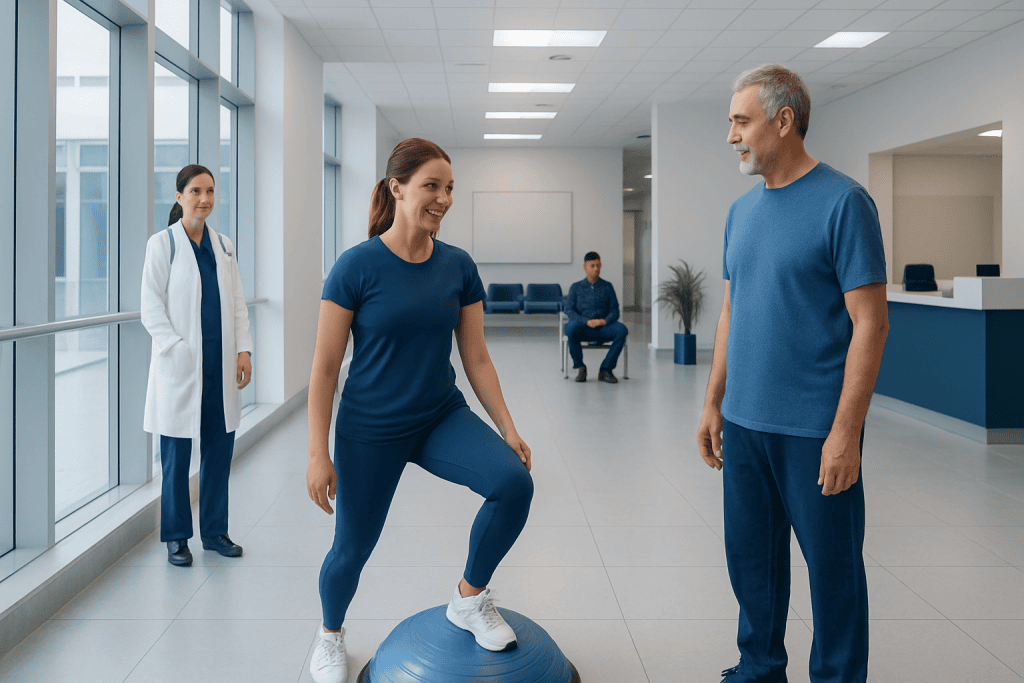
Bosu ball exercises mainly train balance, coordination, core control, and body awareness. They are not suitable for every person or every injury, especially if balance is limited or pain is active.
Key Takeaways
- Bosu ball exercises mainly train balance, coordination, core control, and body awareness.
- They are not suitable for every person or every injury, especially if balance is limited or pain is active.
- Starting with simple, supported movements is safer than advanced standing or jumping drills.
- Good technique, proper footwear, and a clear area help reduce the risk of falls and strain.
- People with recent injuries, dizziness, or chronic joint problems should ask a clinician before starting.
Bosu ball exercises are balance and stability activities performed on a half-dome training tool to challenge the muscles, joints, and nervous system in a controlled way. They can be useful for general fitness and some rehabilitation plans, but they are safest when chosen carefully and adapted to a person’s strength, balance, and medical history.
Overview: What Bosu Ball Exercises Are
Bosu ball exercises use a piece of equipment with a flat platform on one side and an inflated dome on the other. The unstable surface makes the body work harder to stay aligned, which can challenge balance, coordination, and core muscle control. For many people, this type of training adds variety to regular exercise and can support functional movement skills used in daily life.
In practical terms, bosu ball exercises may include standing balance drills, squats, lunges, step-ups, planks, and gentle core work. Some programs use the dome side up, while others use the flat side up to create a different level of instability. The best choice depends on a person’s experience, physical condition, and goals.
These exercises are not automatically better than floor-based training. Instead, they are one tool among many. A stable surface is often best for building basic strength, while a bosu ball may be useful later for improving balance, body awareness, and movement control once a solid foundation is in place.
Potential Benefits for Fitness and Daily Function

The main reason people try bosu ball exercises is to improve balance. Because the surface shifts slightly under the feet or hands, the ankles, hips, trunk, and nervous system must respond together. Over time, this can help with postural control and coordination, especially when the exercises are done regularly and with correct form.
Another benefit is core engagement. During many bosu ball movements, the abdominal and back muscles help stabilize the trunk while the arms or legs move. This does not mean every exercise needs to be highly unstable, but it can be a helpful way to train controlled movement rather than simply holding a rigid position.
Some people also use bosu ball exercises in rehabilitation or recovery programs. In the right setting, supervised balance training may support return to activity after selected ankle, knee, or general deconditioning problems. Rehabilitation should always be individualized, and some patients may benefit more from structured physical therapy and rehabilitation than from unsupervised home exercise.
Useful outcomes may include:
- Better balance and body awareness
- Improved coordination during standing and walking tasks
- Greater confidence with controlled movement
- Added variety in home or gym exercise routines
- A gradual way to challenge stability after basic strength has improved
Who May Benefit Most—and Who Should Be Cautious

Bosu ball exercises are often most appropriate for people who already have basic strength and can stand and move safely without major support. Recreational exercisers, athletes in later-stage training, and some older adults under guidance may benefit from carefully selected drills that target balance and controlled movement.
Caution is important for anyone with a recent injury, significant joint pain, poor balance, numbness in the feet, or a history of falls. The unstable surface can increase the difficulty quickly, and that may raise the chance of stepping awkwardly or losing control. People recovering from lower-limb injuries, including some forms of ankle sprain, should not assume that bosu work is automatically appropriate at every stage.
Patients with dizziness, vertigo, neurological conditions, severe arthritis, or uncontrolled medical problems should speak with a qualified clinician before starting. In some cases, the safer option is to begin with supported standing balance work on the floor, then progress only if symptoms remain stable. If knee pain is a concern, it may also be sensible to first assess whether an underlying condition such as knee pain needs evaluation and treatment.
Common Bosu Ball Exercises and How to Start Safely
For beginners, the safest approach is to keep movements simple and slow. Good starting options include standing with both feet on the floor and one foot lightly touching the dome, seated core exercises with support, or hands-on-bosu balance work near a wall. As control improves, a person may progress to supported squats, step-ups, weight shifts, or modified planks.
Quality matters more than difficulty. Knees should generally track in line with the feet, the trunk should stay controlled, and breathing should remain steady. A person should stop if the exercise becomes jerky, painful, or too unstable to perform with good alignment. A spotter, wall, barre, or sturdy chair may help reduce fall risk during early practice.
It is usually better to master one variable at a time. For example, a patient can begin with a stable stance before adding arm movement, faster speed, or a deeper squat. Jumping, twisting, and single-leg drills are usually best reserved for experienced users or those working with a rehabilitation specialist.
Examples of gradual progression include:
- Double-leg standing balance with support nearby
- Small squats with controlled depth
- Step-ups or toe taps at a slow pace
- Modified plank with hands on the platform
- Single-leg balance only after basic control is reliable
Risks, Limitations, and Common Mistakes
Although bosu ball exercises can be useful, they also have limitations. Highly unstable training is not the best choice for every goal. For example, if someone wants to build maximum leg strength, many experts prefer stable-surface squats or resistance exercises because they allow better force production and more controlled loading.
The most common risks are falls, ankle rolling, knee strain, wrist discomfort during upper-body work, and worsening of existing pain. Problems are more likely when the exercise is too advanced, the surface is slippery, the area is cluttered, or the person is tired and no longer able to control form.
Common mistakes include standing on the bosu too soon without mastering easier steps, using poor footwear, locking the knees, rushing through repetitions, and copying advanced online routines that are not matched to personal ability. Pain should not be treated as a sign of progress. If symptoms persist, professional assessment may be more appropriate than continued trial and error.
When symptoms are related to joint mechanics or recovery after injury, structured orthopedic rehabilitation may provide a more suitable plan than unsupervised balance challenges alone.
Using Bosu Ball Exercises in Recovery and Rehabilitation
In rehabilitation, bosu ball exercises are usually a later-stage option rather than a starting point. After an injury, clinicians often first restore pain control, range of motion, normal walking, and basic strength. Once those pieces are in place, controlled balance challenges may be added to improve confidence and movement quality.
For example, after some ankle or knee problems, a therapist may use simple proprioception drills to retrain how the body senses joint position. Bosu work may be one part of that process, but it is rarely the entire treatment plan. Manual therapy, strengthening, gait retraining, and activity modification may all be needed depending on the diagnosis.
Not every painful joint problem should be exercised through without guidance. Ongoing swelling, locking, repeated giving way, or sharp pain may signal a need for further evaluation. In selected cases, patients may need imaging, specialist review, or more directed care such as sports injuries treatment before returning to unstable-surface training.
Practical Self-care Tips and When to Seek Medical Care
To use bosu ball exercises safely at home, it helps to warm up first, wear supportive shoes, and exercise on a non-slip surface with enough open space around the body. Starting with five to ten minutes of simple drills is often more useful than attempting a long, fatiguing session. Rest is appropriate if balance worsens, muscles shake excessively, or technique becomes difficult to maintain.
People should choose exercises that match their current level, not their past level. A person returning after illness, surgery, injury, or a long break from exercise may need a slower progression than expected. Tracking symptoms over the next 24 hours can be useful; mild muscle fatigue may be normal, but increasing joint pain or swelling is a sign to stop and reassess.
Medical advice should be sought if exercise causes chest pain, unusual shortness of breath, fainting, severe dizziness, sudden weakness, new numbness, or a fall with injury. Care is also appropriate for persistent knee, ankle, hip, back, or wrist pain; repeated loss of balance; or symptoms that do not improve with rest and simpler exercises. Near the end of a recovery journey, some patients may benefit from a tailored plan developed by specialists. Acibadem International’s multidisciplinary teams at JCI-accredited hospitals diagnose and treat musculoskeletal and rehabilitation needs for international patients when more structured assessment is required.
Frequently asked questions
Are bosu ball exercises good for beginners?
They can be, but only if the exercises are simple and appropriately supported. Beginners usually do best with basic balance drills, shallow squats, or modified core exercises near a wall or sturdy support. Advanced standing, jumping, or single-leg routines are often too difficult at first.
Do bosu ball exercises strengthen the core?
Yes, many bosu ball exercises challenge the trunk muscles because the body has to stabilize on an unstable surface. However, core strength can also be improved very effectively with floor-based exercises. The best option depends on the person’s goals, technique, and injury history.
Can bosu ball exercises help after an ankle injury?
They may help in some later stages of recovery by training balance and joint awareness. Still, they are not the first step for every ankle injury, and starting too early may aggravate symptoms. A clinician or physical therapist can decide when unstable-surface work is appropriate.
Are bosu ball exercises safe for older adults?
They can be safe for some older adults when carefully chosen and supervised, especially if the aim is gentle balance training. The main concern is fall risk, so exercises should be adapted to the person’s strength, confidence, and medical conditions. In many cases, supported floor-based balance work is the safer place to begin.
Should bosu ball exercises be used for weight loss?
They can be part of an active lifestyle, but they are not a special weight-loss method on their own. Weight management is usually influenced more by overall physical activity, diet, sleep, and long-term habits. Bosu training is best viewed as a tool for balance and movement control rather than a primary fat-loss strategy.
When should someone stop doing bosu ball exercises?
A person should stop if there is sharp pain, increasing joint swelling, dizziness, repeated loss of balance, or a feeling that the movement cannot be controlled safely. Exercise should also be paused after a fall or any symptom such as chest pain or fainting. If symptoms continue, medical assessment is advisable.
References
- American College of Sports Medicine
- American Academy of Orthopaedic Surgeons
- National Institute on Aging
- National Health Service
- World Health Organization
This article is for general information only and is not a substitute for professional medical advice. Please consult a qualified doctor about your individual situation.
Joint and spine care in Turkey — expert assessment & treatment
JCI-accredited · board-certified surgeons · reply within 24h