Jaundice Light Treatment Newborns: How It Works, Results and What to Expect
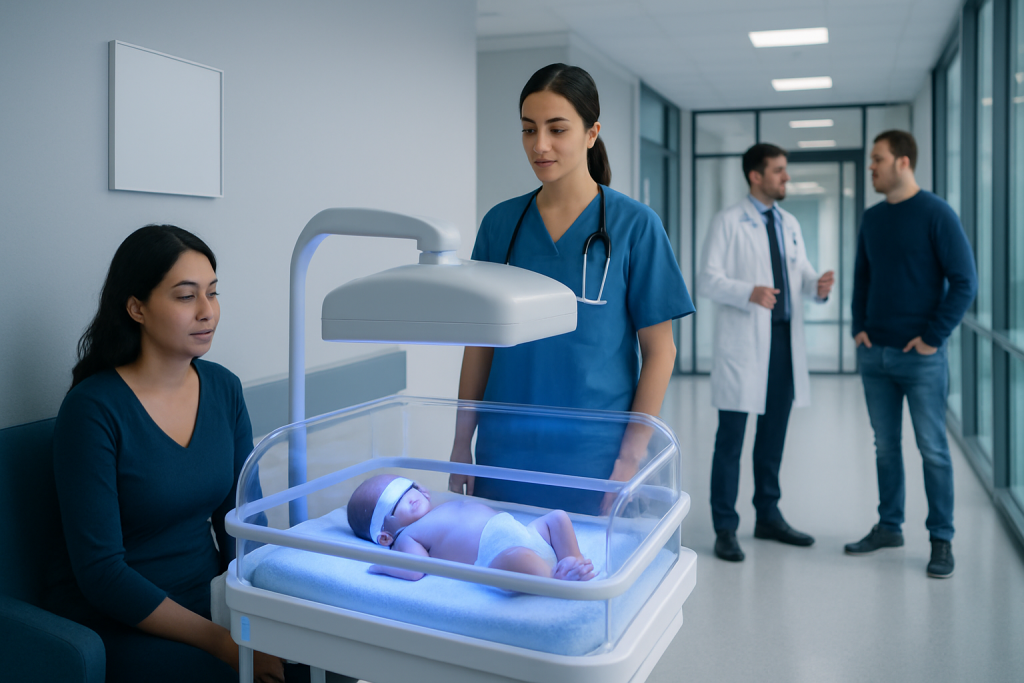
Phototherapy changes bilirubin in the skin into forms a baby can eliminate through urine and stool. Treatment is recommended according to the baby’s bilirubin level, age in hours, gestational age, and individual risk factors.
Key Takeaways
- Phototherapy changes bilirubin in the skin into forms a baby can eliminate through urine and stool.
- Treatment is recommended according to the baby’s bilirubin level, age in hours, gestational age, and individual risk factors.
- Many newborns receive phototherapy continuously for about 1–2 days, although the duration varies.
- Feeding support, temperature checks, eye protection, and repeat bilirubin tests are important during treatment.
- A small rise in bilirubin after treatment can occur, so some babies need follow-up testing.
Jaundice light treatment for newborns, called phototherapy, uses carefully controlled blue light to help the body remove excess bilirubin. It is a common, noninvasive treatment that is monitored closely by a neonatal care team and often improves bilirubin levels within days.
Overview: jaundice light treatment for newborns
Jaundice light treatment for newborns is known medically as phototherapy. It treats elevated bilirubin, a yellow pigment that can build up in the blood and cause yellowing of a baby’s skin and the whites of the eyes. The light is not ultraviolet light and does not burn the skin; it is a specific visible blue-green wavelength designed to help the baby’s body clear bilirubin.
Newborn jaundice is common because a baby’s liver is still developing and may not process bilirubin as efficiently as an older child’s liver. In many babies, bilirubin levels remain mild and settle with feeding and observation. When levels rise beyond a safe threshold, phototherapy can reduce them and help prevent complications from severe untreated hyperbilirubinemia.
Whether treatment is needed depends on more than how yellow a baby looks. Clinicians use a blood or skin bilirubin measurement together with the baby’s age in hours, gestational age, health status, feeding, and risk factors. Care is individualized, especially for babies born early or those with medical conditions.
How phototherapy works
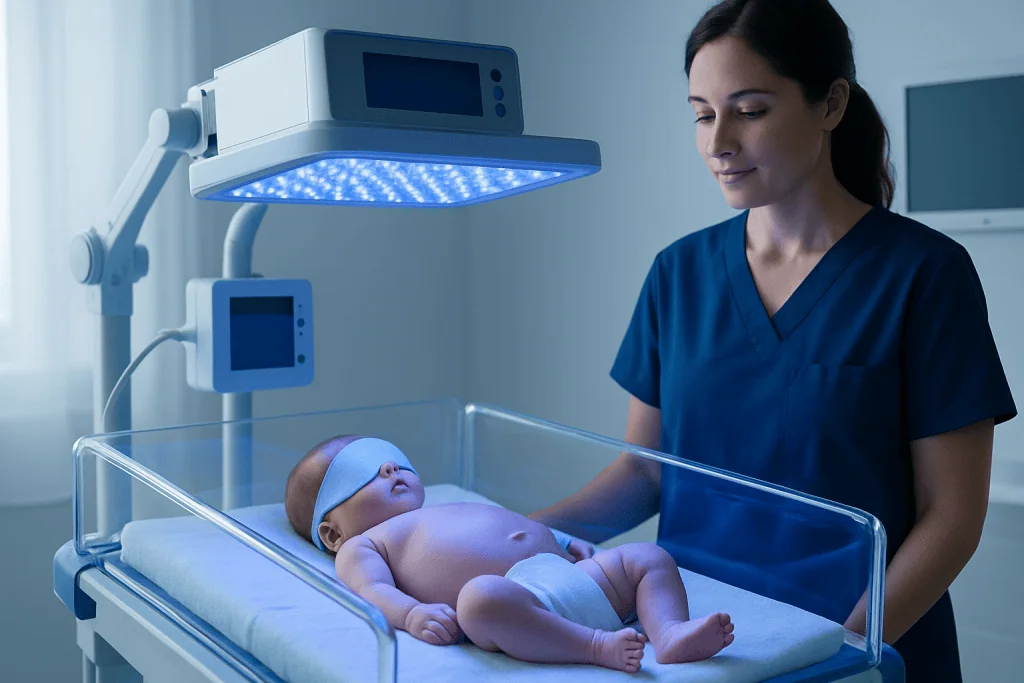
Bilirubin normally leaves the body after the liver changes it into a form that can be passed in stool and urine. In newborns, this process can be slow. Phototherapy exposes as much skin as safely possible to special blue light, which changes bilirubin near the skin into water-soluble forms that the body can remove more easily.
The baby is placed under an overhead light unit, on a light-emitting pad or blanket, or sometimes both. The type and intensity of phototherapy depend on the bilirubin level and how quickly it needs to fall. Treatment may take place in a maternity ward, neonatal unit, or occasionally at home when a clinician considers home phototherapy appropriate and safe.
Phototherapy is not a treatment for every cause of jaundice. The care team also looks for contributing problems, such as inadequate milk intake, bruising from delivery, blood group incompatibility, infection, prematurity, or less commonly liver and metabolic disorders. Identifying the cause helps guide monitoring and any additional care.
Who may need newborn phototherapy?
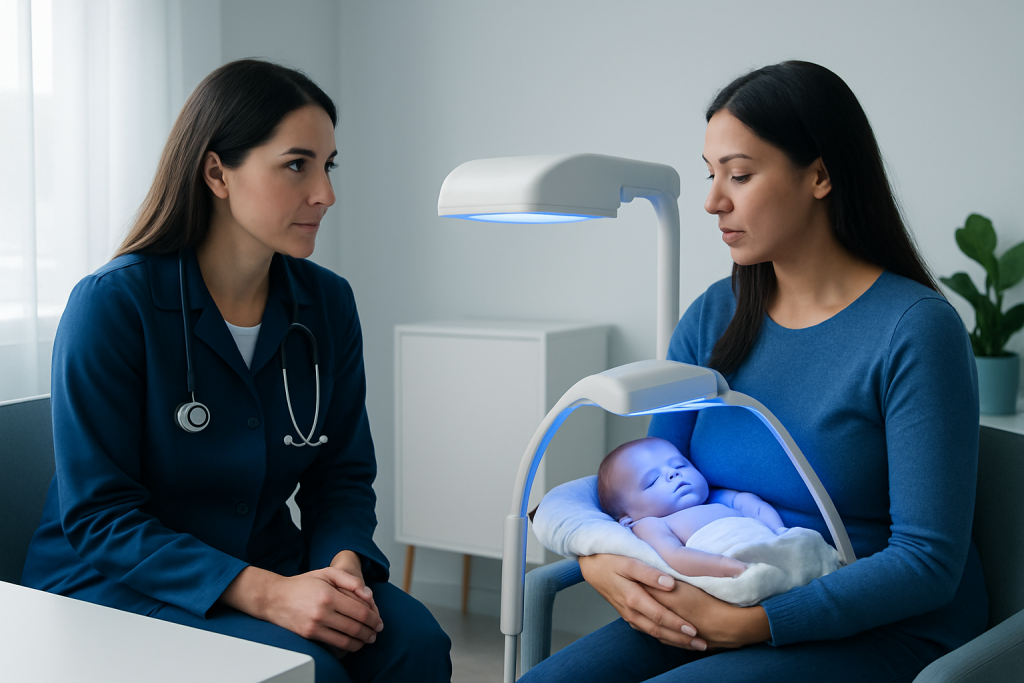
A clinician may recommend phototherapy when the measured bilirubin level reaches the treatment threshold for that particular baby. A level that is safe for a healthy full-term baby at several days old may require closer attention in a baby who is younger, premature, unwell, or has other risk factors. Visual assessment alone cannot reliably determine the bilirubin level.
Babies may be more likely to need treatment if they were born before 38 weeks, have difficulty feeding, lose more weight than expected, have a sibling who required phototherapy, have significant bruising, or have a blood group incompatibility with the birth parent. Babies with increased red blood cell breakdown may also develop bilirubin levels more quickly.
Before beginning treatment, the neonatal team may measure bilirubin in a blood sample and assess feeding, hydration, weight, urine and stool output, and the baby’s general condition. Depending on the situation, further blood tests may help identify why bilirubin is elevated. Newborn jaundice can have several causes, so medical evaluation remains important even when a baby otherwise appears well.
What happens during the procedure?
During phototherapy, the baby usually wears only a diaper so that the light reaches a large area of skin. Soft protective eye shields are used with overhead lamps to protect the eyes. When a fiber-optic light blanket is used, the arrangement may differ, but the care team will explain how the baby is positioned and monitored.
The baby stays under the light for most of the treatment period. Breaks are generally allowed for feeding, cuddling, diaper changes, and clinical checks, unless intensive treatment is needed. Frequent feeding is encouraged because adequate milk intake supports hydration and helps bilirubin leave the body through stools.
Staff check the baby’s temperature, feeding, weight, wet diapers, stools, skin, and comfort. Bilirubin blood tests are repeated at intervals selected by the clinician. The aim is not simply to achieve a single number, but to confirm that bilirubin is falling at an appropriate rate and remains below the threshold for further treatment.
- Before treatment: bilirubin is measured and the baby is assessed for risk factors.
- During treatment: the baby receives controlled light exposure with regular feeding and monitoring.
- After treatment: bilirubin may be rechecked to make sure the level remains safe.
How long does it take for light therapy to work on jaundice?
Phototherapy often starts lowering bilirubin within several hours, but the response depends on the starting bilirubin level and the reason it is elevated. Clinicians commonly see a meaningful improvement over the first 12 to 24 hours when treatment is effective. Blood testing, rather than skin color alone, shows how well the treatment is working.
Some babies need intensive phototherapy if bilirubin is rising quickly or is close to a level that needs urgent management. In these situations, the neonatal team monitors the baby more closely and may investigate causes such as increased red blood cell breakdown. If bilirubin does not fall as expected, clinicians reassess the diagnosis, feeding, hydration, and treatment plan.
Phototherapy is highly effective for most routine cases of neonatal hyperbilirubinemia. It does not replace careful evaluation, particularly if jaundice starts in the first 24 hours after birth, is worsening quickly, or continues longer than expected.
How long does a newborn need light therapy for jaundice?
Many newborns need phototherapy for approximately 24 to 48 hours, but there is no fixed duration for every baby. Treatment continues until the bilirubin level has fallen sufficiently below the treatment threshold and the care team is satisfied that it is unlikely to rise to a concerning level again.
The duration may be shorter for mild elevations that respond quickly and longer when a baby is premature, has ongoing red blood cell breakdown, or begins treatment with a higher bilirubin level. The number of hours under the light may be adjusted around feeding and clinical needs. Parents should not stop treatment independently, even if the baby appears less yellow.
After phototherapy ends, some babies have a bilirubin test several hours later or the following day. The timing is based on the baby’s individual likelihood of rebound jaundice and local clinical protocols.
What to expect after phototherapy for a newborn?
After phototherapy, babies usually return to normal feeding and cuddling routines. Their skin may gradually look less yellow, although color can change more slowly than the bilirubin blood level. It is common for stools to become more frequent or looser and greener while bilirubin is being cleared.
The care team will advise parents about feeding frequency, monitoring wet diapers and stools, and follow-up bilirubin checks if needed. Babies should continue to feed regularly, whether breastfed, formula-fed, or receiving a combination, because good intake supports recovery. A lactation professional or pediatric clinician can help if feeding has been difficult.
Phototherapy is generally well tolerated. Temporary effects can include increased fluid needs, loose stools, mild skin dryness or rash, and changes in body temperature. Staff monitor for these issues and provide supportive care. The baby’s eyes are protected when overhead lights are used, and eye shields are removed for feeding and parent-baby interaction.
Can jaundice come back after light therapy?
Yes. Bilirubin can rise again after phototherapy, which is called rebound hyperbilirubinemia. This is not common in every baby, but it is more likely when jaundice began very early, bilirubin was rising rapidly, the baby was born prematurely, or there is an ongoing cause such as blood group incompatibility.
For this reason, clinicians may arrange a repeat bilirubin measurement after stopping lights or schedule an early follow-up visit. A small increase may not require further treatment, but a significant rise may mean phototherapy needs to restart. Parents should follow the discharge plan even if their baby appears well.
Jaundice can also become more noticeable if feeding is not yet well established. Prompt feeding support and medical review can help address this safely. Sunlight is not a recommended substitute for prescribed phototherapy because its intensity is unreliable and it can expose a newborn to overheating and sun damage.
When to seek medical care
Parents and caregivers should contact a pediatric clinician promptly if they notice yellowing in a newborn, especially if it begins during the first 24 hours after birth, spreads to the legs or palms, or seems to be getting stronger. A bilirubin measurement is the reliable way to assess whether treatment is needed.
Urgent medical assessment is needed if a baby is difficult to wake for feeds, feeds poorly, has fewer wet diapers than expected, develops a fever, has a high-pitched cry, appears unusually floppy or stiff, has arching of the back or neck, or seems generally unwell. These signs do not always mean severe jaundice, but they need timely evaluation.
Families receiving care away from home may benefit from coordinated neonatal and pediatric follow-up. Acibadem International’s multidisciplinary specialists and JCI-accredited hospitals diagnose and treat newborn jaundice for international patients, with treatment plans based on each baby’s clinical assessment.
Frequently asked questions
Is jaundice light treatment safe for newborns?
Phototherapy is a widely used and generally safe treatment when it is prescribed and monitored by trained clinicians. The light is visible blue-green light, not ultraviolet light. Care teams protect the baby’s eyes when needed and monitor hydration, temperature, feeding, and bilirubin levels.
Can parents hold and feed their baby during phototherapy?
In many cases, parents can take their baby out from under the lights for feeding, diaper changes, and comforting. The length and frequency of breaks depend on how intensive treatment needs to be. The neonatal team will explain the best routine for the individual baby.
Does a baby need to drink extra water during phototherapy?
Newborns should not be given plain water unless a clinician specifically advises it. Regular breast milk or formula feeds are usually the appropriate way to support hydration and bilirubin elimination. A care team may recommend additional feeding support if intake is low.
Why are a newborn’s eyes covered during light therapy?
Eye shields are used with overhead phototherapy lamps to protect the baby’s eyes from the bright treatment light. They are checked regularly and are usually removed for feeds, cuddles, and clinical assessments. Fiber-optic blankets may not require the same type of eye protection.
Can sunlight treat newborn jaundice at home?
Sunlight is not a safe or reliable substitute for medical phototherapy. Its light intensity cannot be controlled, and newborns can become overheated, dehydrated, or sunburned. If jaundice is suspected, a clinician should assess the baby and advise on appropriate treatment.
Will phototherapy affect breastfeeding?
Phototherapy does not usually prevent breastfeeding. Frequent feeding is encouraged because it helps maintain hydration and supports bilirubin removal. If breastfeeding is challenging, a pediatric clinician or lactation professional can help develop a feeding plan.
References
- American Academy of Pediatrics
- National Institute for Health and Care Excellence
- World Health Organization
- Centers for Disease Control and Prevention
This article is for general information only and is not a substitute for professional medical advice. Please consult a qualified doctor about your individual situation.
Explore treatments in Turkey — costs, top hospitals & a free quote
JCI-accredited · board-certified surgeons · reply within 24h