Benign Prostatic Hyperplasia Treatment: How It Works, Results and What to Expect

BPH is a noncancerous prostate enlargement that commonly affects urinary flow as men age. Treatment is based on symptom burden, complications, prostate size, overall health and treatment preferences.
Key Takeaways
- BPH is a noncancerous prostate enlargement that commonly affects urinary flow as men age.
- Treatment is based on symptom burden, complications, prostate size, overall health and treatment preferences.
- Medicines can control symptoms for many people, while procedures can provide more durable relief when obstruction is significant.
- Urgent assessment is needed for an inability to pass urine, fever with urinary symptoms, severe pain or visible blood in urine.
- BPH does not usually shorten life expectancy, but untreated urinary obstruction can occasionally lead to complications.
Benign prostatic hyperplasia treatment aims to improve urine flow, reduce troublesome urinary symptoms and prevent complications when they are likely. Options range from monitoring and lifestyle changes to medication and minimally invasive or surgical procedures, selected according to symptoms, prostate anatomy and personal priorities.
Overview: how benign prostatic hyperplasia treatment works
Benign prostatic hyperplasia treatment works by either relaxing muscle around the prostate and bladder outlet, shrinking prostate tissue over time, or physically removing, vaporizing or widening the tissue that blocks urine flow. The most suitable option depends on how much symptoms affect daily life, whether there are complications, the size and shape of the prostate, and the person’s goals regarding recovery and sexual function.
BPH, often called an enlarged prostate, is a noncancerous growth of prostate tissue. The prostate surrounds part of the urethra, the tube that carries urine out of the bladder. As it enlarges, it may narrow this passage and cause a weak stream, delayed starting, frequent urination, urgency, nighttime urination or a feeling that the bladder has not emptied fully.
Not everyone with an enlarged prostate needs active treatment. Watchful waiting, with periodic review and practical symptom-management measures, is appropriate when symptoms are mild and there is no evidence of urinary retention, repeated infection, bladder stones, kidney effects or persistent bleeding. A urologist can help distinguish BPH from other causes of urinary symptoms, including urinary infection, bladder problems and prostate cancer.
Assessment and candidacy for treatment

A clinician will usually begin by discussing urinary symptoms, medical history, current medicines and how symptoms affect sleep, work and everyday activities. Some medicines, including certain decongestants, antihistamines and drugs that affect bladder function, can worsen urine flow in some people. The assessment may include a symptom questionnaire, physical examination and digital rectal examination.
Tests may include urinalysis to look for infection or blood, blood tests when appropriate, a prostate-specific antigen (PSA) test after shared discussion, measurement of urine flow, and a scan to check how much urine remains in the bladder after urination. Ultrasound, cystoscopy or other imaging may be used before a procedure or when the diagnosis is unclear.
Active treatment is more likely to be recommended when symptoms remain bothersome despite conservative measures, when medicines are ineffective or poorly tolerated, or when complications occur. These include repeated urinary retention, recurrent urinary tract infections, bladder stones, recurrent visible bleeding thought to come from the prostate, or evidence that long-term obstruction is affecting the bladder or kidneys. Related concerns such as prostate cancer should be evaluated separately; BPH itself is not cancer.
Medication and non-surgical treatment options
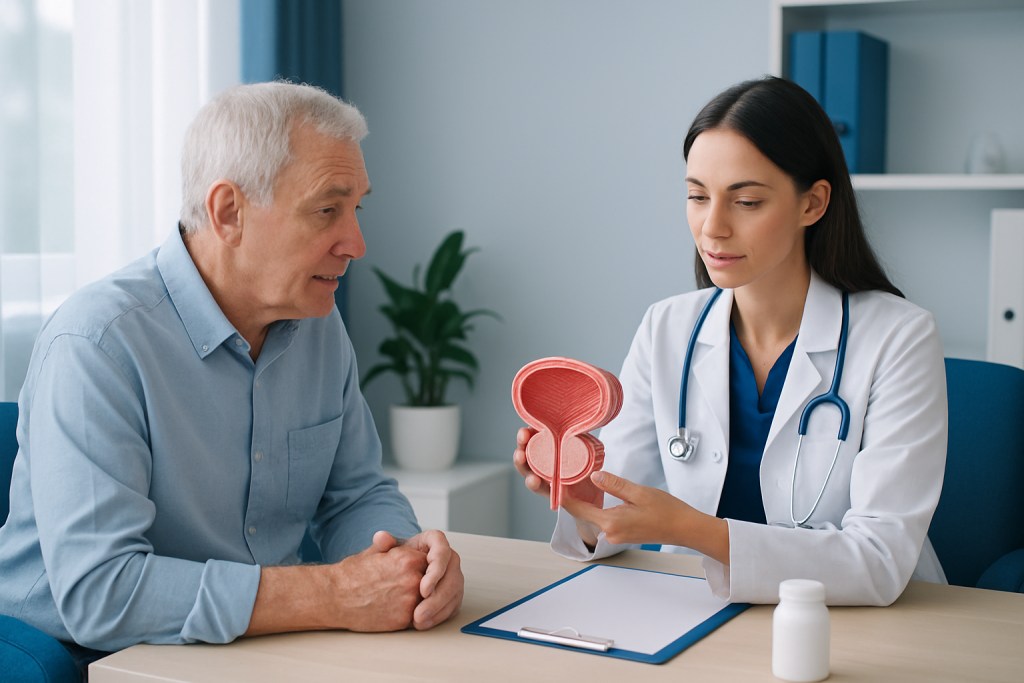
For many people, medication is the first active approach. Alpha-blockers relax smooth muscle in the prostate and bladder neck, often improving urine flow relatively quickly. Possible side effects include dizziness, low blood pressure on standing, nasal congestion and changes in ejaculation. Clinicians consider other health conditions and current medicines when choosing this option.
5-alpha-reductase inhibitors gradually reduce the hormone-related growth of prostate tissue and are most useful when the prostate is clearly enlarged. They can lower the future risk of urinary retention and need for surgery, but improvement may take months. Sexual side effects can occur, and these medicines also affect PSA interpretation, so follow-up should be planned with the prescribing clinician.
Combination treatment may be suitable for some people with more pronounced symptoms and a larger prostate. Other medicines may help when urgency and frequency are prominent, although they require care if bladder emptying is poor. Lifestyle measures can also help: reducing evening fluids and alcohol, limiting caffeine, avoiding constipation, planning toilet access, and reviewing medicines with a doctor rather than stopping prescribed treatment independently.
- Medication is often appropriate for moderate symptoms without major obstruction-related complications.
- Regular review helps determine whether symptoms, bladder emptying and side effects remain acceptable.
- Medication does not eliminate the need to investigate new blood in urine, pain, fever or sudden worsening of symptoms.
Procedures for BPH: step by step, recovery and results
Procedures are considered when symptoms remain unacceptable, complications develop, or a person prefers a more definitive option than long-term medication. The aim is to create a wider channel through the prostate so urine can pass more freely. Options include transurethral resection of the prostate (TURP), laser procedures such as enucleation or vaporization, prostatic urethral lift, water-vapor therapy, and, for selected very large prostates, simple prostatectomy. Availability and suitability vary by anatomy and local expertise.
Before treatment, the urology team reviews imaging, urine tests, blood-thinning medicines, anesthesia needs and goals for sexual function and recovery. During many procedures, a slender instrument is passed through the urethra, so there is no external incision. The surgeon removes, destroys, compresses or retracts obstructing tissue depending on the technique. A urinary catheter is commonly used for a short period afterward, though the exact duration differs between procedures and individuals.
Recovery may involve burning with urination, urinary frequency, urgency or light blood in the urine for days to weeks. Activity restrictions, fluid guidance and follow-up are individualized. Many people notice a stronger stream soon after obstruction-relieving surgery, while bladder irritability may take longer to settle. Benign prostatic hyperplasia treatment should be discussed with a urologist who can explain which method matches the prostate size, urinary findings, health status and priorities.
Procedures can provide substantial and durable symptom relief, but no option is risk-free. Possible risks include urinary tract infection, temporary leakage, bleeding, narrowing of the urethra or bladder neck, erectile difficulties, and changes in ejaculation. Retrograde ejaculation, where semen goes into the bladder rather than out through the penis, is common after some operations and is not harmful, but it can affect fertility and should be discussed in advance.
Can an enlarged prostate go back to normal?
An enlarged prostate does not usually return fully to its earlier size without treatment. BPH is commonly related to age-related hormonal changes and tends to progress gradually in some, though not all, people. Symptoms can fluctuate, and some people remain stable for years without needing procedures.
Medicines called 5-alpha-reductase inhibitors can reduce prostate volume gradually in appropriate patients, but they do not restore every prostate to its original size. Procedures that remove or reduce obstructing tissue can improve urine flow substantially, even though they do not change the underlying tendency for prostate tissue to grow over a lifetime.
Improved symptoms are a more meaningful treatment goal than achieving a particular prostate size. A clinician will consider bladder emptying, recurrent complications and quality of life alongside test results when deciding whether monitoring, medication or a procedure is appropriate.
What is the life expectancy of someone with BPH?
BPH itself does not usually reduce life expectancy. It is a benign condition and is not the same as prostate cancer. Most people with BPH live normally with monitoring, lifestyle adjustments, medication or procedures when needed.
However, severe or prolonged blockage of urine flow can occasionally lead to problems such as urinary retention, recurrent infections, bladder stones or kidney impairment. Prompt assessment and appropriate treatment reduce the likelihood of these complications. Life expectancy is more strongly influenced by overall health conditions, age and access to appropriate medical care than by uncomplicated BPH.
Regular follow-up is particularly important if symptoms are changing, urine is not emptying well, or there is a history of urinary retention. New symptoms should not automatically be attributed to BPH, since several urinary conditions can occur at the same time.
Will ejaculating help BPH?
Ejaculation is not an established treatment for BPH and does not shrink the prostate or reliably relieve urinary obstruction. Some people may notice short-lived changes in pelvic comfort or urinary symptoms, but this is not a substitute for medical assessment or evidence-based treatment.
Sexual activity is generally safe for most people with BPH unless a clinician has advised otherwise for another health reason. BPH medicines and procedures may affect ejaculation or erections differently, so people who are concerned about sexual function should raise this before choosing treatment.
If painful ejaculation, blood in semen, new erectile difficulties or significant urinary changes occur, a medical review can identify possible causes. These symptoms may be related to BPH, infection, inflammation, medication effects or other conditions.
What is the most successful BPH treatment and when to seek medical care
There is no single most successful BPH treatment for every person. Surgical procedures that remove a large amount of obstructing tissue, such as TURP or laser enucleation, generally offer strong and lasting improvement in urine flow for appropriately selected patients. However, the best choice must balance expected symptom relief with prostate size, anesthesia considerations, bleeding risk, recovery time, preservation of ejaculation and the possibility of needing further treatment.
For mild symptoms, monitoring and lifestyle changes may be the most appropriate and least burdensome approach. For moderate symptoms, medicines can be highly effective. Minimally invasive approaches may offer shorter recovery or a lower chance of some sexual side effects for selected people, while more extensive surgery can be preferable for severe obstruction or very large prostates. A urologist can explain realistic benefits and trade-offs of each option.
Medical advice should be sought promptly for a sudden inability to urinate, fever or chills with urinary symptoms, severe lower abdominal pain, visible blood in urine, or symptoms of a urinary infection. A routine appointment is appropriate for persistent weak flow, bothersome nighttime urination, urgency, recurrent infections or a sense of incomplete emptying. Acibadem International’s multidisciplinary specialists and JCI-accredited hospitals diagnose and treat BPH for international patients.
Frequently asked questions
How long does it take for BPH treatment to work?
The timeline depends on the treatment. Alpha-blocker medicines may improve flow and symptoms within days to weeks, while medicines that shrink the prostate can take several months. Procedures may improve flow soon after recovery begins, but urgency and frequency can take weeks or longer to settle.
Can BPH be treated without surgery?
Yes. Many people manage BPH with observation, lifestyle adjustments and medication. Surgery or a minimally invasive procedure is usually considered when symptoms remain troublesome, medication is unsuitable or complications of obstruction develop.
Does BPH always get worse with age?
Not necessarily. Symptoms can remain stable, vary over time or gradually worsen. Regular review is useful because symptoms do not always match prostate size, and bladder function can also influence how a person feels.
Can BPH cause erectile dysfunction?
BPH and erectile dysfunction can occur together, especially with increasing age and shared health factors. BPH itself is not always the direct cause, but some treatments may influence erections or ejaculation. A urologist can help select an option that considers sexual health priorities.
What happens if BPH is left untreated?
Mild BPH without complications can often be safely monitored. In more severe cases, ongoing obstruction may lead to urinary retention, recurrent infection, bladder stones or, less commonly, kidney problems. New or worsening symptoms should be evaluated rather than managed alone.
Will I need a catheter after a BPH procedure?
Many BPH procedures involve a catheter for a short time after treatment to allow urine to drain while swelling settles. The need for a catheter and how long it remains in place depend on the procedure, prostate anatomy and recovery. The treating team will provide individualized instructions.
References
- National Institute of Diabetes and Digestive and Kidney Diseases
- American Urological Association
- European Association of Urology
- Mayo Clinic
- NHS
This article is for general information only and is not a substitute for professional medical advice. Please consult a qualified doctor about your individual situation.
Prostatic Hyperplasia in Turkey — costs, top hospitals & a free quote
JCI-accredited · board-certified surgeons · reply within 24h
Add us as a Preferred Source to see more of our trusted health content across Google Search, AI Overviews and Discover.
Check your numbers in seconds
BMI, calories, due date, blood pressure and 30+ more clinical calculators — free, instant, doctor-reviewed ranges.

More from the Health Library



Related Specialists

Prof. Dr. Serap Gençer
Infectious Diseases & Clinical Microbiology
Prof. Dr. Ali Akyüz
General Surgery
Fzt. Gizem Aydın
Physical Medicine and Rehabilitation
Dr. Alptekin Usta
Emergency Service