

ACL Graft Options: Patellar, Hamstring, Quad or Donor — Compared
Key Takeaways
- Your body remodels any ACL graft into ligament-like tissue over roughly 12 to 24 months, and the graft is temporarily weaker mid-rehab than on surgery day.
- Patellar tendon grafts heal bone-to-bone in the tunnels and post low re-tear rates in athletes, but lingering kneeling discomfort is their signature trade-off.
- Hamstring grafts cause the least anterior knee pain among autografts, yet measurable deep-flexion strength deficits can persist after harvest.
- The quadriceps tendon yields a graft with a larger cross-sectional area than the patellar option and encouraging early data, but its long-term track record is shorter.
- Studies repeatedly show donor (allograft) tissue failing at several times the autograft rate in athletes under about 25 who return to pivoting sports.
- Research in young athletes links each additional month of rehabilitation, up to around nine months, with meaningfully lower re-injury risk — regardless of graft type.
Quick Answer
Surgeons rebuild a torn ACL with one of four main graft options: your own patellar tendon, hamstring tendons, or quadriceps tendon, or donor (allograft) tissue. Evidence consistently shows a patient’s own tissue re-tears less often in young, competitive athletes, while donor grafts can be reasonable for older or lower-demand patients. Each choice trades harvest-site side effects against durability, so the best graft depends on age, sport, and goals.
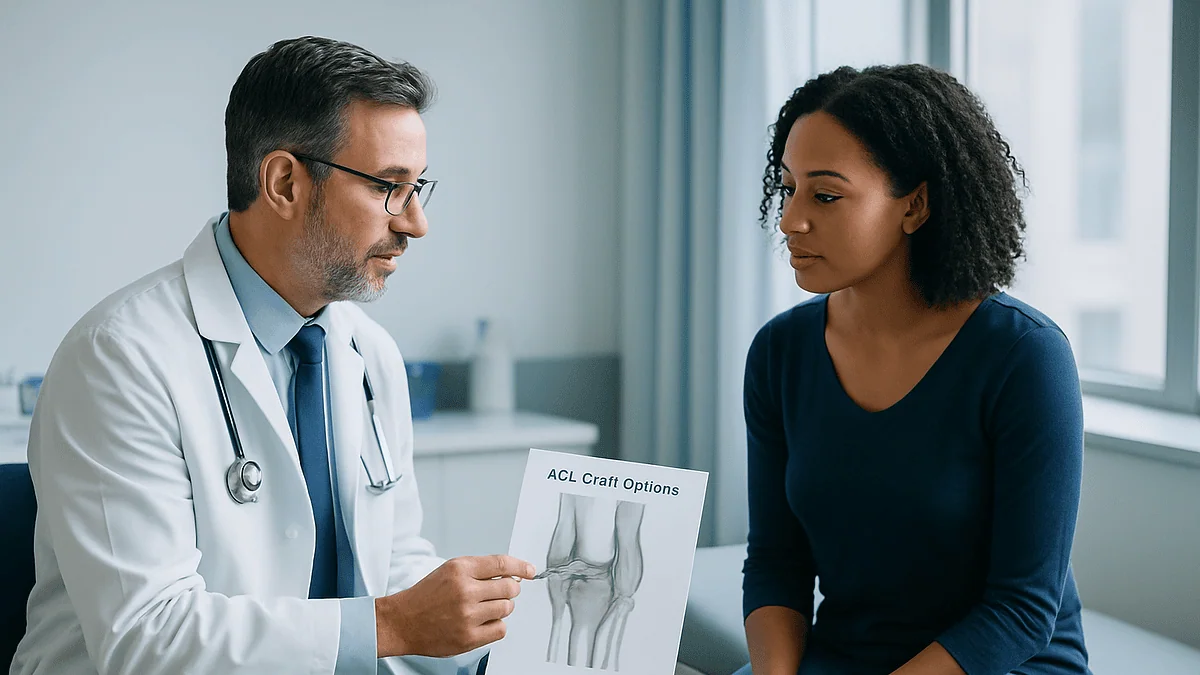
The pop is the part people remember. A 19-year-old midfielder plants her left foot to cut right, the knee buckles inward, and by the time she is helped off the field she already suspects what the MRI will confirm. What she does not expect is the second decision waiting in the surgeon’s office: not whether to fix the ligament, but what to fix it with.
That conversation catches most patients off guard. There is no single “ACL surgery.” There are four common ways to build a new ligament, each borrowing tissue from a different place, and each with a personality of its own — one is famously sturdy but hard on kneelers, one is gentle up front but taxes the hamstrings, one is the fast-rising newcomer, and one comes from a donor entirely.
The good news is that decades of research have made the trade-offs unusually clear. Here is what the evidence actually says about each option, and how surgeons and patients weigh them.
Why can’t a torn ACL just be stitched back together?
It seems like the obvious fix: sew the two ends together and let them heal. The trouble is biology. The anterior cruciate ligament lives inside the joint, bathed in synovial fluid that washes away the clot a healing tissue needs, and its blood supply is thin to begin with. When it ruptures, the ligament tends to fray like the end of a rope rather than snap cleanly, leaving nothing sturdy to stitch. That is why direct repair was largely abandoned decades ago and why, according to MedlinePlus and the Mayo Clinic, reconstruction — replacing the ligament with a tendon graft — became the standard operation.
The graft is threaded through small tunnels drilled in the thighbone and shinbone, then anchored with screws or buttons. From there, something remarkable happens: over the following 12 to 24 months, your body slowly remodels the tendon into tissue that looks and behaves more like a ligament, a process researchers call ligamentization. Cells migrate in, collagen reorganizes, and blood vessels grow.
That timeline explains a theme you will see throughout this article. The graft you receive on surgery day is temporarily weaker during mid-rehab than it was on the operating table, which is one reason rushing back to sport is riskier than most athletes assume — no matter which graft is chosen.
What are the four main ACL graft options?
Nearly every ACL reconstruction uses one of four tissue sources. Three are autografts — tissue harvested from your own body during the same operation — and one is an allograft, donated tissue from a tissue bank.
- Patellar tendon (bone-patellar tendon-bone, or BTB): the central third of the tendon below your kneecap, taken with a small plug of bone at each end.
- Hamstring tendons: usually the semitendinosus, often paired with the gracilis, folded into a multi-strand bundle.
- Quadriceps tendon: a strip of the thick tendon above the kneecap, harvested with or without a bone block.
- Allograft (donor tissue): a tendon — often Achilles, tibialis, or patellar — from a deceased donor, screened and processed by an accredited tissue bank.
Each has a track record. The patellar tendon graft dominated the 1990s and remains the benchmark for competitive athletes. Hamstring grafts rose on the promise of a smaller incision and less pain at the front of the knee. The quadriceps tendon, once reserved for revisions, has surged in popularity over the past decade. Donor tissue spares you a harvest site altogether — at a cost we will get to.
The NHS notes that graft choice is made jointly between patient and surgeon, and that is exactly how it should work: the right answer depends on who you are, not just what tore.
Patellar tendon graft: why surgeons still call it the workhorse
Ask a room full of sports-medicine surgeons which graft they would choose for a 20-year-old college athlete, and the patellar tendon will win a lot of votes. Its defining feature is structural: the graft is harvested with a small block of bone at each end, so once those plugs are seated in the bone tunnels, healing happens bone-to-bone — generally faster and more rigid than tendon healing into bone. Fixation is famously secure, and long-term studies show low re-rupture rates in high-demand athletes.
The price is paid at the front of the knee. Because tissue is taken from the tendon you kneel on, a sizable minority of patients report lingering discomfort with kneeling — a real consideration for wrestlers, tradespeople, gardeners, and anyone whose faith practice involves kneeling. Numbness in a patch of skin near the incision is common, and there is a small, well-documented risk of kneecap fracture or patellar tendon injury after harvest, though both are uncommon.
Anterior knee pain during rehab also tends to be more noticeable with this graft than with hamstring or donor tissue, according to Cleveland Clinic patient education. For most young pivoting-sport athletes, surgeons judge that trade worth making. For someone who kneels for a living, the calculus can flip entirely — which is precisely why this decision deserves a real conversation, not a default.
Hamstring graft: the low-profile option with a strength trade-off
Harvesting a hamstring graft is almost elegant. Through an incision of a few centimeters below the inside of the knee, the surgeon retrieves the semitendinosus tendon — often with its neighbor the gracilis — and folds the strands into a bundle that is comparable in strength to the native ACL. No bone is disturbed, the scar is modest, and kneeling pain is markedly less common than with the patellar option. For years this made it the world’s most popular ACL graft.
Two caveats have tempered that enthusiasm. First, the graft heals tendon-to-bone inside the tunnels, which takes longer than bone-to-bone healing and may partly explain why some large registry analyses have found modestly higher revision rates with hamstring grafts than with patellar grafts, particularly in young athletes. Second, you do give up hamstring tissue. Most people regain everyday strength, but measurable deficits in deep knee flexion — the last part of the curling motion — can persist, which matters to sprinters, martial artists, and anyone whose sport lives in that range.
There is also simple biology to consider: hamstring tendon thickness varies from person to person, and a thinner graft has been linked to higher failure risk in some studies. None of this makes the hamstring a poor choice. It remains an excellent graft for a wide range of patients — just not an automatic one.
Quadriceps tendon: why the newcomer is gaining ground fast
Look at the tendon just above your kneecap and you will see why surgeons got interested. The quadriceps tendon is thick — its harvested cross-sectional area typically exceeds that of a patellar tendon graft — which yields a robust piece of tissue from a single, relatively forgiving harvest site. It can be taken with a bone block from the top of the patella (borrowing the bone-to-bone healing advantage) or as pure soft tissue.
What has the sports-medicine world genuinely intrigued is the early comparative data. Studies to date suggest re-tear rates in the same neighborhood as the patellar tendon graft, with noticeably less kneeling pain and donor-site discomfort. For adolescent athletes and for revision surgeries, many surgeons now reach for it first.
Honesty requires a caveat, and it is an important one: the quadriceps graft simply has a shorter track record. The patellar and hamstring grafts carry 30-plus years of outcome data across millions of patients; the quad tendon’s modern popularity is barely a decade old, and long-term follow-up studies are still maturing. Early quadriceps weakness after harvest is also real and demands committed rehab, since that muscle group is the engine of ACL recovery.
So the fair summary is optimistic but measured: promising strength profile, kinder harvest site, evidence still accumulating. If your surgeon recommends it, that recommendation now rests on legitimately encouraging research rather than novelty.
Donor tissue (allograft): convenient, but not for everyone
An allograft solves the harvest problem by skipping it. The tissue comes from a deceased donor via an accredited tissue bank, which means a shorter operation, smaller incisions, less early pain, and no sacrifice of your own tendon. For patients in their 40s, 50s, and beyond — especially those returning to recreational rather than competitive activity — that package is genuinely attractive, and outcomes in this group are generally good.
The evidence turns sharply against donor tissue in one specific population: young, high-demand athletes. Multiple studies and cohort analyses have found graft failure rates several times higher with allografts than autografts in patients under roughly 25 who return to cutting and pivoting sports. Two mechanisms likely explain it. Donor tissue incorporates and remodels more slowly than your own, leaving a longer window of vulnerability. And some sterilization and processing methods, particularly higher-dose irradiation, can weaken the tissue itself.
What about disease transmission — the question everyone quietly wonders? Screening, testing, and processing standards make transmission extraordinarily rare, though not technically zero, a point worth raising with your surgeon if it weighs on you.
Allografts also keep an important role regardless of age: revision surgeries and complex multi-ligament injuries, where a surgeon may need more tissue than one knee can reasonably donate. Used in the right patient, donor tissue is a legitimate tool. Used reflexively in a teenager, it is a documented mistake.
How do the four grafts compare side by side?
Trade-offs are easier to see laid out in one place. The table below distills the mainstream evidence — with the reminder that individual anatomy, surgeon experience, and your goals can outweigh any single row.
| Graft | Tissue source | Notable strengths | Common trade-offs | Often considered for |
|---|---|---|---|---|
| Patellar tendon (BTB) | Central third of your patellar tendon, with bone plugs | Bone-to-bone healing; long track record; low re-tear rates in athletes | Kneeling pain and anterior knee pain; small fracture risk | Young, competitive pivoting-sport athletes |
| Hamstring | Semitendinosus, often plus gracilis, folded into a bundle | Small incision; least anterior knee pain among autografts | Deep-flexion hamstring strength deficits; slower tunnel healing; graft size varies | Broad range of patients; kneeling occupations |
| Quadriceps tendon | Strip of tendon above the kneecap, with or without bone block | Thick, robust graft; low kneeling pain; encouraging early comparative data | Shorter long-term track record; early quad weakness | Adolescents, revisions, athletes wanting a BTB alternative |
| Allograft (donor) | Screened donor tendon from a tissue bank | No harvest site; shorter surgery; less early pain | Several-fold higher failure risk in young athletes; slower incorporation | Patients over ~35-40 with lower demands; complex revisions |
Notice that no column reads “best overall.” That is not diplomatic hedging — it is what the literature shows. The grafts separate by patient, not by universal quality ranking.
Autograft vs. allograft: what the re-tear numbers actually show
Strip away the details and the deepest divide in ACL graft options is this: your tissue or someone else’s. Here the evidence speaks with unusual clarity, at least for young patients.
Overall, modern ACL reconstruction succeeds most of the time; graft failure across all comers runs in the mid-single-digit percentages. But averages hide the pattern. In studies of athletes under about 25 returning to pivoting sports, allograft failure rates have repeatedly measured several times higher than autograft rates — enough that many sports-medicine surgeons now consider a patient’s own tissue the default below that age, full stop.
Why the gap? Two reasons stand out in the research. Donor tissue is biologically “quiet” — your cells must colonize and remodel it from scratch, which appears to take longer than remodeling your own living tendon, extending the fragile mid-rehab window when athletes feel ready before the graft is. And processing matters: tissue sterilized with higher doses of radiation shows reduced mechanical strength, though modern low-dose and aseptic methods have narrowed that concern.
For patients past their mid-30s with moderate activity goals, the story softens considerably. Failure-rate differences shrink, and the allograft’s gentler recovery becomes a fair trade. The honest takeaway: age and demand level are not footnotes to this decision — they are practically the whole decision.
Does age or sport change which graft is best?
Picture three patients tearing the same ligament in the same week. A 16-year-old club soccer player intent on playing in college. A 34-year-old electrician who skis a few weekends each winter and kneels on concrete every workday. A 52-year-old who tore hers stepping awkwardly off a curb and mostly wants to hike and cycle again.
Evidence-based surgeons would likely steer these three toward different grafts. The teenager gets the strongest push toward her own tissue — patellar or quadriceps tendon in many practices — because her re-tear risk is the highest of any group and donor tissue performs worst in exactly her situation. The electrician’s kneeling job argues against a patellar graft’s signature trade-off, nudging the conversation toward hamstring or quadriceps tendon. The 52-year-old is the classic candidate for whom an allograft’s easier recovery is a reasonable, evidence-supported choice — though her own tissue remains perfectly valid too.
Sport-specific demands add another layer. Athletes who rely on deep knee flexion may want to protect their hamstrings; those in kneeling-heavy sports may want to protect the front of the knee. Skeletal maturity matters as well: in growing adolescents, surgeons modify techniques to protect growth plates, which can influence graft selection.
If a surgeon recommends a graft without asking what you do for work and play, that is worth a follow-up question — or a second opinion.
Kneeling pain, weak hamstrings, and other harvest-site trade-offs
Every autograft is a small controlled injury layered on top of your reconstruction, and the harvest site — not the new ligament — is where many patients notice lasting differences.
With the patellar tendon graft, the front of the knee tells the story. Kneeling discomfort is the most commonly reported long-term complaint, ranging from a minor nuisance on hard floors to something patients actively plan around. A patch of numbness beside the scar, caused by small skin-nerve branches cut during harvest, is common and usually harmless but often permanent.
Hamstring harvest tends to be quieter day to day, but the deficit shows up on a dynamometer: strength in the final degrees of knee flexion can remain measurably reduced even after diligent rehab. The harvested tendon partially regenerates in many people — an odd and genuinely fascinating finding — but the regrown tissue is not identical to the original.
Quadriceps harvest produces early weakness in the very muscle rehab depends on, demanding patience in the first months, though donor-site pain appears less troublesome than with the patellar graft in comparative studies.
Allografts sidestep all of this, which is exactly their appeal — and a reminder that “no harvest morbidity” is a real benefit, not a marketing phrase. The catch, as covered above, is that the benefit is purchased with durability risk in young athletes. There is no free tissue.
Does graft choice change how long recovery takes?
Less than most people hope. The rehabilitation arc after ACL reconstruction is governed mainly by biology that all grafts share: swelling control and motion in the first weeks, strength rebuilding over months, then running, agility, and sport-specific work. The Mayo Clinic and NHS both frame full recovery in terms of many months to a year, and a growing body of research supports holding athletes out of cutting sports for at least nine months — studies in young athletes have linked each additional month of rehab, up to around that mark, with meaningfully lower re-injury rates.
Graft choice colors the early chapters more than the ending. Patellar tendon patients often battle more anterior knee pain in the first months and must work deliberately on kneeling tolerance. Hamstring patients typically protect the harvest site briefly and later chase flexion strength. Quadriceps tendon patients face a steeper early climb in quad strength. Allograft patients frequently feel best soonest — which is precisely the trap, since donor tissue may incorporate more slowly than it feels.
What actually determines your timeline, more than tissue source, is the quality and consistency of rehabilitation and whether you pass objective return-to-sport testing — strength symmetry, hop tests, movement quality — rather than a date on the calendar. Choosing a graft for a faster return is, in most cases, optimizing the wrong variable.
What about ACL repair and newer bridge-enhanced techniques?
You may have read that ACL repair is back. It is true that researchers have revisited the old idea of preserving the native ligament, this time with modern tools: suture-based repairs reinforced with internal bracing, and bridge-enhanced techniques that place a protein scaffold between the torn ends to give healing tissue somewhere to organize. One scaffold-based approach has received U.S. regulatory authorization, and early clinical trial results in carefully selected patients — mainly certain tear patterns near the ligament’s upper attachment, treated soon after injury — have been encouraging.
Encouraging, however, is not the same as established. Reconstruction with a graft rests on decades of outcome data across essentially every age group and sport; repair-based techniques have short- and mid-term results in narrower populations, and questions about long-term durability and re-tear rates in young athletes remain open. Most tears — particularly mid-substance ruptures, the most common pattern — are still not good repair candidates at all.
Where does that leave a patient reading headlines? In a reasonable place, actually: if your tear pattern and timing happen to fit repair criteria, it is a fair question to raise with a surgeon experienced in those techniques. For everyone else, the graft comparison in this article remains the decision that matters. Medicine moves by evidence accumulating, not by press releases — and on repair, the evidence is still accumulating.
Questions worth asking your surgeon before you choose
Surgeons decide faster than patients can absorb, so walk in with questions written down. A few that reliably produce useful answers:
- Which graft do you recommend for me specifically, and why? The answer should reference your age, sport, occupation, and anatomy — not just habit.
- Which grafts do you use most often? Surgeon experience with a particular graft genuinely matters; a technically excellent hamstring reconstruction can outperform an unfamiliar quadriceps harvest.
- If you suggest donor tissue: how is it processed, and what failure rates should I expect at my age?
- How will this choice affect my job or sport? Say the word “kneeling” out loud if it applies to your life.
- What are your criteria for clearing me to return — a calendar date, or objective strength and hop testing?
- What is your plan if this graft ever fails? Today’s choice shapes tomorrow’s revision options, since a revision may need tissue the first surgery already used.
One more suggestion from years of reading patient outcomes research: bring someone with you. Studies of medical visits consistently show patients retain only a fraction of what is said, and this is a decision with a 20-year shadow. A second set of ears is the cheapest surgical equipment you will ever acquire.
When to see a doctor
Some knee moments should send you to a clinician promptly rather than to a search bar. Seek medical evaluation soon if you experienced a popping sensation followed by rapid swelling within hours, if the knee feels unstable or gives way, if you cannot bear weight, or if you cannot fully straighten or bend the joint. The Mayo Clinic notes that prompt assessment matters because ACL tears frequently travel with companions — meniscus tears, cartilage damage, other ligament injuries — that shape both urgency and treatment.
After surgery, a different checklist applies. Contact your surgical team without delay for fever, spreading redness or drainage at the incision, calf pain or swelling (a possible blood clot, which needs urgent attention), chest pain or sudden shortness of breath (call emergency services), pain that escalates rather than eases, or a new pop and instability in the reconstructed knee.
There is a quieter reason to see a doctor, too. Not every ACL tear needs an operation. Lower-demand patients sometimes do well with structured rehabilitation alone, and the NHS explicitly frames surgery as a shared decision based on activity goals rather than an automatic next step. A sports-medicine physician or orthopedic surgeon can lay out both paths honestly. If the recommendation you receive feels rushed or one-size-fits-all, a second opinion is not an insult — it is standard practice for elective surgery.
The bottom line: fit the graft to the life you live
After all the studies, registries, and follow-up cohorts, the ACL graft debate resolves into something surprisingly humane: the best graft is the one matched to your age, your sport, your job, and your surgeon’s hands.
If forced to name what matters most, the evidence points to one principle above the rest — young, competitive athletes should receive their own tissue. That finding is as close to settled as this field gets. Beyond it, the choices are legitimately close calls. Patellar tendon buys proven durability at the cost of the front of the knee. Hamstring spares the kneecap and taxes the flexors. Quadriceps tendon looks like it may offer much of the patellar graft’s sturdiness with a kinder harvest, pending longer follow-up. Donor tissue earns its place in older and lower-demand knees and in complex revisions.
And hovering over every option is the variable patients control most: rehabilitation. A meticulously chosen graft attached to a rushed, halfhearted recovery fails more often than a “second-choice” graft carried through nine-plus disciplined months. The midfielder from our opening scene will spend perhaps two hours in an operating room and two hundred in a gym. Choose the graft thoughtfully — then pour yourself into the part of the outcome that no tissue bank or tendon can supply.
Frequently asked questions
Which ACL graft is the strongest?
On the operating table, all four common grafts test at or above the strength of a native ACL, so raw initial strength rarely decides the choice. What differs is how each graft heals, how fixation holds, and what the harvest costs you. Long-term durability data — especially re-tear rates in your age group and sport — is a far more useful comparison than laboratory load-to-failure numbers.
Which ACL graft has the lowest re-tear rate?
In young, competitive athletes, patellar tendon autografts have historically shown among the lowest re-tear rates, with quadriceps tendon grafts posting comparable early results and hamstring grafts running modestly higher in some large registries. Donor tissue fails most often in this group. In older, lower-demand patients, the differences between grafts shrink considerably, and all options perform well for most people.
Is a donor ACL graft weaker than my own tissue?
Not necessarily at implantation, but it behaves differently afterward. Donor tissue incorporates and remodels more slowly than your own living tendon, extending the vulnerable period during rehab, and some sterilization methods — particularly higher-dose irradiation — can reduce mechanical strength. These factors likely explain why allografts fail several times more often in young athletes, while performing acceptably in older, less demanding knees.
Can you catch a disease from donor graft tissue?
Transmission is extraordinarily rare but not technically zero. Accredited tissue banks screen donor medical and social history, test for infectious diseases, and process tissue under strict standards, which together have made documented transmissions vanishingly uncommon in modern practice. If this risk concerns you, ask your surgeon which tissue bank supplies their grafts and how the tissue is processed — it is a completely reasonable question.
Will a hamstring graft permanently weaken my hamstring?
Most people regain the strength needed for daily life and recreational sport, but studies do find persistent deficits in deep knee flexion — the end range of the curling motion — even after good rehab. Interestingly, the harvested tendon partially regenerates in many patients, though the new tissue is not identical to the original. Athletes who depend heavily on hamstring power, like sprinters, sometimes choose a different graft for this reason.
Which ACL graft is best for someone over 40?
Both autograft and allograft are reasonable after 40, and evidence shows the failure-rate gap between them narrows substantially with age and lower athletic demand. Donor tissue offers an easier early recovery with no harvest-site pain, which many patients in this group value. Your own tissue remains a fully valid choice too, especially if you stay very active. Activity goals, occupation, and surgeon experience should drive the decision.
Does patellar tendon graft kneeling pain ever go away?
Often it improves substantially over the first one to two years, but a sizable minority of patients report some long-term discomfort when kneeling on hard surfaces. For most, it is a manageable nuisance; for people who kneel occupationally or in sport, it can genuinely affect daily life. If kneeling is central to your work or activities, raise it explicitly before surgery — it may point you toward a different graft.
How long after ACL reconstruction can I return to sports?
Most guidance places return to cutting and pivoting sports at nine to twelve months, regardless of graft type, with the Mayo Clinic and NHS framing full recovery in terms of many months to a year. Research in young athletes links longer rehab, up to around nine months, with lower re-injury rates. Passing objective testing — strength symmetry, hop tests, movement quality — matters more than any calendar date.
Does ACL graft choice affect arthritis risk later in life?
Current evidence does not show one graft clearly protecting against arthritis better than another. The larger drivers of long-term joint health appear to be the injury itself — especially accompanying meniscus and cartilage damage — plus re-injury and body-wide factors. Reconstruction restores stability, but studies show ACL-injured knees carry elevated osteoarthritis risk regardless of technique, which makes protecting the meniscus and avoiding re-tear the priorities.
What happens if my ACL graft fails — can it be redone?
Yes. Revision ACL reconstruction is well established, though outcomes are, on average, somewhat less favorable than first-time surgery and rehab is often longer. The revision surgeon must work around existing tunnels and may need a graft source the first operation did not use — one reason your initial choice matters. Allografts and quadriceps tendon grafts frequently play a role in revisions. Discuss the long-term plan before your first surgery.
References
- MedlinePlus — Anterior Cruciate Ligament (ACL) Reconstruction
- NHS — Knee Ligament Surgery
- Cleveland Clinic — ACL Tear
This article is for general information only and is not a substitute for professional medical advice. Please consult a qualified doctor about your individual situation.

More from the Blog

Meniscus Repair Recovery: Why Saving the Meniscus Takes Longer
Meniscus repair recovery typically takes three to six months, compared with three to six weeks after a partial meniscectomy. The difference is biology: a…
Achilles Tendon Repair: Surgery, Recovery and the Return to Sport
Achilles tendon repair is surgery that stitches the torn ends of the tendon back together, usually in under an hour as a same-day procedure.…

ACL Surgery Recovery Time: The Honest 9-12 Month Timeline
Full recovery from ACL reconstruction typically takes 9 to 12 months, even though many people walk without crutches within a few weeks and feel…