

Lymphatic Drainage Massage: What the Evidence Actually Supports After Surgery
Key Takeaways
- Manual lymphatic drainage uses pressure light enough to only stretch the skin — firmer kneading can actually flatten the surface lymphatic vessels it's meant to empty.
- Roughly one in five people treated for breast cancer develops lymphedema, and that condition is where MLD has its strongest evidence, always as part of complete decongestive therapy.
- Compression, not massage, does most of the measurable volume-reduction work in lymphedema care; a Cochrane review found MLD adds only a modest extra benefit on top of bandaging.
- Evidence for routine lymphatic massage after liposuction and other cosmetic procedures consists mainly of small studies and surgeon custom, not large randomized trials.
- Skip lymphatic massage entirely with an active skin infection, a suspected blood clot, or untreated heart or kidney failure — deliberately moving fluid can be unsafe in those situations.
- Certified lymphedema therapists complete roughly 135 hours of specialized training in lymphatic anatomy, technique, and safety screening; a general massage license alone doesn't cover post-surgical lymphatic work.
Quick Answer
Lymphatic drainage massage is best supported as one part of complete decongestive therapy for lymphedema after cancer-related surgery, where studies show it can modestly reduce swelling when combined with compression, exercise, and skin care. Evidence for routine use after cosmetic procedures is limited to small studies. It is generally safe when performed by a certified therapist, but people with active infections, suspected blood clots, or untreated heart failure should avoid it.
A week after her lumpectomy, a friend of mine found herself in a treatment room, braced for the deep, elbow-driven massage she remembered from spa days. What she got instead felt almost like nothing — slow, feather-light strokes moving up her arm toward her collarbone. She left wondering whether anything that gentle could possibly be doing anything at all.
It’s a fair question, and the internet doesn’t help. Search for it and you’ll find claims that this technique flushes toxins, melts post-surgical swelling overnight, even sculpts the body. Somewhere underneath the marketing sits a real therapy with real — if narrower — evidence behind it.
So let’s separate what research actually supports from what gets sold. Because for some people recovering from surgery, this massage genuinely earns its place in a care plan. For others, it’s an expensive series of appointments that the data can’t justify — and in a few situations, it’s something to skip entirely.
What is lymphatic drainage massage, exactly?
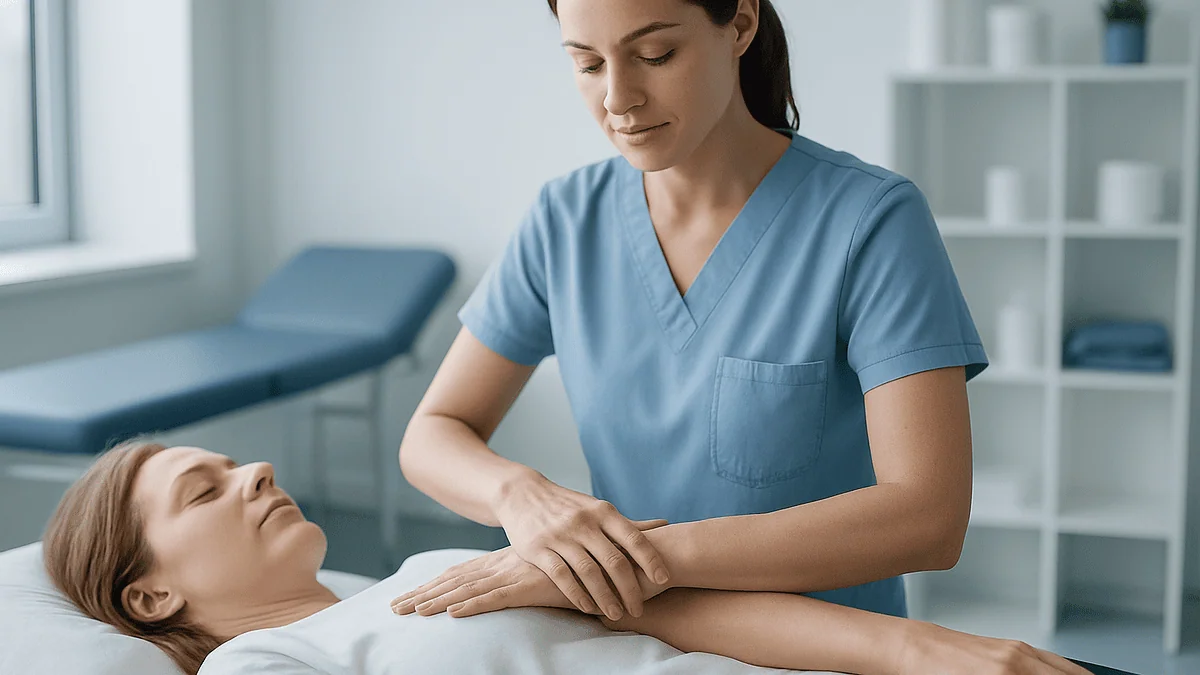
Manual lymphatic drainage, or MLD, is a specialized technique developed in the 1930s by Danish physiotherapist Emil Vodder and refined over the decades that followed. It bears little resemblance to a conventional massage. There’s no kneading, no muscle work, no pressure that leaves you sore the next day.
The reason is anatomical. The lymphatic vessels that collect fluid from your tissues sit just beneath the skin — delicate, thin-walled channels that can flatten under firm pressure. A therapist trained in MLD uses strokes light enough to stretch the skin without compressing what lies beneath it, roughly the weight of a coin resting on your forearm. Each stroke follows a deliberate direction, guiding fluid away from a swollen or surgically disturbed area toward regions where lymph nodes are still working normally.
Sessions typically begin far from the swelling itself. A therapist treating a swollen arm often starts at the neck and trunk, essentially clearing the drain before sending more fluid toward it. That sequence — proximal areas first, then working outward — is one of the clearest markers that you’re receiving genuine MLD rather than an ordinary light massage rebranded with a trendier name.
According to Cleveland Clinic, the technique is used most often for lymphedema, a chronic swelling condition, but it has migrated into post-surgical recovery of all kinds. Whether the evidence traveled with it is a different story — one we’ll get to shortly.
Why do you swell after surgery in the first place?
Every incision triggers the same cascade. Blood vessels in the area become more permeable, letting protein-rich fluid leak into surrounding tissue so immune cells and repair materials can reach the site. That fluid is the swelling you see and feel, and in an uncomplicated recovery it’s temporary — a sign the body is doing its job.
Normally, the lymphatic system mops up the excess. This network of vessels and nodes collects roughly two to three liters of fluid from your tissues every day and returns it to the bloodstream, filtering it through lymph nodes along the way. It’s a quiet, constant housekeeping service most people never think about.
Surgery can disrupt that service in two ways. First, any incision severs some of the tiny surface lymphatic channels in its path, temporarily rerouting local drainage. Second — and more significantly — operations that remove or damage lymph nodes, such as many cancer surgeries, can permanently reduce drainage capacity in an entire limb or region. When the fluid arriving exceeds what the remaining system can carry away, swelling persists and can harden over time. That chronic condition is lymphedema, and Mayo Clinic notes it most often follows treatment for breast, prostate, gynecologic, and skin cancers.
Understanding this distinction matters, because it explains why the evidence for lymphatic massage is strong in one setting and thin in another. Ordinary post-surgical swelling usually resolves on its own. Lymphedema does not.
Where the evidence is strongest: lymphedema after cancer surgery
If lymphatic drainage massage has a home turf, this is it. Roughly one in five people treated for breast cancer develops lymphedema in the arm on the treated side, usually within a few years of surgery or radiation. For them, MLD is a recognized component of standard care — recommended by the NHS, Mayo Clinic, and major lymphedema frameworks worldwide.
Here’s the honest version of what the research shows. A Cochrane systematic review examining MLD for breast cancer-related lymphedema found that adding the massage to compression bandaging produced a modest additional reduction in swelling compared with bandaging alone. Modest is the operative word. The trials were small, the quality of evidence was rated low to moderate, and compression consistently emerged as the heavier lifter.
That nuance often gets flattened in casual coverage, so it’s worth stating plainly: MLD is not a standalone treatment for lymphedema, and no credible guideline presents it as one. It works — to the degree it works — as part of a package called complete decongestive therapy, alongside compression, targeted exercise, and meticulous skin care.
Still, within that package, many patients and therapists find it valuable. Beyond the measurable volume changes, people frequently report that treated limbs feel softer and less heavy, and that the sessions help them tolerate compression bandaging. Those quality-of-life effects are harder to capture in trials but show up repeatedly in patient-reported outcomes. Evidence-based doesn’t always mean dramatic; sometimes it means genuinely helpful at the margins, for a condition where every margin counts.
Can lymphatic massage prevent lymphedema from developing?
This is where hope tends to outrun data. It would be wonderful if a course of gentle massage after node-removing surgery reliably stopped lymphedema before it started. The research, so far, doesn’t show that.
Trials testing MLD as a preventive measure after breast cancer surgery have produced mixed results, and systematic reviews have generally concluded that it cannot yet be recommended for prevention on the strength of the evidence. Some studies found no difference in lymphedema rates between people who received preventive MLD and those who didn’t. Others hinted at benefit but were too small or too short to settle the question.
What does have better support for reducing risk and catching problems early?
- Prospective surveillance — regular limb measurements after surgery so that subtle swelling is treated at the earliest, most reversible stage.
- Progressive exercise — contrary to older advice to baby the affected arm, supervised, gradually increased strength training has been shown to be safe and appears protective. Muscle contraction is one of the main pumps that moves lymph.
- Skin care and injury prevention — avoiding infections and skin breaks in the at-risk limb, since each infection can further damage lymphatic capacity.
- Maintaining a weight that’s healthy for you — higher body weight is a consistent, well-documented risk factor for developing lymphedema.
If a clinic pitches a preventive massage package as insurance against lymphedema, that’s a claim ahead of the science. Ask instead about a surveillance plan.
Does it help after liposuction, tummy tucks, or other cosmetic surgery?
Walk through any city with a busy cosmetic surgery scene and you’ll find lymphatic drainage massage marketed as a near-mandatory part of recovery — packages of six, ten, twelve sessions, sometimes starting within days of the procedure. Many plastic surgeons do recommend it, particularly after liposuction, where fluid can pool under the skin.
The evidence base, though, is strikingly thin compared with the confidence of the marketing. Research in this setting consists mostly of small studies, case series, and surgeon experience rather than large randomized trials. The biological rationale is plausible — liposuction disturbs the very tissue layer where surface lymphatics live, and gentle drainage might help clear the resulting fluid and reduce discomfort or the risk of fluid collecting in pockets. Plausible, however, is not proven, and no rigorous body of research shows that MLD changes final cosmetic results, prevents permanent complications, or speeds healing in a way that patients would notice months later.
Three practical points if you’re considering it after a cosmetic procedure:
- Get your surgeon’s explicit go-ahead first, including on timing. Massaging too early, or too aggressively, over healing tissue can cause harm.
- Be wary of anyone performing deep, painful “lymphatic” work on a fresh surgical site. Genuine MLD is gentle; post-liposuction sessions that leave you bruised are something else.
- Treat large prepaid packages skeptically. Ordinary post-surgical swelling declines on its own over weeks, which makes it easy for any intervention to look effective.
None of this means the massage is useless here — many patients describe real comfort and relief. It means the honest label is “commonly recommended, weakly studied.”
How is MLD different from a regular massage?
The confusion is understandable — both happen on a table, both involve a therapist’s hands. Almost everything else differs, and knowing the differences helps you recognize whether you’re getting the real technique.
Pressure is the giveaway. A deep-tissue therapist works into muscle; an MLD therapist barely dents the skin. If you could comfortably fall asleep mid-session and the strokes feel more like slow skin-stretching than rubbing, that’s consistent with proper technique. If it hurts, it isn’t MLD.
Direction and sequence matter just as much. Conventional massage generally follows muscle groups. MLD follows lymphatic anatomy — always moving fluid toward functioning node clusters at the neck, armpits, and groin, and always clearing the central “exits” before working on the swollen area itself. Sessions often start with breathing exercises, since deep diaphragmatic breathing changes pressure in the chest and helps draw lymph through the large central duct that empties into the bloodstream.
Rhythm is the third distinction. The strokes are slow and repetitive, with a stretch-and-release pattern timed to how lymphatic vessels naturally contract — roughly six to ten gentle pulses per minute in the larger collecting vessels.
Finally, training differs. Any licensed massage therapist can legally offer relaxation massage. Working with lymphedema or post-surgical patients calls for specific certification — typically around 135 hours of coursework covering lymphatic anatomy, technique, bandaging, and the safety flags that tell a therapist when not to proceed. That last skill may be the most valuable one on the list.
What does a session actually involve — and how many might you need?
Expect something closer to a quiet medical appointment than a spa ritual. A typical session runs 45 to 60 minutes. You’ll lie on a table, usually without oils or lotions, since the therapist needs traction against dry skin to stretch it properly. Good practitioners begin by asking about your surgery, your surgeon’s clearance, any history of blood clots or heart conditions, and how the area has been behaving.
The work itself starts centrally — neck, then trunk — before moving to the affected region. Many people find it deeply relaxing; some fall asleep. Afterward you may notice you need to urinate more than usual as the mobilized fluid is processed by the kidneys. That’s expected. What’s not expected is pain, new bruising, or worsening swelling — any of those means stop and reassess.
How many sessions depends entirely on why you’re there:
- Diagnosed lymphedema: the intensive phase of complete decongestive therapy often involves near-daily treatment for two to four weeks, followed by a long-term maintenance phase built mainly around compression garments, exercise, and self-care you perform at home.
- Post-surgical recovery without lymphedema: there is no evidence-based number. Surgeons who recommend it often suggest a handful of sessions during the peak swelling weeks, but this reflects custom more than trial data.
One honest benchmark: if you have true lymphedema and the plan consists of massage alone with no compression component, the plan is incomplete by every major guideline’s standard. Ask why.
Does lymphatic massage flush out toxins? (No — here’s what lymph really does)
Of all the claims attached to this therapy, “detox” is the most persistent and the least defensible. It deserves a direct answer: lymphatic massage does not remove toxins from your body, because that was never the lymphatic system’s job to outsource.
Lymph is mostly water, along with proteins, immune cells, fats absorbed from the gut, and cellular debris. The lymphatic system’s actual roles are collecting excess tissue fluid and returning it to the blood, transporting immune cells, filtering fluid through lymph nodes where infections and abnormal cells can be detected, and absorbing dietary fat from the intestines. Impressive work — none of it “detoxification” in the wellness-industry sense.
The organs that neutralize and excrete actual waste products are your liver and kidneys, and they do it continuously whether or not anyone massages you. A healthy liver processes roughly a liter and a half of blood every minute. No hand technique speeds that up.
Why does the myth endure? Partly because MLD produces real, noticeable effects — a limb feels lighter, a ring fits again, you urinate more after a session — and it’s tempting to narrate those effects as purification rather than fluid relocation. Partly because “detox” sells better than “modest adjunct to compression therapy.”
Here’s the thing: the honest version is still worth something. Moving stubborn protein-rich fluid out of a lymphedematous arm is a legitimate, meaningful goal. It just isn’t cleansing, and clinics leaning hard on detox language are telling you something useful about how carefully they handle evidence in general.
Massage is one piece: what complete decongestive therapy includes
When researchers say MLD “works” for lymphedema, they almost always mean it works inside a four-part program. Understanding the whole program keeps expectations realistic — and helps you spot incomplete care.
Complete decongestive therapy (CDT) is the internationally recognized standard for managing lymphedema. Its components:
- Manual lymphatic drainage — the massage itself, rerouting fluid toward healthy drainage pathways.
- Compression — multi-layer bandaging during the intensive phase, then fitted garments for maintenance. This is the workhorse. Compression provides the sustained external pressure that keeps fluid from re-accumulating between sessions, and trial after trial identifies it as the component driving most of the volume reduction.
- Exercise — performed in compression, using muscle contractions as a natural pump. Lymphatic vessels have no heart pushing them; they rely on vessel contractions, breathing, and movement.
- Skin and nail care — because lymphedematous limbs are prone to infections that can escalate quickly and inflict further lymphatic damage. Keeping skin intact and moisturized is genuinely protective, not cosmetic fussiness.
The structure matters for a practical reason: an hour of expert massage can be undone in a day if fluid simply flows back into an uncompressed limb. Think of MLD as emptying a basin and compression as fixing the faucet’s drip. Do only the first and you’ll be emptying basins indefinitely.
Mayo Clinic and the NHS both describe this combined approach as the foundation of lymphedema care. Any provider offering massage for lymphedema without discussing compression is offering a quarter of a treatment.
The evidence at a glance
Research on lymphatic drainage massage spans everything from well-conducted randomized trials to single-clinic case series, and the strength of support varies enormously by scenario. Here’s a plain-language summary of where things stand, based on systematic reviews and guidance from major medical institutions.
| Scenario | What studies show | Strength of evidence |
|---|---|---|
| Treating diagnosed lymphedema (as part of CDT) | Modest additional swelling reduction when added to compression; improved limb softness and comfort | Moderate — established standard of care |
| Preventing lymphedema after cancer surgery | Mixed trial results; not currently recommended for prevention on evidence grounds | Low |
| Swelling after cosmetic surgery (liposuction, abdominoplasty) | Small studies and surgeon experience suggest comfort and possible fluid benefits; no large trials | Low |
| General post-operative comfort and relaxation | Consistent patient-reported relief; typical of gentle touch therapies broadly | Low to moderate for comfort outcomes |
| “Detoxification” or immune boosting | No physiological basis; waste removal is performed by the liver and kidneys | None |
Two honest caveats accompany any table like this. First, “low evidence” is not the same as “proven ineffective” — for cosmetic-surgery recovery in particular, the research simply hasn’t been done at scale. Second, comfort is a legitimate outcome. A therapy that helps someone tolerate a hard recovery has value even when tape measures barely move. The problem arises only when comfort-level evidence is sold with cure-level promises.
Who should skip or delay lymphatic drainage massage
Gentle as it is, MLD deliberately moves fluid through the body — and there are circumstances where moving fluid is exactly the wrong idea. Reputable therapists screen for these before ever touching a patient, which is one more reason certification matters.
Hold off or avoid MLD entirely, per guidance from Cleveland Clinic and lymphedema care standards, if you have:
- An active skin infection or cellulitis in the area. Massage can spread infection through the very channels it stimulates, and cellulitis in a lymphedematous limb is a medical situation, not a massage appointment.
- A known or suspected blood clot (deep vein thrombosis). Manipulating a limb with a clot risks dislodging it. New one-sided swelling, warmth, or calf pain needs medical evaluation before anyone massages anything.
- Untreated congestive heart failure. A struggling heart can be overloaded by extra fluid returning to the circulation.
- Significant untreated kidney problems, for the same fluid-handling reason.
- Unhealed surgical wounds, drains still in place, or no clearance from your surgeon. Timing after surgery is your surgical team’s call, not the spa’s.
People in active cancer treatment occupy a middle category: MLD is widely used in oncology rehabilitation and is not believed to spread cancer — a fear studies have not supported — but treatment areas, radiation-affected skin, and individual circumstances mean the oncology team should approve the plan first.
A good therapist will ask about every item on this list. If yours doesn’t, that silence is your screening result.
Can you do simple lymphatic self-massage at home?
Yes — and for people managing lymphedema long-term, learning to do so is often part of the standard care plan rather than a budget substitute for it. The NHS describes this as simple lymphatic drainage: a pared-down version of the professional technique that patients or family members perform daily during the maintenance phase.
The essentials, ideally taught in person by a certified lymphedema therapist so the sequence fits your specific anatomy and surgical history:
- Start with breathing. Five or so slow, deep belly breaths change pressure inside the chest and help pull lymph through the central vessels — the system’s main highway to the bloodstream.
- Clear centrally first. Gentle strokes at the neck and the healthy node regions (collarbone, armpit, or groin, depending on the affected area) before touching the swollen limb.
- Keep it featherlight. You’re stretching skin, not pressing muscle. If your fingertips blanch or the skin reddens, you’re using too much force.
- Work toward the exits. Strokes move fluid from the far end of the limb toward the cleared node regions, a few minutes per area.
- Stay consistent. Ten to twenty minutes daily beats an occasional marathon session.
Two boundaries keep this safe. Don’t begin self-massage over a surgical site until your surgeon confirms the incisions have healed adequately. And don’t use self-massage to manage symptoms nobody has diagnosed — new or worsening swelling deserves a medical explanation before it gets a home remedy.
When to see a doctor: red flags during post-surgical recovery
Most post-surgical swelling is boring in the best way — it peaks, plateaus, and fades over days to weeks. Certain changes, though, mean the next call goes to your surgical team or doctor, not your massage therapist. No amount of gentle stroking should stand in for medical evaluation of these signs.
Contact your care team promptly if you notice:
- Sudden or rapidly worsening swelling, especially in one limb, or swelling accompanied by warmth, tightness, or calf pain — possible signs of a blood clot, which needs urgent assessment.
- Redness spreading from the surgical site, skin that’s hot to the touch, red streaks, or fever and chills — hallmarks of infection, which can move quickly in tissue with compromised lymphatic drainage.
- Increasing pain, new drainage, opening edges, or a foul odor at the incision.
- A firm, growing fluid pocket under the skin near the surgical area, which may be a seroma or hematoma requiring your surgeon’s attention.
- Shortness of breath or chest pain — emergency symptoms, always, regardless of context.
- Swelling that persists or returns weeks after surgery, a heavy or tight feeling in a limb, rings or sleeves that no longer fit, or skin that stays dented after a fingertip press. These can signal early lymphedema, and Johns Hopkins and Mayo Clinic both emphasize that earlier treatment means better long-term control.
One pattern worth naming: people sometimes book more massage sessions for swelling that’s actually getting worse, hoping to stay ahead of it. Worsening is information. Let a clinician read it.
How to find a qualified lymphatic drainage therapist
Because “lymphatic massage” appears on spa menus and hospital rehabilitation rosters alike, the title alone tells you little. The credential to look for is certified lymphedema therapist (CLT) — a designation earned through specialized programs typically requiring around 135 hours of training in lymphatic anatomy, manual technique, compression bandaging, and safety screening. Physical therapists, occupational therapists, nurses, and massage therapists can all hold it.
For diagnosed lymphedema or recovery from cancer-related surgery, a CLT working within a rehabilitation setting is the appropriate standard, and your surgical or oncology team can usually refer you. For cosmetic-surgery recovery, standards are looser, which puts more of the vetting on you.
Questions worth asking before booking:
- What lymphatic-specific training and certification do you hold, and through what program?
- Do you require surgical clearance before treating post-operative clients? (The right answer is yes.)
- How do you screen for blood clots, infection, and heart conditions?
- For lymphedema: do you provide or coordinate compression, or work with someone who does?
- What results do you realistically expect, and over how many sessions?
Listen as much to the tone of the answers as their content. A well-trained therapist talks in modest, conditional terms — swelling management, comfort, working alongside your medical team. Sweeping promises about detoxification, guaranteed sculpting results, or preventing complications are the vocabulary of sales, not clinical practice. So are pressure tactics around large prepaid packages before anyone has assessed you.
Cost matters too: sessions commonly run the price of a specialist copay to several times that, and insurance coverage generally applies only to medically indicated lymphedema treatment, not elective recovery packages. Ask before you commit.
The bottom line: what actually matters most
Strip away the marketing and a clear picture remains. Lymphatic drainage massage is a legitimate clinical technique with a genuine but specific evidence base: it earns its keep as one component of complete decongestive therapy for lymphedema, particularly after cancer-related surgery, where it adds a modest measurable benefit on top of compression and consistently improves how affected limbs feel.
Outside that lane, the honest assessment softens. As prevention, it hasn’t proven itself. After cosmetic surgery, it’s a plausible comfort measure that research hasn’t caught up with — reasonable to try with your surgeon’s blessing, unreasonable to treat as essential. As detox, it’s fiction with a soothing hand technique attached.
If I had to rank what matters most for anyone facing post-surgical swelling, the massage itself wouldn’t top the list. Early detection would — measuring and monitoring an at-risk limb so lymphedema is caught when it’s most treatable. Compression would come next, because it does the durable work. Then movement, since muscles are the lymphatic system’s engine. Then skin care, the unglamorous infection-prevention habit that protects everything else. The massage slots in after those, valuable as a supporting player and as a therapy people can actually stick with because it feels good.
That’s a less thrilling pitch than the one on the spa menu. It’s also the one the evidence will stand behind — and after surgery, when your time, money, and energy for recovery are all finite, an honest supporting player beats a false miracle every time.
Frequently asked questions
Does lymphatic drainage massage really work after surgery?
It depends on the surgery. For lymphedema following cancer-related operations, research supports it as part of complete decongestive therapy, where it adds a modest reduction in swelling beyond compression alone. For ordinary post-surgical swelling after cosmetic or other procedures, evidence is limited to small studies, though many patients report genuine comfort. It is not proven to change final surgical results or speed wound healing.
How soon after surgery can I get a lymphatic drainage massage?
Only when your surgeon says so — there is no universal timeline. Incisions need to be adequately healed, drains removed, and any clot or infection risk assessed first. Some surgical teams approve gentle work within a couple of weeks; others prefer waiting longer depending on the procedure and your healing. A reputable therapist will require surgical clearance before treating any post-operative client, and starting too early can cause harm.
How many lymphatic massage sessions do I need after surgery?
There is no evidence-based number for routine post-surgical recovery. For diagnosed lymphedema, the intensive phase of complete decongestive therapy often involves near-daily treatment for two to four weeks, followed by long-term self-care and compression. After cosmetic surgery, surgeons commonly suggest a handful of sessions during peak swelling, but this reflects custom rather than trial data. Be cautious with large prepaid packages sold before anyone has assessed you.
Should lymphatic drainage massage hurt?
No. Genuine manual lymphatic drainage is one of the gentlest hands-on therapies that exists — slow strokes that stretch the skin with roughly the pressure of a coin resting on it. Pain, bruising, or soreness afterward suggests the technique being used isn’t true MLD, and deep pressure over a fresh surgical site can be harmful. If a session hurts, stop, speak up, and reconsider the provider.
Does lymphatic massage remove toxins from the body?
No. The lymphatic system collects excess tissue fluid, transports immune cells, and absorbs dietary fat — it is not a toxin-disposal service, and massage cannot make it one. Waste products are processed continuously by your liver and kidneys. The real, honest effects of MLD involve relocating excess fluid, which can make a swollen limb feel lighter. Clinics promising detoxification are making a claim with no physiological basis.
Can lymphatic massage prevent lymphedema after cancer surgery?
Current evidence doesn’t support it for prevention. Trials testing preventive MLD after breast cancer surgery have produced mixed results, and systematic reviews conclude it cannot be recommended for this purpose yet. Better-supported strategies include prospective surveillance with regular limb measurements, supervised progressive exercise, careful skin protection, and maintaining a healthy weight. If early swelling is detected, prompt treatment at that stage offers the best long-term control.
Is lymphatic drainage massage safe after cancer surgery?
Generally yes, with your oncology team’s approval. MLD is widely used in cancer rehabilitation, and studies have not supported the older fear that massage spreads cancer. That said, radiation-affected skin, healing surgical sites, and individual treatment circumstances all matter, so clearance should come from your medical team first. Choose a certified lymphedema therapist experienced with oncology patients, since they’re trained to screen for the relevant safety concerns.
Can I do lymphatic drainage massage on myself?
Yes, and for long-term lymphedema management, daily self-massage — called simple lymphatic drainage — is often part of standard care. The essentials: begin with slow deep breaths, gently clear the healthy node areas at the neck, armpit, or groin first, then use featherlight strokes moving fluid from the far end of the limb toward those cleared regions. Learn the sequence in person from a certified therapist, and wait for surgical clearance before working near incisions.
Who should not get lymphatic drainage massage?
Avoid or delay it if you have an active skin infection or cellulitis, a known or suspected blood clot, untreated congestive heart failure, significant untreated kidney problems, or unhealed surgical wounds. In these situations, deliberately moving fluid through the body can be unsafe. New one-sided limb swelling with warmth or pain needs urgent medical evaluation before any massage. A qualified therapist will screen for every one of these conditions before treating you.
What’s the difference between lymphatic drainage massage and regular massage?
Nearly everything except the table. MLD uses very light, slow, skin-stretching strokes rather than muscle kneading, follows lymphatic anatomy toward working node clusters instead of muscle groups, and clears central drainage areas at the neck and trunk before touching the swollen region. It typically uses no oils. Therapists treating post-surgical or lymphedema patients should hold lymphedema-specific certification — about 135 hours of specialized training beyond a general massage license.
References
This article is for general information only and is not a substitute for professional medical advice. Please consult a qualified doctor about your individual situation.