

Hypermetropia (Long-Sightedness): Symptoms, Causes and Every Correction Option
Key Takeaways
- Hypermetropia means the eye is slightly too short or its cornea too flat, so light focuses behind the retina and near objects blur first.
- The NIH's National Eye Institute estimates that 5 to 10 percent of Americans are farsighted, making it a normal variant of eye anatomy rather than a disease.
- Children can mask a substantial plus prescription by accommodating, which is why dilating drops are used to reveal the true figure during their examinations.
- Long sight is present from birth and is usually unmasked, not created, in the 40s as the stiffening lens loses the focusing reserve that hid it.
- Uncorrected hyperopia in a young child can cause amblyopia or an inward squint, and correct glasses often straighten the eyes without surgery.
- Laser and lens surgery can reduce dependence on glasses in suitable adults with a stable prescription, but no procedure changes the eye's shape back to normal or halts presbyopia.
Hypermetropia, also called hyperopia, long-sightedness or farsightedness, is a common focusing error in which the eye is slightly too short or its cornea too flat, so light focuses behind the retina and near objects look blurred. It is not a disease and cannot be reversed, but it is reliably corrected with glasses, contact lenses or, for suitable adults, refractive surgery.
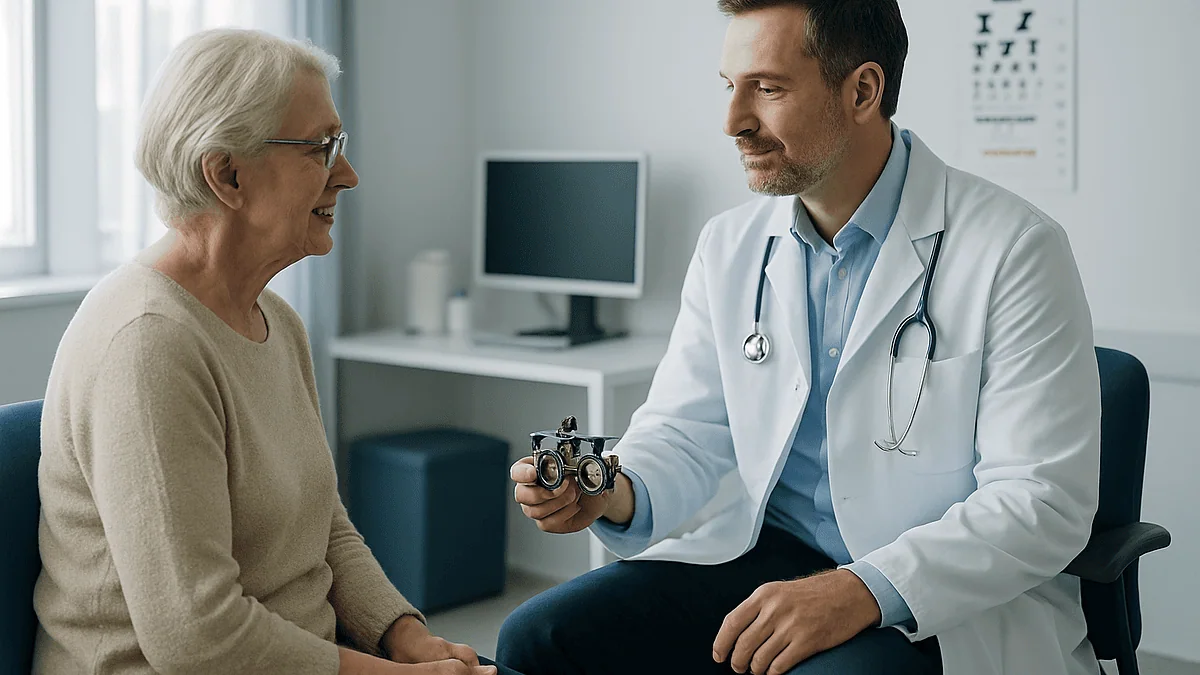
The optometrist slides one more lens into the frame and the letters on the wall snap into place. That is the moment most long-sighted adults remember: not the blur, which crept in so slowly they blamed the lighting, but the relief when the effort stopped. Many had spent years holding menus at arm’s length, rubbing their brows at the end of a workday, assuming everyone’s eyes ached by four o’clock.
Children rarely notice anything at all. A seven-year-old with a moderate prescription can read the board, race through a book and pass a basic vision screen, because young eyes have a powerful focusing muscle that quietly papers over the problem. The cost shows up elsewhere, as headaches, a wandering eye or a dislike of close work that gets mistaken for restlessness.
This guide sets out what hypermetropia is, why it behaves so differently at 7 and at 47, and what every correction option genuinely offers, according to the evidence rather than the brochure.
What is hypermetropia, in plain terms?
Think of the eye as a camera that has been built a fraction too short. Light passes through the cornea, the clear dome at the front, then through the lens behind the pupil. Together they bend the light so it lands as a sharp point on the retina, the light-sensitive layer at the back. In hypermetropia the eyeball is a little shorter from front to back than the optics require, or the cornea is flatter than average, so the focal point falls behind the retina. What actually reaches the retina is a slightly spread-out blur, and the closer the object, the more spread out it becomes.
The National Eye Institute, part of the NIH, estimates that farsightedness affects roughly 5 to 10 percent of Americans, which makes it a normal variation in human anatomy rather than a disorder. Eye specialists call it a refractive error, the same family as short-sightedness and astigmatism.
Severity is measured in diopters, the unit of lens power, written with a plus sign for long-sightedness. A prescription of +1.00 is mild and often needs no correction in a young adult. Around +5.00 or more counts as high, and at that level distance vision blurs too, not just reading. The number on a prescription tells you how much extra bending power the eye needs, not how healthy it is.
Hyperopia, long sightedness, farsightedness: are they the same thing?
Yes. Hypermetropia and hyperopia are the medical terms, the first favored in British and European practice, the second in American ophthalmology. Long sightedness is the everyday British phrase; farsightedness is the American one. The NHS uses long-sightedness, the Mayo Clinic and MedlinePlus use farsightedness, and all four labels describe exactly the same optical situation.
The everyday names are useful but slightly misleading. Long-sighted people are not gifted with superb distance vision. A person with mild hyperopia may see the far horizon clearly because their eye’s own focusing muscle can pull the image forward onto the retina. That works for distance, where little extra effort is needed, but the same muscle is already partly spent when a book arrives at 40 centimeters. The result is not so much long sight as a shrinking comfort zone that starts at the reading distance and, with age or higher prescriptions, spreads outward.
One more term causes confusion: presbyopia. That is the age-related stiffening of the lens that makes almost everyone need reading glasses from their mid-40s onward. It produces similar near blur but has a different mechanism, and someone can have both. Being told you are farsighted at 50 may in fact mean you are presbyopic, hyperopic, or a combination, and the examining clinician will tell you which.
What are the symptoms of long sightedness?
The textbook symptom is blurred close-up vision, but the lived experience is usually strain rather than blur, particularly in people under 40. Mayo Clinic and the NHS list the same cluster of complaints:
- Nearby objects look fuzzy while distant ones stay sharp, at least at first
- Squinting or narrowing the eyes to bring print into focus
- Aching, burning or tired eyes after reading, sewing, screen work or driving
- Headaches, often across the forehead or around the eyes, that build through the day
- A need for brighter light to read comfortably
Children show it differently. They may sit unusually close to the television, lose their place on a page, rub their eyes, blink or frown a lot, or simply avoid drawing and reading. Because they have never seen the world any other way, they will not complain that it is blurred.
Timing is a clue. Long-sighted eyes are usually most comfortable first thing in the morning, when the focusing muscle is rested, and worst in the evening or after a long meeting. If a headache reliably eases when you stop reading and reliably returns when you start again, that pattern is worth mentioning at an eye examination. None of these symptoms is unique to hypermetropia, which is exactly why a proper refraction, rather than self-diagnosis, settles the question.
Why young eyes can hide hypermetropia for years
The eye has a built-in autofocus called accommodation. A ring of muscle around the lens contracts, the lens fattens, and its bending power rises. In a child this system is enormously powerful, which is why a nine-year-old can read the fine print on a coin held a few centimeters from the nose. That same power lets a long-sighted child pull the focal point forward onto the retina without anyone realizing effort is involved.
Clinicians divide the resulting picture into pieces. Latent hypermetropia is the part completely masked by accommodation; it shows up only when the focusing muscle is temporarily relaxed with dilating eye drops during an examination. Manifest hypermetropia is the part that is left over and needs a lens to correct. In a young child the latent portion can be surprisingly large, which is why the NHS and the National Eye Institute both emphasize that a basic letter chart, read at distance, can miss the condition entirely.
The hiding comes at a price. Constant accommodation is muscular work, and work causes fatigue and headache. It can also drag the eyes inward, because focusing and converging are wired together, and in some children that produces a squint, which is covered later in this article. As the years pass the lens gradually stiffens and accommodation weakens, so the latent portion converts to manifest. This is why a prescription that read +1.00 at 25 may read +2.50 at 45 even though the eye itself has not changed shape.
What causes farsightedness?
Hypermetropia comes down to a mismatch between the eye’s length and its focusing power. Three structures can be responsible, alone or in combination, according to MedlinePlus and Cleveland Clinic.
The first is axial length. Most long-sighted eyes are simply a little shorter than the roughly 23 to 24 millimeters of a typical adult eye. A difference of a single millimeter shifts the focus by several diopters, which is why small anatomical variations have large optical consequences. The second is corneal curvature. A cornea that is flatter than average bends light less, so the focal point lands farther back. The third, and least common, is the lens: a lens with lower than normal power, or one displaced backward, produces the same effect. In rare cases an eye that has had its natural lens removed without a replacement becomes very highly hyperopic.
Genes matter. Farsightedness runs in families, and a child with one or both long-sighted parents is more likely to inherit a shorter eye. The exact genes are still being studied, and no single test predicts it. Reading in dim light, sitting close to screens or skipping carrots do not cause hypermetropia; these are durable myths without supporting evidence. Occasionally a medical condition such as a small-eye syndrome or, in adults, swelling behind the retina can create or increase hyperopia, which is one reason a sudden change in prescription deserves a proper look rather than a new pair of glasses alone.
At what age does hypermetropia start?
For most people it starts at birth. Newborn eyes are short because babies are small, and the great majority of infants are mildly long-sighted. The eye grows quickly in the first two years and more slowly through childhood, a process called emmetropization, and for most children the extra length gradually cancels out the focusing error. By around the age of six or seven, many are close to neutral. Others keep a modest plus prescription for life, and a smaller group remain highly hyperopic because the eye stopped growing sooner than its optics needed.
Hypermetropia does not begin in middle age, even though that is when many people are first told they have it. What changes at 40 is not the eye’s shape but its ability to compensate. The stiffening lens loses focusing range year by year, uncovering a farsightedness that was there all along. Someone who never needed glasses may suddenly find that both near work and, later, distance are blurred, and be surprised to learn the underlying prescription is plus rather than the reading-glasses minus they expected.
The practical lesson is about checking, not worrying. The NHS recommends that children have their eyes tested, including a vision screen soon after starting school, and that adults attend for a routine test at least every two years. The Mayo Clinic offers a graded schedule for adults without eye disease: every 5 to 10 years in the 20s and 30s, every 2 to 4 years from 40 to 54, every 1 to 3 years from 55 to 64, and every 1 to 2 years after 65.
Hypermetropia vs myopia: what is the difference?
The two most common refractive errors are mirror images. In myopia, or short-sightedness, the eye is too long or the cornea too steep, so light focuses in front of the retina and distant objects blur while near ones stay clear. In hypermetropia the eye is too short or the cornea too flat, light focuses behind the retina, and near objects blur first.
| Feature | Hypermetropia (long sight) | Myopia (short sight) |
|---|---|---|
| Eye shape | Shorter than average, or flatter cornea | Longer than average, or steeper cornea |
| Where light focuses | Behind the retina | In front of the retina |
| What blurs first | Near objects | Distant objects |
| Prescription sign | Plus (for example +2.00) | Minus (for example −2.00) |
| Corrective lens | Convex, thicker in the center | Concave, thicker at the edge |
| Typical course | Present from birth, often improves in childhood, unmasked in the 40s | Usually appears in school years and progresses through the teens |
| Can the eye compensate? | Partly, by accommodating, at the cost of strain | No, focusing makes it worse |
The last row explains why the two conditions feel so different. A short-sighted child cannot try harder to see the board, so the problem is spotted quickly. A long-sighted child can and does try harder, which buys clarity and pays for it in headaches. Both are corrected with lenses, but in opposite directions: a plus lens adds bending power, a minus lens subtracts it. Astigmatism, the third member of the family, can sit on top of either.
Where does astigmatism fit, and what shape is that eye?
People searching about long sight often bump into astigmatism, and the two frequently travel together. The difference lies in symmetry. A hyperopic or myopic eye is the wrong length but its cornea is still roughly a dome, like the surface of a football, curving equally in every direction. An astigmatic cornea, or occasionally an astigmatic lens, is curved more steeply in one direction than the other, closer to the back of a spoon or the side of a rugby ball. Light entering along the steep axis focuses in a different place from light entering along the flat axis, so instead of one blurred point there are two, and the image is smeared or stretched at every distance.
Because the surface is asymmetric, the correction has to be asymmetric too. Prescriptions for astigmatism include a cylinder power and an axis, in degrees, that tell the lens maker which direction to add extra bending. A long-sighted person with astigmatism will therefore have a plus sphere, a cylinder value and an axis on the same line of the prescription. The Cleveland Clinic and the NHS both describe astigmatism as extremely common in small amounts and not a sign of disease.
Symptoms overlap heavily with hypermetropia: eye strain, headaches, squinting and difficulty with fine detail. What distinguishes astigmatism is the quality of the blur. Straight lines may look slightly doubled, lights at night acquire streaks, and the letters E and F become hard to tell apart. Only a refraction can separate the contributions, which is one more reason why over-the-counter reading glasses, which correct sphere only, leave some people unsatisfied.
How is hypermetropia diagnosed?
A routine eye examination finds it. The visit usually begins with a visual acuity test, reading letters on a chart at distance and at near, followed by a refraction. In a refraction the examiner places lenses of different powers in front of each eye, often using a phoropter or trial frame, and asks which is clearer. An automated instrument called an autorefractor may give a starting estimate in seconds. The result is a prescription in diopters for each eye.
For children, and for adults with unusually variable results, the examiner may use dilating drops that temporarily relax the focusing muscle. Without this step a child’s powerful accommodation can hide much of the true hyperopia, so the measured prescription would be too weak. The drops blur near vision and cause light sensitivity for several hours, sometimes into the next day in younger children, which is worth planning around; the National Eye Institute describes this as a standard part of a comprehensive children’s examination.
Diagnosis is also the moment to check that nothing else is going on. The examiner looks at the front of the eye with a slit lamp and at the retina and optic nerve through the dilated pupil. Long-sighted eyes tend to have shallower front chambers, so a pressure check is relevant, particularly in adults with higher prescriptions. In children, the alignment of the two eyes and the vision in each eye separately are tested, because a large difference between the eyes is the single most important thing not to miss.
Glasses for long sightedness: the first and most reliable option
Spectacles remain the workhorse correction for hypermetropia, and for children under about eight they are usually the only option offered. The lens is convex, thicker in the middle than at the edge, and it adds the bending power the eye lacks so that light lands on the retina without the focusing muscle having to work overtime. For a mild prescription the lenses look almost flat; at higher powers they magnify the eyes slightly and add weight, which modern high-index materials and smaller frames reduce.
Who needs them? The NHS and Mayo Clinic agree that mild hyperopia without symptoms in a young adult often needs no correction at all. Glasses are recommended when there are symptoms, when the prescription is moderate or high, when the eyes are turning inward, or when the two eyes differ substantially. Many adults use them only for close work at first and move to full-time wear as accommodation declines.
Aftercare matters more than people expect. New plus lenses can make the floor look closer and edges seem curved for a few days, because the brain is recalibrating to a slightly magnified image; this usually settles within one to two weeks of consistent wear. Persistent dizziness, double vision or headaches beyond that window are a reason to go back and have the fit and prescription rechecked, not to abandon the glasses. Prescriptions should be reviewed at the intervals the examiner suggests, typically every one to two years, since the manifest portion of hyperopia tends to rise with age.
Contact lenses for hyperopia
Contact lenses correct hypermetropia in exactly the same way as glasses, with a convex shape, but they sit on the tear film rather than a centimeter in front of the eye. That position brings real optical advantages for higher prescriptions: less magnification, a wider field of view and none of the peripheral distortion that plus spectacle lenses can produce. For people who play sport, wear safety equipment, or simply prefer their face uncovered, they are often the first choice.
Soft lenses, worn daily and discarded on a daily, fortnightly or monthly schedule, suit most hyperopic prescriptions. Rigid gas-permeable lenses give crisper optics in some cases, particularly where astigmatism is significant, at the cost of a longer adaptation period. Toric soft lenses correct astigmatism alongside hyperopia, and multifocal contact lenses exist for adults who also have presbyopia, though they involve a visual compromise that not everyone accepts.
Fitting is a clinical task, not a shopping one. The curvature and diameter of the lens have to match the cornea, and an initial trial period with a follow-up check is standard. Hygiene is the non-negotiable part of aftercare. Both the CDC and the NHS link most serious contact-lens infections to sleeping in lenses, exposing them to water, or over-wearing them beyond the recommended schedule. A red, painful or light-sensitive eye in a lens wearer is an urgent problem, covered in the final section, and the lens should come out immediately.
Can you fix hypermetropia permanently? Laser and lens surgery explained
The honest answer is that surgery can reduce or remove the need for glasses in suitable adults, but it does not change the underlying eye or make it younger. Refractive surgery reshapes the cornea, or replaces the natural lens, so that light focuses on the retina without external help. Mayo Clinic and the National Eye Institute describe several approaches.
Laser procedures such as LASIK, LASEK and PRK use an excimer laser to steepen the central cornea, adding bending power. They are generally considered for adults whose prescription has been stable for at least a year, whose corneas are thick and healthy, and whose hyperopia is low to moderate. Higher plus prescriptions are harder to correct with laser and more likely to regress over time, which is why the laser is not offered to everyone who asks. Vision typically clears over days to weeks, with a final result assessed at around three months, and some patients experience dry eye, glare or halos during recovery.
For adults with high hyperopia, or those already developing cataract or presbyopia, lens-based surgery is often more appropriate. Refractive lens exchange removes the natural lens and replaces it with an artificial one of calculated power, a procedure identical in technique to cataract surgery. It carries the risks of intraocular surgery and permanently removes accommodation, so it is generally reserved for older adults.
None of these is offered to children, whose eyes are still growing. Every option involves a detailed suitability assessment, an informed discussion of risks and a period of post-operative follow-up. The decision belongs to the patient and the treating surgeon, weighing eye measurements, lifestyle and expectations rather than the advertising claim of a particular technique.
Hyperopia in children: why early correction protects vision for life
The stakes are higher for a child than for an adult, because a child’s visual brain is still under construction. Vision develops through the first eight or so years as the brain learns to interpret sharp images from each eye. If one eye sends a persistently blurred picture, the brain learns to favor the other, and the neglected eye’s vision fails to develop fully. This is amblyopia, sometimes called lazy eye, and once the developmental window closes it becomes very difficult to reverse. The NHS and the National Eye Institute identify uncorrected refractive error, especially a large difference between the two eyes, as one of its leading causes.
Hypermetropia carries a second risk. The extra focusing effort a long-sighted child uses to see clearly is coupled to the reflex that turns the eyes inward, and in some children the coupling tips over into a convergent squint, medically an esotropia. Glasses that remove the focusing demand often straighten the eyes without any further treatment, which is one of the more satisfying outcomes in pediatric eye care.
Managing a child’s hyperopia usually means full-time glasses in the correct, dilated prescription, regular reviews as the eye grows, and sometimes patching or other therapy for a weaker eye. Parents often worry that glasses will make the eyes dependent or weaker. The evidence points the other way: correct lenses let the visual system develop normally, and many children’s prescriptions fall naturally as the eye lengthens. Children rarely say their vision is blurred. Attend the school-entry screen, and book an examination if a squint, eye rubbing, headaches or an aversion to close work appears.
Living with long sightedness: what changes over the decades
Hypermetropia is a lifelong companion, but its demands change. In the 20s and 30s a mild plus prescription is often invisible; the eye does the work and asks nothing in return. From the early 40s onward, presbyopia begins to remove the focusing reserve that was hiding the hyperopia, and near tasks blur first, then intermediate ones like the dashboard or a computer screen, and finally distance. Long-sighted people commonly reach for reading glasses a few years earlier than their short-sighted friends for this reason.
The correction evolves accordingly. Single-vision glasses for reading may give way to separate distance and near pairs, then to bifocals or varifocals that place different powers in different zones of one lens. Adapting to varifocals takes most wearers between a few days and two weeks of steady use, and the classic advice to point the nose at what you want to see is sound. Screen work benefits from a lens set for arm’s length rather than a book distance.
Two health notes belong here. Long-sighted eyes, being shorter, tend to have a more crowded front chamber, and this anatomy is associated with a higher likelihood of angle-closure glaucoma later in life, as Mayo Clinic notes. Regular examinations that include a pressure check and a look at the drainage angle are therefore a sensible habit from middle age. Cataract, when it eventually arrives, is treated in the same way regardless of refractive error, and the replacement lens can be chosen to reduce a lifelong plus prescription at the same time.
When should you see a doctor about farsightedness?
Most hypermetropia is a routine matter for an optometrist, and the right move is simply to book an examination if near work causes strain, headaches or blur, or if a child shows any of the signs described earlier. Adults without symptoms should still follow the routine schedule their examiner recommends, since the condition becomes more apparent with age and the eye health checks that come with a full examination matter in their own right.
Some situations need faster attention. Seek same-day care, through an eye emergency service or your local urgent care route, if you experience:
- Sudden loss or blurring of vision in one or both eyes, or a curtain or shadow across part of your view
- A sudden shower of floaters or flashing lights, which can signal a retinal tear
- Severe eye pain with a red eye, headache, nausea or halos around lights, a pattern that can indicate acute angle-closure glaucoma and is more common in long-sighted eyes
- A red, painful, light-sensitive eye in a contact lens wearer
- New double vision, a drooping eyelid, or a squint that appears suddenly in a child or an adult
- Any eye injury involving chemicals, a high-speed object or a blow that changes vision
A gradual increase in a plus prescription over years is normal. A rapid jump between examinations, or a prescription that swings from one visit to the next, is not, and it deserves a full dilated assessment rather than a new pair of lenses alone. Parents should trust their instincts: an eye that turns, a child who tilts the head or closes one eye to look at things, or a toddler who does not seem to fix on faces are all reasons to ask for a referral without waiting for the school screen.
Frequently asked questions
Can you fix hypermetropia?
You can correct it fully but not reverse it. Glasses and contact lenses restore sharp near vision by adding the bending power the eye lacks, and for suitable adults refractive surgery can reshape the cornea or replace the lens so that glasses are needed less or not at all. The eye’s shorter length remains, and age-related presbyopia will still arrive on schedule, so surgery is a correction, not a cure.
What is the difference between hypermetropia and myopia?
They are optical opposites. In hypermetropia the eye is too short or the cornea too flat, light focuses behind the retina, near objects blur first and the prescription carries a plus sign. In myopia the eye is too long or the cornea too steep, light focuses in front of the retina, distance blurs and the prescription is minus. Long-sighted eyes can partly compensate by focusing harder; short-sighted eyes cannot.
At what age does hypermetropia start?
Almost everyone is born mildly long-sighted, because infant eyes are small. Most children grow out of it by around six or seven as the eye lengthens, while some keep a plus prescription for life. Adults who are first told they are farsighted in their 40s have not developed it then; the stiffening lens has simply lost the focusing power that was hiding a prescription present since childhood.
What is the eye shape of someone with astigmatism?
The cornea, or occasionally the lens, is curved more steeply in one direction than the other, like the back of a spoon or a rugby ball rather than a football. Light along the steep axis focuses in a different place from light along the flat axis, so images smear at every distance. Astigmatism commonly coexists with hypermetropia and is corrected with a cylinder power and axis added to the prescription.
Is long sightedness hereditary?
Largely, yes. Farsightedness runs in families, and a child with one or both long-sighted parents is more likely to have a shorter eye. The precise genes are still being studied and there is no predictive test, so the practical response is regular eye examinations for children of long-sighted parents rather than genetic screening. Reading habits, screen time and diet do not cause hypermetropia.
Does hyperopia get worse with age?
The eye itself usually does not change shape after childhood, but the measured prescription tends to rise. Young eyes hide part of their hyperopia by accommodating; as the lens stiffens through the 40s and 50s that hidden portion becomes visible and needs a stronger lens. From the outside it looks like worsening long sight, though it is really the loss of a compensating mechanism plus the arrival of presbyopia.
Can you have hypermetropia and presbyopia at the same time?
Yes, and the combination is common after 45. Hypermetropia is a fixed anatomical focusing error present from early life; presbyopia is the age-related stiffening of the lens that affects nearly everyone. A long-sighted person typically notices presbyopia a few years earlier than others because their focusing reserve was already partly spent. Bifocal, varifocal or separate near and distance glasses, and some contact lens designs, address both together.
Are over-the-counter reading glasses enough for farsightedness?
Sometimes, for mild symmetrical hyperopia in an adult who has already had an eye examination to rule out other problems. They correct sphere power only, use the same strength for both eyes and ignore astigmatism, so people with a difference between eyes or a cylinder component often find them tiring. They are also no substitute for the health checks a full examination includes, particularly from middle age onward.
How long does it take to adjust to glasses for long sight?
Most people settle into new plus lenses within a few days to two weeks of consistent wear. Early on, the floor may look closer and straight edges slightly curved because the lenses magnify the image and the brain is recalibrating. Varifocals can take a little longer. Headaches, dizziness or double vision that persist beyond about two weeks are a reason to have the fit and prescription rechecked.
Is laser eye surgery suitable for high hyperopia?
Usually not. Laser procedures steepen the cornea and work best for low to moderate plus prescriptions in adults whose eyes have been stable for at least a year and whose corneas are thick enough. Higher hyperopia is more likely to regress after laser treatment, so surgeons often suggest lens-based surgery instead, particularly for older adults. A detailed suitability assessment with the treating surgeon determines the appropriate option for each eye.
References
- NHS – Long-sightedness
- MedlinePlus – Farsightedness
- National Eye Institute (NIH) – Farsightedness (Hyperopia)
This article is for general information only and is not a substitute for professional medical advice. Please consult a qualified doctor about your individual situation.