

Spinal Fusion Recovery: Week by Week
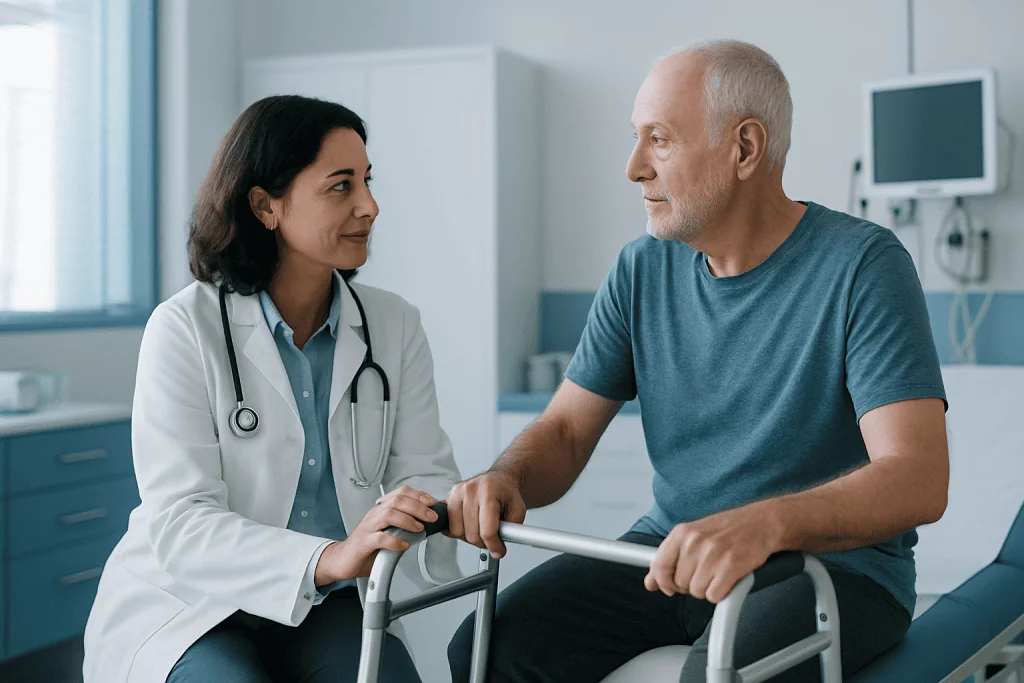
Most people stay in hospital for 3 to 5 nights after spinal fusion, start guided walking within a day, eat normally within a day or two and shower once the wound is sealed and checked. Flying home is usually possible around 10 to 14 days after surgery, if the operating team agrees. Full recovery, with bone fusion maturing, typically takes 3 to 6 months.
Key Takeaways
- Hospital stay after spinal fusion is usually 3 to 5 nights, with guided walking within a day.
- Bending, lifting and twisting are restricted during early healing; walking is the main exercise.
- Most international patients are cleared to fly around 10 to 14 days after surgery, if the team agrees.
- Driving usually resumes once you are off strong painkillers and can brake and turn comfortably.
- Full recovery typically takes 3 to 6 months, with imaging used to confirm the bone is fusing.
- Your surgeon's instructions always take precedence over any general timeline.
What recovery from spinal fusion actually involves
Spinal fusion permanently joins two or more vertebrae so they heal into a single, solid bone. The operation is performed under general anaesthesia, usually takes 2 to 6 hours, and typically combines bone graft with screws, rods or cages to stabilise a painful, unstable or deformed segment of the spine, often after the nerves have been decompressed. You can read how the operation itself is planned and performed on the spinal fusion procedure page. This guide covers what happens afterwards, week by week.
Recovery has two overlapping parts. The first is recovering from the surgery itself: the incision heals, swelling settles and you regain the confidence to walk, wash and travel. This part is usually measured in weeks. The second is the fusion itself, which is bone healing and is measured in months. The published recovery time is 3 to 6 months, and follow-up imaging is used to confirm how the fusion is progressing. Everything below describes what most people experience. Your surgeon’s instructions always take precedence over any general timeline.
Lumbar fusion recovery week by week
The first 48 hours
- Pain: back pain and muscle soreness are expected and are controlled with regular prescribed medicines, often a combination rather than a single drug. Tell the nursing team if pain stops you moving or sleeping.
- Movement and lifting: most patients begin walking within a day of surgery, with a physiotherapist or nurse alongside. Bending, lifting and twisting are restricted from the start. You are usually taught to “log-roll” out of bed, keeping the shoulders and hips moving together.
- Wound and dressing: the incision is covered with a dressing that is checked for bleeding or leakage. A drain may be in place for the first day or two.
- Eating and drinking: fluids usually start within hours of waking and a light diet typically follows within a day. Constipation is common after anaesthesia and strong painkillers, so fluids and any prescribed laxative matter.
- Washing: bed washes or assisted washing only while the dressing is fresh.
- Sleeping: on your back with knees slightly supported, or on your side with a pillow between the knees. The bed is usually adjusted to help you sit up without twisting.
Week 1
- Pain: usually easing but still noticeable, particularly when changing position. Oral painkillers replace any intravenous medicine and are gradually reduced as tolerated.
- Movement and lifting: several short walks a day, increasing gradually, are typically encouraged. Stairs are usually practised before discharge. No bending at the waist, no lifting beyond what your surgeon specifies, and no twisting. Most people are discharged after 3 to 5 nights, sometimes with a brace if the surgeon has prescribed one.
- Wound and dressing: the dressing is inspected and often changed before discharge. Stitches or staples may need removal later; dissolvable stitches and skin glue do not. You are shown how to check the wound yourself.
- Eating and drinking: normal diet. Protein, fibre and plenty of fluids support healing and reduce constipation.
- Washing: showering is usually allowed once the wound is sealed and the team confirms the dressing is waterproof or can be removed; baths and soaking are avoided.
- Driving: not recommended while taking strong pain medicine or while you cannot turn or brake comfortably.
- Work: not yet.
Week 2
- Pain: most people are on simple painkillers by now, with stronger medicine reserved for nights or physiotherapy days. Nerve-related leg symptoms that were present before surgery may improve gradually rather than immediately.
- Movement and lifting: walking distance continues to increase and is usually the main exercise. Sitting for long periods is often limited to comfort. Bending, lifting and twisting restrictions continue.
- Wound: a wound check is usually arranged around this time, and any non-dissolvable stitches or staples are typically removed. The scar may feel numb, tight or itchy.
- Eating, drinking and washing: normal, with showering as before; avoid scrubbing the incision.
- Sleeping: continue the log-roll and pillow support; many people still sleep better on a firmer mattress.
- Driving: usually still not advised; short journeys as a passenger with breaks are usually fine.
- Flying: this is the period in which many international patients are assessed for their return flight, as described below.
Weeks 3 to 6
- Pain: typically intermittent and activity-related. Most people need painkillers only occasionally by the end of this period.
- Movement and lifting: physical therapy, if recommended, usually begins or progresses now, focusing on posture, walking pattern and gentle core activation. Lifting limits and twisting restrictions generally remain in place until your surgeon reviews you.
- Wound: healed on the surface; the scar continues to fade over months. Protect it from strong sun.
- Driving: many surgeons allow driving somewhere in this window once you are off strong medicine and can perform an emergency stop and look over your shoulder comfortably. Ask before you start.
- Work: people with desk-based jobs often return part-time or with adjustments during this period; standing, walking or manual roles usually take longer.
- Sport: walking and, if approved, stationary cycling or gentle swimming. No running, contact sport, golf or gym weights.
Months 2 to 3
- Pain: usually low-level, with stiffness after inactivity more common than sharp pain.
- Movement and lifting: follow-up imaging typically checks the fusion at a review in this period. Depending on what it shows, the surgeon may ease the bending, lifting and twisting restrictions in stages and expand your physiotherapy programme.
- Work: most desk workers are back full-time; physically demanding jobs are usually reviewed individually.
- Sport: gradual return to low-impact activity as approved. High-impact and twisting sports are usually still restricted.
Months 6 to 12
- Pain: for most people, day-to-day pain is minimal by this point, although the treated area may feel stiff.
- Movement and lifting: by 3 to 6 months most people have returned to their usual daily activities, but the bone continues to mature for up to a year and imaging may be repeated to confirm a solid fusion. Lifting technique and core strength remain important long-term.
- Sport and heavier work: return to impact sport, heavy lifting or manual work is decided by the surgeon on the basis of imaging and your progress, not on the calendar alone.
When it is safe to fly home
After a hospital stay of 3 to 5 nights, most international patients are usually cleared to fly home around 10 to 14 days after surgery, once the wound has been checked, pain is controlled on oral medicine and walking is comfortable. Longer or more complex fusions, or any complication, can extend this. The operating team gives the final clearance, and a fitness-to-fly assessment before the return flight is part of the discharge process.
The timing matters for several reasons. Swelling around the incision and the deeper tissues is still settling, and cabin pressure changes and long periods of sitting can make discomfort worse. More importantly, recent surgery and reduced mobility increase the risk of blood clots in the legs, and long-haul flights add to that risk. The fitness-to-fly check typically covers the wound, your mobility and ability to sit for the flight duration, pain control, clot-prevention measures such as compression stockings or a blood-thinning injection if prescribed, and whether you need assistance at the airport.
- Request an aisle seat, and where possible extra legroom, so you can stand and walk the cabin every hour or so.
- Book airport wheelchair or mobility assistance in advance; carrying bags and queuing is more tiring than expected.
- Do not lift luggage into the overhead locker; ask for help.
- Use a small lumbar cushion or rolled jacket for support, and change position regularly.
- Carry in hand luggage: all prescribed medicines in original packaging, a copy of your discharge summary and medication list, a letter from the surgeon describing the implants, and any compression stockings or brace you have been told to wear.
- Keep well hydrated and limit alcohol during the flight.
Warning signs — when to contact your care team immediately
- Fever or chills.
- Spreading redness, warmth or increasing swelling around the incision.
- Any discharge from the wound, especially cloudy, offensive or clear watery fluid, or a wound that opens.
- New or worsening weakness, numbness or tingling in the legs or feet.
- Difficulty passing urine, or any loss of bladder or bowel control.
- Calf pain, swelling or tenderness in one leg.
- Breathlessness, chest pain or coughing up blood.
- Pain that is not controlled by your prescribed medicines or that suddenly worsens.
- A fall or sudden jolt to the back after surgery.
Recovering in Türkiye and then at home
Spinal fusion is performed within the Orthopedics & Joint Center at Acibadem hospitals in İstanbul and Ankara. After discharge you will usually spend several days in accommodation near the hospital until the wound check and fitness-to-fly assessment. Choose ground-floor or lift-access accommodation, avoid soft low sofas, and plan for someone to help with bags and shopping. The international patient team coordinates prior reports and imaging, arranges appointments, organises the hospital visit and the follow-up after you return home; interpreters can be arranged.
Before you leave, a follow-up appointment with the operating team reviews the wound, your mobility, your medicines and the restrictions that apply for the coming weeks. After you return home, follow-up is done remotely with the operating team, and you will be told when to send photographs of the wound or copies of any imaging done locally. Take home a discharge summary, the operation note, your imaging on disc or a secure link, an implant card or letter, a medication list with doses and stop dates, and written physiotherapy instructions, so that your local doctor or physiotherapist has the full picture.
Questions to ask your surgeon before you fly out
- How many levels were fused, and what implants were used?
- Exactly what may I lift, and for how long do the bending and twisting restrictions apply?
- Do I need a brace, and when can I remove it?
- Which medicines do I take, for how long, and how do I reduce them?
- Do I need clot-prevention medicine or stockings for the flight, and for how long afterwards?
- When can I shower, drive, return to work and start physiotherapy?
- What follow-up imaging is needed, when, and can it be done at home?
- Who do I contact remotely, and how quickly, if a warning sign appears?
- Are there any symptoms specific to my operation that I should watch for?
Add us as a Preferred Source to see more of our trusted health content across Google Search, AI Overviews and Discover.

Update history
- PublishedSeptember 9, 2026
- Medical review approvedSeptember 10, 2026
- Last content updateSeptember 9, 2026
More Patient Guides

Septoplasty Recovery: Week by Week
Learn what to expect after deviated septum surgery: a week-by-week septoplasty recovery timeline, when it is usually safe to fly home, and…
8
Gallbladder Surgery Recovery: Week by Week
Learn what to expect after gallbladder surgery: a week-by-week recovery timeline, pain, diet, wound care, when it is safe to fly home…
8
Robotic Hysterectomy Recovery: Week by Week
Recovery from robotic hysterectomy week by week: pain, lifting, wounds, driving, flying home safely, warning signs and questions to ask before you…
9
Breast Reconstruction Recovery: Week by Week
DIEP flap recovery week by week: hospital stay, drains, pain, walking, showering, driving, when it is usually safe to fly home, and…
8