

Are Clear Aligners as Effective as Braces? Bite Problems Each Handles and Daily Upkeep

Key Takeaways
- Aligners and braces move teeth through identical bone remodeling; the difference is how precisely each can aim force, not how the body responds.
- For mild to moderate crowding or spacing, published comparisons find aligner and brace outcomes broadly similar; for large rotations, deep bites, and jaw discrepancies, braces remain more predictable.
- Aligners work only while worn, and hospital guidance sets the target at roughly 20 to 22 hours a day, with anything less risking trays that no longer fit.
- A full orthodontic course typically spans around 18 months to two years according to the NHS, with adjustments roughly every six to eight weeks for either appliance.
- Refinement rounds, extra trays ordered when a tooth lags behind its programmed position, are common in aligner treatment and routinely extend the initial estimate.
- Retainers, not the last aligner tray, hold the result, and the NHS advises they may be needed indefinitely at night after either braces or aligners.
Clear aligners and braces move teeth using the same biology, and for mild to moderate crowding or spacing, published comparisons find them broadly similar in outcome. Fixed braces remain more predictable for severe crowding, large tooth rotations, deep bites, and complex jaw-relationship problems. Aligners demand 20 to 22 hours of daily wear; braces demand meticulous cleaning around brackets. The right choice depends on the bite and the person, decided with an orthodontist.
A father and his sixteen-year-old sit in the same waiting room for opposite reasons. She wants the treatment nobody at school will notice. He wants the one he is least likely to lose in a restaurant napkin. Both have typed clear aligners vs braces into a phone that morning and come away with a dozen confident answers that contradict each other.
The honest picture is less tidy than the advertisements and more encouraging than the skeptics. Teeth do not know what is pushing them. Bone remodels the same way whether the force comes from a wire or a shell of medical-grade plastic. What differs is how precisely that force can be aimed, how much the result depends on the wearer, and what each option asks of you every single day for a year or two.
This explainer walks through what each appliance actually does, which bite problems favor which tool, what the evidence genuinely supports, and what the daily upkeep looks like when the novelty wears off.
Clear aligners vs braces: what each one actually is
Braces are the appliance most people picture: small brackets bonded to the front of each tooth, connected by a thin metal wire that the orthodontist bends, tightens, or swaps at each visit. The wire wants to return to its ideal arch shape, and as it does, it drags the teeth along with it. Ceramic brackets tinted to match enamel work the same way and are simply less visible. Some systems place brackets on the tongue-facing side of the teeth, hidden from view but harder to clean.
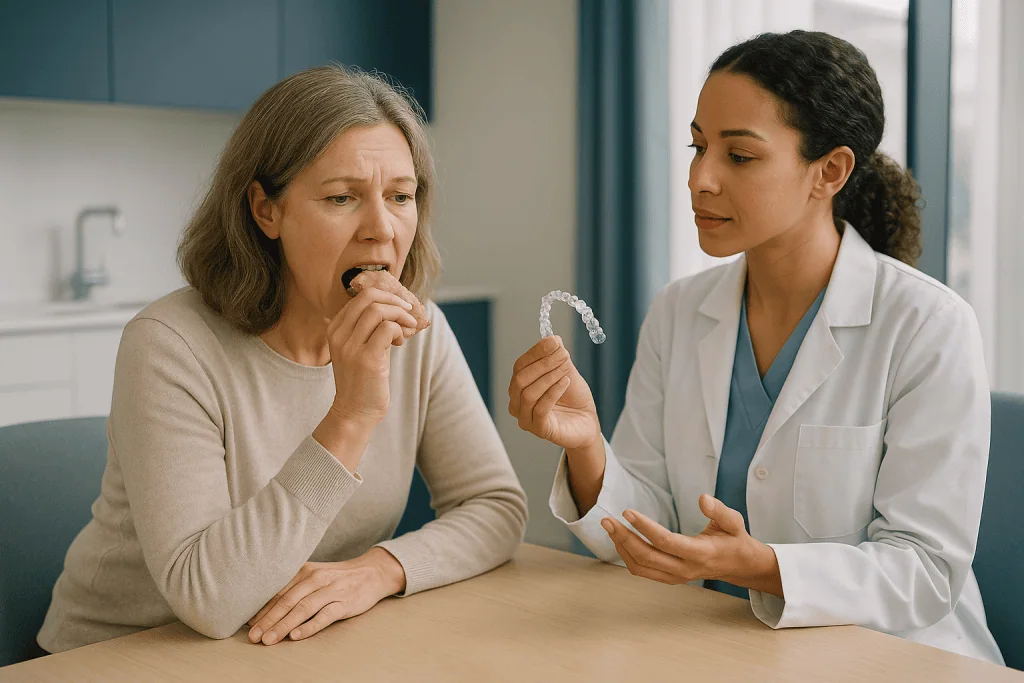
Clear aligners are a series of removable, transparent trays, each one digitally shaped to be slightly different from the current position of your teeth. You wear a tray for a set period, then move to the next in the sequence. Each tray nudges specific teeth a fraction of a millimeter. Small tooth-colored bumps called attachments are often bonded to certain teeth to give the plastic something to grip, and tiny elastic bands can be hooked between trays to pull the jaws into better alignment.
Both approaches treat malocclusion, the clinical term for teeth or jaws that do not meet properly. MedlinePlus groups malocclusion into three broad classes: a normal bite with crowded or misplaced teeth, an upper jaw that sits too far forward over the lower, and a lower jaw that sits forward of the upper. That classification matters because it predicts, better than any brochure, which appliance an orthodontist is likely to suggest.
One more distinction is worth fixing in mind early. Braces are fixed; they work whether or not you feel like cooperating. Aligners are removable; they work only while they are in your mouth. Almost every difference in effectiveness and upkeep flows from that single fact.
How teeth actually move, and why the tool matters less than you think
Teeth are not set in bone like fence posts in concrete. Each root sits in a socket lined with a thin, living ligament, and when steady, gentle pressure is applied to one side of that ligament, the body responds in a beautifully predictable way. On the compressed side, cells called osteoclasts dissolve a sliver of bone. On the stretched side, osteoblasts lay new bone down. The tooth migrates through the jaw a little at a time, and the socket travels with it.

This process, known as bone remodeling, is the same whether the pressure comes from an archwire or a plastic tray. It is also slow by design. Push too hard and the ligament is crushed rather than stimulated, which can damage the root. That is why orthodontic treatment is measured in months rather than weeks, and why the NHS describes a typical course as lasting around 18 months to two years depending on complexity.
Where the appliances diverge is in control. A bracket is glued to a precise spot on the tooth and gives the orthodontist a fixed handle. Bending a wire can tip a tooth, rotate it, push it deeper into the bone, or pull it out slightly, and the force is applied continuously around the clock. An aligner, by contrast, applies force by squeezing the crown, the part of the tooth above the gum. It has no direct grip on the root, so movements that require the root to travel a long way, or a round tooth to spin, are harder to program reliably.
Think of it as the difference between steering a shopping cart by the handle and steering it by pushing on the basket. Both get you down the aisle. One is easier to aim around a tight corner.
Are clear aligners as effective as braces? What the evidence actually shows
The short answer is: for the right bite, yes; for the wrong bite, not yet. Systematic reviews indexed in the NIH PubMed database have compared aligner and fixed-appliance outcomes for more than a decade, and a consistent pattern emerges. In cases of mild to moderate crowding or spacing, where teeth mostly need to tip or slide along the arch, the final alignment achieved by aligners is broadly comparable to braces, and treatment time is often similar or somewhat shorter.
The same reviews identify movements where aligners lag. Rotating rounded teeth such as canines and premolars, pulling a tooth downward out of the bone (extrusion), closing the gaps left by extractions, and correcting a deep bite or a significant jaw discrepancy are all described as less predictable with aligners alone. Several reviews also note that aligner cases more often need refinement, meaning an extra set of trays partway through to correct movements that did not track as planned.
Two cautions about reading this evidence. First, most comparisons are observational rather than randomized, and aligner technology has changed across the study period, so older data may understate what current systems can do. Second, effectiveness in a trial assumes the appliance was worn as prescribed. Cleveland Clinic and other hospital guidance put the wear target at roughly 20 to 22 hours a day. Fall well short of that and the trays stop matching the teeth, and no study result applies to you.
An honest orthodontist will therefore never answer this question in the abstract. They will look at your scans, classify the movements needed, and tell you which of those movements are firmly within aligner territory and which are borderline. That conversation is the real answer to the headline question.
Braces or aligners for overbite, crossbite, and other bite problems
Bite problems are not one thing. The table below groups the common ones the way orthodontists tend to think about them, alongside where each appliance usually stands. Treat it as a map of typical practice, not a verdict on any individual mouth.
| Bite problem | What it means | Where aligners usually stand | Where braces usually stand |
|---|---|---|---|
| Mild to moderate crowding | Teeth overlap because there is not quite enough room | Well suited; a common aligner case | Well suited |
| Spacing or gaps | Teeth are too far apart | Well suited for small to moderate gaps | Well suited, including large gaps |
| Increased overjet (front teeth stick out) | Upper front teeth sit too far ahead of lower | Mild cases with elastics; harder when jaw position is the cause | Established option, often with elastics or growth appliances |
| Deep bite | Upper front teeth cover too much of the lower | Less predictable; opening a deep bite is a known weak point | More predictable |
| Open bite | Front teeth do not meet when back teeth are together | Sometimes favorable, because trays can seat back teeth | Suited, sometimes with additional appliances |
| Crossbite | Some upper teeth bite inside the lower teeth | Single-tooth or mild cases | Preferred for wider or skeletal crossbites |
| Severe rotation or impacted teeth | Teeth twisted or stuck in the bone | Limited grip; often needs braces or a hybrid approach | Standard approach |
Notice how often the deciding factor is whether the problem lives in the teeth or in the jaws. Aligners are a tooth-moving tool. When the jaws themselves are mismatched, braces combined with elastics, growth-guidance appliances in younger patients, or in adults occasionally jaw surgery, are the pathways an orthodontist will discuss. None of that is a failure of aligners; it is a matter of using the instrument built for the job.
Who is usually a good candidate, and who is usually asked to wait
Orthodontists tend to sort people into three broad groups at a first consultation, and the sorting has less to do with age than most patients expect.
The first group are strong candidates for either option. Their bite falls into MedlinePlus class one, meaning the jaws line up but the teeth are crowded, spaced, or slightly tipped. Their gums are healthy, their fillings are sound, and they have no active dental disease. For this group, the aligner-versus-braces decision is largely about lifestyle, visibility, and how confidently they can commit to 20-plus hours of daily wear.
The second group are better served by braces, at least as the main appliance. Their movements involve large rotations, significant root repositioning, extraction-space closure, or a deep bite. Some will be offered a hybrid plan: braces to do the heavy structural work, then aligners to finish detailing. Others simply need fixed appliances start to finish.
The third group are asked to wait, and the reasons are protective rather than dismissive. Active gum disease has to be brought under control first, because moving teeth through inflamed bone risks loosening them. Untreated cavities need filling, since a tray or bracket can trap plaque against a weak spot. Children whose adult teeth have not fully arrived may be monitored until eruption is further along, although some early problems are treated deliberately young. Anyone with jaw joint pain, uncontrolled reflux that softens enamel, or a habit like heavy grinding will usually have that addressed alongside or before orthodontics.
There is no upper age limit. Adult teeth move more slowly than adolescent teeth because bone is denser and growth has stopped, but the NHS is explicit that adults can be treated, and adult orthodontics is now routine. What matters is the health of the foundations, not the birth year.
Clear aligners vs braces: daily upkeep compared
Effectiveness is decided in the clinic. Upkeep is decided at your kitchen sink, and it is where most of the practical differences between the two options live.
With braces, the appliance never comes off, so oral hygiene has to work around it. Food lodges between brackets and under the wire. The NHS recommends brushing after every meal where possible and at least twice daily with fluoride toothpaste, using a small-headed brush angled above and below each bracket. Interdental brushes or floss threaders reach where ordinary floss cannot. Skip this and the enamel around brackets develops chalky white patches, the early stage of decay, which remain visible long after the braces come off. Hard, sticky, and chewy foods are restricted because they snap wires and pop brackets loose. Contact sports call for a mouthguard fitted over the brackets.
With aligners, the trays come out for eating and drinking anything other than water, and that is both the gift and the burden. You can eat what you like. You also have to brush, or at minimum rinse thoroughly, before the trays go back in, because a tray seals whatever is on your teeth against the enamel for hours. The trays themselves need cleaning morning and night with a soft brush and cool water; hot water warps them. A case travels with you everywhere, since a tray wrapped in a napkin has a short life expectancy.
Both options bring you back to the clinic for adjustments, which the NHS describes as roughly every six to eight weeks. Aligner reviews are sometimes spaced further apart because there is no wire to change, but this varies by practice and by how well the trays are tracking.
The daily time cost is honestly similar. Braces demand more careful brushing. Aligners demand more frequent brushing and relentless discipline about wear time.
How long do clear aligners take compared with braces?
Treatment length depends far more on the bite than on the appliance. The NHS gives around 18 months to two years as the typical span for a full course of orthodontic treatment, and both aligners and braces fall inside that range for comparable cases. Simple alignment of a few crowded front teeth can be shorter. Complex bite correction can run longer.
Within that envelope, a few appliance-specific patterns are worth knowing. Aligner plans are mapped digitally at the outset, so you are usually told an estimated number of trays and a projected finish. That estimate assumes near-perfect wear and predictable tracking. When a tooth lags behind its programmed position, the orthodontist orders refinement trays, and the finish date moves. It is common rather than exceptional, and it is not a sign the treatment is failing, but it does mean the initial timeline should be read as an estimate, not a promise.
Braces timelines are adjusted in real time at each visit. A broken bracket or a missed appointment adds weeks. There is no equivalent of forgetting to wear them, but there is the equivalent of a wire that cannot progress because hygiene has allowed inflammation to set in.
Adults generally move more slowly than teenagers, whichever tool is used, because adult bone remodels less quickly. Anyone who has been told a treatment will take a few months regardless of their bite should treat that as a flag to seek a second opinion rather than a selling point.
Once active treatment ends, a second phase begins that is often underplayed at consultation: retention, covered later in this article. Counting only the active phase understates how long orthodontics really lasts, and that applies equally to both options.
What the first days and weeks usually feel like
Neither appliance is painful in the sharp sense, but both produce a dull, pressure-heavy ache that arrives a few hours after a change and peaks over the first two or three days. That ache is the ligament around each tooth responding to load, and it is the same biological signal whether the load comes from a wire or a tray.
With braces, the first week brings soft-tissue adjustment as much as tooth soreness. The cheeks and lips are not used to brackets, and small ulcers form where they rub. Orthodontists supply soft wax to press over any offending bracket until the lining toughens, which it does within a couple of weeks. Speech is usually unaffected after the first day or two. Soft foods and cool drinks are the standard advice while the teeth are most tender.
With aligners, the first tray feels tight and the tongue explores every edge. A slight lisp is common for a few days as speech adapts to the plastic. Most people notice tenderness each time a new tray goes in, then relief as the teeth catch up to the tray shape. Attachments, the small bonded bumps, can feel rough against the lip at first. Taking trays out and replacing them is awkward initially and becomes automatic within a week.
The following weeks settle into rhythm. Braces wearers learn which foods are worth the risk. Aligner wearers learn that a coffee habit now requires planning, and that the trays go straight back in after eating rather than waiting until the end of the meal conversation. By the first review appointment, roughly six to eight weeks in according to NHS timelines, both groups usually report that the appliance has faded into the background of daily life.
What are the downsides of clear aligners? The honest list
Aligners are often marketed as the option with no drawbacks. That is not true, and knowing the drawbacks in advance is what separates people who finish on schedule from people who quietly give up.
- Compliance carries the whole treatment. Below roughly 20 to 22 hours a day of wear, the trays stop fitting, teeth drift, and the sequence has to be redone. Nobody else can do this part for you.
- Some movements are simply less predictable. Rotations, extrusion, deep-bite opening, and large root movements are documented weak points in the PubMed-indexed comparison literature, and refinement rounds are common.
- Eating becomes a scheduled event. Every snack means trays out, brush, trays in. Grazing through the afternoon is incompatible with the wear target.
- Trays trap whatever is on the teeth. Sugary drinks sipped with trays in bathe the enamel in acid for hours, which is why anything other than water is discouraged during wear.
- Attachments and elastics are visible. The invisible promise is approximate; the small tooth-colored bumps are noticeable up close.
- Trays get lost and broken. A dropped or chewed tray means either moving to the next one early or wearing the previous one until a replacement arrives.
- Dry mouth and mild gum irritation are reported by some wearers, particularly in the first weeks.
Braces have a mirror-image list: white-spot lesions around brackets if hygiene slips, food restrictions, broken brackets, soft-tissue ulcers, and higher visibility. Neither list is a reason to avoid treatment. Both are reasons to choose the appliance whose demands you can genuinely live with for two years, rather than the one that sounds nicer for two minutes.
Why do some dentists hesitate to recommend aligners? Do aligners work as well as braces in their hands?
Patients often report leaving a consultation surprised that their dentist steered them toward braces, or declined to offer aligners at all. Several legitimate reasons sit behind that hesitation, and none of them involve secret prejudice against plastic.
The first is case selection. A clinician who has seen aligner cases stall on a stubborn rotation or an unopened deep bite will be cautious about recommending them for the same movements again. That caution reflects the evidence summarized earlier rather than contradicting it.
The second is training and scope. Orthodontists complete several additional years of specialty training after dental school. General dentists can and do provide aligner treatment for straightforward cases, but many choose to refer anything beyond mild alignment, and some prefer not to offer aligners rather than manage a case that outgrows their comfort. That is responsible practice, not reluctance.
The third is the rise of remote, direct-to-consumer aligner services that skip in-person examination. Dental professional bodies have raised concerns about treating teeth without X-rays, without checking gum and bone health, and without a clinician physically monitoring progress. A dentist who is wary of those services may sound, to a patient, as if they are wary of aligners in general. The distinction is important: the issue is unsupervised tooth movement, not the material.
The fourth is honest assessment of compliance. A clinician who has watched a patient struggle to wear a retainer, or who is treating a young teenager, may reasonably judge that a fixed appliance will produce a more reliable result. That judgment is a prediction about behavior, and it is fair to push back if you think it underestimates you, while accepting that the clinician has seen more cases than you have.
Eating, drinking, kissing: living with aligners and braces day to day
The questions people are shy about asking in the chair are often the ones that decide whether they can stick with treatment, so here they are, answered plainly.
Can you kiss with aligners in? Yes. The trays fit snugly against the teeth and do not shift with normal contact. Most partners cannot tell they are there once they know. The practical caveat is hygiene: trays should be clean, and a rinse beforehand helps with the faint plastic taste some people notice. With braces, kissing is also perfectly possible; the early-weeks ulcers that make it uncomfortable resolve as the cheeks adapt.
Can you drink coffee or tea with aligners in? Hot drinks warp the plastic, and dark drinks stain both trays and attachments. Cold water is the only drink that hospital guidance supports with trays in place. Everything else means trays out, drink, rinse, trays in. Many wearers find this quietly reduces snacking and sugary-drink habits, an incidental benefit.
What about alcohol? Same rule: trays out. Sugary mixers are hard on enamel, and clear spirits sipped with trays in still bathe the teeth in liquid the saliva cannot wash away.
Do braces really rule out popcorn, hard candy, and corn on the cob? For most people, yes, or at least they require cutting food into pieces and chewing with the back teeth. A broken bracket adds an unplanned visit and stalls progress on that tooth.
Can you play a wind instrument or contact sport? Both appliances allow it. Brass and reed players adjust their embouchure within a few weeks with braces and often find aligners easier. Sports call for a mouthguard over braces; aligners can usually be replaced with a sports guard for the game and put back in immediately afterward, keeping the wear clock ticking.
Retainers: the part of clear aligners vs braces nobody wins without
The day active treatment ends is not the day orthodontics ends. Teeth have a long memory. The ligament and bone around a freshly moved tooth take months to mature into their new position, and the soft tissues of the lips, cheeks, and tongue keep exerting the same pressures that helped create the original problem. Left unsupported, teeth drift back toward where they started. Orthodontists call this relapse, and it happens after braces and aligners alike.
Retainers are the answer, and they are not optional. Two broad types exist. Removable retainers are clear trays or wire-and-acrylic plates worn mostly at night. Fixed retainers are thin wires bonded to the back of the front teeth, invisible from the front, that stay in place for years. Many people are given both.
How long? The NHS is direct: retainers may need to be worn indefinitely, typically at night, for as long as you want the teeth to stay where they are. Early on, wear is usually more intensive, then steps down to nights only. The exact schedule is set by your orthodontist and depends on how far teeth traveled and how stable the bite is.
Aligner patients sometimes assume the last tray in the series is their retainer. It is not. Trays are made to move teeth; retainers are made to hold them, and they are fabricated from more durable material for that purpose.
Retention also comes with its own upkeep. Removable retainers need daily cleaning and periodic replacement as they wear or crack. Fixed retainers need careful flossing underneath, since plaque collects around the wire, and a bonded retainer that partly detaches can let a single tooth wander before you notice. Whichever appliance straightened your teeth, the retainer is what you will be living with longest.
What people often get wrong about clear aligners vs braces
Several beliefs circulate so widely that they deserve individual correction.
Aligners are the gentle, modern option and braces are old-fashioned. Both apply comparable forces and rely on identical biology. Braces are not outdated; they remain the more predictable tool for a range of complex movements, and self-ligating brackets, heat-activated wires, and digital planning have modernized them as thoroughly as aligners.
Aligners are always faster. For mild crowding, treatment times are broadly similar, and refinement rounds routinely extend aligner cases. Speed is set by the bite and by biology, not by the appliance.
Straight front teeth mean a fixed bite. Alignment and bite are different goals. A plan that lines up the visible teeth while leaving the back teeth meeting poorly can create chewing problems and uneven wear. This is a particular concern with remote services that photograph the smile but never assess how the jaws meet.
Adults are too old for orthodontics. Adult treatment is routine. It is slower and requires healthy gums and bone, but age itself is not a barrier.
You can take aligners out for a day or two without consequence. Teeth begin moving back within hours. A missed day is recoverable; a missed week often means trays no longer seat and the plan has to be revisited.
Braces damage teeth. The appliance does not. Plaque left around brackets does, in the form of white-spot lesions and gum inflammation. Good hygiene eliminates most of that risk, and the same applies to plaque sealed under an aligner.
The finish is permanent. Without retainers, relapse is common after either appliance. The straightening is temporary; the retaining is for life.
Questions to ask your care team before choosing
A good consultation is a conversation, and the questions below tend to surface the information that brochures leave out. Bring them written down; most people forget half of them once the scans appear on screen.
- Which specific movements does my bite need, and which of those are you confident aligners can deliver? Which would you rather do with braces?
- Is my problem in the teeth, the jaws, or both? If the jaws, what are the options for addressing that?
- What is your realistic estimate of treatment length, and what would make it longer?
- How many refinement rounds do you typically see in cases like mine?
- Would a hybrid plan, braces first and aligners to finish, make sense for me?
- What is your policy if I lose or break a tray, or if a bracket comes off?
- How often will I be seen in person, and who monitors progress between visits?
- Will I need attachments, elastics, or enamel reshaping between teeth, and where will they be visible?
- What is the retention plan afterward, for how long, and what does replacing a retainer involve?
- Do I have any gum, enamel, or jaw-joint issues that should be addressed before we begin?
- What happens if I decide partway through that I cannot manage the wear time?
Cost is a legitimate question too, and the answer varies so widely with case complexity, appliance type, and location that no figure quoted online is a useful guide. Ask your care team directly what is included, what is charged separately, and how retainers are handled after active treatment ends. The answers to that question belong in the consultation room, not in an article.
When to call your doctor or orthodontist
Most orthodontic discomfort is expected and settles within days. A smaller set of signs should prompt a call to your orthodontist or dentist promptly rather than waiting for the next scheduled review.
- Pain that is severe, worsening after the third day, or concentrated in a single tooth rather than a general ache across the arch.
- A tooth that feels noticeably loose, or that has moved in a direction the plan did not intend.
- A wire that has come free and is stabbing the cheek or gum and cannot be covered with wax, or a bracket that has detached from the tooth.
- An aligner that no longer seats fully after several days of full wear, or one that has cracked in a way that leaves a sharp edge.
- Gums that are red, swollen, bleed readily, or are receding from a tooth, which can signal inflammation that moving teeth will worsen.
- New white or brown spots on the enamel around brackets or attachments.
- A mouth ulcer that has not healed in two weeks.
- Clicking, locking, or pain in the jaw joint that started or worsened after treatment began.
- Any allergic-type reaction such as swelling of the lips or tongue, difficulty breathing, or a widespread rash, which needs urgent medical attention.
- Difficulty swallowing, or a swallowed piece of appliance accompanied by coughing or chest discomfort, which should be assessed in an emergency setting.
Between reviews, your treating team remains the right first call for anything that feels wrong. They have your records, your scans, and your plan, and they can distinguish an expected bump from a problem that needs a change of course. Every decision about continuing, pausing, or adjusting treatment rests with them and with you, not with anything you read here.
Frequently asked questions
Do aligners work as well as braces for crowded teeth?
For mild to moderate crowding, yes, comparisons in the PubMed-indexed literature find broadly similar alignment outcomes. The picture changes with severe crowding that requires extractions or large rotations, where braces are more predictable and aligner plans more often need refinement. The decisive factor is how far each tooth must travel and in what direction, which an orthodontist assesses from scans and X-rays rather than from a photograph of the smile.
What are the downsides of clear aligners?
The main downsides are total dependence on wear time, reduced predictability for rotations and deep bites, scheduled eating with trays out for every meal and drink, the risk of losing trays, and the need to brush before reinserting them. Attachments and elastics are also more visible than the word invisible suggests. None of these are reasons to avoid aligners, but they are reasons to be honest about whether you can live with them daily for a year or more.
Why don't some dentists recommend clear aligners?
Usually because of case selection, scope, or compliance rather than a dislike of the technology. A clinician may judge that your specific movements are more reliably done with braces, may prefer to refer anything beyond mild alignment to an orthodontist, or may be cautious about remote aligner services that skip in-person examination. Asking which movements concern them, and why, turns that hesitation into useful information about your own bite.
Is asking about cost the right question when comparing aligners and braces?
It is a fair question, but no figure quoted online can tell you whether a price is reasonable for your case. Cost varies with complexity, appliance type, length of treatment, refinement rounds, retainers, and location. Ask your care team what is and is not included, how retainers are handled afterward, and what happens if treatment runs longer than planned. Comparing complete plans is more useful than comparing headline numbers.
Can I kiss with aligners on?
Yes. Aligners fit snugly against the teeth and do not move during normal contact, and most partners cannot tell they are in. Keeping the trays clean and rinsing beforehand helps with the faint plastic taste some people notice. With braces, kissing is also possible; the early ulcers on the inside of the lips that can make it uncomfortable settle within a couple of weeks as the cheeks adapt.
Braces or aligners for overbite: which is usually chosen?
It depends on whether the overbite comes from tooth position or jaw position. When upper front teeth are tipped forward with the jaws otherwise aligned, aligners with elastics can be an option. When the lower jaw sits too far back, braces with elastics, growth-guidance appliances in younger patients, or in some adults surgical planning are the pathways more often discussed. An orthodontist distinguishes the two using X-rays that show the jaw relationship.
How long do clear aligners take compared with braces?
For comparable bites, similar lengths. The NHS gives around 18 months to two years as the typical span for orthodontic treatment, and both appliances fall within that range for most cases. Simple alignment can be shorter, complex bite correction longer. Aligner estimates assume near-perfect wear, and refinement rounds commonly extend them. Adults of any age can be treated but tend to move more slowly than teenagers because adult bone remodels less quickly.
What are the clear aligners pros and cons in one honest summary?
Pros: near-invisible, removable for eating and cleaning, no food restrictions, fewer soft-tissue ulcers, and often fewer emergency visits for broken parts. Cons: results depend entirely on wearing them 20 to 22 hours daily, some movements are less predictable, eating becomes scheduled, trays can be lost, and attachments are visible up close. Braces flip most of these: always working, more predictable for complex bites, but harder to clean and more visible.
Do I need a retainer after aligners as well as after braces?
Yes. Teeth drift back toward their original positions after either appliance because the surrounding bone and ligament take months to stabilize and the lips and tongue keep pressing. The NHS advises retainers may be needed indefinitely, usually at night, for as long as you want the result to hold. The final aligner tray is not a retainer; retainers are made from more durable material specifically to hold, not move, teeth.
Can adults get braces or aligners, or is orthodontics just for teenagers?
Adults are treated routinely with both appliances. Treatment is generally slower because adult bone is denser and growth has finished, and it requires healthy gums and bone as a foundation, so any gum disease is managed first. Adults with worn or missing teeth may have plans coordinated with restorative dentistry. Age itself is not a barrier; the health of the supporting tissues is what determines suitability.
References
- NHS – Orthodontics
- MedlinePlus – Malocclusion of teeth
- MedlinePlus – Orthodontia
- Cleveland Clinic – Malocclusion
This article is for general information only and is not a substitute for professional medical advice. Please consult a qualified doctor about your individual situation.

More from the Blog
Does Professional Teeth Whitening Hurt? Zings, Gum Irritation and Managing Discomfort
Professional teeth whitening is not usually painful, but many people feel temporary tooth sensitivity: brief, sharp jolts often called zingers, plus mild gum soreness…

White Marks on Teeth: Fluorosis, Demineralisation and What Helps
White marks on teeth are usually dental fluorosis, early enamel demineralization, or a developmental enamel defect — not true scars. Early demineralization can fade…

Tooth Nerve Pain: What Helps Until You See a Dentist
No home remedy switches off tooth nerve pain instantly, but several steps can ease it within minutes: hold a cold compress against the outside…
Why Do We Have Wisdom Teeth? A Leftover From an Older Menu
Wisdom teeth are third molars inherited from human ancestors whose coarse, uncooked diets demanded extra grinding power and larger jaws. As cooking and softer…

Can You Eat After a Filling, and How Long Do Fillings Last?
Yes, you can usually eat after a dental filling, though timing depends on the material. Tooth-colored composite fillings harden instantly under a curing light,…
Why Do My Teeth Hurt? Decoding Tooth Pain by Type
Tooth pain usually traces to a handful of mechanisms: exposed dentin causing sensitivity, decay or a cracked tooth, inflammation or infection inside the tooth,…