

How a Dental Bridge Is Placed: Shaping Support Teeth, Impressions and the Cementing Visit
Key Takeaways
- In a traditional bridge, the two healthy teeth beside the gap are shaped to carry crowns while the missing tooth is replaced by a fused false tooth called a pontic.
- Cleveland Clinic describes the dental bridge procedure as two or more visits, with roughly two weeks of laboratory time between the shaping appointment and the cementing visit.
- A temporary bridge is held with deliberately weak cement, so sticky foods and upward flossing are the two habits most likely to dislodge it.
- The try-in before cementing, checking margins, contacts, bite and shade with no adhesive in place, is the step that catches problems while they can still be corrected.
- Cleveland Clinic gives a typical bridge lifespan of five to fifteen years, with decay at crown margins and gum disease around the anchors being the leading causes of earlier failure.
- Implant-supported replacement avoids shaping the neighboring teeth but, according to Mayo Clinic, requires surgery and many months for bone to heal before the tooth can bear load.
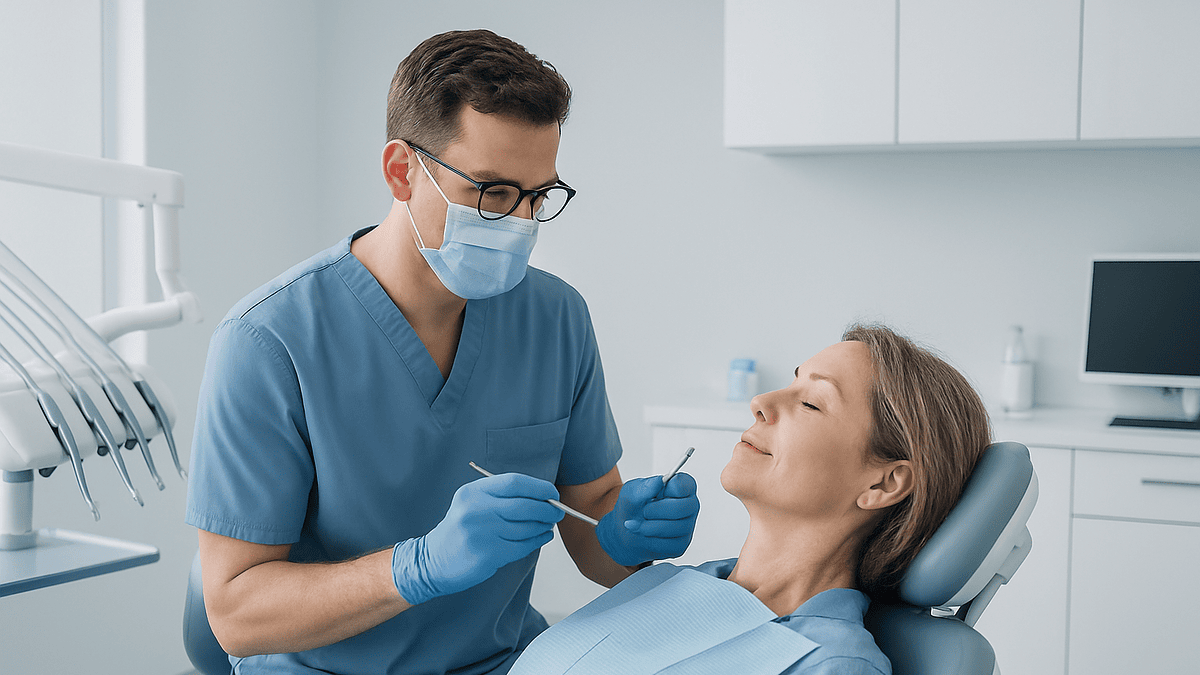
A dental bridge procedure usually takes two or more visits spread over a few weeks. At the first, the dentist numbs the area, reshapes the teeth on either side of the gap so they can carry crowns, takes an impression or digital scan, and fits a temporary bridge. A dental laboratory then builds the bridge, which is checked for fit and bite and cemented at the second visit.
The gap shows up in photographs before it shows up anywhere else. A molar came out after a failed root canal, chewing shifted quietly to the other side, and now a friend’s wedding pictures have a shadow where a tooth used to be. The dentist has suggested a bridge and mentioned reshaping the neighboring teeth, and that phrase alone has kept a few people awake at night.
A dental bridge procedure is less mysterious than the word “bridge” makes it sound. Two anchor teeth are trimmed to accept crowns, a mold or scan captures every ridge of the bite, a laboratory builds one connected piece, and a second visit fixes it in place. Between those steps sit the questions that matter to the person in the chair: how much of my own tooth goes, how long I wear the temporary, and what the cementing visit feels like.
This explainer walks through each step in the order it happens, with the evidence behind the timelines.
How a dental bridge procedure works, in plain language
A bridge does exactly what its name suggests: it spans a space by resting on supports at each end. In dentistry, the supports are the natural teeth on either side of a missing tooth, and the span is a false tooth fused between two crowns. The dental term for an anchor tooth is an abutment; the false tooth in the middle is a pontic. Cleveland Clinic describes the classic version, the traditional bridge, as a pontic held by crowns cemented onto the teeth on both sides of the gap.
The mechanics are simple. A crown is a hollow cap that fits over a trimmed tooth like a thimble over a fingertip. When two of those caps are joined to a pontic and cemented down, the whole unit becomes one rigid piece. Chewing force lands on the pontic, travels sideways through the connectors into the crowns, and is absorbed by the roots of the abutment teeth. Those roots are doing double duty, which is why the health of the anchor teeth matters so much in planning.
Not every bridge follows the same blueprint. A cantilever bridge is anchored to a tooth on one side only, an option some dentists reserve for spaces with little chewing load. A resin-bonded, or Maryland, bridge uses thin metal or ceramic wings glued to the back of neighboring teeth rather than full crowns, so far less enamel is removed. An implant-supported bridge replaces the natural abutments with implants set into the jaw, which turns the project into a surgical one with a different timeline.
What this article follows is the traditional path, because it is the one most people mean when they ask about the dental bridge procedure, and because its three defining steps, shaping, impressions and cementing, are where most of the questions arise.
Dental bridge steps begin with the first appointment: checking the anchor teeth
Before a drill comes anywhere near enamel, the dentist is trying to answer one question: can these two teeth carry a third? The first appointment is largely an inspection of the proposed abutments. The dentist looks at existing fillings, checks for cracks, tests whether the teeth are tender to tapping, and takes X-rays to see the roots and the bone around them. A tooth with a short root, a large old filling or an untreated infection may not be a safe anchor, and finding that out now avoids an unpleasant surprise later.

Gum health is part of the same assessment. A bridge is only as stable as the ground it stands on, and the NHS guidance on dental treatments makes clear that gum disease needs attention before restorative work proceeds. If pockets around the anchor teeth are deep or bleeding, a cleaning phase may be scheduled first, which lengthens the overall timeline but protects the investment.
Bite matters too. The dentist watches how the upper and lower teeth meet, because a bridge that sits even slightly high will take every chewing stroke first and can loosen, chip or make the abutment teeth ache. Some practices take a preliminary impression at this stage so the laboratory can study the bite and, in some cases, prepare a temporary bridge in advance.
This visit is also the moment for the conversation about alternatives. Cleveland Clinic lists implants and removable partial dentures alongside bridges as options for a single missing tooth, and a thorough first appointment lays those out neutrally rather than assuming the bridge is a done deal. The decision belongs to the patient and the treating dentist together, informed by the X-rays sitting on the screen between them.
Shaping the support teeth: why healthy enamel has to be removed
This is the step people worry about most, and the worry is reasonable. Two teeth that may be perfectly sound are going to be reduced in size so that crowns can fit over them. A crown adds material to the outside of a tooth, so unless the tooth is made smaller first, the finished crown would be bulky, sit high in the bite and look oversized. The dentist removes a layer of enamel from every surface, following the original shape in miniature, so that the crown restores the tooth to roughly its former dimensions.
The area is numbed first with a local anesthetic, a medicine injected near the tooth that blocks nerve signals for a few hours. Most people feel pressure and vibration during shaping but not sharp pain. The sensation is often compared with having a filling placed, only longer, because two teeth are involved and the reduction is more thorough. Cleveland Clinic notes that soreness of the teeth and gums for a few days afterward is common and expected.
Shaping also removes enamel that cannot grow back, which is the central trade-off of a traditional bridge. Once a tooth has been prepared for a crown, it will always need a crown. That is why dentists weigh a bridge carefully when both neighbors are completely untouched, and why the resin-bonded design, which keeps far more tooth, is sometimes offered for front teeth with light chewing loads.
Toward the end of shaping, the dentist smooths a defined edge, called a margin, around the base of each preparation. The crown will finish exactly at that line. A clean, continuous margin is what stops food and bacteria from slipping under the finished bridge, and getting it right takes patience rather than speed.
Impressions and digital scans: how the laboratory learns your bite
Once the abutment teeth are shaped, the dentist needs a precise record of them, the gap, the gums and the opposing teeth. Historically that meant an impression: a tray filled with soft putty-like material pressed over the teeth for a few minutes until it sets into a rubbery mold. Many practices now use an intraoral scanner instead, a small camera wand that builds a three-dimensional digital model as it passes over the teeth. Either way, the goal is identical, a copy accurate enough that a bridge built on it will seat without rocking.

Small details decide whether the impression is usable. The gum edge around each prepared tooth must be visible, so the dentist may tuck a thin cord into the gum line for a minute to push it back, or use a mild solution to control bleeding. A bite registration, a soft wafer the patient closes on, records how the upper and lower teeth meet so the laboratory can set the bridge to the correct height. Shade selection happens at the same appointment, with the dentist holding a fan of tooth-colored samples beside the neighboring teeth under natural or color-corrected light.
If anything is unclear, a second impression is taken on the spot. That few minutes of repetition saves a wasted laboratory cycle and an extra appointment later.
The mold or file then goes to a dental laboratory, where a technician either casts a model and hand-builds the bridge in wax before converting it to metal and porcelain, or mills it from a solid block of ceramic guided by the digital scan. Cleveland Clinic gives the typical laboratory turnaround as about two weeks, which is the interval that shapes the rest of the patient’s timeline.
Living with a temporary dental bridge between visits
Nobody leaves the first appointment with two stubs and a hole. A temporary bridge, usually made of acrylic or a similar resin, is fitted over the prepared teeth before the anesthetic wears off. It does three jobs: it covers the sensitive shaped enamel, it keeps the neighboring teeth from drifting into the gap, and it lets the person eat and speak more or less normally while the laboratory works.
Temporaries are deliberately held on with a weaker cement so the dentist can remove them easily at the next visit. That same weakness is why they come with a short list of habits to avoid:
- Chewing on the temporary side is best kept light; tough or crunchy foods can crack the acrylic.
- Sticky foods such as caramel or chewing gum can pull the temporary off in one piece.
- Flossing works differently. Rather than popping floss up between the units, which can lift the temporary, the dentist typically shows how to slide the floss out sideways.
Some sensitivity to cold in the days after shaping is expected, because the enamel layer that normally insulates the tooth has been thinned. Cleveland Clinic describes this as common and usually short-lived. If the temporary does come loose, it is not an emergency, but it should not be left off for days either; exposed preparations can become tender and the teeth can shift enough to spoil the fit of the final bridge. Most practices ask patients to call so it can be re-cemented, and to keep the piece safe in the meantime.
The temporary also acts as a rehearsal. If it feels high in the bite or rubs the tongue, mentioning that before the final bridge is made gives the laboratory a chance to adjust the design rather than the dentist adjusting finished porcelain.
What happens at the cementing visit
The second appointment is shorter and, for most people, easier than the first. The dentist removes the temporary bridge, cleans off any residual cement and checks that the prepared teeth are healthy. The new bridge is then tried in without any adhesive. This is the most important few minutes of the whole dental bridge procedure, because a bridge that is cemented with a flaw locked in is very hard to correct.
Several things are checked in sequence. The margins are inspected, often with a fine probe and X-ray, to confirm the crowns meet the tooth edges without gaps or overhangs. The contacts with the neighboring teeth are tested with floss; too tight and the bridge will not seat, too loose and food will pack in. The bite is checked with thin marking paper that leaves colored dots where the teeth touch; any spot that hits early is adjusted with a fine polishing bur. Finally the patient looks in a mirror and judges the shade and shape, because a bridge that fits perfectly but looks wrong is not finished.
Some dentists cement a bridge temporarily for a week or two at this point, especially when the bite is complex, so the patient can test it in real life before it is fixed permanently. Others proceed straight to final cementation once everything checks out.
For permanent placement, the inside of the crowns and the tooth surfaces are cleaned and dried, a dental cement is mixed, and the bridge is pressed firmly into position. The patient bites on a cotton roll or soft wafer while the cement sets, usually for several minutes. Excess cement is flaked away from the gum line, the floss check is repeated, and the bite is confirmed one last time. Local anesthetic is often unnecessary for this visit, though it is available if the teeth are sensitive.
How long does a dental bridge take from first visit to final fit?
The honest answer has two parts: chair time and calendar time. Chair time for the shaping and impression appointment is usually the longer of the two visits, because two teeth are prepared, records are taken and a temporary is made. The cementing visit is typically shorter. Cleveland Clinic frames the whole process as taking place over two or more appointments with roughly two weeks between them for laboratory work.
Several things stretch that timeline, and it helps to know them in advance:
- Preliminary treatment. If an anchor tooth needs a root canal, a new core filling or gum treatment first, weeks or months may be added before shaping begins.
- Extraction healing. When the missing tooth has only just been removed, many dentists wait for the gum to settle so the pontic can be shaped to the final contour of the ridge, rather than to swollen tissue that will shrink away from it.
- Laboratory remakes. If the try-in reveals a fit or shade problem, the bridge goes back and another interval is added.
- Same-day options. Some practices with in-house milling can design and make a ceramic bridge from a digital scan in a single extended appointment. That shortens the calendar but does not skip any of the checking steps.
Implant-supported bridges run on an entirely different clock. Mayo Clinic notes that dental implant treatment can take many months, because the jawbone has to heal around each implant before it can carry any load. Anyone weighing a tooth-supported bridge against an implant bridge is therefore comparing weeks against months, which for some people is the deciding factor and for others is irrelevant.
The realistic expectation for an uncomplicated traditional bridge is two appointments spread across several weeks, with the temporary bridge filling the gap in between. Anything shorter is a bonus; anything longer usually has a reason worth asking about.
Who a dental bridge is usually for, and who is usually asked to wait
The classic candidate is someone missing one tooth, or occasionally two adjacent teeth, whose neighbors on both sides are present, well rooted and either already crowned or in need of some restoration anyway. When an anchor tooth already carries a large filling, crowning it as part of a bridge costs little in healthy enamel and may strengthen it. Cleveland Clinic lists restoring chewing, speech, appearance and preventing drift of the remaining teeth as the reasons bridges are recommended.
Good candidates also tend to share a few background features: gums that are healthy or have been treated to stability, a bite that is not destructively heavy, and a daily cleaning routine they can realistically keep up, because the underside of a pontic needs cleaning that a toothbrush alone cannot reach.
Other people are commonly asked to wait or to consider a different route:
- Anyone with active, untreated gum disease around the proposed anchors. Bone loss can undermine a bridge from beneath, so stabilizing the gums comes first.
- People whose anchor teeth have cracks, very short roots or heavy mobility. These teeth may not survive the added load.
- Those with a gap so long that it would need three or more pontics on two anchors; the lever forces rise sharply and dentists often steer toward implants or a removable option.
- Patients with a recent extraction whose ridge is still remodeling, as noted above.
- Children and adolescents whose jaws are still growing, in whom fixed restorations can end up out of position as the bones develop.
Being asked to wait is not a refusal. It is usually a sequencing decision: treat what is unstable, let it settle, then build. Which route ultimately fits a given mouth is a judgment for the treating dentist, made with the patient and with the X-rays in view.
Dental bridge vs implant vs partial denture: how the options compare
A bridge is one of three mainstream ways to replace a single missing tooth, and the dental bridge procedure is easier to weigh when the alternatives sit beside it. The table below summarizes the general features that Cleveland Clinic, Mayo Clinic and the NHS describe for each option; individual cases vary, and none of these rows amounts to a recommendation.
| Feature | Traditional bridge | Implant and crown | Removable partial denture |
|---|---|---|---|
| What supports it | Crowns on the two neighboring teeth | A titanium post healed into the jawbone | Clasps or rests on remaining teeth and the gums |
| Effect on neighboring teeth | Enamel removed for crowns | Neighbors left untouched | Neighbors untouched, but clasps rest on them |
| Surgery needed | No | Yes, to place the implant | No |
| Typical timeline | Two or more visits over a few weeks (Cleveland Clinic) | Many months, allowing bone to heal (Mayo Clinic) | Several visits over a few weeks |
| Fixed or removable | Fixed | Fixed | Removable; taken out for cleaning |
| Bone preservation at the gap | Does not stimulate bone under the pontic | Load on the implant helps maintain surrounding bone | Does not stimulate bone |
| Cleaning | Floss threaded under the pontic daily | Brushed and flossed like a natural tooth | Removed and cleaned separately |
Two patterns stand out. A bridge is the fastest fixed option and avoids surgery, but it spends enamel on the neighbors and leaves the bone under the gap unloaded. An implant protects the neighbors and the bone but asks for a surgical procedure and patience; Mayo Clinic notes that people with certain medical conditions, heavy smoking habits or inadequate bone may not be suitable without additional steps. A removable partial denture is the least invasive and the easiest to modify later, at the price of being removable.
Which trade-off is acceptable depends on the state of the neighboring teeth, the person’s health, their tolerance for surgery and how they feel about a removable appliance. That weighing is exactly what the first appointment is for.
What the days and weeks after a dental bridge procedure usually look like
The first evening after the shaping appointment is mostly about numbness wearing off and the novelty of a temporary bridge. Lips and cheek can feel thick for a few hours; eating on the other side until sensation returns avoids an accidental bite. Once feeling comes back, a dull ache in the gums around the prepared teeth is common, along with a sharp twinge when something cold touches the area. Cleveland Clinic describes several days of soreness and sensitivity as the norm rather than the exception. Over-the-counter pain relievers, chosen with the dentist’s advice, are the usual approach; no one should need anything stronger for an uncomplicated case.
During the temporary phase, the day-to-day rules are the ones covered earlier: soft-side chewing, no sticky foods, floss pulled out sideways. Many people forget about the temporary within a few days, which is exactly when it is most likely to be dislodged by an absent-minded toffee.
After the cementing visit, a second adjustment period begins. The new bridge feels larger than it is for a day or two, the tongue explores it constantly, and speech may be fractionally altered for a short spell. Mild bite awareness, the sense that one spot touches first, sometimes appears once the cement has fully set and the numbness of the appointment has passed. That is worth a quick return visit for a small polish rather than something to tolerate, because a high spot can make the anchor teeth ache and can chip porcelain over time.
Within a couple of weeks the bridge should feel like part of the mouth. The habit that matters most from this point is threading floss or using an interdental brush under the pontic every day, because the space between the false tooth and the gum is where plaque collects unseen. A routine dental examination is typically the moment the dentist first checks the margins, the bite and the gum health around the new work.
How long does a dental bridge last, and what shortens its life?
Cleveland Clinic gives a typical lifespan of five to fifteen years, with some bridges lasting longer, and that spread is not a hedge. The upper and lower ends are determined by different things, most of them within the patient’s and dentist’s influence.
Bridges rarely fail because the porcelain wears out. They fail at the interfaces. The most common problems reported in dental literature and echoed in Cleveland Clinic’s overview are decay at the crown margins, gum disease around the abutments, loss of the anchor tooth’s nerve, fracture of the porcelain and loosening of the cement. Each has a mechanism worth understanding.
Decay at the margin happens when plaque sits at the junction between crown and tooth, exactly where enamel was thinned during shaping. A crown itself cannot decay, but the tooth beneath its edge can, and that edge is often below the gum line where brushing misses it. Gum disease around anchors follows the same logic: the pontic creates a sheltered zone, and if floss is not threaded beneath it daily, the bone around the abutments can gradually recede.
Nerve damage in an abutment can appear years later. Shaping a tooth removes enamel close to the pulp, and a small proportion of prepared teeth eventually become inflamed and need root canal treatment through the crown. Porcelain fracture and cement loosening are mostly mechanical, driven by heavy grinding, chewing ice or hard candies, or a bite that was slightly high from the start.
The practical reading of the five-to-fifteen-year range is this: the lower end tends to belong to bridges on borderline anchor teeth in mouths where the underside is never cleaned, and the upper end to well-designed bridges on sound teeth that are flossed daily and checked at regular examinations. No dentist can promise where a particular bridge will fall, but the levers that push it toward the longer end are not mysterious.
What people often get wrong about getting a bridge
Several beliefs circulate around bridges that do not hold up against what the evidence and guidance actually say.
“They only drill the bad teeth.” The opposite is true. The missing tooth is gone; it is the two healthy neighbors that are shaped. Anyone who assumes their intact teeth will be left alone is in for a surprise at the first appointment, which is why this article spends so long on the shaping step.
“A bridge is permanent, so I can stop worrying about that gap.” A bridge is fixed, not permanent. Cleveland Clinic’s five-to-fifteen-year figure means most people who receive a bridge in midlife will need it replaced or revised at least once, and each replacement asks a little more of the anchor teeth.
“Crowned teeth can’t decay.” The crown material cannot, but the tooth edge beneath it can, and margin decay is one of the leading reasons bridges fail. A bridge raises, rather than lowers, the importance of cleaning that gum line.
“Flossing a bridge is the same as flossing normal teeth.” It is not, because the three units are joined and floss cannot pass between them from above. It has to be threaded underneath the pontic with a floss threader or replaced by an interdental brush. Skipping this step is the single most common reason gums around a bridge deteriorate.
“If the temporary falls off, just wait for the next appointment.” Exposed prepared teeth become sensitive and can shift within days, which can ruin the fit of a bridge the laboratory is already building. A quick re-cementing visit protects weeks of work.
“An implant is always better.” Implants preserve neighbors and bone, but they require surgery, healthy bone and months of healing, and Mayo Clinic notes they are not suitable for everyone. For a person with two already-crowned neighbors who wants a fixed tooth without surgery, a bridge can be the more sensible choice. The better option is the one that fits the mouth, not the one with the more modern name.
Questions to ask your care team before the first drill touches enamel
A good dental bridge procedure begins with a good conversation, and dentists generally welcome patients who arrive with specific questions. These are the ones that tend to change decisions.
- How healthy are the two anchor teeth, and what did the X-rays show about their roots and the bone around them?
- Do either of these teeth already have large fillings or crowns, or would they be completely untouched teeth being shaped for the first time?
- Is a resin-bonded bridge, which removes far less enamel, a reasonable option for this particular gap, and if not, why?
- How would an implant compare for my mouth specifically, in terms of bone available, medical history and timeline?
- What material will the bridge be made of, and what does that mean for appearance and for wear on the opposing teeth?
- How long should I expect to wear the temporary, and what should I do if it comes loose?
- Will the bridge be cemented permanently at the second visit, or trialed first with temporary cement?
- How exactly should I clean under the pontic, and can someone show me with a threader or interdental brush before I leave?
- Do I grind or clench, and would a night guard be advisable to protect the porcelain?
- What signs after cementing would you want me to call about rather than wait for my next examination?
- If an anchor tooth developed a problem years from now, what would the options be?
Two of these deserve particular weight. The question about untouched versus already-restored neighbors gets to the heart of the enamel trade-off, and the answer often tips a decision toward or away from a bridge. The question about cleaning under the pontic is the one that most influences how long the finished bridge will serve, and a five-minute demonstration in the chair is worth more than any leaflet.
None of these questions second-guesses the dentist. They simply make sure that the person whose teeth are being shaped understands what is being traded and why.
When to call your doctor or dentist after a dental bridge procedure
Most of what follows a bridge appointment is mild and predictable: a few days of soreness, some cold sensitivity, a temporary that feels a little foreign. A shorter list of signs deserves a phone call rather than patience, and knowing them in advance takes much of the anxiety out of the waiting period.
Call the dental practice promptly if any of the following occur:
- The temporary or the final bridge comes loose, cracks or falls out. Bring the piece with you if you can.
- Pain that worsens after the first few days instead of easing, or pain that wakes you at night, which can signal an inflamed nerve in an anchor tooth.
- A persistent high spot in the bite, so that one area touches first every time you close, lasting more than a few days.
- Sensitivity to hot or cold that lingers for many seconds after the trigger is removed, or that is getting worse rather than better week by week.
- Bleeding, swelling or a bad taste around the bridge that does not settle with careful cleaning.
- Any sensation of the bridge rocking or lifting when you chew.
Seek same-day or urgent care, through the dental practice, an urgent dental service or, if those are unavailable, a general emergency service, for red-flag signs: swelling of the face or jaw that is spreading, swelling that makes it difficult to open the mouth, swallow or breathe, fever alongside dental pain, or a swelling under the tongue or in the floor of the mouth. The NHS lists facial swelling with difficulty swallowing or breathing among the dental symptoms that need emergency assessment, because an infection in these tissues can progress quickly.
A loose temporary at nine in the evening is an inconvenience, not an emergency; a swollen jaw and a fever are the reverse. When in doubt, a call to the practice is never the wrong move, and the treating team is the right place for every decision about what happens next.
Frequently asked questions
Is it painful to get a dental bridge?
Most people describe the shaping appointment as uncomfortable rather than painful, because the area is numbed with local anesthetic before any enamel is removed. Pressure and vibration are felt; sharp pain usually is not. Cleveland Clinic notes that soreness of the gums and sensitivity to cold for several days afterward are common. The cementing visit is typically easier, and many people do not need numbing for it.
How long does it take for a dentist to do a bridge?
Cleveland Clinic describes the process as two or more appointments spread over a few weeks, with about two weeks of laboratory time between shaping and cementing. The first visit is the longer one because two teeth are prepared, records are taken and a temporary is fitted. Preliminary gum or root canal treatment, healing after an extraction or a laboratory remake can extend that timeline.
Who is not a good candidate for a dental bridge?
People whose anchor teeth are cracked, loose, short-rooted or surrounded by active gum disease are usually asked to wait or to consider another option, because those teeth may not carry the extra load. Very long gaps, jaws that are still growing and freshly extracted sockets that have not settled are other common reasons to delay. The final judgment rests with the treating dentist after examination and X-rays.
How long does a dental bridge last?
Cleveland Clinic gives a typical range of five to fifteen years, with some bridges lasting longer. Where a particular bridge falls depends largely on the health of the anchor teeth, daily cleaning under the pontic, bite forces and regular examinations. Bridges most often fail through decay at the crown edges or gum disease around the anchors rather than through wear of the porcelain itself.
What are the dental bridge steps in order?
The sequence is examination and X-rays of the anchor teeth, numbing and shaping those teeth to accept crowns, taking an impression or digital scan along with a bite record and shade choice, fitting a temporary bridge, laboratory fabrication, and finally a try-in at the second visit where fit, contacts, bite and appearance are checked before the bridge is cemented in place.
What happens if my temporary dental bridge falls off?
It is not an emergency, but it should be re-cemented within a day or two. Exposed prepared teeth become sensitive, and the neighboring teeth can shift enough in a few days to spoil the fit of the final bridge already being made. Keep the piece safe, avoid chewing on that side, and call the practice for a short re-cementing appointment.
Dental bridge vs implant: which is better for one missing tooth?
Neither is universally better. A bridge avoids surgery and is finished in weeks, but requires shaping the neighboring teeth and does not stimulate the bone under the gap. An implant leaves the neighbors untouched and helps maintain bone, but needs surgery and, according to Mayo Clinic, many months of healing. The right choice depends on the condition of the neighbors, bone available and personal health.
How much of my natural tooth is removed for a bridge?
Enough enamel is removed from every surface of each anchor tooth so that a crown can fit over it and restore the original size. The exact amount depends on the crown material and the tooth, and the dentist can explain it for your case. That enamel does not grow back, so a tooth shaped for a bridge will always need a crown, which is the main trade-off of a traditional bridge.
Can I eat normally right after the bridge is cemented?
Most dentists suggest waiting until the cement has fully set and any numbness has passed, then easing back into normal foods over a day or two. The bridge may feel large and the bite slightly unfamiliar at first. Very hard items such as ice or hard candies are best avoided long term, because they can chip porcelain or loosen cement over time.
How do I clean under a dental bridge?
Floss cannot pass between the joined units from above, so it has to be threaded beneath the pontic using a floss threader, or the space cleaned with an interdental brush or a water flosser. This should be done once a day along with normal brushing, because plaque trapped under the false tooth is a leading cause of gum disease and decay around the anchor teeth.
References
This article is for general information only and is not a substitute for professional medical advice. Please consult a qualified doctor about your individual situation.

More from the Blog
Dental Implants vs Dentures: Function, Comfort and Long-Term Cost Compared
Dental implants generally restore stronger chewing, feel closer to natural teeth, and help preserve jawbone — but they require surgery and a higher upfront…

Diabetes and Dental Implants: What Good Glucose Control Makes Possible
Most people with diabetes can receive dental implants successfully when blood glucose is well managed. Studies report implant survival above 90 percent over several…

Can You Have an MRI With Dental Implants? The Short Answer Is Reassuring
Yes, almost everyone with dental implants can safely have an MRI. Modern implants are made of titanium or zirconia, materials with essentially no magnetic…
Dental Implants for a Single Front Tooth: Why the Smile Zone Has Stricter Candidacy Rules
Yes, a dental implant can replace a single front tooth, but the smile zone is judged more strictly than back teeth. The dental team…
CBCT Scan: Why 3D Imaging Comes Before Every Serious Implant Plan
A CBCT (cone beam computed tomography) scan builds a detailed 3D image of the jaws, teeth, nerve canals, and sinuses in a single quick…

Osseointegration: How Implants Fuse With Bone — the Science Made Simple
Osseointegration is the biological process in which living bone grows directly onto the surface of a titanium implant, anchoring it without cement, screws into…