

After a Dental Hygiene Appointment: Brief Sensitivity, Foods to Delay and Home Routine
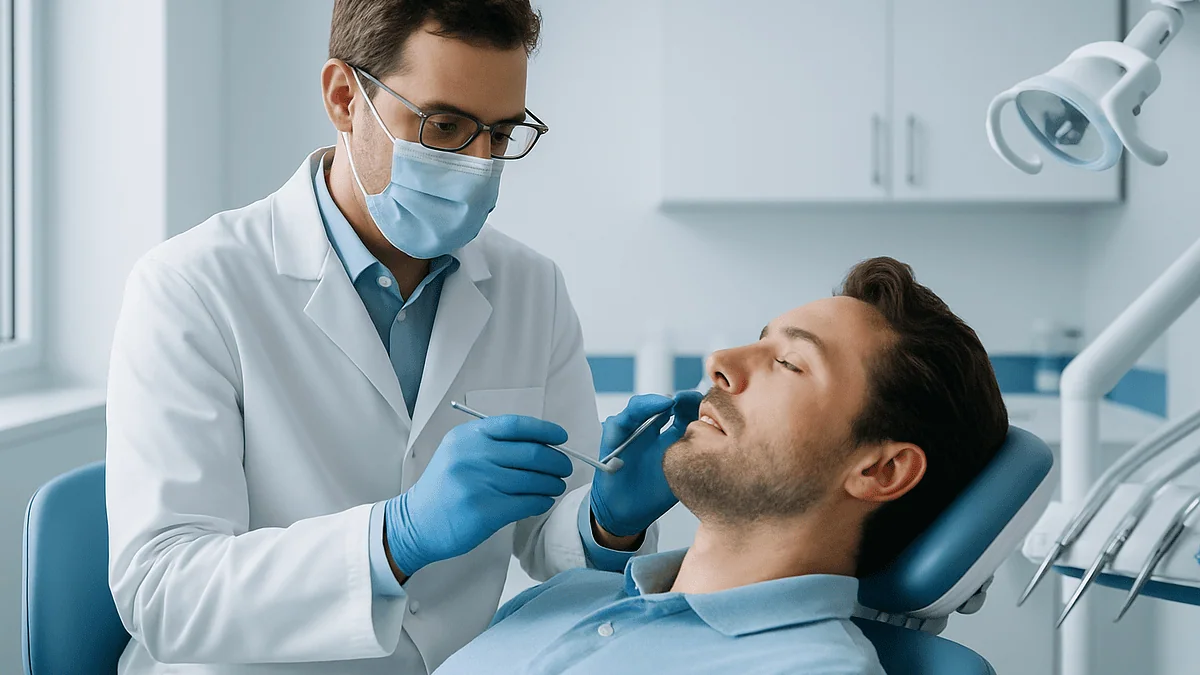
Key Takeaways
- Calculus that has coated a tooth for months acts as an insulator, so removing it exposes dentin to cold and sweet for the first time in a long while, which is why the sting appears the same day.
- The NHS notes that root planing, the deeper procedure used for periodontitis, can cause discomfort for up to 48 hours, while sensitivity after a routine scale and polish is generally milder and shorter.
- Cleveland Clinic describes procedure-related tooth sensitivity as temporary, typically fading over days to a few weeks, and a pattern that worsens instead of easing is the signal to call.
- Bleeding gums are a sign of plaque-driven gingivitis, per MedlinePlus, and the fix is gentler, more thorough brushing plus daily interdental cleaning, not brushing less.
- The NHS advises spitting rather than rinsing after brushing, because rinsing washes away the fluoride film before it can strengthen enamel.
- Check-up and hygiene intervals are set by individual risk, from every three months to every two years in NHS guidance, so the six-month habit is a convention rather than a rule.
Mild tooth sensitivity after a dental cleaning is common and usually short-lived. Removing hardened plaque uncovers tooth surfaces and gum margins that were coated for months, so cold, heat and sweet foods can sting for a few days. For most people it settles on its own within days to a couple of weeks. Lukewarm, soft foods, gentle twice-daily brushing with fluoride toothpaste and daily interdental cleaning help; contact your dentist if pain worsens or persists.
The receptionist hands you a small paper cup of water, and you take one careful sip. It goes straight to a back molar like a tiny electric jolt. Ten minutes ago the hygienist was chatting about her weekend while an ultrasonic tip hummed against your teeth; now the tooth that felt nothing all year is suddenly very awake. You run your tongue along the front teeth. They feel glassy, almost unfamiliar, the way a windshield feels after the wipers finally clear months of grime.
This is the moment most people start searching for after dental cleaning sensitivity, usually in the parking lot. Is it normal? Did something get damaged? Can I still have the coffee I was planning?
The short version is reassuring, and the longer version is more interesting: what you are feeling is the predictable result of removing a hardened shell that had been quietly insulating your teeth. Knowing why it happens makes the next few days easier to manage, and it tells you exactly which signs would justify a phone call.
What actually happens during a dental hygiene appointment?
A hygiene appointment is a professional cleaning, and the word professional is doing real work. Plaque is the soft, sticky film of bacteria that forms on teeth every day; when it is left in place it absorbs minerals from saliva and hardens into calculus, also called tartar, a crust that no toothbrush can remove. The core of the visit is scaling: physically lifting that calculus off the tooth surface, including the part of the tooth that sits just below the gum line where a brush cannot reach.
Hygienists use two families of instruments. Ultrasonic scalers vibrate a metal tip at high frequency while spraying a fine water mist, shattering calculus and flushing debris away. Hand scalers and curettes are slim, curved steel tools that scrape the remaining deposits off by feel. Many clinicians use both, finishing with hand instruments to check that every surface is smooth.
Polishing follows. A soft rubber cup spinning with a mildly gritty paste removes surface stain and the last thin layer of plaque. Some offices use an air-powder jet instead. Either way, the aim is a smooth surface, because bacteria cling more easily to rough ones.
Depending on your risk, the visit may end with a fluoride varnish, a sticky coating painted onto the teeth that releases fluoride slowly to strengthen enamel. The NHS describes fluoride varnish as a standard preventive measure, particularly for people at higher risk of decay.
Alongside the mechanical work, the hygienist assesses the gums: measuring pocket depths around each tooth with a thin probe, noting bleeding points and looking for early signs of gum disease. That assessment is often what decides whether your next visit is routine or something more involved.
Why does after dental cleaning sensitivity happen?
To understand the sting, picture the anatomy. Enamel is the hard outer shell covering the crown of each tooth. Beneath it lies dentin, a softer, living layer riddled with microscopic tubules that run inward toward the pulp, the nerve-rich center of the tooth. Where a tooth meets the gum, and especially on any root surface exposed by receding gums, there is no enamel at all. Dentin sits nearly at the surface, protected only by a thin cement-like layer and by whatever is covering it.
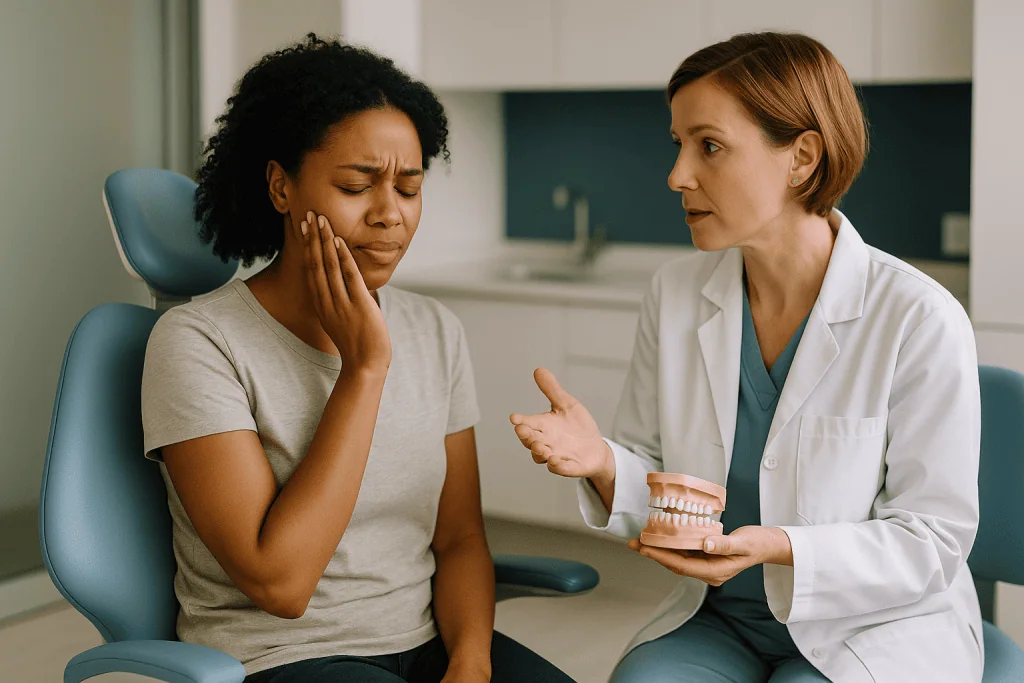
For months, calculus and plaque have been that cover. They are unhealthy, but they are also an insulator. Scaling strips them away in a single afternoon. Cold water, air from the suction tip and the metal instruments themselves now reach dentin that has not felt a temperature change in a long time. Fluid in the tubules shifts, nerve endings in the pulp register the movement and you feel a sharp, brief zing. Cleveland Clinic describes this open-tubule mechanism as the basis of most tooth sensitivity, whether the trigger is a cleaning, gum recession or worn enamel.
Several factors amplify the effect after a hygiene visit:
- Gum tissue that was swollen from gingivitis, the early inflammatory stage of gum disease, shrinks back as it heals, exposing a little more root.
- Ultrasonic water spray and polishing temporarily dehydrate the tooth surface, which heightens temperature response.
- Teeth that already had recession, cracks or worn enamel had less reserve to begin with.
None of this means the enamel was harmed. Scaling instruments are designed to remove calculus, which is far softer than enamel, and studies of properly performed scaling show removal of deposits, not healthy tooth structure. The tooth has simply lost a coat it should never have been wearing.
How long does sensitivity last after a cleaning?
The honest answer is: not long, for most people, but with a range. Cleveland Clinic characterizes sensitivity following dental procedures as temporary, typically fading over days to a few weeks as the tooth surface rehydrates, saliva deposits minerals back into open tubules and the gums settle. After a routine scale and polish with little inflammation to begin with, many people notice the effect only that evening and the next morning.
The picture shifts when the appointment was deeper. Root planing, the smoothing of root surfaces below the gum line in treated gum disease, disturbs more tissue. The NHS notes that root planing can cause pain and discomfort for up to 48 hours afterward, which is why it is often done under local anesthetic and sometimes over more than one visit.
What shapes your personal timeline?
- How much calculus was removed. More deposit means more newly uncovered surface.
- The state of your gums beforehand. Inflamed gums bleed more and take longer to firm up.
- Existing recession or enamel wear. These teeth were sensitive in waiting.
- Habits in the following days. Ice-cold drinks and acidic snacks keep tubules open longer.
The pattern matters as much as the duration. Expect sensitivity that is sharp but brief, triggered by cold or sweet, and that eases as soon as the trigger is removed. Each day should feel a little less reactive than the day before. A tooth that begins to throb without a trigger, that keeps you awake or that hurts when you bite down is following a different script, and that deserves a call rather than patience. The clinician who cleaned your teeth has your pocket measurements and knows which areas were worked hardest, so they are the right person to interpret an unexpected course.
Routine scaling vs. scaling and root planing: what did you have?
People often leave the chair unsure which procedure they had, and the difference explains a lot about the recovery. Both remove bacterial deposits; they differ in depth, in the tissue disturbed and in the reason they are done.

| Feature | Routine scale and polish | Scaling and root planing |
|---|---|---|
| Usual reason | Preventive care; plaque and calculus above and just below the gum line | Treatment for periodontitis, the stage of gum disease where bone support is lost |
| Depth of work | Crown and shallow gum margin | Root surfaces within deepened pockets, often several millimeters below the gum |
| Anesthetic | Rarely needed | Local anesthetic commonly used |
| Number of visits | Usually one | Often divided across visits by quadrant or half |
| Typical aftermath | Brief sensitivity, minor gum tenderness | Discomfort for up to 48 hours (NHS), more noticeable gum tenderness |
| Follow-up | Interval set by risk | Re-assessment of pocket depths, closer maintenance schedule |
Periodontitis is the destructive form of gum disease in which chronic inflammation erodes the bone and ligament holding teeth in place. Mayo Clinic describes scaling and root planing as the foundation of its non-surgical treatment: scaling removes calculus and bacteria from tooth and root surfaces, and root planing smooths the roots so that bacteria have fewer footholds and the gum can reattach.
If your visit involved numbing, took longer than usual, or was scheduled as a return appointment for the other side of your mouth, you most likely had root planing. Your home routine is the same in either case, but you can reasonably expect a slower settling of tenderness, and your care team may ask you to return sooner to check how the pockets have responded. Treatment decisions from there, including whether any adjunctive medicines or referral are considered, rest with the treating dentist.
Who is a hygiene appointment for, and who is asked to wait?
Nearly everyone with teeth benefits from professional cleaning, because calculus forms regardless of how well you brush. Children are usually seen from the first tooth onward, adults on a schedule set by risk, and older adults, people with dry mouth from medicines and anyone with diabetes are often asked to come more frequently, since the CDC and the NHS both identify these as groups at elevated risk of gum disease.
Pregnancy is not a reason to postpone. Hormonal changes make gums more prone to inflammation, and routine cleaning is considered safe and helpful throughout pregnancy. Tell the team you are pregnant so they can plan positioning and any imaging accordingly.
A few situations prompt a pause or a conversation first:
- Active infection or a swollen, painful area in the mouth. The dentist will usually want to address the acute problem before a full cleaning.
- Recent oral surgery or extraction. Healing sockets are left alone until the surgeon clears the area.
- Certain heart conditions. The American Heart Association limits antibiotics before dental work to a small group of high-risk cardiac diagnoses, such as some prosthetic valves or prior infective endocarditis. Whether you fall into that group is a decision for your cardiologist and dentist together, not something to guess at.
- Bleeding disorders or blood-thinning medicines. Cleaning is rarely cancelled, but the team may adjust technique and will want to know what you take. Never stop or change a prescribed medicine for a dental visit unless your prescribing clinician tells you to.
- Feeling unwell with a respiratory infection. Aerosol-generating procedures are often rescheduled for everyone’s protection.
The common thread is information. The more your hygienist knows about your health, medicines and previous reactions, the better they can pace the appointment and predict how you will feel afterward.
Gums sore after dental cleaning: what is normal?
Tender gums are, in a sense, evidence that the appointment was needed. Gingivitis is the early, reversible stage of gum disease: plaque along the gum line provokes inflammation, the tissue becomes puffy and red, and it bleeds when brushed or probed. MedlinePlus lists bleeding during brushing as a hallmark sign. Inflamed tissue is fragile, so scaling around it causes some bleeding during the visit and leaves the margin sore for a day or two.
What tends to follow is encouraging. Once the calculus is gone and the daily plaque load falls, the inflammation begins to resolve. Mayo Clinic notes that gingivitis commonly improves with professional cleaning and consistent home care. The gums firm up and turn from dark red toward coral pink, and bleeding on brushing diminishes over the following one to two weeks in most cases. You may also see the gum edge appear to shrink slightly. That is swelling going down, not tissue being lost, though the tooth may look a fraction longer and feel more sensitive as a result.
Normal after-cleaning soreness has a recognizable character:
- A general, diffuse tenderness along the gum line rather than one throbbing spot.
- Slight bleeding with brushing that decreases day by day.
- Gum that is tender to touch but not visibly swelling further.
Rinsing with warm salt water is a low-risk comfort measure many dental teams suggest; it does not treat gum disease, but it can ease soreness. Continue brushing the tender areas gently rather than skipping them, because plaque left behind reignites the very inflammation that made the gums fragile. Soreness that intensifies after the second day, gum that swells into a lump, or a foul taste that does not clear with cleaning suggests something other than routine healing and should be reported.
What to eat after teeth cleaning, and what to delay
There is no published nutrition protocol for the hours after a routine cleaning, and it is worth saying so plainly. The advice that follows is about comfort and about protecting any fluoride varnish that was applied, not about preventing harm to the teeth themselves.
If fluoride varnish was placed, your hygienist will have told you how long to hold off on eating and drinking and what to avoid. That instruction exists because the varnish needs time to set and release fluoride into the enamel; hot drinks soften it and sticky or crunchy foods can peel it away early. Follow the window you were given at the appointment rather than a number from the internet.
Beyond varnish, think in terms of what will set off freshly exposed dentin:
- Temperature extremes. Ice water, ice cream and very hot soup are the classic triggers. Lukewarm is your friend for a day or two.
- Acid. Citrus, tomatoes, vinegar dressings, wine and carbonated drinks briefly soften the tooth surface and can sharpen sensitivity. The NHS advises limiting acidic foods and drinks and not brushing immediately after them.
- Sugar. Sweet foods pull fluid through dentin tubules, producing the same zing that cold does.
- Hard or sticky textures. Chewy candy, hard nuts and popcorn hulls can lodge in tender gum margins.
What works well: yogurt, eggs, soft cooked vegetables, bananas, pasta, oatmeal, fish, and room-temperature water. Protein and calcium-rich foods are simply pleasant to eat when the gums are tender; there is no evidence they speed healing beyond ordinary good nutrition.
Staining is a separate question. Polishing leaves teeth smooth and slightly dehydrated, and some clinicians suggest holding off on coffee, tea and red wine for the rest of the day to keep the surface bright. That is cosmetic advice, not medical, and skipping it will not damage anything.
After dental cleaning sensitivity: the first few days at a glance
Recovery from a hygiene visit is short enough to describe almost hour by hour, with the understanding that these are typical patterns, not guarantees.
The first evening. Teeth feel unusually smooth and reactive. Cold water bites. Gums along the margin are tender and may show a pink tinge when you spit after brushing. Brush gently but thoroughly that night; skipping is the worst move, because plaque begins reforming within hours. Stick to lukewarm food and drink.
Day one to two. This is usually the peak for gum tenderness, and if you had root planing it is the window the NHS flags for discomfort, up to about 48 hours. Sensitivity to cold is still present but you begin to notice that it fades instantly once the trigger is gone. Bleeding on brushing is less than the first night.
Days three to seven. For a routine cleaning, most people report that they have stopped thinking about their teeth. Cleveland Clinic frames procedure-related sensitivity as settling over days to a few weeks, and the early part of that range is where routine visits typically land. Gums look tighter and pinker. If you started a toothpaste formulated for sensitive teeth, its effect is only beginning; these products build up over repeated use.
Week two and beyond. Residual sensitivity, if any, is usually confined to teeth that had recession or wear before the visit. Gum bleeding should be minimal or absent with normal brushing. If you had root planing, your care team will likely have booked a re-evaluation to measure pockets again; Mayo Clinic describes this reassessment as part of standard periodontal care.
Two things should hold true across the whole timeline: each day is at least as comfortable as the last, and nothing hurts spontaneously. When either stops being true, the course has changed and the team should hear about it.
The home routine after a cleaning: what the guidelines actually say
The single most useful thing you can do with a freshly cleaned mouth is keep it that way, and the guidance here is unusually consistent across health services. The NHS recommends brushing twice a day for about two minutes with a fluoride toothpaste, once last thing at night and at one other time during the day. Fluoride works by being incorporated into the enamel surface, making it more resistant to acid and helping early soft spots re-harden.
Technique carries more weight than force. Use a soft or medium brush, angle the bristles toward the gum line and move in small circles or short strokes rather than scrubbing across the teeth. Hard brushing does not remove plaque better; it wears enamel and pushes gums back, which is a direct route to long-term sensitivity. Electric brushes with a pressure sensor help people who tend to press too hard.
Two details from the NHS advice are easy to miss:
- Spit, don’t rinse. Rinsing with water or mouthwash straight after brushing washes away the fluoride film before it can act. If you like mouthwash, use it at a different time of day.
- Clean between the teeth once a day with floss or interdental brushes. A toothbrush reaches roughly three of the five surfaces of each tooth; the contact points between teeth are where gum inflammation usually starts.
Tender gums in the first few days are not a reason to skip interdental cleaning. Go slowly and expect a little bleeding that diminishes over the week. The NHS also advises against brushing immediately after acidic food or drink, because the softened surface is more vulnerable to abrasion.
Tobacco deserves a sentence of its own. Smoking is among the strongest modifiable risk factors for periodontitis identified by the CDC, and it masks gum bleeding, so disease progresses quietly. If you smoke, the weeks after a cleaning are a natural moment to talk to your care team about support to stop.
Do sensitive toothpastes and fluoride treatments help?
Several options exist, and the evidence for them ranges from solid to modest. Because you are managing a self-limiting symptom, the bar for using anything should be comfort, and the choice belongs in a conversation with your dentist or hygienist rather than in a product aisle.
Desensitizing toothpastes. These typically contain potassium nitrate, which is thought to calm the nerve response inside the tooth, or stannous fluoride and similar agents that deposit material into open dentin tubules and block fluid movement. Cleveland Clinic notes that these pastes generally need repeated use over several weeks before their effect is noticeable, so starting one the evening of your cleaning is reasonable but the payoff comes later. They are used in place of, not in addition to, regular toothpaste and should still contain fluoride.
Fluoride varnish and gels. Applied in the office, high-concentration fluoride helps remineralize exposed dentin and is a mainstay of decay prevention in the NHS approach. Its benefit for sensitivity is real but variable between people.
Professional desensitizing agents and bonding. For a stubborn area, a dentist can paint on a resin or varnish that seals the tubules, or place a thin bonded filling over an exposed root. These are treatments for persistent sensitivity, not for the ordinary two-day aftermath.
Gum grafting. Where recession is significant, surgically covering the root is an option Mayo Clinic lists among periodontal treatments. It is a decision for a specialist assessment, well beyond the scope of post-cleaning care.
What the evidence does not support is any expectation of instant relief. Sensitivity after a hygiene visit usually resolves on its own within the window described earlier, and the main value of a desensitizing paste is for people whose teeth were sensitive before they sat in the chair.
What people often get wrong about post-cleaning sensitivity
“The hygienist scraped off my enamel.” Enamel is the hardest substance in the body; calculus is a mineralized crust that is much softer. Scaling instruments are designed and angled to remove deposits from the tooth surface. The sensitivity you feel is exposed dentin that was already there under the calculus, not enamel that was removed.
“My gums bleed when I brush, so I should brush less.” MedlinePlus identifies bleeding gums as a sign of gingivitis caused by plaque. Brushing less lets more plaque accumulate and worsens the inflammation. Gentle, thorough brushing and daily interdental cleaning are what stop the bleeding.
“Sensitivity means the cleaning caused a cavity.” Decay develops over months, not overnight. Brief, cold-triggered sensitivity that fades within seconds is a dentin response. Pain that lingers, throbs or wakes you is a different pattern and warrants an examination, but it is not created by a cleaning.
“Now is the perfect time to whiten.” Whitening products are themselves a common cause of sensitivity, as Cleveland Clinic notes. Layering them onto freshly exposed dentin tends to compound discomfort. If whitening is on your mind, ask your dentist about timing.
“Mouthwash can replace brushing when my mouth is sore.” No rinse removes plaque mechanically. Mouthwash is at best a supplement, and the NHS advises not using it straight after brushing because it rinses fluoride away.
“If I brush hard enough, I can stay ahead of tartar.” Once plaque mineralizes, only professional instruments remove it. Hard brushing wears enamel and drives gums back, creating exactly the exposed root surfaces that make future cleanings more uncomfortable.
“Bleeding stopped, so the gum disease is gone.” Gingivitis is reversible; periodontitis is managed, not reversed, and Mayo Clinic describes ongoing maintenance visits as part of its long-term care. Only probing measurements tell your dentist which situation you are in.
How often should you have a dental cleaning?
The twice-a-year rule is a habit more than a guideline. The NHS sets the interval for dental check-ups according to individual risk, anywhere from every three months to every two years, and hygiene visits follow the same logic. The right frequency is the one that keeps calculus and inflammation from getting ahead of you, and that varies enormously between people.
Factors that usually shorten the interval:
- A diagnosis of periodontitis. Mayo Clinic describes regular maintenance cleanings as essential after treatment, often more frequent than routine preventive visits.
- Diabetes, which the CDC links to a higher risk and faster progression of gum disease.
- Smoking, for the same reason, plus its masking of bleeding.
- Dry mouth, whether from medicines, radiotherapy or medical conditions, because saliva normally helps control plaque.
- A history of frequent decay or rapid calculus build-up.
- Braces, bridges or implants, which create hard-to-clean surfaces.
Factors that can lengthen it: healthy gums with shallow pockets, no bleeding on probing, low decay history and a consistent home routine.
Frequency is not the only variable. The content of the visit also adapts. Someone with stable, healthy gums may need only a quick assessment and polish; someone recovering from periodontal treatment may have selected pockets re-instrumented at each visit. Your hygienist’s probing chart, which records pocket depth around every tooth, is what drives these decisions, and it is reasonable to ask to see it.
A practical way to think about it: a cleaning resets the clock, and your daily routine determines how fast it runs again. People who spit rather than rinse, clean between their teeth daily and manage acidic and sugary intake tend to arrive with less to remove, which also means milder after dental cleaning sensitivity and a shorter recovery. The interval your care team recommends reflects what they found this time, and it can change in either direction at the next visit.
Questions to ask your care team
Most of the uncertainty people carry out of a hygiene appointment could have been resolved in the chair. Hygienists generally welcome questions, and the answers are specific to your mouth in a way no article can be. Consider asking:
- Was this a routine cleaning, or did you do any root planing? Which areas?
- Did you place fluoride varnish, and how long should I wait before eating, drinking or brushing?
- Which teeth are most likely to feel sensitive over the next few days, and why?
- What were my pocket measurements, and have they changed since last time?
- Do I have gingivitis, periodontitis or healthy gums? What is the difference for me?
- Are there areas I am consistently missing when I brush or floss? Can you show me?
- Would a toothpaste for sensitive teeth be worth trying, and for how long before judging it?
- Is an electric brush, interdental brush or floss the better choice for the spaces between my teeth?
- How soon should I come back, and what would make you want to see me sooner?
- Is there anything about my medicines or health conditions that changes how you care for my gums?
- What symptoms in the next week would you want a call about?
If you have a heart condition, a bleeding disorder, an implanted device or you take blood thinners, raise it before the cleaning begins, even if you have mentioned it before. Records change hands and memories fade.
Take the answers seriously enough to write them down, especially the pocket depths and the areas flagged for improvement. A hygiene appointment is one of the few medical encounters where the measurements are simple enough to track yourself, and watching a bleeding score fall from one visit to the next is a more reliable motivator than any lecture.
When to call your doctor
Ordinary after-cleaning sensitivity is brief, triggered and improving. The signs below describe something else, and each warrants contacting your dental practice or, where indicated, urgent medical care.
Call your dentist promptly if you notice:
- Pain that is worsening after the second day rather than easing, or that appears without a trigger.
- Throbbing or constant ache in one tooth, pain that wakes you, or pain on biting.
- Sensitivity that has not improved after two to three weeks, or that is severe enough to stop you eating normally.
- Gum that is swelling into a lump, or a pimple-like spot on the gum, with or without a bad taste.
- Bleeding that continues for more than a few minutes after brushing or that starts spontaneously, especially if you take blood-thinning medicines.
- A tooth that feels loose or has shifted.
- A rough edge, chipped filling or piece of a restoration that you think may have dislodged.
Seek urgent care the same day if you have:
- Facial swelling, particularly spreading toward the eye or under the jaw.
- Fever with mouth or jaw pain.
- Difficulty swallowing, difficulty opening your mouth fully, or any trouble breathing. These can indicate a spreading infection and are emergency signs; the NHS advises immediate care in this situation.
People with diabetes, weakened immunity or a heart condition for which their cardiologist has flagged infection risk should have a lower threshold for calling. If you developed fever or feel generally unwell in the days after a cleaning and you fall into one of these groups, tell both your dentist and your medical team.
Every decision about examination, imaging, medicines or further treatment rests with the clinicians who can see your mouth and your records. The value of knowing these signs is simply that you will call sooner rather than later.
Frequently asked questions
Why are my teeth sensitive after cleaning?
Because the cleaning removed calculus and plaque that were covering exposed dentin, the porous layer beneath enamel. Dentin contains tiny fluid-filled tubules leading to the nerve, and once uncovered they react to cold, heat and sweet. Swollen gums also shrink as inflammation resolves, exposing a little more root. This is a normal response to a healthier surface, not a sign that enamel was damaged.
How long does sensitivity last after cleaning?
For most people a few days, and for some up to a couple of weeks; Cleveland Clinic describes procedure-related sensitivity as temporary and settling over days to weeks. After root planing for gum disease, the NHS notes discomfort can last up to 48 hours. The key pattern is steady improvement. Sensitivity that worsens, lingers beyond two to three weeks or becomes a constant ache should be checked by your dentist.
Is it normal for gums to be sore after a dental cleaning?
Yes, particularly if the gums were inflamed beforehand. Gingivitis makes gum tissue fragile, so scaling around it causes minor bleeding and tenderness that usually peaks in the first day or two and then eases. Warm salt-water rinses can soothe the area. Soreness that increases after the second day, a swelling lump, or a persistent bad taste is not typical healing and warrants a call.
What can I eat right after a teeth cleaning?
Soft, lukewarm foods are the most comfortable: yogurt, eggs, oatmeal, pasta, bananas, cooked vegetables and fish. For a day or two, limit very cold, very hot, acidic and sugary items, which trigger exposed dentin. If fluoride varnish was applied, follow the eating and drinking instructions your hygienist gave you so the coating has time to set. There is no evidence any particular food speeds healing.
Can I drink coffee after a dental cleaning?
Usually yes, once any fluoride varnish waiting period your hygienist specified has passed. Hot drinks can soften varnish, so timing matters if one was placed. Some clinicians suggest avoiding coffee, tea and red wine for the rest of the day to keep freshly polished teeth bright, but that is cosmetic advice. Letting coffee cool a little will also be kinder to sensitive teeth.
Did the hygienist damage my enamel?
Properly performed scaling removes calculus, which is far softer than enamel, and does not strip healthy tooth structure. The sensitivity you notice comes from dentin that was already exposed by gum recession or wear and had been insulated by deposits. If you feel a sharp or rough edge that was not there before, mention it; it may be a chipped filling or remaining calculus rather than enamel loss.
Should I stop brushing the areas that bleed?
No. Bleeding on brushing is a sign of plaque-related gum inflammation, and skipping those areas allows more plaque to build and worsens the problem. Brush gently with a soft brush angled toward the gum line, clean between the teeth daily, and expect bleeding to decrease over about a week or two as the gums heal. Persistent or heavy bleeding, especially on blood thinners, should be reported.
Do sensitive toothpastes work after a cleaning?
They can help, but not overnight. Toothpastes containing potassium nitrate or stannous fluoride either calm the nerve response or block dentin tubules, and Cleveland Clinic notes they generally need several weeks of regular use to show an effect. Since post-cleaning sensitivity often resolves on its own in that time, their main benefit is for people whose teeth were sensitive before the visit. Ask your dentist which type suits you.
Can I whiten my teeth right after a hygiene appointment?
It is better to ask your dentist about timing first. Whitening agents are a well-recognized cause of tooth sensitivity in their own right, and applying them to dentin freshly uncovered by scaling tends to compound discomfort. Many clinicians suggest letting sensitivity settle before starting any whitening, and a dentist can also check that gums have recovered enough to tolerate the product.
How often should I have my teeth cleaned?
As often as your risk requires. NHS guidance sets check-up intervals from every three months to every two years depending on gum health, decay history and factors such as diabetes, smoking and dry mouth. People treated for periodontitis are usually seen more frequently for maintenance. Your hygienist’s pocket measurements and bleeding scores guide the interval, and it can change at each visit.
References
- NHS: How to keep your teeth clean
- NHS: Gum disease
- Cleveland Clinic: Teeth sensitivity
- MedlinePlus: Gingivitis
This article is for general information only and is not a substitute for professional medical advice. Please consult a qualified doctor about your individual situation.

More from the Blog
Impacted Canine vs Impacted Wisdom Tooth: Why One Is Often Saved and the Other Removed
An impacted canine is usually saved because it is a cornerstone tooth with the longest root in the mouth, guides the bite and anchors…
Do Root Canals Make You Sick? Old Myths About Treated Teeth, Corrected
No. Current evidence does not show that a properly treated root canal tooth causes cancer, heart disease, arthritis or other illnesses. The idea traces…
Do Teeth Need Straightening Before Porcelain Veneers? When Orthodontics Comes First
Not everyone needs braces before veneers, but many people benefit from straightening first. Porcelain veneers can mask mild rotations, small gaps, and uneven edges,…
Sinus Lift: Why Upper-Jaw Implants Sometimes Need It, and How It Heals
A sinus lift is a surgical procedure that adds bone between the upper jaw and the maxillary sinus so a dental implant has enough…
How 3D Imaging Changes Oral and Maxillofacial Surgery Planning Around Nerves and Sinuses
3D imaging in oral surgery planning, most often a cone beam CT scan, gives surgeons a layered view of the jaw so they can…

Oil Pulling: The Ancient Practice vs the Actual Evidence
Oil pulling, swishing edible oil in the mouth for 10 to 20 minutes, may modestly reduce plaque and mouth bacteria, according to a handful…