

Tooth Decay Myths: Sugar-Free Means Safe, Brushing Harder Helps and Other Errors
Key Takeaways
- Sugar-free drinks avoid bacterial acid but many contain citric or phosphoric acid that erodes enamel directly, and the NHS flags sipping them over hours as a key risk.
- Plaque lifts with light pressure from a soft brush; pressing hard recedes gums and wears enamel without removing the hardened tartar that only professional scaling can shift.
- Decay is driven by how many separate times a day teeth face acid, so six small snacks do more damage than the same sugar eaten at one meal.
- The WHO advises keeping free sugars below 10 percent of daily energy, with a further suggested reduction below 5 percent, partly for dental health.
- Early white-spot lesions can arrest with fluoride and diet changes, but once enamel breaks into a cavity no diet, paste or rinse rebuilds lost tooth structure.
- The NHS sets routine examination intervals by individual risk, from three months to two years, so the familiar six-month rule is a starting point rather than a guideline.
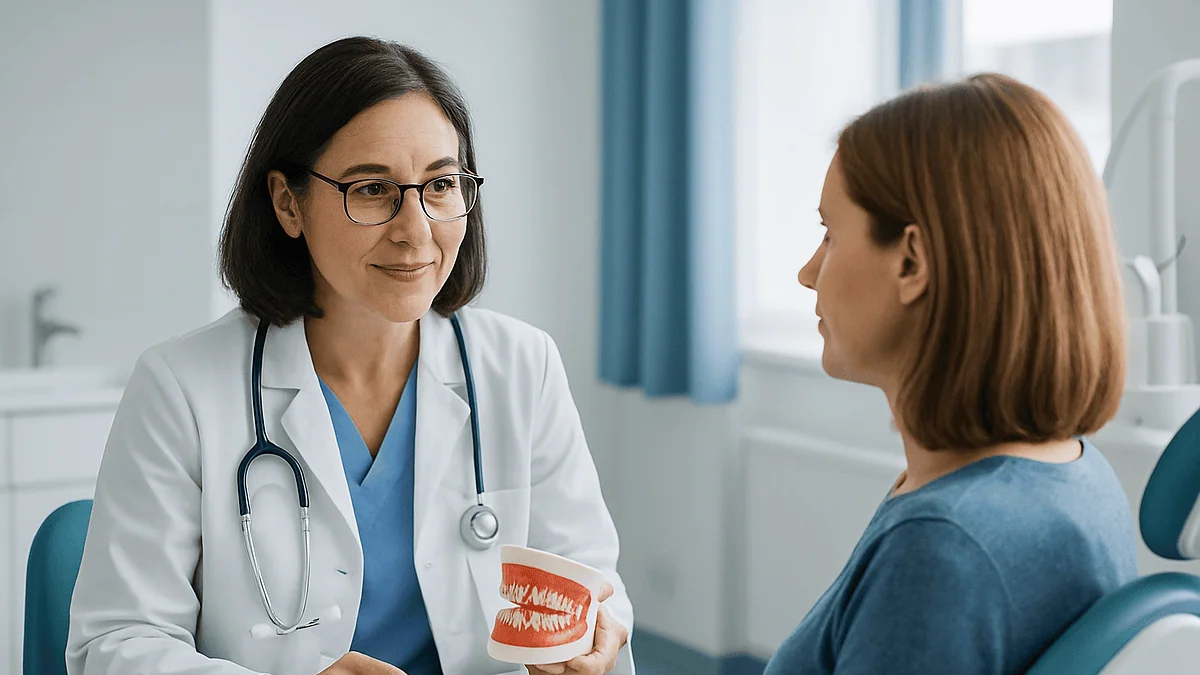
Most tooth decay myths fall apart under evidence. Sugar-free does not mean safe, because acidic drinks and starchy snacks still feed decay or erode enamel. Brushing harder damages gums and enamel rather than cleaning better. Early decay can sometimes be halted, but a cavity never heals on its own, and only a dental professional can judge which stage you are at.
A father in a dental waiting room is reading the label on a bottle of sparkling water. Zero sugar, it says, and he relaxes a little, because his daughter has just been told she has two small cavities and he is trying to work out what went wrong. He brushes her teeth hard every night. He switched the family to diet soda last year. By every rule he knows, this should not have happened.
His confusion is common, and it is not his fault. Tooth decay myths travel faster than dental science, and some of the most widely repeated ones sound sensible: if sugar causes cavities, sugar-free must be safe; if plaque is the enemy, scrubbing harder must help. Both ideas are wrong in ways that quietly cost people enamel.
This explainer walks through what actually happens on the surface of a tooth, which habits matter most, and where the evidence is genuinely uncertain.
How tooth decay actually works, in plain language
Tooth decay is not a hole that sugar burns through enamel. It is a slow chemical tug of war that plays out thousands of times a day. Bacteria living in dental plaque, the sticky film that forms on teeth within hours of brushing, break down fermentable carbohydrates from food and drink. The by-product is acid. That acid lowers the pH at the tooth surface and pulls minerals, mainly calcium and phosphate, out of the enamel. Dentists call this demineralization.
Saliva fights back. It buffers the acid, washes away food debris and carries minerals back to the surface, a process called remineralization. Fluoride, a naturally occurring mineral used in toothpaste and in many public water supplies, speeds up that repair and makes the rebuilt enamel more acid-resistant. In a healthy mouth, loss and repair roughly balance.
Decay begins when the balance tips. Each acid attack lasts a while after eating, and if attacks come too often, or saliva is scarce, or plaque is thick and undisturbed, the surface loses more mineral than it regains. The first visible sign is a chalky white spot, which is enamel that has gone porous but is still intact. Left alone, the surface eventually collapses into a cavity, which is the stage most people picture. Mayo Clinic and MedlinePlus both describe this progression from surface softening to cavitation, and both note that once the surface breaks, bacteria move into the softer dentin beneath and the process accelerates.
Everything else in this article follows from that mechanism. Frequency of acid exposure matters more than quantity. Saliva and fluoride are the repair crew. And the window where damage can still be reversed is early and narrow, which is why so many tooth decay myths do harm: they persuade people they are safe when the balance is already tipping.
Myth: sugar-free means safe. Do sugar free drinks cause cavities?
Sugar-free is one of the most misleading words on a drinks shelf, and the father in our waiting room is not alone in trusting it. Removing sugar removes one source of bacterial acid, which is real progress. It does nothing about the acid already in the bottle.
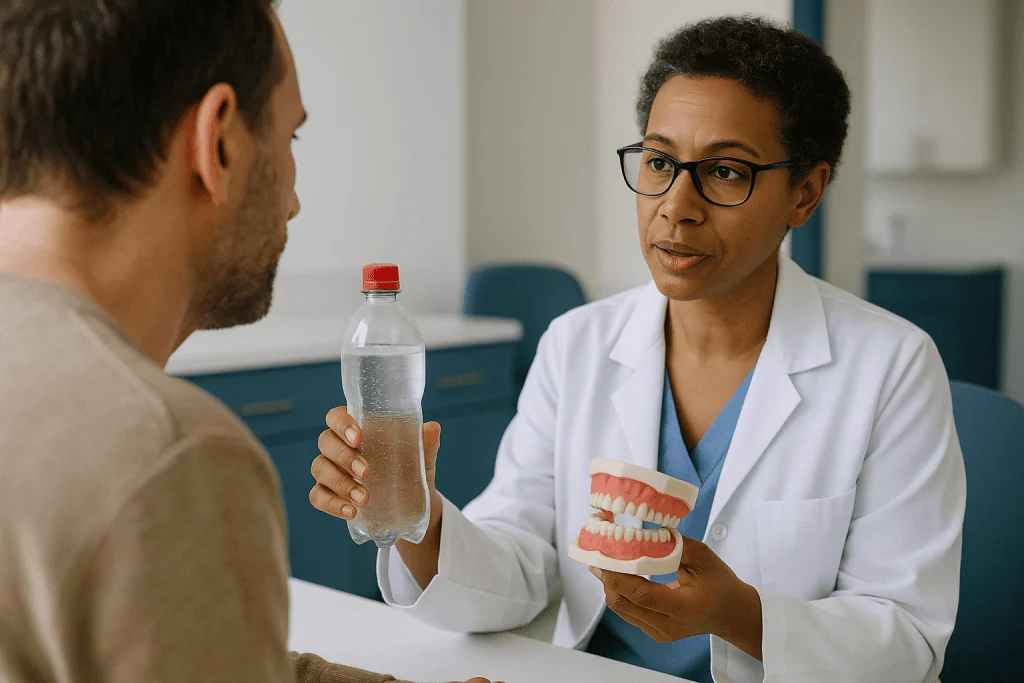
Most diet sodas, flavored sparkling waters, sports drinks and fruit-flavored teas contain acids such as citric, phosphoric or carbonic acid to give them bite. Those acids dissolve enamel directly, no bacteria required. Dentists call this dental erosion, a chemical wearing of the tooth surface that is distinct from decay but just as permanent. The NHS lists acidic drinks, including diet versions, among the main causes of erosion, and advises keeping them to mealtimes and drinking them quickly rather than sipping.
Sipping is the crucial detail. A sugar-free drink nursed over an afternoon at a desk keeps the mouth below the pH at which enamel starts to dissolve for most of that time. Saliva never gets a chance to catch up. The same drink finished in ten minutes with a meal is a far smaller insult.
There is one genuine exception worth naming by class. Sugar alcohols such as xylitol, used in some sugar-free gums and mints, are not fermented by the main decay-causing bacteria, and chewing stimulates saliva. Evidence summarized by Harvard Health suggests sugar-free gum after meals may modestly help, though the benefit comes largely from saliva flow and the quality of the trials is mixed. It is a small helper, not a substitute for brushing.
The honest summary: sugar-free drinks do not feed decay the way sugary ones do, but many are acidic enough to erode enamel, and the habit of constant sipping is the real problem. Water remains the only drink with no catch.
Myth: brushing harder cleans better. Does brushing harder clean better?
Scrubbing feels productive. It is also the single most common way people damage healthy teeth with a toothbrush.
Plaque is soft. It is a film of bacteria and protein, not a layer of grime bonded to the tooth, and it lifts away with light pressure and the right angle. What does not lift away with pressure is tartar, which is plaque that has hardened with minerals from saliva; tartar needs professional removal with instruments, and no amount of force at home will shift it. Pressing harder therefore adds nothing to plaque removal while subtracting from two things that do not grow back.
The first is gum tissue. Repeated hard brushing, especially with a horizontal sawing motion, pushes the gum margin down the root. Receded gums expose root surfaces that are softer than enamel, more sensitive to cold and far easier for decay to attack. The second casualty is enamel itself, which thins over years at the gumline into notches that can be seen and felt.
The NHS and Mayo Clinic both recommend a soft-bristled brush held at roughly a 45-degree angle to the gumline, moved in short, gentle strokes or small circles, for about two minutes, twice a day. Mayo Clinic notes that electric toothbrushes can help people who brush too hard, partly because many models signal when pressure is excessive. Technique, time and consistency do the work; force does not.
A useful self-check: if your toothbrush bristles splay outward within a few weeks, you are pressing too hard. If your gums bleed, the usual cause is plaque left behind at the gumline, which calls for gentler and more thorough brushing there, not for avoiding the area. Bleeding that continues for more than a couple of weeks despite good cleaning is a reason to book a dental visit, not a reason to brush harder.
Myth: only candy counts. Frequency matters more than the sweet thing itself
People tend to think of decay as a candy problem. It is really a frequency problem, and that changes what to worry about.
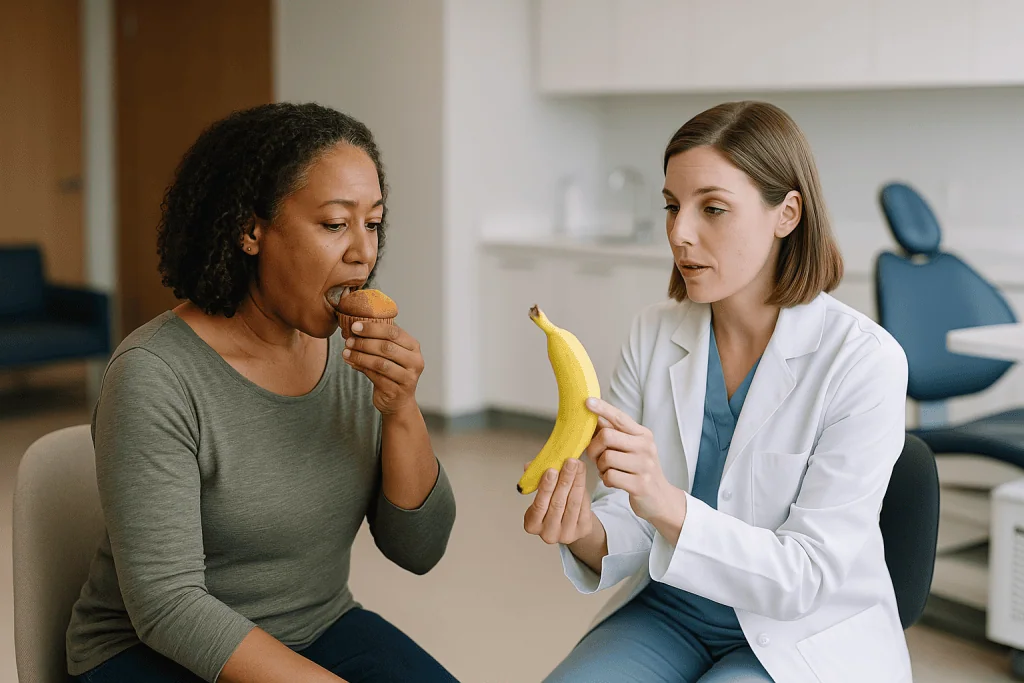
Every time fermentable carbohydrate reaches plaque, bacteria make acid and the surface of the tooth loses mineral for a period afterward. Whether that carbohydrate arrives as a chocolate bar, a cracker, a dried apricot or a spoonful of honey matters far less than how many separate times it arrives. Six small snacks spread across a day produce six acid attacks; the same amount of sugar eaten at one sitting produces one. This is the principle behind the long-standing advice, repeated by the NHS and CDC, to keep sugars to mealtimes and limit between-meal snacking.
Hidden sugars widen the net. Flavored yogurt, granola, breakfast cereal, ketchup, pasta sauce and many so-called health bars carry substantial free sugars. The World Health Organization defines free sugars as those added by manufacturers or cooks plus sugars naturally present in honey, syrups and fruit juice, and its guideline recommends keeping free sugars below 10 percent of total daily energy, with a further suggested reduction below 5 percent for additional benefit, dental health being one of the explicit reasons. Whole fruit is not in that category: the sugar is held inside cell walls, and chewing produces saliva.
Stickiness and texture are the other multipliers. Foods that cling to teeth, such as soft dried fruit, crackers and gummy sweets, extend the acid attack because they linger. A sugary drink that is swallowed quickly is a shorter insult than a biscuit that packs into grooves.
The practical shift is to count exposures, not grams. Someone who eats dessert with dinner and drinks water otherwise is doing better, by the mechanism of decay, than someone who avoids desserts but grazes on fruit snacks and sips juice all day.
What is the 2 2 2 rule in dentistry, and is it evidence-based?
Ask the question online and you will get several answers, which is the first clue that the 2-2-2 rule is a memory aid rather than a clinical guideline. The most common version is: brush twice a day, for two minutes each time, and see a dentist twice a year. A second version swaps the last item for waiting two hours after eating before brushing, or avoiding food and drink for two hours after brushing. None of these appear word for word in any major guideline.
The pieces hold up to different degrees. Twice a day for two minutes is squarely supported: the NHS recommends brushing for about two minutes, last thing at night and at one other time, using a fluoride toothpaste, and Mayo Clinic gives the same guidance. Two minutes is roughly the time it takes to reach every surface of every tooth without rushing, which is why it is the number used.
Twice-yearly check-ups are more nuance than rule. The NHS states that the interval between routine dental examinations should be set according to individual risk, anywhere from three months for people at high risk of decay or gum disease to as long as two years for adults with healthy mouths. A six-month default is a reasonable starting point, not a law of nature.
The timing elements have a kernel of truth. The NHS advises against brushing immediately after eating or drinking something acidic, because enamel is temporarily softened and brushing can wear it away; waiting about an hour is the figure it gives, not two. And spitting out toothpaste without rinsing, then avoiding food or drink for a while, lets fluoride stay in contact with teeth longer.
Treat 2-2-2 as a friendly reminder of the basics, and let your dentist set the visit interval and the details.
Can tooth decay be reversed? What the evidence says about early lesions
Yes, within a strict limit, and the limit is the part social media tends to leave out.
Decay in its earliest stage is a white spot: enamel that has lost mineral beneath a still-intact surface. At this point the process can be stopped and partly reversed. Fluoride, from toothpaste, water or professionally applied varnish, drives calcium and phosphate back into the porous enamel and forms a more acid-resistant surface. Reducing the frequency of sugar and acid exposure gives saliva time to do its share. Mayo Clinic and the Cleveland Clinic both describe fluoride treatments as able to halt or reverse decay in this early stage, and dentists routinely choose to monitor such spots rather than drill them.
Once the enamel surface breaks down into a cavity, that option closes. No remineralization, diet, oil pulling, herbal rinse or supplement can rebuild lost tooth structure, because enamel contains no living cells capable of regenerating it. The cavity will stay the same size or grow. Claims that cavities can be healed at home with mineral-rich diets or special pastes have not been supported by controlled evidence and should be treated as unproven. Some early lesions do become inactive and stable, which may be what people are describing when they say a cavity healed, but a hole does not fill itself.
Where the line sits is a professional judgment made with a mirror, a probe and often an X-ray. A dentist may describe a lesion as non-cavitated and active, meaning it is still in the reversible window but currently losing ground, or as arrested, meaning it has stabilized. That distinction determines whether the plan is fluoride and watchful monitoring or a restoration. Only the treating team can make it; a white spot you notice in the mirror could be either.
How long does tooth decay last, and how fast does it progress?
People ask this two ways: how long until a cavity becomes a problem, and whether decay eventually goes away. The second answer is simple. Decay does not run its course like a cold. A cavitated lesion persists until it is treated or until the tooth is lost. The first answer is messier, because progression rates vary enormously between people and even between teeth in the same mouth.
Mainstream sources deliberately avoid giving a fixed timeline, and for good reason. Mayo Clinic describes decay as developing over time rather than in a set number of months, and the Cleveland Clinic notes that factors such as fluoride exposure, saliva flow, diet, the location of the lesion and the type of tooth surface all change the speed. Decay through thick enamel on a chewing surface can take years to reach dentin; decay on an exposed root surface, which is softer, can advance within months. Dry mouth from medication or medical treatment can turn a slow mouth into a fast one.
What the evidence does support is the shape of the curve. Progress through enamel is slow because enamel is dense and can remineralize. Once decay reaches dentin, the softer tissue beneath, it spreads more quickly and often wider than the opening suggests, which is why a small dark spot can hide a larger problem underneath. When decay reaches the pulp, the living core of the tooth, it typically causes pain and may lead to an abscess, a pocket of infection at the root.
Pain is a late signal, not an early one. Many cavities cause nothing noticeable for a long time, which is the strongest argument for routine examinations at the interval your dentist recommends rather than waiting for a symptom.
Why did our ancestors not brush their teeth, and did they get cavities?
This question usually arrives as an argument: if humans managed for millennia without toothbrushes, perhaps modern dentistry is overselling. The archaeological record gives a more interesting answer.
Skeletal remains from hunter-gatherer populations do show low rates of decay compared with later groups, and the reason lines up neatly with the mechanism described earlier. Diets were low in fermentable sugars and refined starches, high in fiber and tough textures that scrubbed teeth and stimulated saliva, and eating tended to happen in fewer, larger episodes rather than constant grazing. Fewer acid attacks, more saliva, less decay.
Two shifts changed that. The spread of farming brought softer, starch-heavy diets, and decay rates rose in populations that adopted cereals. Then, much later, cheap refined sugar became widely available, and decay became common across all ages. Researchers reading teeth from different periods can often see these transitions in the enamel.
Our ancestors also did not leave their mouths alone. Chewing sticks, fibrous twigs frayed at one end, appear across many cultures and are still used in parts of the world today. People picked their teeth, chewed resins and used abrasive powders. The toothbrush is recent; the habit of cleaning is not.
Finally, surviving without brushing is not the same as thriving. Dental abscesses were a recognized cause of serious illness before antibiotics, worn and lost teeth were routine by middle age, and shorter average lifespans meant fewer years for decay to accumulate. A modern person who eats a modern diet but skips brushing does not inherit an ancestor’s diet-driven protection; they get the worst of both worlds. The lesson from the past is about what we eat and how often, which is exactly what the evidence on decay says today.
Is teeth cleaning safe or not? What a professional scale and polish does
The worry behind this search is usually that scraping and polishing might strip enamel or push bacteria into the bloodstream. The evidence is reassuring on both counts.
A professional cleaning, which dental teams call scaling and polishing, removes two things a toothbrush cannot: tartar, the hardened plaque that bonds to teeth above and below the gumline, and surface stains. The instruments, whether hand scalers or ultrasonic tips that vibrate and spray water, are designed to work at the junction between tartar and tooth. Enamel is the hardest substance in the body, and routine scaling does not remove it in any meaningful amount. Polishing uses a mild abrasive paste for a short period and is similarly gentle. The NHS and Cleveland Clinic both describe scale and polish as a standard preventive procedure.
Some discomfort is normal, particularly around gums that are already inflamed, and teeth may feel sensitive to cold for a few days afterward, especially where tartar was shielding an exposed root surface. Bleeding during cleaning is a sign of existing gum inflammation, not of damage caused by the clinician, and typically reduces as the gums heal.
The bloodstream question deserves a straight answer. Bacteria do enter the blood briefly during cleaning, but they also do so during ordinary chewing and brushing, and the body clears them. For the great majority of people this carries no risk. A small group with specific heart conditions, certain implanted devices or weakened immune systems may be advised differently by their physician and dental team, which is why your medical history is taken before treatment. Tell the team about any heart valve problems, recent surgery or blood-thinning medication; the decision about precautions rests with them.
What professional cleaning does not do is replace daily brushing. It resets the mouth; home care keeps it there.
Myth: baby teeth do not matter because they fall out anyway
Few tooth decay myths cause as much avoidable harm as this one, and it is often held by caring, attentive parents who assume the stakes are low.
Primary teeth do far more than hold a place. They allow a child to chew a varied diet, support clear speech and guide the permanent teeth into position; a baby molar lost early to decay lets neighboring teeth drift, and the adult tooth beneath can erupt crooked or crowded. Decay in baby teeth hurts just as much as decay in adult teeth, and an abscessed primary tooth can damage the developing permanent tooth under it. CDC data show that cavities are among the most common chronic conditions of childhood, and untreated decay is linked to problems with eating, sleeping, school attendance and concentration.
Early childhood decay has a characteristic pattern. It often appears on the upper front teeth first, and the strongest risk factor is frequent or prolonged exposure to sugary liquids, including juice, sweetened milk and formula from a bottle at nap time or overnight. Saliva flow drops during sleep, so the liquid pools against the teeth for hours.
Guidance from the NHS, CDC and Mayo Clinic converges on a simple pathway: start cleaning as soon as the first tooth appears, use a fluoride toothpaste in the amount your dentist or pediatrician advises for the child’s age, supervise brushing until the child can do it well on their own, offer only water or plain milk in bottles at bedtime, and have a first dental visit by the first birthday or when the first tooth comes through. The dental team will also discuss whether fissure sealants, thin protective coatings painted onto the grooves of molars, suit your child.
Treating baby teeth as disposable sets children up for pain now and orthodontic trouble later. Treating them as a dress rehearsal for lifelong habits does the opposite.
More errors: no pain means no decay, bleeding gums mean stop, rinsing after brushing
Beyond the headline myths, a cluster of smaller misunderstandings quietly undermines good intentions. Three come up constantly.
The first is that a tooth which does not hurt is a tooth that is fine. Enamel contains no nerves, so decay confined to enamel is silent. Dentin transmits sensations more readily, which is why sensitivity to cold or sweet can be an early sign, but even dentin decay can be painless until it approaches the pulp. By the time a tooth aches spontaneously or keeps a person awake, the lesion is usually deep. Mayo Clinic is explicit that you may not be aware of a cavity forming, which is the reason routine examinations exist.
The second is that bleeding gums mean you should brush less or avoid the area. The opposite is true. Gums bleed when plaque left at the gumline inflames them, a condition called gingivitis. Gentle, thorough brushing and cleaning between teeth with floss or interdental brushes removes the cause, and the bleeding usually settles as inflammation resolves. The NHS notes that persistent bleeding, bad breath or gums pulling away from teeth warrant a dental visit, because untreated gingivitis can progress to periodontitis, which damages the bone supporting teeth.
The third is rinsing with water after brushing to get rid of the toothpaste. It feels tidy, and it washes away most of the fluoride before it can do its work. The NHS advice is to spit out excess toothpaste and not rinse. If you like a mouthwash, use it at a different time of day rather than straight after brushing, for the same reason.
Two more worth a sentence each. Whitening does not treat decay; it changes color only. And chewing ice or opening packages with your teeth has no bearing on decay but is a reliable way to chip enamel.
Who needs treatment now, and who is usually asked to wait and watch
Not every spot a dentist finds leads to a drill, and understanding how that decision is made helps the conversation in the chair.
Restorative treatment, usually a filling, is generally recommended when decay has broken through the enamel surface into a cavity, when it has reached dentin, or when food packs into the lesion and it cannot be kept clean. Larger cavities, or teeth weakened by old restorations, may need a crown, a cap that covers the whole tooth. If decay has reached the pulp, options narrow to root canal treatment, which removes the infected pulp and seals the canal, or extraction. These are descriptions of the pathway, not a prediction of what any individual will be offered; the choice depends on the tooth, the person and the clinical findings.
Monitoring is often the plan for non-cavitated lesions, the white spots described earlier. A dentist may apply fluoride varnish, recommend a specific toothpaste or diet changes, and re-examine at the next visit to see whether the spot has arrested. Fissure sealants may be suggested for deep grooves in molars, in children and sometimes adults. Choosing to wait is an evidence-based decision in this stage, not neglect; drilling a lesion that could have remineralized removes healthy tooth for no benefit.
Some people are asked to pause treatment for other reasons. Those with an acute infection may need the swelling settled first. People on blood-thinning medicines or with certain heart or immune conditions may need their physician consulted about precautions. Pregnancy is not a reason to delay routine care; the NHS and CDC note that dental treatment is safe during pregnancy and that the dentist will time and tailor it.
Whatever the plan, it belongs to the treating team, revisited at each examination as the mouth changes.
Tooth decay myths versus what the evidence shows, at a glance
Readers who skim deserve the headline corrections in one place. The table pairs each common belief with the position of mainstream clinical guidance, and the sections above carry the detail and mechanism.
| Common belief | What the evidence shows |
|---|---|
| Sugar-free drinks cannot harm teeth | Many are acidic enough to erode enamel directly; sipping over hours is the main risk (NHS) |
| Brushing harder removes more plaque | Plaque lifts with light pressure; force wears enamel and recedes gums (Mayo Clinic, NHS) |
| Only candy and soda cause cavities | Any fermentable carbohydrate feeds acid; frequency of exposure matters most (WHO, CDC) |
| Cavities can heal with the right diet or paste | Early white-spot lesions can arrest with fluoride; a cavitated hole does not regrow (Mayo Clinic, Cleveland Clinic) |
| No pain means no decay | Enamel has no nerves; pain is usually a late sign (Mayo Clinic) |
| Bleeding gums mean brush less | Bleeding signals plaque-driven inflammation; gentle thorough cleaning is the fix (NHS) |
| Rinse well after brushing | Spit, do not rinse, so fluoride stays on teeth (NHS) |
| Baby teeth do not matter | They guide adult teeth and can abscess; decay is a leading childhood condition (CDC) |
| Everyone needs a check-up every six months | Interval is set by individual risk, from three months to two years (NHS) |
| Professional cleaning damages enamel | Scaling removes tartar and stain, not meaningful enamel; mild sensitivity is common (Cleveland Clinic) |
One pattern runs through the right-hand column. Almost every myth overestimates the power of a single product or a single moment and underestimates the slow arithmetic of frequency, saliva and fluoride. If you take one idea away, make it this: decay is governed by how often teeth are under acid attack and how well they are allowed to recover, not by whether a label says sugar-free or how hard you scrub.
What the days and weeks after a filling usually look like
Most people who correct a tooth decay myth late end up in the chair for a restoration, so it helps to know what the following days commonly bring. Nothing here is a promise; it is the typical pattern described by Mayo Clinic and the Cleveland Clinic, and your own dentist’s instructions take precedence.
Immediately afterward, if local anesthetic was used, the lip, cheek or tongue stays numb for a few hours. The practical risk is biting the inside of the cheek without feeling it, so most teams advise waiting until sensation returns before eating anything that needs chewing. Tooth-colored composite fillings are set with a light and can usually be used once the numbness wears off; the dentist will say if a longer wait applies.
Over the first few days, some sensitivity to cold, heat, sweetness or biting pressure is common, particularly with deeper fillings where the pulp was close. The Cleveland Clinic describes this as usually settling within a few weeks as the tooth calms down. Mild soreness of the gum where the anesthetic went in, or where a clamp sat, is also ordinary and short-lived.
Two things are worth reporting rather than waiting out. If the bite feels high, as if that tooth meets first when you close, the filling may need a small adjustment; this is quick and prevents aching. And if sensitivity worsens rather than eases, if pain becomes spontaneous or throbbing, or if it lingers for a long time after a cold drink, the pulp may be reacting and the tooth should be reassessed.
Longer term, a filling restores shape and function but does not make the tooth immune. The margin where filling meets tooth is a classic site for new decay, which is why home care and check-ups continue exactly as before.
Questions to ask your care team about tooth decay
A good dental visit is a conversation, and the right questions turn a verdict into a plan. These are the ones that tend to produce the most useful answers.
- Is this lesion cavitated or still in the early stage where it might arrest with fluoride and changes at home?
- What is my overall decay risk, and how does that change the interval you recommend between examinations?
- Which of my habits is doing the most harm: frequency of snacks, acidic drinks, brushing technique, or something I have not thought of?
- Would fluoride varnish, a prescription-strength toothpaste or fissure sealants be appropriate for me or my child, and why?
- Do any of my medicines reduce saliva, and if so, what can be done about dry mouth?
- If a filling is needed, what are the options for material, and what are the trade-offs in durability and appearance for this particular tooth?
- What should I expect in the days after treatment, and what would be a reason to call you?
- Are there alternatives to the treatment you are proposing, including monitoring, and what happens if I choose to wait?
- How should I clean between my teeth given the spacing and any existing restorations?
- Is there anything in my medical history, such as a heart condition, pregnancy or blood-thinning medicine, that changes how you would approach treatment?
Write the answers down, or ask the team to note them in your record. Bring a list of medicines and supplements, because dry mouth from medication is a common and often overlooked driver of new decay in adults. If the plan includes watching a lesion, ask what you are watching for and when the next look will be.
Nothing in this article replaces that exchange. The evidence tells you how decay works and which myths to drop; your treating team tells you what is true of your mouth.
When to call your doctor or dentist: red-flag signs
Most decay is a slow, routine matter for a scheduled appointment. Some signs mean the situation has moved beyond that, and the right response is a same-day call to a dentist, an urgent care service or, for the most serious, emergency services.
Seek urgent dental care if you have toothache that is severe, throbbing or wakes you at night; pain that persists long after hot or cold food; a visible swelling of the gum or face; a bad taste, pus or an unpleasant smell from around a tooth; or a tooth that has become loose or broken with pain. These point toward decay that has reached the pulp or an abscess, which the NHS and Mayo Clinic both flag as needing prompt assessment rather than waiting for a routine slot.
Treat the following as a medical emergency: facial swelling that is spreading, especially toward the eye or down the neck; difficulty opening the mouth, swallowing or breathing; fever with a swollen face; or feeling generally very unwell with a dental infection. Dental infections can spread into the tissues of the face and neck, and in rare cases become life-threatening. Do not wait for a dental appointment in these circumstances.
Children deserve a lower threshold. A child who refuses food on one side, holds their cheek, has a swollen face or develops a fever alongside a sore tooth should be seen promptly.
Two less dramatic situations also justify a call. Bleeding gums that do not settle after two weeks of gentle, thorough cleaning, and sensitivity after a filling that is getting worse rather than better, both warrant reassessment. In every case, the treating team decides what the signs mean and what to do; this list exists so that nobody mistakes an infection for something that can wait.
Frequently asked questions
Do sugar free drinks cause cavities?
Sugar-free drinks do not feed the bacteria that cause cavities, but most contain acids that erode enamel directly, which is a separate and permanent form of damage. The NHS advises keeping acidic drinks, including diet versions, to mealtimes and finishing them quickly rather than sipping. Water is the only drink without a trade-off; sugar-free gum after meals can modestly help by stimulating saliva.
Does brushing harder clean better?
No. Plaque is a soft film that lifts away with light pressure and good technique, while hard brushing wears enamel at the gumline and pushes gums down the root, exposing softer surfaces to decay. The NHS and Mayo Clinic recommend a soft brush at a 45-degree angle, gentle short strokes, about two minutes, twice a day. Splayed bristles within weeks are a sign you are pressing too hard.
What is the 2 2 2 rule in dentistry?
The 2-2-2 rule is a memory aid, usually meaning brush twice a day, for two minutes, and see a dentist twice a year. Twice-daily two-minute brushing with fluoride toothpaste matches NHS and Mayo Clinic guidance. The visit interval is not fixed: the NHS recommends dentists set it by individual risk, from three months to two years, so twice a year is a reasonable default rather than a rule.
Can tooth decay be reversed?
Only in its earliest stage. A white-spot lesion, where enamel has lost mineral but the surface is intact, can be halted and partly remineralized with fluoride and fewer sugar and acid exposures. Once a cavity has formed, lost tooth structure does not regrow, and home remedies claiming to heal cavities are unproven. A dentist decides whether a lesion is still in the reversible window.
How long does tooth decay last?
Decay does not resolve on its own; once a cavity forms it persists until treated. How fast it progresses varies widely with saliva, fluoride, diet and the tooth surface involved, and major sources such as Mayo Clinic deliberately avoid a fixed timeline. Enamel decay tends to move slowly and can arrest, while decay in dentin or on exposed roots advances more quickly. Pain usually arrives late.
Why did our ancestors not brush their teeth?
Hunter-gatherer diets were low in sugar and refined starch, fibrous enough to scrub teeth, and eaten in fewer sittings, so decay was far less common. Many cultures still cleaned teeth with chewing sticks, resins and powders. Decay rose with farming and then with cheap refined sugar. Eating a modern diet without brushing does not recreate that ancestral protection; it combines the risks of both worlds.
Is teeth cleaning safe or not?
Professional scaling and polishing is a standard preventive procedure that removes tartar and stains without removing meaningful enamel, the hardest substance in the body. Mild sensitivity and some bleeding from already-inflamed gums are common and short-lived. People with certain heart conditions, implanted devices or weakened immunity should tell the dental team, who will decide whether any precautions are needed.
Should I brush right after eating?
Not immediately after acidic food or drink. Acid softens enamel for a period, and brushing during that window can wear it away. The NHS advises waiting about an hour, or brushing before the meal instead. Brushing last thing at night and at one other time of day, with fluoride toothpaste, spitting rather than rinsing, is the pattern supported by guidance.
Do baby teeth really need fillings?
Often, yes. Primary teeth guide permanent teeth into position, support speech and chewing, and can decay to the point of pain and abscess that may damage the developing adult tooth beneath. The CDC describes cavities as one of the most common chronic childhood conditions. Whether a specific baby tooth needs a filling, monitoring or another approach is a decision for the child’s dental team.
Can a cavity exist without any pain?
Yes, and most do for a long time. Enamel has no nerves, so decay confined to enamel is silent, and even decay in dentin may cause only occasional sensitivity to cold or sweet. Spontaneous or throbbing pain usually means decay is near or in the pulp. This is why routine examinations at the interval your dentist recommends matter more than waiting for a symptom.
References
- NHS: Tooth decay
- NHS: How to keep your teeth clean
- Cleveland Clinic: Cavities (tooth decay)
- MedlinePlus: Tooth decay
This article is for general information only and is not a substitute for professional medical advice. Please consult a qualified doctor about your individual situation.

More from the Blog

Chipped or Loose Porcelain Veneer: Repair, Rebonding or Replacement Explained
A chipped or loose porcelain veneer can often be managed without replacing it. Small edge chips may be smoothed or patched with tooth-colored composite…
What Does a Dental Spa Visit Include? Cleaning, Polishing and Gum Care in a Calmer Setting
A dental spa visit usually includes the same core clinical steps as a standard hygiene appointment: an examination of the teeth and gums, removal…

Anesthesia for Impacted Tooth Removal: Local, Sedation or General and What You Feel
Impacted tooth removal is usually done with one of three anesthesia approaches: a local anesthetic that numbs the jaw while you stay awake, sedation…

Smile Makeover Timeline: How Whitening, Bonding and Veneers Are Sequenced Visit by Visit
A smile makeover timeline usually spans several weeks to a few months and follows a fixed order: a full dental examination and any needed…
What an Oral and Maxillofacial Surgeon Treats: Impacted Teeth, Cysts, Trauma and Jaw Alignment
An oral and maxillofacial surgeon treats conditions of the mouth, jaws and face that go beyond routine dentistry: impacted or difficult wisdom teeth, cysts…

Is Orthognathic Surgery Painful? Numbness, Swelling and How Discomfort Is Managed
Orthognathic (corrective jaw) surgery is usually described as less painful than people expect, because the surgery is done under general anesthesia and the nerves…