

Smile Makeover Timeline: How Whitening, Bonding and Veneers Are Sequenced Visit by Visit

Key Takeaways
- Whitening gel lightens natural enamel only; bonding, veneers and crowns keep the shade they were made in, which is why color is finalized before any restoration is placed.
- Freshly whitened teeth look temporarily brighter because enamel is dehydrated, so dentists commonly wait one to two weeks before matching restoration shades.
- Composite bonding is usually completed in one visit at roughly 30 to 60 minutes per tooth and typically lasts three to ten years, according to Cleveland Clinic.
- Porcelain veneers require two appointments a few weeks apart because a technician fabricates them, and the enamel reduction involved is permanent.
- Active gum disease or untreated decay pauses the cosmetic timeline because restorations bonded over disease or against swollen gums fail early.
- NHS guidance places the duration of whitening results anywhere from a few months to about three years, so top-up whitening is often planned to keep natural teeth matched to restorations.
A smile makeover timeline usually spans several weeks to a few months and follows a fixed order: a full dental examination and any needed gum or tooth treatment first, then teeth whitening, then a short pause while the new shade settles, and finally composite bonding or porcelain veneers color-matched to the whitened teeth. Veneers typically need two visits a few weeks apart; bonding is often finished in one. The treating dental team sets the exact sequence.
She had already picked the dress and booked the photographer. The only thing she could not picture was the smile, because one front tooth had chipped years ago on a water-bottle cap, two others were a shade darker than the rest, and every mirror seemed to notice. Her question to the dentist was simple: how many visits, in what order, and how long between them?
That question sits at the heart of every smile makeover timeline. The individual procedures are well described. What trips people up is the sequencing: whether whitening goes before or after veneers, why bonding cannot be brightened later, and why a hygienist appointment often lands before anything cosmetic happens at all.
What follows is a visit-by-visit walk through that order, drawn from mainstream dental guidance rather than marketing. It will not tell you what your teeth need; only the team examining them can. It will explain why the order matters and what each stage typically involves.
What a smile makeover timeline actually covers
The phrase “smile makeover” is not a clinical term. It is shorthand for a coordinated set of cosmetic dental procedures planned together rather than one at a time. The three most common building blocks are teeth whitening, composite bonding and veneers, sometimes joined by orthodontics, gum reshaping or crowns.
Each of those has its own logic. Whitening uses a peroxide-based gel to break down stain molecules inside enamel; it changes the color of natural tooth only. Composite bonding is tooth-colored resin sculpted directly onto a tooth and hardened with a light, used to repair chips or close small gaps. A veneer is a thin shell, usually porcelain or composite, bonded over the front surface of a tooth to change its shape, size or color.
Cleveland Clinic notes that whitening agents have no effect on restorations such as bonding, crowns or veneers, which only match the shade they were made in. That single fact drives almost the entire sequence. Anything artificial must be made after the natural teeth around it have reached their final color, or the restoration will look either too bright or too dull for years.
The other organizing principle is that cosmetic work sits on top of health, not instead of it. Gum inflammation, decay under an old filling or a cracked tooth all change what can safely be bonded or veneered. So the realistic timeline begins with an ordinary examination, not a shade guide.
Read across, the standard order looks like this: assess, stabilize, whiten, wait, then restore. The visits described in the rest of this article follow that arc. Yours may skip stages, add some, or run in a different order for reasons specific to your mouth. Where that happens, the reason is worth asking about.
Visit one: the consultation, before anything touches a tooth
The first appointment is mostly conversation and measurement. Expect a clinical examination, dental X-rays if recent ones are not on file, photographs and often a shade assessment against a standardized guide. Some practices take impressions or a digital scan so a technician can build a mock-up of the proposed result in wax or on screen.
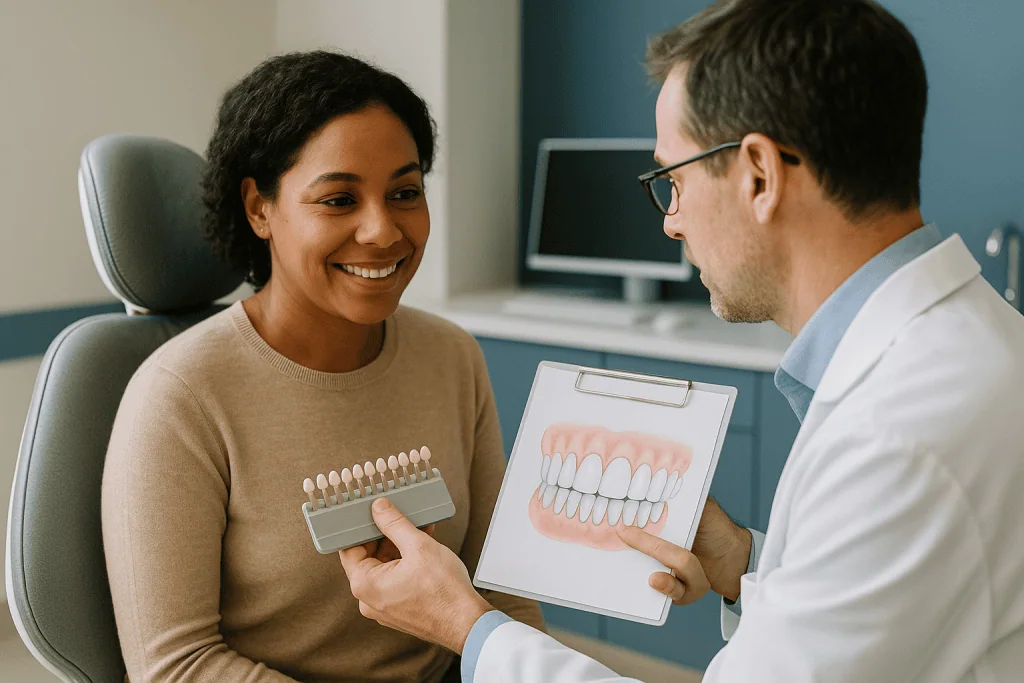
Two things are being decided here. The first is whether the mouth is ready. MedlinePlus lists untreated decay, gum disease and worn or broken restorations among the problems a routine dental check is designed to catch, and none of them pairs well with fresh cosmetic work. The second is what the person actually wants changed. “Whiter” and “straighter” mean different things to different people, and a good consultation pins that down before any material is chosen.
This is also the moment to talk about reversibility. Whitening does not remove tooth structure. Composite bonding removes little or none. Porcelain veneers usually require a thin layer of enamel to be trimmed away, and Cleveland Clinic is explicit that this step cannot be undone; a veneered tooth will need a veneer or crown for life. Those are different commitments and deserve different amounts of thought.
Bring your medical history, including any bleeding disorders, medications that affect the gums, pregnancy or breastfeeding, and a history of jaw clenching or grinding. Each can change the plan. Someone who grinds heavily at night, for example, may be steered toward bonding or a night guard alongside veneers because porcelain can chip under repeated force.
You should leave with a written sequence: which visits, in which order, roughly how far apart. If the plan is presented as a single package with no stages explained, ask for the breakdown. The order is the treatment.
Why healthy gums and teeth come first in the sequence
People are often surprised when the first “makeover” appointment is a hygiene visit. It is not a delay tactic. Inflamed gums bleed, swell and sit at a different level than healthy gums. A veneer margin placed against a puffy gum line may be visible once the swelling settles, and bonding adhesives do not seal reliably against a bleeding surface.
The NHS describes professional cleaning, treatment of decay and management of gum disease as core dental care that takes priority over cosmetic procedures. In practice, that means fillings are replaced, cavities under old restorations are addressed and any active gum disease is brought under control before whitening starts.
Timing varies with what is found. A straightforward scale and polish can be done the same day as the consultation. Gum treatment that requires deeper cleaning under the gum line is usually followed by a review, because the tissue needs time to tighten and recede to its settled position. Only then can a dentist judge where the edge of a veneer will sit.
There is a hidden benefit to this stage. Removing surface stain and tartar often lifts the shade of the teeth by itself, which can change how much whitening is wanted, or whether it is wanted at all. Some people find the polished result closer to their goal than they expected and choose to shorten the plan.
One more point matters for anyone with existing crowns or large fillings on front teeth. Because those will not whiten, the dentist may plan to replace them at the end of the sequence so they can be matched to the final shade. That adds visits, but it avoids a mismatched tooth in the middle of a bright smile.
Whitening before veneers: why the shade gets locked in early
Whitening is placed early for one reason: it is the only step that changes natural tooth color, and every artificial surface added afterward is matched to that color. Whiten after veneers or bonding, and the natural teeth brighten while the restorations stay put.

Two delivery methods are common. In-office whitening applies a higher-concentration gel under the dentist’s supervision, often with the gums protected by a barrier. Cleveland Clinic describes this as typically completed in a single appointment of around an hour, sometimes repeated. Take-home whitening uses custom trays worn with a lower-strength gel over a period of days to weeks; the NHS notes this route may involve several visits over a couple of months while the trays are fitted and progress checked. Many plans combine the two.
Only a registered dental professional should carry out or prescribe whitening, according to NHS guidance, both because of the chemistry involved and because a dentist can rule out decay or gum recession that would make the gel painful or ineffective.
The pause after whitening is the part people most often want to skip. Freshly bleached enamel is temporarily dehydrated, which makes it look brighter than it will once rehydrated over the following days. Dentists commonly build in a wait of roughly one to two weeks before final shade matching for bonding or veneers so the color being copied is the settled one, not the temporary peak. Skipping that wait risks a restoration that ends up visibly lighter than its neighbors.
How long whitening holds varies widely. NHS guidance gives a range from a few months to up to three years, depending on diet, smoking and oral hygiene. Any veneers or bonding made to match will stay the same shade regardless, which is why maintenance whitening later is often planned to keep the natural teeth in step.
How long does a smile makeover take from first visit to final polish?
There is no single answer, but the stages have typical durations that can be laid end to end. The table below draws on Cleveland Clinic and NHS descriptions of each procedure. It is a planning aid, not a promise; your own timeline depends on what the examination finds.
| Stage | Typical visits | Typical gap before next stage | Notes |
|---|---|---|---|
| Consultation and imaging | 1 | Days to 2 weeks | Longer if a lab mock-up is made |
| Hygiene, fillings, gum treatment | 1–3 | Days to several weeks | Gum treatment needs healing before margins are set |
| Whitening | 1 in-office visit, or trays over days to weeks | About 1–2 weeks | Shade settles as enamel rehydrates |
| Composite bonding | Usually 1 | None required | Cleveland Clinic: about 30–60 minutes per tooth |
| Porcelain veneers | 2 (preparation, then fitting) | A few weeks for lab fabrication | Temporary veneers worn in between |
| Review and adjustment | 1 | 1–2 weeks after fitting | Bite and gum check |
Add the middle column and a plan with whitening plus bonding alone can be done inside a month. A plan involving porcelain veneers more often runs two to three months, because the laboratory phase and the review sit in series rather than in parallel. Plans that include orthodontics first stretch to many months or longer, since tooth movement cannot be hurried.
Two things extend timelines more than anything else: discovering decay or gum disease at the first visit, and changing the design after temporaries are placed. The first is unavoidable and worth the delay. The second is why the mock-up stage exists; it is far cheaper in time to change a wax model than a fitted veneer.
If a proposed timeline is dramatically shorter than these ranges, it is fair to ask which stage has been compressed and why.
Dental bonding vs veneers: where each sits in the sequence
Bonding and veneers solve overlapping problems with different materials and different commitments, and that changes where each lands in the schedule.
Composite bonding is applied directly. The dentist roughens the surface lightly, brushes on a conditioning liquid, sculpts resin onto the tooth, hardens it with a curing light and polishes it. Cleveland Clinic puts the time at roughly 30 to 60 minutes per tooth, usually without local anesthetic unless a cavity is being treated at the same time. Because there is no laboratory step, bonding can be done at the visit immediately after the whitening pause, and several teeth can be completed in one sitting. Cleveland Clinic gives an expected lifespan of about three to ten years before repair or replacement, with staining and chipping the usual reasons.
Porcelain veneers are indirect: the tooth is prepared, an impression or scan is sent to a technician, and the shell is fitted at a later visit. That built-in gap is why veneers occupy two appointments a few weeks apart. Cleveland Clinic cites a typical lifespan of around ten to fifteen years for porcelain, with composite veneers shorter. Porcelain resists stain better than resin, which matters if coffee or red wine is part of daily life.
The sequencing choice often follows the extent of change. A small chip on one tooth beside otherwise even teeth is a classic bonding case and can be a single visit. Changing the shape or alignment of six or eight front teeth is a veneer case with a longer arc. Some plans use both: veneers on the central teeth, bonding on the smaller teeth at the corners of the smile, done at the veneer fitting visit so shades can be matched side by side.
Neither option is inherently better. The question to ask is which one your teeth, your bite and your tolerance for irreversible enamel removal point toward.
The veneer visits, one by one: preparation, temporaries and fitting
The veneer stage is where the timeline branches into two distinct appointments, and it helps to know what each one is for.
At the preparation visit, the dentist numbs the area, then removes a thin layer of enamel from the front and sometimes the edge of each tooth so the finished veneer sits flush rather than bulky. Cleveland Clinic describes this reduction as permanent; the tooth will always need to be covered afterward. An impression or digital scan is taken, the final shade is confirmed against the whitened neighboring teeth, and temporary veneers are placed. These are usually acrylic, held with a weaker cement, and designed to protect the prepared teeth and preview the shape.
The gap between visits exists because a technician is building the porcelain by hand or by milling. Cleveland Clinic gives this as a matter of weeks. Temporaries are functional but not robust: they can stain, feel slightly rough, and may loosen with sticky or very hard foods. Sensitivity to cold is common during this window because enamel has been reduced.
At the fitting visit, the temporaries are removed, the teeth are cleaned, and each veneer is tried in with water or a trial paste so color and fit can be checked in the mouth before anything is bonded. This is the last moment to request small changes. Once approved, the tooth surface is etched, adhesive is applied, the veneer is seated and cured with a light, and excess cement is trimmed. The bite is checked and adjusted.
A short review a week or two later is standard practice. Gums may be tender, and minor high spots in the bite often only become obvious once normal chewing resumes. Bringing a list of anything that feels off to that review is more useful than trying to judge the result the same afternoon.
Who a smile makeover is usually for, and who is usually asked to wait
Cosmetic dentistry is elective, which means the deciding factor is not how much someone wants it but whether the mouth can safely support it right now. Dentists tend to think in terms of readiness rather than eligibility.
Good candidates generally have healthy gums, teeth free of active decay, a stable bite and realistic expectations about what color and shape can change. Adults whose jaws have finished growing are the usual group; the NHS notes that whitening is not recommended for people under 18, and most cosmetic restorations are deferred until tooth position and gum levels have settled.
Several situations commonly lead to a pause rather than a refusal:
- Active gum disease, which must be treated and reviewed first so gum levels are stable when veneer margins are planned.
- Untreated cavities or failing fillings on the teeth involved, since cosmetic material bonded over disease will fail early.
- Pregnancy or breastfeeding, during which the NHS advises against whitening as a precaution given limited safety data.
- Heavy grinding or clenching without a protective night guard, because porcelain can fracture under repeated load.
- Ongoing orthodontic treatment, since tooth positions are still changing.
- Very worn teeth or a collapsed bite, where crowns or a broader rehabilitation may be more appropriate than veneers alone.
Existing crowns, large fillings or root-treated teeth do not rule someone out, but they add steps: those teeth will not whiten and may need new restorations matched at the end of the sequence.
Expectations deserve honest handling too. Whitening lightens natural tooth within limits and cannot remove every kind of discoloration; grey or tetracycline-type staining often responds less than yellow surface stain. Veneers change shape and color but cannot correct a severely crowded arch on their own. A candid conversation about what the plan can and cannot deliver is part of being a good candidate.
What the days and weeks after each stage usually look like
Because a makeover is several procedures in a row, recovery comes in installments rather than as one block. Knowing what is ordinary at each point makes it easier to spot what is not.
After whitening, the most common experience is transient tooth sensitivity to cold and sometimes a mild gum irritation where gel touched soft tissue. Cleveland Clinic describes these effects as typically short-lived, easing over a few days. Many dentists suggest avoiding strongly colored foods and drinks for a day or two while the enamel rehydrates, though the evidence for how much this matters is limited.
After bonding, there is usually no true recovery period. The resin is fully hardened when you leave. The tooth may feel slightly different to the tongue for a few days as you adjust to the new shape, and the composite can pick up stain faster than enamel, so Cleveland Clinic suggests moderation with tea, coffee and tobacco to prolong its appearance.
After veneer preparation, expect cold sensitivity and some gum tenderness while wearing temporaries. Chewing on the other side, avoiding very hard or sticky foods and keeping the gum line clean with gentle brushing all help. A temporary that comes loose is inconvenient rather than dangerous, but it should be reattached promptly so the prepared tooth is not left exposed for long.
After the veneers are fitted, gums often feel tender for a few days where cement was cleaned away, and the bite may need a minor adjustment at the review. Speech occasionally feels different for a short period because the tongue is meeting new edges; this settles quickly for most people.
Across all stages, twice-daily brushing with a fluoride toothpaste and daily cleaning between the teeth, as MedlinePlus recommends for adults generally, remain the foundation. Cosmetic materials do not decay, but the tooth underneath them still can.
Smile makeover steps when orthodontics or gum reshaping is involved
Some smiles need the frame adjusted before the picture goes in. Two additions change the timeline more than any other: moving the teeth and reshaping the gum line.
Orthodontics goes first, always. Fixed braces or clear aligners shift teeth over months, and any veneer or bonding placed before movement finishes will end up in the wrong position or the wrong proportion. The NHS describes orthodontic treatment as typically taking many months to a couple of years depending on complexity. In a makeover plan, that means the cosmetic stages described earlier do not begin until the retainer phase, and even then a short settling period is usual.
There is a practical upside. Aligning the teeth often reduces how much enamel needs removing for veneers, because the porcelain no longer has to disguise a rotation or a tooth sitting behind its neighbor. In some cases alignment plus whitening alone achieves the goal and veneers drop out of the plan altogether.
Gum reshaping, sometimes called gum contouring, trims or recontours gum tissue so that tooth lengths look even, or to address a smile that shows a large band of gum. It is a minor surgical procedure done with a scalpel, laser or electrosurgery under local anesthetic. When it is part of a plan, it sits after hygiene treatment and before final veneer preparation, with a healing gap so the new gum position is stable when margins are set. Cleveland Clinic notes that gum healing after minor periodontal procedures generally takes days to a few weeks.
Both additions push whitening later too, since there is little point brightening teeth that will then be hidden behind brackets or trimmed at the gum line. The rule of thumb holds: structural changes first, color next, restorations last. It is slower, and it is the order that produces a result the mouth can actually hold.
Risks and alternatives, in plain clinical language
Every stage carries some risk, and a fair timeline discussion includes them.
Whitening most commonly causes temporary tooth sensitivity and gum irritation, both described by the NHS and Cleveland Clinic as usually short-lived. Uneven results can occur where teeth have existing restorations, exposed root surfaces or internal staining. Overuse of whitening products, particularly unsupervised, can damage enamel and gums.
Composite bonding can chip, stain or debond, and it is less durable than porcelain. Because it removes little or no enamel, its main risk is aesthetic rather than structural, and it can usually be repaired or replaced without harming the underlying tooth.
Porcelain veneers carry the largest commitment. Enamel removal is irreversible, and a small proportion of prepared teeth become persistently sensitive or, less often, need root canal treatment later if the nerve reacts. Veneers can fracture or come off, especially with grinding or biting on hard objects, and a damaged veneer generally has to be remade rather than patched. Gum recession over years can expose the margin, which may prompt replacement.
Alternatives exist at every level. Professional cleaning alone lifts stain. Whitening alone changes color without touching tooth structure. Bonding addresses chips and small gaps reversibly. Orthodontics changes position without covering teeth. Crowns cover the whole tooth and suit teeth that are already heavily filled or weakened. And doing nothing is a legitimate option; cosmetic problems do not progress the way disease does.
The point of laying these out is not to discourage anyone. It is to make sure the sequence chosen matches how much change is wanted and how much permanence is acceptable. A dentist who explains why a particular tooth is better suited to bonding than a veneer, or vice versa, is doing the risk conversation properly.
What people often get wrong about smile makeover timelines
A handful of misconceptions cause most of the disappointment in cosmetic dentistry. Correcting them up front saves visits.
“I can whiten later to touch everything up.” Natural teeth will lighten; bonding, veneers and crowns will not. Whitening after restorations creates a mismatch rather than fixing one, which is why color is finalized first and any later whitening is planned to bring natural teeth back to the shade the restorations were matched to.
“Veneers are like false nails; they just go on.” Most porcelain veneers require enamel reduction, and Cleveland Clinic is direct that this is permanent. So-called no-preparation veneers exist for selected cases but are not suitable for everyone and can look bulky if the tooth is not already slightly recessed.
“Faster is a sign of a better clinic.” The waits in a timeline are functional: gums healing, enamel rehydrating, a technician fabricating porcelain. Compressing them shifts the risk onto the patient in the form of mismatched shade or unstable margins.
“Bonding is the cheap version of veneers.” It is the reversible version. It suits different problems, chiefly small chips and gaps, and has a shorter expected lifespan, roughly three to ten years by Cleveland Clinic’s estimate versus ten to fifteen for porcelain. Neither is the budget option of the other; they are different tools.
“Whitening works on all discoloration equally.” Yellow surface staining responds best. Grey tones, staining from certain antibiotics taken in childhood and single dark teeth after trauma respond less predictably, and a dentist may suggest a different approach for those teeth.
“Once it’s done, it’s done.” Every material in a makeover has a maintenance cycle. Whitening fades over months to years, bonding is refreshed, veneers are eventually replaced. The finished smile is a starting point for upkeep, not an endpoint.
How long the results last, and the maintenance timeline that follows
A smile makeover has a second, longer timeline that begins the day the last restoration is fitted. It is less dramatic than the treatment phase, but it determines how the result looks in five years.
Whitening is the shortest-lived element. NHS guidance places its duration anywhere from a few months to about three years, with smoking and staining drinks at the short end. Because veneers and bonding hold their shade, many plans include periodic top-up whitening with custom trays to keep the natural teeth aligned with them, timed by the dentist rather than by habit.
Bonding sits in the middle. Cleveland Clinic gives roughly three to ten years before repair or replacement, and the usual triggers are surface staining that no longer polishes out, small chips at the edges, or a change in the surrounding gum line. Repolishing at hygiene visits can extend its appearance considerably.
Porcelain veneers are the most durable, with Cleveland Clinic citing around ten to fifteen years. They are not indestructible. The common failure modes are fracture from biting hard objects, debonding, and margins becoming visible as gums recede with age. A night guard is often recommended for anyone with signs of grinding, both to protect the porcelain and the opposing natural teeth.
Everyday care is unglamorous and decisive. MedlinePlus advises brushing twice daily with fluoride toothpaste, cleaning between teeth daily and keeping regular dental checkups; those recommendations apply unchanged to restored teeth, because decay at a veneer margin or under bonding is what ends a restoration early, not the material wearing out. A non-abrasive toothpaste is often suggested to avoid dulling composite.
Review intervals are set by the dentist, but a check every six to twelve months is a common baseline, allowing small chips to be smoothed and early margin problems to be caught before they require a remake.
Questions to ask your care team before the timeline starts
The most useful consultations are the ones where the patient arrives with questions rather than only a photograph of a smile they like. These are the ones that tend to change plans for the better.
- Which of my teeth are healthy enough for cosmetic work now, and which need treatment first?
- In what order will you sequence whitening, bonding and veneers for me, and why that order?
- How long will you wait after whitening before matching the shade of any restorations?
- For each tooth, are you proposing bonding, a veneer or a crown, and what is the reason for that choice?
- How much enamel will be removed for each veneer, and is a minimal-preparation option realistic for me?
- What will I be wearing between the preparation and fitting visits, and what should I avoid eating?
- Can I see a mock-up or trial version of the result before anything irreversible is done?
- Do I show signs of grinding or clenching, and should a night guard be part of the plan?
- What is the expected lifespan of each material you are proposing, and what does replacement involve later?
- How will my existing fillings or crowns be handled so they match the final shade?
- What sensitivity or discomfort should I expect after each stage, and what would be unusual?
- How often will you want to review the work once it is finished?
Ask for the answers in writing, ideally as a staged plan with approximate intervals. A plan that can be written down can be questioned, adjusted and compared, and it gives you something concrete to return to if a stage feels rushed or unclear.
It is also entirely reasonable to ask for time between the consultation and the first irreversible step. Cosmetic dentistry is elective. A short pause to think costs nothing clinically, and a team confident in its plan will not object.
When to call your doctor or dentist during a smile makeover
Most of what happens between visits is mild and expected: cold sensitivity after whitening or veneer preparation, a slightly tender gum line, a temporary veneer that feels rough. Some symptoms are not part of a normal timeline and should prompt a call to the dental practice, or urgent care if the practice is closed.
Contact your dental team promptly if you notice any of the following:
- Tooth pain that is throbbing, wakes you at night or is not eased by simple measures your dentist has advised, particularly after veneer preparation, since this can signal the nerve is inflamed.
- Sensitivity that is getting worse rather than better several days after whitening or fitting.
- Swelling of the gum, face or jaw, or a bad taste or discharge near a treated tooth, which can indicate infection.
- Fever alongside any dental symptom.
- A temporary or permanent veneer that comes off, leaving the prepared tooth exposed.
- Bleeding from the gums that does not stop with gentle pressure, or gums that turn white or blistered after whitening gel contact.
- A bite that feels clearly off, with pressure concentrated on one restored tooth, since uneven load can fracture porcelain.
- Any chip, crack or sharp edge on a new restoration.
- Difficulty swallowing or breathing, or rapidly spreading facial swelling, which are emergencies requiring immediate medical attention rather than a routine dental call.
None of these means the plan has failed. Most are straightforward to manage when caught early, and several, such as a loose temporary, are simply inconvenient. What matters is that the treating team hears about them quickly rather than at the next scheduled visit.
If you are unsure whether something is normal, the practice would rather take the call. The timeline belongs to you and your dental team together, and adjusting it in response to how your mouth is responding is part of doing it well.
Frequently asked questions
How long does a smile makeover take from start to finish?
Typically several weeks to a few months, depending on which procedures are included. Whitening plus bonding can often be completed within about a month. Plans with porcelain veneers usually run two to three months because of the laboratory phase and a review visit. Adding orthodontics extends the timeline to many months, since tooth movement must finish before cosmetic work begins. Your dental team will give a staged estimate after examination.
Should I do whitening before veneers or after?
Before. Whitening changes the color of natural teeth only, and veneers are made to match the surrounding teeth at the time of fabrication. If you whiten afterward, your natural teeth lighten while the veneers stay the same shade. Dentists usually whiten first, then wait roughly one to two weeks for the shade to settle before taking the final shade match for veneers or bonding.
What are the smile makeover steps in order?
The usual order is examination and imaging, then any needed hygiene, fillings or gum treatment, then orthodontics or gum reshaping if planned, then whitening, then a short settling pause, and finally bonding or veneers matched to the new shade. A review visit follows to check the bite and gums. Individual plans skip or add stages, but structural changes come first, color next and restorations last.
Dental bonding vs veneers: which is faster?
Bonding is faster. Composite bonding is applied directly and hardened in the chair, taking about 30 to 60 minutes per tooth in a single visit according to Cleveland Clinic. Porcelain veneers need two visits several weeks apart because a technician makes them. Speed is not the only consideration: bonding is reversible and suits small chips and gaps, while veneers involve permanent enamel reduction and typically last longer.
Why does my dentist want to treat my gums before cosmetic work?
Because inflamed gums bleed, swell and sit at a different level than healthy gums. Veneer margins planned against swollen tissue may become visible once the swelling settles, and adhesives do not seal reliably on a bleeding surface. Treating gum disease and decay first, as NHS and MedlinePlus guidance prioritizes, gives cosmetic work a stable foundation and often lifts the shade of the teeth on its own.
How many visits do porcelain veneers take?
Usually two main visits plus a review. At the first, the dentist prepares the teeth, takes impressions or a scan, confirms the shade and fits temporary veneers. After a laboratory period that Cleveland Clinic describes as a few weeks, the second visit is for trying in, adjusting and bonding the final veneers. A short follow-up a week or two later checks the bite and gum health.
What does recovery feel like between smile makeover visits?
Mild and stage-specific for most people. After whitening, temporary cold sensitivity and slight gum irritation are common and usually ease within days. Bonding has essentially no recovery period. Between veneer preparation and fitting, sensitivity and gum tenderness are typical while temporaries are worn. After fitting, gums may be sore briefly and the bite may need a small adjustment. Worsening pain or swelling is not typical and warrants a call.
Can I speed up the smile makeover timeline?
Some stages cannot be compressed safely. Gums need time to heal before margins are set, whitened enamel needs time to rehydrate before shades are matched, and porcelain takes weeks to fabricate. Whitening and bonding can sometimes be scheduled closer together, and mock-ups reduce the risk of late redesigns that add visits. Ask your dentist which waits are functional and which are simply scheduling.
How long do smile makeover results last?
It varies by material. NHS guidance places whitening results anywhere from a few months to about three years. Cleveland Clinic estimates composite bonding at roughly three to ten years and porcelain veneers at around ten to fifteen years before replacement. Daily brushing with fluoride toothpaste, cleaning between teeth, regular checkups and a night guard for grinders all influence where in those ranges a given smile lands.
Who should wait before having a smile makeover?
Anyone with active gum disease or untreated decay, who needs those treated and reviewed first. The NHS advises against whitening under age 18 and during pregnancy or breastfeeding. People mid-orthodontic treatment wait until teeth have settled. Heavy grinders may be asked to use a night guard before porcelain is placed. Waiting is about readiness, not exclusion; most of these situations resolve into a later, more stable plan.
This article is for general information only and is not a substitute for professional medical advice. Please consult a qualified doctor about your individual situation.

Planning This Treatment in Turkey
Our full guide for international patients: techniques, hospital stay, recovery and cost.
More from the Blog
What an Oral and Maxillofacial Surgeon Treats: Impacted Teeth, Cysts, Trauma and Jaw Alignment
An oral and maxillofacial surgeon treats conditions of the mouth, jaws and face that go beyond routine dentistry: impacted or difficult wisdom teeth, cysts…

Is Orthognathic Surgery Painful? Numbness, Swelling and How Discomfort Is Managed
Orthognathic (corrective jaw) surgery is usually described as less painful than people expect, because the surgery is done under general anesthesia and the nerves…

Which Aesthetic Dentistry Option Fits the Flaw? Whitening, Bonding and Veneers Compared
Whitening, bonding and veneers solve different flaws. Whitening lightens natural enamel but cannot change shape or brighten fillings and crowns. Composite bonding adds tooth-colored…

How a Gummy Smile Is Assessed: Measuring Gum Display, Lip Movement and Tooth Shape
A gummy smile assessment measures how much gum shows above the upper front teeth during a full smile, usually with a ruler, photographs and…
Preparing for Tooth Decay Treatment: Eating Beforehand, Allergies and Anesthesia Questions
Preparing for a cavity filling is usually simple: eat a light meal before a local anesthetic appointment because your mouth will be numb afterward,…

Getting Ready for SRP Deep Cleaning: Eating Before Anesthesia and Medications to Mention
Preparing for deep cleaning (scaling and root planing) usually means eating a normal meal beforehand if only a local anesthetic is planned, since chewing…