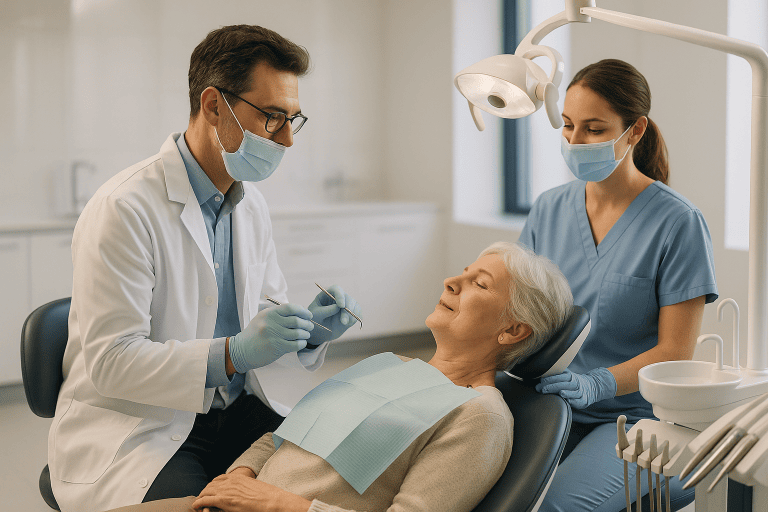
Composite Bonding
Composite bonding is a minimally invasive cosmetic dental treatment that uses tooth-colored resin to repair chips, gaps, discoloration, or uneven edges and improve the appearance of your smile.
Quick answer
Composite bonding, also called dental bonding, is a minimally invasive treatment in which tooth-coloured resin is applied directly to a tooth, shaped by hand and hardened with a curing light. It repairs chips, closes small gaps, masks localised discolouration and refines uneven edges, usually with little or no drilling, and a single tooth can often be treated in one visit.
What Is Dental Bonding?
Dental bonding is a procedure in which a dentist applies tooth-coloured composite resin directly to a tooth, sculpts it by hand, and hardens it with a curing light. It repairs chipped edges, closes small gaps, masks localised discolouration and reshapes uneven or worn teeth, usually with little or no drilling. It suits people whose teeth and gums are fundamentally healthy but who want a limited, visible flaw corrected without losing sound tooth structure.
You will see the same treatment called composite bonding, tooth bonding or cosmetic bonding. The names describe one procedure. Because the work happens directly in the mouth rather than in a laboratory, a single tooth can often be treated in one appointment, and several teeth can frequently be handled in one or two sessions. That efficiency is part of why dental bonding in Turkey has become a practical option for international patients: the clinical work fits inside a short, well-planned visit, provided the assessment and planning are done properly beforehand.
Patients tend to ask the same things about bonding: what is it exactly, how long does it last, can it be removed, and does it harm the tooth underneath. This page answers those questions plainly. It also explains how the procedure is performed step by step, what recovery looks like, what drives the cost, and, just as importantly, where bonding works well and where a different treatment would serve you better. Good cosmetic dentistry is not only about improving a smile in the short term. It is about preserving healthy tooth structure, respecting how your teeth function, and choosing a treatment that fits your situation realistically.
What is composite bonding?
Composite bonding is the same procedure described from the side of the material. The word composite refers to the resin-based material used for the restoration. It is engineered to match natural tooth shades and can be layered to create depth, contour and a surface texture close to natural enamel. The word bonding refers to the way that material adheres to the tooth once the enamel has been prepared and an adhesive system applied. The result is a restoration that becomes attached to the outer surface of the tooth and is then refined, polished and adjusted until it blends with the enamel around it.
Although bonding is usually discussed as a cosmetic treatment, it can also play a restorative role. It may replace small areas of tooth structure lost to wear, trauma or early decay, provided the tooth remains fundamentally sound. In that sense, composite bonding sits at the intersection of aesthetics and functional repair, which is exactly why careful case selection matters more than the material itself.
How does composite resin tooth bonding work?
Composite resin tooth bonding works by creating a micromechanical bond between the resin and the prepared surface of the tooth. An etching solution creates microscopic irregularities in the enamel, an adhesive agent flows into those irregularities, and the composite resin is then applied and hardened with a curing light, locking the material to the tooth. Because natural enamel and dentine: the layers described in dental anatomyhave subtle optical qualities, the dentist typically builds the restoration in thin increments of different shades and translucencies rather than in one solid block.
The technique is additive by nature. In most cosmetic cases, material is added to the tooth rather than removed from it, and the bond is most predictable on sound, healthy enamel. That is the practical reason dentists describe bonding as one of the most conservative options in aesthetic dentistry: the tooth underneath stays largely as it was.
How is dental bonding different from veneers, crowns and fillings?
Dental bonding is a direct technique: the dentist shapes the material on your tooth, in one sitting. Porcelain veneers are custom-made shells fabricated outside the mouth and then cemented to the teeth, usually after some enamel preparation. Dental crowns go further still, covering a much larger portion of the tooth, and are reserved for teeth that need substantial structural protection. Bonding can sometimes be used instead of these treatments, and sometimes alongside them within a broader smile plan.
Whitening is different again: it changes tooth colour but cannot alter shape or repair damage. And while bonding uses the same family of tooth-coloured materials as modern dental fillings, the intent differs. A filling replaces structure lost to decay; bonding is primarily used to refine shape, edge and surface appearance, although the two purposes can overlap when an old, discoloured filling on a front tooth is replaced for aesthetic reasons.
Who May Need Composite Bonding?
Composite bonding is usually recommended for patients with relatively healthy teeth and gums who want to correct limited aesthetic or structural concerns. It is most useful when the changes needed are localised rather than extensive. Many people who seek bonding are bothered by one or two specific features, a single chipped tooth, one uneven edge, one small gap, rather than by the overall condition of their teeth.
Typical reasons for considering bonding include a chipped incisal edge, small spaces between teeth, mild asymmetry, worn corners, irregular tooth contours, superficial cracks, or stains that have not responded well to whitening. Bonding may also be considered when an old filling on a front tooth has darkened or become visible and needs replacing with a more natural-looking restoration.
Some patients arrive after a specific event: biting into something hard, a sporting knock, minor dental trauma. Others are responding to gradual change rather than a single incident. Teeth wear over time through grinding, clenching, acidic exposure and ordinary age-related surface loss, and even subtle shortening or flattening of the front teeth can alter the balance of a smile. Neither situation is more legitimate than the other; both deserve a proper assessment before any material touches the tooth.
That assessment begins with a detailed dental examination. The dentist evaluates not only the visible concern but also the condition of the enamel, the bite relationship, existing restorations, gum health and any signs of habits such as bruxism. Photographs are usually taken, and in some cases digital smile analysis or study models help with planning. Shade assessment is another important part of diagnosis, particularly when the restoration will sit in a highly visible area of the smile.
X-rays may be recommended if there is any concern about underlying decay, cracks extending deeper into the tooth, older restorations, or problems affecting the pulp or root. If gum inflammation or untreated cavities are present, these generally need attention before cosmetic bonding goes ahead. A healthy foundation matters, because aesthetic treatment holds up best when the surrounding oral tissues are stable.
Bonding is especially appropriate for patients who want improvement but prefer a conservative approach, and it is often favoured for younger adults or in any situation where preserving maximum natural tooth structure is a priority. It is not for everyone. If a tooth is heavily damaged, if the bite places excessive load on the area, or if you want a broad colour change across many teeth, another treatment may be more suitable, and a good clinician will say so.
Conditions Composite Bonding Can Address
Composite bonding is versatile, but it performs best when used for clearly defined indications. Composite bonding teeth at the front of the mouth demands particularly careful shade selection and contouring, because these teeth are visible in speech and smiling and sit under different light throughout the day. The goal, in every case, is to enhance appearance while protecting function and conserving healthy enamel.
- Chipped teeth: small to moderate chips, especially on front teeth, can often be rebuilt to restore a natural outline.
- Gaps between teeth: minor spacing, particularly between the upper front teeth, may sometimes be closed or visually reduced.
- Discolouration: localised stains, mottled enamel, or areas that do not respond adequately to whitening may be masked with composite.
- Uneven edges or shape irregularities: teeth that appear too short, asymmetrical, pointed or worn can often be reshaped.
- Surface defects: small enamel imperfections, roughness or developmental irregularities may be improved.
- Worn teeth: early wear from grinding or acidic erosion may sometimes be restored conservatively, depending on severity.
- Visible old restorations: older fillings on front teeth that have darkened may be replaced for a more natural appearance.
- Minor structural repair: small areas of tooth loss from trauma or decay may be restored if the tooth remains fundamentally sound.
The limits matter as much as the list. Composite bonding is generally not the right treatment for severe crowding, significant bite problems, extensive tooth destruction, advanced decay, or situations with a high risk of repeated fracture. In those cases, orthodontic treatment, veneers, crowns or other restorative approaches usually provide a more stable long-term answer.
For that reason, the best treatment plan is not always the simplest one at first glance. A thorough evaluation clarifies whether bonding will give a durable, proportionate result, or whether another option would better support both your appearance and your long-term oral health.
How Composite Bonding Is Performed
Treatment starts with consultation and planning, not with resin. At this stage the dentist discusses your concerns, examines the teeth and confirms whether bonding is appropriate. For international patients, planning often begins before travel, using photographs, dental history and any prior records available, with the in-person examination confirming what can be treated conservatively and whether any preliminary dental work is needed first.
If whitening is part of your smile plan, it is normally discussed and sequenced before bonding. The shade of the composite is selected to match your teeth at the time of treatment, and composite itself does not lighten the way natural enamel can. Whitening after bonding risks a visible mismatch; whitening before it lets the dentist match the new, lighter shade.
Do you need anaesthesia for dental bonding?
In many cases, no. When bonding is limited to the outer surface of the tooth and no decay is being removed, the procedure often requires no injection at all. If the area is sensitive, or if bonding is combined with another restorative step, local anaesthesia can still be used for comfort: an area covered in more detail under dental anaesthesiology. Your dentist decides this with you at the appointment, based on what the tooth actually needs.
What happens during the appointment?
The clinical sequence is precise but straightforward:
- Cleaning and isolation. The tooth is cleaned and kept dry, because moisture interferes with the adhesive process.
- Surface preparation. The enamel may be very lightly roughened or contoured; in many cases little or no natural tooth structure is removed.
- Etching. An etching solution creates the microscopic surface irregularities that improve adhesion.
- Adhesive. A bonding agent is applied and prepared according to the clinical protocol.
- Layering. Composite resin in carefully selected shades is built up incrementally, each layer hardened with a curing light.
- Sculpting and bite check. The dentist shapes the contour, edge profile and surface anatomy, then checks that the restored tooth meets its opposing tooth correctly and is not overloaded during chewing.
- Finishing and polishing. Fine instruments and polishers create the final gloss and texture.
The layering stage is where the craft shows. Composite resin bonding teeth layer by layer, shade by shade, is closer to sculpting than to filling a cavity: rather than placing a single block of material, the dentist builds translucency and depth incrementally so the restoration behaves like enamel in different light. This is particularly important on front teeth, where a flat, opaque restoration is immediately noticeable.
Finishing and polishing are essential steps, not cosmetic afterthoughts. A well-polished bonded surface is smoother, more comfortable against the lip and tongue, more resistant to plaque accumulation, and visibly more natural. The final polish is a large part of what makes the restoration disappear into the smile.
The technology involved is focused on precision rather than scale: high-resolution digital imaging, magnification, shade-matching tools, modern adhesive systems and curing lights that support effective polymerisation of the resin. In selected cases, digital smile planning or a mock-up helps you visualise the likely change before treatment begins. None of this replaces clinical skill: it supports communication and predictability, and the result still depends heavily on the hands doing the work.
How long does composite bonding take?
A small single-tooth repair can take well under an hour. Multiple teeth, or more detailed aesthetic refinement, may need a longer session or a staged approach across more than one appointment. This is one of bonding’s practical strengths: visible improvement is often achieved quickly, without laboratory turnaround time, which is also what makes the treatment realistic within a short international visit.
Recovery After Dental Bonding
Recovery from dental bonding is typically mild, and most patients return to normal daily activity immediately after the appointment. It still helps to know what to expect over time.
| Time Period | What to Expect |
|---|---|
| Day 1 | The tooth is usable straight away. If anaesthesia was used, numbness usually resolves within a few hours. The restoration may feel new to the tongue at first, but significant discomfort is uncommon. |
| First week | Most patients adapt quickly to the new shape. It is sensible to avoid biting very hard items directly with treated front teeth and to follow any advice about limiting strongly staining foods and drinks, particularly soon after polishing. |
| First month | The restoration should feel natural in daily function. Any small bite irregularity or roughness should be reviewed promptly, as simple polishing or adjustment can improve both comfort and longevity. |
| Longer term | With good oral hygiene, regular dental reviews and protection from habits such as grinding or nail biting, bonded restorations can remain attractive and functional for years, though maintenance or touch-ups may eventually be needed. |
Follow-up is simple but genuinely useful. Bonded restorations should be reviewed at routine check-ups so the dentist can monitor wear, polish, staining, marginal adaptation and the effect of your bite and habits over time. One of bonding’s practical advantages is that it can usually be refined, re-polished or repaired without starting again from scratch.
Benefits of Composite Bonding
The advantages of bonding are best understood in terms of what they mean for daily life and for the long-term preservation of your teeth.
| Benefit | What It Means for You |
|---|---|
| Conservative treatment | Often little or no healthy tooth structure needs to be removed, which helps preserve the natural tooth. |
| Natural appearance | Tooth-coloured resin can be shaped and polished to blend with neighbouring teeth in colour, contour and surface texture. |
| Efficient improvement | Many concerns can be corrected in a single visit or a short treatment plan, helpful for patients travelling internationally. |
| Versatility | The same technique addresses chips, small gaps, uneven edges, localised discolouration and other minor defects. |
| Repairable material | If a bonded area wears, chips or stains over time, it can often be adjusted, polished or repaired without replacing the whole restoration. |
| Functional support | Beyond appearance, bonding restores smooth edges, improves contour and protects areas of minor structural loss. |
How Long Does Composite Bonding Last, and Can It Be Undone?
Composite is a strong material, but it is not enamel and it is not porcelain. Bonded restorations can pick up surface stain, lose some gloss, or chip under heavy load over time, particularly on the biting edges of front teeth. How long a restoration stays looking its best depends on where it sits in the mouth, how your bite loads it, your habits, and how well it is maintained. The honest framing is this: bonding is durable and repairable rather than permanent and untouchable. Periodic polishing or small touch-ups are a normal part of owning bonded teeth, not a sign that the treatment failed.
Can composite bonding be removed?
In most cosmetic cases, yes, because bonding is additive, the composite can usually be removed or replaced by a dentist without leaving the tooth worse than before treatment, provided little or no enamel was removed originally. Removal is a careful clinical procedure, done with fine instruments and magnification so the enamel underneath is protected; it is not something to attempt outside a dental setting. If the original bonding involved reshaping or repaired lost structure, the tooth will still need some form of restoration afterwards, so “removable” does not always mean “back to untouched”. Your dentist can tell you which situation applies to your teeth.
Does composite bonding damage your teeth?
Performed correctly on a suitable tooth, bonding is one of the least damaging treatments in cosmetic dentistry, precisely because it usually adds material rather than removing it. The etching step alters only a microscopic layer of enamel. The realistic caveats are indirect: a poorly finished restoration can trap plaque at its margins, and a restoration placed on an overloaded tooth can chip repeatedly. Both risks are managed by good technique, sensible case selection and routine review, which is why the planning stage deserves as much attention as the procedure itself.
What Influences a Good Result
A successful result depends on more than the material. Case selection comes first: bonding performs best when the defect is limited, the surrounding tooth structure is healthy, and the forces acting on the tooth are well understood. A carefully chosen indication almost always outperforms an ambitious one.
The condition of the enamel matters, because composite adheres most predictably to sound enamel. Patients with extensive previous restorations, active decay, significant erosion or deep cracks may need a different approach. Gum health is equally important: inflamed gums affect the appearance of the smile and make the precise moisture control that bonding requires more difficult.
The bite is another key factor. Front teeth that take heavy contact during chewing, clenching or night-time grinding are at greater risk of chipping and accelerated wear. Some patients benefit from a protective night guard after treatment, and if the bite is genuinely unstable, orthodontic or restorative planning may be needed before or alongside bonding rather than after it.
Habits and lifestyle shape durability too. Frequent coffee, tea, red wine or tobacco use contributes to surface staining over time. Biting pens, opening packages with the teeth, chewing ice and nail biting all raise the risk of fracture. Aftercare does not need to be complicated, consistent dental hygiene and regular reviews cover most of it, but it does require awareness.
Clinical artistry is the element patients cannot see on a price list. Composite bonding is technique-sensitive: the final result depends on shade selection, an understanding of tooth anatomy, precise layering, contouring, finishing and polishing. In visible areas, the goal is never simply to fill a defect but to create a restoration that looks proportionate and natural within the whole smile and face.
Finally, realistic expectations contribute more to satisfaction than any single clinical variable. Bonding can make a meaningful improvement, sometimes a striking one, but it remains a material placed directly on the tooth, with strengths and limits. Understanding how it compares with porcelain veneers and other options in longevity, stain resistance, reparability, cost and degree of preparation is part of choosing well.
How Much Is Composite Bonding?
There is no single universal answer, because bonding is priced case by case, and this page deliberately quotes no figures. Clinics often publish a bonding teeth price per tooth, but what that number includes varies widely between providers, which is why two quotes are rarely comparing the same thing. What you can usefully understand is what drives the cost of any bonding quote, wherever in the world you are treated, including in Turkey.
- Number of teeth treated: a single chipped edge is a different undertaking from reshaping several front teeth.
- Complexity of the work: masking deep discolouration or rebuilding worn edges takes longer than smoothing a minor irregularity.
- Preliminary treatment: hygiene visits, gum treatment, whitening or replacement of old restorations may need to come first and are sometimes quoted separately.
- Planning and imaging: digital smile analysis, photography and mock-ups may or may not be included in a headline figure.
- The clinician’s experience: bonding is technique-sensitive, and skilled aesthetic work is priced accordingly.
- Aftercare: whether review appointments, polishing and minor adjustments are included matters over the life of the restoration.
When you compare quotes, compare scope rather than headline numbers: ask exactly which teeth are included, whether examination and X-rays are covered, what happens if an adjustment is needed, and how future touch-ups are handled. A quote that answers those questions clearly tells you more about the clinic than the number itself does.
Why Acting Early Can Matter
Bonding is usually elective, but delaying an evaluation is not always neutral. A small chip may stay stable, or it may become more noticeable, develop rough edges, or take additional stress during chewing. Minor wear tends to progress if grinding or acid exposure continues. A discoloured area can signal an older restoration failing at its margin or, occasionally, a deeper structural issue that deserves proper assessment rather than cosmetic camouflage.
There is also a straightforward treatment-planning reason to act earlier: conservative dentistry works best while problems are still small. A limited defect can often be repaired with additive bonding alone; if the damage worsens, more extensive restoration may eventually be needed. Preserving enamel is genuinely valuable, because enamel provides the strongest, most predictable surface for bonding and supports the long-term integrity of the tooth.
Timing also affects how simple the solution can be. People sometimes live with a concern for years and then seek treatment under deadline pressure: an event, a relocation, a role with public visibility. Assessing earlier leaves time to consider options calmly, sequence treatment properly, and decide whether bonding, whitening, aligners or another approach will produce the most balanced result.
Coming to Turkey for Composite Bonding: What to Plan
Turkey is an established destination for dental treatment, and bonding travels better than many procedures because it is completed chairside, without laboratory waiting time. That said, a good outcome abroad depends on the same things a good outcome at home does, accurate diagnosis, honest case selection and skilled execution, plus some planning that only international patients need to think about.
Is it worth going to Turkey for composite bonding?
It can be, if the treatment is genuinely indicated and the visit is planned realistically. Bonding suits international care well: it is minimally invasive, usually completed in one or two appointments, and requires no surgical recovery before flying. It is less suitable as a spontaneous add-on to a holiday. The cases that go well are assessed properly first, ideally with photographs and dental history shared before travel, so that the in-person examination confirms a plan rather than improvising one. If the examination reveals that veneers, orthodontics or restorative work would serve you better, the honest answer may be a different treatment or a longer timeline than one trip allows.
Is it a good idea to travel to Turkey for dental work?
The sensible answer is: it depends on the treatment, the provider and your willingness to plan. Straightforward, well-defined procedures such as bonding fit a short visit; complex multi-stage work needs either a longer stay or several trips. Wherever you choose to be treated, look for a thorough pre-travel assessment, a clear written treatment plan, transparency about what is and is not included, and a defined arrangement for reviews and touch-ups after you fly home. Treatment that begins with a diagnosis rather than a package tends to end better.
What does a typical care pathway look like?
For bonding, an international pathway usually follows this shape:
- Remote pre-assessment: photographs, dental history and any existing records are reviewed before travel to gauge suitability and scope.
- In-person examination: on arrival, a full clinical assessment, including gum health, bite and any necessary X-rays, confirms or adjusts the plan.
- Preliminary work if needed: hygiene treatment, whitening or replacement of failing restorations is sequenced before bonding.
- The bonding appointment: one session for limited work; a staged approach for multiple teeth or detailed refinement.
- Review before departure: a short follow-up allows bite checks, polishing and any fine adjustment while you are still in the country.
- Ongoing care at home: routine check-ups with your local dentist, with your treatment records available to support continuity.
Build a small buffer into your travel dates rather than booking the tightest possible schedule. Bonding rarely needs it, but having a spare day for a final polish or bite adjustment is far easier than arranging remote follow-up later. Ask in advance how the clinic handles questions after you return home and what documentation you will take with you: a written record of materials and shades used makes any future maintenance by your local dentist simpler.
Composite Bonding at Acibadem
Dental care at Acibadem sits within a broader clinical framework, delivered through its dental and oral health units, rather than as a standalone cosmetic service. In practice, that means patients are evaluated first and directed to a procedure second. If bonding is the right choice, the plan is built around it; if another option would better protect the tooth, stabilise the bite or achieve your goals more appropriately, that becomes part of the discussion. This measured approach matters in dentistry, where the most conservative treatment is often, but not always, the right one.
A smile concern can involve more than one specialty, including restorative dentistry, prosthodontics, orthodontics, periodontics and endodontics. Within a hospital-based healthcare group, those perspectives can be coordinated when a diagnosis is not straightforward or when a plan involves more than one step. Modern diagnostic support, imaging, digital planning tools and contemporary restorative protocols, helps dentists assess tooth structure, smile balance and treatment suitability with precision, while the clinical result still rests on experience and technique.
For patients travelling from abroad, international patient services coordinate the practical side of care: scheduling, language support, treatment sequencing, medical documentation and planning enough time in Turkey for consultation and treatment. Bonding itself is not a one-size-fits-all procedure, some patients want a repair no one will notice, others want broader enhancement that still keeps a natural character, and the appropriate plan depends on facial features, tooth proportions, age, bite, habits and how visible the treated teeth are in speech and smiling. Personalised planning aligns the dental work with the individual rather than with a generic cosmetic template.
Making a Considered Decision
If you are weighing up composite bonding, the most useful next step is a professional evaluation of your teeth, bite and aesthetic goals. In some cases bonding is exactly the right answer: conservative, efficient and natural-looking. In others, a different treatment offers the better long-term result. The value of a thorough assessment is not to confirm a procedure you have already chosen, but to establish what is genuinely most appropriate for your smile.
A second opinion is worth its time whenever you have been asked to choose between bonding, veneers, orthodontic treatment or the replacement of older restorations: the options differ meaningfully in how much tooth structure they involve and how they age. With careful planning, composite bonding can repair small imperfections and bring a smile into better balance while preserving the natural tooth underneath, which is precisely why it has earned its place as one of the most conservative tools in aesthetic dentistry.
Preparation
- Your dentist examines your teeth and discusses your aesthetic goals to confirm that composite bonding is suitable. A shade is selected to match your natural teeth, and minimal preparation is usually needed. In some cases, small adjustments or light polishing may be performed before the resin is applied.
Aftercare
- Avoid biting very hard foods with treated teeth for the first day and maintain good oral hygiene with brushing and flossing. Limit staining foods and drinks such as coffee, tea, and tobacco to help preserve the color. Regular dental check-ups and occasional polishing can help maintain the result.
Frequently Asked Questions
What is composite bonding and how can it improve my smile?
Composite bonding is a cosmetic dental treatment that uses a tooth-colored resin to improve the shape, color, length, or surface of teeth. It is often used to repair chips, close small gaps, smooth uneven edges, and cover minor discoloration. The material is carefully matched to your natural tooth shade for a harmonious look. At Acibadem, dental specialists assess your teeth, bite, and smile goals to create a personalized treatment plan.
Is composite bonding painful, and do I need anesthesia?
Composite bonding is usually a comfortable procedure and often does not require anesthesia, especially when only the outer surface of the tooth is treated. If bonding is being used to repair a deeper chip or an area close to the nerve, local anesthesia may be recommended for comfort. Most patients describe the treatment as quick and gentle. Acibadem dentists explain each step clearly and tailor the approach to your needs.
How long does composite bonding take during one visit?
In many cases, composite bonding can be completed in a single visit. The exact time depends on how many teeth are being treated and how much reshaping is needed. A single tooth may take less than an hour, while multiple teeth will take longer. After preparing the surface, the dentist applies, shapes, hardens, and polishes the resin. Acibadem specialists provide a personalized timeline after examining your teeth and discussing your expectations.
How long does composite bonding last on front teeth?
Composite bonding can last several years when it is well cared for, but longevity depends on your bite, oral hygiene, diet, and habits such as nail biting or teeth grinding. Front teeth are visible and can be exposed to wear, so maintenance matters. The bonding may eventually need polishing, repair, or replacement. At Acibadem, dentists evaluate your lifestyle and bite pattern to help you understand what results are realistic for you.
Can composite bonding fix chipped teeth, gaps, and uneven edges?
Yes, composite bonding is commonly used to correct small chips, minor gaps between teeth, uneven edges, worn corners, and subtle shape differences. It is a versatile option for patients who want visible improvement without more invasive treatment. However, larger gaps, major alignment issues, or heavy bite problems may be better treated with veneers, orthodontics, or other procedures. Acibadem specialists can recommend the most suitable option after a personalized dental assessment.
Will composite bonding look natural and match my other teeth?
When done carefully, composite bonding can look very natural. The resin comes in different shades and translucencies, allowing the dentist to match the surrounding teeth as closely as possible. Shape, contour, and polishing are also important for a realistic result. If teeth whitening is planned, it is often better to whiten first and then match the bonding to the brighter shade. Acibadem dentists use a personalized approach to achieve a balanced, natural-looking smile.
What is the difference between composite bonding and porcelain veneers?
Composite bonding uses tooth-colored resin placed directly onto the tooth, while porcelain veneers are thin custom-made ceramic shells bonded to the front surface. Bonding is usually more conservative, faster, and easier to repair, but it may stain or wear sooner than porcelain. Veneers can offer greater durability and stain resistance, though they often require more planning and tooth preparation. At Acibadem, your dentist helps compare both options based on your smile goals and oral condition.
How much does composite bonding cost in Turkey?
The cost of composite bonding in Turkey depends on several factors, including the number of teeth treated, the complexity of the reshaping, the materials used, and whether other dental procedures are needed first. Because every smile is different, it is best to avoid one-size-fits-all estimates. After reviewing photos or examining you in person, Acibadem specialists can provide a personalized treatment plan and detailed quotation for international patients.
Do I need special care after composite bonding treatment?
After composite bonding, good daily care helps maintain the appearance and lifespan of the results. Brush and floss regularly, attend routine dental checkups, and avoid habits that can chip the material, such as biting hard objects, opening packages with your teeth, or chewing ice. Limiting strongly staining foods and drinks can also help, especially soon after treatment. If you grind your teeth, your dentist may suggest a night guard. Acibadem provides individualized aftercare advice.
Can international patients travel to Turkey for composite bonding and return quickly?
Yes, many international patients choose Turkey for composite bonding because treatment is often completed quickly, sometimes within one visit depending on the case. This can make it suitable for shorter dental trips. Before travel, online consultation and photo review may help the team understand your needs. Once in Turkey, Acibadem specialists perform a full examination and confirm the best plan. Travel timing depends on the number of teeth, your bite, and any additional treatments needed.
Medically reviewed by the Acıbadem International Medical Board September 13, 2026
See our medical review board →
Update history
- PublishedJuly 19, 2026
- Medical review approvedSeptember 13, 2026
- Last content updateSeptember 12, 2026
Planning this treatment in Turkey
Our English guides for international patients: costs, timelines, safety and travel.
From the Acibadem Blog

Composite Bonding in One Visit: How International Patients Fit It Into a Short Trip
Composite bonding can often be completed in a single appointment because the tooth-colored resin is shaped and hardened directly on the tooth, with no…
Composite Bonding Results: Blending With Natural Teeth and What the Resin Cannot Change
Composite bonding results depend on how carefully tooth-colored resin is shade-matched, layered, and polished onto natural enamel; done well, it can disguise small chips,…
Composite Bonding vs Veneers: Which Fits Your Teeth, Budget and Timeline
Composite bonding and veneers fix similar cosmetic problems in different ways. Bonding sculpts tooth-colored resin directly onto teeth in one visit, costs less, and…