

When Composite Bonding Chips or Stains: Repair, Polish or Replace?

Key Takeaways
- The Cleveland Clinic gives roughly 3 to 10 years as a typical lifespan for composite bonding before touch-ups or replacement, so a chip after several years is expected wear rather than failure.
- Dentists increasingly repair a chipped corner by roughening, etching and adding new resin instead of replacing the whole restoration, because every replacement removes a little more enamel.
- Whitening products do not change the color of bonding, according to the NHS, so bleaching natural teeth makes existing composite look darker and usually means it must be polished or redone to match.
- Surface stain from coffee, tea and wine can often be polished away, but a dark line at the margin may signal a failed seal or decay and needs examination rather than scrubbing.
- Long-term studies reviewed in Dental Materials found annual failure rates of around 1 to 3 percent for posterior composites, with grinding and caries risk influencing survival more than the brand of material.
- Spontaneous pain, heat sensitivity, a loose tooth, or swelling near a chipped bonded tooth are reasons for prompt dental contact, not a routine cosmetic appointment.
A chipped composite bonding can often be repaired by adding fresh resin to the existing material after the dentist roughens and re-bonds the surface, while surface stains are usually polished away rather than replaced. Full replacement is generally reserved for large fractures, decay beneath the bonding, or deep discoloration. Your dentist will examine the tooth, check your bite, and advise which option fits your situation.
It usually happens on something ordinary. A crusty baguette, an ice cube at the bottom of a glass, the cap of a pen that did not want to come off. Then the tongue finds a new edge on a front tooth, and the mirror confirms it: a small corner of the bonding is gone. The tooth underneath is fine. The feeling in the stomach is not.
People who have had composite bonding on a front tooth tend to assume the worst in that moment, that the whole thing has failed and must be redone from scratch. Most of the time, that is not what happens. A composite bonding chipped repair is one of the more routine jobs in a dental practice, and in many cases it means adding material rather than removing it.
This explainer walks through how dentists decide between a polish, a patch and a full redo, what the evidence says about how long each tends to last, and the signs that mean the chip is a message about something larger, like a grinding habit or decay under the edge.
Why does composite bonding chip in the first place?
Composite bonding is a tooth-colored plastic resin, filled with tiny glass particles, that a dentist sculpts onto a tooth and hardens with a blue light. The Cleveland Clinic describes it as a way to repair chips, close small gaps and cover discoloration without reshaping much of the natural tooth. That is its great appeal: little or no drilling, often finished in a single visit.
The same qualities that make bonding gentle also make it the softest option on the shelf. Composite resin is weaker than natural enamel, the hard outer shell of the tooth, and considerably weaker than porcelain. It also sits on the tooth rather than being locked into it, held by a microscopic mechanical grip created when the dentist etches the enamel with a mild acid and applies a liquid bonding agent.
Chips happen where force meets a thin edge. On a front tooth, bonding is thinnest exactly where it does the most work: the biting edge and the corners. Biting directly into something hard, catching a fork, grinding at night or using teeth as tools all concentrate stress on that fine margin. Over years, the resin also absorbs a small amount of water and loses some of its early surface gloss, which is why older bonding tends to pick up stain before it fractures.
None of this means the dentist did poor work. The Cleveland Clinic lists a typical lifespan of roughly 3 to 10 years before bonding needs touching up or replacing, and the wide range reflects habits, bite forces and location as much as technique. A composite bonding chipped repair is, in that sense, an expected part of owning bonding rather than a sign that something went wrong.
Can composite bonding be repaired, or does it need replacing?
The honest answer is that both happen, and the choice is clinical rather than cosmetic alone. Repair means adding new composite to the existing restoration after preparing its surface. Replacement means removing most or all of the old resin and rebuilding the tooth from a clean enamel surface.

Dentists have moved toward repair over the past two decades for a simple reason: every replacement removes a little more tooth. Research on the longevity of composite restorations, summarized in a review by Demarco and colleagues published in Dental Materials, emphasizes that failure is driven as much by the patient and the clinician as by the material, and that repairing a localized defect can extend the useful life of a restoration while sparing sound tooth structure.
A dentist weighing the decision will typically look at four things:
- Size and location of the defect, and whether it reaches the tooth itself.
- Whether there is decay, a leaking margin or a dark line at the edge of the bonding.
- Color match, since old composite may have darkened and new resin may not blend with it.
- The reason it chipped, because a bite problem will break a repair just as efficiently as it broke the original.
Replacement tends to win when the bonding is old and generally discolored, when several corners have failed, when decay is present under the edge, or when the original work was already a compromise for a tooth that may now suit a different restoration. Repair tends to win when the defect is small, the rest of the bonding is sound and the color still matches well.
Neither decision is permanent. A repaired tooth can be replaced later, and a dentist may suggest a trial repair precisely because it costs the tooth nothing if a fuller rebuild becomes necessary down the line. The judgment call always rests with the treating dentist who can see the tooth, the bite and the X-ray.
What can I do if my composite bonding has chipped? First steps at home
Resist the urge to fix it yourself. Adhesives sold for household use are not designed for the mouth, can irritate gums and will make the dentist’s job harder because residue has to be cleaned off before resin can bond.
Instead, treat the moment the way MedlinePlus advises for any broken tooth. Rinse gently with warm water to clear debris. If the chip is big enough to find, save it in a small container; a dentist may want to see how much is missing even if the piece itself cannot be reattached. A cold compress on the cheek helps if the area feels bruised or swollen.
Run your tongue over the edge. A sharp point can scrape the lip or tongue over a few days, and most dental teams are happy to smooth that edge quickly even when the full repair has to wait for a longer appointment. Some pharmacies sell soft dental wax marketed for braces; a small piece pressed over a sharp corner is a reasonable short-term buffer, not a repair.
Eat on the other side where you can, and keep hard, chewy and sticky foods away from the tooth. Cold sensitivity after a chip is common when a sliver of dentin, the softer layer beneath enamel, has been uncovered. The NHS notes that a chipped or broken tooth may feel sensitive, and that it is sensible to see a dentist even when it does not hurt.
Then make the call. Book a routine appointment for a painless chip with no mobility and no bleeding. Ask for an urgent slot if the tooth hurts spontaneously, feels loose, or if a large piece of the natural tooth has gone with the bonding. The next sections explain what the dentist is likely to do once you are in the chair.
What happens during a composite bonding chipped repair
Most repairs are shorter than the original bonding appointment. The Cleveland Clinic gives 30 to 60 minutes per tooth as a typical range for bonding itself; a small corner repair often sits at the lower end of that or below it.
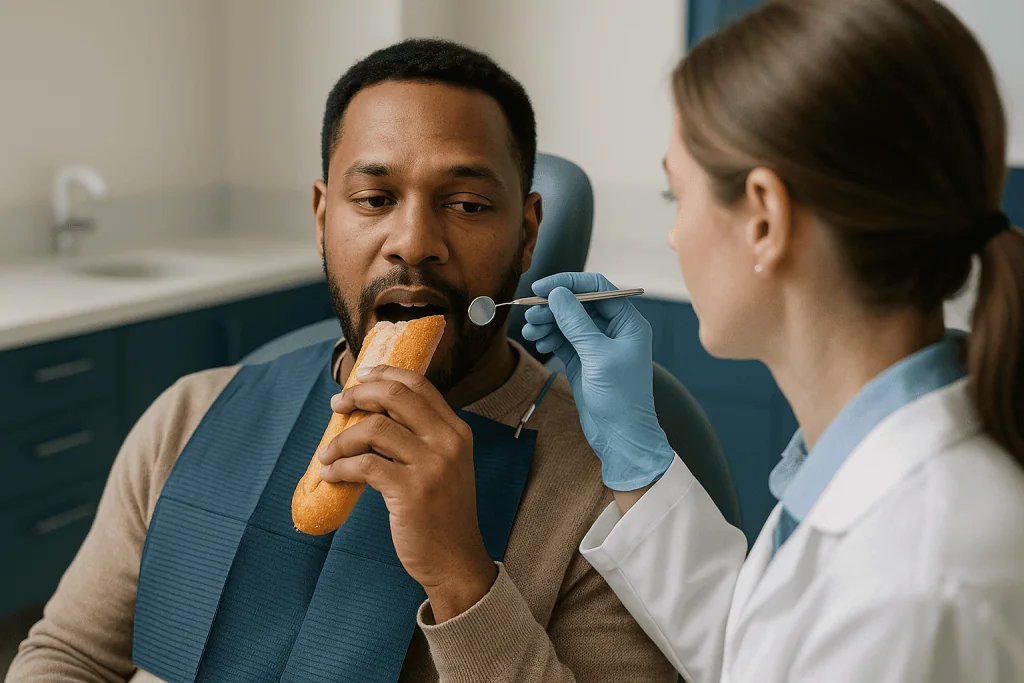
The dentist starts by examining the tooth under good light and magnification and checking the bite with marking paper, the thin colored strip you bite on to show where teeth touch. If the chip is on a corner that takes heavy contact, that will shape the repair. An X-ray may be taken if there is any doubt about decay under the margin.
Preparing old composite is the step that matters most. Fresh resin does not stick well to a smooth, aged resin surface, so the dentist roughens the chipped area with a fine bur or air abrasion, extends the preparation slightly onto surrounding enamel, and then etches the enamel with a mild phosphoric acid gel for a few seconds. A bonding agent, a thin liquid adhesive, is painted on and light-cured. Some clinicians add a silane coupling agent, a primer that improves adhesion to the glass filler inside old composite.
Shade selection comes next. Composite is layered in small increments, each hardened with the curing light, often with a more opaque inner layer to block through-shine and a translucent outer layer to mimic enamel. The dentist then carves the new corner to match its neighbor, checks the bite again and polishes through progressively finer discs and pastes until the surface shines.
Anesthetic is often unnecessary, since no sensitive tooth structure is being drilled. Where a chip has exposed dentin and the tooth is sensitive to air, the dentist may offer a local anesthetic; that choice is made at the chairside based on comfort, not routine.
Repair, polish or replace: a side-by-side comparison
The three options overlap, and dentists frequently combine them, polishing the rest of a tooth while patching one corner. The table lays out how they usually differ.
| Option | Usually suited to | What is done | Typical trade-offs |
|---|---|---|---|
| Polish only | Surface stain, dull finish, tiny roughness, minor edge wear | Fine discs, rubber points and polishing paste restore gloss; may remove a hair’s breadth of resin | Does not add material; deep or intrinsic discoloration will not lift |
| Repair (add composite) | Small to moderate chips where remaining bonding is sound and well-matched | Roughen, etch, bond, layer new resin, shape and polish | Color blending between old and new resin can be imperfect; bond to old composite is weaker than to enamel |
| Replace | Large fractures, decay at the margin, widespread discoloration, repeated failures | Remove old resin, re-etch clean enamel, rebuild the full restoration | Longer visit; small loss of enamel each time; opportunity to reassess whether another restoration type suits better |
A fourth path belongs in the conversation even though it is not a treatment: leaving a trivial chip alone. A barely visible edge on a back tooth that is smooth to the tongue and shows no leakage may simply be monitored at routine check-ups. Dentists who favor conservative care often prefer watching to intervening when nothing is at risk.
Alternatives beyond composite exist for teeth that keep failing. Porcelain veneers, thin ceramic shells bonded to the front surface, and crowns, which cover the whole tooth, are stronger and more stain-resistant but involve removing more enamel and cannot be patched in the same way. They are a different decision, with different risks, and worth a dedicated discussion with your dentist rather than a quick swap after one chip.
How big of a chip can dental bonding fix?
The size question comes up constantly, and the answer depends less on millimeters than on what is left to bond to and how hard the area will be hit.
Small chips at the biting edge of a front tooth are composite’s natural territory. The Cleveland Clinic lists repairing chips and cracks, and lengthening teeth that are shorter than their neighbors, among the standard uses of bonding. When most of the tooth and the original restoration remain, adding a corner is straightforward.
Medium chips, say a corner that takes a third or so of the incisal edge, are still usually within range, but the dentist will think harder about the bite. The further a restoration extends without tooth structure behind it, the more leverage every bite applies to the bond line. In those cases dentists often build in extra bulk at the back of the tooth or adjust how the opposing teeth meet so the new edge is not the first point of contact.
Large fractures change the conversation. When a chip takes a substantial portion of the crown of the tooth, exposes a large area of dentin or approaches the pulp, the living core that holds the nerve, composite alone may not be the most durable answer. A dentist may suggest a ceramic restoration or, where the nerve is affected, assessment for root canal treatment first. MedlinePlus notes that a broken tooth exposing the pulp can become painful and infected, which is why urgency rises with size.
Position matters as much as size. A back tooth absorbs several times the chewing load of a front tooth, so the same volume of composite may be a confident fix on an incisor and a short-lived one on a molar. The person best placed to judge is the dentist with the tooth in view; the size categories above are a guide to the conversation, not a verdict.
Composite bonding stained: can it be polished back, or is replacement the only fix?
Stain is the quieter failure. Nothing breaks, but over months a front tooth starts to look a shade warmer than its neighbors, or a brown line creeps along the edge where bonding meets enamel.
Two kinds of discoloration behave very differently. Surface stain sits on and in the outer layer of resin, picked up from coffee, tea, red wine, curry spices and tobacco. Composite is slightly porous and gets more so as its surface wears, which is why older bonding stains faster than fresh. This type usually responds well to professional polishing; the dentist removes a microscopically thin layer of stained resin and restores a smooth, glossy surface that resists new stain for a while.
Intrinsic discoloration is different. The resin itself has darkened through years of water uptake and chemical change, or the margin has opened and stain has worked underneath. Polishing cannot reach that. The NHS points out that whitening products do not work on dental restorations such as crowns, veneers or fillings, and the same applies to bonding. If you whiten your natural teeth, the bonding stays its original shade and may suddenly look darker by contrast.
That mismatch is one of the most common reasons bonding is replaced on a tooth that has not chipped at all. Dentists generally advise completing any whitening first, waiting a couple of weeks for the shade to settle, and then matching new composite to the lighter tooth.
A dark line specifically at the margin deserves attention rather than cosmetic patience. It can be harmless stain trapped in a tiny ledge, or it can signal that the seal has failed and bacteria are reaching the tooth beneath. Only an examination, sometimes with an X-ray, can tell the two apart, which is why stained bonding should be seen rather than simply scrubbed harder at home.
Who is usually a good candidate for repair, and who is asked to wait
Repair suits a specific profile. The remaining bonding is intact, with no soft or chalky areas and no gap at the edge. The color still matches the tooth well. The chip has a clear cause, like biting a shell in a sandwich, rather than a pattern. The person’s gums are healthy and the tooth does not hurt on its own. In that setting most dentists will offer a same-day repair.
Several situations tend to prompt a pause rather than a quick patch.
- Active gum inflammation or bleeding around the tooth, because moisture and blood ruin the bond. Treating the gums first gives the repair a dry field to stick to.
- Recent or planned whitening, since the shade will shift and a repair matched today may not match in a fortnight.
- Suspected decay or a leaking margin, which must be removed before any resin goes on; a patch over decay simply hides it.
- Signs of heavy grinding, such as flattened edges or chips on several teeth, where the dentist may want to address the bite or provide a night guard alongside the repair rather than feed resin into a problem that will break it again.
- Pain to hot, lingering sensitivity or spontaneous ache, which point to the nerve rather than the surface and need assessment before cosmetics.
Children and teenagers with bonding on front teeth, often placed after a playground injury, are repaired in much the same way, and dentists tend to prefer repairing and re-repairing composite until growth is complete, because more permanent restorations are generally deferred until the teeth and gums have settled into their adult positions.
Being asked to wait is not a refusal. It is usually the dentist protecting the result, and the repair follows once the underlying issue is managed.
The days and weeks after a chipped dental bonding repair
Composite is fully hardened by the curing light before you leave, so there is no setting period in the way there is with some other materials. You can eat as soon as any anesthetic has worn off, although many dentists suggest avoiding very hard foods on that tooth for the first day or two while you get used to the new edge.
The first thing most people notice is the shape. A rebuilt corner can feel enormous to the tongue for a day or two even when it matches the neighbor perfectly in the mirror. That sensation fades as the brain recalibrates. If the edge still feels high, catches when you bring your teeth together or clicks against the lower teeth in a way it did not before, that is worth a quick call; a few seconds of adjustment at the chair fixes it and prevents the repair from taking excess load.
Mild sensitivity to cold can appear in the first few days, especially if dentin was exposed by the chip. It typically eases on its own as the tooth settles. The Cleveland Clinic lists temporary sensitivity among the expected after-effects of bonding. Sensitivity that worsens, lasts more than a few weeks, or arrives with heat rather than cold is a different matter and belongs in the red-flag section below.
Staining habits matter most in the early weeks. Fresh composite polishes to its smoothest finish right after placement, and keeping heavily pigmented drinks to a minimum during that period gives the surface its best start. Brushing twice daily with a soft brush and fluoride toothpaste, flossing or using interdental brushes around the tooth and keeping routine check-ups are all the maintenance it needs. At each visit the dentist will check the margin, re-polish if required and catch a loosening edge before it becomes the next chip.
How long does repaired composite bonding last? What the evidence shows
The uncomfortable truth is that no one can promise a number for an individual tooth. What the evidence offers instead are ranges and risk factors.
For bonding as a whole, the Cleveland Clinic gives a typical lifespan of about 3 to 10 years before touch-ups or replacement are needed. That spread is not vagueness; it reflects how much the outcome depends on where the bonding sits, how the person bites and what they eat and do with their teeth.
The research literature adds detail. A review by Demarco and colleagues in Dental Materials, pooling long-term clinical studies of posterior composite restorations, reported annual failure rates in the region of 1 to 3 percent, with fracture and secondary decay as the leading reasons for failure, and found that patient factors such as caries risk and bruxism, the medical term for habitual grinding or clenching, influenced survival more than the choice of composite material. The same authors have argued that repairing a localized defect rather than replacing the whole restoration is a reasonable way to extend service life while preserving tooth structure.
Repairs specifically have been studied less than original restorations, and the available data mostly come from back teeth. The consistent finding is that a bond to roughened old composite is weaker than a bond to fresh enamel, which is why dentists extend preparations onto enamel where they can. In practice a well-executed repair in a favorable bite behaves much like the original bonding; a repair in a heavy-grinding mouth may fail sooner, whatever the technique.
Two practical conclusions follow. First, a chip after several good years is normal wear, not a defect. Second, if bonding fails repeatedly in the same place within months, the useful question is not which resin to try next but what force keeps breaking it.
What people often get wrong about chipped bonding
Misunderstandings cluster around the same handful of ideas, and each one can lead to a worse decision.
“If it chipped, the whole thing has failed.” A corner missing from an otherwise sound restoration is a local defect. Dentists increasingly repair rather than replace precisely because tearing out good material to fix a bad corner removes enamel for no gain.
“Superglue will hold it until the appointment.” Household adhesives are not tested for use in the mouth, can irritate soft tissue and leave residue that compromises the real repair. Dental wax or simply leaving the edge alone is the better bridge.
“Whitening will lighten my stained bonding too.” The NHS is explicit that whitening does not act on restorations. Bleaching natural teeth makes bonding look darker by comparison, and the resin then needs polishing or replacing to match.
“Bonding is just weaker than everything else, so I should upgrade.” Composite is softer than porcelain, but it is also repairable, reversible and tooth-sparing. A ceramic veneer that fractures cannot be patched chairside; it is remade. Strength is one trade-off among several.
“A good dentist’s bonding never chips.” The longevity data show that patient habits and bite forces drive failure as strongly as technique or material. A night grinder will chip excellent work. That is an argument for addressing the habit, not for blaming the dentist.
“A dark edge is just coffee.” Sometimes. Sometimes it is a failed seal with decay beneath. Nobody can tell from the bathroom mirror, which is why a margin line that appears or grows deserves an examination.
“Small chips can wait indefinitely.” On a smooth back-tooth edge, monitoring is reasonable. On a front tooth, a chipped corner concentrates stress and tends to grow, and an exposed sliver of dentin is more prone to decay. Sooner is usually simpler.
How to stop the next chip: grinding, nails and other habits
Repair fixes the damage. Prevention addresses the cause, and the cause is usually mechanical.
Bruxism sits at the top of the list. The NHS describes teeth grinding as often happening during sleep, frequently linked to stress and anxiety, and notes that signs include worn or chipped teeth, facial pain and headaches, particularly on waking. Many people are unaware they grind until a partner mentions the sound or a dentist spots the wear pattern. If grinding is suspected, a dentist may recommend a custom night guard, a thin plastic appliance worn over the teeth during sleep that absorbs the force that would otherwise land on the bonded edge. The NHS also points to stress management and, where relevant, assessment for sleep problems as part of managing grinding; those conversations belong with your dental and medical teams.
Daytime habits are easier to notice and harder to break. Nail biting, chewing pen caps, holding pins or hair grips between the teeth, cracking nuts or ice and tearing open packaging all apply exactly the kind of sharp, off-axis force that bonding dislikes. Front teeth were designed to cut soft food, not to work as tools.
Food choice at the front of the mouth matters too. Biting directly into very hard or crusty items with bonded front teeth is the single most common story behind a chipped corner. Cutting apples, carrots and crusty bread into pieces and chewing them on the back teeth takes seconds and spares the resin.
Sport is the other recurring theme, especially for teenagers whose bonding often exists because of an earlier knock. A properly fitted mouthguard for contact and ball sports protects the restoration and the tooth beneath it.
Finally, keep the check-ups. A dentist can re-polish a roughened surface, adjust a high spot and spot a hairline crack in the resin before any of them becomes a fracture.
Questions to ask your care team about repairing chipped bonding
A short appointment goes further when you arrive with the right questions. These are the ones that tend to shape the decision.
- Is the rest of this bonding sound, or are there other weak spots you can see?
- Is there any sign of decay or leakage at the edge, and do we need an X-ray to be sure?
- Why do you think this chipped? Is my bite putting extra force on this corner?
- Would you repair this or replace it, and what tips the balance in my case?
- How will you prepare the old composite so the new resin bonds to it?
- Will the color of the repair match the old material and my natural tooth, and what happens if I want to whiten later?
- Do you see signs that I grind or clench, and would a night guard make sense?
- Will I need anesthetic, and how long should I expect the visit to take?
- What sensitivity or feeling is normal afterward, and what should prompt me to call?
- If this chips again in the same place, what would you suggest next?
- Are there alternatives to composite for this tooth, and what are the trade-offs in terms of tooth structure, repairability and longevity?
- How often should this tooth be checked and re-polished?
Asking for a written treatment plan is reasonable, and it helps to know what is included, whether a bite assessment or follow-up polish forms part of the plan, and what the team recommends if the first approach does not hold. Dentists who repair routinely are generally glad to explain their reasoning; the decision about which route to take stays with the dentist who can see the tooth, but a patient who understands the trade-offs is a better partner in keeping the result.
When to call your doctor or dentist
Most chips are cosmetic nuisances that can wait for a routine slot. Some are not, and the difference is usually in what the tooth is doing rather than how it looks.
Contact your dental practice promptly, or an urgent dental service if the practice is closed, when any of the following apply:
- Spontaneous toothache, or pain that wakes you at night, which can point to an inflamed or infected nerve.
- Sharp pain on biting or releasing pressure, suggesting a crack in the natural tooth rather than the resin.
- Sensitivity to heat, or cold sensitivity that lingers for more than a few seconds after the stimulus is gone.
- A tooth that feels loose or has shifted position after a knock.
- Swelling of the gum or face, a bad taste, pus or a pimple-like bump on the gum near the tooth, which MedlinePlus lists among signs of dental infection.
- Bleeding from the tooth itself, or a visible pink or red spot at the fracture, indicating the pulp may be exposed.
- A large piece of natural tooth lost along with the bonding.
Seek emergency medical care, not just dental care, if a dental injury came with a head injury, loss of consciousness, difficulty breathing or swallowing, or facial swelling that is spreading rapidly, since those can signal problems beyond the tooth.
After a repair, call if the bite feels high and does not settle within a day or two, if sensitivity is increasing rather than easing after the first couple of weeks, or if the new edge feels rough or catches floss, which can indicate a ledge that will trap plaque and stain.
Nothing in this article replaces an examination. A dentist with the tooth in front of them, a bite check and where needed an X-ray is the only route to knowing whether a chip is a polish, a patch, a rebuild or a sign of something that needs treating first. That judgment, and the plan that follows, belongs to your treating team.
Frequently asked questions
What can I do if my composite bonding has chipped?
Rinse with warm water, save any piece you can find, avoid biting on that tooth and book a dental appointment. Do not use household glue; it irritates tissue and interferes with the real repair. Dental wax can cover a sharp edge temporarily. A painless chip can wait for a routine visit, while pain, looseness or a large fracture of the natural tooth should be seen urgently.
Can composite bonding be repaired without replacing it all?
Yes, in many cases. The dentist roughens the chipped area, extends slightly onto enamel, etches, applies a bonding agent and layers fresh composite before shaping and polishing. Repair is favored when the remaining bonding is sound and the color still matches. Replacement is more likely when there is decay at the edge, widespread discoloration or repeated failures in the same spot.
Can dental bonding be used to fix a chipped natural tooth?
Repairing chipped or cracked teeth is one of the standard uses of dental bonding listed by the Cleveland Clinic. The dentist etches the enamel, applies adhesive and sculpts composite to rebuild the missing corner, usually in a single visit with little or no drilling. Very large fractures, or chips that expose the nerve, may need a different restoration or treatment of the nerve first.
How big of a chip can dental bonding fix?
Small and moderate chips on front teeth are well within bonding’s range, provided enough tooth and sound restoration remain to bond to. Larger fractures involving a substantial part of the tooth, exposed dentin over a wide area or the pulp often call for a ceramic restoration or nerve assessment. Position matters too: the same chip may be durable on an incisor and short-lived on a heavily loaded molar.
How much does it cost to fix chipped composite bonding?
This article does not publish price figures, because they vary widely with the size of the repair, whether an X-ray or bite adjustment is needed, whether polishing or full replacement is advised, and the healthcare system you are in. The practical step is to ask your dental team for a written treatment plan that sets out what is included before any work begins.
How to fix chipped bonding on a front tooth that is also stained?
The dentist will usually assess whether the stain is surface-level or has darkened the resin itself. Surface stain can often be polished off and the chipped corner repaired with new composite in the same visit. If the whole restoration has discolored, matching a fresh patch becomes difficult and replacement of the bonding on that tooth is more commonly recommended.
Does composite bonding stained by coffee need to be replaced?
Not necessarily. Pigment from coffee, tea and red wine usually sits in the outer layer of resin and responds to professional polishing, which removes a microscopically thin stained layer and restores gloss. Replacement becomes more likely when the resin has darkened throughout, when stain has crept under an open margin, or when you have whitened your natural teeth and the bonding no longer matches.
Why does my chipped dental bonding keep breaking in the same place?
Repeated fracture in one spot usually points to force rather than material. A high bite contact, a grinding or clenching habit, or a daytime habit like nail biting concentrates stress on that corner. The NHS lists chipped teeth among the signs of bruxism. A dentist may check the bite, adjust contacts or suggest a night guard alongside the repair.
How long does a repaired composite bonding last?
No fixed number applies to an individual tooth. The Cleveland Clinic cites about 3 to 10 years for bonding generally, and reviews of long-term studies report annual failure rates around 1 to 3 percent for composites, driven largely by grinding and decay risk. A repair in a favorable bite tends to behave like the original bonding; one in a heavy-grinding mouth may fail sooner.
Can I whiten my teeth after a bonding repair?
You can whiten natural teeth, but the NHS notes whitening does not act on restorations, so the bonding keeps its shade and may look darker afterward. Dentists generally advise whitening first, waiting a couple of weeks for the color to settle, and then having bonding repaired or replaced to match the lighter teeth. Discuss sequencing with your dentist before starting either.
References
- Cleveland Clinic: Dental Bonding
- MedlinePlus: Broken or knocked out tooth
- NHS: Chipped, broken or cracked tooth
- NHS: Teeth grinding (bruxism)
This article is for general information only and is not a substitute for professional medical advice. Please consult a qualified doctor about your individual situation.

More from the Blog

Who May Suit Teeth Veneers? Bite, Enamel Thickness and Grinding Habits Explained
People most often considered for teeth veneers have healthy gums, little or no untreated decay, enough natural enamel to bond to, and a bite…

Laser Dentistry Myths: Does a Laser Replace Every Drill and Every Injection?
No. Dental lasers can remove some decay, reshape gum tissue and treat certain gum pockets, and research suggests they may reduce the need for…

Eating After a Tooth Extraction: Soft Foods, Straws to Avoid and Getting Back to Normal
After a tooth extraction, most people eat cool or lukewarm soft foods for the first 24 hours, move to semi-soft foods over the next…

How Gum Graft Surgery Treats Gum Recession: Where the Tissue Comes From and How It Is Placed
A gum graft procedure treats gum recession by moving a small piece of soft tissue onto the exposed root and thin gum margin so…

The First Weeks With Porcelain Veneers: Adjusting Your Bite, Speech and Sensitivity
In the first weeks with porcelain veneers, a slightly different bite, softer or hissier s sounds, and sensitivity to cold are common while the…
Is Wisdom Teeth Removal Different After 30? What Fully Formed Roots Change
Wisdom teeth removal after 30 is common and there is no age cutoff, but it is usually a slightly different operation. By the mid-twenties…