

Composite Bonding in One Visit: How International Patients Fit It Into a Short Trip

Key Takeaways
- The Cleveland Clinic puts typical chair time for dental bonding at 30 to 60 minutes per tooth, but the assessment and review around it usually add at least two more touchpoints.
- Bonded composite resin typically lasts three to ten years, with position on the tooth, bite forces and habits like nail biting deciding where in that range it lands.
- Whitening products do not lighten fillings, veneers or bonded resin, so any planned whitening should happen before bonding and the shade allowed to stabilize.
- Fresh resin can absorb pigment in its first 48 hours, which is why coffee, tea, red wine and tobacco are commonly avoided for two days after placement.
- Bonding creates no wound or trapped air, so flying is not medically restricted afterward; the practical reason to leave a buffer day is to adjust any high spot or rough edge before departure.
- The NHS advises that journeys longer than four hours raise clot risk, so calf exercises, walking and hydration matter on the trip home regardless of what dental work was done.
Composite bonding can often be completed in a single appointment because the tooth-colored resin is shaped and hardened directly on the tooth, with no laboratory stage. A short trip still needs room for an examination, any cleaning or decay treatment first, a day or two for the bite to settle, and a follow-up plan at home, since bonded resin can chip and typically lasts three to ten years.
The chip is small, a corner missing from a front tooth after an unlucky encounter with a fork. It shows in every photograph. You have a work trip coming up, a few days in a city where a relative keeps mentioning a dentist, and the question forms almost on its own: could composite bonding one visit abroad really be squeezed between a conference and a flight home?
It is a reasonable question, and the honest answer has two halves. The chair time for bonding is genuinely short. The episode of care around it, the examination, the checks on gum health and bite, the settling period and the follow-up, is not. Most disappointment with dental work done during travel comes from confusing the first half with the second.
This explainer walks through what happens in the chair, who is usually a good candidate, what the first weeks look like, and what the medical evidence says about fitting it into a compressed timetable. It does not recommend traveling for care. It aims to help you ask better questions of whichever team you sit down with.
Can you really get composite bonding in one visit abroad?
Often, yes, and the reason is mechanical rather than a matter of marketing. Composite bonding uses composite resin, a putty-like mixture of plastic and fine glass particles that a dentist sculpts directly onto the tooth and hardens with a light. Because nothing is sent to a laboratory, the tooth is finished in the same sitting. The Cleveland Clinic gives a typical range of 30 to 60 minutes of chair time per tooth.
That figure is the part of the story that travels well. The rest does not fit so neatly into a short stay. Before resin touches enamel, a dentist normally wants to examine the mouth, take radiographs where indicated, confirm the gums are healthy and rule out decay in the tooth being treated. Bonding placed over an untreated cavity or onto inflamed gum tissue is bonding that fails early, and a dentist who skips those steps to save you a day is not doing you a favor.
So when people ask about composite bonding one visit abroad, the more useful framing is this: the treatment can be a single appointment, but the care plan usually spans at least three touchpoints. There is an assessment, a treatment session, and a review once the bite has settled. On a compressed trip, the third of those often has to happen with a dentist at home, which means it needs arranging before you leave rather than after something feels wrong.
None of this makes bonding during travel impossible. It makes the calendar the real clinical variable. The sections that follow describe what each stage involves so the timetable you build is one a dentist would recognize as safe, and the decision about whether to proceed sits, as it should, with the clinician who has examined your mouth.
What actually happens during composite bonding, step by step
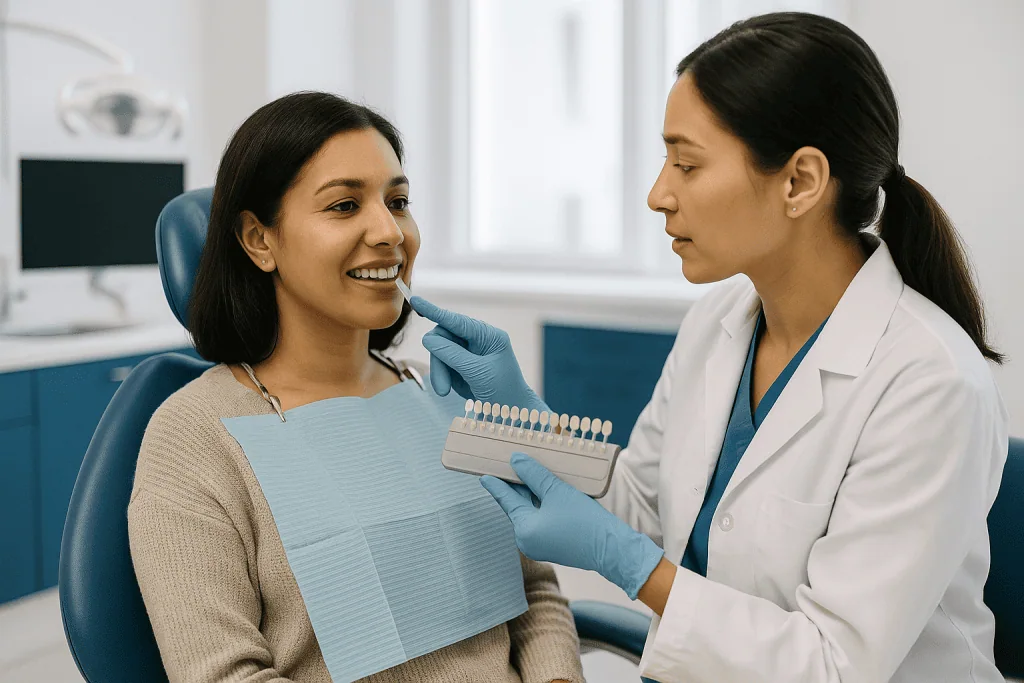
Picture the appointment from the chair. The first few minutes are spent on color. The dentist holds a shade guide, a fan of small tooth-shaped tabs in graded tones, against your natural teeth in daylight-balanced light and chooses the resin shade or shades that will blend. For a front tooth this can take longer than the shaping itself, because a good match relies on layering a slightly more opaque resin underneath and a more translucent one at the edge, mimicking how real enamel lets light through.
Next comes preparation, which for bonding is usually minimal. Many chips and gaps need no drilling at all. Where the surface must be freshened, the dentist removes a thin layer and then applies an etching gel, a mild acid that roughens the enamel at a microscopic level so the adhesive has something to grip. The Cleveland Clinic notes that anesthesia is often unnecessary unless bonding is being used to treat a cavity close to the nerve; when a local anesthetic is used, it works by temporarily blocking nerve signals in the area and wears off over the following hours.
A bonding agent, a thin liquid adhesive, is painted on and set with a curing light, a handheld blue light whose wavelength triggers the resin to harden. The resin itself is then added in small increments, each shaped and cured before the next, until the missing corner or the gap is rebuilt. Shaping with fine burs and polishing discs follows, and the dentist checks the bite, asking you to close and slide your teeth, then adjusting any high spot.
Polishing is the finish that matters most for staining and for how the tooth feels to your tongue. A well-polished surface picks up less pigment and fewer bacteria. When it is done, the tooth is fully hardened and ready to use, which is one genuine advantage over restorations that need a laboratory return trip.
How long does composite bonding take, from consultation to finish?
The chair time is the easy number. The Cleveland Clinic’s range of 30 to 60 minutes per tooth is a fair planning figure for a single chip or a small gap. Treating two adjacent front teeth so the shade and shape match can run toward the upper end for each, and closing a wider space between teeth, sometimes called a diastema, takes longer still because the dentist is building contours on two surfaces that must meet naturally.
What people underestimate is everything around that hour. A first examination on its own may take a good part of a morning once radiographs, photographs, a gum assessment and a conversation about goals are included. If the check finds tartar that needs removing or a small cavity, that work comes first, and some dentists prefer the gums to settle for a few days after a cleaning before bonding near the gum line so bleeding does not compromise the adhesive.
A realistic compressed schedule that some clinicians are comfortable with looks like this: an assessment early in the trip, treatment a day or more later, and a brief review before departure to smooth any edge your tongue has found and re-check the bite. That is three visits, not one, even though the bonding itself happened in a single sitting. Whether a shorter version is appropriate is a judgment only the examining dentist can make.
Timing also interacts with whitening. Composite resin does not lighten with bleaching products, a point the NHS makes clearly about restorations and whitening. If you are considering whitening, most dentists will want it done first and the shade to stabilize before choosing resin, and that alone can push bonding beyond a short stay. Ask about this early rather than discovering it in the chair.
Who composite bonding is usually for, and who is usually asked to wait
Bonding suits small problems on otherwise healthy teeth. The classic candidates are a chipped corner, a worn or uneven edge, a narrow gap between front teeth, a single tooth that is slightly shorter or darker than its neighbors, or an exposed root surface near the gum that is sensitive or unsightly. The Cleveland Clinic also lists bonding as an option for repairing decayed teeth as an alternative to metal fillings. In each case the tooth is doing most of the structural work and the resin is an addition rather than a replacement.

Dentists commonly ask people to wait, or steer them elsewhere, in a few recognizable situations. Active decay in the tooth or its neighbors comes first, because resin bonded over disease hides a problem that keeps growing. Gum inflammation, with bleeding on brushing or red swollen margins, is another pause point; the tissue needs to be healthy before an adhesive edge is placed against it. A heavy bite or a habit of grinding or clenching, known as bruxism, puts repeated force on a bonded edge and raises the chance of chipping, so a dentist may want a protective night guard in the plan or may suggest a stronger material.
Very large defects, where more than a modest portion of the tooth is missing, tend to be poor candidates because resin has less to hold onto and more to withstand. Teeth that have had root canal treatment or that show cracks may need a crown instead. Younger patients whose teeth are still erupting are usually assessed case by case, since the gum line and tooth position are still changing.
The pattern in all of this is that bonding rewards a stable mouth. If a clinician asks you to treat something else first, that is the evidence-based sequence at work, not an obstacle.
Composite bonding vs veneers: which fits a short stay, and at what trade-off
The question comes up in almost every consultation about front teeth, and it is a fair one. A veneer is a thin shell, usually porcelain, made in a laboratory and cemented over the front of a tooth. Bonding is resin built up directly. The differences that matter for planning, durability and reversibility are easiest to see side by side.
| Feature | Composite bonding | Porcelain veneers |
|---|---|---|
| Where the work happens | Directly on the tooth, in the chair | Shell made in a laboratory, then fitted |
| Number of appointments for the restoration itself | Usually one | Usually two or more, with a wait between |
| Tooth removal | Often none or minimal | A thin layer of enamel is usually removed |
| Reversibility | Often reversible when no enamel was cut | Generally not reversible once enamel is prepared |
| Typical lifespan | 3–10 years (Cleveland Clinic) | Generally longer; ask your dentist for their expected range |
| Stain resistance | Can pick up stain over time; can be re-polished | Porcelain resists staining well |
| Repair after a chip | Usually repairable in the chair | Often needs remaking |
Read across the rows and the pattern is clear. Bonding is the more conservative and the more time-efficient option, which is why it is the one that tends to be discussed for a compressed schedule. It is also the option that asks more of you afterward, in polishing visits, in avoiding hard biting on the edge, and in accepting that it will probably need refreshing sooner.
Veneers trade time and enamel for longevity and stain resistance. Because they involve a laboratory stage and a return visit, they rarely suit a stay of a few days, and a dentist who tries to compress that process should be asked how the fit and shade will be verified. Neither option is better in the abstract. The right one depends on how much tooth is missing, how the bite loads the edge, and how the person feels about irreversibility, all of which the examining clinician weighs.
Why the assessment matters more than the appointment slot for composite bonding one visit abroad
If there is one opinion this article holds firmly, it is that the examination is the treatment’s foundation, not its formality. Anyone weighing composite bonding one visit abroad is really deciding whether to accept a compressed assessment, and that is where the risk concentrates.
A proper assessment does several things at once. It confirms the tooth is sound with radiographs where indicated, because a chip that exposes a hairline crack or sits over hidden decay is a different problem from a clean fracture. It records gum health, since resin margins placed against inflamed tissue collect plaque and discolor. It examines the bite, watching how the upper and lower teeth meet and slide, because a bonded edge that takes the first contact when you close will chip no matter how well it was polished. And it establishes the shade in natural light before any drying, since a tooth that has been dehydrated under a rubber dam or from mouth breathing looks lighter than it really is.
Remote consultations built on photographs can screen for suitability, but they cannot replace any of those checks. The CDC’s guidance on medical travel emphasizes gathering your medical and dental records beforehand, understanding what follow-up will be needed, and knowing how complications would be handled once you are home. Those are assessment tasks, and they belong to you as much as to the dentist.
The practical implication for a short trip is that the assessment should be the first thing on the itinerary, with treatment afterward and a buffer between them. Bringing recent radiographs from your own dentist, a list of medicines and allergies, and a note of any grinding or jaw symptoms turns a rushed first meeting into a useful one. A dentist who welcomes that information, and who is willing to say the tooth needs something else first, is behaving exactly as guidelines expect.
What the first days and weeks after composite bonding usually look like
The resin is fully hard when you leave, so you can bite and speak normally straight away. What changes over the following days is mostly perception. Your tongue is an extraordinarily sensitive instrument and will explore the new edge constantly at first, finding tiny ridges the dentist’s polishing disc missed. Most people stop noticing within a short while; if a spot stays sharp or catches your lip, it is a two-minute adjustment and worth mentioning rather than tolerating.
The bite can also feel unfamiliar. If the bonded tooth now meets its opposite a fraction earlier than before, you may sense a high spot when you close, or a slight tenderness in the tooth from the extra load. This is one of the strongest arguments for a review before you travel home, because the fix is a quick adjustment, whereas leaving it can lead to a chip or a sore tooth on the flight.
Mild temperature sensitivity is common when enamel has been etched or a thin layer removed, and it usually eases as the tooth settles. Sensitivity that is sharp, lingering after the cold stimulus is gone, or that wakes you at night is a different signal and should be reported.
Color is the other thing to watch early. Fresh resin has a surface layer that can absorb pigment before it fully matures, which is why the Cleveland Clinic advises avoiding coffee, tea, red wine and tobacco for the first 48 hours after bonding. After that, the resin behaves much like a natural tooth: it can stain slowly over years, and it can be re-polished.
By the end of the first couple of weeks, a well-placed bonding should feel like part of your tooth rather than an addition to it. Anything that still feels wrong at that point deserves a dentist’s eyes, wherever you happen to be.
Composite bonding aftercare: eating, staining and keeping it clean
Aftercare for bonding is mostly ordinary good oral hygiene applied with slightly more intention. The NHS advice to brush twice a day with a fluoride toothpaste and to clean between teeth daily applies unchanged; the resin does not decay, but the natural tooth around its edges can, and the margin where resin meets enamel is exactly where plaque likes to sit.
A few habits deserve specific attention because resin, while strong, is more brittle than enamel at a thin edge. Biting fingernails, chewing pens or ice, tearing packaging with the front teeth and cracking nuts or seeds with the incisors all concentrate force on precisely the area that was rebuilt. None of these are forbidden in a medical sense; they are simply the most common reasons a dentist sees the same chip return. If you know you grind or clench at night, raise it with the dentist, since a night guard is often part of protecting bonded edges.
On staining, two facts guide everything. First, the Cleveland Clinic’s 48-hour window for avoiding strongly pigmented drinks and tobacco reflects the resin’s early vulnerability. Second, the NHS is clear that whitening products do not lighten fillings, crowns or veneers, and the same applies to bonded resin. That means whitening after bonding will lighten your natural teeth and leave the resin where it was, creating a mismatch. If whitening is in your future, tell the dentist before bonding, not after.
Regular professional cleanings help more than most people expect. A hygienist can re-polish resin surfaces that have dulled and remove surface stain the toothbrush cannot, and a dentist can check the margins for early breakdown. If your bonding was placed during travel, establishing that maintenance relationship with a dentist at home is the single most useful piece of aftercare you can arrange.
Flying after dental bonding: what the evidence says about travel timing
Bonding itself creates no barrier to air travel. Unlike a freshly extracted tooth or a sinus procedure, there is no wound that pressure changes disturb, and a properly placed and cured restoration contains no trapped air. The pressure-related tooth pain that occasionally troubles divers and flyers is associated with untreated decay, leaking fillings or sinus problems rather than with sound resin restorations, which is one more reason the pre-treatment examination matters.
The travel consideration for bonding is not physiological but logistical. A bonded edge that is slightly high in the bite can chip under the repeated small clenches most people make on a plane, and a rough spot found by your tongue on the way to the airport cannot be smoothed at thirty thousand feet. Leaving a day between treatment and departure, with a brief review in between, addresses both. This is a comfort-and-quality buffer rather than a medical prohibition, and your dentist can tell you whether it is needed in your case.
Where medical evidence does speak firmly is on the journey itself. The NHS notes that long journeys of more than four hours by plane, car or train raise the risk of deep vein thrombosis, a clot in a deep leg vein, and recommends moving around when possible, exercising the calf muscles while seated, staying hydrated and avoiding excess alcohol. That advice applies to anyone flying home after any appointment and is worth taking seriously even though a dental visit itself does not raise clot risk.
The CDC’s medical travel guidance adds the planning layer: see a travel medicine provider several weeks before departure if you have health conditions, carry copies of your records and details of exactly what was done, and know who will see you at home if something goes wrong. For bonding, that last item is usually the one people forget until a chip appears.
How long does composite bonding last, and what makes it fail early?
The Cleveland Clinic gives a typical lifespan of three to ten years for dental bonding, and the width of that range is itself informative. Where a restoration lands within it depends far more on where it sits and how it is treated than on the material’s brand.
Location comes first. A small repair on the flat face of a front tooth, protected from biting forces, tends toward the longer end. A rebuilt incisal edge, the thin biting rim of a front tooth, takes a shear force every time you bite into an apple or a sandwich and is the most common site for chipping. Bonding on back teeth is loaded by chewing forces many times greater and is generally judged on different terms.
Size matters next. Resin bonded to a broad area of sound enamel has a strong mechanical and chemical grip. Resin holding a large missing corner with little enamel to attach to is asking a lot of adhesive, and dentists often prefer a stronger indirect restoration in that situation.
Then come habits and bite. Grinding, clenching, nail biting and using teeth as tools shorten the life of any restoration. Acid exposure from frequent sugary or acidic drinks softens the enamel margin around the resin. Smoking and heavy coffee or tea consumption stain the surface, which is not a failure of strength but is often the reason people seek replacement.
When bonding does fail, it usually fails gracefully: a small chip, a margin that darkens, a surface that dulls. Catastrophic loss of the whole restoration is uncommon when the underlying tooth is sound. Most of these problems are repairable in a single short visit by adding fresh resin to the existing restoration. That repairability is one of the material’s genuine strengths and one reason it remains widely used for conservative cosmetic corrections.
Risks, side effects and alternatives explained in neutral terms
Composite bonding is among the more conservative procedures in dentistry, but conservative is not the same as risk-free, and a fair explainer sets out both the common nuisances and the rarer problems.
The most frequent issue is chipping or fracture of the resin, especially at thin edges under biting load. Next comes discoloration: either general surface stain, which polishing addresses, or a dark line along the margin where resin meets tooth, which indicates the seal has begun to break down and plaque has crept in. Sensitivity to temperature can occur after etching or preparation and usually settles; persistent or spontaneous pain suggests the tooth itself needs attention. A rough edge or an overhang near the gum can irritate the tissue and trap plaque, leading to localized gum inflammation. Shade mismatch, where the resin looks slightly different from the neighboring tooth in certain light, is a cosmetic rather than a health risk but is a common reason for redoing the work. Complete loss of the bonding, debonding, is less common and usually reflects poor enamel quality, moisture during placement or heavy bite forces. Allergic reactions to resin components are rare but reported.
Alternatives depend on the problem. For a chip, options range from leaving it and smoothing the edge, through bonding, to a porcelain veneer or, for large defects, a crown. For a gap between front teeth, orthodontic movement with braces or aligners closes the space without adding material, at the cost of time. For a discolored tooth, whitening may achieve enough on its own, with the NHS noting that professional whitening is a regulated dental treatment. For a worn edge caused by grinding, addressing the grinding with a protective appliance may come before any cosmetic repair.
Which of these fits is a clinical judgment based on the amount of tooth remaining, the bite and your priorities. A team that lays out the alternatives without steering is doing its job.
What people often get wrong about composite bonding one visit abroad
Myths gather around any treatment that promises speed, and bonding done during travel attracts a particular set. Correcting them is part of making a safe plan.
The first is that one visit means no check-up is needed. It means the resin is placed in one sitting; it does not mean the examination, gum assessment or bite check can be skipped. Bonding over undiagnosed decay or inflamed gums is the most common reason a quick appointment turns into a slow problem.
The second is that composite is permanent. The Cleveland Clinic’s typical range of three to ten years makes clear it is a maintained restoration, likely to need polishing and eventually repair or replacement. Anyone told otherwise should ask what evidence supports the claim.
The third is that whitening later will bring the natural teeth up to the resin’s brightness. The NHS is explicit that whitening does not change the color of restorations, and the more common result is a mismatch with the resin looking darker than the newly whitened enamel. Whiten first, then bond, if both are planned.
The fourth is that a purely cosmetic edge does not need to respect the bite. Every front tooth edge participates in biting and in the sliding movements of chewing and speech, and an edge that takes contact too early will chip regardless of how it looks.
The fifth is that bonding cannot be fixed once you are home. Resin is the most repairable of restorative materials; a dentist anywhere can add to it, provided they know what was used and can see the tooth. That is why carrying a written record of the treatment matters.
The last myth is that the whole plan must be compressed into the trip. If an examining dentist advises treating a cavity or a gum problem first and returning later, that is not a failed visit. It is the assessment doing what it is for.
Questions to ask your care team before anything is booked
A short trip removes the luxury of thinking things over between visits, so the questions need to be ready in advance. These are the ones experienced dentists say they wish more people asked.
- What did the examination and radiographs show about this tooth and its neighbors, and is there anything you would want to treat before bonding?
- How does my bite load this edge, and does anything about it make chipping more likely for me?
- Do I grind or clench, and if so, would you want a protective appliance as part of the plan?
- If I am considering whitening, should that happen first, and how long would you want the shade to stabilize?
- How will you choose and check the shade, and will I see it in natural light before you finish?
- Is any enamel being removed, and is this restoration reversible if I later change my mind?
- How many teeth are you treating, and how long do you expect the appointment to take for my case?
- Is a review visit before I leave possible, and what would you check at it?
- What written record of materials, shades and radiographs can I take home for my own dentist?
- If the resin chips after I am home, what do you recommend I do, and what should a local dentist know?
- What symptoms in the first weeks would you want to hear about straight away?
Listen as much to how the answers are given as to their content. A team that describes limits, explains why a step cannot be skipped, and offers alternatives is behaving as guideline-based care expects. A team that answers every question with reassurance and no specifics is telling you something too.
Write the answers down or ask for them in writing. The CDC’s advice for anyone receiving care while traveling stresses carrying records and understanding follow-up arrangements, and for bonding those two items are what make a chip at home a minor inconvenience rather than a puzzle.
When to call your doctor or dentist after composite bonding
Most bonding settles without incident, and the ordinary early sensations, a tongue exploring a new edge or a brief twinge with cold, are not emergencies. Certain signs, though, should prompt a call rather than a wait, whether you are still traveling or already home.
Contact a dentist promptly if you have tooth pain that is sharp, lingers well after a hot or cold stimulus is removed, or wakes you at night, because this suggests the tooth’s nerve is irritated rather than the resin simply adjusting. Do the same if you cannot bring your teeth together comfortably or the bonded tooth takes all the pressure when you bite, since a high spot can crack the resin or bruise the tooth’s supporting tissue. A rough or sharp edge cutting your tongue or lip, a piece of resin that has come away, a tooth that feels loose, or a dark line appearing along the margin all warrant a visit, though not usually an urgent one.
Seek urgent care if you develop swelling of the gum, face or jaw, fever, a bad taste with pus, or bleeding that does not stop, as these point to infection or injury that bonding itself should never cause and that may indicate an underlying tooth problem. If a fragment of resin or tooth is inhaled rather than swallowed, with coughing or breathlessness, this is a medical emergency.
After a long journey home, the NHS red flags for a deep vein clot apply to any traveler: throbbing pain, swelling or warmth in one calf or thigh, or skin that looks red or darkened. Sudden breathlessness, chest pain or coughing up blood can signal a clot that has traveled to the lungs and needs emergency services immediately.
In every case, the assessment and any decision about repair, replacement or further treatment belong to the clinician who examines you. This article describes what to watch for; it does not replace that examination.
Frequently asked questions
Can composite bonding really be finished in one visit?
Yes, the restoration itself is usually completed in a single appointment because the resin is shaped and light-hardened directly on the tooth with no laboratory stage. What cannot be compressed into that hour is the examination beforehand, any treatment of decay or gum inflammation, and a review once the bite has settled. Plan for those as separate steps even when the bonding is one sitting.
How long does composite bonding take per tooth?
The Cleveland Clinic gives a typical range of 30 to 60 minutes per tooth. Treating several front teeth together, or closing a wider gap between two teeth, tends toward the upper end for each tooth because shade layering and shaping two matching surfaces take longer. Your dentist can give a case-specific estimate after examining the tooth.
Is it safe to fly after dental bonding?
There is no medical reason a sound, fully cured bonding restoration would be affected by cabin pressure, since it contains no trapped air and there is no wound. The practical consideration is comfort: a slightly high bite or a rough edge is easier to adjust before you leave than after. General long-haul precautions against clots, such as walking and calf exercises, apply to everyone.
What does composite bonding aftercare involve in the first week?
Brush twice daily with a fluoride toothpaste and clean between teeth as usual, avoid strongly pigmented drinks and tobacco for the first 48 hours as the Cleveland Clinic advises, and steer clear of biting nails, pens or ice with the treated tooth. Report any sharp edge, high spot in the bite or lingering pain rather than waiting for it to settle on its own.
Composite bonding vs veneers: which is more conservative?
Bonding is generally the more conservative choice because it often requires no enamel removal and can be reversed if no tooth was cut, whereas porcelain veneers usually require a thin layer of enamel to be removed permanently. Veneers tend to resist stain better and last longer, while bonding is quicker and easier to repair. The right choice depends on how much tooth is missing and how the bite loads it.
Will teeth whitening lighten my composite bonding later?
No. The NHS states that whitening does not change the color of fillings, crowns or veneers, and bonded resin behaves the same way. Whitening after bonding lightens the natural enamel and leaves the resin unchanged, which usually produces a visible mismatch. If whitening is part of your plan, dentists generally advise completing it first and allowing the shade to stabilize before matching resin.
How long does composite bonding last before it needs redoing?
The Cleveland Clinic gives a typical range of three to ten years. Small repairs on protected surfaces tend to last longer, while thin biting edges on front teeth, heavy grinding, nail biting and frequent staining drinks shorten the interval. Most failures are minor chips or marginal staining that a dentist can repair by adding fresh resin rather than replacing the whole restoration.
What should I bring to a bonding consultation when time is short?
Recent dental radiographs if you have them, a list of your medicines and allergies, notes on any grinding, clenching or jaw symptoms, and a clear description of what bothers you about the tooth. The CDC recommends anyone receiving care while traveling carry medical records and understand follow-up arrangements, and those items let a compressed first visit become a proper assessment.
What happens if my composite bonding chips after I get home?
A chipped bonding is usually repairable in a short visit by any dentist, who adds fresh resin to the existing restoration after roughening the surface. Knowing which resin and shade were used helps, so ask for a written record before leaving the treating practice. A chip is not an emergency unless it leaves a sharp edge cutting your tongue or exposes a sensitive area.
Does composite bonding hurt or need anesthesia?
Often it does not. The Cleveland Clinic notes anesthesia is usually unnecessary unless bonding is being used to treat a cavity near the tooth’s nerve or the tooth surface must be reshaped. When a local anesthetic is used, it temporarily blocks nerve signals and wears off over the following hours. Mild temperature sensitivity afterward is common and usually settles; lingering or spontaneous pain should be reported.
References
- Cleveland Clinic: Dental Bonding
- NHS: How to keep your teeth clean
- NHS: Deep vein thrombosis (DVT)
- MedlinePlus: Dental care – adult
This article is for general information only and is not a substitute for professional medical advice. Please consult a qualified doctor about your individual situation.

More from the Blog

Tooth Extraction Healing Timeline: The Socket From the First Day to the Fourth Week
After a tooth extraction, a blood clot forms in the socket within the first day, soft granulation tissue replaces it over the following week,…
Bringing Old X-Rays and Records to a Dental Anatomy Assessment: Why History Helps Planning
Bringing old X-rays and records to a dental anatomy assessment gives the clinician a timeline rather than a single snapshot. Prior radiographs, periodontal charts,…
How Periodontal Disease Develops Below the Gumline and Why SRP Deep Cleaning Is Planned
Periodontal disease begins when bacterial plaque collects along the gumline, inflames the gums (gingivitis) and, if it persists, spreads below the gum to destroy…
Before Clear Aligners Start: Digital Scans, Cavities to Treat and the Aligner Plan
Before starting clear aligners, an orthodontist or dentist usually completes a full dental exam, X-rays, photographs and a digital scan of both jaws. Any…

Canker Sore vs Cold Sore: How to Tell Them Apart in Ten Seconds
Location is the fastest clue. Canker sores are shallow, round ulcers with a white or yellow center that form inside the mouth, on the…
Is a Dental Spa Right for Anxious Patients? Comfort Care Without Cutting Corners
A dental spa can suit many anxious patients when the comfort features sit on top of standard clinical care rather than replacing it. Warm…