

Who Needs Scaling and Root Planing (SRP)? Pocket Depths That Call for a Deep Cleaning

Key Takeaways
- Healthy gum pockets measure about 1 to 3 millimeters; readings of 4 millimeters or more, particularly with bleeding on probing, are the usual trigger for scaling and root planing.
- Pockets deeper than about 5 millimeters cannot be cleaned effectively with brushing, flossing or a routine cleaning, which is why the work moves below the gumline.
- Scaling removes plaque and tartar from the root; root planing smooths the contaminated root surface so the gum can reattach, and the two are performed as one procedure.
- A full mouth is commonly treated in two to four visits by quadrant, followed by a reassessment visit where every site is re-probed against the original chart.
- After SRP, maintenance visits typically shift from every six months to every three to four months, because disease-associated bacteria recolonize deep pockets quickly.
- Gum recession and cold sensitivity after deep cleaning usually reflect swelling resolving and roots being exposed, not tissue removed by the instruments.
Scaling and root planing is usually recommended for people whose gum pockets measure 4 millimeters or deeper, especially when the gums bleed on probing, X-rays show bone loss, or tartar sits below the gumline. Healthy pockets measure about 1 to 3 millimeters and are managed with routine cleaning. Your dentist or periodontist decides based on a full periodontal chart, not a single number.
The hygienist calls out numbers while a colleague writes them down: three, three, four, five, four, six. You are lying back with your mouth open, trying to work out whether six is good or bad. Then the dentist leans in and says the phrase you have half-heard before: you may need a deep cleaning.
That moment is where most people first ask who needs scaling and root planing. The numbers being read aloud are pocket depths, measured in millimeters with a thin probe slipped gently between tooth and gum. They are the single most useful clue your dental team has about whether the bone and tissue holding your teeth are quietly losing ground.
This explainer walks through what those measurements mean, which depths usually tip the decision toward treatment, who is often asked to wait, and what the weeks afterward tend to look like. It leaves the decision where it belongs, with the team that has your chart in hand.
What scaling and root planing actually does, in plain language
Start with the two words. Scaling means scraping away plaque and tartar. Plaque is the soft, sticky film of bacteria that forms on teeth every day; tartar, which dentists call calculus, is plaque that has hardened into a crust the toothbrush can no longer remove. Routine cleaning scales the parts of the tooth you can see. Scaling and root planing, often shortened to SRP, follows the tartar down below the gumline onto the root.
Root planing is the second step. The root surface of a tooth is not enamel; it is a softer material called cementum, and when bacteria and their toxins soak into it, the surface becomes rough and irritating to the gum. Planing smooths that root so the gum tissue can reattach more snugly and plaque has fewer footholds. Think of it as sanding a splintered fence post so the soil can settle back against it.
The target of all this work is periodontitis, the stage of gum disease in which inflammation has spread from the gum margin into the ligament and bone that anchor the tooth. Gingivitis, the earlier stage, is redness and bleeding confined to the gum itself and is reversible with good home care and a standard cleaning. Periodontitis is different because the bone that has been lost does not grow back on its own, which is why the aim shifts from reversal to control, according to Mayo Clinic.
Nothing about SRP is exotic. It uses the same ultrasonic scalers and hand instruments as a regular cleaning, applied deeper, more slowly, and usually with the gum numbed. What changes is the goal: not polish, but removing the infection source from a place you cannot reach at home.
Who needs scaling and root planing? The pocket-depth rule of thumb
The simplest answer to who needs scaling and root planing is anyone whose periodontal probing shows pockets deep enough that a toothbrush, floss and ordinary cleaning cannot keep them clean. A periodontal pocket is the space between the tooth and the gum collar around it. In health that space is shallow, about 1 to 3 millimeters, and the gum hugs the tooth. When the attachment fibers are destroyed by inflammation, the pocket deepens and becomes a sheltered trough where bacteria thrive out of reach.
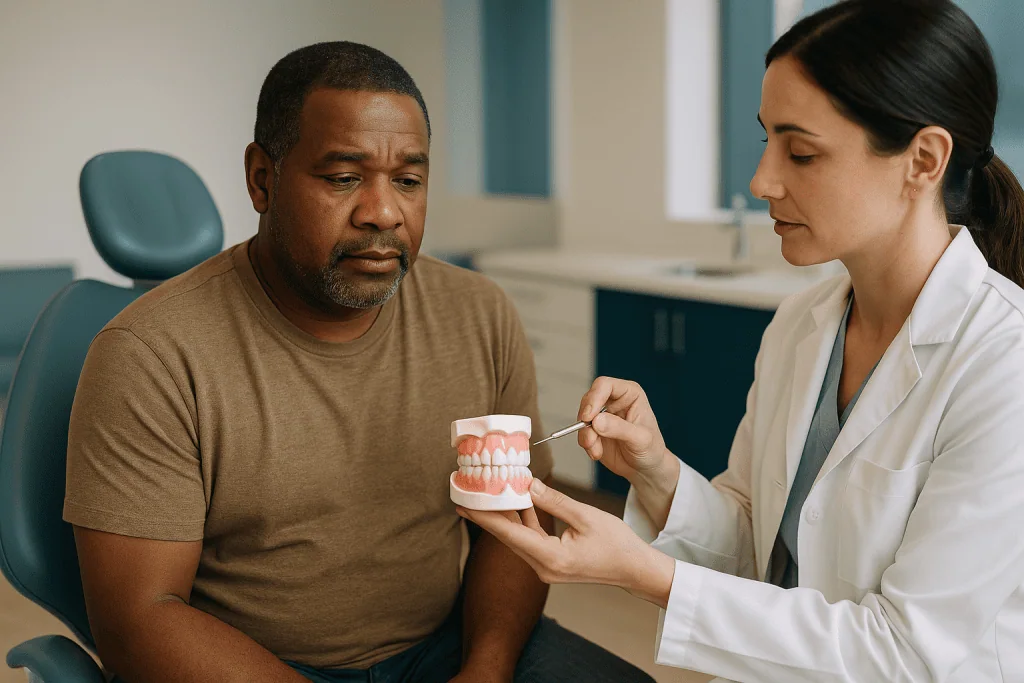
Mayo Clinic notes that pocket depths of 4 millimeters or more usually indicate periodontitis, and that pockets deeper than about 5 millimeters cannot be cleaned well with routine care. That is the practical threshold most dentists use: once several sites measure 4 millimeters or more, particularly if they bleed when probed, deep cleaning moves from optional to recommended.
Depth is rarely judged alone. The dentist also looks at whether the gum has pulled back from the tooth, whether X-rays show the bone level has dropped below where it should sit, and whether tartar is visible under the gum. A mouth with one isolated 4-millimeter spot behind a crowded molar is a different situation from a mouth with 5s and 6s on every back tooth.
Age is not the deciding factor. Periodontitis is more common with the years, but a smoker in their twenties or someone with poorly controlled diabetes can develop pockets early, while a seventy-year-old with meticulous home care may never need SRP. The question is what the chart shows, not how many birthdays you have had, as the NHS describes in its overview of gum disease.
Periodontal pocket depth chart: what the millimeters mean
Because the numbers read aloud during probing confuse almost everyone, here is a plain summary of how clinicians typically interpret them. Treat this as a map of how decisions tend to be made, not a verdict about your own mouth; only a full chart, X-rays and an examination can give you that.
| Probing depth | What it usually suggests | Typical approach |
|---|---|---|
| 1–3 mm, no bleeding | Healthy gum attachment | Routine cleaning and home care |
| 1–3 mm with bleeding | Gingivitis, inflammation without bone loss | Improved brushing and flossing, standard cleaning, recheck |
| 4 mm, especially with bleeding | Early periodontitis likely | Scaling and root planing often considered |
| 5–6 mm | Moderate periodontitis; cannot be cleaned well at home | Scaling and root planing usually recommended |
| 7 mm or deeper | Advanced periodontitis | SRP first; surgical options may be discussed if pockets persist |
The depth ranges and their meaning follow the descriptions published by Mayo Clinic, and the healthy range of 1 to 3 millimeters is widely cited across dental guidance.
Two refinements matter. First, bleeding on probing, meaning the gum bleeds when the probe touches the base of the pocket, signals active inflammation; a 4-millimeter pocket that bleeds is more concerning than a 4-millimeter pocket that does not. Second, clinicians also record clinical attachment loss, which measures how far the gum has detached from its original position on the tooth. A pocket can look shallow because the gum has receded, even though attachment has been lost. The chart above is a starting point; the full record is what guides care.
Scaling and root planing vs regular cleaning: what is the difference?
People often leave the office puzzled about why a cleaning they have had for years is suddenly not enough. The honest answer is that the two procedures have different jobs.
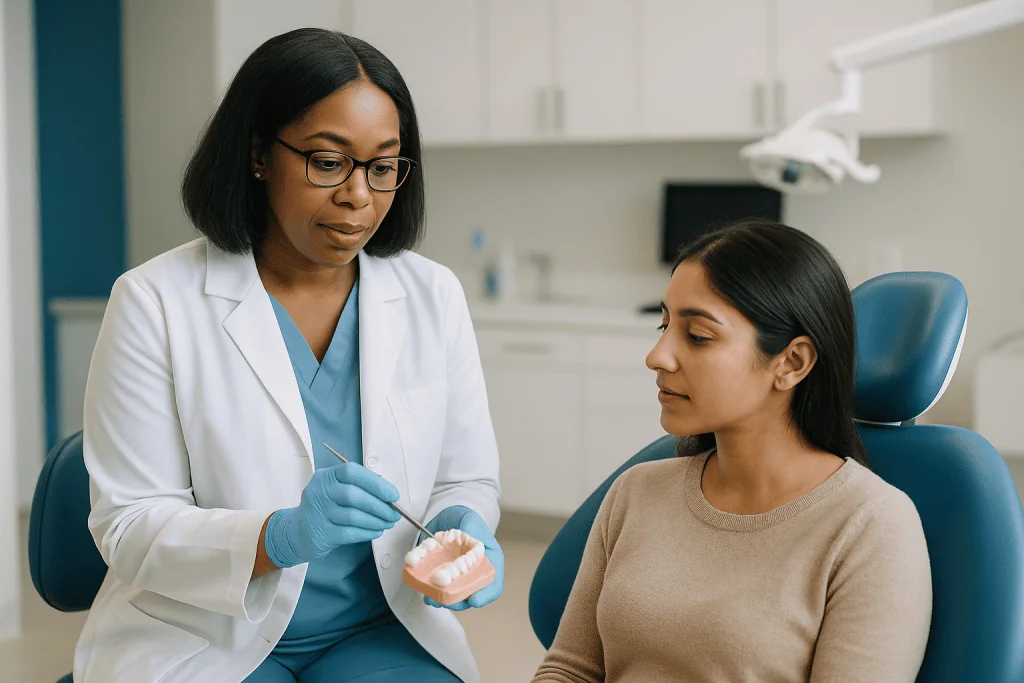
A routine cleaning, called prophylaxis, is preventive. It removes plaque and tartar above the gumline and slightly below it, polishes the teeth, and keeps a healthy mouth healthy. It assumes the gum attachment is intact and the pockets are shallow. It is usually done in a single visit without anesthesia.
Scaling and root planing is therapeutic. It is a treatment for an existing disease, periodontitis, and it works several millimeters below the gumline on the root surface. Because the instruments must reach the bottom of deep pockets, the gum is usually numbed with local anesthetic. The work is slower and more thorough, and Cleveland Clinic describes it as commonly divided into sections, treating one or two quadrants of the mouth per visit so that each area receives careful attention and the patient is not numb everywhere at once.
The follow-up also differs. After a prophylaxis, you are typically seen again in six months. After SRP, you move onto periodontal maintenance, a closer recall schedule that keeps pockets under watch. The distinction matters for insurance paperwork too, which is one reason the terminology on your treatment plan changes.
None of this means a regular cleaning was a mistake or that your previous dentist missed something. Periodontitis can develop gradually, and pockets that measured 3 millimeters two years ago may measure 5 today. The shift from prophylaxis to SRP reflects a change in what the probe is finding, not a change in how seriously anyone took your care.
Beyond pocket depth: the other findings your dentist weighs
Probing numbers get the attention, but a dentist deciding who needs scaling and root planing is looking at a wider picture. Several findings push the decision toward treatment even when individual depths seem borderline.
Radiographic bone loss is the most decisive. On a bitewing or full-mouth X-ray, healthy bone sits about a millimeter or two below the point where enamel meets root. When the bone edge has dropped further, or looks moth-eaten between teeth, the diagnosis of periodontitis is confirmed regardless of how the gum appears, as Mayo Clinic explains in its description of how the condition is diagnosed.
Subgingival calculus, tartar hidden below the gum, is another. It can sometimes be felt with a probe as a rough ledge or seen as a shadow on X-ray. Tartar is porous and holds bacteria against the root like a sponge; it cannot be brushed away and is a direct target of scaling.
Gum recession, where the gum margin has migrated down the root, exposes cementum and often accompanies attachment loss. Loose teeth, teeth that have drifted or developed new gaps, and persistent bad breath that returns within hours of brushing round out the clinical picture, according to MedlinePlus.
Then there is risk. Smoking roughly doubles to triples the likelihood of periodontitis and slows healing; diabetes raises both risk and severity; certain medicines reduce saliva and shift the bacterial balance. A clinician seeing 4-millimeter pockets in a heavy smoker with diabetes will often recommend SRP sooner than for the same pockets in a non-smoker, because the trajectory is different. All of this is weighed together, which is why no single number from the chart should be read on its own.
Who is usually asked to wait, and when SRP is not the right tool
Not everyone with bleeding gums needs a deep cleaning, and a good dentist is as willing to say no as yes.
People with gingivitis, meaning inflammation without pocket deepening or bone loss, are generally managed with a standard cleaning, coaching on brushing and interdental cleaning, and a recheck. The NHS describes gingivitis as reversible with good oral hygiene, so treating it with SRP would be using a heavier instrument than the problem requires.
Pseudo-pockets are another case. When the gum is swollen, the probe may read 4 or 5 millimeters even though no attachment has been lost; the gum has simply puffed up. Once inflammation settles, often after a routine cleaning and two weeks of improved home care, the readings fall. Many dentists will clean, re-probe, and only then decide whether SRP is warranted.
Some patients are asked to wait for medical reasons. Those with uncontrolled diabetes may be referred back to their physician first, because high blood sugar impairs healing. People on certain blood-thinning treatments may need coordination with their prescribing clinician around bleeding; this is a conversation, not a reason to adjust anything yourself. Anyone with a history of infective endocarditis or certain heart valve conditions may need antibiotic cover before dental work, and the American Heart Association sets out which groups this applies to. Pregnancy is not a barrier to SRP; untreated periodontitis is generally considered the greater concern, though timing is often discussed.
Finally, SRP is a non-surgical treatment with limits. Very deep pockets, furcation involvement where bone loss has exposed the fork between molar roots, or teeth already too loose to save may need different plans. In those situations SRP may still be the first step, but the team will usually explain what comes next if pockets do not respond.
Is root planing necessary after scaling, or is scaling alone enough?
This question comes up constantly, usually from people hoping to skip the longer, numbed appointment. The short answer is that in modern practice the two steps are performed together as one procedure and are not really separable.
Here is why. Scaling removes the bulk of plaque and tartar from the root. But bacterial toxins penetrate a thin surface layer of cementum, and the root left behind after scaling alone is often pitted and contaminated. Root planing removes that outer layer and smooths the surface. A smooth, clean root allows the gum’s long junctional epithelium, the thin band of tissue that seals the pocket, to reattach more closely; a rough one keeps attracting plaque and keeps the gum inflamed. Cleveland Clinic describes the two steps as parts of a single deep-cleaning treatment aimed at helping gums reattach to the teeth.
There is a nuance worth knowing. Dental research in recent decades has moved away from aggressive planing that strips away healthy cementum, toward gentler, more conservative instrumentation that removes deposits and biofilm while preserving root structure. Many clinicians now use the term periodontal debridement to reflect this. The principle remains the same: the root must be clean and smooth enough to let the gum settle back, and that cannot be achieved by scraping the visible crown of the tooth.
If pockets are shallow and no bone loss is present, you do not need root planing at all, because you do not need SRP; a standard cleaning suffices. If you do have periodontitis, scaling without planing leaves the job half finished. The decision about which teeth and sites need the full procedure sits with the clinician reading your chart.
What actually happens during a scaling and root planing appointment
Knowing the sequence removes much of the dread. A typical SRP visit unfolds in a few predictable stages.
It begins with a review of your chart and X-rays and a check of your medical history, including any medicines you take. If you have a heart condition that calls for antibiotic cover, that will have been arranged in advance with your physician. The dentist or hygienist then numbs the area to be treated. For most people this means a topical gel followed by a local anesthetic injection in the gum; some practices offer anesthetic gel placed directly into pockets for shallower cases. Numbness, not pain, is the sensation people report during the work.
Next comes the cleaning itself. An ultrasonic scaler, a vibrating tip that sprays cooling water, breaks up tartar and flushes bacteria from the pocket; hand instruments called curettes then follow the root surface by feel, removing remaining deposits and smoothing the cementum. You will hear scraping and feel pressure and vibration. The mouth is treated in sections, commonly one or two quadrants per visit, so a full mouth may take two to four appointments, as Cleveland Clinic describes.
Some clinicians place an antimicrobial agent into deep pockets after cleaning or irrigate with an antiseptic rinse. These are adjuncts, meaning add-ons whose benefit is modest and site-specific; the mechanical cleaning is the treatment. Whether any adjunct is used is a decision for your treating team based on your pockets.
The appointment ends with instructions for the rest of the day and a date for the next quadrant or the reassessment visit. Most people drive themselves home and return to normal activities, with the main inconvenience being a numb lip for a couple of hours.
What the days and weeks after deep cleaning usually look like
Recovery from SRP is more about sensation than about limitation. Nobody is bedridden, but the mouth does let you know something happened.
In the first day or two, expect tenderness in the treated gums and some bleeding when you brush. The gum may look slightly more red or swollen before it settles. Teeth frequently feel sensitive to cold, because roots that were covered by inflamed, swollen tissue are now exposed to air and temperature. Cleveland Clinic notes that soreness and sensitivity typically ease over a few days to a week or two. Soft foods, lukewarm drinks and gentle but thorough brushing are the usual advice; stopping brushing to avoid discomfort is the one thing that reliably makes healing slower.
Over the following weeks the gum tightens. As swelling resolves, the gum margin often shrinks back a little, which can make teeth look longer and create small dark triangles between them where swollen tissue used to sit. This is a sign that inflammation is receding rather than a complication, though it is worth being prepared for.
A reassessment visit, commonly scheduled a few weeks after the last quadrant is treated, is where the real answer arrives. The hygienist re-probes every site and compares the numbers with the original chart. Pockets that have shrunk from 5 to 3 millimeters and stopped bleeding are considered responding. Sites that remain deep and bleed may be re-treated or referred for further evaluation.
From that point most people move onto periodontal maintenance. Instead of six-month cleanings, visits are typically every three to four months, a schedule Mayo Clinic describes as part of ongoing care. The interval is set by how your gums behave, not by a fixed calendar.
What are the downsides of scaling and root planing?
Every treatment has trade-offs, and SRP is no exception. Being honest about them helps people decide with their eyes open.
The most common downside is sensitivity. Cleaning below the gum removes deposits that were, in a perverse way, insulating the root. Cold sensitivity can be sharp for days and occasionally lingers for weeks; for a minority it becomes a longer-term nuisance that needs desensitizing toothpaste or other measures from the dental team.
Recession and the appearance of longer teeth follow from the same mechanism: as inflamed gum shrinks to a healthy size, more root shows. This is cosmetic and expected, but on front teeth it can be noticeable, and it is worth asking about before treatment rather than after.
Discomfort during and after the procedure is real but usually manageable with the numbing used and with simple measures afterward; your team will advise on pain relief appropriate for you. Bleeding is normal in the first day and more pronounced in smokers and in people on blood-thinning treatment.
Infection is uncommon but possible, since instruments are working in an area already colonized by bacteria. The American Heart Association explains that dental procedures involving the gums can introduce bacteria into the bloodstream, which is why people with specific heart valve conditions are advised about antibiotic cover.
There is also the possibility that SRP does not do enough. In very deep pockets, instruments may not reach the base, and pockets of 7 millimeters or more are less likely to resolve fully with non-surgical care alone. In that case the downside is not harm but incomplete benefit, and the next step may be a referral to a periodontist. The honest framing is that SRP controls periodontitis; it does not undo the bone already lost, and it does not work without the daily home care that follows it.
Alternatives, adjuncts and what comes next if pockets stay deep
SRP is the standard first-line, non-surgical treatment for periodontitis, but it sits within a larger set of options that your team may raise.
The most important alternative is not really an alternative at all: improved daily plaque control. Brushing twice a day, cleaning between teeth daily with floss or interdental brushes, and stopping smoking are described by the NHS as the foundation of managing gum disease at every stage. SRP without this foundation rarely holds.
Adjuncts are add-ons used alongside SRP, not instead of it. Antiseptic mouth rinses can reduce plaque in the short term. Locally placed antimicrobial agents, delivered into a deep pocket by the clinician, release medicine over days to a couple of weeks and may help specific stubborn sites. Systemic antibiotics are sometimes used for aggressive or widespread disease, with the choice and duration decided by the prescribing dentist. The evidence for each of these shows modest additional pocket reduction at best, and Mayo Clinic presents them as supplements to mechanical cleaning. None replaces it.
If pockets remain deep after SRP and reassessment, surgical options enter the conversation. Flap surgery lifts the gum to allow direct access to roots and bone, then repositions it so pockets are shallower. Bone grafts, soft-tissue grafts and guided tissue regeneration aim to rebuild lost support in selected sites. These are periodontist-level decisions that depend on the tooth, the pattern of bone loss and your overall health.
For a tooth with hopeless bone loss or severe mobility, extraction and replacement may be discussed. That is not a failure of SRP; it reflects how much support was lost before treatment began. Whatever the pathway, the sequence is almost always the same: clean thoroughly, reassess, then escalate only where the chart shows it is needed.
How often do you need scaling and root planing?
A common misunderstanding is that SRP becomes a recurring treatment, repeated every year like a cleaning. In most cases it does not work that way.
Scaling and root planing is active therapy: it is performed once across the affected areas, followed by a reassessment. If pockets respond, you move onto periodontal maintenance. Maintenance visits are more frequent than routine cleanings, typically every three to four months according to Cleveland Clinic, and they include re-probing, cleaning of any sites that remain deeper than 3 millimeters, and reinforcement of home care. The three-to-four-month interval is based on how quickly disease-associated bacteria recolonize deep pockets after cleaning; waiting six months gives them too long a head start.
Repeat SRP of a specific site is reserved for pockets that persist or deepen again at reassessment or during maintenance. A full-mouth repeat is uncommon when maintenance is kept up, but it can be needed if someone drops out of care for years, resumes smoking, or develops a new medical condition that worsens gum health.
The maintenance interval is not fixed for life. People whose pockets stay shallow and whose gums stop bleeding may be stretched to longer intervals over time; those with persistent deep sites, diabetes or a smoking habit tend to stay at the shorter end. The schedule is a response to your readings, which is another way of saying the probe, not the calendar, sets the pace.
One practical point: maintenance works only if you attend. Research summarized by NIH’s National Institute of Dental and Craniofacial Research emphasizes that periodontitis is a chronic condition requiring ongoing care, much like high blood pressure. The deep cleaning is the start of management, not the finish.
What people often get wrong about deep cleaning
Myths about SRP are stubborn, and several of them lead people to delay or refuse care they would benefit from. Here are the ones dental teams hear most, with what the evidence actually says.
“If it doesn’t hurt, I don’t need it.” Periodontitis is usually painless until late. Bone loss does not ache; teeth loosen quietly. The NHS notes that gum disease often has few symptoms early on, which is precisely why probing exists.
“Deep cleaning is just an upsell.” The distinction between prophylaxis and SRP rests on measurable findings: pocket depth, bleeding and X-ray bone loss. If you are unsure, ask to see your chart and your X-rays. A legitimate recommendation can be shown, not just stated.
“Deep cleaning makes gums recede.” The disease caused the attachment loss. Cleaning removes the swelling that was hiding it. The gum looks lower afterward because it is healthier and smaller, not because tissue was removed.
“Once treated, I’m done.” Lost bone does not regenerate on its own, and the bacteria return. Without maintenance and daily interdental cleaning, pockets tend to deepen again.
“Mouthwash can replace it.” No rinse penetrates a 5-millimeter pocket to remove hardened tartar. Rinses are adjuncts, and Mayo Clinic frames them as such.
“Bleeding gums are normal.” Healthy gums do not bleed with gentle brushing or flossing. Bleeding is inflammation, and it is the earliest warning sign most people ignore.
The thread running through these myths is that they treat gum disease as cosmetic or optional. It is a chronic bacterial infection of the tissues holding your teeth, with documented associations with cardiovascular and metabolic health described by Harvard Health. That deserves the same seriousness as any other long-term condition.
Questions to ask your care team before you agree to SRP
A deep cleaning is a reasonable thing to question, and a good clinician welcomes it. Going in with specific questions turns a vague recommendation into a shared plan. These are the ones worth raising.
- Which teeth and sites have pockets of 4 millimeters or more, and can I see them on my chart?
- Do my X-rays show bone loss, and where? Can you point it out to me?
- Which sites bleed on probing, and how does that change your recommendation?
- Is this periodontitis, or could some of these readings be swollen gums that might settle after a routine cleaning and better home care?
- How many visits do you expect, and will you treat by quadrant?
- What kind of numbing will you use, and what should I expect to feel during and afterward?
- What sensitivity or recession should I prepare for, especially on my front teeth?
- Do you plan to use any adjunct, such as a locally placed antimicrobial, and what is the evidence it helps in my case?
- Given my medical history and medicines, is there anything you need to coordinate with my physician first?
- When will you re-probe, and what readings would count as a good response?
- If pockets do not improve, what are the next steps and would you refer me to a periodontist?
- What maintenance interval do you anticipate, and what would allow it to lengthen over time?
- What exactly should I be doing at home between now and the first appointment?
Two of these matter more than the rest. Seeing your own chart and X-rays grounds the recommendation in evidence you can look at, which Mayo Clinic describes as the basis for diagnosing periodontitis. And asking what counts as a good response at reassessment gives you a yardstick for judging whether the treatment did its job. Write the answers down; numbness and a busy schedule make them easy to forget.
When to call your doctor or dentist
Most of what follows SRP is mild and expected: tenderness, cold sensitivity, a little bleeding on brushing, and gums that look slightly different as swelling settles. A short list of signs, however, should prompt a call to your dental office the same day, or to a physician or emergency service if they are severe.
Call promptly if you notice any of the following in the days after treatment:
- Bleeding that does not slow with gentle pressure after 20 to 30 minutes, or that restarts repeatedly.
- Pain that worsens after the second or third day rather than easing, or that is not controlled by the measures your team advised.
- Swelling of the gum, face or jaw that increases, especially with a bad taste or pus.
- Fever, chills or feeling generally unwell, which can signal infection spreading beyond the gum.
- Numbness that persists well beyond the expected few hours, or new tingling in the lip, chin or tongue.
- Difficulty swallowing or breathing, or swelling under the tongue or in the neck, which needs urgent care.
- A tooth that has become noticeably looser or has shifted.
Separately, see a dentist soon, before any treatment is planned, if you have gums that bleed regularly, persistent bad breath, gums that have pulled away from teeth, teeth that feel loose, or a change in how your teeth fit together when you bite. MedlinePlus lists these as features of periodontitis that warrant evaluation.
People with heart valve disease, a history of infective endocarditis, poorly controlled diabetes, or who take blood-thinning treatment should also check in with their physician before SRP so the two teams can coordinate. The American Heart Association sets out which heart conditions call for antibiotic cover around dental procedures. Whatever your situation, every decision about treatment, timing and medicines rests with the clinicians who know your history, so when in doubt, call and ask.
Frequently asked questions
What qualifies for scaling and root planing?
A diagnosis of periodontitis is what qualifies someone for SRP: pockets of 4 millimeters or more, bleeding on probing, and X-ray evidence of bone loss or tartar below the gumline. Dentists weigh the whole chart rather than one reading. Gingivitis alone, with shallow pockets and no bone loss, is managed with routine cleaning and improved home care instead.
Do I need deep cleaning teeth if only one or two pockets measure 4 mm?
Possibly only at those sites, and sometimes not at all. Isolated 4-millimeter readings without bleeding or bone loss may be re-checked after a standard cleaning and better interdental care. If the sites bleed or X-rays show bone loss, localized SRP of just those teeth is common. Your dentist decides based on the full chart and X-rays.
Is root planing necessary after scaling?
Yes, when you have periodontitis. Scaling removes deposits, but the root surface left behind is rough and contaminated with bacterial toxins; planing smooths it so the gum can reattach and plaque has fewer footholds. The two are performed together as a single procedure. If you do not have periodontitis, you do not need either step beyond a routine cleaning.
What are the downsides of scaling and root planing?
The main downsides are cold sensitivity, gum tenderness for a few days to a week or two, and gums that look lower once swelling resolves, making teeth appear longer. Bleeding is normal early on. Infection is uncommon. In very deep pockets SRP may not fully resolve the problem, and further periodontal treatment may be discussed.
What is the average cost of periodontal scaling and root planing?
This article does not quote prices, because fees vary widely by region, by how many quadrants need treatment, and by insurance coverage. The useful step is to ask your dental office for a written treatment plan listing each quadrant and any adjuncts, then check it against your coverage before scheduling. Costs should never be the reason a diagnosis goes unexplained.
How does scaling and root planing vs regular cleaning differ in what is done?
A regular cleaning is preventive, removes plaque and tartar above and just below the gumline, and is done without numbing in one visit. SRP is treatment for periodontitis, works several millimeters down on the root surface, is usually done under local anesthetic, and is split across visits by quadrant. Follow-up also shifts to closer periodontal maintenance.
Does scaling and root planing hurt?
During the procedure, numbing means most people feel pressure, vibration and scraping rather than pain. Afterward, gums are typically tender and teeth sensitive to cold for a few days, occasionally longer. Your dental team will advise on comfort measures suited to you. Pain that worsens after the first few days is a reason to call the office.
Can periodontal pockets shrink after deep cleaning?
Often, yes. As inflammation resolves and the gum reattaches to the cleaned root, pockets commonly become shallower and stop bleeding, which is checked at the reassessment visit a few weeks later. Bone that has already been lost does not grow back on its own, so the goal is control and stability rather than a return to the original anatomy.
How long does it take to recover from scaling and root planing?
Tenderness and sensitivity usually ease over a few days to a week or two, according to Cleveland Clinic. Gums continue tightening over the following weeks, and the reassessment visit is typically scheduled once the last quadrant has had time to heal. Normal eating, work and activities generally resume the same or next day, with softer foods at first.
Can I just use mouthwash instead of a deep cleaning?
No. Antiseptic rinses reduce surface plaque but cannot penetrate a deep pocket or remove hardened tartar from the root. Guidance from Mayo Clinic describes rinses and other antimicrobials as adjuncts used alongside mechanical cleaning, not replacements. Daily brushing, interdental cleaning and professional treatment where pockets are deep remain the foundation of managing periodontitis.
References
- NHS: Gum disease
- MedlinePlus: Periodontitis
- NIH National Institute of Dental and Craniofacial Research: Gum disease
This article is for general information only and is not a substitute for professional medical advice. Please consult a qualified doctor about your individual situation.

More from the Blog

TMJ Splint Therapy: How a Night Guard Is Made, Fitted and Adjusted Over Time
TMJ splint therapy uses a custom-made oral appliance, usually a hard acrylic night guard, to reduce jaw muscle strain and protect the teeth in…

Is Composite Bonding Right for Chips, Gaps or Uneven Edges? Who Suits It
Composite bonding suits adults with healthy gums, sound enamel and small cosmetic flaws: minor chips, narrow gaps between front teeth, slightly uneven or worn…

Who Needs a Space Maintainer? When an Early Lost Baby Tooth Calls for One
A space maintainer is usually considered when a child loses a baby tooth well before the permanent tooth beneath it is ready to come…

Orthodontic Warning Signs: Broken Wires, Loose Brackets and Pain That Is Not Normal
Orthodontic problems to report include a broken or protruding archwire, a bracket or band that has come loose, a cracked or lost aligner, swelling…

What MRI and CT Reveal About TMJ: The Disc, Arthritis and Joint Damage
MRI is the preferred way to see the soft tissues of the temporomandibular joint, especially whether the cartilage disc sits on top of the…

What Porcelain Veneers Can Change and What Still Depends on Your Gums: Realistic Results
Porcelain veneers are thin ceramic shells bonded to the front of teeth. They can reliably change color, small chips, minor spacing and the shape…