

Which Aesthetic Dentistry Option Fits the Flaw? Whitening, Bonding and Veneers Compared

Key Takeaways
- Whitening changes only the color of natural enamel and dentin; it cannot alter shape and will not lighten fillings, crowns or existing veneers.
- Composite bonding adds resin to the tooth, so it is usually reversible and suits small chips and gaps, with Cleveland Clinic citing a typical 3 to 10 year lifespan.
- Conventional porcelain veneers require removal of a thin layer of enamel, about half a millimeter, and are permanent; Cleveland Clinic gives a typical 10 to 15 year lifespan before replacement.
- Gray or banded intrinsic stains, such as those from childhood antibiotic exposure, respond poorly to bleaching and are more often addressed with bonding or veneers.
- The NHS states that whitening results last from a few months to up to three years, with smoking and staining drinks shortening the effect.
- The '4-8-10 rule' is informal shorthand for how many front teeth show in a smile, not a clinical guideline, and the right number of veneers is whichever solves the flaw with the least enamel lost.
Whitening, bonding and veneers solve different flaws. Whitening lightens natural enamel but cannot change shape or brighten fillings and crowns. Composite bonding adds tooth-colored resin to repair small chips, gaps or edges and is usually reversible. Veneers cover the whole front surface to change color and shape together, but they involve removing enamel and are permanent. A dentist matches the option to the specific flaw and to the health of the teeth and gums.
Maya leans toward the bathroom mirror and tilts her head the way she has practiced for the engagement photos. The light catches it again: one front tooth a shade grayer than its neighbor, a tiny chip on the corner she picked up on a water bottle years ago, and an overall color she would describe, generously, as ‘tea.’ Three small things. She has three treatments on her search history, whitening vs bonding vs veneers, and no idea which one is actually meant for her.
That confusion is common, and it is not the patient’s fault. Cosmetic dentistry is usually sold as a menu, when it is really a matching exercise. Each of these three options was designed for a particular kind of flaw. Pick the right one and the fix is modest, durable and kind to the tooth. Pick by wish list instead of by flaw, and people end up paying for enamel they did not need to lose, or disappointed by a result that never could have addressed the real problem.
So let us start where a good dentist starts: with the flaw, not the treatment.
Whitening vs bonding vs veneers: start with the flaw, not the treatment
Every cosmetic dental complaint can be sorted into one of three buckets: the color is wrong, the shape is wrong, or both are wrong across several teeth at once. That sorting decides most of the decision before any brochure is opened.
Whitening is a color tool only. It works on natural enamel and the dentin beneath it, the softer yellowish layer that gives a tooth much of its hue. It does nothing for a chip, a gap or a tooth that sits at an angle, and it will not lighten existing fillings, crowns or veneers, a point both the NHS and Mayo Clinic stress.
Bonding is a shape tool with a small color bonus. A dentist adds tooth-colored composite resin to build up a worn edge, close a narrow gap or mask a single discolored patch. Because material is added rather than removed, it is the most conservative way to change form.
Veneers are the whole-face tool. A thin shell, usually porcelain, covers the entire visible surface of a tooth, which is why they can alter color, length, width and alignment at the same time. That power comes with a permanent trade: enamel is usually removed to make room.
Before any of the three, the treating dentist will want to deal with anything that is not cosmetic. Active decay, gum inflammation and cracked teeth need treatment first, because bleaching gel on a cavity hurts, and resin or porcelain placed over disease simply hides it. Maya’s grayer tooth is a good example: a single dark tooth sometimes signals an old injury to the nerve, and that needs an X-ray and a diagnosis before anyone talks about shade.
Keep that order in mind as we walk through what each option actually involves. The technical detail matters less than one question: what is the flaw, exactly?
How teeth whitening actually works
Professional whitening relies on peroxide-based bleaching gels. The active ingredient, hydrogen peroxide or carbamide peroxide (which breaks down into hydrogen peroxide), is a mild oxidizer. It seeps into the microscopic pores of enamel and dentin and breaks the long, dark pigment molecules called chromogens into smaller, colorless fragments. Nothing is scraped away; the stain is chemically dismantled from the inside.
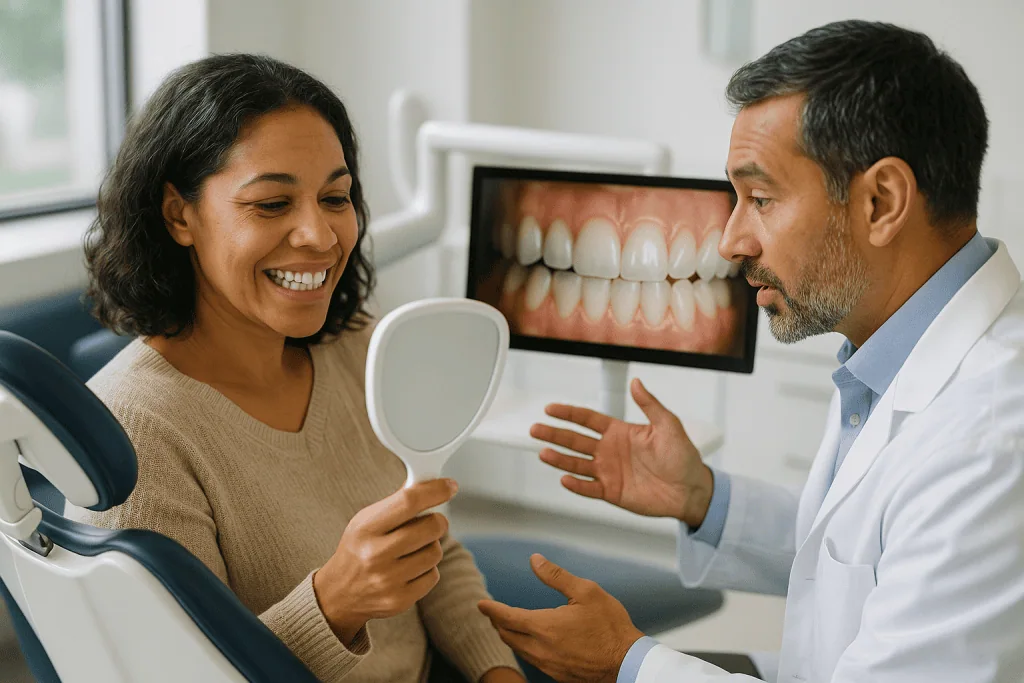
There are two main dentist-supervised routes. In the first, the gel is applied in the dental chair, often with a protective barrier painted over the gums and sometimes with a light or laser to speed the reaction. The NHS describes this type of in-chair session as taking about an hour. In the second, the dentist makes custom trays from an impression or scan, and the person wears the gel at home for a period the dentist specifies, usually over a few weeks. Over-the-counter products use lower-strength gels and one-size trays or strips; they can lighten mild staining but give less predictable results, and ill-fitting trays let gel leak onto gums.
Whitening is strongest against extrinsic stains, the surface film left by coffee, tea, red wine and tobacco, and against the natural yellowing that comes with age as enamel thins and shows more dentin. It is weaker against intrinsic stains that formed inside the tooth, such as the gray banding from certain antibiotics taken in childhood, or the white flecks of fluorosis. MedlinePlus notes that these deeper discolorations often respond poorly to bleaching and may need bonding or veneers instead.
Two practical points follow. First, whitening lightens only living, natural tooth structure, so a bonded corner or an old crown will stay its original shade and may suddenly look darker against a brighter neighbor. Second, results are not permanent. The NHS says the effect can last anywhere from a few months to up to three years, depending on diet and smoking.
What happens during composite bonding
Composite bonding, sometimes called dental bonding or cosmetic bonding, uses composite resin: a putty-like mix of plastic and finely ground glass that a dentist shapes by hand and hardens with a blue curing light. It is the same family of material used for tooth-colored fillings, refined for appearance.
The appointment is usually straightforward. The dentist selects a resin shade against the neighboring teeth, ideally after any planned whitening is finished. The tooth surface is lightly roughened with a mild etching gel, which creates microscopic texture, then coated with a bonding agent that acts as a primer. Resin is added in thin layers, each one shaped and cured before the next goes on. Once the form is right, the dentist trims the edges to match the bite and polishes the surface until it catches the light like enamel. Cleveland Clinic puts the typical time at 30 to 60 minutes per tooth, and local anesthetic is often unnecessary unless the work is near a nerve or involves removing decay.
Bonding is additive. That is its great strength. A chipped incisor corner, a small triangular gap between two front teeth, a short or uneven edge, a single dark spot: each can be corrected by building material onto healthy enamel rather than cutting it back. If the person later chooses a different treatment, the resin can usually be removed and the tooth beneath is largely as it was.
Its limits are equally clear. Resin is softer than porcelain and less stain-resistant, so it dulls faster and can chip on hard foods or pens. It works best for small or medium changes on one or a few teeth. Asking bonding to reshape a whole smile or to hide very dark discoloration tends to produce bulky results that need frequent touch-ups.
What actually happens when you get veneers
A veneer is a custom shell, roughly the thickness of a fingernail, bonded to the front surface of a tooth. Most are made of porcelain (a dental ceramic prized for its glassy translucence and stain resistance); some are made of composite resin, either built directly in the mouth or made in a lab.
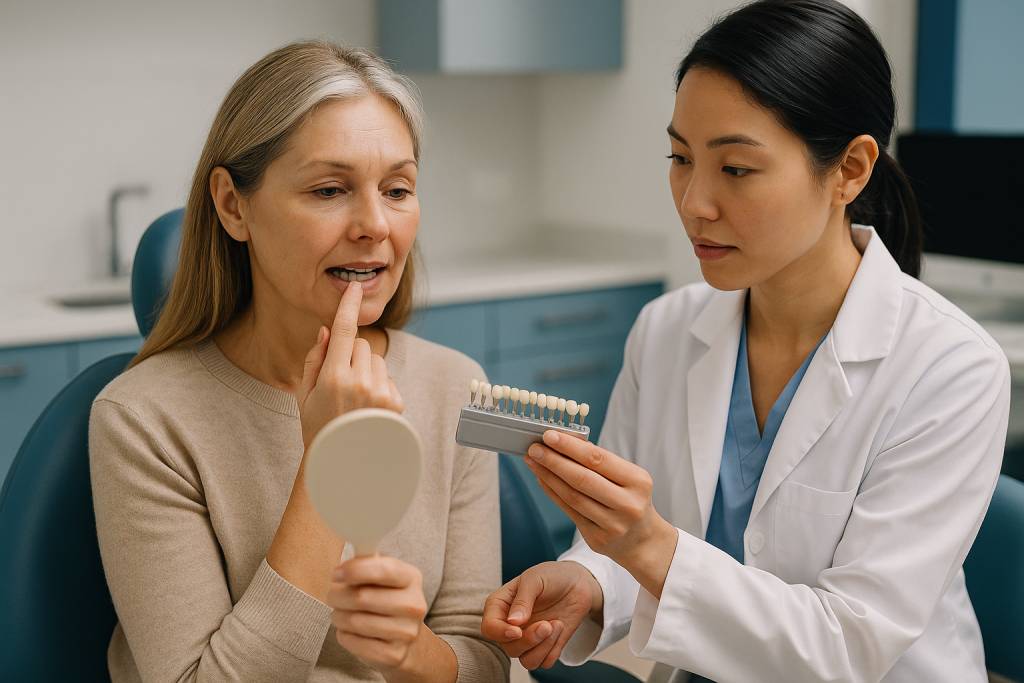
Porcelain veneers are usually a multi-visit process. At the first appointment the dentist takes photographs, checks the bite and discusses shade and shape. Then comes preparation: a thin layer of enamel is removed from the front of each tooth so the finished veneer does not look thick or bulge at the gum line. Cleveland Clinic describes this as about half a millimeter, though the exact amount depends on how much the tooth position or color needs to change. Local anesthetic is typical. The dentist takes an impression or digital scan, fits temporary veneers, and sends the case to a dental laboratory. Cleveland Clinic notes the wait for the permanent veneers is usually a few weeks. At the final visit the temporaries come off, each porcelain shell is checked for fit and color, the enamel is etched, and the veneer is cemented with a light-cured resin. Edges are trimmed and the bite is fine-tuned.
Composite veneers can sometimes be completed in a single visit because the dentist sculpts them directly, but they share bonding’s softer, more stain-prone nature.
The defining feature of a conventional veneer is that it is not reversible. Once enamel has been removed, the tooth will always need a veneer or a crown. So-called ‘no-prep’ or ‘minimal-prep’ veneers exist, but they suit only certain tooth positions and colors; on many teeth a no-prep shell would look too thick or too opaque. Whether that applies is a judgment for the treating dentist after examining the mouth.
Which flaw does each option fix? A side-by-side table
The table below is a starting map, not a prescription. Real teeth combine flaws, and a dentist may recommend pairing options, such as whitening first and bonding a single chip afterward.
| The flaw | Whitening | Composite bonding | Veneers |
|---|---|---|---|
| Yellow or brown surface staining on otherwise sound teeth | Usually the first choice | Not needed | Excessive for color alone |
| Gray or banded intrinsic discoloration | Often limited response | Can mask a single tooth | Effective, especially across several teeth |
| Small chip or worn edge on one tooth | Does nothing for shape | Usually the first choice | Possible, but removes healthy enamel |
| Narrow gap between two front teeth | No effect | Often suitable | Suitable if other changes are also wanted |
| Several teeth that are short, uneven or mildly rotated | No effect | Can help modestly; may look bulky | Often the most predictable option |
| Existing fillings or crowns that no longer match | Will not lighten them | Can replace small fillings | Can cover a tooth with a large old filling |
| Teeth that are crooked or crowded | No effect | Limited | Can disguise mild cases; orthodontics may be advised first |
Two patterns stand out. Whitening sits alone in the first row and drops out everywhere else, because color is the only thing it can change. Bonding and veneers overlap in the middle rows; the difference is how much change is needed and how many teeth are involved. Small, few and reversible points to bonding. Larger, many and long-term points to veneers, with the enamel trade-off that implies.
The last row deserves emphasis. Veneers can visually straighten mildly misaligned teeth, but they do so by removing more enamel from the teeth that stick out. When alignment is the main complaint, many dentists will raise orthodontic treatment, including clear aligners, as an alternative that keeps the natural tooth whole.
Who is usually a candidate, and who is usually asked to wait
Good candidates for all three treatments share a foundation: healthy gums, no untreated decay, and enough sound enamel to work with. Beyond that, each option has its own gatekeepers.
For whitening, dentists look for stains that are likely to respond, which generally means yellow or brown rather than gray, and for teeth without large front fillings or crowns that would stay dark. Age matters too. The NHS advises that whitening is not suitable for children and, in the UK, it is not permitted for people under 18. Many clinicians also defer whitening during pregnancy and breastfeeding, not because harm has been shown but because safety data are limited and the treatment is elective. People with very sensitive teeth or exposed root surfaces may be asked to treat that first, since bleaching gel on exposed dentin can be sharply uncomfortable.
For bonding, the tooth needs enough healthy enamel for the resin to grip; heavily worn or decayed surfaces bond less reliably. Habitual grinders or clenchers are often asked to have a night guard made, because resin edges snap under that kind of load.
For veneers, the wait list is longer. Untreated gum disease means the gum line will move after treatment and expose the veneer edge. Severe grinding can crack porcelain. Teeth with very large fillings or previous root canal treatment may be better served by a crown. Significant crowding usually leads to a conversation about orthodontics first. And because veneers are permanent, dentists tend to be cautious with people in their late teens and early twenties whose gums and bite are still settling, and with anyone whose main worry is a color problem that whitening could solve on its own.
None of these are automatic exclusions. They are prompts for a longer conversation, and the decision rests with the treating team after an examination.
Is whitening better than veneers? Teeth whitening vs veneers explained
People ask this as if it were a contest, and the honest answer is that they are not competing for the same job. Ask instead: is shape part of the problem?
If the teeth are a pleasing size and position and the only complaint is color, whitening is almost always the more sensible first step. It removes no tooth structure, it is reversible in the sense that the effect fades, and if the result disappoints, nothing has been lost except time. The NHS is clear that whitening cannot change shape and will not lighten crowns, veneers or fillings, so it also has a hard ceiling: a person unhappy with a gummy smile, short teeth or a dark single tooth that resists bleaching will not get there with peroxide alone.
Veneers, by contrast, can deliver a brighter color and a new shape in one treatment, and porcelain holds its shade far longer than natural enamel does after whitening. But that result is bought with enamel that does not grow back, a commitment to replacement when the veneers eventually wear or chip, and a higher chance of post-treatment sensitivity. Cleveland Clinic lists sensitivity, chipping and the irreversibility of enamel removal among the recognized downsides.
Here is the opinion the evidence supports: the least invasive option that actually fixes the flaw is the right one, and whitening earns a trial before veneers whenever color is the only issue. Some people whiten, find their shade satisfying and stop. Others whiten, discover that shape was bothering them more than they realized, and then discuss bonding or veneers with a clearer head and a brighter baseline shade to match.
What whitening should not be used for is as a substitute where it cannot work. Repeated bleaching of a tooth that stays gray is a sign the flaw is intrinsic, and the conversation needs to move on.
Composite bonding vs veneers: is it better to get veneers or bonding?
This is the comparison where the two treatments genuinely overlap, so the decision turns on four practical factors: how many teeth, how much change, how long the person wants it to last, and how much they value keeping the option to change their mind.
Bonding wins on conservatism. Because resin is added to the tooth, a dentist can repair a chipped corner or close a small gap in a single visit while leaving the enamel underneath essentially untouched. If it stains or chips, it can be polished or patched in the chair. If the person later wants veneers or orthodontics, the resin can be removed. For a young adult with one damaged incisor, that flexibility is a strong argument.
Veneers win on scale and endurance. When six or eight front teeth need to change shape and color together, layering resin by hand across all of them is slow, hard to keep symmetrical and prone to looking thick. Lab-made porcelain can be designed as a set, mimics the light-scattering depth of enamel more convincingly, and resists coffee and wine stains in a way resin never will. Cleveland Clinic gives typical lifespans of 3 to 10 years for bonding and 10 to 15 years for porcelain veneers, a gap that reflects the materials rather than the skill of any provider.
The cost of that endurance is enamel. A veneer is a permanent decision made on behalf of a tooth that will need covering for the rest of its life.
A fair summary: bonding for one or two teeth with modest flaws, or as a reversible first step; veneers for a group of teeth needing a lasting change in both shape and color, once the person understands what permanent means. Many dentists will sketch both plans, and some will build a trial version in composite so the person can live with the new shape before committing to porcelain.
How long does each option last, and what shortens it?
Longevity figures are typical ranges from clinical experience, not guarantees, and they swing widely with habits. With that caveat, the reference points are consistent across mainstream sources.
Whitening fades. The NHS puts the effect at a few months to up to three years, with the shorter end for people who smoke or drink a lot of tea, coffee or red wine. Most people who whiten plan on periodic touch-ups under their dentist’s guidance rather than expecting a one-time change.
Bonding wears. Cleveland Clinic cites 3 to 10 years before resin typically needs repair or replacement. The failure modes are gradual: the surface loses its polish and picks up stain, the margin where resin meets tooth can darken, and edges chip under hard biting. The upside is that repairs are usually quick and local.
Porcelain veneers endure longest, at 10 to 15 years in Cleveland Clinic’s estimate, with composite veneers closer to 4 to 8 years. When porcelain fails it is usually by chipping, debonding (the veneer loosening from the tooth) or by the gum receding and exposing an edge. Replacement means another round of preparation.
The same handful of habits shortens all three:
- Grinding or clenching, especially at night, which overloads edges and can crack porcelain
- Using teeth as tools: biting nails, tearing packaging, chewing ice or pens
- Smoking and heavy consumption of staining drinks, which dull resin and re-stain natural enamel
- Skipping cleanings, since plaque at the margins leads to gum recession and decay beneath restorations
A night guard for known grinders, a soft toothbrush, non-abrasive toothpaste and routine dental visits are the evidence-supported basics. None of them are glamorous, and they do more for longevity than any material choice.
What the following days and weeks usually look like
The aftermath of each treatment is different enough that it should factor into the choice, especially for anyone planning around an event.
After whitening, the most common experience is tooth sensitivity: a brief zing to cold air or water, sometimes a dull ache. Mayo Clinic describes this as usually temporary, and most people find it eases within a few days. Gums may look pale or slightly irritated where gel touched them; that also settles quickly. Many dentists suggest avoiding strongly colored foods and drinks for a short period because freshly bleached enamel is thought to be more porous, though the evidence for how long this window lasts is thin. The final shade is often judged a week or so later, once the teeth have rehydrated and any temporary chalky look has gone.
After bonding, people can generally eat normally the same day once any anesthetic has worn off. The new edge may feel unfamiliar to the tongue for a day or two. Mild sensitivity is possible if the bonding was near the gum or over exposed dentin. A short follow-up to check the bite and polish is common.
Veneers have two phases. During the temporary phase, which Cleveland Clinic notes usually lasts a few weeks while the laboratory makes the porcelain, the plastic temporaries are weaker and may feel rough or slightly bulky; chewing sticky or very hard foods on them is discouraged. After the permanent veneers are cemented, some sensitivity to temperature is expected for days to a couple of weeks as the prepared teeth settle. The gums may be tender where the edges were fitted. A follow-up visit to fine-tune the bite is standard, because even a slightly high spot on one veneer concentrates force and raises the chance of a chip.
Across all three, the expected course is discomfort that fades rather than pain that grows. Anything moving in the wrong direction is a reason to call.
Risks, trade-offs and the alternatives nobody mentions
Every cosmetic dental treatment carries risks that are modest when the treatment is chosen well and larger when it is not. Stating them plainly is part of informed consent.
Whitening’s risks are mostly short-lived: tooth sensitivity, gum irritation from gel contact, and uneven results when some teeth respond better than others. The NHS also cautions about whitening carried out by non-dental providers and about over-the-counter kits with poorly fitting trays, which raise the chance of gel burns to the gums. Excessive, unsupervised bleaching can leave teeth looking chalky or translucent at the edges. Existing restorations will not lighten and may need replacing to match.
Bonding’s risks are functional: chipping under load, staining over time, and a visible line where resin meets tooth if the margin was not polished well or the gum has receded. Because bonding sits on the surface, failures are rarely serious and are usually repairable.
Veneers carry the weightiest trade-offs. Enamel removal is permanent, and Cleveland Clinic lists lasting sensitivity, chipping, debonding and the eventual need for replacement among the recognized downsides. A tooth that loses too much enamel or is repeatedly prepared may one day need a crown instead. Color is fixed at cementation; if the natural teeth beside a veneer are later whitened, the veneer will not follow.
The alternatives deserve equal airtime. Orthodontic treatment, including aligners, straightens crooked or gapped teeth without removing structure. Enamel microabrasion, a gentle polishing of the outer enamel, can reduce shallow white or brown spots. A crown is more appropriate than a veneer for a tooth that is heavily filled or cracked. And ‘watch and wait’ is a legitimate plan for minor flaws that only the owner notices, particularly in younger people whose smiles are still maturing. A good treating team will lay out each of these, not just the three headline options.
What is the 4 8 10 rule for veneers?
Search this phrase and the answers are confident and contradictory, which is usually a sign that no formal guideline exists. It does not. The ‘4-8-10 rule’ is informal shorthand some dentists and patients use to talk about how many veneers a smile needs, and it is worth understanding so it does not steer a decision it was never designed to make.
The numbers refer to groups of front teeth. Four means the four upper incisors, the flat central teeth that dominate a narrow smile or a photo taken straight on. Eight adds the two canines and the first premolars on each side, covering everything that shows in a moderate smile. Ten extends to the second premolars for people whose smiles are wide enough to reveal teeth toward the back. The idea is simply that veneers should stop where the visible smile stops, so there is no abrupt change from bright porcelain to a darker natural tooth at the corner of the mouth.
As a conversation prompt, it is useful. As a rule, it has problems. Smile width varies enormously; some people show only six teeth when they grin fully, others show twelve. Lower teeth are ignored entirely, even though they show when people talk. And the phrase can nudge a person who needs one veneer for one damaged tooth toward treating eight healthy ones for symmetry, which means removing enamel from teeth that had nothing wrong with them.
A more defensible approach is the one dentists actually use in the chair: photograph the person smiling naturally and speaking, count the teeth that show, and then ask whether color matching through whitening can bring the untreated teeth close enough that fewer veneers are needed. The right number is whatever solves the flaw with the least healthy enamel lost, and it is a clinical judgment, not a formula.
What people often get wrong
Cosmetic dentistry attracts myths in both directions: some make people afraid of safe treatments, others make them casual about permanent ones. Here are the corrections the evidence supports.
‘Whitening strips the enamel.’ Supervised peroxide whitening oxidizes stain molecules; it does not dissolve enamel. The NHS and Mayo Clinic describe the recognized side effects as temporary sensitivity and gum irritation, not structural damage. The real risks come from misuse: overly frequent unsupervised bleaching, or high-strength gel applied without a dentist’s assessment.
‘Whitening will brighten my whole smile.’ It brightens natural teeth only. Crowns, veneers and fillings keep their shade, which is why they can look darker afterward and why dentists whiten first and match restorations second.
‘Veneers are just stuck on; you can take them off later.’ Conventional veneers require enamel removal, and Cleveland Clinic is explicit that the process is not reversible. The tooth will need a veneer or crown for life.
‘Bonding is a cheap version of veneers.’ It is a different tool. Bonding is designed for small, additive repairs and is prized for being reversible. Judged as a whole-smile makeover, it will disappoint; judged as a fix for one chipped corner, it is often ideal.
‘Porcelain veneers are maintenance-free forever.’ They resist stain but still chip, debond and outlive the gum line that framed them. Cleveland Clinic’s 10 to 15 year estimate is a typical range before replacement, not a lifetime.
‘Whiter is always better.’ Natural enamel has depth and slight translucence. Shades far brighter than the whites of a person’s eyes tend to read as flat and artificial in daylight. Most dentists will show shade options in natural light for exactly this reason.
‘A single dark tooth just needs a veneer.’ One tooth that darkens on its own is sometimes a sign of nerve damage from an old knock. That needs a diagnosis, and sometimes root canal treatment, before any cosmetic work.
Questions to ask your care team
The most useful consultation is the one where the person walks in with a specific complaint and a short list of questions, rather than a treatment already decided. These are the ones that tend to surface the information that matters.
- What exactly is causing the flaw I am bothered by, and is any of it a health problem rather than a cosmetic one?
- Which of whitening, bonding or veneers addresses that specific flaw, and why not the others?
- Is there a less invasive option, including orthodontics or simply monitoring, that would achieve a similar result?
- If we do this, how much natural enamel will be removed, and what does that commit me to in twenty years?
- Would you recommend whitening first so that any bonding or veneers can be matched to a lighter shade?
- Could I try the new shape in a temporary or composite version before committing to porcelain?
- How many teeth do you think need treating to look natural when I smile and speak, and could that number be smaller?
- What are the typical lifespans for these materials in someone with my habits, and what will replacement involve?
- Do I show signs of grinding or clenching, and should a night guard be part of the plan?
- What sensitivity or discomfort should I expect in the first weeks, and what would be a reason to call you?
- Are any of my existing fillings or crowns going to look mismatched afterward, and what is the plan for them?
- How will my gum health and bite be checked before and after, and how often should I come back?
Bring photographs of your own smile from a few years ago, and of smiles you like, but treat the second set as a conversation starter rather than a target. Teeth that look right in one face can look wrong in another, and an experienced clinician will say so. The final plan should be one the treating team can explain in terms of your teeth, not a package.
When to call your doctor
Most people feel little after cosmetic dental work beyond mild, fading sensitivity. The signs below are the ones that should prompt a call to the treating dentist, or urgent medical care where noted, rather than waiting for a scheduled follow-up.
Call the dentist promptly if:
- Tooth pain is severe, throbbing, wakes you at night, or is getting worse rather than better after the first few days
- Sensitivity to hot or cold persists for more than a couple of weeks after bonding or veneers, or a tooth becomes painful to bite on
- Gums are swollen, bleeding persistently, or show white or ulcerated patches after whitening gel contact that do not heal within a few days
- A veneer or piece of bonding feels loose, moves when you press it, or comes off entirely; keep the piece and avoid chewing on that side
- A sharp edge is cutting your tongue or cheek
- The bite feels uneven or one tooth hits first when you close
- You notice a bad taste, pus or a small bump on the gum near a treated tooth, which can signal infection
Seek emergency care immediately if you develop facial swelling that spreads toward the eye or neck, fever with dental pain, difficulty swallowing or breathing, or if a dislodged veneer or fragment is inhaled and causes coughing or breathlessness. Signs of an allergic reaction, such as hives, lip or tongue swelling, or wheezing, also need emergency assessment.
A single tooth that darkens on its own, with or without pain, deserves a dental appointment even when nothing cosmetic is planned, because it can indicate a nerve that has died after an old injury.
Whatever the symptom, the treating team knows exactly what was done, which materials were used and what your teeth looked like beforehand. They are the right first call, and every decision about further treatment sits with them.
Frequently asked questions
Is it better to get veneers or bonding?
It depends on how many teeth are involved and how much change is needed. Bonding is usually preferred for one or two teeth with small chips, gaps or worn edges, because it adds material without removing enamel and can be reversed or repaired. Veneers are usually chosen when several front teeth need a lasting change in both shape and color, accepting that enamel removal is permanent. The treating dentist weighs both against the specific flaw.
Is whitening better than veneers?
Whitening is the more conservative option and is generally tried first when color is the only complaint, since it removes no tooth structure and its effect simply fades over time. Veneers are considered when shape, size or alignment also need to change, or when discoloration is intrinsic and does not respond to bleaching. Neither is universally better; they address different flaws, and the least invasive option that fixes the actual problem is usually the right one.
Which is better, teeth whitening or composite bonding?
They fix different things, so the question is what bothers you. Whitening lightens the overall shade of natural teeth but does nothing for chips, gaps or uneven edges. Composite bonding repairs shape on individual teeth and can mask a single discolored area, but it does not brighten the whole smile. Many people whiten first and then bond a chip or gap, so the resin can be matched to the lighter shade.
What is the 4 8 10 rule for veneers?
It is informal shorthand, not a guideline. The numbers refer to the four upper incisors, the eight teeth including canines and first premolars, or the ten teeth extending to second premolars, roughly matching how many teeth show in a narrow, moderate or wide smile. Dentists use it to explain why veneers should stop where the visible smile stops. The actual number depends on your smile width and how many teeth genuinely need changing.
How long does dental bonding last?
Cleveland Clinic gives a typical range of 3 to 10 years before composite bonding needs repair or replacement. The lower end applies to people who grind their teeth, bite nails or chew hard objects, and to bonding on biting edges that take heavy load. Resin also picks up stain from coffee, tea, red wine and smoking. Repairs are usually quick, and a night guard can extend the life of bonding in known grinders.
What are the pros and cons of porcelain veneers?
Porcelain veneers can change color, shape and apparent alignment of several teeth at once, resist staining well, and typically last 10 to 15 years according to Cleveland Clinic. The main drawbacks are that enamel removal is permanent, sensitivity can follow treatment, veneers can chip or debond, and they will eventually need replacing. They also cannot be whitened later, so the shade is fixed at the time they are cemented.
Can you whiten veneers or bonding?
No. Peroxide whitening acts on natural enamel and dentin, not on porcelain or composite resin, so veneers, bonding, fillings and crowns keep their original shade. This is why dentists usually recommend whitening before any cosmetic restorations are placed or replaced, so the new material can be matched to the lighter color. Stained bonding can sometimes be polished or replaced; stained porcelain generally needs professional cleaning or replacement.
Does teeth whitening hurt or damage enamel?
Supervised whitening does not remove or dissolve enamel. Mayo Clinic and the NHS describe the common side effects as temporary tooth sensitivity and mild gum irritation, which usually settle within days. Problems are more likely with poorly fitting over-the-counter trays that let gel leak onto gums, or with repeated unsupervised use. People with exposed roots or untreated cavities may experience sharper discomfort and should be assessed by a dentist first.
Should you whiten before or after bonding?
Before. Composite resin is shade-matched to the neighboring teeth at the time it is placed and cannot be lightened afterward. Whitening first, then allowing the color to stabilize for a short period the dentist specifies, lets the bonding be matched to the final shade. The same sequence applies to veneers: any planned whitening of untreated teeth should be finished before the veneer shade is chosen and the porcelain is made.
Is teeth whitening safe during pregnancy?
Harm has not been demonstrated, but safety data are limited, and because whitening is elective most dentists advise waiting until after pregnancy and breastfeeding. Gums are also more prone to inflammation during pregnancy, which can make gel contact more irritating. Routine dental check-ups and cleanings remain important during pregnancy. If timing matters to you, discuss it with both your dentist and your prenatal care provider.
References
This article is for general information only and is not a substitute for professional medical advice. Please consult a qualified doctor about your individual situation.

Planning This Treatment in Turkey
Our full guide for international patients: techniques, hospital stay, recovery and cost.
More from the Blog

How a Gummy Smile Is Assessed: Measuring Gum Display, Lip Movement and Tooth Shape
A gummy smile assessment measures how much gum shows above the upper front teeth during a full smile, usually with a ruler, photographs and…
Preparing for Tooth Decay Treatment: Eating Beforehand, Allergies and Anesthesia Questions
Preparing for a cavity filling is usually simple: eat a light meal before a local anesthetic appointment because your mouth will be numb afterward,…

Getting Ready for SRP Deep Cleaning: Eating Before Anesthesia and Medications to Mention
Preparing for deep cleaning (scaling and root planing) usually means eating a normal meal beforehand if only a local anesthetic is planned, since chewing…

How Long Do Fissure Sealants Last? Wear, Chipping and Check-Ups That Keep Them Working
Fissure sealants typically last several years rather than a lifetime. CDC data show they prevent about 80% of cavities in back teeth for two…
Can You Have Orthodontics With Gum Disease or Missing Teeth? What Is Planned Around
Orthodontics with gum disease or missing teeth is usually possible, but only after the gums are stable and the plan has been built around…

What Causes Orofacial Pain? TMJ, Nerves, Muscles and How Structured Care Is Planned
Orofacial pain most often comes from one of four places: the temporomandibular (jaw) joint and its chewing muscles, the teeth and their supporting bone,…