

After a Tick Bite: When Doctors Recommend an Evaluation and How Lyme Disease Care Begins

Key Takeaways
- Lyme bacteria generally need a blacklegged tick to stay attached for 36 to 48 hours before transmission occurs, so prompt removal is the most protective step available (CDC).
- The Lyme rash, erythema migrans, appears 3 to 30 days after a bite in roughly 70 to 80 percent of infections and expands over days, while an ordinary bite reaction appears within hours and fades (CDC).
- A preventive antibiotic is considered only when several conditions align, including a likely blacklegged tick attached 36 hours or more in a high-incidence area, with the medicine started within 72 hours of removal (CDC).
- Antibody tests are often negative in the first weeks of infection, so early Lyme disease is usually diagnosed from the rash and exposure history rather than a blood test (CDC, NHS).
- Lyme disease diagnosed months after a bite is still treated with antibiotics; later-stage features include Lyme arthritis, facial palsy, and heart rhythm changes (CDC).
- Treatment does not confer immunity, and repeat infection from a new tick bite is possible, so tick checks after outdoor exposure remain essential every season (Mayo Clinic).
See a doctor after a tick bite if you cannot remove the tick fully, if it was likely attached for 36 hours or more, if a spreading or ring-shaped rash appears within about a month, or if fever, fatigue, headache, joint pain, or facial weakness develop in the weeks that follow. Lyme disease is usually treated with a course of antibiotics chosen by your clinician, and earlier evaluation generally means simpler care.
It is nearly always the shower that finds it. A small dark bump behind the knee, stubborn as a seed, that turns out to have legs. The hike was two days ago. Or was it three? You pull, it comes away, and then the questions arrive faster than answers: Was that a deer tick? Was it there long enough to matter? Do I need to do anything at all?
For a tick bite, when to see a doctor is rarely an emergency decision, but it is not a trivial one either. Most bites pass without consequence. A minority carry the bacterium that causes Lyme disease, and the difference between a straightforward course of care and a drawn-out recovery often comes down to noticing the right things in the right window.
This explainer walks through what actually happens during a bite, how clinicians decide who needs evaluation now and who can reasonably watch and wait, and how Lyme disease care typically begins once it is suspected.
Tick bite: when to see a doctor, and when watching is reasonable
Start with the reassuring part. A tick that has been on your skin for a few hours, in an area where Lyme disease is uncommon, is very unlikely to have passed on anything. The bacterium that causes Lyme disease, Borrelia burgdorferi, generally needs the tick to stay attached and feeding for 36 to 48 hours before it moves into a person, according to the CDC and Mayo Clinic. Remove a tick promptly and you have already done the single most protective thing available.
Where a doctor’s evaluation becomes worthwhile is in a handful of situations. The tick was engorged, meaning swollen with blood, which suggests it had been feeding for a day or more. Part of it broke off under the skin and you cannot get it out. You live in or visited a region where blacklegged ticks are common, and the tick was attached long enough to matter. Or, most decisively, something changes in the days and weeks afterward: a rash that widens, a fever without another explanation, an ache in the joints or neck that does not fit the day you had.
The phrase “tick bite, when to see a doctor” gets searched millions of times because the honest answer depends on context, and people sense that. A clinician can look at the bite, ask where you were and for how long, sometimes identify the tick, and decide whether a short preventive antibiotic, a period of watchful waiting, or immediate treatment makes sense. None of those choices is something to self-assign. Bring the tick in a sealed bag if you still have it; identification can change the conversation.
What actually happens when a tick bites
A tick is not a mosquito. It does not dart in, drink, and leave. It climbs on, walks to a warm, protected fold of skin, cuts a small opening with its mouthparts, and cements itself in place with a substance from its saliva. Then it feeds slowly, sometimes for several days, swelling from the size of a poppy seed to something closer to a small grape.

That slow timeline is the reason the 36-to-48-hour figure matters. Borrelia bacteria live in the tick’s gut. During the first day of feeding they multiply and migrate toward the salivary glands, and only then can they pass into the person. The CDC notes that this is why most people who develop Lyme disease never noticed the tick at all: the ones that stay long enough to transmit are often the tiny immature ticks, called nymphs, which are easy to miss.
Tick saliva also contains compounds that numb the skin and dampen the local immune response, which is why the bite itself rarely hurts or itches at first. A small red bump afterward is a normal reaction to the bite, similar to any insect bite, and does not by itself mean infection.
Not every tick carries the bacterium, and not every carrying tick transmits it. Infection rates in blacklegged ticks vary widely by region and by life stage. Lyme disease is concentrated in the Northeast, mid-Atlantic, and upper Midwest of the United States, with a smaller focus on the Pacific coast, according to the CDC. Geography is one of the first things a clinician will ask about, because it changes the odds before any test is ordered.
What does a tick bite look like?
Usually, unremarkable. The bite site is often a small pink or red bump, sometimes with a darker center where the mouthparts were, roughly the size of a pencil eraser. It may itch mildly for a few days. Mayo Clinic describes this local reaction as common and not, on its own, a sign of disease. If the tick is still attached, you will see it as a small dark spot with a body that may be flat and seed-like or swollen and grayish, depending on how long it has fed.
People often expect drama and are puzzled when there is none. The truth is that a tick bite can look like almost nothing, which is why the surrounding details matter more than the bump itself: Where on the body is it? Ticks favor the scalp, behind the ears, the armpits, the groin, the waistband line, and behind the knees. Was there an outdoor exposure in tall grass, leaf litter, or brush? How many days ago?
What a clinician watches for in the following weeks is different from the bite reaction. A local bump stays roughly the same size and fades over a few days. The rash of early Lyme disease, called erythema migrans, does the opposite: it appears after a delay and grows. The CDC puts that delay at 3 to 30 days after the bite, with about 7 days being typical, and describes a rash that expands gradually over several days and can reach 12 inches or more across.
If you are unsure what you are looking at, a photograph taken the day you notice it, with a coin beside it for scale, gives your care team something concrete to compare against a week later. Change over time is the most useful signal you can offer.
How to remove a tick without making things worse
The goal is simple: get the whole tick out, quickly, without squeezing its body. Mayo Clinic and the CDC agree on the method, and it requires nothing more than fine-tipped tweezers.

- Grasp the tick as close to the skin as you can, at the head or mouthparts rather than the swollen body.
- Pull straight upward with steady, even pressure. Do not twist or jerk.
- If mouthparts break off and remain in the skin, try once to remove them with clean tweezers; if they will not come easily, leave them and let the skin heal over.
- Clean the area and your hands with soap and water or rubbing alcohol.
- Dispose of the tick by flushing it, sealing it in tape or a bag, or keeping it in a sealed container in case identification is needed later.
Then comes the part people skip: write down the date and the place on your body. A note on your phone is enough. If a rash or fever appears later, that timestamp is exactly what your clinician will want.
What not to do matters just as much. Folk methods such as touching the tick with a hot match, coating it in petroleum jelly or nail polish, or smothering it are not recommended by any major health authority. Mayo Clinic cautions that these approaches can irritate the tick into releasing more saliva into the wound, and they delay removal, which is the one thing you can control. Crushing the tick with your fingers is also discouraged.
A retained fragment of mouthpart is unpleasant but not dangerous in the way people fear. It cannot transmit infection on its own, since the bacteria travel from the tick’s live gut and glands. The body treats it like a splinter. If the area becomes increasingly red, warm, or painful over several days, that suggests an ordinary skin infection and is a reason to be seen.
Who is usually offered a preventive antibiotic, and who is asked to wait
Some people leave a clinic after a tick bite with a short preventive antibiotic; many more are told, kindly, that they do not need one. The distinction is not arbitrary. Guidelines summarized by the CDC set out conditions under which a preventive course is considered, and all of them generally need to apply together.
The tick should be identified as a blacklegged tick, the species that carries Borrelia. It should have been attached for an estimated 36 hours or more, judged by how engorged it looks or by how much time has passed since the exposure. The preventive medicine should be started within 72 hours of the tick being removed, because its benefit falls off after that window. And the bite should have occurred in an area where Lyme disease is common. If any of these is missing, most clinicians will recommend observation instead.
Why not simply treat everyone? Because the great majority of tick bites, even in high-incidence regions, never lead to infection, and antibiotics carry their own small risks: stomach upset, sun sensitivity with certain classes, and allergic reactions. Treating hundreds of people to prevent a handful of infections is a trade most guideline bodies consider unfavorable unless the odds are tilted by the criteria above. The prescribing clinician weighs these factors; this article cannot, and no reader should decide alone.
People who are asked to wait are not being dismissed. Watchful waiting means active watching. The CDC advises monitoring the bite site and general health for about 30 days, the outer edge of the window in which erythema migrans typically appears. If a rash or symptoms develop, treatment at that stage is still considered early, and outcomes for early treated Lyme disease are generally good.
Bite scenarios at a glance: what guidelines typically suggest
Because the right next step shifts with a few key details, it helps to see the common scenarios side by side. This table summarizes general guidance from the CDC, Mayo Clinic, and the NHS. It is a map, not a verdict; your clinician makes the call with the full picture in front of them.
| Situation | What guidelines generally describe | Typical next step |
|---|---|---|
| Tick removed within a few hours, not engorged, no symptoms | Transmission of Lyme bacteria is unlikely before 36 hours of attachment (CDC) | Clean the site; watch for 30 days; no visit usually needed |
| Tick engorged or attached more than 36 hours in a high-incidence area, removed within the last 72 hours | Meets the conditions under which a preventive antibiotic is considered (CDC) | Contact a clinician promptly to discuss options |
| Mouthparts left in skin | Cannot transmit infection alone; treated like a splinter (Mayo Clinic) | Leave to heal; see a clinician if redness spreads or pain grows |
| Expanding rash 3 to 30 days after a bite | Consistent with erythema migrans, present in 70 to 80 percent of Lyme infections (CDC) | Same-week evaluation; treatment often started on clinical grounds |
| Fever, fatigue, headache, joint aches after outdoor exposure, no rash noticed | Early Lyme disease and other tick-borne infections can present without a rash (CDC, NHS) | Evaluation; testing timing matters |
| Facial drooping, palpitations, severe joint swelling weeks to months later | Features of later-stage Lyme disease (CDC) | Prompt evaluation; still treatable with antibiotics |
Two things stand out in that table. First, the clock matters at both ends: early removal prevents infection, and early recognition simplifies treatment. Second, the absence of a rash does not close the question. Roughly one in five infected people never develops one, so a fever after a woodland weekend deserves the same attention a rash would get.
Early signs of Lyme disease that clinicians watch for
Ask a clinician what they look for in the first month after a tick bite and the answer is a pattern, not a checklist. The CDC groups early Lyme disease, roughly 3 to 30 days after a bite, around a rash plus a flu-like illness that arrives without the cough or runny nose you would expect from a respiratory virus.
The rash, erythema migrans, is the signature. It is usually flat or slightly raised, warm to the touch, rarely itchy or painful, and it grows. Some clear in the center to form a ring, the classic bullseye, but many do not; a uniformly red, expanding oval counts just as much. The fever is often low-grade. Fatigue can be out of proportion to anything else going on. Headache and a stiff neck are common. Muscle and joint aches tend to move around rather than settle in one place. Swollen lymph nodes near the bite may appear.
What makes these signs meaningful is context: outdoor exposure in a region where Lyme disease occurs, a plausible time gap, and the absence of another explanation. A summer fever with a sore throat and a house full of sick children points elsewhere. A summer fever after a week of trail work, with a warm red patch spreading on the calf, points here.
Clinicians also listen for what is missing. Erythema migrans typically does not blister, does not weep, and does not appear within the first day or two. A red bump that shows up immediately and fades within a few days is the body reacting to the bite, not the bacteria.
The purpose of knowing these signs is not to diagnose yourself. It is to recognize when a conversation with your care team has become worth having, and to describe what you have noticed with enough precision that they can act on it.
Tick bite rash vs bullseye: telling an ordinary reaction from erythema migrans
Nearly everyone who searches for images of Lyme disease sees the same picture: a red ring with a pale center and a red dot in the middle, like an archery target. That image has done some good, but it has also caused two kinds of mistakes. People with an ordinary bite reaction panic because it is round and red. People with a genuine erythema migrans rash dismiss it because it never developed rings.
The ordinary reaction appears within hours of the bite, sits within about an inch of the site, may itch, and fades over two to three days. It is your skin objecting to tick saliva. It does not grow.
Erythema migrans behaves differently on almost every count. It appears after a delay, most often around a week and sometimes as long as a month, according to the CDC; the NHS notes it can occasionally appear as late as three months after the bite. It expands, often by a centimeter or more per day, and can reach the size of a dinner plate. It is usually warm but not very itchy or painful. The bullseye pattern appears in only a fraction of cases; a solid red or bluish-red patch, an oval with a darker rim, or a rash with a crusted center are all recognized forms. On darker skin tones the redness can be subtle and the rash may look more like a bruise, which is one reason diagnosis can be delayed.
A practical way to sort the two at home is the pen test many clinicians suggest: trace the edge of the redness with a ballpoint pen and look again in 24 hours. If the color has clearly crossed the line, that is worth reporting. If it has stayed inside or shrunk, it is behaving like a local reaction.
One more distinction. Multiple rashes appearing on parts of the body far from the bite, days to weeks later, are a recognized feature of early disseminated Lyme disease, where the bacteria have spread through the bloodstream. That pattern warrants an evaluation without waiting for other symptoms.
How doctors diagnose Lyme disease, and why testing right after a bite can mislead
Here is a fact that surprises many people: a blood test taken the day after a tick bite tells you almost nothing about Lyme disease. The standard tests look for antibodies, the proteins your immune system makes in response to the bacterium, and antibodies take time to appear. The CDC and NHS both note that testing in the first few weeks of infection can be negative even when the infection is real.
Because of that lag, clinicians diagnose early Lyme disease mainly on clinical grounds. If someone has a rash consistent with erythema migrans and a plausible exposure, the CDC guidance is to treat without waiting for laboratory confirmation. A negative early test does not overturn a characteristic rash.
When testing is used, it follows a two-step process. The first step is a screening test that detects antibodies broadly. If it is positive or borderline, a second, more specific test confirms the result. Both steps are needed; a positive screen alone is not a diagnosis. This two-tier approach is designed to reduce false positives, since the screening test can react to antibodies from other infections or conditions.
Testing is most informative when symptoms have lasted several weeks or when later-stage features such as joint swelling, facial palsy, or heart rhythm changes are being evaluated. At that point antibodies are usually detectable, and a negative two-tier result carries real weight.
Testing the tick itself, which some private laboratories offer, is not recommended by the CDC for guiding treatment. A tick carrying the bacterium may not have transmitted it, and a negative tick test does not rule out a bite from another tick you never saw. Clinicians also keep other tick-borne infections in mind, including anaplasmosis and babesiosis, which can cause similar fevers and are transmitted by the same blacklegged ticks. Distinguishing among them is part of why an evaluation, rather than a guess, is worthwhile.
How Lyme disease treatment begins once it is suspected
Lyme disease is a bacterial infection, and it is treated with antibiotics. That sentence is the whole framework; everything else is detail chosen by the prescribing clinician for the individual in front of them.
For early disease, oral antibiotics are the standard approach. The classes most often used in guidelines include tetracyclines, penicillin-type antibiotics, and certain cephalosporins. Each works by interfering with the bacteria’s ability to build proteins or cell walls, so they cannot multiply, and the immune system clears what remains. The choice among them depends on age, pregnancy, allergies, other medicines, and whether a second tick-borne infection is also being covered. The CDC describes treatment courses lasting a few weeks; the exact length is a clinical decision, not a fixed rule, and this article deliberately does not describe doses or schedules.
For later-stage disease involving the nervous system or heart, intravenous antibiotics are sometimes used, and care may involve specialists in infectious disease, neurology, or cardiology. Lyme carditis, an inflammation of the heart’s electrical system that can cause slowed or irregular rhythms, occasionally requires hospital monitoring while antibiotics take effect.
Patients frequently ask whether they will feel worse before they feel better. A temporary flare of symptoms in the first day or two of treatment has been described and is thought to reflect the immune response to dying bacteria; it is uncomfortable but usually brief. Any new or severe reaction, especially rash, swelling of the face or throat, or difficulty breathing, should be reported immediately as it could indicate an allergy to the medicine rather than a treatment response.
Finishing the course as prescribed matters. Stopping early because symptoms have eased is one of the more common reasons people return with recurring problems. If side effects make the medicine hard to continue, the right move is a call to the prescriber, not a quiet decision to stop. Alternatives exist, and switching is a routine conversation.
What the following days and weeks usually look like
Recovery from early Lyme disease has a fairly consistent shape, even though the pace varies from person to person. The CDC states that people treated with appropriate antibiotics in the early stages usually recover rapidly and completely. In practice, that means the fever and headache tend to ease within the first several days of treatment. The rash often begins to fade within days and is usually gone by the end of the course. Fatigue and joint aches are the stragglers and can linger for weeks after the antibiotics are finished.
Lingering does not mean failure. The NHS notes that some people have symptoms such as tiredness, aches, and loss of energy that persist for months after treatment, and that these symptoms generally improve slowly over time. The CDC refers to this as post-treatment Lyme disease syndrome when symptoms last more than six months, and describes it as affecting a small percentage of treated patients. Its cause is not fully understood; the leading explanations involve a prolonged immune response or residual tissue damage rather than ongoing infection. Studies cited by the CDC have not shown benefit from extended or repeated antibiotic courses for these persistent symptoms, and prolonged antibiotics carry real risks, which is why mainstream guidelines do not recommend them.
During the first weeks it is reasonable to pace yourself the way you would after any significant infection: sleep, fluids, gentle movement rather than a return to full training. Many clinicians suggest a follow-up visit or call near the end of the course to confirm the rash has resolved and symptoms are trending the right way.
Two cautions about expectations. First, some antibiotic classes increase sun sensitivity, and a sunburn during treatment is a common and avoidable setback; ask your prescriber whether yours does. Second, a completed course of treatment does not confer immunity. You can be infected again by a future tick bite, so the prevention habits that matter before treatment matter just as much afterward.
Is four months too late to treat Lyme disease?
No. That is the short answer, and it deserves to be said plainly because the fear behind the question keeps some people from seeking care at all. Lyme disease that has gone unrecognized for months is still treated with antibiotics, and the CDC describes later-stage disease as responsive to treatment, though recovery may be slower and some effects may take longer to settle.
What changes over months is where the bacteria have gone and what they have stirred up. In early disseminated disease, weeks after the bite, Borrelia can spread through the bloodstream to the nervous system, heart, and other areas of skin. Late disease, months after the bite, is dominated by arthritis: episodes of swelling and pain in one or a few large joints, most often a knee, that come and go. Nerve involvement can produce numbness, shooting pains, or weakness in the hands and feet. Memory and concentration difficulties are described by some patients. Facial palsy, a drooping of one or both sides of the face caused by inflammation of the facial nerve, is a hallmark of nervous system involvement and can appear weeks after the bite even in people who never noticed a rash.
At this stage, the two-tier antibody test is usually positive, and it becomes a useful part of the workup rather than an unreliable one. Clinicians will also look for other causes of joint swelling or nerve symptoms, because Lyme arthritis can resemble other forms of arthritis, and a positive Lyme test in someone from a high-incidence area does not automatically explain every symptom.
Treatment for later disease may be a longer oral course or, for certain nervous system or heart presentations, intravenous antibiotics, as determined by the treating team. Joint symptoms can persist for a while even after the infection clears, and a minority of people develop an antibiotic-refractory arthritis that is managed with other approaches. None of that is a reason to delay. The sooner an evaluation happens, the fewer months are spent wondering.
What people often get wrong about tick bites and Lyme disease
Misconceptions cluster around this topic, and several of them lead to worse decisions. Here are the ones clinicians correct most often.
“No bullseye, no Lyme.” The ring-shaped rash is the famous version, not the only one. The CDC describes erythema migrans as taking many forms, including uniformly red patches, and notes that 20 to 30 percent of infected people never develop any rash at all. Fever and aches after a plausible exposure are enough to prompt an evaluation.
“I’d know if I’d been bitten.” Most people who develop Lyme disease do not recall a tick. Nymphal blacklegged ticks are roughly the size of a poppy seed and favor spots you rarely look at.
“Burn it off or smother it in oil.” No health authority recommends this. It delays removal, which is the only step that reliably prevents transmission, and may provoke the tick to release more saliva into the wound.
“Get a blood test the next day.” Antibodies take weeks to appear. An early negative test can create false reassurance, and an early positive one is more likely to reflect a past exposure or cross-reaction. Timing the test is part of the clinician’s job.
“Any tick means Lyme.” Only blacklegged ticks transmit Borrelia. Dog ticks and lone star ticks do not, though they carry other infections worth knowing about, such as Rocky Mountain spotted fever and ehrlichiosis, and lone star tick bites have been linked to an acquired red-meat allergy.
“Long-term antibiotics fix lingering symptoms.” Trials summarized by the CDC have not shown that extended antibiotic courses help persistent post-treatment symptoms, and prolonged use carries risks including serious infections related to intravenous lines. This is one area where hope and evidence part ways, and guidelines follow the evidence.
“Once treated, I’m immune.” There is no lasting immunity. Repeat infections from new bites happen, which is why tick checks after every outdoor season remain the backbone of prevention.
Questions to ask your care team
A good consultation after a tick bite is short, specific, and leaves you knowing what to watch for. These questions tend to draw out the information that matters, and writing down the answers saves a second visit.
- Based on where I was, how long the tick was likely attached, and what it looked like, do I meet the conditions for a preventive antibiotic, or is watching the better option for me?
- What exactly should I monitor over the next 30 days, and what specific change would you want to hear about the same day rather than at a routine visit?
- If I develop a rash, do you want a photograph first, or should I come in?
- Is a blood test useful for me right now, or would it be more informative later? What would a negative result mean at this point?
- If I am being treated, which class of antibiotic is this, why did you choose it for me, and are there sun-exposure or food interactions I should know about?
- What symptoms during treatment would suggest an allergic reaction rather than an expected response?
- How long might fatigue or joint aches reasonably last after the course ends, and at what point would you want to reassess?
- Could this be a different tick-borne infection, and does the treatment you have chosen cover that possibility?
- Should anyone else who was on the same trip, including children or pets, be checked?
- Who do I contact if something changes after hours?
Bring the tick if you have it, the date of the bite, a photo of the site, and a list of your current medicines and allergies. That small bundle of facts does more to sharpen a clinical decision than any amount of online research, and it keeps the decision where it belongs: with the person examining you.
When to call your doctor
Most tick bites need nothing more than clean removal and a month of ordinary attention. A few situations call for a prompt conversation with your care team, and a smaller number call for urgent care the same day.
Contact your doctor within a day or two if the tick was engorged or likely attached for 36 hours or more in an area where Lyme disease is common, especially if it was removed within the last 72 hours, since that is the window in which a preventive antibiotic can be considered. Call if mouthparts remain in the skin and the area becomes increasingly red, warm, swollen, or painful over several days, which suggests an ordinary skin infection. Call if any rash appears near the bite or elsewhere in the 3 to 30 days after exposure and grows rather than fades, whether or not it forms a ring. Call if fever, chills, unusual fatigue, headache, stiff neck, or migrating joint or muscle aches appear within a month of a bite or of time spent in tick habitat, even if you never saw a tick.
Seek care urgently, the same day, for red-flag signs. Drooping or weakness on one or both sides of the face. Palpitations, a noticeably slow or irregular heartbeat, fainting, chest pain, or shortness of breath, which can indicate Lyme carditis and require monitoring. Severe headache with a stiff neck and sensitivity to light. Numbness, tingling, or weakness in the limbs, or sudden confusion. A hot, markedly swollen joint. During antibiotic treatment, any hives, swelling of the lips, face, or throat, or difficulty breathing, which may signal an allergy to the medicine and is an emergency.
If in doubt, call. Clinicians would rather hear about a rash that turns out to be a harmless bite reaction than see a facial palsy that could have been headed off weeks earlier. Every decision about testing, treatment, and follow-up rests with the team examining you, and reaching them early gives them the most options.
Frequently asked questions
How do you know if a tick bite is serious?
A tick bite is more likely to matter if the tick was engorged or attached for 36 hours or longer, if the bite happened where Lyme disease is common, or if a spreading rash, fever, fatigue, headache, or joint aches develop within about a month. The bite itself, a small red bump that fades in days, is not a sign of infection. When those risk factors are present, a clinician can decide whether prevention, monitoring, or treatment is appropriate.
What are at least 5 early signs of Lyme disease?
The CDC describes early Lyme disease as an expanding rash at or near the bite, often but not always ring-shaped, together with fever, chills, fatigue, headache, stiff neck, and muscle or joint aches that shift from place to place, appearing roughly 3 to 30 days after a bite. Swollen lymph nodes may also occur. These signs overlap with many illnesses, so their value lies in prompting an evaluation, not in self-diagnosis.
What does a tick bite look like?
Usually a small pink or red bump, about the size of a pencil eraser, sometimes with a darker dot at the center where the mouthparts entered, and occasionally mildly itchy. If the tick is still attached, it appears as a dark seed-like or swollen grayish spot. This local reaction fades within a few days. A rash that appears after a delay and grows larger over days is a different sign and should be assessed by a clinician.
Is 4 months too late to treat Lyme?
No. Lyme disease that has gone unrecognized for months is still treated with antibiotics, and the CDC describes later-stage disease as treatable, though recovery can take longer. By this point the infection may have caused joint swelling, facial nerve palsy, nerve pain, or heart rhythm changes, and antibody testing is usually informative. The treating team chooses the antibiotic and route. Delaying further only extends the time spent unwell.
How to remove a tick safely at home?
Use fine-tipped tweezers to grasp the tick as close to the skin as possible, then pull straight upward with steady pressure without twisting. Clean the area with soap and water or alcohol. If mouthparts remain and will not come out easily, leave them to heal like a splinter. Do not use heat, petroleum jelly, or nail polish; these delay removal and are not recommended by Mayo Clinic or the CDC. Note the date and location.
Tick bite rash vs bullseye: how can I tell the difference?
An ordinary bite reaction appears within hours, stays small, may itch, and fades in two to three days. Erythema migrans, the Lyme rash, appears after a delay of days to weeks, expands steadily, feels warm but rarely itches, and may or may not clear in the center to form a bullseye. Tracing the edge with a pen and checking 24 hours later shows whether it is growing. A growing rash warrants a clinician’s assessment.
Should I get a blood test right after a tick bite?
Usually not. Lyme tests detect antibodies, which take several weeks to develop, so a test in the first days after a bite is often negative even if infection has occurred. The CDC recommends diagnosing early Lyme disease from a characteristic rash and exposure history rather than waiting on lab results. Testing becomes more useful when symptoms have lasted weeks or when later-stage features are present. Your clinician decides on timing.
Can I get Lyme disease if the tick was only on me for a few hours?
It is very unlikely. The CDC and Mayo Clinic note that the bacterium generally requires 36 to 48 hours of attachment to move from the tick into a person, because it must first migrate from the tick’s gut to its salivary glands. A tick found and removed the same day it attached carries a low risk. It is still sensible to note the date and watch the site for about a month.
Will I feel worse when Lyme treatment starts?
Some people notice a brief flare of fever or aches in the first day or two of antibiotics, thought to reflect the immune response to dying bacteria; it typically passes quickly. Most people then improve steadily, with fever and headache easing first and fatigue lingering longest. Hives, facial or throat swelling, or breathing difficulty are not part of that pattern and may indicate an allergy to the medicine, requiring immediate contact with your care team.
Can you get Lyme disease twice?
Yes. Treatment for Lyme disease does not produce lasting immunity, and people who spend time in tick habitat can be reinfected by a new bite in a later season. This is why prevention habits remain important after recovery: checking skin and scalp after outdoor time, showering soon after coming indoors, treating clothing where appropriate, and removing any tick promptly. A new expanding rash after a previous episode should be evaluated as a new infection.
References
- CDC: Lyme Disease: Signs and Symptoms
- CDC: Lyme Disease: Treatment
- NHS: Lyme disease
- MedlinePlus: Tick Bites
This article is for general information only and is not a substitute for professional medical advice. Please consult a qualified doctor about your individual situation.

More from the Blog
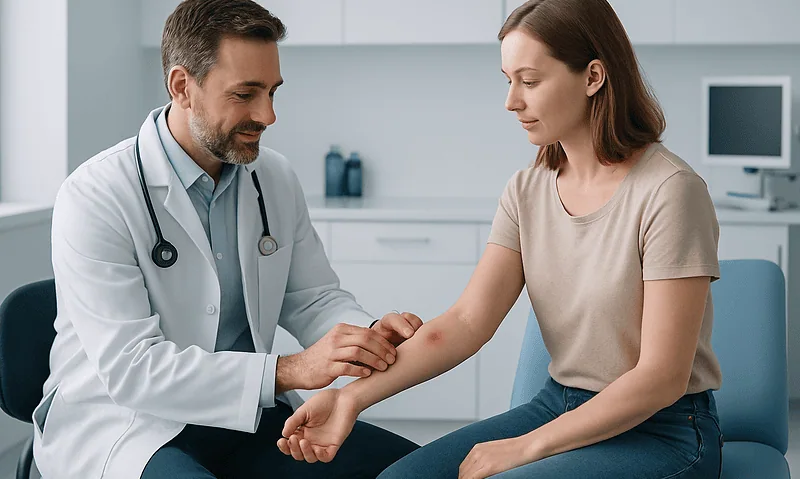
Tick Bites: Safe Removal and the Signs of Infection to Watch For
Tick bites are best handled by removing the tick as soon as you find it: grasp it close to the skin with fine-tipped tweezers,…

Salmonella Infection: When Doctors Order a Stool Test and How the Result Changes Treatment
Doctors usually order a salmonella stool test when diarrhea is severe, bloody, lasting more than a few days, accompanied by high fever, or occurring…

Walking Pneumonia: The Mycoplasma Infection Behind the Lingering Cough
Walking pneumonia is a mild form of pneumonia most often caused by the bacterium Mycoplasma pneumoniae. It typically brings a dry, hacking cough that…

Athlete’s Foot and Nail Fungus: Why They Return and What Actually Clears Them
Athlete's foot is a fungal skin infection of the feet that usually clears with an over-the-counter antifungal cream, spray or powder used for the…

Does Dengue Need Hospital Care? When Fluids and Monitoring Move From the Clinic to a Ward
Most people with dengue recover at home with rest, oral fluids and daily check-ins, because there is no specific antiviral and care is supportive.…

Long COVID Symptoms: The Patterns Doctors Now Recognize and the Tests That Help
Long COVID symptoms are health problems that persist or newly appear at least three months after a COVID-19 infection and last two months or…