

After Gum Recession Treatment: Normal Tenderness vs Bleeding or Swelling to Report

Key Takeaways
- Soreness after a gum graft usually peaks in the first two to three days and eases steadily, with soft tissue commonly healing over about one to two weeks according to the Cleveland Clinic.
- Ordinary post-surgical swelling builds for roughly 48 to 72 hours and then shrinks; swelling that keeps growing after day three, feels hot and tense, or spreads toward the eye or neck is a red flag.
- A whitish or greyish surface on the graft in the first week is common and reflects revascularization, whereas dark purple or black, dry, shrivelled tissue that lifts or slides suggests a failing graft.
- Oozing and pink-tinged saliva on the first day are expected, but bleeding that firm gauze pressure cannot control, or that restarts briskly after day two, should be reported the same day.
- The palate donor site is often sorer for longer than the graft itself, and its yellowish-white healing film is normal fibrin rather than pus.
- Receded gum does not regenerate on its own, and a graft repairs tissue without removing the brushing force, grinding or gum disease that caused the loss, so long-term stability depends on treating the cause.
After gum recession treatment, a dull ache, mild puffiness, slight oozing in the first day and a pale or whitish look to the graft are usually part of normal healing. Bleeding that soaks gauze after firm pressure, swelling that keeps growing after the third day, fever, pus, a foul taste, or a graft that lifts or slides are gum graft warning signs to report to your periodontist promptly.
It is the second evening after your gum graft, and you are standing at the bathroom mirror with a flashlight, trying to decide whether the pinkish-grey patch above your canine looks like healing or like trouble. The instruction sheet said “some discomfort is expected.” It did not say how much, for how long, or what to do about the metallic taste that appeared after dinner.
Almost everyone who has had a graft for receding gums has stood in that same spot. The trouble is that the early signs of a graft settling in and the early signs of a problem can look alike for a day or two. Knowing the gum graft warning signs, and knowing the ordinary aches that are not warning signs, spares you needless worry and, more importantly, gets you on the phone quickly when a call is genuinely needed.
This explainer walks through what the procedure does to the tissue, why it hurts the way it does, what the first fortnight usually looks like, and the specific changes your care team wants to hear about.
What actually happens during gum recession treatment
Gum recession is the gradual retreat of the gum margin away from the crown of the tooth, exposing root surface that was never meant to meet air, cold water or a toothbrush. Once gum tissue has receded it does not grow back on its own, which is why periodontists, dentists who specialize in the gums and supporting bone, may suggest a graft when recession is progressing, causing sensitivity, or leaving roots vulnerable to decay.
A gum graft moves living tissue to the exposed area so it can knit onto the root and the surrounding gum. The tissue comes from one of three places. In a connective tissue graft, the most common technique, a small flap is opened on the roof of the mouth and a layer of tissue from beneath it is removed, then sutured over the exposed root. A free gingival graft takes tissue directly from the surface of the palate, which is often chosen when the goal is to thicken thin gum rather than cover a root. Some people receive processed donor tissue or a collagen-based matrix instead, which avoids a second surgical site, according to the Cleveland Clinic overview of gum grafting.
Whichever source is used, the sequence is similar. The area is numbed, the root surface is cleaned and smoothed so nothing sits between it and the new tissue, the graft is positioned and stitched, and sometimes a protective dressing is placed. Over the next days, tiny blood vessels grow from the surrounding gum into the graft, a process the tissue depends on completely, because the graft has no blood supply of its own on day one.
That single fact explains most of what follows: why the graft looks pale at first, why pressure and movement are the enemies of early healing, and why bleeding and swelling deserve a closer look than plain soreness does.
Who a gum graft is usually for, and who is asked to wait
Grafting is rarely the first move. Your dentist will usually want to know why the gum receded before repairing it, because the cause shapes both the technique and the odds that the result lasts. Aggressive brushing, a thin natural gum type, tooth position, grinding, orthodontic movement and, most often, gum disease can all drive recession, as the NHS and the National Institute of Dental and Craniofacial Research describe.

People commonly offered a graft include those with recession that is measurably worsening between visits, roots that ache with cold or sweet foods despite desensitizing measures, exposed root surfaces developing decay, or thin gum around an implant or a tooth about to receive orthodontic treatment. Cosmetic concern about “long teeth” is a legitimate reason too, though it is weighed differently from a root at risk of decay.
Several groups are typically asked to wait, or to do preparatory work first. Active periodontitis, the infected and inflamed stage of gum disease, is treated and stabilized before grafting, since placing new tissue into an infected site invites failure. Smokers are often asked to stop or pause, because nicotine narrows the very small blood vessels that must grow into the graft. Diabetes that is not well controlled slows wound healing generally, and the treating team may coordinate with the physician managing it. People taking blood-thinning medicines are not excluded, but their surgeon and prescribing clinician will decide together whether any adjustment is appropriate; patients should never change these medicines on their own.
Someone still brushing with a hard-bristled brush and a heavy hand is usually coached on technique first. Repairing the gum without removing the force that eroded it is a repair with a countdown attached.
Normal tenderness after a gum graft: what "expected" really feels like
Expect soreness, and expect it to be worse than the numb, painless afternoon of surgery suggested. When the local anesthetic wears off, usually within a few hours, most people describe a steady ache at the graft site and, if tissue was taken from the palate, a raw, burning sensation on the roof of the mouth that flares with hot drinks and salty food.
This discomfort follows a recognizable arc. It is typically most noticeable through the first two to three days and then eases steadily, with most people feeling largely comfortable within one to two weeks, the general recovery window the Cleveland Clinic describes for gum grafting. Chewing on the treated side, talking a lot, or accidentally touching the site with the tongue can all cause sharp but brief spikes that settle within minutes.
Other sensations that alarm people but are ordinary: a tight, pulled feeling from the sutures; a whitish or greyish film over the graft in the first several days, which is surface tissue changing as new cells move in rather than a sign of death; mild aching in nearby teeth; a small amount of pink-tinged saliva on the first night; and a bruised feeling in the cheek or lip that was retracted during surgery.
What tenderness should not do is climb. Pain that is clearly worse on day four than on day two, pain that wakes you at night after having settled, or pain that spreads into the jaw or ear rather than staying local is a change in direction, and changes in direction are what your care team asks you to report. Steady, easing soreness is the body doing its work. Escalating pain is the body asking for a second look.
Gum graft warning signs: bleeding that should be reported
Some bleeding is built into the first day. The graft bed and the palate donor site are both fresh wounds in a warm, wet environment, and saliva makes even a small amount of blood look dramatic. A little oozing for several hours, saliva that stays faintly pink overnight, and a small spot on the pillowcase are all within the expected range.
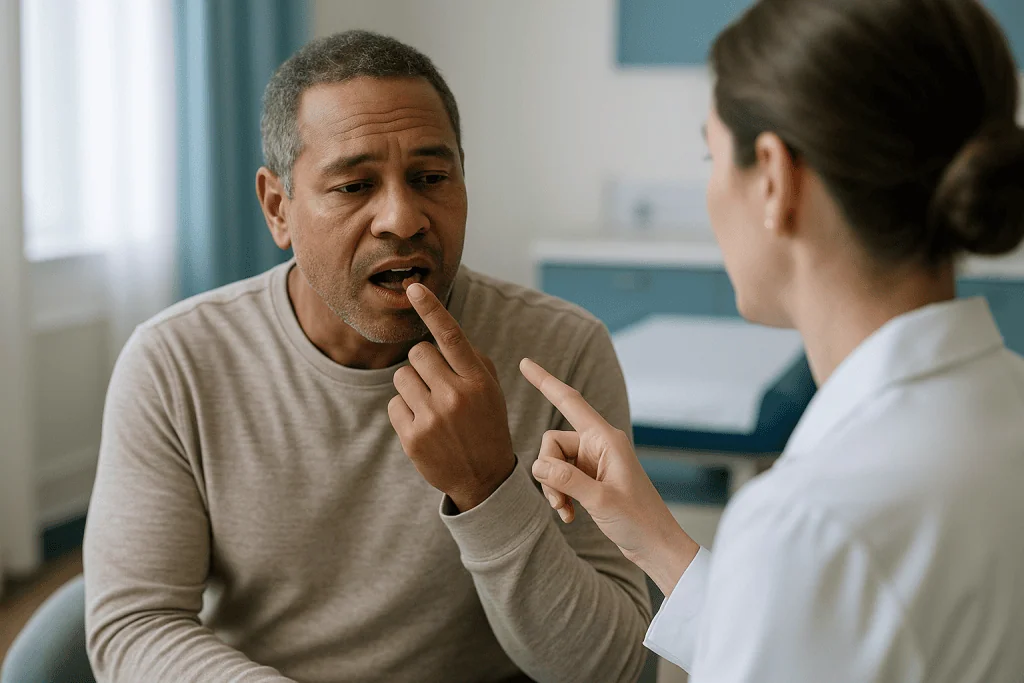
Bleeding becomes a gum graft warning sign when it behaves differently from a normal oozing wound. Your team will want to hear from you if:
- bright red blood keeps flowing after you have applied firm, steady pressure with clean gauze or a damp tea bag for the length of time your surgeon advised
- bleeding stops and then restarts briskly on the second or third day, particularly after you have been resting
- you are spitting or swallowing mouthfuls of blood rather than noticing tinges in saliva
- a large, dark, jelly-like clot keeps forming and falling away from the palate
- bleeding is accompanied by dizziness, lightheadedness or a racing heart
Certain factors raise the likelihood of troublesome bleeding: blood-thinning medicines, aspirin-type anti-inflammatory pain relievers taken without the surgeon’s knowledge, alcohol, vigorous rinsing, drinking through a straw, and heavy exercise that raises blood pressure in the head. If you are on an anticoagulant, the pre-surgery plan you agreed with your prescribing clinician stands; the point is simply that your surgeon knows about it and can advise faster if bleeding occurs.
One practical distinction helps: oozing that a gauze pad controls within the advised time is a wound. Bleeding that overwhelms the gauze is a phone call, during office hours or after them.
Swelling after gum graft: normal puffiness vs concerning swelling
Swelling is the body flooding an injured area with fluid, immune cells and repair materials. After a graft it is expected, and its timing is more telling than its size. Ordinary post-surgical swelling builds over the first 48 to 72 hours, plateaus, and then recedes over the following week, a pattern the Cleveland Clinic and other mainstream sources describe for oral surgery generally. A puffy cheek or lip on the treated side, a feeling of fullness in the palate, and mild bruising that turns yellow-green as it fades are all in this category.
Swelling after gum graft becomes concerning when it breaks that pattern. Swelling that is still increasing on day four or five, rather than shrinking, suggests either bleeding into the tissues or infection. Swelling that is hot, shiny, tense and tender in a focused spot, especially with a bad taste or visible pus at the gum line, points toward infection. Swelling that spreads toward the eye, under the jaw or into the neck, or that makes swallowing or breathing feel difficult, is an emergency regardless of the hour.
Fever accompanying swelling changes the picture too. A slightly raised temperature on the first evening can occur after surgery, but a fever appearing on day three or later, or one that climbs, is not part of graft healing and should be reported the same day.
Cold compresses applied to the outside of the face in the first day or two, sleeping with the head raised on an extra pillow, and avoiding strenuous activity all help ordinary swelling run its course. None of these measures will control swelling driven by infection, which is why swelling that ignores them deserves a call rather than more ice.
Normal healing or a problem? A side-by-side guide
The table below gathers the distinctions from the previous sections into one place. It is a guide for deciding when to pick up the phone, not a tool for diagnosing yourself; only the team that placed the graft can examine the site and judge what it needs.
| What you notice | Usually part of healing | Report to your care team |
|---|---|---|
| Pain | Steady ache, worst in first 2–3 days, then easing | Pain rising after day 3, waking you at night, or spreading to jaw or ear |
| Bleeding | Oozing or pink saliva on day one, controlled by gauze pressure | Bright flow not stopped by pressure, or brisk bleeding restarting after day 2 |
| Swelling | Builds for 48–72 hours, then shrinks; mild bruising | Still growing after day 3; hot, tense, spreading; trouble swallowing or breathing |
| Graft color | Pale, whitish or greyish surface film in first week | Dark purple, black, or tissue that looks dry and shrivelled |
| Graft position | Slight edge visible under sutures; feels tight | Graft lifting, sliding, folded or clearly detached; root fully exposed again |
| Taste and smell | Faint metallic taste on day one | Persistent foul taste or odor, visible pus, or salty discharge |
| Temperature | Mildly warm on the first evening | Fever from day 3 onward, or any fever that keeps climbing |
| Sutures | Loosening as tissue heals; dissolving types fray | Several sutures lost early with the graft moving, or a suture cutting into tissue |
Two habits make this table more useful. First, take a quick, well-lit photo of the site each morning; a sequence shows direction of change far better than memory. Second, when you call, describe the trend rather than the snapshot: “the swelling was smaller yesterday and larger today” tells a clinician more than “it’s swollen.”
Gum graft healing stages: what the days and weeks usually look like
Healing follows a broadly predictable sequence, though the exact pace varies with the technique used, the size of the area treated, your general health, and whether you smoke. The ranges below are typical, drawn from the Cleveland Clinic’s description of gum graft recovery, and your surgeon’s own timeline should take precedence.
Day 1. Numbness fades into aching. Slight oozing is common. The graft looks pink to pale. You are asked to leave the area completely alone: no brushing it, no prodding, no pulling the lip to look.
Days 2 to 3. This is usually the low point for comfort. Swelling peaks, the palate donor site feels raw, and the graft may take on a whitish or greyish surface as the outer layer of cells changes. Soft, cool, bland foods are easiest.
Days 4 to 7. Pain and swelling should be clearly receding. New blood vessels are growing into the graft, and the surface begins to look pinker again from the edges inward. Sutures may start to loosen. Escalating pain or swelling in this window is the most common reason for an early review appointment.
Week 2. Many people feel largely back to normal by now. The Cleveland Clinic notes that soft tissue typically heals over about one to two weeks, and a follow-up visit around this time often includes suture removal if non-dissolving stitches were used. The graft still bonds only weakly to the root, so gentle care continues.
Weeks 3 to 6 and beyond. The graft matures, thickens and gradually matches the color of neighboring gum. Full maturation, and any final judgment about how much root has been covered, takes months rather than weeks, so a slightly bulky or uneven appearance early on is not the final result.
The palate donor site: what is normal on the roof of the mouth
People are often surprised that the roof of the mouth, not the graft itself, is the site they complain about most. If your surgeon used your own tissue, the palate has been cut, some tissue removed and the wound either sutured closed, covered with a dressing, or, in a free gingival graft, left to heal as an open surface.
Normal experiences at the donor site include a burning or raw feeling, especially with hot, spicy, acidic or salty food; a sensation that food is catching there; slight bleeding when the area is bumped by the tongue or a piece of toast; and, if a protective stent or dressing was placed, a plasticky taste and the odd feeling of a foreign object. Open donor sites take on a yellowish-white appearance as they heal, which looks worrying but reflects the normal fibrin layer that forms over any open wound in the mouth. This surface layer is not pus; pus is creamy, comes with a foul taste and is usually accompanied by increasing pain and swelling.
Donor sites usually feel sore for longer than the graft site, sometimes for two to three weeks in the case of an open free gingival graft wound, though comfort improves steadily through that period. Sharp or rough edges from a loosened dressing can be reported so the team can smooth or replace it.
Donor-site signs worth a call are the same as elsewhere: bleeding that firm pressure cannot control, pain that climbs after day three, a swelling that is hot and tense, or a bad taste that does not clear with the gentle rinsing your team allowed. A dressing that falls off entirely in the first few days is not an emergency, but your surgeon will want to know, because an exposed donor wound is more likely to bleed and to sting.
Signs of gum graft failure: what the tissue looks like when it is not taking
The phrase “signs of gum graft failure” is one of the most searched after this procedure, and it deserves a careful answer. A graft fails when it does not establish a blood supply from the surrounding tissue, so it never becomes living, attached gum. This is uncommon but does happen, and it is more likely when the graft has been disturbed, when the site was infected, when someone smokes, or when the underlying gum was very thin to begin with.
Healthy early grafts often look pale or whitish, so color alone in the first week is a poor guide. What clinicians look for is a combination of features developing together over several days:
- the graft turning dark purple, deep red-black or frankly black rather than pale
- tissue that looks dry, shrunken, leathery or shrivelled instead of moist and plump
- the graft lifting, folding or sliding so that its edges no longer sit against the surrounding gum
- a foul odor or taste from the site, with or without visible pus
- the exposed root becoming fully visible again beneath or beside the graft
- a graft that comes away entirely, which people occasionally find on the pillow or in the sink
None of these should be interpreted at home. Some grafts that look alarming in the first week partially survive and are trimmed and allowed to heal; others that appear fine early on shrink over the following weeks. Only an examination, and sometimes a second review a week later, can tell the difference. What you can do is report the changes above the same day you notice them, because an infected failing graft benefits from prompt cleaning, and a graft that has partly lifted may sometimes be re-secured if seen early.
If a graft does fail, it is usually possible to plan a second procedure once the tissue has healed. That decision, its timing and the technique used sit with your periodontist.
How to protect the graft in the first two weeks
Most gum graft warning signs are things you watch for. Protecting the graft is the part you control, and it matters because the tissue is held in place by sutures and a delicate fibrin clot until blood vessels take over. Anything that shears the graft sideways in the first week can undo careful surgery.
Leave the site alone. The Cleveland Clinic advises against brushing or flossing the grafted area until your periodontist says it is safe, which is usually after the first follow-up. Brush the rest of your mouth gently. Resist pulling your lip down to inspect the graft; the stretch itself can tug the tissue.
Eat soft, cool or lukewarm foods that require little chewing, and chew on the other side. Yogurt, scrambled eggs, smoothies eaten with a spoon, soft pasta and mashed vegetables are typical choices. Avoid crunchy, crumbly, sticky, very hot, spicy and acidic foods until cleared, and avoid drinking through straws, since suction disturbs clots.
Rinse only as instructed. Many surgeons prescribe an antiseptic mouth rinse, commonly chlorhexidine, to keep bacteria down while brushing is off limits. Use it exactly as your team directed, usually by holding it gently over the area rather than swishing hard.
Rest for the first couple of days and skip strenuous exercise, heavy lifting and bending, all of which raise blood pressure in the head and can restart bleeding. Sleep with your head slightly elevated.
Do not smoke or vape. Nicotine constricts the small vessels that must grow into the graft, and the act of drawing on a cigarette applies suction to the site. If stopping feels impossible, tell your team honestly so they can factor it into follow-up.
Keep every scheduled review, including ones that seem unnecessary because you feel fine. Early problems are often visible to a clinician before they are felt.
Medicines after a gum graft: what they do and why timing matters
Your surgeon may send you home with instructions covering pain relief, an antiseptic rinse and, in some situations, an antibiotic. Understanding what each is for helps you recognize when something is not working as expected. All decisions about which medicine, how much and for how long belong to the prescribing clinician; nothing here is a suggestion to start, stop or alter anything.
Pain relievers. Two classes are commonly used. Acetaminophen (paracetamol) works mainly in the central nervous system and does not affect bleeding. Non-steroidal anti-inflammatory drugs, such as ibuprofen, reduce the inflammatory chemicals that drive both pain and swelling, but some agents in this family also reduce platelet stickiness, which is why surgeons give specific guidance about them and why aspirin-type products are often avoided unless already prescribed for a medical reason. Some teams advise taking the first dose before the anesthetic fully wears off, because pain that is prevented is easier to manage than pain chased after it arrives. Pain that is poorly controlled despite following your instructions is itself worth reporting.
Antiseptic rinse. Chlorhexidine reduces bacterial load on a surface you cannot brush. It commonly causes temporary tooth staining and altered taste, both of which resolve after the course ends.
Antibiotics. Not everyone receives them; many surgeons reserve them for larger procedures, medically complex patients or established infection. If prescribed, finishing the course as directed matters, and any rash, hives, swelling of the lips or face, or difficulty breathing after a dose is an emergency.
Regular medicines. Blood thinners, diabetes medicines and steroids all interact with healing. The plan agreed before surgery should be followed, and any confusion resolved by a call to the team rather than a guess at home.
What people often get wrong about recovery from gum recession surgery
Several beliefs circulate widely enough that they deserve direct correction.
“A white graft means it has died.” A whitish or greyish surface in the first week is common and usually reflects the outer cell layer changing as the graft is revascularized. Death of a graft shows as dark, dry, shrivelled tissue, often with odor, developing over days. Color alone in week one is not a verdict.
“No pain means I can go back to normal.” Comfort returns before strength. The Cleveland Clinic describes soft tissue healing over roughly one to two weeks, but the bond between graft and root remains fragile beyond the point where soreness fades. Brushing the site or biting into an apple in week two because it no longer hurts is a common cause of trouble.
“Rinsing hard keeps it clean.” Vigorous swishing dislodges clots and can shift the graft. Gentle rinsing, only as instructed, is protective; forceful rinsing is not.
“Bleeding always means failure.” Most bleeding is ordinary oozing that stops with pressure. The concern is bleeding that pressure cannot control or that restarts briskly after day two.
“Swelling equals infection.” Swelling that peaks around day two or three and then shrinks is the normal inflammatory response. Infection is suggested when swelling keeps growing later, feels hot and tense, and travels with pain, fever or a foul taste.
“The gum will grow back on its own, so grafting is optional cosmetics.” Receded gum does not regenerate. Grafting is sometimes cosmetic, but often it protects root surfaces from decay and sensitivity, as the NHS and NIDCR describe in the context of gum disease.
“Once grafted, the problem is solved for good.” A graft repairs tissue; it does not remove the brushing habit, grinding or gum disease that caused the loss. Long-term stability depends on addressing those.
Questions to ask your care team before you leave the office
The best time to learn what your surgeon considers normal is before the anesthetic wears off, when you can still concentrate. Recovery instructions vary between techniques and between clinicians, so the answers you receive should override any general guide, including this one. Consider asking:
- Which technique did you use, and did you take tissue from my palate? This tells you whether to expect a second sore site.
- How much bleeding is normal tonight, and how long should I hold pressure before I call?
- What will the graft look like over the first week, and what change in appearance would you want to hear about?
- On which day should swelling be at its worst, and when should I expect it to start shrinking?
- Which pain relievers do you want me to use, which should I avoid because of bleeding, and how do they fit with my regular medicines?
- Have you prescribed a rinse or an antibiotic, and exactly how do you want me to use them?
- When can I brush near the site, when can I floss it, and when can I chew normally on that side?
- Do I have dissolving or non-dissolving sutures, and what should I do if one comes out early?
- Was a dressing or stent placed, and what should I do if it falls off?
- When is my follow-up, and how do I reach someone after hours if something on your warning list appears?
- What underlying cause of my recession do you want me to change, and how will we check that the graft is stable over time?
Writing the answers down, or asking whether they can be added to your printed instructions, is worth the extra two minutes. Half of post-operative anxiety comes from not remembering what was said.
When to call your doctor: red-flag signs after a gum graft
Ordinary healing after a gum graft is uncomfortable but predictable: soreness that eases, swelling that peaks and recedes, and a pale graft that slowly pinks up. The signs below fall outside that pattern and should be reported to your periodontist or dentist the same day, using the after-hours number if the office is closed.
- Bleeding that continues despite firm, steady pressure for the time your surgeon advised, or bleeding that restarts briskly on the second day or later
- Swelling that is still increasing after the third day, or swelling that is hot, tense, shiny or spreading toward the eye, under the jaw or into the neck
- Fever appearing from about day three onward, or any fever that keeps rising
- Pain that escalates after day three, wakes you at night after having settled, or spreads to the jaw or ear
- A persistent foul taste or odor, visible pus, or salty discharge from the graft or donor site
- The graft turning dark purple or black, looking dry and shrivelled, lifting, folding, sliding or coming away entirely
- Several sutures lost early with the graft moving, or a dressing exposing an open donor wound that bleeds
- Rash, hives, or swelling of the lips or face after any prescribed medicine
- Numbness or tingling in the lip, chin or palate that has not begun to fade by the day after surgery
Seek emergency care immediately, rather than waiting for a callback, if you have difficulty breathing or swallowing, rapidly spreading facial or neck swelling, bleeding you cannot slow at all, or fainting or lightheadedness with bleeding.
When something worries you but is not on this list, call anyway. Clinicians would far rather reassure you over the phone than see a small problem on day ten that could have been handled on day four. The judgment about what your graft needs, and whether any medicine should change, always rests with the team that placed it.
Frequently asked questions
How long does normal tenderness last after a gum graft?
Soreness is usually most noticeable for the first two to three days and then eases steadily, with most people feeling largely comfortable within one to two weeks, the typical soft-tissue recovery window described by the Cleveland Clinic. The palate donor site can stay tender a little longer. Pain that climbs after day three, or returns after settling, is a change your care team wants to hear about.
What is the typical gum graft recovery time before I can eat normally?
Most surgeons ask for soft, cool foods and chewing on the opposite side for at least the first one to two weeks, matching the healing window the Cleveland Clinic describes. Crunchy, sticky, hot and spicy foods are usually reintroduced gradually after the first follow-up, when the team has checked that the graft is attached. Your surgeon’s specific timeline, based on the technique used, takes precedence.
Is it normal for a gum graft to look white or grey?
Yes, a pale, whitish or greyish surface during the first week is common and usually reflects the outer layer of cells changing while new blood vessels grow into the graft. A graft that is not taking tends to look dark purple or black, dry and shrivelled, and may lift or produce a foul odor. Only an examination can distinguish the two, so report worrying changes rather than judging color alone.
How much swelling after gum graft surgery is too much?
Swelling that builds over the first 48 to 72 hours and then shrinks is expected. It becomes concerning when it is still increasing on day four or five, feels hot, tense and shiny, or spreads toward the eye, under the jaw or into the neck. Swelling that makes swallowing or breathing difficult is an emergency and should be treated as such regardless of the time of day.
What are the early signs of gum graft failure?
Clinicians look for several features developing together over days: the graft turning dark or black, tissue that looks dry and shrunken, edges lifting or the graft sliding out of position, a persistent foul taste or pus, and the root becoming fully visible again. Any of these should be reported the same day. A pale graft in the first week, by itself, is not a sign of failure.
Why does the roof of my mouth hurt more than the graft?
If your own tissue was used, a piece was removed from the palate, leaving a wound that is often left partly open or covered with a dressing. Open wounds in the mouth sting with hot, salty, spicy or acidic food and are bumped by the tongue constantly. This soreness is expected and eases over one to three weeks. Bleeding that pressure cannot control or rising pain there should still be reported.
Can I brush my teeth after a gum graft?
You can gently brush the rest of your mouth, but the Cleveland Clinic advises against brushing or flossing the grafted area until your periodontist says it is safe, usually after the first follow-up. Many surgeons prescribe an antiseptic rinse, commonly chlorhexidine, to control bacteria in the meantime. Brushing the site too early is one of the most common ways a healing graft is disturbed.
What does a bad taste in my mouth mean after gum recession treatment?
A faint metallic taste on the first day is usually from small amounts of blood and is not concerning. Antiseptic rinses can also alter taste temporarily. A persistent foul or salty taste from day three onward, particularly with increasing pain, swelling or visible pus, can indicate infection at the graft or donor site and should be reported to your care team the same day.
Do lost stitches mean the graft has failed?
Not necessarily. Dissolving sutures fray and loosen as the tissue heals, and losing one or two after the first several days is common. The concern is several sutures lost early while the graft visibly moves, lifts or folds, or a suture cutting into tissue. In those cases, call your surgeon, because a partly lifted graft can sometimes be re-secured if it is seen promptly.
What are the gum graft healing stages after the first two weeks?
Once soft tissue has closed over one to two weeks, the graft continues to mature for weeks to months, thickening and gradually matching the color of neighboring gum. The early result can look bulky or uneven, and the final amount of root coverage is judged only after several months. Your periodontist will also want the original cause of recession addressed so the repair remains stable.
References
- NHS: Gum disease
- NIH National Institute of Dental and Craniofacial Research: Periodontal (Gum) Disease
- MedlinePlus: Gum Disease
This article is for general information only and is not a substitute for professional medical advice. Please consult a qualified doctor about your individual situation.

More from the Blog
Questions to Ask Before Teeth Veneers: Enamel Removal, Repairs and Future Replacement
Before veneers, ask how much enamel will be removed (a thin layer, often around half a millimeter, that never grows back), whether porcelain or…
How Long Does Wisdom Teeth Removal Take? In the Chair and in Recovery
Wisdom teeth removal usually takes 20 to 60 minutes of actual surgery. A single, fully erupted tooth can come out in a few minutes,…
Does Everyone Have Wisdom Teeth? The Evolution Happening in Your Jaw
No. While most adults develop four wisdom teeth, research suggests that between 5% and 37% of people, depending on ancestry, never form one or…

Preparing for Restorative Dental Treatment: Medications, Diabetes and Past Anesthesia
Preparing for restorative dental treatment such as fillings, crowns, root canal work or implants mostly means sharing information: a complete list of your medicines…

What You Can and Cannot Eat with Braces: Safe Foods, Risky Foods and Practical Swaps
With braces, avoid foods that are hard, sticky, chewy or need biting into: whole apples, corn on the cob, popcorn, nuts, hard candy, caramel,…
How Bleeding Gums Are Treated at the Dentist: From Gum Measurements to Deep Cleaning
Dentists treat bleeding gums by first measuring the space between gum and tooth with a thin probe, then removing the plaque and hardened tartar…