

Amputee Rehabilitation Stages: Wound Healing, Limb Shaping, Prosthetic Fitting and Walking
Key Takeaways
- Rehabilitation follows the body's repair sequence: the wound must close before compression starts, and the limb must stop changing shape before a definitive socket can be made.
- MedlinePlus patient guidance describes a surgical wound closing over roughly 4–8 weeks for many people, with slower healing when circulation is poor, as in diabetes or vascular disease.
- Keeping the knee straight and the hip extended for set periods in the first weeks prevents contractures, which can otherwise make a prosthesis very hard to use later.
- Phantom limb pain originates in the spinal cord and brain, according to Mayo Clinic, and is a neurological rather than psychological phenomenon.
- The NHS describes adapting to a prosthetic limb as taking several months, and the residual limb keeps shrinking for a year or more, so socket adjustment is expected rather than a sign of failure.
- Wheelchair-based independence is a complete rehabilitation pathway, and the choice between prosthesis and wheelchair rests on fitness, level of amputation, wound healing and personal goals rather than age alone.
Amputee rehabilitation usually moves through overlapping stages: wound healing in the first weeks, shaping the residual limb with compression, a prosthetic fitting once the limb is stable, gait or functional training, and long-term follow-up. Patient information from MedlinePlus and the NHS describes healing over several weeks, with a first prosthesis often fitted weeks to a few months after surgery. Timelines vary widely, and the treating team sets each step.
The morning after a below-knee amputation, a retired postal worker asked the physical therapist a question she hears almost every week: “So when do I get the leg?” He meant a prosthesis. He also meant, without saying it, when will I be myself again. The honest answer runs through several amputee rehabilitation stages, and the first of them has nothing to do with artificial limbs at all.
Rehabilitation after amputation is less a straight road than a set of gates. The wound has to close before the limb can be compressed. The limb has to stop changing shape before a socket can be made. The socket has to fit before anyone practises walking on a ramp. Skip a gate and the one behind it tends to swing shut.
This explainer walks through each gate in turn: what is happening in the tissue, what the team is watching for, roughly how long each phase tends to take according to mainstream patient guidance, and where the common misunderstandings sit. Every timeline is a range, not a promise, and every decision belongs to the treating team.
What actually happens across the amputee rehabilitation stages
Rehabilitation after an amputation is not a single program with a start date and a finish line. It is a chain of stages that overlap, and the amputee rehabilitation stages most teams describe follow the body’s own repair sequence: first the wound has to close, then the residual limb (the part of the limb that remains after surgery) has to settle into a stable shape, and only then can a prosthesis (an artificial limb) be built to fit it. Walking, or using an artificial arm, comes after that. Staying well comes after everything.
Two facts explain why the order cannot be rushed. Swelling in the residual limb changes its size and shape from day to day in the early weeks, so a socket made for a swollen limb will not fit a shrunken one. And a fresh surgical wound placed under pressure from a rigid socket can open or break down, which sends the whole process backward. The early weeks are therefore spent on work that looks unglamorous: healing, compressing, stretching, and strengthening the rest of the body.
The team is deliberately broad. Surgeons and nurses manage the wound. Physical therapists handle strength, balance and later gait (the pattern of walking). Occupational therapists focus on daily tasks, from dressing to cooking, and lead most upper-limb training. A prosthetist (the specialist who designs, makes and fits artificial limbs) joins early, sometimes before surgery, and stays for years. Pain specialists, psychologists and social workers round it out, because NHS and MedlinePlus guidance both note that mood, motivation and home support shape recovery as much as muscle does.
Each stage below has a purpose, a typical range, and a reason the team may hold you in it a little longer.
What are the 5 stages of rehabilitation after an amputation?
Ask three rehabilitation services how many stages there are and you may get three numbers. Some academic frameworks list nine phases, beginning before surgery and ending with lifelong follow-up. Most patient-facing teams compress these into five, which is the version people usually mean when they search for it. The count matters less than the logic: each stage has a job that must be mostly done before the next one works.
| Stage | Main job | Who leads | Typical focus period (per MedlinePlus and NHS patient guidance) |
|---|---|---|---|
| 1. Pre-operative and acute post-operative | Prepare, control pain, protect the wound, prevent clots and stiffness | Surgeon, nurses, physical therapist | Days before and the first days after surgery |
| 2. Wound healing and limb shaping | Close the wound, reduce swelling, build strength and balance | Nurses, physical therapist, prosthetist | Roughly the first several weeks |
| 3. Prosthetic fitting | Cast or scan the limb, build and adjust a socket | Prosthetist, physical therapist | Weeks to a few months after surgery, once the limb is stable |
| 4. Prosthetic training | Learn to stand, walk or use the device in daily life | Physical or occupational therapist | Weeks to months |
| 5. Community reintegration and follow-up | Return to home, work and activity; monitor skin, fit and health | Whole team | Ongoing, lifelong |
Notice that the middle three stages are where most of the visible action happens, yet the first and last stages carry the most risk of being neglected. Preparation before surgery is where a person learns transfers, practises using a walker with one leg, and meets the prosthetist, so the shock of the first post-operative morning is smaller. Long-term follow-up is where a socket that has quietly become loose is caught before it causes a pressure sore.
Keep the table in mind as a map rather than a schedule. A person with a traumatic amputation and good circulation may move through the middle stages quickly. A person with diabetes and vascular disease may spend far longer in stage two, and that slower pace is not a failure.
How long does the stump take to heal after amputation?
The word “stump” is still common in everyday speech; clinicians generally say residual limb, and this article uses both so nobody is left guessing. Whatever the name, the healing question has two answers, because a wound can be closed on the surface long before the tissue underneath has finished remodelling.
Surface healing comes first. Patient guidance from MedlinePlus describes a surgical wound that, for many people, closes over roughly 4–8 weeks, with stitches or staples usually removed a few weeks after surgery. The NHS notes that healing is slower when the blood supply is poor, which is exactly the situation for the largest group of people having amputations: those with diabetes, peripheral arterial disease or both. In that group, a wound that takes longer is expected rather than alarming, provided it is moving in the right direction and shows no signs of infection.
Deep healing is a longer story. Muscle that was divided and stitched over the bone end has to form scar, bone has to smooth its cut edge, and the skin has to toughen enough to tolerate a socket. This process continues for months. It is one reason a first prosthesis is often described as temporary or preparatory, and why the definitive socket comes later.
Several factors nudge the timeline in either direction. Good blood sugar control, not smoking, adequate protein intake and keeping the limb elevated when resting all favour closure. Infection, ongoing pressure on the wound, uncontrolled swelling and poor circulation all delay it. The team checks the wound at each visit, and nobody is asked to bear weight in a socket until they judge the skin can take it.
The practical point: a residual limb that looks healed at week four may still be biologically young. Treat it gently, and expect it to keep changing.
Why the first week is about pain, positioning and preventing complications
Nobody spends the first post-operative week thinking about ramps and stairs, and rightly so. The early priorities are quieter and, in many ways, more consequential.

Pain control comes first. Surgical pain, pain at the wound edge and, for many people, early phantom sensation all overlap. The team typically uses several approaches together: regional nerve blocks placed during surgery, medicines from different classes, positioning, ice and later gentle handling of the limb. Which medicines, at what dose and for how long is entirely the prescribing team’s decision; the mechanism is simply to keep pain low enough that a person can breathe deeply, move and sleep, because all three protect healing.
Positioning is the second priority and the one most often underestimated. A residual limb left resting over a pillow or hanging over the edge of a chair for days can develop a contracture (a permanent tightening of muscle and joint that limits movement). A tight hip or knee makes a prosthesis far harder to use later, sometimes impossibly so. Therapists therefore teach people to keep the knee straight and the hip extended for set periods each day, even when it is uncomfortable.
Preventing complications fills the rest of the week. Deep breathing and early sitting up reduce the risk of chest infection. Moving the intact limb, and getting out of bed with help, lowers the risk of blood clots. Skin over the heel and sacrum is checked because a person newly immobile is at risk of pressure injury. MedlinePlus discharge guidance for leg amputation stresses this early mobility for exactly these reasons.
Emotionally, the first week is often a fog of relief, grief and disbelief. Teams increasingly introduce psychological support here rather than waiting for a crisis, and peer visitors who live well with limb loss can make the future feel real.
Limb shaping: why the residual limb is compressed and how it changes
A freshly amputated limb swells. Fluid collects in the tissue, the shape is often bulbous at the end, and the volume can shift noticeably within a single day. Limb shaping is the deliberate process of controlling that swelling so the residual limb becomes firm, gently tapered and consistent enough for a socket to be made.
The main tool is compression. Early on this may be a soft or rigid dressing applied in theatre. Once the wound allows, most people move to a shrinker (an elastic sock shaped for the residual limb) or to elastic bandaging in a figure-of-eight pattern. NHS recovery guidance describes compression garments being used to reduce swelling and shape the limb once the wound has healed enough. The shrinker is worn most of the day and often at night, removed for washing and skin checks, and replaced with a smaller size as the limb reduces.
Why so much effort? Because a socket is only as good as its fit. A limb that is still shrinking will loosen inside any socket made for it, causing rubbing, blisters and unstable walking. Prosthetists typically wait until the limb’s volume has become reasonably stable over several weeks before casting for a definitive socket, and even then they expect further shrinkage during the first year.
Shaping is paired with two other jobs. Desensitization (gradually teaching the skin to tolerate touch, pressure and texture) starts with light stroking and progresses to firmer massage and tapping, so the limb is not exquisitely tender when the socket arrives. Strengthening continues at the same time: hip and trunk muscles for a leg amputation, shoulder and core muscles for an arm.
People often describe this stage as the most tedious. It is also the one that most determines how comfortable the first prosthesis will feel.
Phantom limb pain and phantom sensation: what the evidence actually shows
Two terms are easy to confuse. Phantom sensation is the feeling that the missing limb is still present: an itch on a foot that is no longer there, or a sense that the toes are curled. Phantom limb pain is pain that seems to come from the missing part. Mayo Clinic and the NHS both describe these experiences as common after amputation, and neither is imagined.
The mechanism is neurological rather than psychological. Nerves that once carried signals from the limb still enter the spinal cord and brain, and the brain’s map of the body does not update overnight. Mayo Clinic notes that phantom pain was once thought to be a psychological problem but is now understood to originate in the spinal cord and brain, where areas that used to receive input from the limb reorganize and can generate pain. Residual limb pain, by contrast, is felt in the remaining tissue and often has a local cause such as a neuroma (a tangle of regrowing nerve endings), a poorly fitting socket or a bony spur.
What does the evidence support for treatment? Medicine classes used include certain antidepressants and anticonvulsants that act on nerve signalling; these are prescribed and adjusted only by the treating clinician, and response varies. Non-drug approaches include mirror therapy (watching the reflection of the intact limb moving, to give the brain matching visual input), graded motor imagery, transcutaneous electrical nerve stimulation and desensitization. Trials of mirror therapy are small and results are mixed; some people report meaningful relief, others little. Good compression and a well-fitting prosthesis are associated with fewer symptoms for many people, though causation is hard to prove.
For most people, phantom pain is most intense in the early months and tends to become less frequent with time, but a minority live with persistent symptoms. Telling the team early, and describing the pain precisely, is the single most useful thing a person can do.
Who gets an early prosthetic fitting, and who is usually asked to wait
A prosthesis is a tool, and like any tool it suits some tasks and some users better than others. The rehabilitation team weighs a long list of factors before deciding when, or whether, to fit one, and the honest position is that the decision belongs to that team in conversation with the person concerned.
Several things favour early fitting. A below-knee amputation preserves the knee, which makes walking with a prosthesis much less demanding than an above-knee amputation, where the person must control an artificial knee as well. Good heart and lung fitness matters because walking with a prosthesis uses measurably more energy than walking on two intact legs, and more again at higher levels of amputation. A wound that has healed cleanly, skin that tolerates compression, a residual limb free of contracture, and a person who can follow multi-step instructions all tip the balance toward earlier progress.
Other factors prompt the team to wait, or to plan a different path. Slow wound healing, especially with diabetes or vascular disease, is the commonest reason to delay. Severe joint stiffness, significant heart failure, advanced lung disease, poor balance from stroke or neuropathy, and impaired memory that makes safe donning and skin checks unreliable are all weighed. The state of the other leg counts too: many people with vascular amputations have disease on both sides.
Waiting is not the same as being excluded. Some people are fitted later after further healing and conditioning. Some use a prosthesis for transfers and short distances while relying on a wheelchair for longer ones. Some decide, with their team, that a wheelchair-based life gives them more independence than a prosthesis they can only wear briefly. Each of these is a legitimate rehabilitation outcome, and the NHS explicitly frames wheelchair use as a valid option rather than a consolation prize.
Prosthetic fitting after amputation: how the socket is built and adjusted
The part of a prosthesis people notice is the foot or the hand. The part that determines comfort is the socket: the custom shell the residual limb sits inside. Almost everything the prosthetist does is aimed at getting the socket right.
Fitting begins with a record of the limb’s shape, either a plaster cast or a digital scan, taken once swelling has settled enough to trust. From that shape a check socket is made: a clear plastic test version that lets the prosthetist see exactly where skin is pressing too hard or too little. Adjustments are made, sometimes several rounds, before a definitive socket is built in laminated or carbon material. Between the skin and the socket sits a liner (a soft sleeve of gel or foam that cushions and grips), and the whole assembly is held on by a suspension system such as a locking pin, suction or an outer sleeve. Below the socket, a pylon (a rigid tube) connects to the foot or knee unit.
Two realities surprise people. First, the initial prosthesis is usually described as preparatory, because the limb will keep shrinking. Prosthetists expect to add socks of varying thickness to fill the gap, then to replace the socket once volume stabilizes, which the NHS notes may take many months. Second, fitting is never finished. Body weight changes, activity changes and normal aging all alter fit over the years, and a socket that has loosened is a leading cause of skin breakdown.
The prosthetist will also decide component choices with the person: a stiffer or more flexible foot, a knee unit with more or less built-in control, a body-powered or externally powered hand. None of these choices is best in general; each is a trade-off between weight, stability, effort and the tasks that matter most to the individual.
Learning to walk with a prosthetic leg, and how long it takes to walk normally
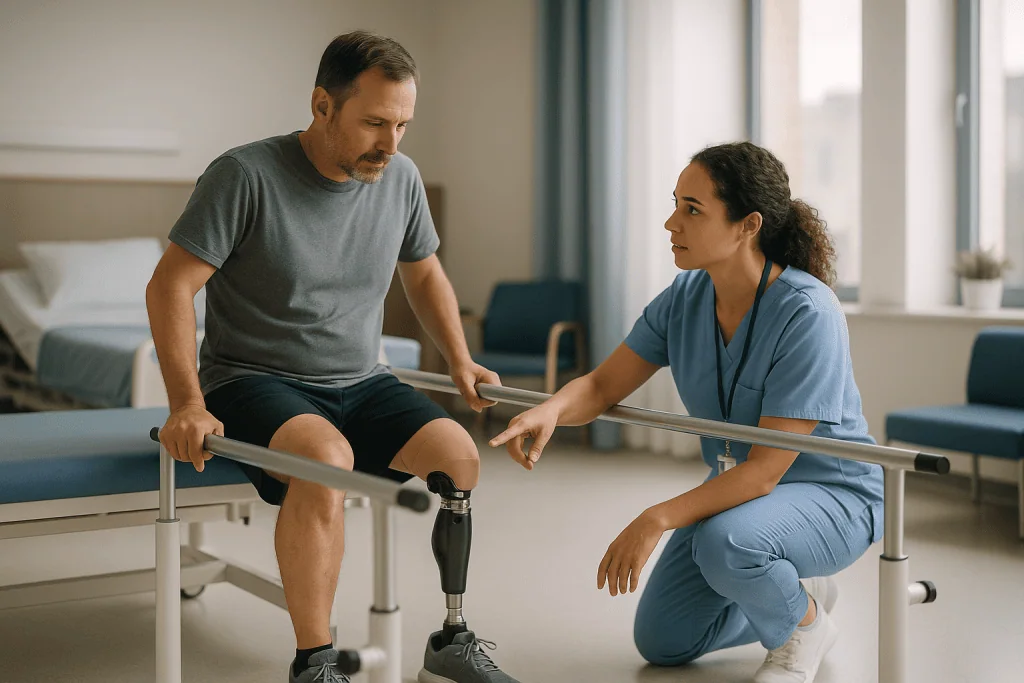
The first steps with a prosthesis almost always happen between parallel bars, holding on with both hands, with a therapist beside the new limb. It feels nothing like walking. The socket is unfamiliar, the ground is not where the brain expects, and the body has spent weeks protecting the residual limb rather than loading it.
Gait training follows a fairly consistent progression. Standing and shifting weight side to side comes first, teaching trust in the prosthetic side. Then step-to walking, where the prosthetic leg catches up to the intact one. Then step-through walking with equal stride lengths. Then turning, stopping, and walking without the bars using a walker or crutches. Stairs, ramps, kerbs and uneven ground follow, along with the skill that matters most for safety: falling in a controlled way and getting up again.
Above-knee users have an extra task: learning to control an artificial knee that must lock when weight goes through it and swing freely when it does not. This takes longer and demands more strength through the hip and trunk.
So how long until walking feels normal? NHS guidance says it can take several months to get used to a prosthetic limb, and therapists tend to describe a settled, confident gait as a months-long project rather than a weeks-long one. Many people walk short distances in clinic within weeks of receiving their prosthesis; walking across a car park in wind, on a slope, while carrying shopping, is a different level of skill. “Normal” also gets redefined. A prosthetic gait uses more energy, has a slightly different rhythm and may need a stick for longer distances, and none of that means training has failed.
Progress is not linear. A blister, a socket adjustment or a bad week of phantom pain can pause things. The team plans for these pauses.
How long does an amputated arm take to heal, and how does upper-limb rehab differ?
The biology of healing does not care whether the wound is on an arm or a leg. The same MedlinePlus and NHS guidance about a surgical wound closing over several weeks, and healing more slowly where blood supply is poor, applies to upper-limb amputation. Because most arm amputations follow trauma or cancer surgery rather than vascular disease, circulation is often better and the surface wound may close toward the shorter end of the range. Deep remodelling of muscle, bone and nerve still takes months, and phantom sensation in the hand is very common.
What differs is everything after healing. The hand is not a weight-bearing structure; it is a tool of extraordinary precision, and no prosthesis reproduces it. Rehabilitation is therefore led mainly by occupational therapy and centres on function rather than gait. Early sessions teach one-handed techniques for dressing, eating, writing and personal care, and address the strain that the intact arm and shoulder take on when they do double duty.
Prosthetic options fall into three broad groups. Body-powered devices use a harness and cable across the shoulders so that shrugging or reaching opens and closes a hook or hand; they are durable and give useful feedback through the cable. Myoelectric devices (which use small electrical signals from muscles in the residual limb to drive a motorized hand) allow more natural movement but are heavier and need charging and maintenance. Passive or cosmetic prostheses restore appearance and can stabilize objects without active grip. None is superior for everyone.
Training with any of these takes weeks to months of practice, and it is common, not a sign of failure, for people to wear a prosthesis selectively for particular tasks and go without it for others. Fit at the socket, control of shoulder and neck posture, and realistic goal-setting predict use far better than the sophistication of the device.
What the following weeks and months usually look like
Timelines below draw on MedlinePlus and NHS patient guidance and describe typical patterns, not commitments. Someone with a traumatic amputation and healthy vessels may run ahead; someone with diabetes and vascular disease often runs behind, for entirely understandable reasons.
In the first week, the person is usually still in hospital or an inpatient rehabilitation unit. Pain is managed, the wound is inspected, positioning to prevent contracture begins, and the first transfers from bed to chair are practised. Most people are on their feet, on one leg with support, within days.
Across weeks two to eight, wound healing dominates. Sutures or staples typically come out a few weeks after surgery. Once the team is satisfied with the wound, compression with a shrinker starts, and the limb begins to change shape quickly. Physical therapy shifts to balance, strength and wheelchair or walker skills for getting around the home. Many people are discharged home during this window with outpatient follow-up.
Somewhere between about six weeks and a few months, if healing and shaping have gone well, the prosthetist casts or scans the limb and a preparatory prosthesis is fitted. Gait training begins in earnest. This window is the most variable of all, and the wound decides it.
Over the following months, the limb keeps shrinking, socks are added, and the socket is adjusted or replaced. Walking distances grow and outdoor skills are added. Driving, return to work and sport are discussed with the team. Phantom pain, if present, is usually easing by now, though not for everyone.
Beyond the first year, follow-up settles into a rhythm: skin checks, socket reviews, attention to the other leg, and management of the underlying condition. Rehabilitation, in the sense of learning, never quite ends; it just becomes ordinary life.
What people often get wrong about amputee rehabilitation stages
Some misunderstandings about amputee rehabilitation stages are harmless. Others lead people to push too early, give up too soon or blame themselves for a normal setback. These are the ones therapists correct most often.
Myth: once the wound is healed, rehabilitation is basically done. Surface healing is the end of stage two, not the end of the process. Shaping, fitting and training all lie ahead, and the NHS describes adaptation to a prosthesis in months, not weeks.
Myth: you walk out of the fitting appointment. The first prosthesis is delivered in a clinic, tried between parallel bars, and usually worn for short, supervised periods at first. Wear time is increased gradually so skin can adapt.
Myth: phantom pain means something is wrong in your head. Mayo Clinic is explicit that phantom pain originates in the spinal cord and brain. It is a nervous system phenomenon, and it deserves the same careful assessment as any other pain.
Myth: older adults cannot learn to use a prosthesis. Age alone is not the deciding factor; cardiovascular fitness, balance, cognition and the level of amputation matter far more. Many older people walk with a prosthesis, and many younger people with severe vascular disease do not. The team assesses the person, not the birth date.
Myth: a prosthesis fits once and stays fitted. The residual limb shrinks for a year or more and continues to change with weight and age. A loosening socket is expected and is fixed with socks, adjustment or a new socket.
Myth: pain, blisters or a bad week mean you are failing. Skin problems and setbacks are common enough that teams build them into the plan. Reporting them early is what keeps them small.
Myth: rehabilitation without a prosthesis is not real rehabilitation. Wheelchair-based independence, home adaptation and one-handed skills training are complete, valid rehabilitation pathways.
Questions to ask your care team
Rehabilitation goes better when the person understands the plan and can say what matters to them. Writing questions down before appointments helps, because clinic visits are short and the emotional load is high. These are the questions experienced therapists wish more people asked.
- What level is my amputation, and what does that mean for the type of prosthesis and the effort walking or using it will take?
- What signs would tell you my wound is healing well, and what would make you slow things down?
- How should I position my limb during the day and at night to prevent stiffness, and for how long each time?
- When do you expect compression to start, and how do I know if a shrinker is too tight or too loose?
- What do I do if I notice phantom pain, and which approaches do you usually try first?
- Am I likely to be a prosthesis user, and if not, or not yet, what does my rehabilitation plan look like instead?
- Who is my prosthetist, and when will I meet them?
- How will my socket be adjusted as my limb shrinks, and how often should I expect that?
- What is the plan for protecting my other leg, or my remaining hand and shoulder?
- What psychological and peer support is available, and can my family join sessions?
- What activities are realistic goals for me in the first months, and which should wait?
- Who do I call, and at what number, if something goes wrong at home?
Two further questions are worth asking of yourself rather than the team. What does a good day look like a year from now, in concrete terms: cooking a meal standing up, walking to the mailbox, returning to a particular job? And what are you most afraid of? Both answers shape the plan, and both are easier to share when the team already knows you expect straight answers.
When to call your doctor
Most of the discomfort after amputation is expected and manageable at home with the guidance the team provides. Some signs, though, indicate a problem that needs assessment the same day, and a few need emergency care. MedlinePlus discharge guidance and NHS complication guidance describe the following.
Contact the surgical or rehabilitation team promptly if the wound edges are separating, if there is new or spreading redness, warmth or swelling around the wound, if fluid or pus is draining or the dressing has an unpleasant smell, or if you develop a fever or feel generally unwell with shivering. Also call if pain in the residual limb becomes suddenly more severe or changes in character, if the skin at the end of the limb turns dark, dusky or unusually pale, or if numbness or tingling is new and persistent.
Once a prosthesis is in use, report any blister, open sore, or area of skin that stays red for more than a short while after the socket comes off. Skin breakdown under a socket can deepen quickly, especially with diabetes or reduced sensation, and stopping wear early is far easier than treating an ulcer.
Seek emergency care immediately for signs that may indicate a blood clot or its complications: swelling, warmth or pain in the calf or thigh of either leg; sudden shortness of breath; chest pain; or coughing up blood. The same urgency applies to heavy bleeding from the wound that does not stop with firm pressure, a fall with a head injury or a limb that looks deformed, or sudden confusion.
Emotional red flags deserve equal weight. Low mood that does not lift, withdrawal from people, hopelessness, or any thoughts of self-harm should be raised with the team or a crisis service straight away. Rehabilitation teams expect these conversations and are trained to help.
Frequently asked questions
What are the stages of amputee rehabilitation?
Most teams describe five overlapping stages: preparation and the acute post-operative days, wound healing with limb shaping, prosthetic fitting, prosthetic training, and long-term community reintegration with follow-up. Some academic frameworks split these into nine phases, but the logic is the same: each stage prepares the tissue, the fit or the skills that the next one depends on. Not everyone progresses to a prosthesis, and wheelchair-based rehabilitation follows the same early stages.
How long does it take for the stump of an amputated limb to heal?
The surface wound closes for many people over roughly 4–8 weeks, according to MedlinePlus patient guidance, with sutures or staples usually removed a few weeks after surgery. The NHS notes healing takes longer where blood supply is poor, which is common with diabetes and vascular disease. Deeper remodelling of muscle, bone and nerve continues for months, and the residual limb keeps shrinking well into the first year.
How long does it take to walk normally with a prosthetic leg?
The NHS says it can take several months to get used to a prosthetic limb, and therapists describe a settled, confident gait as a months-long project. Many people walk short distances in clinic within weeks of receiving a prosthesis; slopes, uneven ground and longer distances come later. Above-knee users need longer to control an artificial knee. Walking with a prosthesis also uses more energy, so a stick for longer distances is common and not a setback.
How long does it take for an amputated arm to heal completely?
The wound itself follows the same biology as any surgical wound, closing over several weeks according to MedlinePlus and NHS guidance, often toward the shorter end when circulation is good, as it usually is after trauma. Complete healing, meaning stable scar, remodelled bone and settled nerve endings, takes months. Learning one-handed techniques and, if chosen, training with a body-powered or myoelectric prosthesis is a further process of weeks to months led by occupational therapy.
When does prosthetic fitting after amputation usually happen?
Fitting usually happens weeks to a few months after surgery, once the wound has healed and the residual limb’s volume has stopped changing quickly. The wound decides this window more than the calendar does. A preparatory prosthesis often comes first, with socks added as the limb shrinks, and a definitive socket is made later once volume has stabilized, which the NHS notes can take many months. The prosthetist and rehabilitation team set the timing together.
Is phantom limb pain real, and does it go away?
It is real. Mayo Clinic describes phantom pain as originating in the spinal cord and brain after the nervous system loses input from the missing limb. For most people it is most intense in the early months and becomes less frequent over time, though a minority have persistent symptoms. Treatments include medicine classes that act on nerve signalling, mirror therapy, electrical nerve stimulation and desensitization; evidence for each is mixed, and the treating team tailors the approach.
Why does my residual limb keep changing size?
Swelling from surgery drains gradually, muscles that are no longer used for their old job lose bulk, and fat distribution shifts as the limb adapts. These changes are fastest in the first weeks and continue for a year or more, which is why a shrinker is worn consistently and why sockets are adjusted or replaced. Later changes in body weight, fluid balance and activity can alter fit again, so lifelong prosthetic follow-up is standard.
Can older adults learn to walk with a prosthetic leg?
Yes, many do. Age alone is not the deciding factor. Heart and lung fitness, balance, memory and attention, the level of amputation and the condition of the other leg matter far more. A below-knee amputation is considerably less demanding than an above-knee one at any age. Where a prosthesis is not the right tool, wheelchair-based rehabilitation offers independence, and the choice rests with the person and their treating team.
What is a shrinker sock and do I need to wear it all the time?
A shrinker is an elastic compression sock shaped for the residual limb, used once the wound can tolerate it to reduce swelling and create a firm, tapered shape for socket fitting. NHS recovery guidance describes compression garments for exactly this purpose. It is usually worn most of the day and often at night, removed for washing and skin checks, and replaced with smaller sizes as the limb reduces. Your team will set your wearing schedule.
What can I do before surgery to help rehabilitation?
When surgery is planned rather than emergency, preparation makes a measurable difference to the early weeks. Meeting the physical therapist and prosthetist, practising transfers and single-leg walker use, learning positioning to prevent contractures, stopping smoking, and optimizing blood sugar all help. Strengthening the arms, trunk and the other leg pays off immediately after surgery. Talking with a peer who lives with limb loss, and with a psychologist if offered, makes the first post-operative days less disorienting.
References
This article is for general information only and is not a substitute for professional medical advice. Please consult a qualified doctor about your individual situation.

More from the Blog

Physical Therapy Myths: No Pain No Gain, Machines Do the Work and Other Misconceptions
Physical therapy myths often come from a kernel of truth stretched too far. Some effort and mild, short-lived soreness can be part of rehabilitation,…

Magnifiers, Lighting and Electronic Aids: How Vision Rehabilitation Training Works
Low vision aids training is a rehabilitation program that teaches people with permanent, uncorrectable vision loss to use magnifiers, task lighting, contrast changes and…

What a Brain Injury Rehabilitation Program Covers: Movement, Thinking, Speech and Daily Skills
A brain injury rehabilitation program is a coordinated course of therapy that helps a person relearn movement, thinking, communication and everyday skills after a…
Daily Residual Limb Care During Amputee Rehabilitation: Skin Checks, Compression and Liners
Residual limb care during amputee rehabilitation means checking the skin of the remaining limb at least twice a day (a mirror helps for the…

Sore After Therapeutic Exercise? Normal Muscle Ache vs Pain That Means the Plan Needs Changing
Mild, symmetrical muscle ache that starts 12 to 24 hours after a rehab session, peaks within about three days and eases with gentle movement…

Manual Therapy and Prehab: The Hands-On Side of Physiotherapy
Manual therapy is a set of hands-on techniques, joint mobilization, manipulation, and soft-tissue work, that physical therapists use to ease pain and improve movement,…